









Introduction
Knife Statistics: This industry includes a wide range of products, such as outdoor, kitchen, and specialty knives, each catering to specific consumer requirements. Significant trends influencing the market consist of an increasing demand for high-quality, precision-engineered knives and advancements in technology.
These advancements include enhanced blade coatings and ergonomic designs, along with a movement towards sustainable and eco-friendly materials. Prominent companies like Victorinox, Wüsthof, and Shun are active in the market, offering innovative designs and high-performance products. The industry benefits from a growing consumer interest in cooking and outdoor pursuits.
Nevertheless, challenges such as variable raw material costs and fierce competition remain. Overall, the knife sector is progressing with innovations in materials and customization possibilities, ensuring ongoing growth and diversification.
Editor’s Choice
- The worldwide knife market achieved a revenue of USD 4.2 billion in 2023.
- The knife market, categorized by material, clearly demonstrates a predominance of steel, which constitutes 60% of the entire market share.
- In 2023, it was projected that revenue would attain USD 4.2 billion. With anticipated growth to USD 4.5 billion in 2024, USD 4.8 billion in 2025, and USD 5.1 billion by 2026.
- The knife market, categorized by material, clearly demonstrates a predominant presence of steel, which constitutes 60% of the overall market share.
- “The Gem of the Orient” holds the title of the most expensive knife in the world. With a remarkable valuation of USD 2.1 million, thus making it the priciest knife globally.
- In 2022, the United States emerged as the foremost importer of table knives. Representing 25.7% of global imports, valued at USD 108 million.
General Knife Statistics
- The worldwide knife market achieved a revenue of USD 4.2 billion in 2023.
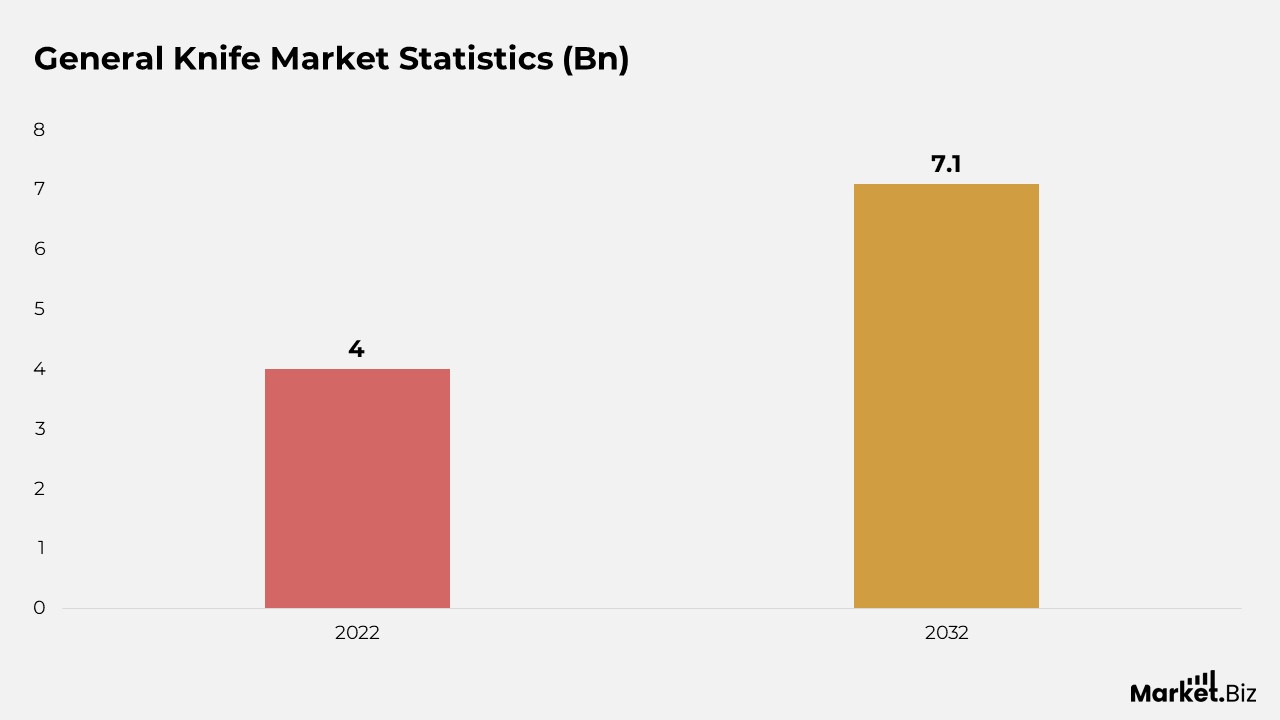
- By the year 2032, the overall market is projected to attain USD 7.1 billion, with fixed blades contributing USD 2.76 billion, folding blades USD 2.30 billion, and side slides USD 2.04 billion.
- The knife market, categorized by material, clearly demonstrates a predominance of steel, which constitutes 60% of the entire market share.
- In 2022, China emerged as the leading exporter of knives. Representing 51% of the global market with an export value of USD 1,870 million.
- In the same year, the United States was identified as the largest importer of knives. Accounting for 27.5% of global imports, valued at USD 1,001 million.
- The list of the priciest knives in the world is topped by “The Gem of the Orient,” which is appraised at an extraordinary USD 2.1 million, making it the most expensive knife in existence.
- In the United Kingdom, the Offensive Weapons Act (2019) implemented regulations such as banning the possession of specific knives in private and limiting the delivery of knives to individuals under the age of 18.
Knife Usage Statistics
- In 2015, a survey carried out in the United Kingdom evaluated the usefulness of Stanley knives and other utility knives among respondents.
- The majority, 51%, expressed that although they found having a utility knife available to be beneficial. It served primarily as a preventive tool for anticipated needs.
- Conversely, 31% of participants regarded it as a significant item that they utilized regularly.
- A smaller segment, 9%, believed they could not manage without it due to its critical role in their daily activities.
- Nevertheless, 4% mentioned that they would have difficulty locating it when required, and 5% indicated that they never utilized the tool.
Knife Market Growth Statistics
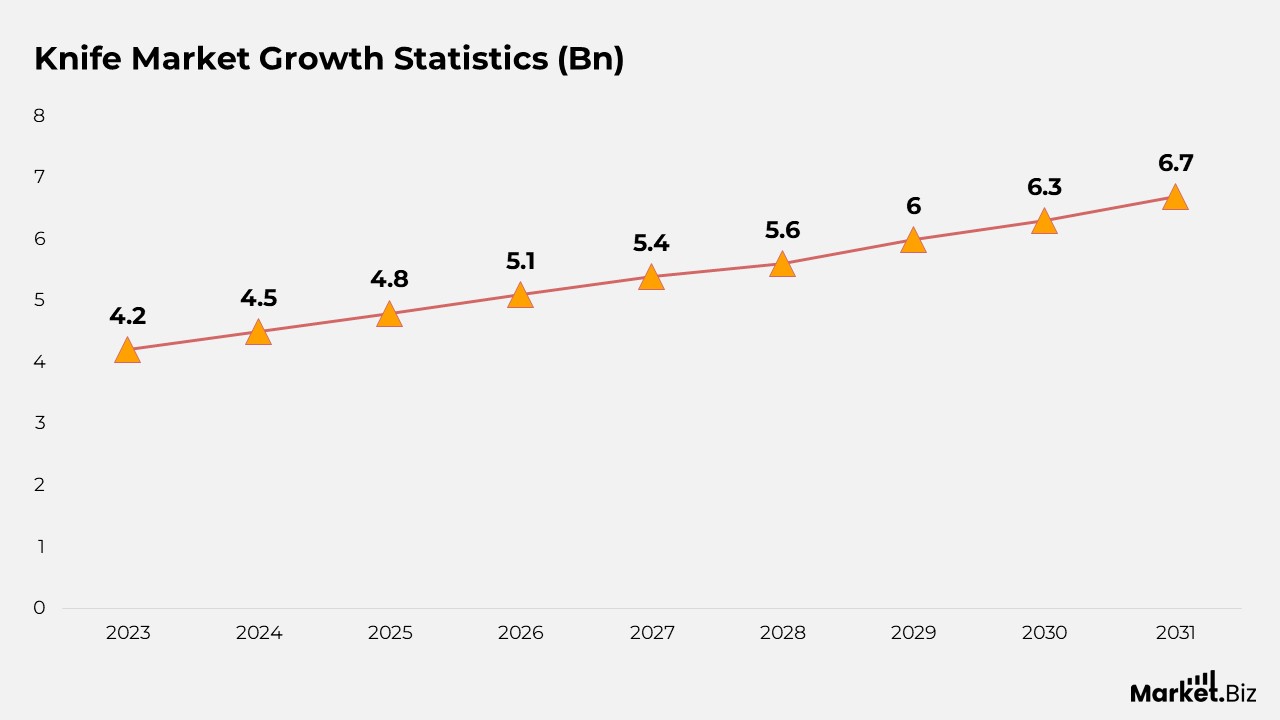
- In 2023, it was projected that revenue would attain USD 4.2 billion, with anticipated growth to USD 4.5 billion in 2024, USD 4.8 billion in 2025, and USD 5.1 billion by 2026.
- This positive trend is expected to persist, with market predictions indicating revenues of USD 5.4 billion in 2027, USD 5.6 billion in 2028, and USD 6.0 billion in 2029.
- By the end of the decade, the knife market is forecasted to reach USD 6.3 billion in 2030 and USD 6.7 billion in 2031. Ultimately culminating in an estimated USD 7.1 billion in 2032.
Statistics of Knife Material
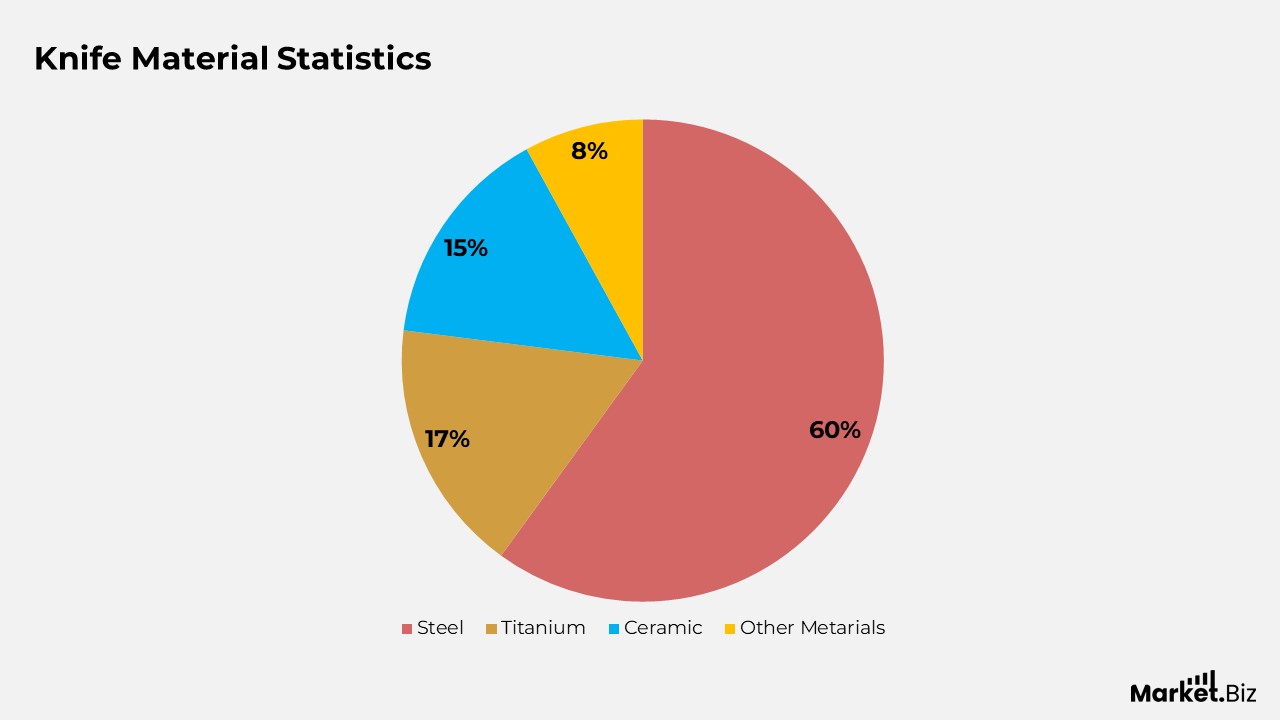
- The knife market, categorized by material, clearly demonstrates a predominant presence of steel, which constitutes 60% of the overall market share.
- Following steel, titanium holds a 17% share, indicating its favored status in specialized and high-performance uses.
- Ceramic knives, recognized for their light weight and sharpness, account for 15% of the market.
- Other materials, such as composites and non-metallic alternatives, together comprise an 8% share.
Knife Price Statistics
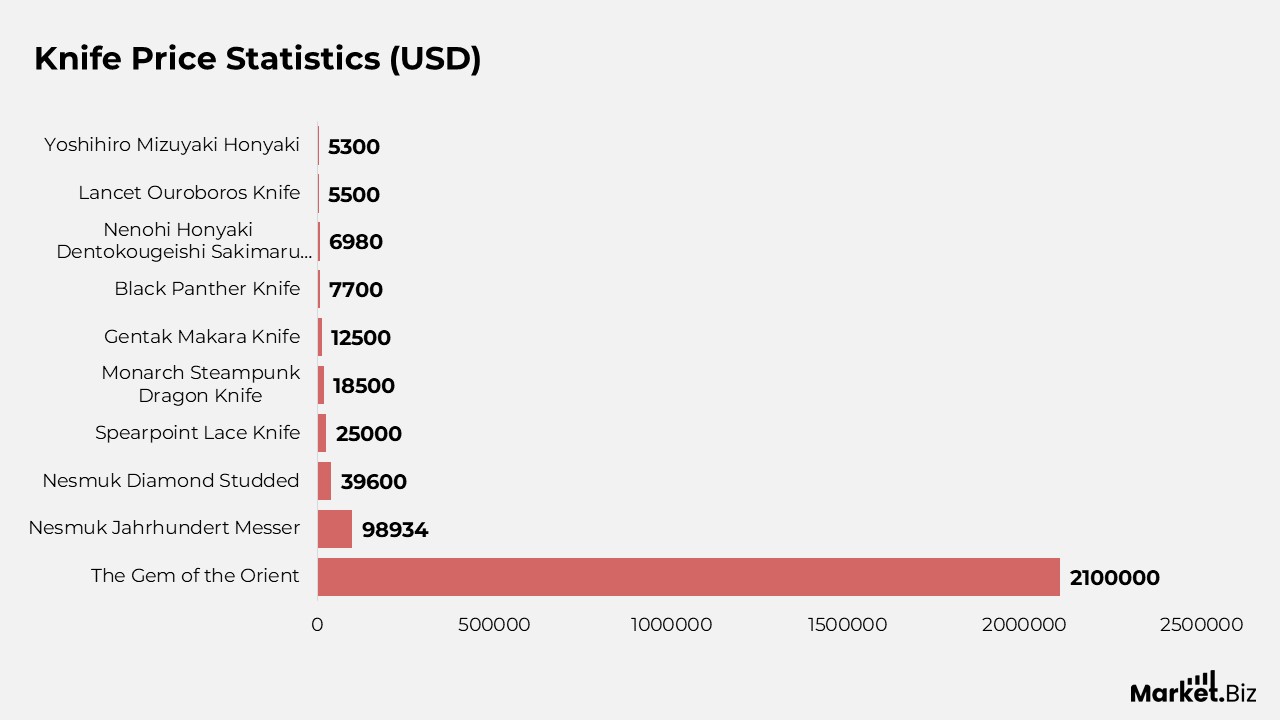
- “The Gem of the Orient” holds the title of the most expensive knife in the world. With a remarkable valuation of USD 2.1 million, thus making it the priciest knife globally.
- Following closely is the “Nesmuk Jahrhundert Messer,” which is priced at USD 98,934, alongside the “Nesmuk Diamond Studded” knife, valued at USD 39,600.
- The “Spearpoint Lace Knife” is appraised at USD 25,000; however, the “Monarch Steampunk Dragon Knife” is listed at USD 18,500.
- Other distinguished top-notch knives include the “Black Panther Knife” at USD 7,700, the “Gentak Makara Knife” at USD 12,500, and the “Nenohi Honyaki Dentokougeishi Sakimaru Takobiki” featuring a Corian handle, priced at USD 6,980.
- Additionally, the “Yoshihiro Mizuyaki Honyaki” and “Lancet Ouroboros Knife” are also prominent, with prices of USD 5,300 and USD 5,500, respectively.
Knife Import Statistics
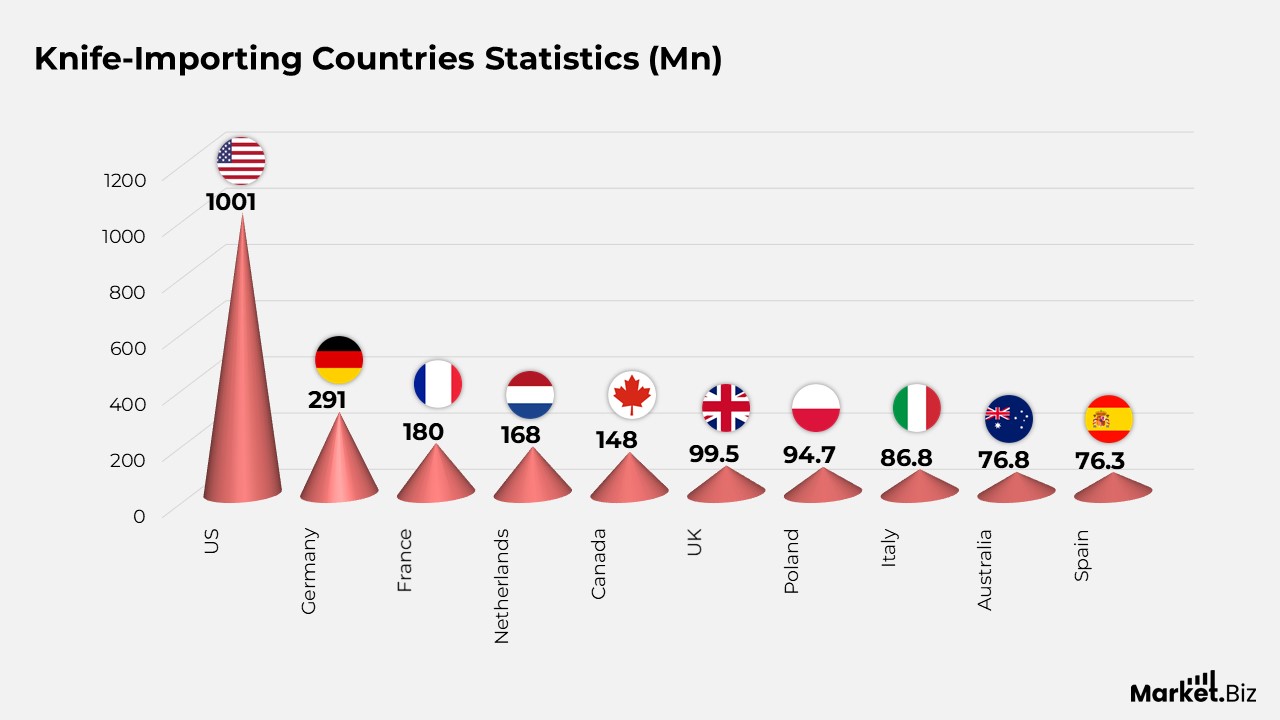
Knife-Importing Countries Statistics
- In 2022, the United States emerged as the foremost importer of knives, representing 27.5% of the global imports, with a total value of USD 1,001 million.
- Germany ranked second, importing knives valued at USD 291 million, which accounts for 7.95% of the market.
- France secured the third position, with an import price of USD 180 million of global imports. However, the Netherlands imported knives worth USD 168 million.
- Canada’s imports amounted to USD 148 million, closely followed by the United Kingdom with imports totaling USD 99.5 million.
- Italy, Poland, Australia, and Spain also made important contributions. With import values of USD 86.8 million, USD 94.7 million, USD 76.8 million, and USD 76.3 million, respectively.
Cutlery Importing Leading Countries
- In 2022, the United States became the leading global importer of cutlery, with a trade value of USD 2,820.1 million.
- Germany ranked second with imports amounting to USD 901.7 million. Poland’s cutlery imports were valued at USD 485.4 million, closely followed by France at USD 483.4 million.
- The Netherlands secured the fifth position, with a trade value of USD 441 million.
- The United Kingdom’s imports totaled USD 397.2 million, and both Canada and Mexico had nearly identical import figures, at USD 371.4 million and USD 370.3 million, respectively.
- Japan’s cutlery imports reached USD 331.2 million, while Italy completed the top ten with USD 288.2 million.
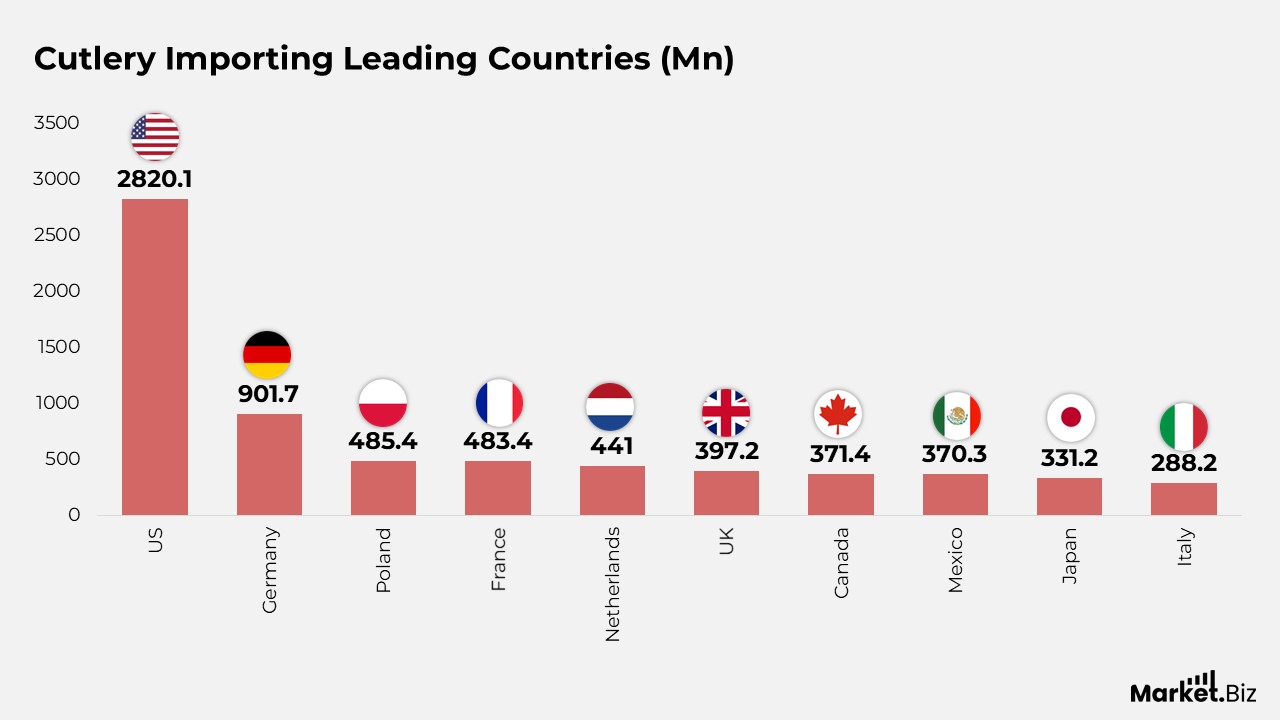
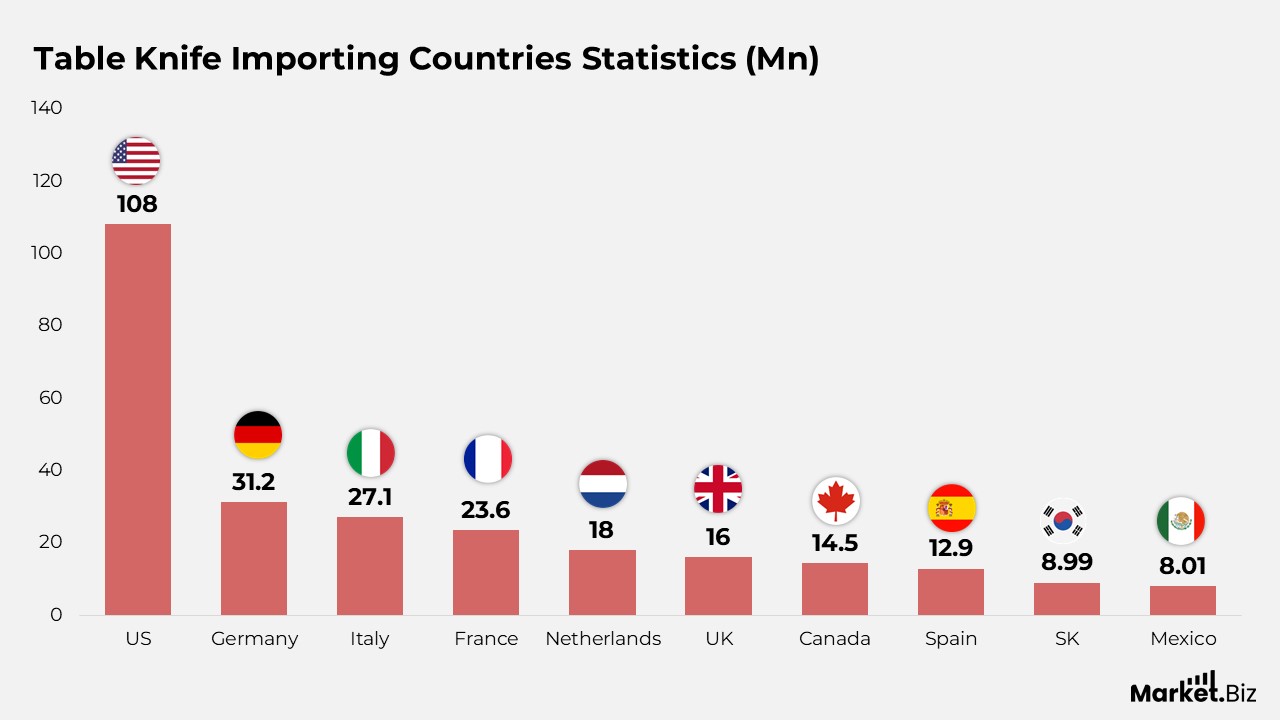
Table Knife Importing Countries Statistics
- In 2022, the United States emerged as the foremost importer of table knives, representing 25.7% of global imports, valued at USD 108 million.
- Germany ranked second with imports amounting to USD 31.2 million. This accounted for 7.46% of the market; however, Italy imported table knives worth USD 27.1 million, securing 6.48% of the market share.
- France contributed 5.64% of the total imports, with a monetary value of USD 23.6 million.
- The Netherlands imported table knives valued at USD 18 million, and the United Kingdom’s imports were worth USD 16 million.
- Spain, Canada, South Korea, and Mexico also made significant contributions, with import values of USD 12.9 million, USD 14.5 million, USD 8.99 million, and USD 8.01 million, respectively.
Knife Export Statistics
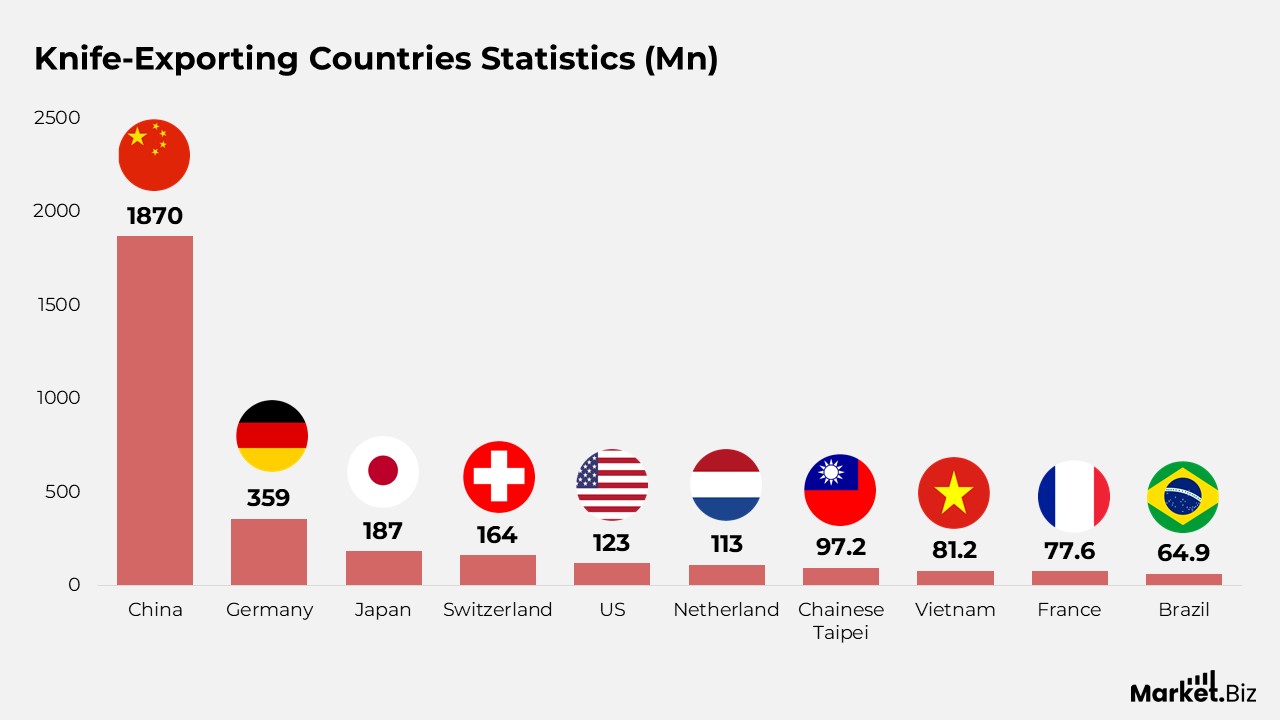
Knife-Exporting Countries Statistics
- In 2022, China emerged as the foremost exporter of knives. Capturing 51% of the global market with an export value of USD 1,870 million.
- Germany ranked second, with exports amounting to USD 359 million, which corresponds to 9.81% of the market share.
- Japan secured the third position, exporting knives valued at USD 187 million, thereby contributing 5.09% to the global market.
- Switzerland and the United States also stood out as significant exporters. With export values of USD 164 million and USD 123 million, respectively.
- The Netherlands exported knives worth USD 113 million, while Chinese Taipei, France, Vietnam, and Brazil contributed USD 97.2 million, USD 77.6 million, USD 81.2 million, and USD 64.9 million, respectively.
Cutlery Exporting Countries Statistics
- In 2022, China held the position of the foremost exporter of cutlery globally, achieving a trade value of USD 6,797.1 million and thereby dominating the international market.
- Germany secured the second position, exporting cutlery valued at USD 1,057.4 million. This was followed by Poland, which exported cutlery worth USD 982.1 million.
- Vietnam emerged as a notable contender, with exports amounting to USD 601.4 million, while Mexico and the United States contributed USD 524.3 million and USD 540.9 million, respectively.
- Other significant exporters included Czechia, with exports valued at USD 355.9 million, the Netherlands at USD 297.6 million, Japan at USD 281 million, and France at USD 254.4 million.
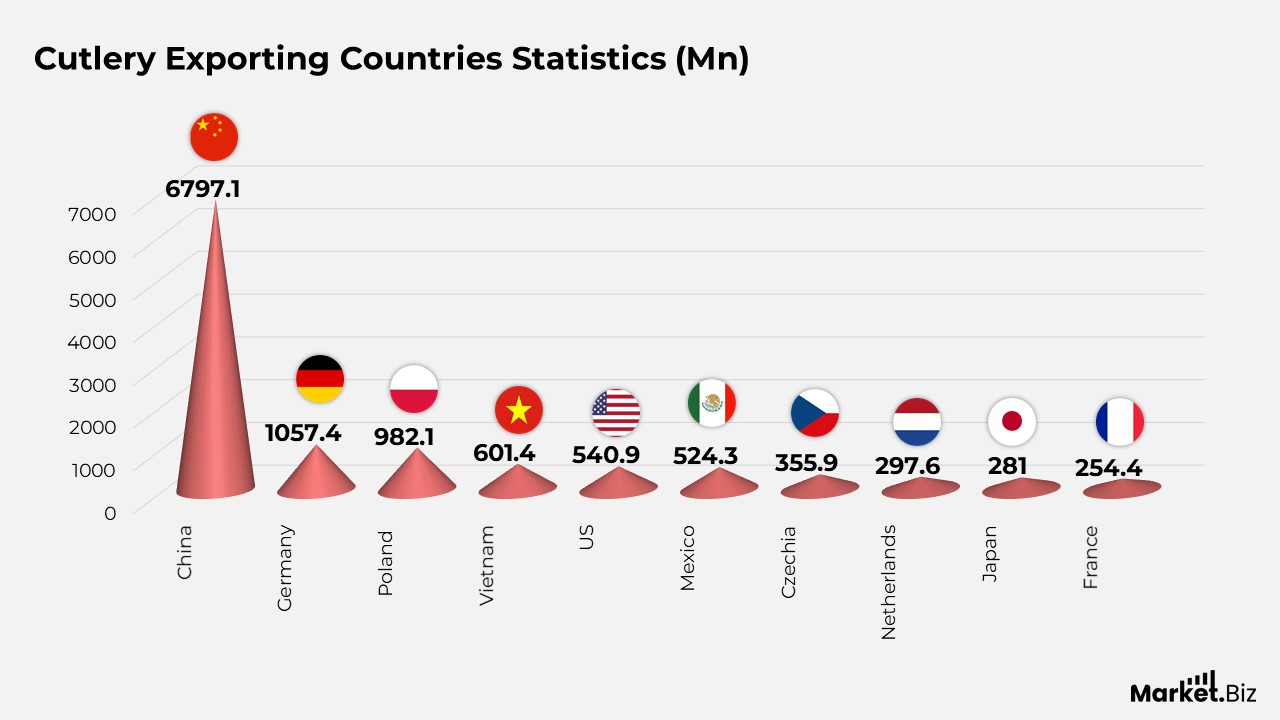
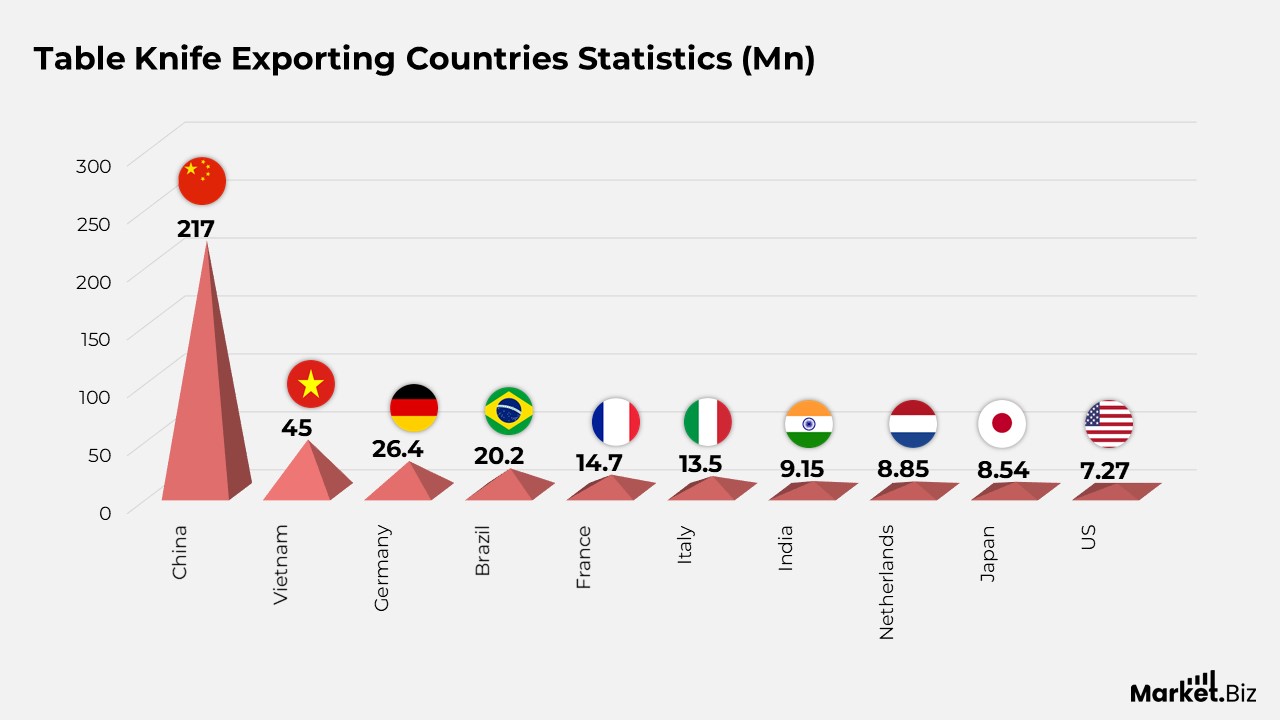
Table Knife Exporting Countries Statistics
- In 2022, China led the global market for table knife exports, representing 52% of the total exports valued at USD 217 million.
- Vietnam ranked as the second exporter, contributing USD 45 million, which accounts for 10.8% of the market.
- Germany possessed a 6.31% share, with table knife exports worth USD 26.4 million, while Brazil’s exports amounted to USD 20.2 million, making up 4.83% of the market.
- France and Italy also had significant shares, with their exports valued at USD 14.7 million and USD 13.5 million, respectively.
- Other notable exporters included India (USD 9.15 million, 2.19%), the Netherlands (USD 8.85 million, 2.12%), Japan (USD 8.54 million, 2.04%), and the United States (USD 7.27 million, 1.74%).
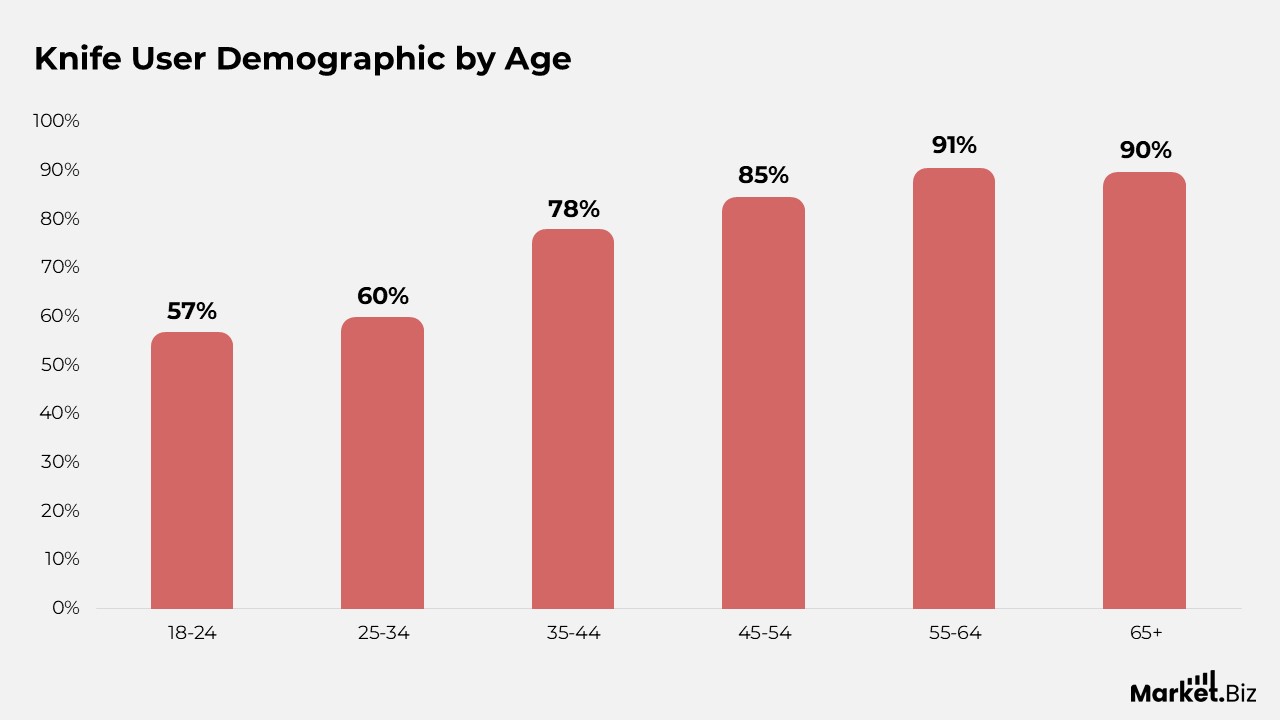
Knife User Demographic Statistics
By Age
- In 2015, the possession of Stanley knives or other utility knives within households in the United Kingdom exhibited considerable variation across different age groups.
- Among younger adults aged 18-24, 57% indicated that they had a utility knife in their home, whereas this figure rose to 60% for individuals aged 25-34.
- Ownership was notably higher among middle-aged respondents, with 78% of those aged 35-44 and 85% of individuals aged 45-54 reporting that they owned such tools.
- The highest levels of ownership were recorded among older adults, with 91% of people aged 55–64 and 90% of those aged 65 and older possessing a utility knife in their households.
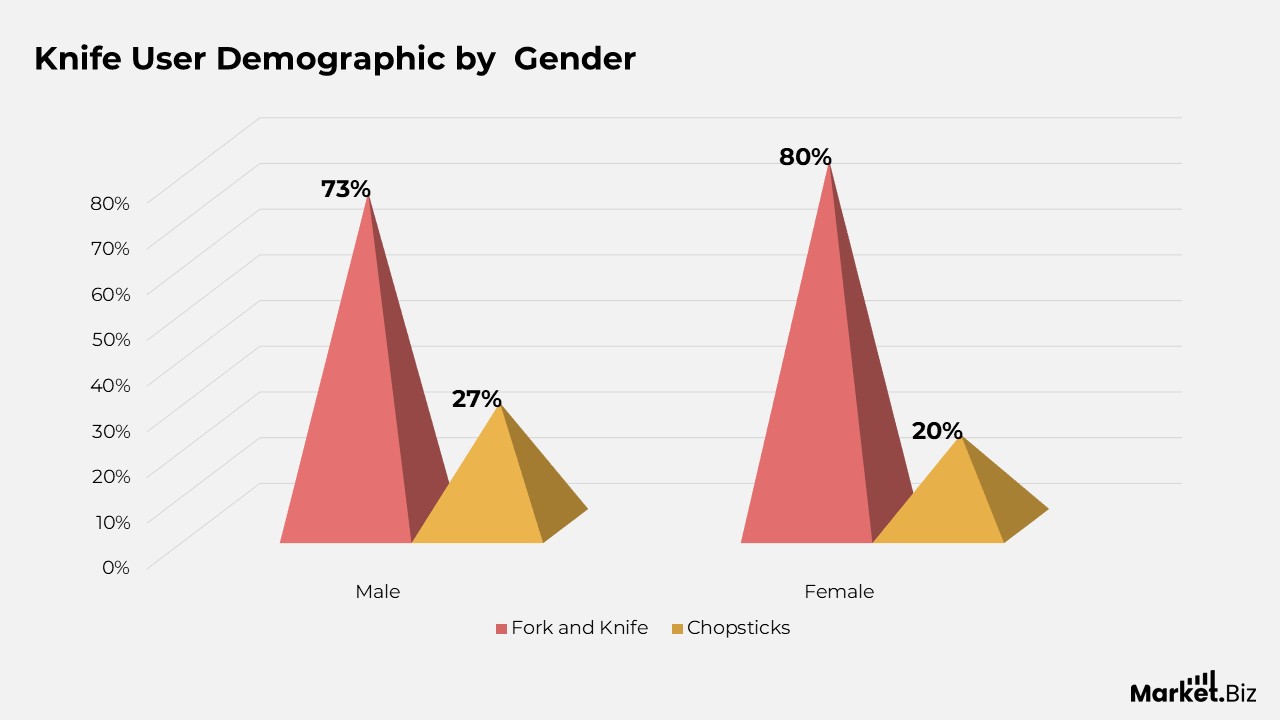
By Gender
- In 2014, the preferences for cutlery used during the consumption of Asian meals in the United States varied by gender.
- Among men, 73% favored the use of a fork and knife, whereas 27% chose chopsticks.
- In contrast, 80% of women preferred a fork and knife, with only 20% selecting chopsticks.
Knife Crime Statistics
By Children
- In the first and second quarters of 2015, there were 16 discharges recorded in each quarter. This number increased to 23 in the third quarter, before experiencing a slight decline to 21 in the fourth quarter.
- The trend persisted with 19 discharges in the first quarter of 2016, reaching a peak of 26 in the second quarter.
- However, there was a significant drop in the number of discharges to 9 in the third quarter of 2016, which then rebounded to 19 by the fourth quarter.
- In 2017, the number of discharges remained relatively low, with 14 in the first quarter and a further decrease to 8 in the second quarter.
- The figure then increased again to 17 discharges in the third quarter of 2017.
By Adults
- In the first sector of 2015, there were 668 community verdicts. This figure saw a slight increase to 675 in the second quarter and further rose to 692 in the third quarter.
- However, the total decreased to 612 in the fourth quarter of 2015.
- In 2016, the numbers remained relatively stable, with 674 sentences recorded in the first quarter, 645 in the second quarter, and 675 in the third quarter. By the fourth quarter of 2016, the total had dropped to 548.
- In 2017, community sentences experienced another increase, reaching 690 in the first quarter. Although this number declined to 614 in the second quarter, it rose slightly to 650 in the third quarter.
Recent Developments
- In early 2024, Benchmade launched a new tactical folding knife specifically designed for law enforcement and military applications. This knife boasts enhanced blade durability and features a new locking mechanism, which provides improved safety and performance in high-pressure situations.
- Spyderco, a well-known knife manufacturer, declared a $30 million investment in 2024 aimed at advancing its blade technology. The focus will be on developing precision sharpening and corrosion-resistant steel methods. This investment will also improve Spyderco’s automated manufacturing processes.
- In 2025, it is anticipated that custom knives will account for 20% of the high-end knife market, as the demand for artisanal and unique products continues to grow.
Conclusion
The knife industry is set for ongoing growth, propelled by consumer preferences, technological progress, and increasing demand across multiple segments.
Significant trends encompass innovations in materials and ergonomic designs, with leading companies making substantial investments in research and development, while new entrants are aiming at niche markets.
Despite facing challenges such as variable raw material prices and regulatory obstacles, the market forecast remains optimistic. To maintain a competitive edge, stakeholders ought to concentrate on technological innovation, sustainability, and expansion into emerging markets.
FAQs
3.47% of the surveyed population indicated that they carry or use weapons, with 71.3% of these individuals being male.
Although this minor decrease is a positive development, the overall incidence of knife crime continues to be alarming, with 53,047 offenses documented within a year. Additionally, NHS statistics reveal a 10% reduction in hospital admissions due to assaults involving sharp instruments, which has decreased to 3,508 in the most recent year, and a 26% decline since 2020.
An extremely stressful environment, filled with fear and anxiety, leads some young individuals to perceive that carrying a knife is a rational reaction to these circumstances.

