








Introduction
Fitbit Usage Statistics: Fitbit, a prominent player in the wearable fitness technology market, has long been a valuable source of insights into user behavior and health trends. In recent years, Fitbit’s devices have played a crucial role in helping millions of users track their physical activity, heart rate, and overall wellness.
Fitbit continues to offer a diverse array of health-focused features designed to support fitness and overall well-being. Key metrics, such as steps taken and minutes of moderate-to-vigorous physical activity, highlight the evolving dynamics of personal health tracking. This overview of Fitbit usage statistics highlights significant patterns in user engagement, emerging health trends, and the broader impact of wearable technology on daily life.
Editor’s Choice
- In January 2021, Google acquired Fitbit for $2.1 billion to develop innovative devices and services that aim to improve users’ health, success, knowledge, and overall well-being.
- In 2023, Fitbit sold 6.6 million units, representing a 28% decline from 2022.
- Fitbit generated an estimated $1 billion in revenue in 2023, a 10% decrease from 2022.
- In 2021, Fitbit users averaged 150 minutes of moderate-to-vigorous physical activity per week.
- The average resting heart rate among Fitbit users in 2021 ranged from 60 to 70 beats per minute.
- Fitbit users averaged 7,500 steps per day in 2021, with variation by age and gender.
- In 2022, 2 million Fitbit users enrolled in the device’s AFib detection feature.
- Fitbit ranked as the sixth most popular wearable brand in the UK.
- In 2021, Fitbit users in the United States collectively walked 47 trillion steps.
Fitness App Market Size
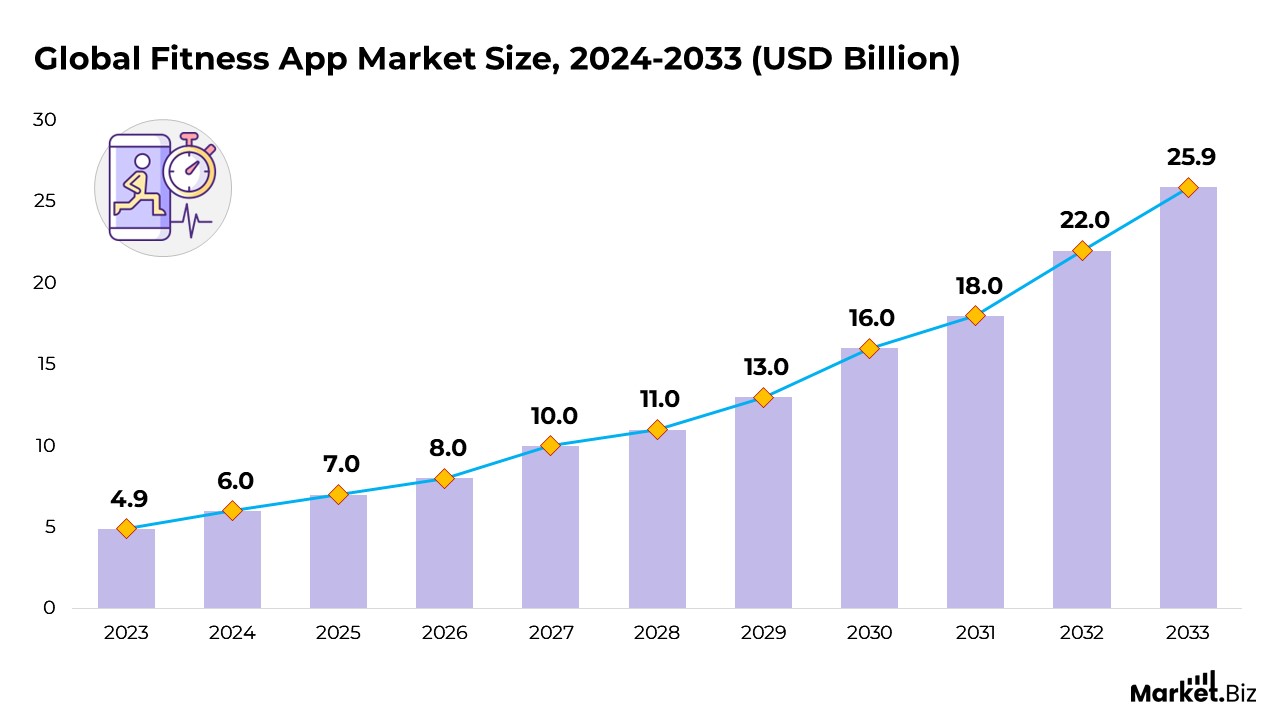
- According to Market.us, the global fitness app market is projected to grow from $7.0 billion in 2025 to $22.0 billion by 2032, representing a compound annual growth rate (CAGR) of 18% from 2024 to 2033.
- The growth of the fitness app market is driven by increasing awareness of healthy lifestyles, the rise of smartphone use, the adoption of wearable devices, and the prevalence of diet-related diseases.
- In 2023, the exercise and weight-loss segment accounted for over 54.8% of the market share, with apps offering fitness-tracking tools and motivational features, such as scheduled notifications and video demonstrations.
- In 2023, iOS held a 62.4% market share, with Apple users increasingly active, utilizing popular fitness apps such as Centr, MyFitnessPal, Sworkit, and Freeletics.
- The smartphone market accounted for 53.4% of revenue, driven by global smartphone adoption and a shift from in-person gym visits to home workouts via fitness apps.
- North America dominated the market in 2023, accounting for 49.1% of the market and USD 2.4 billion in value, driven by high smartphone adoption and a strong fitness culture.
(Source: Market.us)
Fitness Tracker Market Size
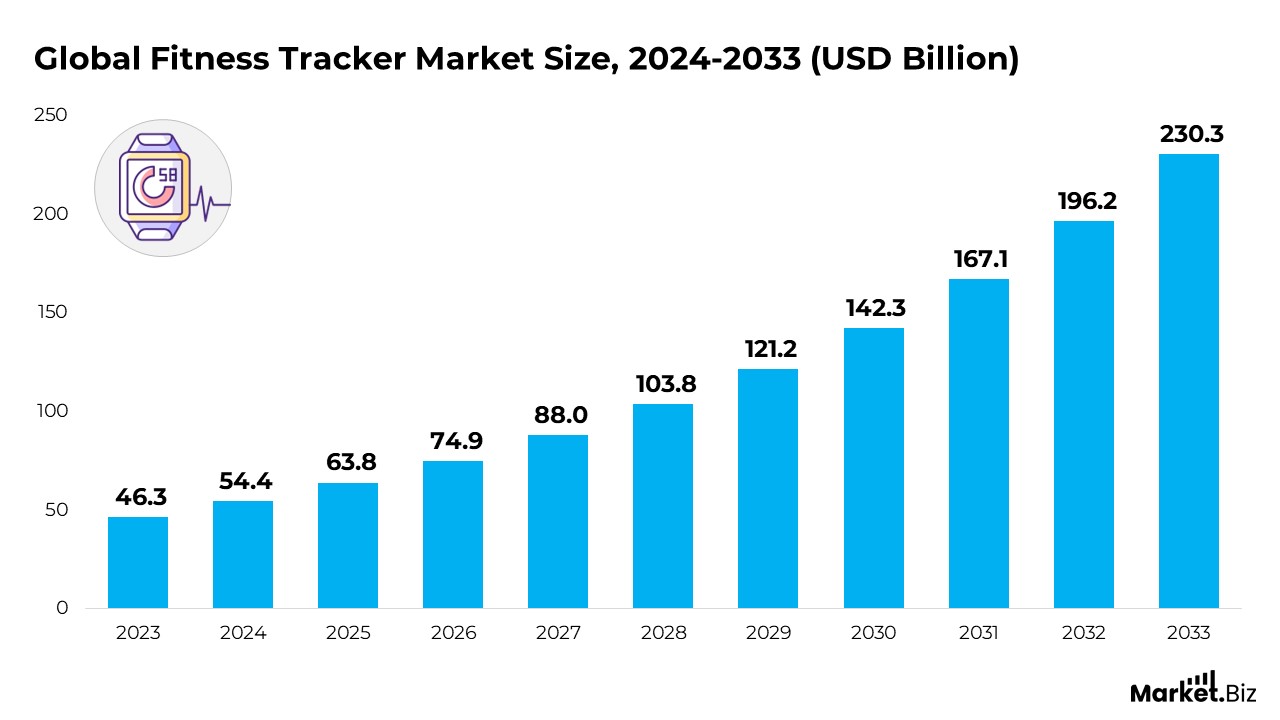
- According to Market.us, the global fitness tracker market is projected to grow from $63.8 billion in 2025 to $196.2 billion by 2032, representing a compound annual growth rate (CAGR) of 17.4% from 2024 to 2033.
- The focus on personal health monitoring, smart technologies, and the rising prevalence of lifestyle diseases are driving growth in the fitness app market.
- In 2023, smartwatches accounted for 49.3% of the fitness tracker market, followed by smart bands at 29.1%, with smart clothing and other categories accounting for 12.6% and 9.0%, respectively.
- In 2023, running tracking dominated the fitness tracker market with a 23.5% share, while heart rate tracking and sleep monitoring captured 21.2% and 20.3%, respectively.
- Online channels accounted for 65.2% of the fitness tracker market in 2023, driven by convenience, product variety, competitive pricing, and superior customer experience.
- North America led the fitness tracker market in 2023, with a 43.2% share and a market value of USD 20.0 billion, supported by high consumer health awareness and advanced technological infrastructure.
(Source: Market.us)
General Fitbit Statistics
- In 2023, the Fitbit fitness tracker app surpassed 50 million downloads on the Google Play Store.
- The number of active Fitbit users grew steadily from 2012 to 2023, with 38.5 million active users in 2023, a slight decline from 40 million the previous year.
- Smartwatch and fitness tracker shipments are expected to reach approximately 524 million units in 2024, driven by increasing demand.
- Fitbit lost its leadership in the wearable market to a tech giant, now controlling over 20% of the market.
- As of September 2023, the Fitbit Sense 2 was the most expensive device at nearly $300, followed by the Fitbit Versa 4 and Fitbit Luxe, both priced at around $200.
- 72.87% of Fitbit users monitor their heart rate during exercise.
- 65% of Fitbit users utilize the device to set personal goals, track progress, and receive motivational notifications.
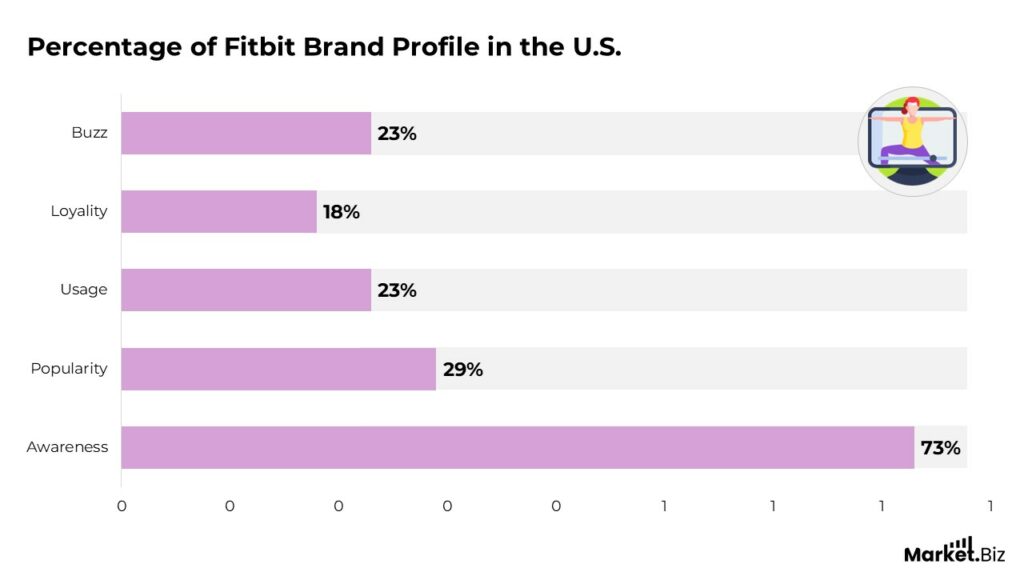
- Fitbit enjoys a high level of brand awareness, with 73% of U.S. wearable users recognizing it.
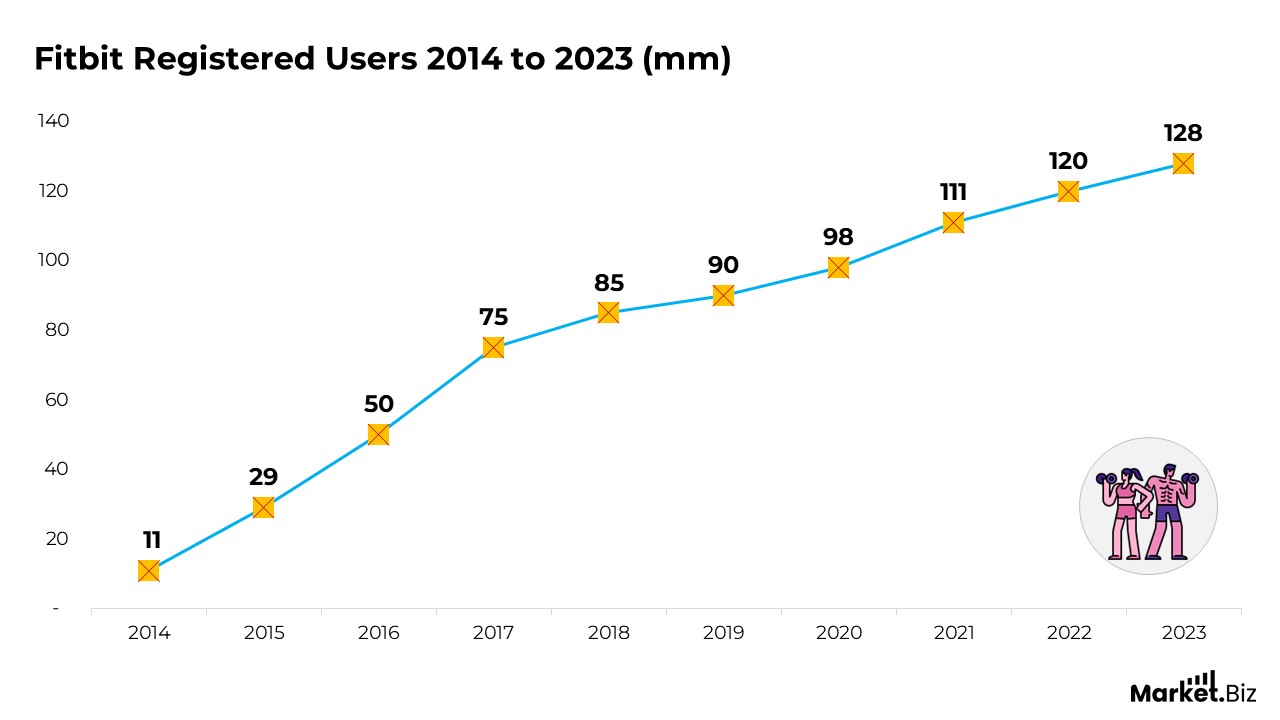
- The number of registered Fitbit users grew steadily from 2014 to 2023. In 2023, Fitbit had approximately 128 million registered users, an increase of 8 million from the previous year.
(Source: Fitbit, Statista)
Why Users Choose Fitbit for Their Fitness Journey?
- Approximately 65% of Fitbit users use the device to set personal goals, track their progress, and receive motivational reminders to stay engaged in their fitness journey.
- According to Fitbit data, approximately 96.10% of users prefer their devices for accurate tracking of daily activities, including step counts, distance travelled, and calories burned, underscoring their role in promoting an active lifestyle.
- Around 96.10% of users prefer using their Fitbit devices for accurate tracking of daily activities, including step counts, distance travelled, and calories burned, emphasizing its role in promoting an active lifestyle.
- Approximately 96.10% of users prefer using their Fitbit devices for accurate tracking of daily activities, including step counts, distance travelled, and calories burned, emphasizing its role in promoting an active lifestyle.
(Source: Fitbit Internal Data)
Demographics of Fitbit Usage
Age
The demographic profile of Fitbit users is diverse, with various age groups making up significant portions of the user base:
Young Adults (18-24 years old):
- Approximately 15.79% of Fitbit users fall within the 18-24 age range, indicating the device’s appeal to younger individuals starting their fitness journey.
Early Career Professionals (25-34 years old):
- The 25-34 age group accounts for 25.93% of Fitbit users, representing a key demographic that prioritizes maintaining an active lifestyle.
Middle-Aged Adults (35-44 years old):
- Fitbit users aged 35-44 constitute 19.40% of the total, indicating heightened health and fitness awareness, as individuals in this age group focus on long-term wellness.
Older Adults (45-54 years old):
- Approximately 16.08% of Fitbit users are aged 45-54, and this group is increasingly adopting fitness trackers to monitor and improve their health.
- The 55-64 age group makes up 12.94% of Fitbit users, highlighting the growing interest in health monitoring as people approach retirement age.
- Users aged 65 and above account for 9.87% of Fitbit’s user base, indicating a rising trend among older adults of incorporating fitness and wellness tools into their daily routines.
(Source: Coolest Gadgets, Sci-tech, Similarweb )
Gender
Monthly Active Fitbit Users
| Year | Users from 2014 to 2023 (mm) |
|---|---|
| 2014 | 6.7 |
| 2015 | 14.9 |
| 2016 | 23.6 |
| 2016 | 23.6 |
| 2017 | 29 |
| 2018 | 33.8 |
| 2019 | 38.3 |
| 2020 | 40.2 |
| 2021 | 41.5 |
| 2022 | 40 |
| 2023 | 38.5 |
(Source: Statista, Business of Apps)
Number of Fitbit Devices Sold Globally
| Year | Number of Fitbit Devices Sold (1,000s) |
|---|---|
| 2021 | 10,600 |
| 2022 | 9,200 |
| 2023 | 6,600 |
(Source: Statista)
Fitbit Registered Users (MM)
(Source: Statista, Business of Apps)
Fitbit Brand Profile
Key Competitors and Market Position Fitbit
- In 2022, the Apple Watch overtook Fitbit to become the top wearable device globally, capturing 29.7% of the market share, while Fitbit held a smaller 4.4% share.
- In the United States, Apple dominated the fitness tracker market in 2022, holding a 50% share, with Fitbit securing second place at 16%. Samsung trailed behind, controlling just 6% of the U.S. fitness tracker market.
- In 2020, Samsung ranked as the second-largest player in the global wearables market, with a 9.8% share, surpassing Fitbit in terms of market presence.
(Source: IDCCorporate).
Range of Fitbit Wearable Devices
Fitbit offers a diverse range of wearable devices designed to cater to various user preferences and needs:
- Fitbit Luxe: A stylish fitness and wellness tracker priced around $149.95, offering sleep tracking, heart rate monitoring, and stress management features.
- Fitbit Charge 5: A feature-rich fitness tracker equipped with built-in GPS, heart rate monitoring, stress management tools, and sleep tracking. Price: approximately $179.95.
- Fitbit Inspire 3: A budget-friendly fitness tracker offering essential health features, including heart rate monitoring and sleep tracking. Price: around $99.95. Fitbit Ace 3: A child-friendly activity tracker designed with features like activity tracking, sleep monitoring, and parental controls. Priced at around $79.95.
- Fitbit Versa 4: A smart wearable that combines advanced health and fitness tracking with built-in GPS, music control, and a voice assistant. Priced at about $229.95.
- Fitbit Sense 2: A quality health-focused smartwatch that includes advanced features like ECG, stress management, skin temperature monitoring, and built-in GPS. Price: approximately $299.95.
(Source: Sci-Tech-Today)
Fitbit’s Impact on Fitness and Health
- Users of Fitbit are 43% more likely to increase their physical activity levels.
- On average, Fitbit users walk 700 more steps per day than those who don’t use the device.
- Fitbit trackers have helped users increase their weekly active minutes by 4.2 hours.
- Fitbit users engage in 43% more minutes of moderate-to-vigorous physical activity per week than non-users.
- Users of the Fitbit app who set weight-loss goals have lost an average of 7.4% of their body weight.
- Users who consistently monitor their sleep with Fitbit report sleeping an average of 20 minutes longer each night.
- Fitbit wearers experience an average 10% reduction in resting heart rate.
(Source: Fitbit Research, Market.us)
Fitbit Usage – By Country
- Fitbit has 83% brand awareness in the UK, with 39% of wearable device users expressing a positive opinion of the brand. Among those familiar with Fitbit, 47% have a favorable view of it.
- In 2023, 28% of wearables users in the UK used Fitbit, and among those aware of the brand, 34% actively used it.
- Around 22% of wearables users in the UK indicated they are likely to use Fitbit again. This translates to a strong brand loyalty of 79% among its users in 2023.
- In October 2023, 24% of UK wearables users reported encountering Fitbit through media, social media, or advertising in the past three months. This means 29% of those familiar with the brand had recent exposure, indicating growing interest in Fitbit in the UK.
- According to Fitbit data, the United States accounts for the largest share of Fitbit’s user base, representing 65.9% of website visits. However, there has been a slight decrease of approximately 1.38% in total visitor share as of March 2024.
(Source: Statista, Fitbit Statista).
Upcoming and New Fitbit Launches
Fitbit is set to unveil several exciting products and updates:
- Fitbit Charge 6: The next iteration of the Charge series is expected to come with upgraded sensors, extended battery life, and enhanced features for more accurate health tracking.
- Fitbit Luxe 2: The follow-up to the Luxe offering additional wellness-focused features along with customizable fashion accessories for a more personalized experience.
- Software Enhancements: Regular firmware updates will be released for existing devices, introducing improvements in functionality and new features, including enhanced sleep tracking and advanced stress-management tools.
- New Health Insights: Fitbit plans to introduce fresh health metrics powered by Google’s AI and machine learning to offer more tailored health recommendations and insights to users.
(Source: Sci-tech Today).
Recent Developments
Launches & Approvals
- In April 2022, Fitbit received U.S. FDA approval for its photoplethysmography-based algorithm, enabling its devices to detect atrial fibrillation in users.
- In April 2021, Fitbit launched the Luxe, a new fitness tracker that combines the brand’s classic health and wellness features with a sleek, jewellery-inspired design.
User Engagement:
- Fitbit has built a strong and active user community, with over 38.5 million users participating in a range of activities, including joining challenges, tracking food and water intake, and monitoring their fitness progress.
- The brand’s effective user engagement strategies play a key role in maintaining its solid market presence and fostering high levels of brand loyalty.
Conclusion
Fitbit maintains a prominent position in the wearable technology market, benefiting from strong brand recognition and user engagement, particularly in regions such as the United States and the UK. Although it faces stiff competition from giants like Apple and Samsung, Fitbit’s ongoing innovation and wide range of features help retain a loyal customer base.
The brand’s focus on personalized health and fitness tracking, combined with its effective media presence and intuitive devices, makes it a popular choice among users. Despite some fluctuations in market share and a slight decline in user growth, Fitbit’s ability to maintain strong brand loyalty and expand its presence highlights its enduring impact in the wearable technology industry.
FAQ’s
Fitbit users commonly use features such as heart rate monitoring during workouts (72.87% of users), goal setting and progress tracking (65% of users), and sleep tracking (86% of users).
In 2023, approximately 79% of Fitbit users reported brand loyalty, suggesting they are likely to continue using the device due to positive experiences.
With a Fitbit, you can monitor the following:
Steps taken and distance travelled
Active minutes and calories burned
Heart rate
Sleep patterns and quality
Floors climbed (available on devices with altimeters)
Exercise-specific metrics (varies by model)
Female health tracking (available on select models)
Built-in GPS for tracking outdoor activities without needing a phone (available on certain models)
To connect your Fitbit device to your smartphone, first download the Fitbit app from the App Store or Google Play Store. Once you sign in to your account, the app will guide you through the process of pairing your device with your phone.