









Introduction
Data Analytics Statistics provide essential insight into how organizations collect, process, and interpret data to drive smarter decisions across industries. As businesses generate vast volumes of structured and unstructured data, analytics tools play a critical role in uncovering patterns, optimizing operations, and improving customer experiences.
These statistics highlight adoption trends, investment priorities, data volumes, analytics maturity levels, and the growing influence of advanced techniques such as AI-driven analytics, machine learning, and real-time processing.
By examining Data Analytics Statistics, business leaders, analysts, and technology teams can better understand how data-driven strategies support competitiveness, efficiency, and innovation in an increasingly digital and insight-led global economy.
Editor’s Choice
- A growing number of organizations are embracing data-driven decision-making. With productivity levels rising to nearly 63% as analytics becomes embedded in daily operations.
- Data governance has emerged as a strategic priority, with around 60% of data leaders focusing on stronger oversight, quality control, and data management frameworks.
- Expanding adoption of big data technologies and advanced analytics is expected to lift employment levels to approximately 58%, reflecting rising demand for data-skilled professionals.
- Integrating business intelligence tools into analytics platforms has helped organizations boost operational efficiency by up to 80%.
- Handling unstructured data remains a major obstacle, with about 95% of businesses reporting challenges in extracting value from non-standardized data sources.
- Around 60% of organizations now actively use AI and big data analytics within their operations. Signaling steady progress toward analytics-driven business models.
- A large majority of organizations, nearly 91.9%, reported measurable business value from their data and analytics investments in 2023.
- Around 3 in 5 organizations actively use data analytics to drive business innovation and create new growth opportunities.
- More than half of data leaders (56%) plan to increase their data and analytics budgets this year.
- The data ecosystem is expected to expand rapidly, with up to 1.4 million new roles in data science and data analytics projected between 2023 and 2027.
Enterprise Data Analytics Priorities, Challenges, and Adoption Statistics
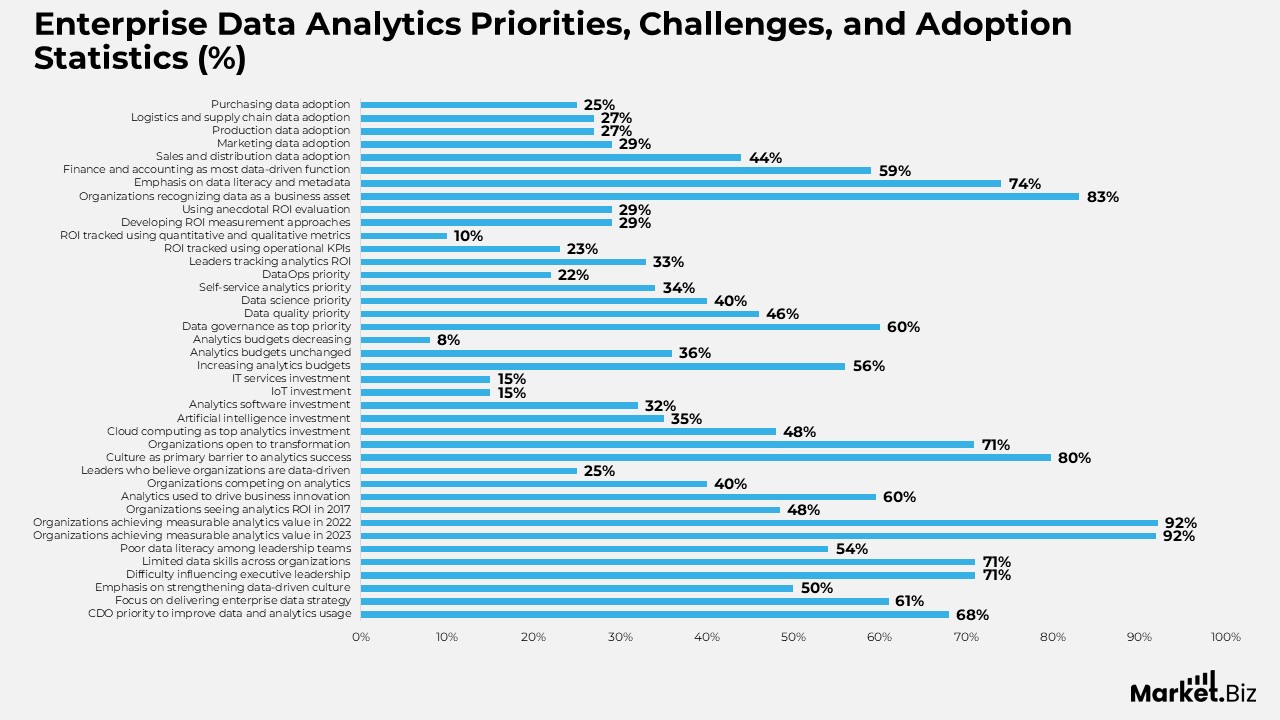
- A strong majority of chief data officers prioritize improving how data and analytics are used. With 68% identifying it as a top focus area for 2023 and beyond.
- Delivering on an enterprise-wide data strategy ranks as a top priority for 61% of data leaders. While 50% emphasize strengthening the organizational data culture.
- Influencing executive leadership remains one of the most persistent challenges, with 71% of data leaders citing difficulty in gaining buy-in from executive committees.
- Limited data skills pose an equally significant barrier, affecting 71% of organizations, while poor data literacy impacts around 54% of leadership teams.
- Nearly 91.9% of organizations reported achieving measurable value from data and analytics investments in 2023, slightly below 92.1% in 2022.
- Long-term progress remains strong, as only 48.4% of organizations reported returns from data and analytics investments in 2017.
- Around 3 in 5 organisations actively use data analytics to drive innovation. With 59.5% of business leaders confirming that analytics-led innovation initiatives are underway.
- Despite this progress, only 2 in 5 organizations report effectively competing on analytics or managing data as a strategic asset.
- Approximately 1 in 4 analytics leaders believe their organizations have successfully become data-driven.
- Organizational culture remains the primary hurdle, with 79.8% of leaders identifying people, processes, or structure as the main obstacle rather than technology.
- Encouragingly, 70.9% of analytics leaders say their organizations are open to transformation and change.
Moreover
- Cloud computing is the leading technology investment area, with 48% of organisations prioritising cloud-based platforms such as IaaS, PaaS, and SaaS.
- Other major analytics investment areas include artificial intelligence at 35%, analytics software at 32%, and both IoT and IT services at 15% each.
- More than half of data leaders, around 56%, report increasing analytics budgets, while 36% indicate budgets remain stable, and just 8% report reductions.
- Data governance ranks as the top priority for 3 in 5 data leaders, followed by data quality (46%), data science (40%), self-service analytics (34%), and DataOps (22%).
- Only 33% of data leaders currently track return on investment for analytics teams, split between operational KPIs (23%) and combined qualitative and quantitative measures (10%).
- Another 29% of leaders are still developing ROI measurement approaches, while an additional 29% rely primarily on anecdotal evaluation methods.
- A large majority of analytics professionals, 83%, report that their organizations now recognize data as a valuable business asset.
- Around 74% also acknowledge that data literacy and metadata management are critical to the success of analytics. Driving investments in data documentation and governance tools.
- Finance and accounting departments lead in data maturity, with 59% of leaders identifying them as the most data-driven functions.
- Other departments actively leveraging data include sales and distribution (44%), marketing (29%), production (27%), logistics and supply chain (27%), and purchasing (25%).
(Sources: Deloitte, NewVantage Partners, Gartner, Atlan, BARC)
Chief Data Officer Adoption, Reporting Structure, and Role Maturity
- Nearly 4 in 5 organizations now have a Chief Data Officer in place, signaling widespread recognition of data leadership at the executive level.
- CDO adoption has accelerated rapidly over the past decade, rising from just 12% of organizations in 2012 to 55.9% in 2017, 65% in 2021, and 73.7% in 2022.
- Today, fewer than 15% of organizations operate without a formally appointed Chief Data Officer.
- Reporting structures for CDOs remain divided, with 28.3% reporting to the Chief Operating Officer and 27.4% reporting to the Chief Information Officer.
- A smaller share of CDOs report directly to the Chief Executive Officer at 15%, while 8.8% report to the Chief Digital Officer and 3.5% to the Chief Financial Officer.
- Developing and executing an enterprise data strategy represents the primary responsibility for 48.1% of CDOs.
- Other core responsibilities include analytics leadership (16%), data governance (14.1%), and data management (12.3%), reflecting variation in how organizations define the role.
- Only about 2 in 5 organisations report a clear understanding of the CDO’s responsibilities and the organisational value they create.
- Nearly 3 in 5 organisations continue to struggle to define the scope and expectations of the CDO position.
- Leadership stability remains a challenge, with 1 in 3 organisations having employed 2 to 4 CDOs since first establishing the role.
- Just 36% of organizations describe the CDO role as fully established and successful.
- Meanwhile, 13% of organizations report persistent turnover issues tied to the role, and 3% classify the CDO position as unsuccessful.
(Sources: NewVantage Partners)
Big Data Analytics Impact on Jobs and Workforce Skills
- Organizations increasingly view big data analytics as the technology most likely to generate new employment opportunities over the next 5 years.
- More than half of companies, around 58%, believe that advances in data analytics and related technologies will create jobs rather than eliminate them.
- Approximately 3 in 5 organizations report that big data and analytics skills are becoming more critical to their long-term competitiveness.
- As enterprises work to build data-driven cultures, analytics capabilities have become essential across business functions.
- Analytical thinking ranks as the most in-demand skill, cited by 72% of organizations.
- Technological literacy follows closely, with 68% of companies highlighting its growing importance.
- Systems thinking continues to gain relevance, with 60% of organizations identifying it as a key capability for analytics-driven environments.
- Workforce demand for data-focused roles is expected to expand significantly, with up to 1.4 million new positions in data science and analytics projected between 2023 and 2027.
- Overall demand for data analysts, data scientists, big data specialists, business intelligence professionals, database experts, and data engineers is forecast to rise by approximately 30% to 35%.
(Sources: World Economic Forum)
Leading Fields of Expertise in Enterprise Data Functions
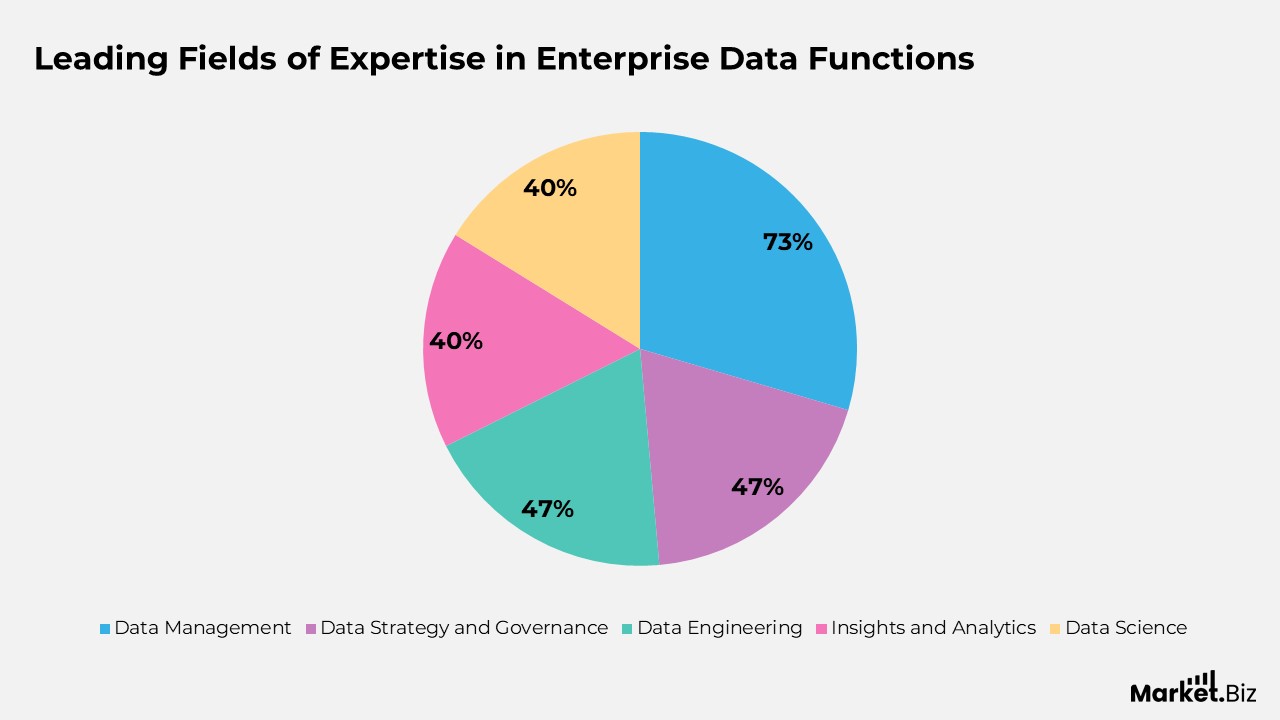
- Data management is the most common area of expertise. With about 73% of professionals focus on managing and organising enterprise data.
- Nearly 47% of respondents specialize in data strategy and governance, highlighting the importance of data policies, compliance, and oversight.
- Data engineering expertise is also reported by around 47%, reflecting strong demand for building and maintaining data pipelines and infrastructure.
- Insights and analytics capabilities are present among approximately 40% of professionals, supporting business intelligence and decision-making.
- Data science expertise accounts for roughly 40%, underlining its growing role in advanced analytics, modeling, and predictive analysis.
(Sources: Edge Delta, Statista)
Industries Experiencing the Highest Job Growth from Analytics Adoption
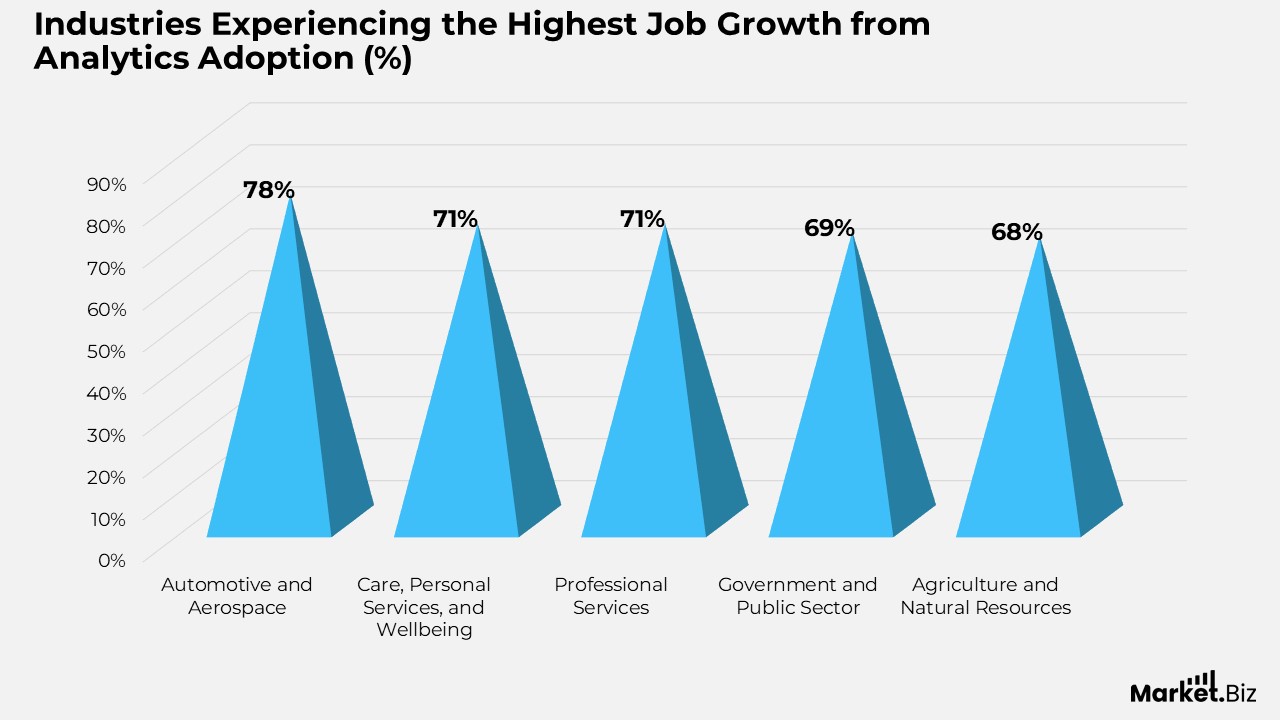
- The automotive and aerospace sector is expected to see the strongest employment uplift from big data analytics adoption. With job growth projected at around 78%.
- Care, personal services, and well-being industries are also positioned for significant workforce expansion. Employment growth linked to analytics adoption is expected to reach approximately 71%.
- Professional services firms are anticipated to experience similar gains. With big data initiatives contributing to an estimated 71% increase in employment demand.
- Government and public sector organizations are expected to expand their workforce as analytics adoption deepens. With projected employment growth of about 69%.
- Agriculture and natural resources industries are increasingly leveraging analytics, supporting roughly 68% employment growth to keep pace with data-driven transformation.
(Sources: Edge Delta, Statista)
BI Software Market Share by Leading Vendors
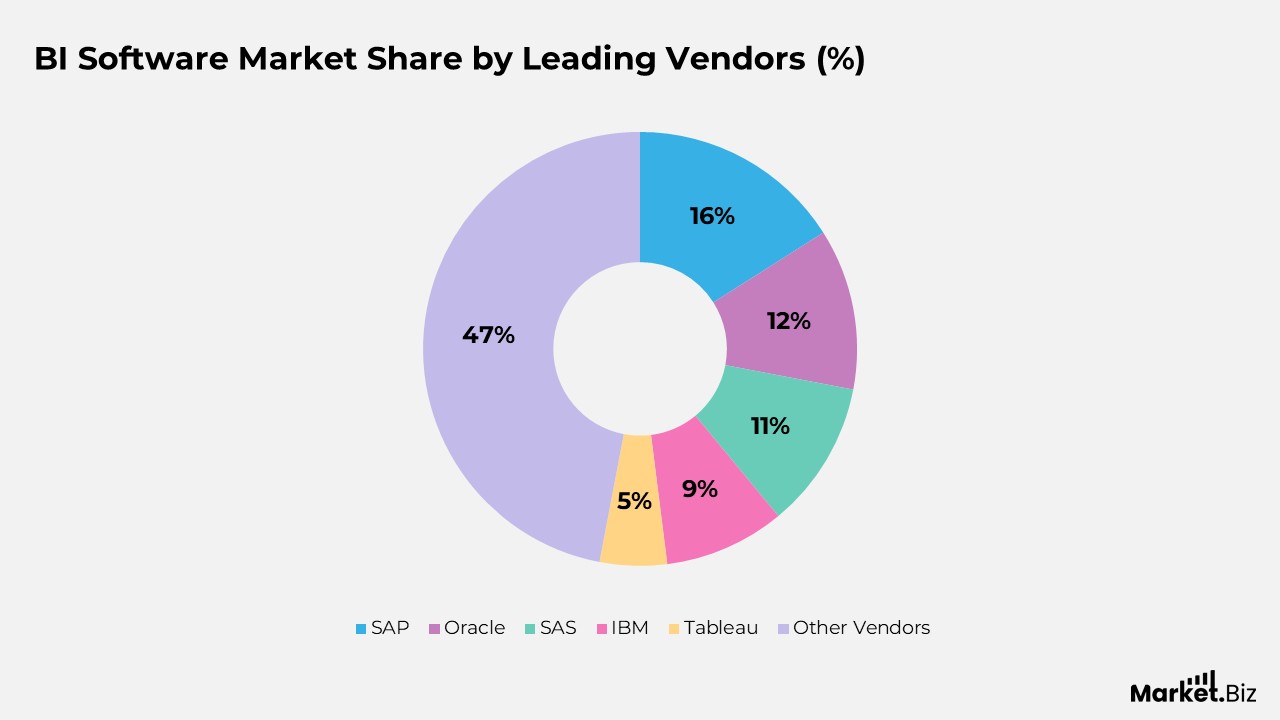
- SAP leads the business intelligence software market with a 16.0% share, reflecting strong adoption across large enterprises.
- Oracle holds a 12.0% market share, supported by its broad analytics portfolio and deep integration with enterprise systems.
- SAS accounts for 11.0% of the market, driven by its long-standing strength in advanced analytics and statistical modeling.
- IBM captures a 9.0% share by leveraging analytics capabilities embedded in its broader enterprise software ecosystem.
- Tableau represents 5.0% of the market and is widely used for data visualisation and self-service analytics.
- Other vendors collectively account for the largest share at 47.0%. Highlighting a highly fragmented market with many regional and niche BI providers.
(Sources: Edge Delta, Statista)
Industries Leading Big Data Analytics Adoption
- The media, entertainment, and sports industries are expected to lead the adoption of big data analytics, with uptake projected at around 95%.
- Financial services continue to show strong momentum in analytics deployment, with adoption levels reaching approximately 91%.
- Health and healthcare organizations are rapidly integrating data-driven technologies, achieving an adoption rate of about 89%.
- The automotive and aerospace sectors are advancing analytics across design, manufacturing, and operations, with adoption estimated at 89%.
- Professional services firms are increasingly leveraging big data analytics to enhance decision-making and client outcomes, with adoption approaching 88%.
(Sources: Edge Delta, Statista)
Global Data Generation and Data Type Distribution
- Around 1,000 petabytes of digital data are generated worldwide each day, creating significant challenges in storage, processing, and analysis.
- The majority of this data is unstructured, accounting for approximately 80%–90% of total data volumes generated.
- Structured data represents a much smaller share, contributing roughly 20% of all digital data produced.
- Semi-structured data occupies a narrow middle ground, accounting for about 5%–10% of the overall data volume.
(Sources: Edge Delta, Statista)
Enterprise Data Storage Trends and Governance Priorities
- Around 21% of companies continue to store large volumes of data in internal, on-premises data centres.
- At the same time, cloud adoption is accelerating, with approximately 54% of organizations investing in cloud platforms to store, access, and analyse large-scale data.
- Cloud repositories now hold the largest average data volumes, reaching about 498 terabytes per organization.
- Third-party data centres also manage substantial workloads, with average storage volumes of roughly 407 terabytes.
- Edge and remote locations are becoming increasingly important for data processing, handling an average of 390 terabytes.
(Sources: Edge Delta, Statista)
Conclusion
Data analytics statistics highlight how data has become a foundational asset for organizations seeking efficiency, innovation, and competitive advantage. Widespread adoption of analytics, AI, and cloud-based platforms reflects a clear shift toward data-driven decision-making across industries.
At the same time, the statistics reveal ongoing challenges around data governance, skills gaps, cultural adoption, and effective measurement of return on investment. As data volumes continue to grow and analytics capabilities mature, organizations that invest in strong data strategies, skilled talent, and robust governance frameworks are better positioned to translate insights into measurable business value. Overall, data analytics is expected to remain a critical driver of productivity, innovation, and workforce transformation in the digital economy.
FAQ’s
Data analytics statistics show that organizations increasingly rely on data to guide strategic and operational decisions. They highlight how analytics improves productivity, supports innovation, and helps businesses respond faster to market changes by turning raw data into actionable insights.
These statistics help organisations understand adoption trends, investment priorities, and performance outcomes in analytics. They also provide benchmarks for measuring maturity, identifying skill gaps, and evaluating how effectively data initiatives deliver business value.
Data analytics adoption is expanding across sectors such as finance, healthcare, manufacturing, government, and professional services. Statistics indicate growing use of AI, cloud platforms, and advanced analytics to optimize operations, enhance customer experiences, and improve risk management.
Data analytics statistics commonly highlight challenges such as managing unstructured data, strengthening data governance, fostering data-driven cultures, and addressing shortages in analytics and data science skills. Measuring return on investment also remains a key concern for many organizations.