









Introduction
Employee Quiet Quitting Statistics: Quiet quitting has become one of the trending issues in the labour force, where employees are saying goodbye to going beyond their job descriptions. It is the reason why, up to this point, almost 59% of the U.S. employees are quietly quitting since it marks a really big change in the workplace culture; perhaps for most, especially the younger generations, such as the Millennials and Gen Z, they aren’t resonating with the hustle culture anymore.
They would rather enjoy their work-life balance. Statistics on quiet quitting are therefore reported on the alarm bells ringing regarding productivity, employee motivation, and organizational loyalty as well as internal communication. Organizations that fail to take notice of such trends stand to record higher turnover rates and lower productivity. It is necessary to appreciate the data that underlines quiet quitting to formulate appropriate retention strategies for post-pandemic employment.
Editor’s Choice
- 59% of U.S. workers who quietly quit their jobs included Gen Z and Millennials, moving away from the hustle culture mentality.
- An estimated $1.5T is lost within the U.S. yearly due to disengaged and “going-through-the-motions” work.
- Only 21% of employees engage in active work participation.
- A total of 70% of Gen Z individuals minimized their efforts in their jobs due to a lack of meaning being associated and timely feedback received.
- Burnout drives 52% of employees worldwide to quit in silence.
- Remote employees are 35% more likely to be disengaged.
- Some 45% quit quietly due to lack of career progression.
- Tech and healthcare lost upwards of $240 billion because of quiet quitting.
- Poor communication can raise quitting by 25%.
- Women are 10% more likely to disengage because of being overwhelmed.
- Half of the managers cannot even identify quiet quitters.
- Mentor visibility increases retention by 30%, thereby reducing disengagement.
General Employee Quiet Quitting Statistics
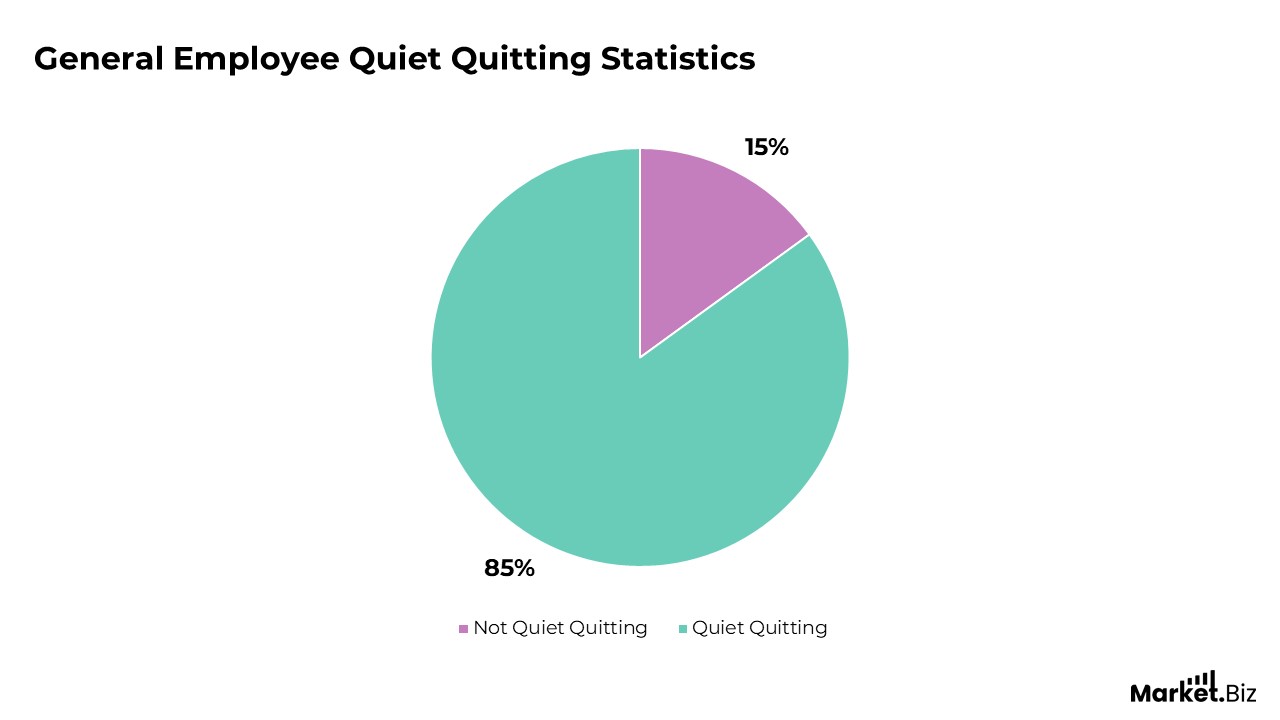
- Slightly more than half of the employees throughout the world are termed as quiet quitters owing to their lack of engagement at the workplace.
- Almost 70% of Gen Z employees tend to show little or no effort at the workplace.
- Of those roles that do not provide opportunity for advancement and career growth, 64% of employees will simply say that they do the bare minimum.
- About 48% of working professionals have mentally quit from their roles ever since the spread of the pandemic.
- It’s said that remote employees are 35% more likely to place themselves in silent quitting due to minimal connection regarding companies’ culture.
- One in three employees disengages for reasons of bad or inconsistent management.
- Organizations with disorganized communications have 25% higher quit rates.
- 52% of the world’s workforce complains of burnout, the most prevalent reason for their quiet quitting behaviour.
- 63% of employees are believed to have demotivated themselves from putting in extra efforts because of a lack of recognition.
- Large corporations record the highest rate of 61% internal users opting for quiet quitting compared to smaller organizations.
Moreover
- 45% of employees share that they have quiet quit because they feel that their company does not offer enough advancement.
- The technology and healthcare industries are among the most exhibited industries for the highest disengagement levels.
- Quiet quitting accounts for trillions of dollars in productivity loss each year.
- One in four employees is likely to say that he is avoiding taking on responsibilities beyond the functions of his core job.
- Women are 10% more likely than men to quietly quit under heavy imbalances of workloads, along with feeling undervalued.
- Only 21% of workers are fully engaged at their workplace, indicating that there is practically a quiet quitting epidemic.
- Quiet quitting has increased by 15% due to the changes in the workplace after the pandemic.
- An absence of mentorship and feedback accounts for the disengagement reported by 38% of early-career workers.
(Source: Teambuilding, WP-Content)
What Is Quiet Quitting?
Quiet quitting seems to be a workplace trend where employees put into practice the hard work portion of their actual job description, leaving no room for additional duties, staying after hours, or even going the extra mile. It does not imply quitting, but rather withdrawing completely from the hustle culture and, more so, from unnecessary duties. This is generally due to feelings of burnout or not being appreciated, vagueness of expectations, or ineffective instructions from their leaders.
Those who practice quiet quitting want a better balance of life with work and healthy boundaries. It speaks more to bigger issues of organizational culture within the organization, communication defects, and employee satisfaction. Some of the top employee engagement strategies must be rethought for such companies to retain talent and spark motivation again.
Causes of Quiet Quitting
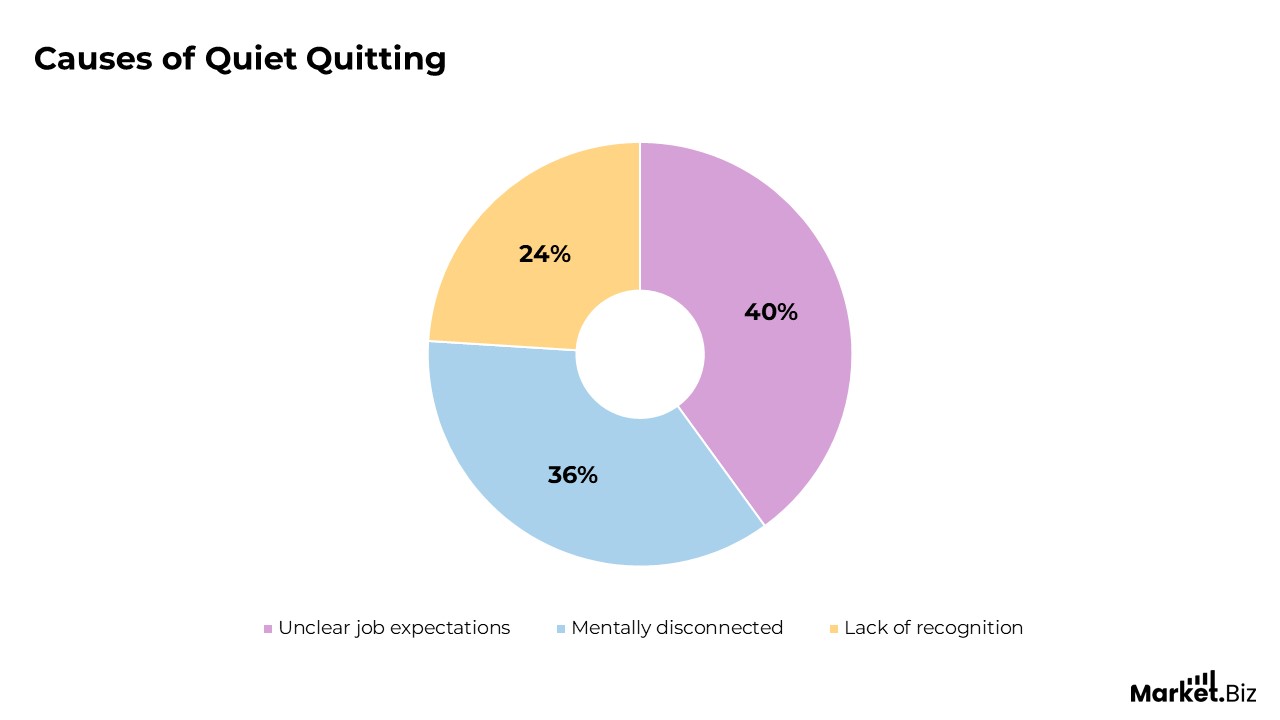
- Disengagement from extra job duties is reported by 24% employees to be caused by a lack of recognition.
- In a way, 36% or more of the work population is mentally disconnected from their jobs and just physically shows up.
- Unclear job expectations trigger quiet quitting among about 40% of employees, leading to confusion and frustration.
- Poor managerial practices cause disengagement among one in three employees.
- Lack of career growth opportunity leads to an effort reduction in 45% of employees.
- It creates emotional distance between duties and 37% employees.
- 56% of quiet quitters cite toxic workplace culture as a reason.
- Poor pay drives 41% of employees into quiet quitting.
- For 39% of employees, a lack of feedback from supervisors demotivates them.
- Not having enough work-life balance leads 49% employees to quiet quitting.
- 35% of employees practicing quiet quitting cite this as their reason for feeling cut off from teams and their company while working remotely.
- 44% of professionals disengage when there is no purpose or meaning in their work.
- 40% of quiet quitters mention bias and favouritism in the workplace.
- Limited learning and development opportunities stagnate and disengage for 42% of respondents.
- 53% of employees report suffering from quiet quitting from overwhelming workloads due to insufficient support.
How Quiet Quitting Became a Challenge?
- Quiet quitting translates into reduced productivity, where disengaged employees engage in less-than-full participation by their colleagues.
- 50% of managers, however, find it hard to spot quiet quitters, which hinders timely interventions.
- Employee morale declines when high performers notice a fellow employee’s slack behaviour, creating team dysfunction.
- Engaged employees increase turnover costs through recruitment and training of disengaged employees.
- Quiet quitting negatively affects customer satisfaction, with low service quality from disengaged employees.
- Workplace culture is bound to deteriorate once the employees stop their collaborative efforts, leading to a silo mentality and the breakdown of communication.
- Quiet quitting via the loss of discretionary effort can cause suboptimal performance and block organization growth and innovation.
- Quiet quitting correlates with increased absenteeism, where disengaged employees tend to take unjustifiable leaves.
- The employee retention crisis deepens as quiet quitting propels disengagement all over the spectrum across industries.
- Once again, motivating the quiet quitters comes without clear signals for managers, making it difficult to engage or raise performance.
- Quiet quitting compromises company loyalty in such situations, as the employees become less concerned with the long-term welfare of the organization.
- Collaboration suffers due to quiet quitting, which means teamwork fails to help the organization meet targets and deadlines.
- Quiet quitting, eroding trust in its leaders, marks its employees’ loss of faith in the managers and the company vision at large.
Benefits of Quiet Quitting
- A new work-life balance will help employees to escape burnout and even maintain mental health, and improve their overall wellness.
- Quiet quitting induces boundaries, which help employees to defend time spent when not at work.
- Quiet tasks require less effort spent in more time on the core responsibilities of roles assigned to improve efficiency.
- Well, quiet quitting employees reduce stress levels because they no longer burden themselves with work beyond their limits.
- Quiet quitting allows employees the time to recharge; thus, productivity is measured in the long term when they are at work.
- This could create clarity in expectations, since employees would take on only the work that had been defined well enough.
- Quiet quitting instils a more realistic view of the job, which, in turn, reduces the pressure to constantly exceed the performance bar.
- Reducing overtime prevents burnout from happening to employees and consequently improves job satisfaction and longevity on the job.
- Quiet quitting could lead to increased independence as the employee manages his or her workload, however they see fit.
- Less discretionary effort cultivated by a worker keeps the employee away from feelings of resentment towards the employer.
- Such people can avoid getting drained by the things they do while quietly quitting as they take on only the work that falls within the official job description.
- Quiet quitting could expose the organization to probes and a lack of engagement with workers, giving the platform for organizations to reconsider and improve their workplace culture.
- It can ensure a more even distribution of workload within the organization to ensure no one employee faces an overwhelming amount of extra work.
Quiet Quitting by Country
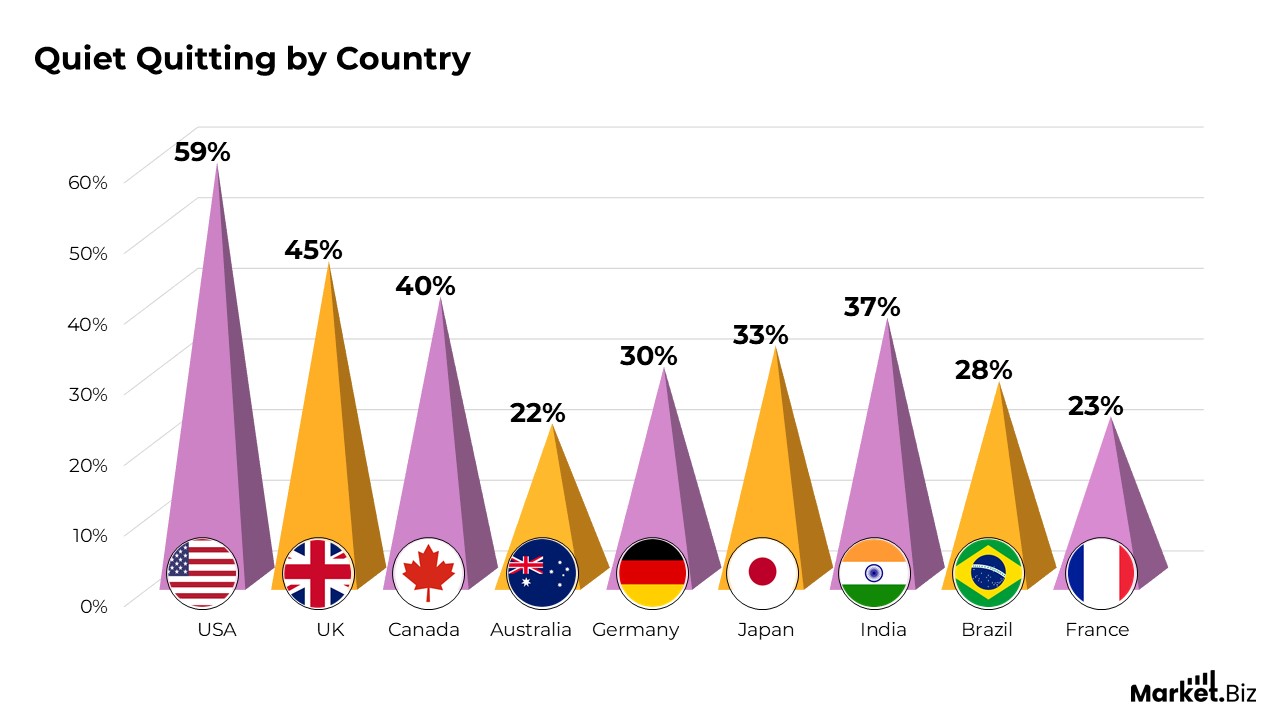
- The USA has found that 59% of employees “quiet quit,” an even more painful figure by his measurement. Millennials and Generation Z suffer the most from this phenomenon of detachment.
- Almost 45% of employees in the UK were reported to be disengaged, and thus increased concerns about productivity and retention.
- In Canada, the trend is further infected with quiet coming by stealth since 40% of employees allow themselves to put less than usual effort into their jobs due to extreme dissatisfaction.
- In Australia, this form of quiet quitting has increased 22% in part because of dissatisfaction with work-life balance, and it comes from a lack of understanding between employees and management.
- In Germany as well, quiet quitting exists in even greater proportions, with around 30% of employees feeling disengaged due to stubborn work cultures.
- In Japan, since overtime culture tends to consume much energy, 33% of workers now disengage to care for their mental health.
- In India, 37% of employees are quietly quitting, mostly attributing it to a lack of career growth and opportunities as reasons.
- An obvious 28% in Brazil belong to the quiet quitting group, primarily due to leadership issues and disparate expectations concerning work and rewards.
- In South Korea, half of the quiet disengagement is attributable to its long hours of work, along with increasing work stress.
- In France, with so many labour regulations, 23% of the workers claim to be disengaged due to burnout over job pressures.
Quiet Quitting by Annual Costs
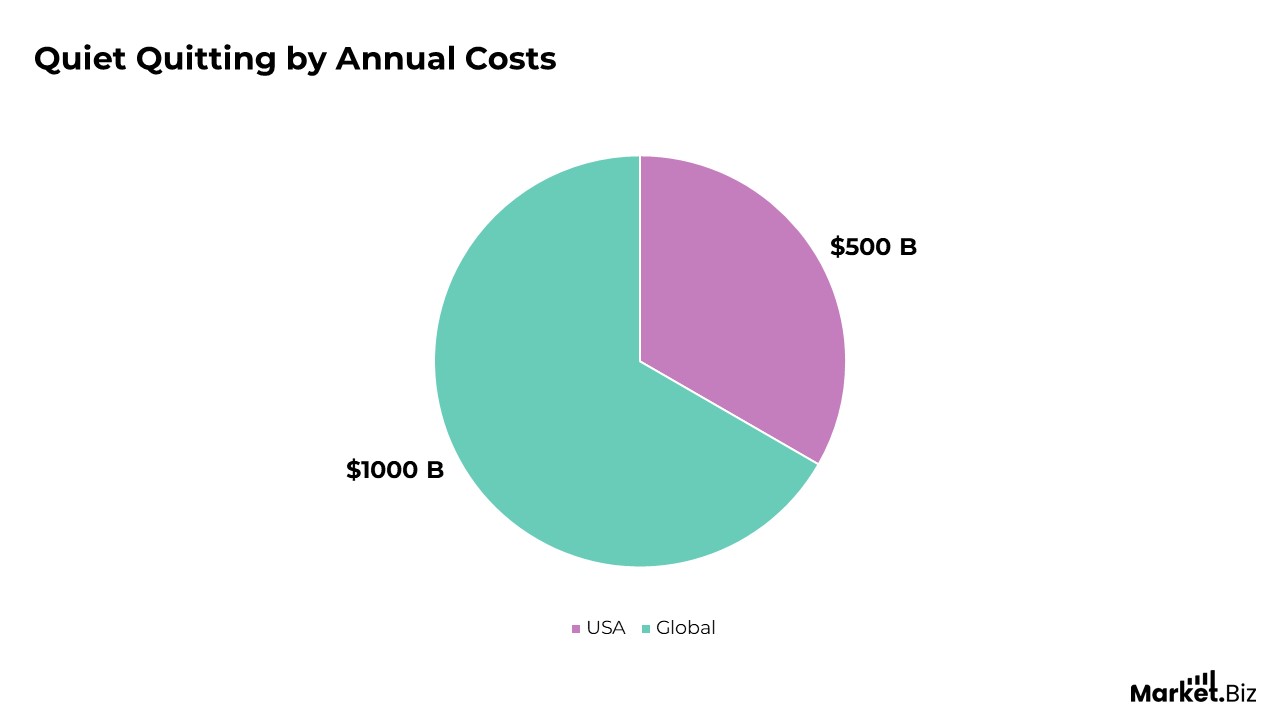
- Estimates show that quiet quitting costs companies in the United States about $1.5 trillion every year in loss of productivity by employees embarking on disengaged tasks.
- Quiet quitting puts global businesses at risk of losing $3 trillion in annual losses whenever such trends persist.
- Employee turnover linked to quiet quitting incurs costs of recruiting and training, which go up to $4,000 per employee.
- In larger firms, such as the USA, these costs directly related to disengaged workers could match costs of up to 15% on operations.
- The healthcare sector loses an estimated $200 billion annually from quiet quitting, mostly due to burnout and staff attrition.
- The quiet quitting would see the productivity of a team cut down by 20%, which translates into enormous losses for many industries.
- Companies that will not bother to treat quiet quitting would have their revenue down by 6% growth each year due to less employee engagement.
- The technology-related industry suffers the most here, with above $40 billion being lost every year on account of software engineers and developers’ disengagement.
- Every small and medium-sized enterprise incurred an average annual loss of $2,500 per employee as a result of engaging in quiet quitting behaviours.
- Quiet quitting leads to decreased customer satisfaction levels by a whopping 15% in retail, thus causing an annual revenue loss of $10 billion.
- Quiet quitting brings down innovation output and can cost companies in creative sectors as much as $5 billion per year in unrealized potential.
- The financial industry incurs an annual loss of $12 billion due to missed sales opportunities from unengaged financial advisors and support staff.
(Source: Teambuilding, WP-Content)
Quiet Quitting by Demographic
- It has been estimated that 70% of Gen Z employees have quiet quitting tendencies. They are even showing signs of disengagement from their jobs, which is often due to the unfulfilling jobs they’ve gotten.
- Another 58% of quiet quitters fall between the ages of 24 and 40 years, and they often complain of promotion deficiencies and poor work-life balance.
- They were seen to be 10% more likely than men to do the quiet quit. They generally cited burdensome workloads and a lack of recognition as reasons behind quiet quitting.
- The percentage of Gen Xers engaging in quiet quitting has risen to 45%, driven by their discontent with leadership and a feeling of never attaining career goals.
- A quarter of Baby Boomers, now nearing retirement, are said to engage in quiet quitting mainly due to burnout and demotivation.
- People working from home are 35% more likely to experience quiet quitting, given the isolation and disconnectedness of the culture in the workplace.
Moreover
- Among blue-collar roles, 40% employees silently quit due to high stress, physical demands, and low recognition.
- Quiet quitting is more likely among parents with younger children-about 30%, because they seek better work-life balance and flexible hours.
- Leaders have a 20% tendency to engage in quiet quitting, often due to not being recognized and being overworked.
- Quiet quitting, as reported by people of color employees, is 5% more prevalent, where underrepresentation in workplace issues would primarily feature in the reasons due to concerns about workplace discrimination.
- Quiet quitting is caused by 45% of young developers in the technology industry, where most of them admitted that the limited room for career growth triggered their state of disengagement, as well as high burnout rates.
- The 55-plus age group was likely to disengage by 30% because of prioritizing retirement plans rather than more work commitments and stress.
Warning Signs of Quiet Quitting
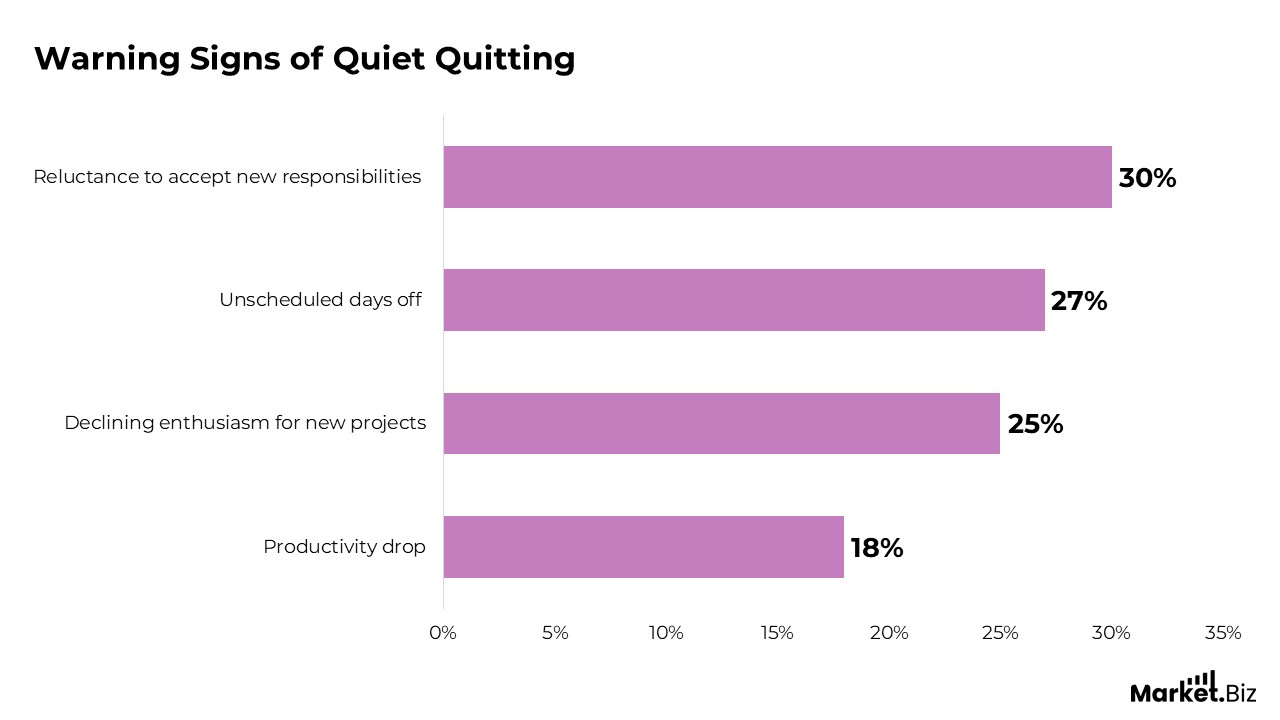
- According to this study, 18% of quiet quitters demonstrate a more serious productivity drop, completing at most what is minimally required of them.
- 25% of quiet quitters may be disengaged during this period, evidenced by their declining enthusiasm for new projects.
- Employees who engage quietly in this so-called quitting are increasing their incidence of absences, taking more unscheduled days off whenever possible; 27% of quiet quitters do this.
- 30% of quiet quitters report a marked reluctance to accept new responsibilities or volunteer for new projects.
- 35% of employees report withdrawal from team activities or social interaction as a key sign of disengagement.
- A lack of applying for feedback or development opportunities is also a sign of quiet quitting: 33% of disengaged workers said this.
- 60% of quiet quitters display low energy and motivation, often disengaged from day-to-day tasks and conversations.
- 25% of quiet quitters undergo a change in job performance from overachiever to complacent. They then begin to do only what is required of them.
- Focusing more on basic human expectations rather than on true spirit proprietorship signifies a decline 45% of quiet quitters.
- 30% of disengaged employees show perceived disinterest in company goals, thus no longer linking their efforts to the organization’s vision.
- 40% of quiet quitters sharpen boundaries to have stricter work-life balance boundaries, refusing jobs outside working hours or overtime to have time for themselves.
- Disgruntled employees are twice as likely to disengage and quietly quit if they find problems with leadership or job expectations.
Solving Quiet Quitting
- So many of our employees, 50% feel more engaged when the company offers them clear opportunities for career development, thus reducing quiet quitting.
- Rewarding and acknowledging employees with feedback boosts motivation. Hence, 62% of employees are likely to remain engaged.
- Flexible working hours act as an engagement catalyst, accounting for 25% towards tackling work-life balance issues that ultimately lead to quiet quitting.
- Improved communication between employees and management is likely to cut down quiet quitting by approximately 40%, making employees trust and believe in company transparency.
- Programs fostering employee wellness cut down on burnout; 55% of them claim higher job satisfaction and less disengagement.
- Mentoring and professional development programmes lead to a 30% increase in retention, addressing quiet quitting concerning stagnation.
- 50% of quiet quitters say they would consider re-engagement if offered further challenges that aligned with their career interests.
- Encouraging an inclusive culture and celebrating diversity is a strong employee retention factor, with 42% of workers more likely to be engaged.
Conclusion
People know what they say about quiet quitting. More often than not, it is actually about burnout and feeling that your contribution is not recognized, and there are fewer career advancements. The trend is much evident in the younger generation, where they escape from the toil of their lives, according to their desires, and they want a real work-life balance.
Such a trend leads to disengagement and weakened loyalty with the organizations, decreased productivity, and further destruction of internal communication. Added to home-based working and ineffective management styles, it induces a silent migration from going beyond. Promising solutions such as mentorship, flexible schedule, and specific growth opportunities seem to be changing the trend as regards motivation and retention across industries. Now, it is obligating an organization regarding quiet quitting to develop resilient, engaged, future-ready workplaces.
FAQs
Quiet quitting is a rising global phenomenon in which more than a fair share of the workforce is disengaging from going above and beyond and doing just enough to stick to job descriptions, especially during these post-pandemic times.
Millennials and Gen Z generally have the highest rates of quiet quitting, created mainly due to workplace culture misalignment, lack of growth, and concerns about work-life balance.
This mass disengagement ultimately leads to reduced productivity, stifled innovation, and higher turnover, especially in industries such as tech and healthcare.
Some of the causative factors are burnout, unclear expectations, inadequate recognition, and little opportunity for career advancement, thereby crushing motivation over time.
Some potential solutions to counter quiet quitting include enhancing communication, providing mentorship, bettering career pathways, and creating an appreciation and inclusive culture.