









Introduction
Enterprise Resource Planning (ERP) Software Statistics: Enterprise Resource Planning (ERP) software has become an essential tool for businesses across various industries, helping them streamline operations, enhance decision-making, and boost efficiency by consolidating critical processes such as finance, supply chain, and customer relationship management into a single platform.
With the growing adoption of ERP systems, recent data highlights both the challenges and rewards of their implementation. While companies often face hurdles like budget overruns, delayed timelines, and operational disruptions, the benefits of ERP systems, including cost reduction, improved data visibility, and increased productivity, are undeniable.
Gaining a deeper understanding of these statistics is key for businesses looking to fully leverage ERP systems and optimize their operations for better performance and data-driven decision-making.
Editor’s Choice
- 53% of IT executives list ERP as one of their top investment priorities.
- Implementing ERP software can cut administrative costs by 22%.
- 90% of organizations hire consultants for ERP implementation.
- ERP project failure rates range from 55% to 75%.
- Around 28% of companies report a positive ROI within a year of adopting ERP software.
- Approximately 26% of employees actively use their company’s ERP software.
- Finance, accounting, and IT employees are the primary decision-makers when purchasing ERP software.
- ERP is the leading technology investment priority for finance organizations, with 64% of firms planning to implement it within the next three years.
- 32% of businesses in a 2021 survey indicated that their recent technology initiatives involved replacing legacy systems.
- Employee satisfaction with ERP implementations is generally positive, though 10% express dissatisfaction, particularly in companies lacking effective change management.
- 27% of companies place little or no emphasis on change management, aligning with the dissatisfaction seen in their ERP implementations.
- Among businesses seeking change management services from consultants, only 33% found organizational change management challenging, compared to 67% overall.
- The most common change management activities for ERP implementations include customized training (73%), communication (57%) and strategy development (63%).
(Source: Oracle Netsuite, Learn 2G, Finances Online, Deloitte, Netsuite.)
Reasons for Implementing ERP Systems
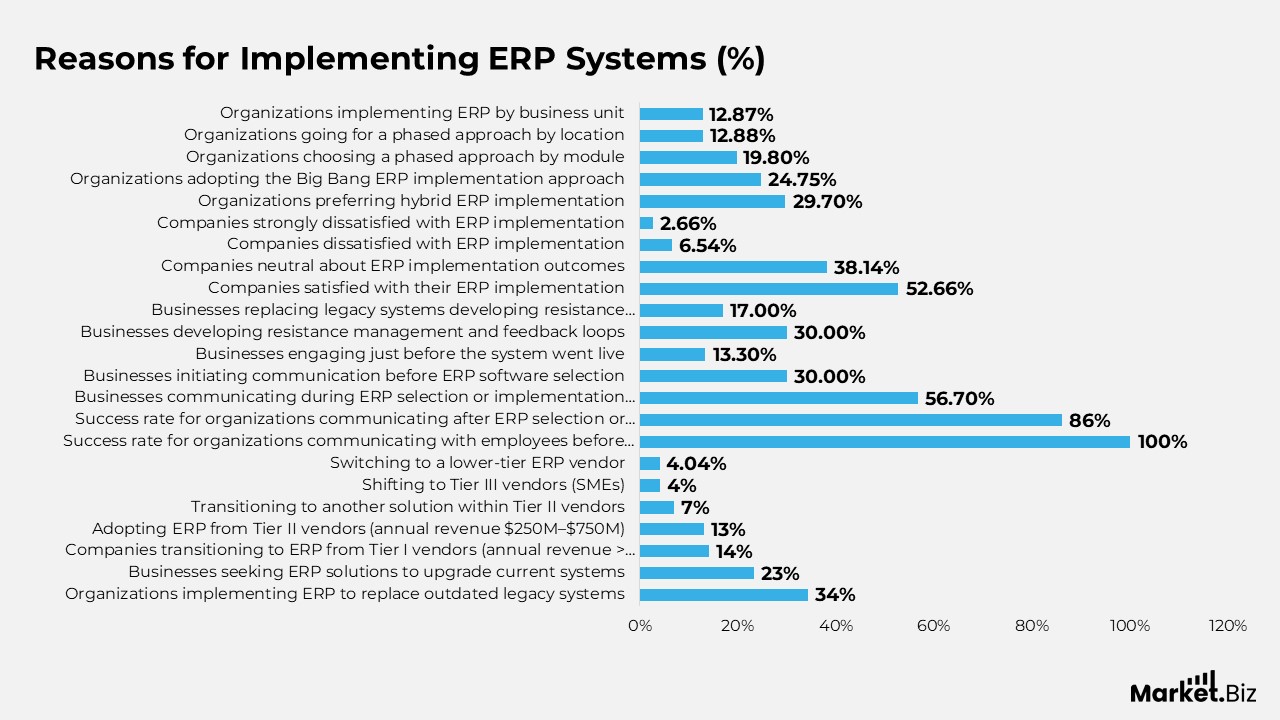
- 34.24% of organizations implement ERP systems to replace outdated legacy systems.
- 23.32% of businesses seek ERP solutions to upgrade their current systems.
- 14.14% of companies transition to ERP solutions from Tier I vendors (annual revenue over $750 million).
- 13.13% adopt ERP from Tier II vendors (annual revenue between $250–750 million).
- 7.07% transition to another solution within Tier II vendors.
- 4.04% shift to Tier III vendors, primarily serving small and medium-sized enterprises (SMEs).
- 4.04% opt to switch to a lower-tier ERP vendor.
- 100% of organizations that communicated with employees before ERP implementation reported project success, while only 86% of those who started communication after software selection or during implementation experienced success.
- 56.70% of businesses communicated during the ERP selection or implementation phase.
- 30.00% initiated communication before ERP software selection.
- 13.30% engaged just before the system went live.
- 30% of businesses developed a resistance management plan and feedback loops, but only 17% of organizations replacing legacy systems took these steps.
- 52.66% of companies expressed satisfaction with their ERP system implementation.
- 38.14% remained neutral about the ERP implementation outcomes.
- 6.54% were dissatisfied with the ERP system implementation.
- 2.66% expressed strong dissatisfaction with the implementation.
- 29.70% of organizations prefer a hybrid approach for ERP implementation.
- 24.75% adopt the Big Bang approach, deploying all business units simultaneously.
- 19.80% choose a phased approach by module.
- 12.88% go for a phased approach by location.
- 12.87% implement ERP by business unit.
(Source: FinancesOnline, Statista, DemandSage)
Consulting Services for ERP Projects
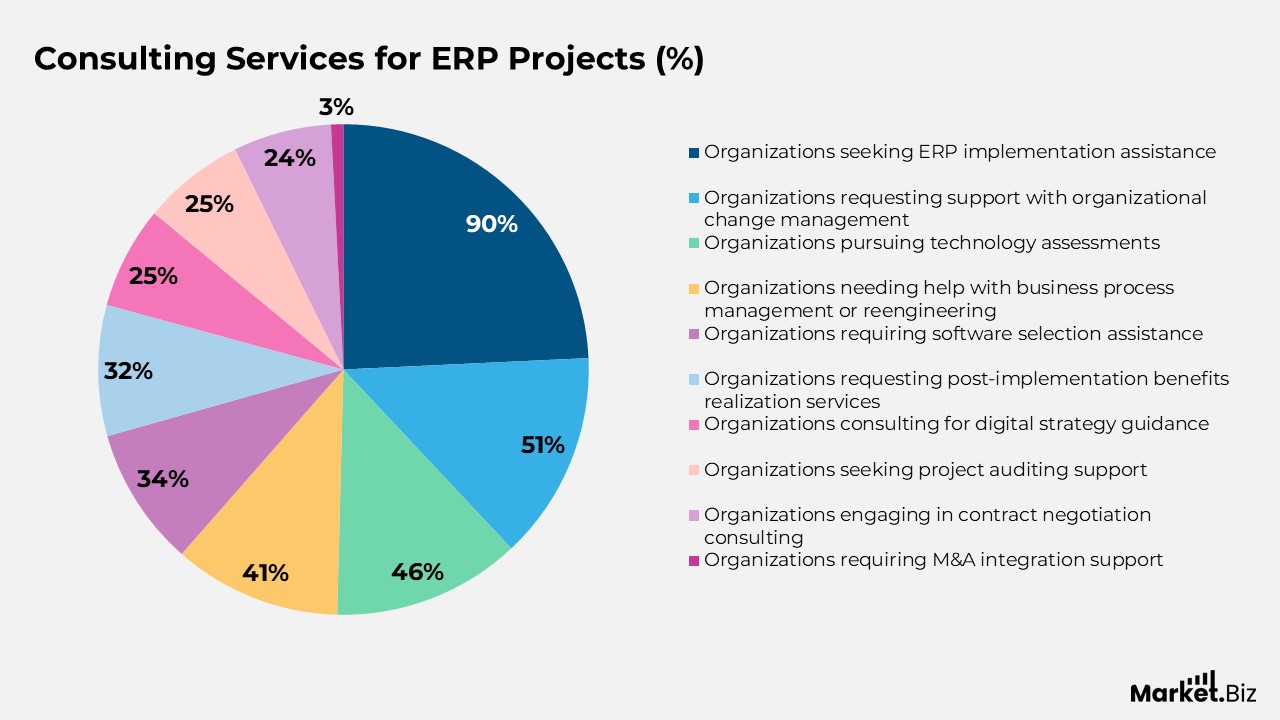
78% of organizations engage consultants for ERP implementations, with the following consulting services being most requested:
- 90% seek ERP implementation assistance.
- 51% request support with organizational change management.
- 46% pursue technology assessments.
- 41% need help with business process management or reengineering.
- 34% require software selection assistance.
- 32% request post-implementation benefits realization services.
- 25% consult for digital strategy guidance.
- 25% seek project auditing support.
- 24% engage in contract negotiation consulting.
- 3% require M&A integration support.
(Source: FinancesOnline, DemandSage, AIMultiple, Statista)
ERP Software Market Size
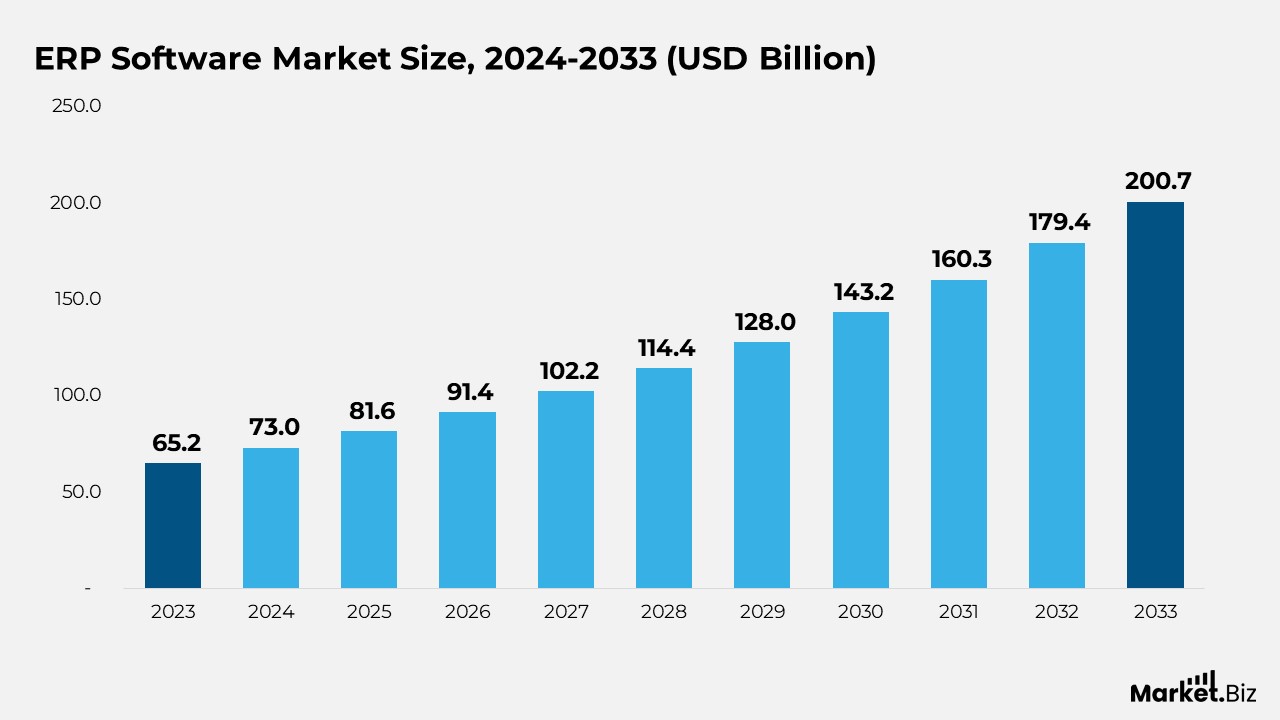
- According to Market.us, the ERP software market is expected to rise from $73.0 billion in 2024 to $200.7 billion by 2033, representing a compound annual growth rate (CAGR) of 11.9% from 2024 to 2033.
- The growth of the ERP market is driven by the need for improved business efficiency, regulatory compliance, and data-driven decision-making, with a focus on scalability, flexibility, and emerging technologies.
- In 2023, the on-premises segment held a dominant share of 64.8% in the ERP software market, driven by the need for greater control over enterprise resources and data.
- The Finance segment led the market with a 29.1% revenue share in 2023, outpacing other business functions such as Supply Chain, Human Resources, and others.
- Large Enterprises held the largest revenue share of 67.3% in 2023, owing to their complex operations and the need for robust ERP solutions.
- The Manufacturing segment dominated the market, capturing 24.5% of the revenue in 2023, driven by the need to manage complex operations like production planning and supply chain coordination.
- The ERP software demand in North America was valued at US$ 25.9 billion in 2023 and is expected to grow significantly, supported by the presence of leading ERP vendors like Microsoft and Oracle.
(Source: Market.us)
Digital Transformation Market Size
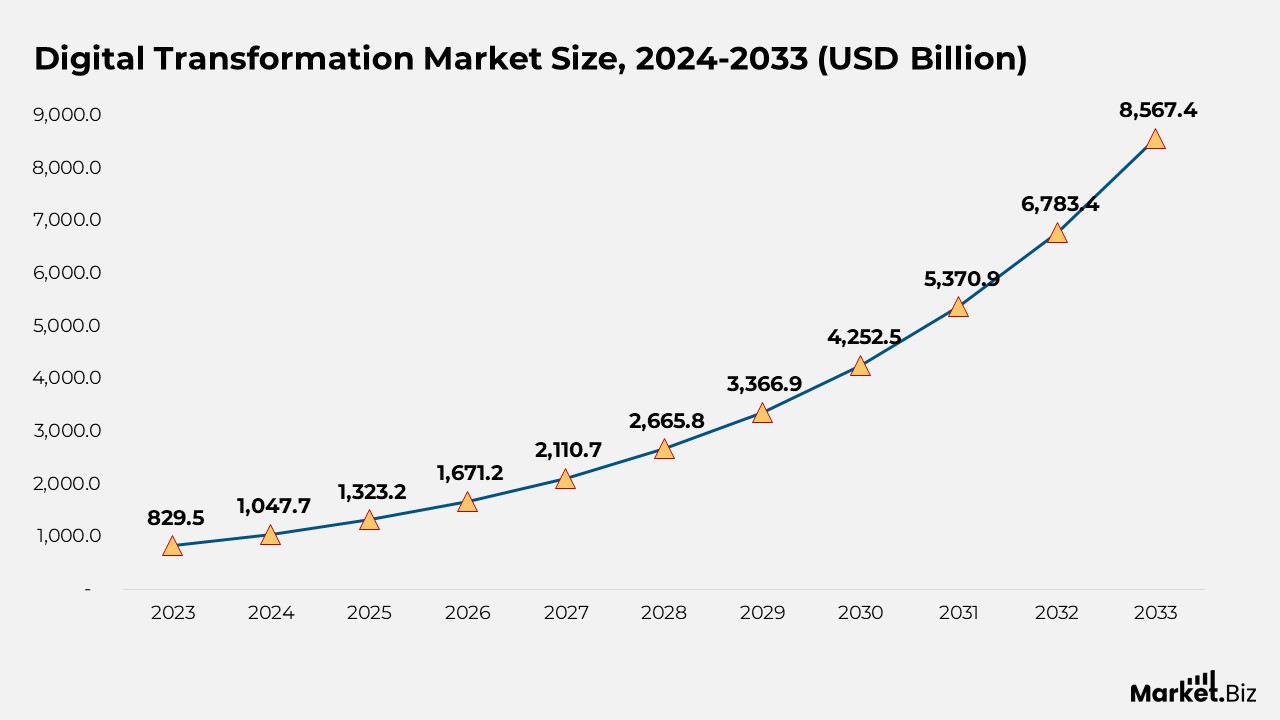
- According to Market.us, the digital transformation market is expected to rise from $1,047.7 billion in 2024 to $8,567.4 billion by 2033, representing a compound annual growth rate (CAGR) of 26.3% from 2024 to 2033.
- The growth of the Digital Transformation market is fueled by businesses’ need to adopt digital technologies, including cloud computing, big data analytics, AI, IoT, RPA, and cybersecurity, to stay competitive.
- In 2023, the Solution segment dominated the market, capturing 69.7% of the share, driven by increased demand for digital business solutions to enhance operational efficiency and customer experience.
- The on-premises segment held 63.9% of the market in 2023, with adoption driven by concerns over data security and regulatory compliance.
- The Big Data & Analytics segment led the market with a 30.1% share in 2023, fueled by the growing volumes of data across industries such as retail, healthcare, banking, and manufacturing.
- Large Enterprises captured 61.5% of the digital transformation market in 2023, supported by their financial resources to invest in advanced technologies like cloud computing, AI, and IoT.
- The BFSI sector led the market with a 27.4% share in 2023, driven by the need for improved customer experience, operational efficiency, and regulatory compliance.
- North America accounted for 41.9% of the global digital transformation market in 2023, with a market value of US$ 218.2 billion, and is expected to experience significant growth.
- North America’s mature digital infrastructure, robust IT ecosystem, and widespread technology adoption have accelerated digital transformation across various industries.
(Source: Market.us)
Key Change Management Activities During ERP Implementation
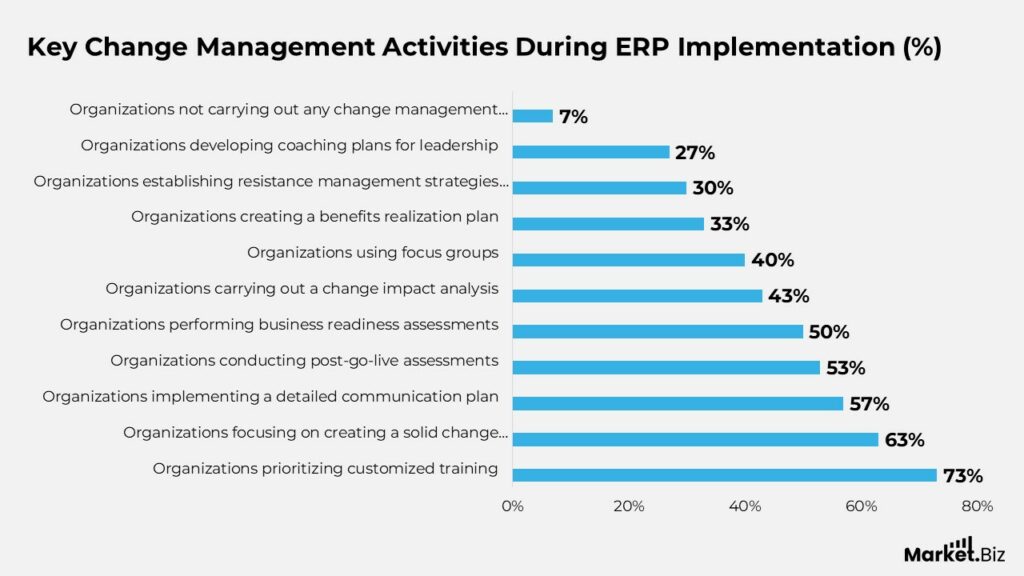
The most commonly implemented change management activities include:
- 73% prioritize customized training.
- 63% focus on creating a solid change management strategy.
- 57% implement a detailed communication plan.
- 53% conduct post-go-live assessments.
- 50% perform business readiness assessments.
- 43% carry out a change impact analysis.
- 40% from focus groups.
- 33% create a benefits realization plan.
- 30% establish resistance management strategies and feedback loops.
- 27% develop coaching plans for leadership.
- 7% do not carry out any change management activities.
(Source: FinancesOnline, DemandSage, Blue Link, AIMultiple, Statista)
ERP Adoption in Small Business Statistics
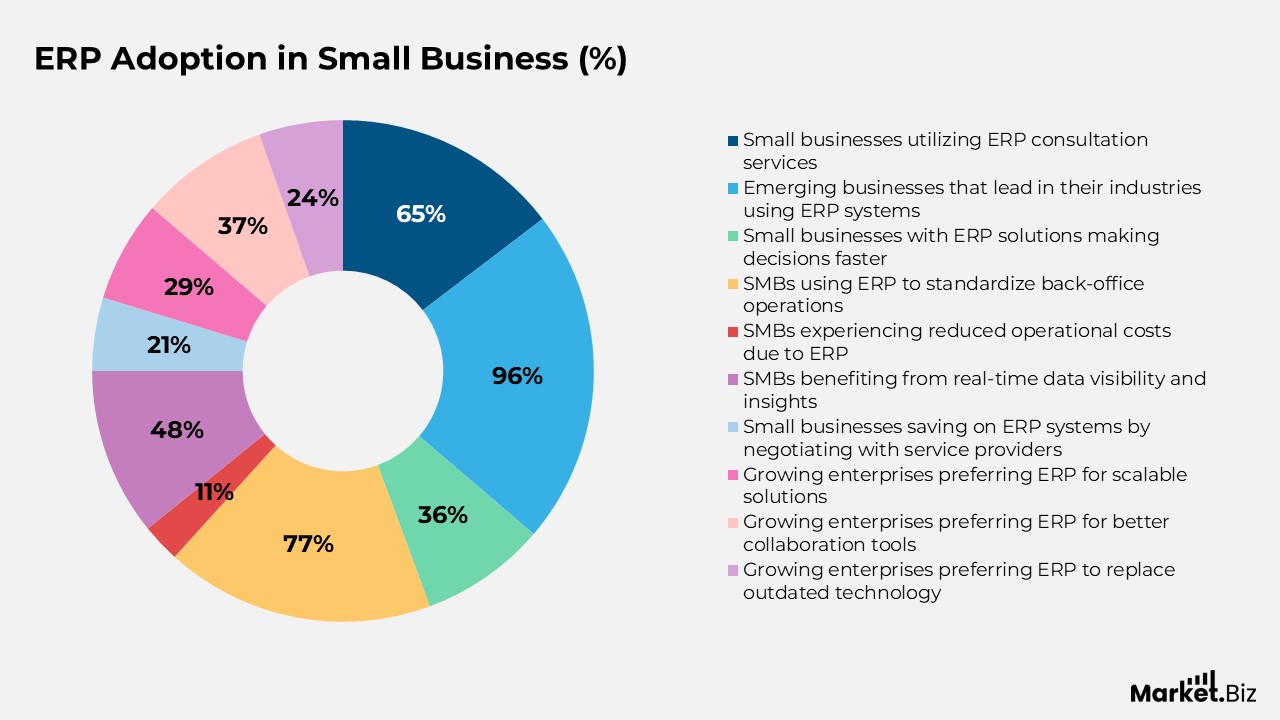
- 65% of small businesses are utilizing ERP consultation services to enhance their operations.
- 96% of emerging businesses that lead in their industries depend on some form of ERP system.
- Small businesses with ERP solutions can make decisions 36% faster than they could without these systems.
- SMBs favor ERP systems over standalone platforms for several reasons: 77% use ERP to standardize back-office operations, 11% experience reduced operational costs, and 48% benefit from real-time data visibility and insights.
- Small businesses that negotiated with ERP service providers typically saved an average of 21% on their systems.
- According to SMB market respondents, it takes about 11 months to realize the benefits of an ERP system fully.
- Growing enterprises prefer ERP systems over individual solutions due to the scalable solutions (29%), the need for better collaboration tools (37%), and the ability to replace outdated technology (24%).
(Source: FinancesOnline, DemandSage, Statista)
New Technologies in ERP
- 63% of organizations are investing in cognitive technologies to enhance their competitive edge.
- 15% of executives believe AI has the potential to drastically change the landscape, determining which companies succeed or fail.
- 33% of businesses consider custom APIs essential for transforming and extracting data from ERP systems.
- However, intelligent technology is incorporated into only 4% of ERP solutions.
- In the UK, 53% of CIOs plan to enhance their ERP systems with innovative, intelligent technologies.
(Source: Deloitte, UST SmartOps, Accenture)
ERP Usage Statistics
- Manufacturing companies are the leading adopters of ERP software, making up the largest user group.
- Manufacturers represent 47% of organizations seeking to purchase ERP software, the largest share among all industries.
- Following manufacturing, the next most likely sectors to adopt ERP software include distributors (18%), construction (4%), and services (12%).
- In a survey of businesses planning to invest in ERP software, 89% identified accounting as the most important function of ERP, with other key areas including sales (33%), inventory and distribution (67%), CRM and technology (21%).
- 40% of companies cited enhanced functionality as their primary reason for implementing an ERP system.
- The most significant influencers in ERP software consumptions were employees from the IT department (23%) and finance and accounting (23%).
- On average, 26% of employees actively use their organization’s ERP software.
(Source: Deloitte, UST SmartOps, Accenture)
ERP Return on Investment Statistics
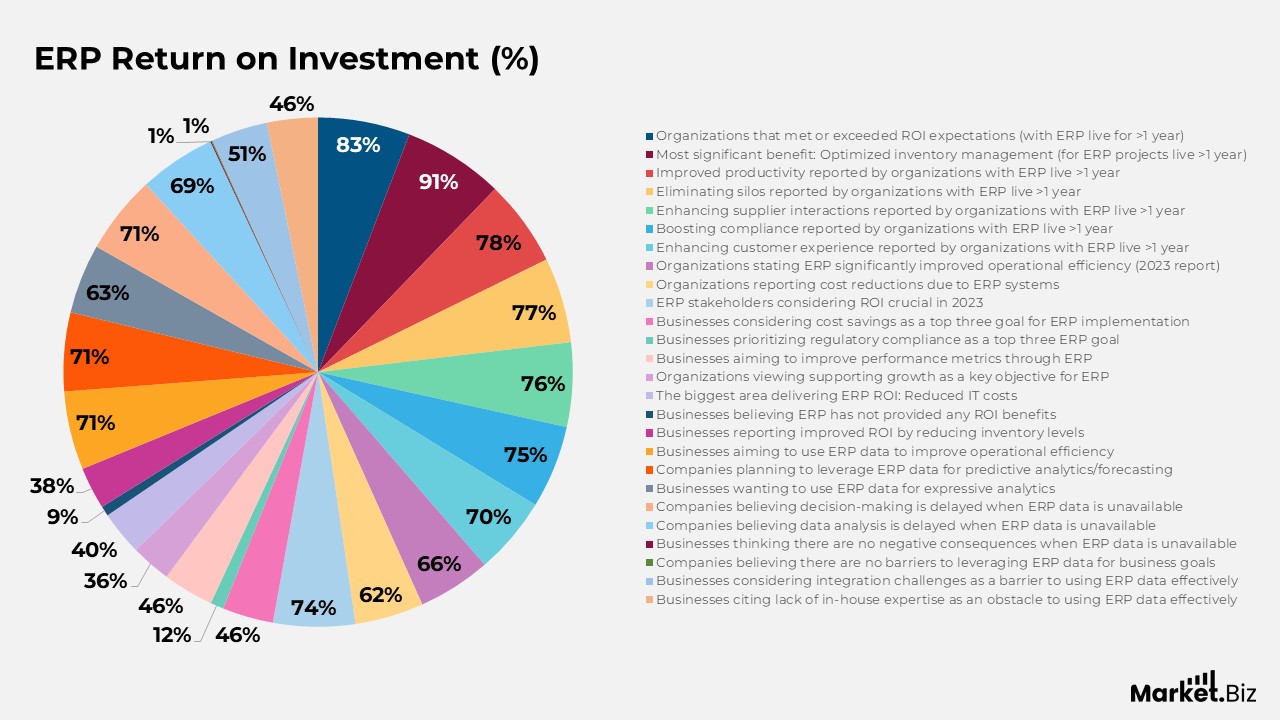
- Among organizations that conducted an ROI analysis before launching their projects and have been live for over a year, 83% reported that their ERP projects met or exceeded their ROI expectations.
- The most significant benefit for 91% of companies with at least one phase of their ERP project live for a year or more was optimized inventory management.
- Additional advantages reported by organizations included 78% improving productivity, 77% eliminating silos, 76% enhancing supplier interactions, 75% boosting compliance, and 70% enhancing the customer experience.
- According to a 2023 report, 66% of organizations stated that their ERP systems have significantly improved operational efficiency.
- 62% of survey participants reported that their ERP systems led to cost reductions, particularly in purchasing and inventory management.
- The top three benefits identified by businesses from their ERP systems include reduced process time, increased collaboration, and a centralized data system.
- For midsize corporations (with revenue below $1 billion), the annual cost of owning an ERP system ranges between 3% to 5% of their revenue.
- For large enterprises (with revenue exceeding $1 billion), the cost of owning an ERP system typically accounts for 2% to 3% of their annual revenue.
- In 2023, 74% of ERP stakeholders consider ROI crucial, a significant increase from 43% in 2022.
- 46% of businesses regard cost savings as one of the top three most important goals for implementing ERP.
More Stats
- 12% of businesses prioritize regulatory compliance as one of the top three goals for ERP.
- 46% of businesses aim to improve performance metrics through ERP, ranking it among their top three goals.
- 36% of organizations view supporting growth as one of the top three key objectives for their ERP systems.
- The biggest area where ERP has delivered ROI for companies is in reduced IT costs, benefiting 40% of businesses.
- 9% of companies believe their ERP system has not provided any ROI benefits.
- 38% of businesses report that their ERP system has improved ROI by reducing inventory levels.
- 71% of businesses aim to use ERP data to improve operational efficiency.
- 71% of companies plan to leverage ERP data for predictive analytics or forecasting future outcomes.
- 63% of businesses want to usage ERP data for expressive analytics to understand past performance.
- 71% of companies trust that decision–making is delayed when ERP data is unavailable.
- 69% of companies feel that data analysis is delayed if ERP data is not accessible.
- Only 1% of businesses think there are no negative consequences when ERP data is unavailable.
- 1% of companies believe there are no barriers to leveraging their ERP data to achieve business goals.
- 51% of businesses consider integration challenges a barrier to effectively using ERP data for business goals.
- 46% of businesses cite a lack of in-house expertise as an obstacle to leveraging their ERP data for business success.
(Source: Oracle Institute, Statista, Blue Link)
Technology Statistics
- Cost is rarely a factor in not choosing the cloud, with only 6.2% of companies citing it as the reason for avoiding cloud solutions.
- 96% of organizations expect the majority of their data to be cloud-based within the next 5 years.
- 76% of businesses have already transitioned or are in the process of migrating their on-premises ERP systems to the cloud.
- 83% of companies are utilizing more SaaS applications in 2023 compared to the previous year.
- The primary reason for 39% of businesses shifting to the cloud is to benefit from improved business processes.
- 32% of businesses are motivated to move to the cloud due to scalability and the potential for higher ROI.
- Cloud software continues to see increasing demand, with Gartner projecting global spending on cloud services to reach $678.8 billion in 2024, marking a 20.4% growth from $563.6 billion in 2023.
- Over the next five years, $2 trillion in revenue will be captured by companies excelling in personalized customer experiences, driven by AI technologies.
- In 2023, 25% of B2B businesses incorporated AI technology into their e-commerce operations.
Moreover
- By 2030, AI is expected to automate 50% of current work activities, allowing teams to focus more on creative problem-solving and value-added tasks.
- The SaaS (Software as a Service) segment remains the largest part of the cloud computing market.
- The overall cloud computing market is predicted to reach $947.3 billion by 2026.
- Following their cloud migration, 94% of businesses reported significant security improvements.
- Only 11% of companies encrypt the majority of their cloud data.
- Business leaders who succeed are 55% more likely than their peers to prioritize the integration of advanced sales technology.
- The North American B2B eCommerce market is expected to surpass $4 trillion by 2025.
- 65% of B2B companies engage in fully online transactions, with 18% of their revenue coming from eCommerce.
- Omni-channel selling and marketplaces are rapidly growing, with B2B marketplace sales copying in 2023, and the normal buyer using 10 or more sales channels.
(Source: Oracle Institute, DemandSage, Statista, Blue Link)
Challenges in ERP Implementation
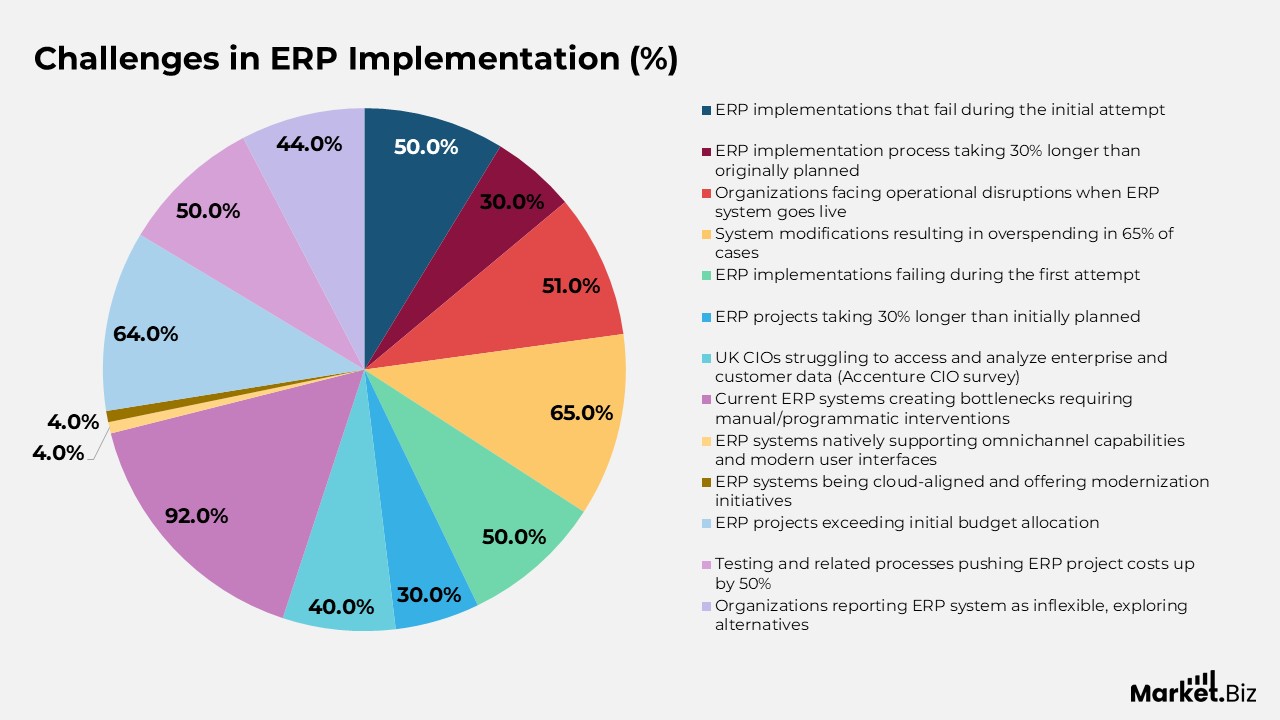
- Data collected over the years reveals that 50% of ERP implementations fail during their initial attempt.
- ERP projects often exceed their original budget by 3 to 4 times the initial estimate.
- The implementation process tends to take 30% longer than originally planned.
- 51% of organizations face operational disruptions when their ERP system goes live.
- Required system modifications to enhance usability result in 65% of cases of overspending.
- The top three areas where ERP systems tend to fall short for users are data accuracy, user experience, and analytics.
- The most frequently mentioned challenges during ERP implementation include a lack of adequate process reengineering and insufficient testing.
- 50% of ERP implementations fail during the first attempt.
- On average, ERP projects take 30% longer than initially planned to complete.
- 51-54% of organizations face operational disruptions when their ERP systems go live.
- The top three challenges reported by users of current ERP systems are user experience (UX), data accuracy, and analytics.
- According to an Accenture CIO survey, 40% of UK CIOs struggle to access, analyze, or effectively use enterprise and customer data for informed decision-making.
- 92% of current ERP systems create a bottleneck for CIOs, requiring manual or programmatic interventions to enable data sharing.
- Only 4% of ERP systems natively support omni-channel capabilities and modern user interfaces.
- Just 4% of ERP systems are cloud-aligned and offer modernization initiatives.
- 64% of ERP projects exceed their initial budget allocation.
- Testing and related processes often push ERP project costs up by as much as 50% beyond the original budget.
- 44% of organizations report that their ERP system is inflexible, prompting them to explore alternatives for system extensions.
(Source: Oracle Institute, Statista, G2.com, Inc.)
Conclusion
The Enterprise Resource Planning (ERP) market is experiencing continued growth as organizations across diverse industries acknowledge the substantial advantages of ERP systems, including improved operational efficiency, better decision-making, and enhanced regulatory compliance.
The statistics highlight a significant shift towards cloud-based ERP solutions, emphasizing scalability, flexibility, and the integration of cutting-edge technologies such as AI and IoT. Although challenges like high ERP project failure rates and the need for effective change management persist, businesses are increasingly prioritizing ERP investments to optimize processes and achieve higher returns on investment.
The strong presence of large enterprises in the ERP market, coupled with the growing influence of finance, accounting, and IT departments in decision-making, underscores the value of ERP in managing complex business operations. As companies continue to phase out legacy systems and advance their digital capabilities, ERP remains a fundamental driver of business transformation and long-term growth.
FAQ’s
The growth of the ERP market can be attributed to businesses’ increasing recognition of the need for streamlined operations, improved decision-making capabilities, and regulatory compliance. Technological advancements like cloud computing, AI, and IoT also play a significant role in driving the adoption of more flexible and scalable ERP solutions.
Cloud-based ERP offers enhanced scalability, flexibility, and the ability to access data remotely, making it a cost-effective and adaptable solution for businesses. In contrast, on-premise ERP provides more control over data and security, which is often preferred by companies with stringent regulatory or security requirements.
ERP projects fail for various reasons, including unclear objectives, poor change management, and insufficient user training. To mitigate these risks, businesses should focus on effective planning, active stakeholder engagement, and implement a dedicated change management team to ensure smooth adoption and success.
ERP implementation brings several benefits, such as improved operational efficiency, reduced costs, streamlined business processes, and better decision-making through real-time data integration. It also helps maintain regulatory compliance and can lead to a higher return on investment (ROI) when executed correctly.
Employees play a critical role in the success of an ERP system. Their willingness to embrace the new technology and use the system effectively directly impacts the system’s effectiveness. Proper training and effective change management are essential to ensuring a high rate of employee adoption and successful ERP implementation.