









Introduction
Managed Services Statistics: Services entail the outsourcing of particular IT or business functions to a third-party provider known as a Managed Service Provider (MSP). These services include the management of IT infrastructure, cybersecurity, cloud services, and network management. Additionally, they cover backup and disaster recovery, application management, help desk support, compliance and reporting, among others.
The advantages of these services include cost control, scalability, access to specialised expertise, and enhanced operational efficiency. This allows organisations to focus on their primary activities while ensuring that their IT and business processes are managed and secured effectively. The managed services market is currently witnessing rapid and substantial growth. Propelled by digital transformation, the adoption of cloud technologies, and essential cybersecurity requirements.
Projections indicate that the global market will expand from hundreds of billions in the mid-2020s to over $1 trillion by the early 2030s. Characterised by robust Compound Annual Growth Rates (CAGRs) ranging from 7% to 14%. As businesses increasingly outsource their IT functions to concentrate on core operations. They are relying on MSPs for the proactive management of complex environments, which include AI, IoT, and security.
Editor’s Choice
- In 2022, the managed services market was valued at $278.9 billion and began its upward trend.
- By 2032, the market revenue is expected to reach an impressive $834.7 billion, indicating steady growth.
- Further, the occurrence of cyberattacks is notably high, with an average of 39 attacks happening every 39 seconds.
- Most small and medium-sized enterprises (SMEs) anticipate that cloud services will become a vital part of their operations within the next five years, with 71% sharing this perspective.
- The delivery of managed services alongside standard offerings rose significantly. Comprising 63% of the company’s business operations in 2022.
General Managed Services Statistics
- In 2022, the managed services market was valued at $278.9 billion and began its upward trend.
- Further, the market’s impressive growth trajectory is expected to reach 834.7 units by 2032.
- Further, by 2032, the total market revenue is anticipated to achieve a remarkable $834.7 billion, indicating steady growth.
- Moreover, despite apprehensions regarding data security, approximately 78% of global companies express confidence in their outsourcing partners.
- The United States alone outsources over 300,000 jobs each year, underscoring the lasting attractiveness of outsourcing for managed service providers.
- Moreover, the number of connected devices is rapidly increasing, with projections of reaching 22 billion by 2025.
- It is projected that by 2021, the global economic repercussions of cybercrime will surpass $6 trillion annually.
- In 2021, the highest revenue from managed services constituted 44% of the company’s overall income.
Managed Services Market Size Statistics
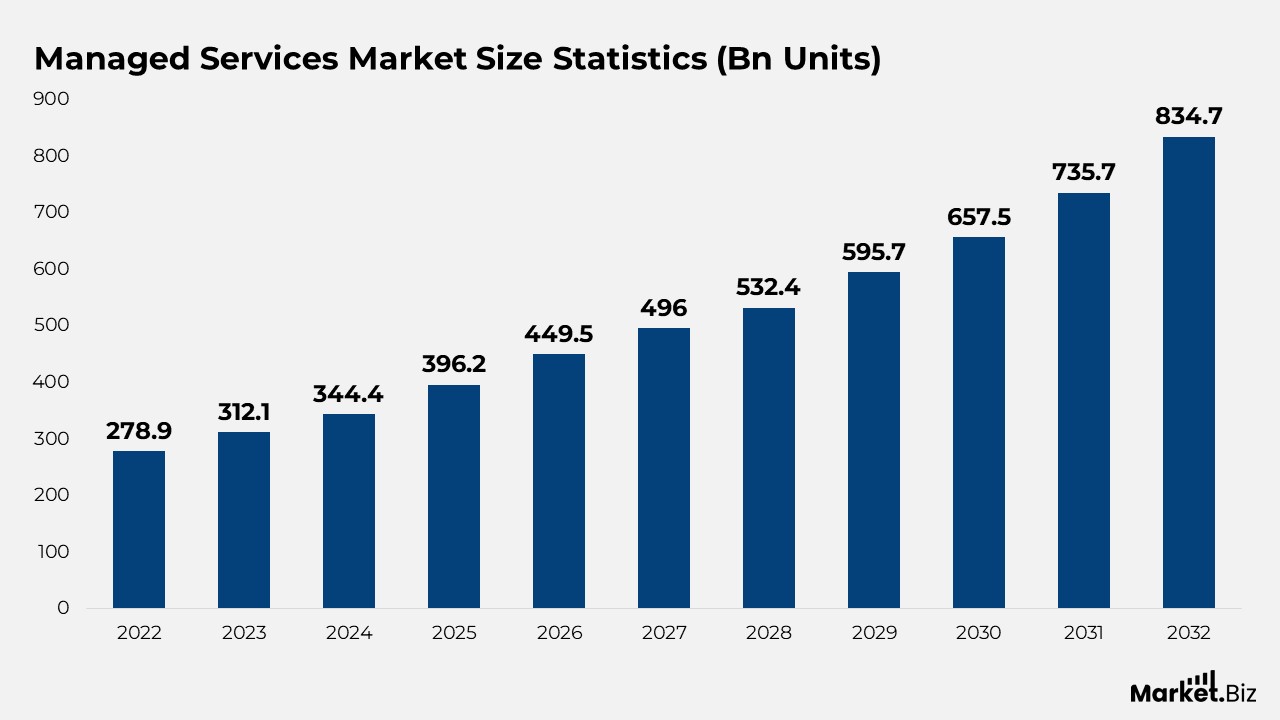
- In 2022, the market size commenced at 278.9 units and initiated its upward trend.
- Over the following years, this expansion persisted. The market is growing to 312.1 units in 2023 and 344.4 units in 2024.
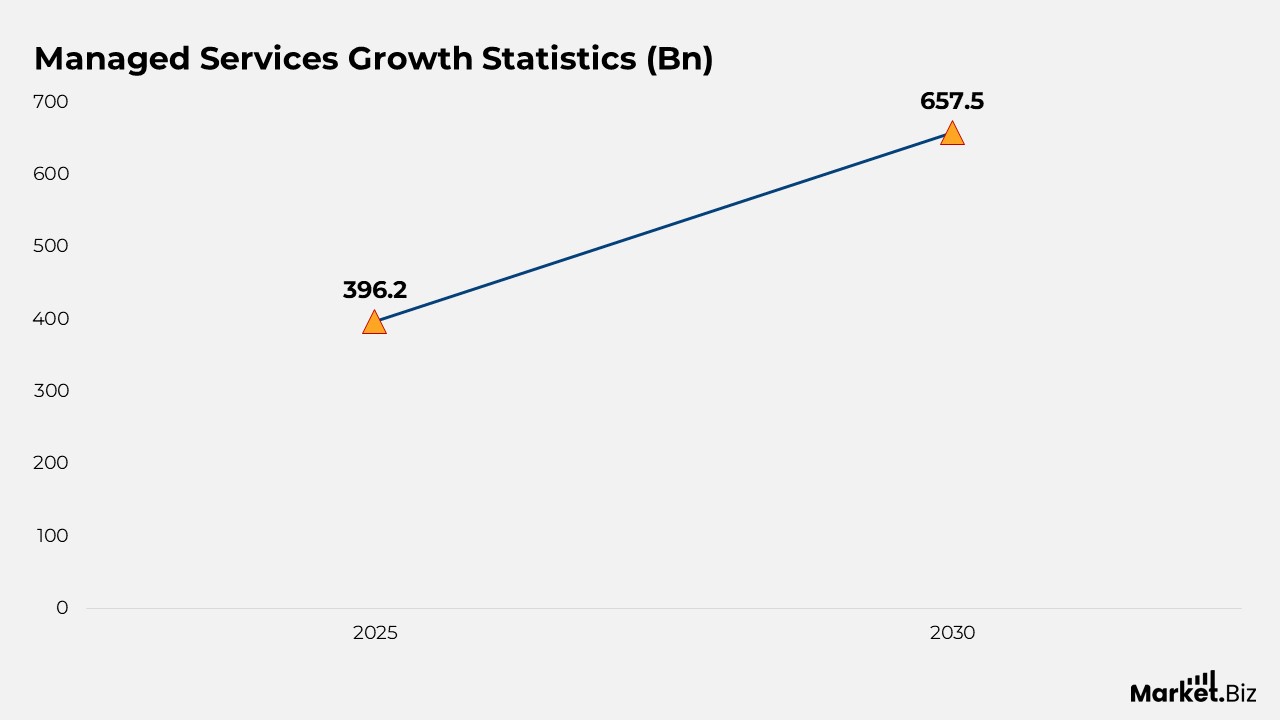
- The trend continued as the market attained 396.2 units in 2025 and maintained its steady rise, reaching 449.5 units in 2026 and 496 units in 2027.
- Further, the momentum extended into 2028, with the market size achieving 532.4 units and continuing to increase. This culminated in a notable 595.7 units in 2029.
- The upward trend remained strong in 2030, reaching 657.5 units, and sustained its pace, achieving 735.7 units in 2031.
- The market’s impressive growth trajectory culminated in 834.7 units in 2032.
Managed Services Solutions Statistics
- In 2022, the total revenue reached $278.9 billion, with different solution segments making significant contributions.
- Managed Data Centre services produced $48.2 billion. Managed Network and Managed Mobility services contributed $44.6 billion and $41.8 billion, respectively.
- Managed Backup and Recovery, Managed Infrastructure, and Managed Communication services also provided considerable contributions. Amounting to $36.3 billion, $39 billion, and $33.5 billion, respectively. Additional solutions in the market generated $35.4 billion in revenue.
- Further, as we look towards the future, the managed services sector is anticipated to grow significantly.
- By 2032, the market revenue is expected to reach an impressive $834.7 billion, indicating steady growth.
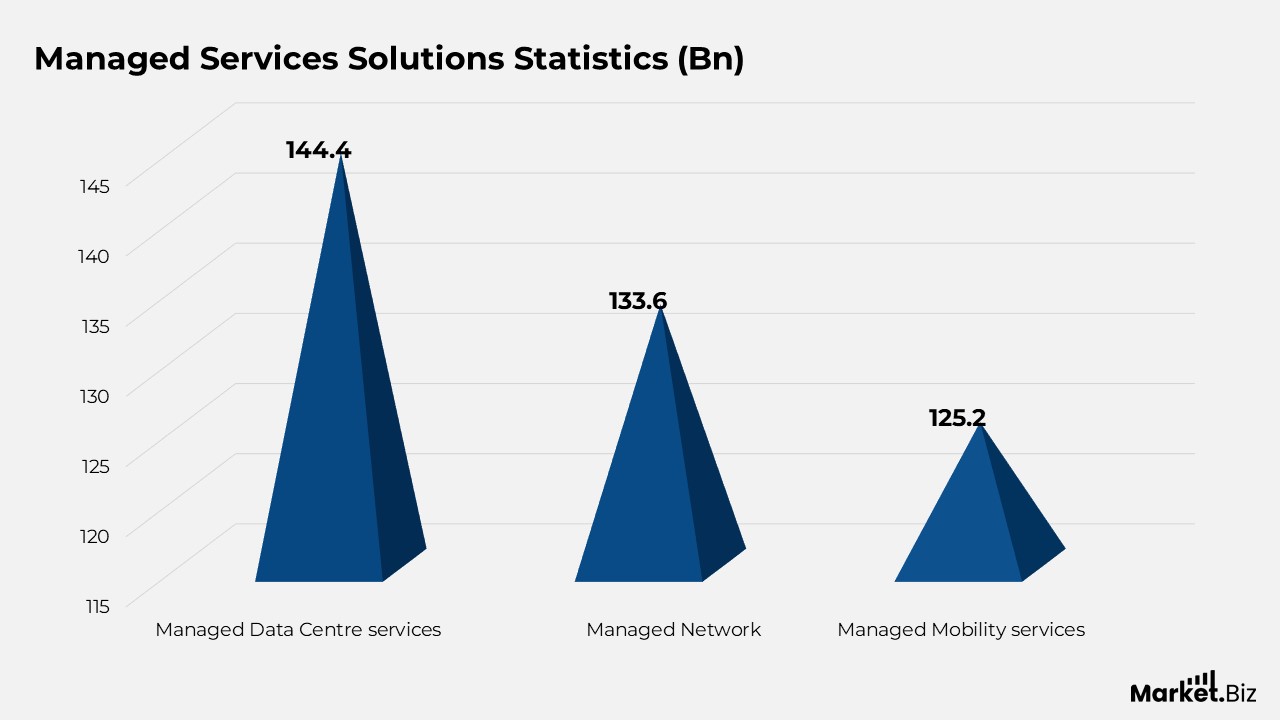
- Key sections such as Managed Data Centres, Managed Networks, and Managed Mobility services are projected to see substantial growth. With revenues of $144.4 billion, $133.6 billion, and $125.2 billion, respectively.
Statistics of Managed Services in Cybersecurity
- It is projected that by the year 2021, the worldwide economic repercussions of cybercrime will surpass $6 trillion each year.
- The occurrence of cyberattacks is notably high, with an average of 39 attacks happening every 39 seconds.
- Moreover, one in three emails directed at businesses is harmful, and 95% of cyberattacks result from human mistakes.
- Data breaches in the year 2020 are anticipated to cost businesses an average of more than $150 million.
- In addition, 60% of businesses impacted by cyberattacks are likely to shut down within a span of 6 months.
- A majority of Americans (56%) are unaware of the steps to take if their data is compromised.
- Small and medium-sized enterprises (SMBs) face an average of 8 hours of downtime due to cyberattacks, and 62% do not possess the essential in-house cybersecurity expertise.
- Lastly, 21% of companies’ data folders remain unprotected, rendering them vulnerable to access.
Managed Services Statistics by IT Services
- A significant number of organisations, totaling 94%, are either contemplating or have already implemented cloud-based solutions to enhance their outsourcing strategies.
- Most small and medium-sized enterprises (SMEs) anticipate that cloud services will become a vital part of their operations within the next five years. With 71% sharing this perspective.
- In terms of IT outsourcing, nearly half of enterprises (49%) assert that it allows them to utilise their limited resources more efficiently for their primary activities.
- In a similar vein, 49% of enterprises indicate that outsourcing their IT functions aids in directing their limited resources towards their core operations.
- Continuous network monitoring, ensuring 99.99% uptime, is achievable around the clock.
- Managed IT services can lead to a reduction in overall infrastructure costs, resulting in financial savings.
- It is estimated that a considerable portion, roughly 65%, of IT budgets is dedicated to maintaining existing systems and operations.
- Initiatives related to big data, cloud computing, and mobility are associated with a growth increase of 53%.
- Managed Service Providers (MSPs) do not represent a threat to your internal IT team.
- In the United Kingdom, 45% of businesses intend to raise their spending by 10% to 20% in 2023 compared to 2022.
Managed Service Approach Statistics
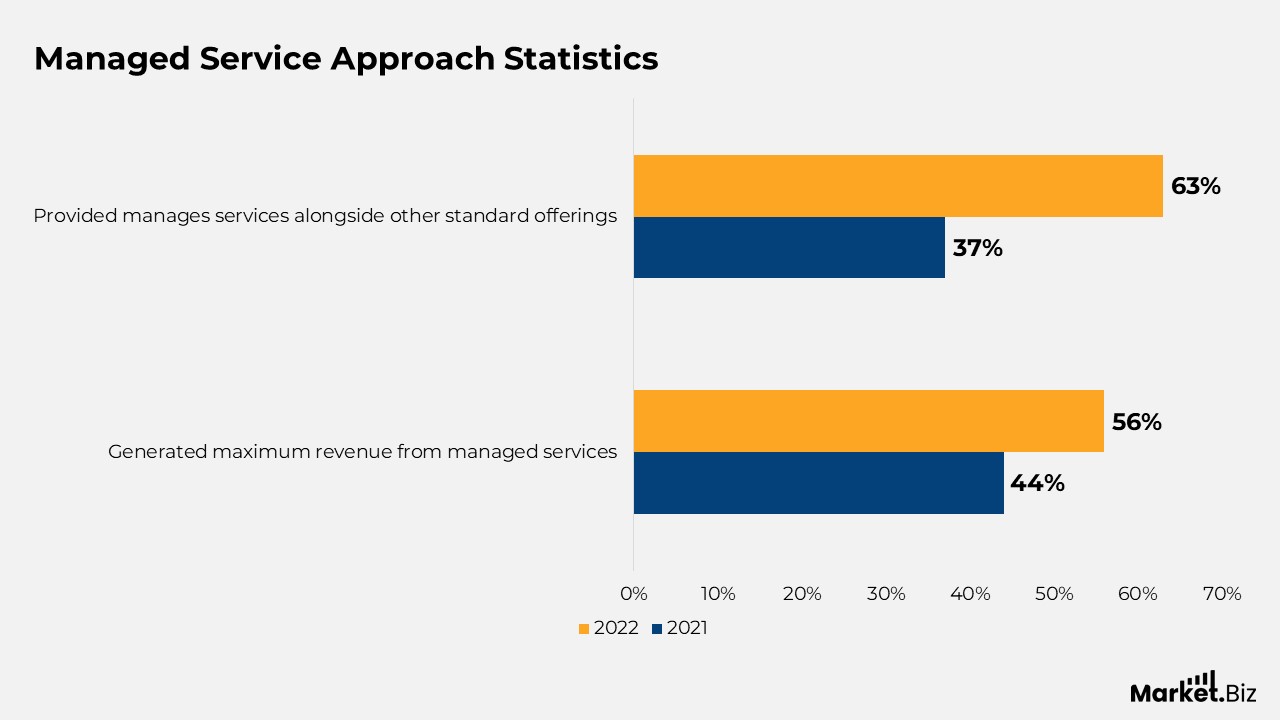
- In 2021, managed services generated a maximum revenue that represented 44% of the company’s overall income.
- During that same year, these services were offered in conjunction with other standard products, making up a slightly lesser share at 37%.
- However, in 2022, a notable change occurred in the revenue composition. Managed services saw considerable growth, contributing 56% to the total revenue. Which indicates a rising emphasis on these specialised services within the company.
- At the same time, the delivery of managed services alongside standard offerings rose significantly, comprising 63% of the company’s business operations in 2022.
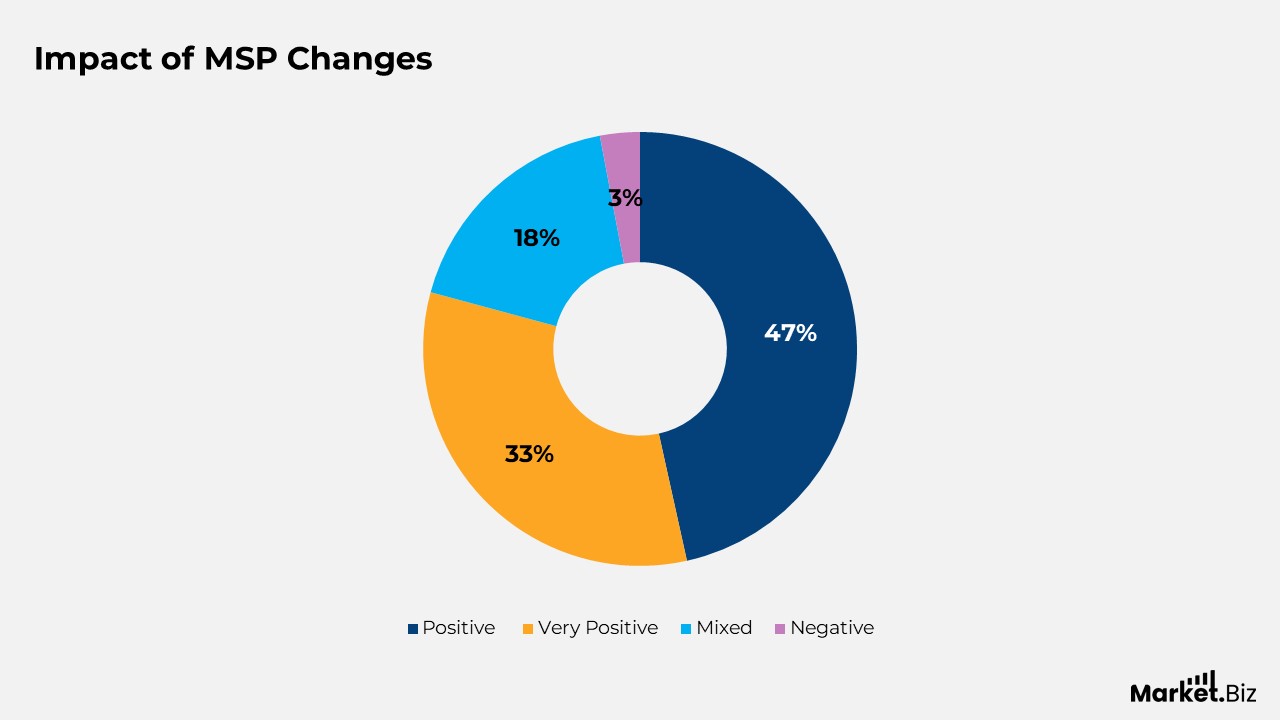
Impact of MSP Changes
- The effects of modifications in Managed Service Provider (MSP) operations have largely been favourable, with 47% of participants indicating a positive result.
- However, a considerable segment, 33%, conveyed a very positive attitude towards the MSP changes. Underscoring a significant degree of satisfaction and success in their execution.
- Nonetheless, 18% reported mixed outcomes, implying that while certain elements of the changes were advantageous, others may have introduced challenges or uncertainties.
- Only 3% noted a negative or unclear impact, suggesting that the majority of respondents have experienced concrete benefits from the adjustments made to their MSP operations.
Managed Services Recent Development
- At the beginning of 2023, IBM finalised its acquisition of Taos. A provider of cloud professional and managed services, for a sum of $200 million
- Significantly, in 2023, NTT Ltd., a worldwide technology services provider. Obtained $500 million in funding aimed at enhancing its managed services capabilities. With a particular emphasis on improving its cloud, cybersecurity, and IT infrastructure services.
- Further, the global managed services market is anticipated to experience a compound annual growth rate (CAGR) of 8.1% from 2023 to 2028. Propelled by a rising demand for IT outsourcing, increased cloud adoption, and the necessity for specialised IT expertise.
- The cybersecurity executive order issued by the US government in early 2024 highlights the critical need for securing IT services.
- Wipro, a prominent IT services firm, secured $400 million in early 2024 to further invest in its managed services portfolio.
Managed Services Future Predictions
- By the year 2027, the Managed Services (MS) market is expected to experience significant expansion, propelled by the integration of AI/ML for automation. A surge in cloud adoption (particularly private clouds), an increased demand for specialised cybersecurity solutions, and the emergence of Edge/IoT management.
- By 2029, the Managed Services (MS) market is projected to witness substantial growth, fuelled by AI/Automation facilitating self-healing IT systems, widespread cloud adoption, escalating cybersecurity requirements, and the advent of Agentic AI that will autonomously address the majority of customer issues.
- Agentic AI is anticipated to independently resolve 80% of typical support problems, with Robotic Process Automation (RPA) and AI contributing to the development of self-healing systems, thereby making automation essential for Managed Service Providers (MSPs).
Conclusion
The managed services industry exhibits significant growth potential from 2022 to 2032. As revenues consistently rise during this timeframe, it becomes clear that companies and sectors are increasingly depending on managed services to manage vital components of their operations.
The market’s growth is especially remarkable in areas like data center management, network services, and mobility solutions. Which mirrors the changing demands of a technology-oriented environment.
This information highlights the lasting significance of managed services in enhancing business performance and guaranteeing the effective management of critical IT infrastructure and communication systems.
FAQ’s
Managed Data Services encompasses the daily oversight of enterprise data, commonly referred to as shared data. This encompasses exports, conversions, imports, consolidations, configurations, and security audits typically conducted across various departments and/or geographical regions.
Managed Service Providers (MSPs) deliver specialised expertise and knowledge. Offering cost-efficient solutions by removing the necessity for businesses to recruit and train internal teams. This guarantees access to advanced expertise while enhancing budget management.
Two instances of MSP offerings include technical support fix services and subscription services. MSP technical support fix services concentrate on remotely troubleshooting or dispatching technicians to a business’s premises to address any problems.

