









Introduction
Halal Meat Statistics: Halal meat refers to meat that is prepared in accordance with Islamic dietary laws, which outline what is permissible and what is prohibited for Muslims regarding meat consumption. The meat must originate from animals such as cattle, sheep, goats, and poultry, which are deemed Halal, while pork and its derivatives are categorically forbidden (Haram) under Islamic dietary regulations.
Numerous countries have agencies or organisations that provide certifications for Halal meat products, ensuring that the meat is produced and processed in accordance with Halal standards. This adherence is crucial for the diets of Muslims globally and necessitates strict compliance with religious guidelines throughout the meat production process.
The global halal meat market is witnessing substantial growth, with a projected compound annual growth rate (CAGR) of 7.6%–8.6% expected from 2025 to 2034. This growth is fuelled by an expanding Muslim population and rising demand for hygienic, ethically sourced food options. Poultry accounts for a 56.7% share of the market, with the Asia-Pacific region leading in consumption.
Editor’s Choice
- In 2023, the Halal meat market‘s revenue was reported to be USD 294.4 billion.
- The food service sector holds a significant 65% share in the market share distribution among end-users.
- Islamic Finance leads the Halal market with the largest share, accounting for 43%.
- According to Volza’s Global Import data, the total global import volume of Halal meat was 215,000 shipments.
- A global survey conducted by Frost & Sullivan in 2016 indicated that Halal consumers around the world spent a remarkable $2 trillion collectively.
- In 2021, the overall value of global consumer expenditure in the Halal market across different categories was considerable, with Halal Food at the forefront, totaling $1,267 billion (or $1.267 trillion).
General Halal Meat Statistics
- In the year 2023, the revenue of the Halal meat market was recorded at USD 294.4 billion.
- Regarding the distribution of market share among end-users, the food service sector leads with a considerable 65% share, underscoring its vital importance in the market.
- Founded in 1972, the Saudi Arabian Standards Organisation (SASO) is dedicated to establishing Halal standards, thereby ensuring the authenticity of Halal food products.
- Brazil is recognised as the foremost global exporter of halal meat, with a notable trade value of $5.19 billion.
- As per Volza’s Import data, the overall import of Halal meat amounted to 215,000 shipments.
- Brazil has established itself as the leading exporter, boasting a significant export value of $16.2 billion.
- In 2021, the aggregate value of worldwide consumer expenditure in the Halal market across different categories was substantial, with Halal Food at the forefront, totaling $1,267 billion.
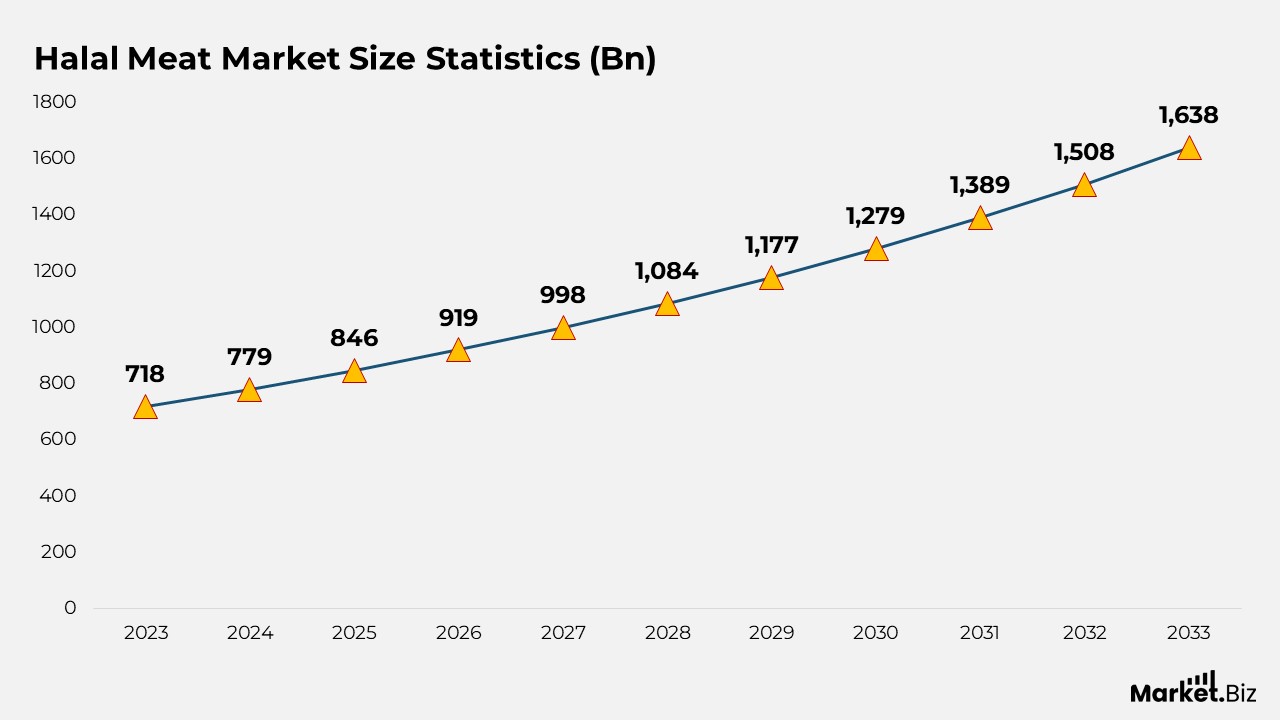
Halal Meat Market Size Statistics
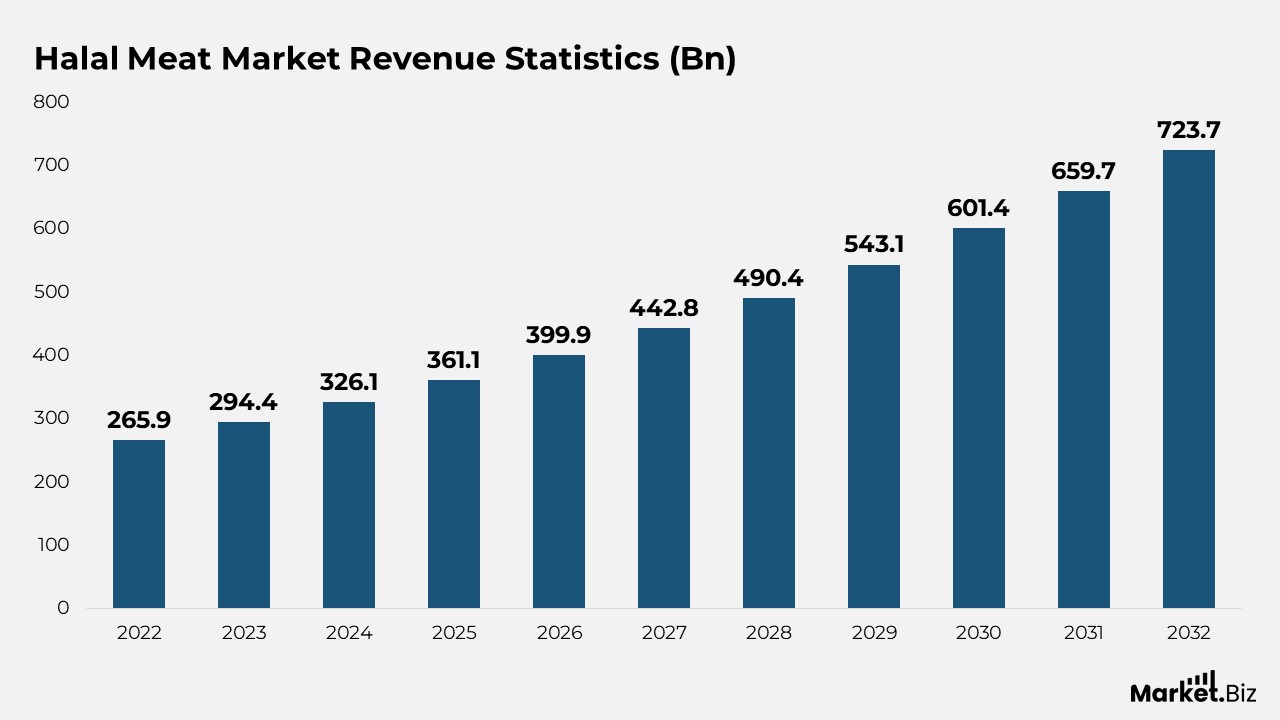
- In 2022, the market revenue was recorded at USD 265.9 billion and is projected to grow to USD 294.4 billion in 2023.
- The anticipated growth is expected to continue, with forecasts of USD 326.1 billion in 2024, USD 361.1 billion in 2025, and USD 399.9 billion in 2026.
- As we approach 2027 and the subsequent years, the market is predicted to undergo significant growth. It is expected to reach USD 442.8 billion in 2027, USD 490.4 billion in 2028, and USD 543.1 billion in 2029.
- The favorable trend is likely to continue, with estimated revenues of USD 601.4 billion in 2030, USD 659.7 billion in 2031, and USD 723.7 billion in 2032.
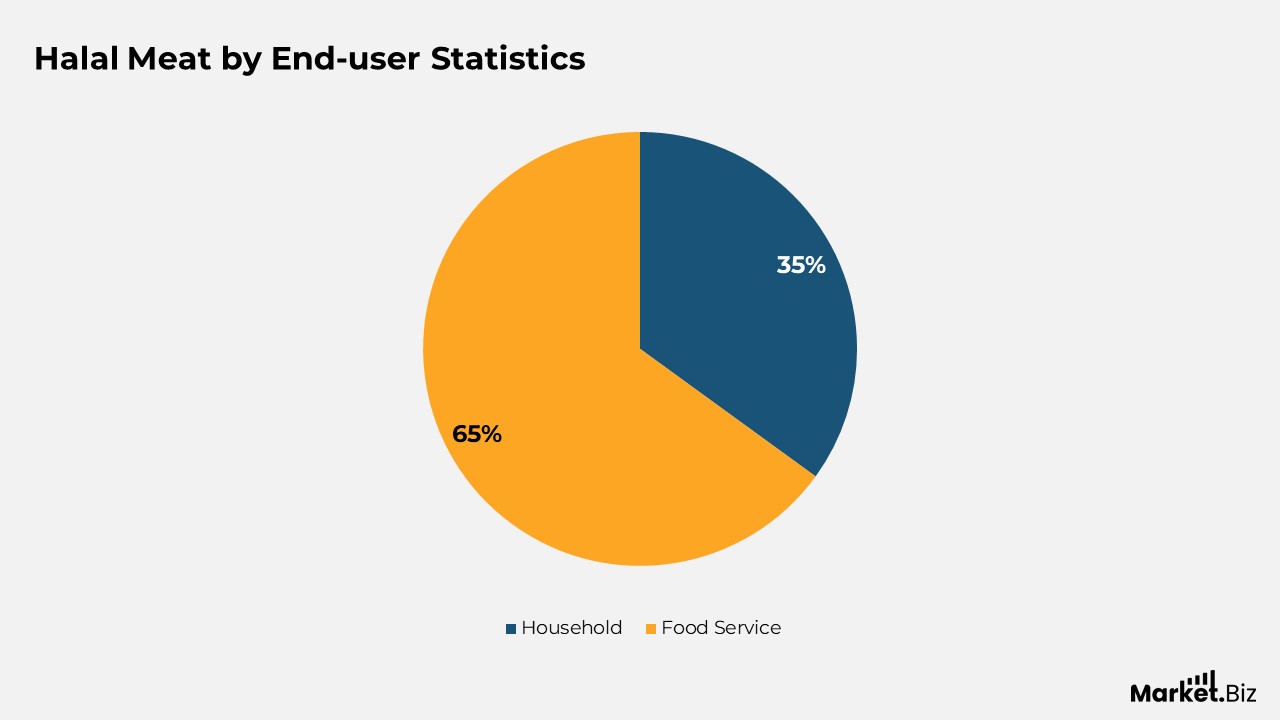
Halal Meat by End-user Statistics
- In the context of market share allocation among end-users, the food service sector leads with a considerable 65% share, underscoring its significant position in the market.
- On the contrary, the household segment possesses a notable yet comparatively smaller share of 35%.
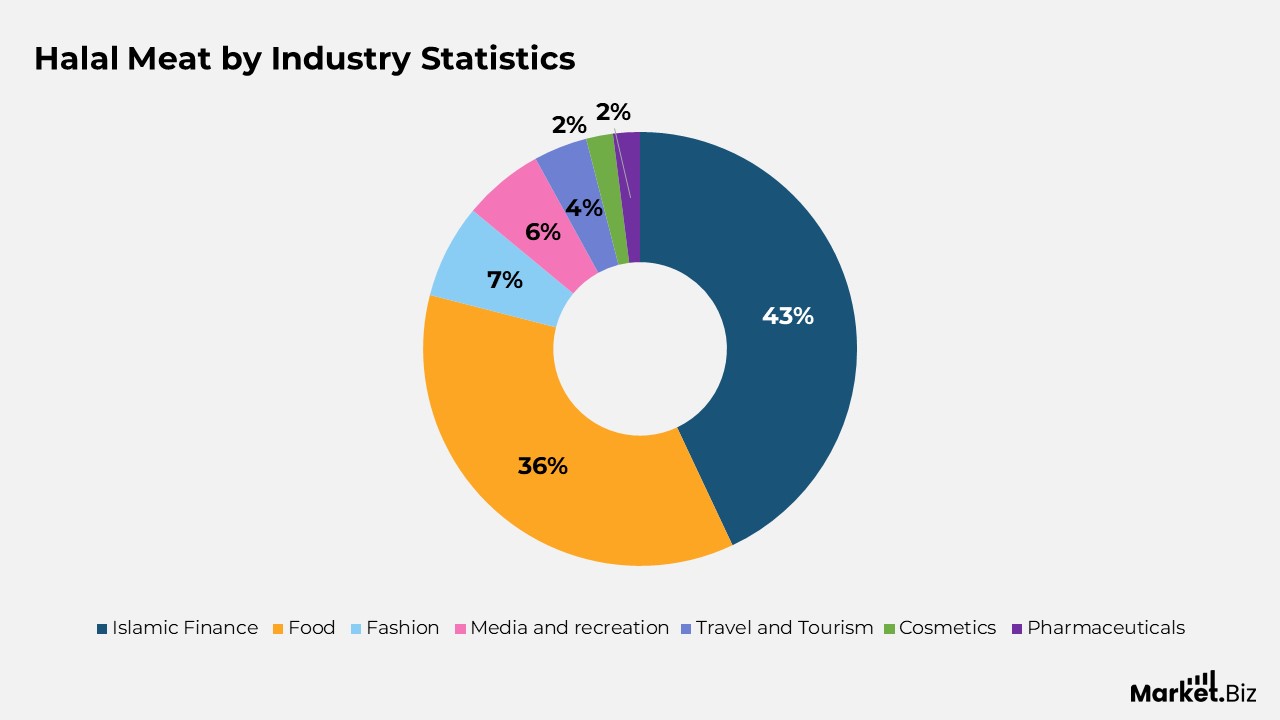
Statistics of Halal Meat by Industry
- Islamic Finance leads the Halal market with a commanding 43% share.
- This sector is dedicated to financial products and services that comply with Islamic principles, successfully attracting a significant portion of the Halal-conscious consumer demographic.
- The Food industry closely monitors trends, representing 36% of the market, as consumers increasingly prioritise beverages and Halal-compliant food.
- The Fashion sector captures a 7% share, indicating the rising demand for Halal-compliant and modest clothing options.
- Recreation and media account for 6%, emphasising the importance of Halal-friendly entertainment and leisure activities.
- Tourism and Travel make up 4%, as travellers seek experiences that align with their Halal requirements.
- Lastly, both Cosmetics and Pharmaceuticals each hold a 2% share, underscoring the significance of Halal-certified products in the healthcare and beauty industries.
Halal Meat Exporting Nations Statistics
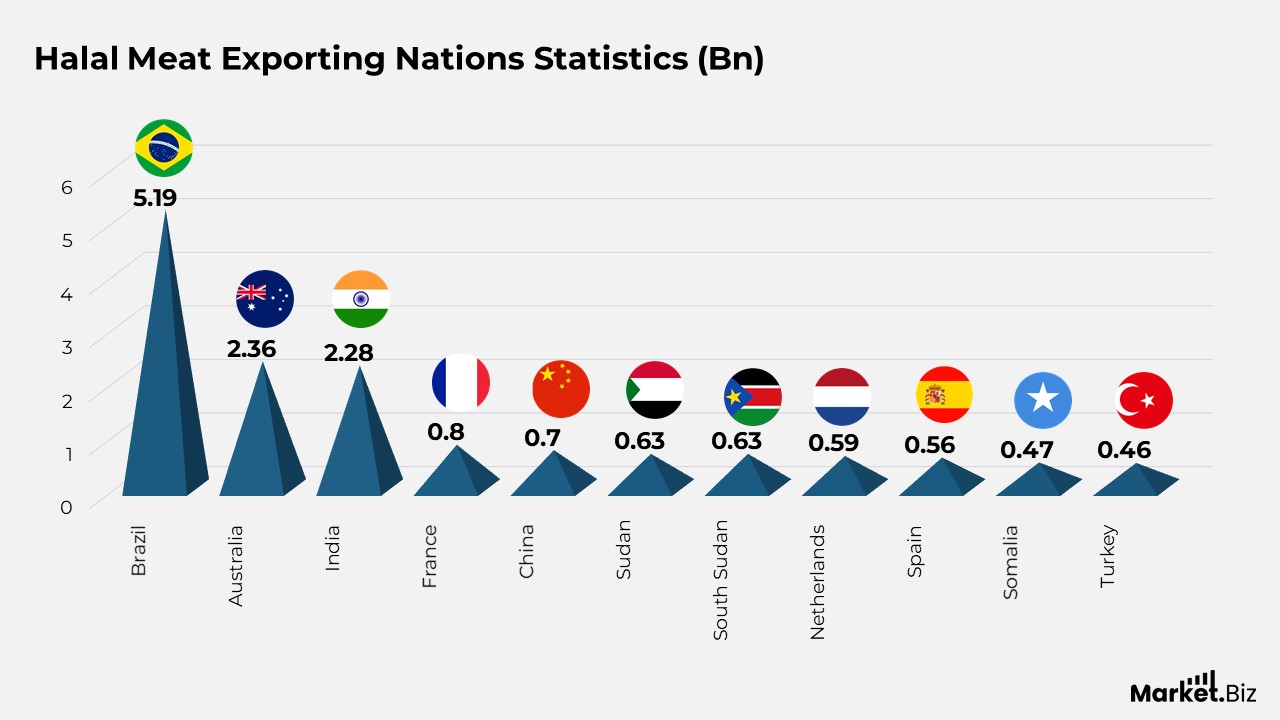
- Brazil is recognised as the foremost exporter of halal meat globally, with a significant trade value of $5.19 billion.
- Following closely, Australia holds the second rank with exports amounting to $2.36 billion. Meanwhile, India occupies the third position with $2.28 billion.
- Additional players in the international halal meat export market include France at $0.8 billion, China at $0.7 billion, South Sudan and Sudan together at $0.63 billion, the Netherlands at $0.59 billion, Somalia at $0.47 billion, Spain at $0.56 billion, and Turkey at $0.46 billion.
Halal Meat Importing Nations Statistics
- According to Volza’s Import data, the worldwide import of Halal meat amounted to a total of 215,000 shipments.
- These shipments originated from 722 distinct suppliers and were received by 6,705 importers across the globe.
- This indicates the primary sources from which the world imports its Halal meat.
- Vietnam emerged as the leading importer of Halal meat, accounting for a significant 70,738 shipments.
- Malaysia followed in second place with 23,133 shipments, while the United Arab Emirates secured the third position with 19,691 shipments.
Statistics of Halal Consumer Spending
- A global survey conducted by Frost & Sullivan in 2016 indicated that Halal consumers around the world collectively spent an impressive $2 trillion, which included expenditures on beverages, food, and various lifestyle elements.
- This trend suggests that the impact of the Halal industry extends beyond just food products, branching out into areas such as pharmaceuticals, tourism, cosmetics, and more.
- As consumer demand continues to grow, the Halal market is becoming increasingly diverse, encompassing a range of industries including toiletries, healthcare, and logistics, among others.
- For example, in 2016, the tourism sector alone witnessed Halal consumers spending $169 billion. Projections indicated that this amount would rise to $283 billion by 2022.
Halal Meat Consumer Spending by Category Statistics
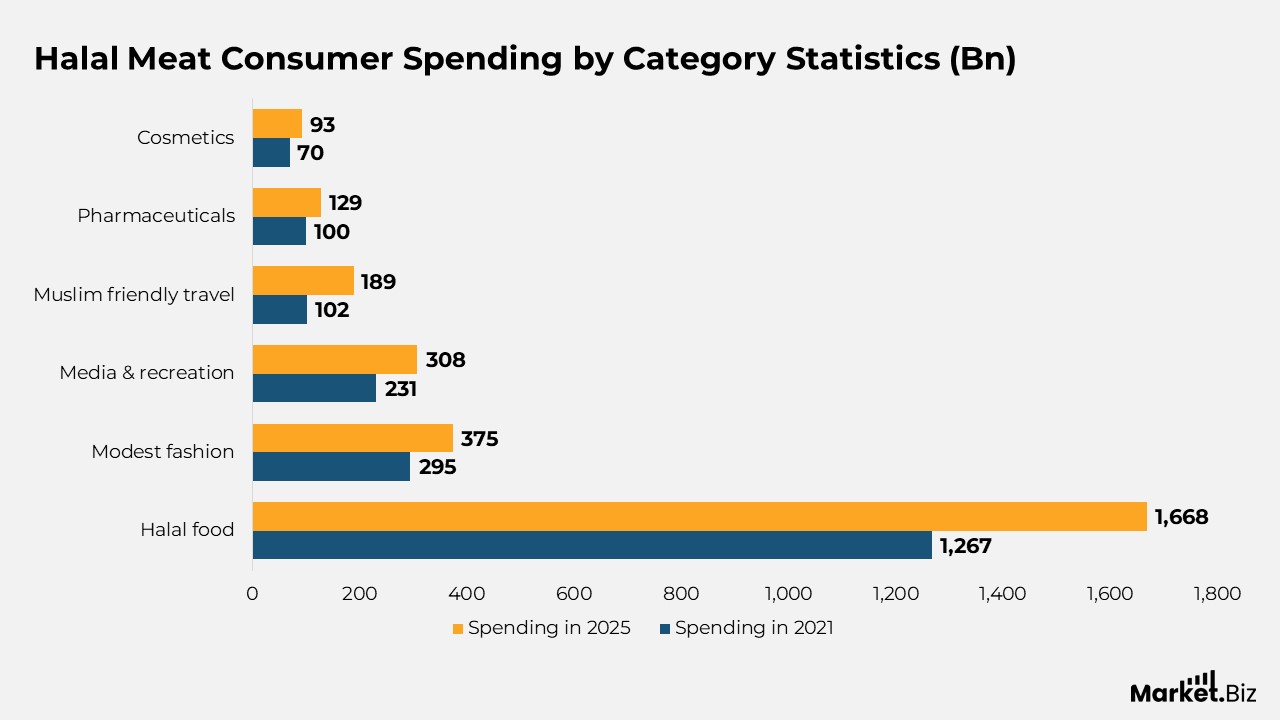
- In 2021, the overall value of global consumer expenditure in the Halal market across different sectors was considerable, with Halal Food at the forefront, amounting to $1,267 billion (equivalent to $1.267 trillion).
- This was succeeded by Recreation & Media at $231 billion, Pharmaceuticals at $100 billion, Muslim-friendly travel at $102 billion, Modest Fashion at $295 billion, and Cosmetics at $70 billion.
- The Halal market included a wide array of industries, underscoring the importance of Halal principles in the lives of consumers.
- Looking forward to 2025, projections suggest a significant increase in Halal consumer spending across these sectors.
- The Halal Food sector is forecasted to attain a value of $1,668 billion, indicating sustained growth in this essential category.
- The Modest Fashion market is projected to expand to $375 billion, highlighting the rising demand for modest apparel options.
- The Media & Recreation industry is anticipated to grow to $308 billion, emphasising the significance of Halal-compliant entertainment and leisure pursuits.
- Muslim-friendly travel is expected to rise to $189 billion, reflecting the increasing interest in travel experiences that conform to Halal standards.
- The Pharmaceuticals sector is predicted to reach $129 billion, while the Cosmetics industry is expected to increase to $93 billion.
Recent Statistics
- Tyson Foods is recognised as one of the largest meat producers in the world. It has completed the acquisition of Amigos Meat, a prominent supplier of halal-certified meats.
- Midamar Corporation, a well-known supplier of halal meats, has obtained $20 million in funding to facilitate its expansion efforts and improve its production capabilities.
- There are numerous opportunities available in catering to the increasing Muslim population, which is expected to reach 2.2 billion by 2030, thereby driving the global demand for halal-certified products.
Halal Meat Future Predictions
- The sector is anticipated to expand at a Compound Annual Growth Rate (CAGR) ranging from 5.12% to 7.6% over the forthcoming five years, propelled by a rise in consumer awareness regarding halal standards.
- The escalating demand from a varied consumer demographic, with the US market expected to exceed $20 billion by 2026, is influenced by perceptions surrounding health and safety.
Conclusion
In summary, Halal meat is of great significance in Islamic dietary practices, regulated by strict religious guidelines. It has seen considerable growth and diversification, extending into various sectors. The global Halal meat market is experiencing an upward trend, generating significant revenues and establishing its presence in both the food service and domestic markets.
Maintaining Halal standards, which encompass ethical sourcing and humane slaughtering methods, is crucial for preserving the trust of consumers who are mindful of Halal principles.
The authenticity of products is ensured through Halal certification, which is overseen by certification organisations in many countries. Ultimately, the Halal meat industry reflects a vibrant, growing market, driven by consumers seeking products that resonate with their religious and cultural beliefs.
FAQs
Islam represents a diverse tapestry rather than a singular entity—Muslim individuals originate from various parts of the globe, each with distinct culinary traditions and dietary habits. In the United States, 83% of Muslims adhere to a Halal diet. At FamilyWorks, one of our core principles is to develop programs that incorporate the insights and leadership of the communities we support.
Muslims primarily consume halal food to fulfill Allah’s directives as stated in the Quran, which reflects their faith and spiritual bond. Additionally, this choice aligns with ethical standards regarding animal welfare, advocating for humane slaughter practices and ensuring that the food is clean and nourishing for both the body and spirit.
Typically, animals such as cattle, sheep, goats, and poultry are classified as Halal. Nonetheless, specific regulations may differ based on geographical location and individual interpretation.