









Introduction
Intelligent Virtual Assistant statistics provide a data-driven overview of how conversational AI technologies are being adopted, deployed, and utilized across consumer and enterprise environments. Reflecting their growing role in customer service, sales, HR, IT support, healthcare, and personal productivity.
These statistics capture key indicators such as adoption rates, usage intensity, industry penetration, and regional diffusion. Helping measure how advances in natural language processing, machine learning, and cloud computing translate into real-world business and user outcomes. From an analytical standpoint, they reveal the transition of virtual assistants from experimental tools to embedded operational assets. While also highlighting gaps between adoption and intensive daily use.
Overall, Intelligent Virtual Assistant statistics serve as a critical reference for understanding market maturity, operational impact, and future growth trajectories within the conversational AI landscape.
Editor’s Choice
- A 2024 industry assessment indicates that Apple Inc. holds a leading position in the intelligent virtual assistant landscape, with an 18% market share, closely followed by 24/7 Customer Inc. at 17%. Reflecting strong competition among top providers.
- North America is the largest regional market for intelligent virtual assistants, accounting for 42.5% of global adoption. Driven by high enterprise digitisation and consumer technology adoption.
- Google Assistant recorded the highest usage penetration in 2024, capturing 39% of total usage share. Demonstrating its widespread integration across devices and platforms.
- Users aged 30-39 make up the largest demographic segment. Accounting for approximately 32% of the overall intelligent virtual assistant user base.
- Time-efficiency gains remain moderate for many users. As nearly 50% report saving fewer than 5 hours per week through intelligent virtual assistant use.
- The global chatbot market is experiencing strong expansion, projected to reach USD 9.30 billion by 2025 and scale further to USD 27.07 billion by 2030, driven by enterprise automation demand.
- The smart speakers market continues to expand rapidly, anticipated to grow from USD 14.56 billion in 2024 to USD 19.14 billion by 2025, supported by rising household adoption.
- Amazon’s Alexa is widely perceived as the most advanced intelligent virtual assistant. With 44% of respondents recognized it for superior intelligence and functionality.
Company Size Segmentation of Intelligent Virtual Assistant Participants
- Large enterprises with more than 2,501 employees represent the largest participant group, accounting for 45.9% of total respondents. Highlighting stronger adoption among large-scale organizations.
- Small organisations with fewer than 250 employees account for 32.5% of participants. Indicating significant penetration of intelligent virtual assistants among smaller businesses.
- Midsize companies with 251-2,500 employees account for 21.7% of the participant base, reflecting moderate adoption in the mid-tier.
(Sources: Metrigy Research Corp, Statista)
Current Adoption Status of Intelligent Virtual Assistants
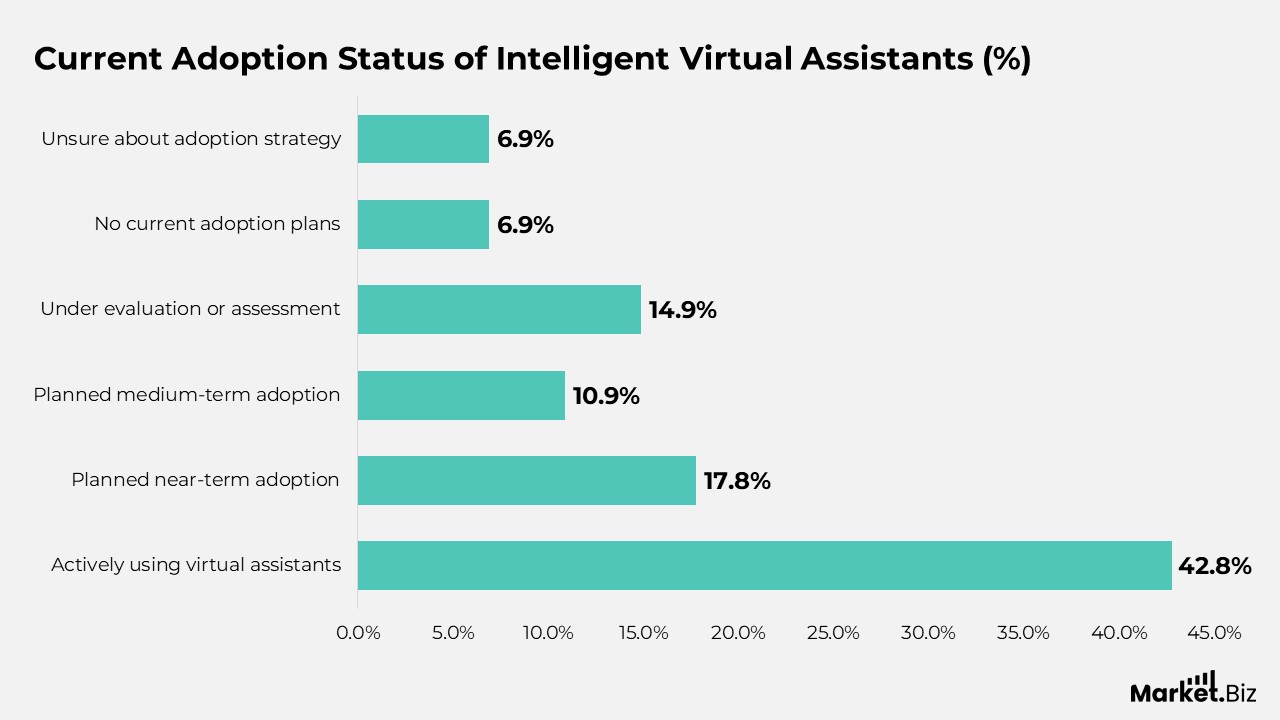
- Active usage leads the adoption landscape, with 42.8% of organizations already using virtual assistant technologies in their operations, indicating strong early integration.
- Planned near-term adoption remains significant, as 17.8% of respondents report implementation plans aligned with the next deployment cycle.
- Medium-term planning accounts for 10.9% of organizations, reflecting cautious but structured adoption roadmaps.
- Evaluation-stage adoption stands at 14.9%, indicating a sizable share of organisations assessing feasibility, ROI, and integration readiness.
- A smaller segment, representing 6.9%, indicates no current plans to adopt virtual assistant solutions. Highlighting ongoing resistance or low-priority use cases.
- Uncertainty persists among 6.9% of respondents, suggesting gaps in internal alignment or clarity around virtual assistant deployment strategies.
(Sources: Metrigy Research Corp, Statista)
Virtual Assistant Availability by Core Meeting Provider
- Organisations using Cisco Webex or Meeting Server show the strongest reliance on built-in virtual assistant capabilities. With 84.6% using native features and only 7.7% relying on third-party applications.
- Microsoft Teams users also demonstrate high adoption of integrated virtual assistants. With 75.0% relying on built-in functionality and 25.0% supplementing capabilities with third-party solutions.
- Zoom users display a more mixed approach, with 40.0% using built-in assistant features and an equal 40.0% depending on third-party virtual assistant applications.
- Alternative or non-mainstream meeting platforms account for a limited share: 7.7% report using other solutions, and 0.0% indicate third-party or built-in assistants.
- Uncertainty is most visible among Zoom users, where 20.0% report being unsure about the source of their virtual assistant capabilities. Suggesting lower visibility into platform-level integrations.
(Sources: Metrigy Research Corp, Statista)
Organizational Investment Priorities for Intelligent Virtual Assistants
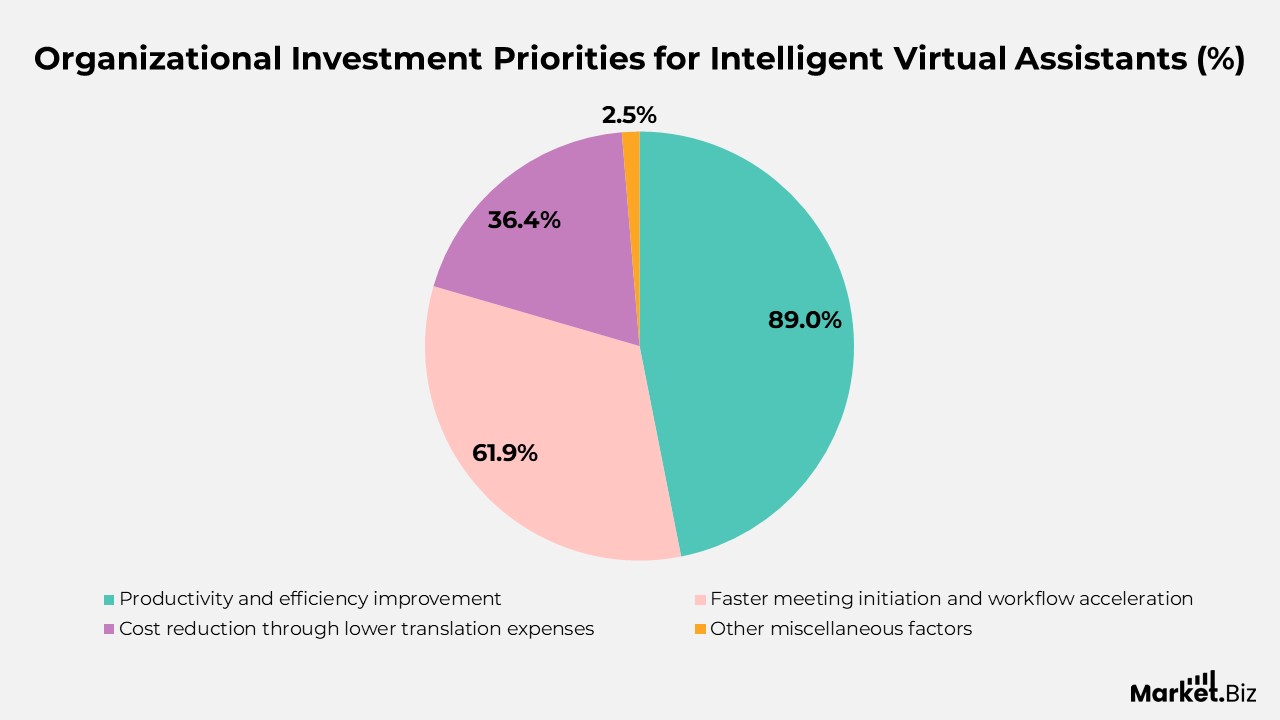
- Productivity improvement emerges as the dominant investment driver. With 89.0% of organizations cited efficiency gains as the primary reason for adopting virtual assistant technologies.
- Faster meeting initiation ranks second among the most influential factors, reported by 61.9% of respondents. Underscoring the value placed on time savings and workflow acceleration.
- Cost optimisation through reduced translation expenses motivates 36.4% of organisations, underscoring the growing importance of multilingual support in global operations.
- Other miscellaneous factors play a limited role in investment decisions. Accounting for only 2.5% of responses, indicating a highly concentrated set of core value drivers.
(Sources: Metrigy Research Corp, Statista)
Importance Ranking of Security Features in Virtual Assistant Deployment
- End-to-end encryption ranks as the most critical security requirement, with an importance score of 3.3. Reflecting a strong enterprise focus on protecting meeting data from unauthorised access.
- Digital rights management controls for transcripts are also prioritised, with a score of 3.3, highlighting concerns about content ownership, access control, and misuse prevention.
- Centralised storage in a single repository for all meeting content has an importance rating of 3.0. Indicating demand for simplified governance and secure content management.
- Restrictions on external content sharing for translation purposes also score 3.0. Underscoring the organisation’s sensitivity to data exposure during language processing activities.
(Sources: Metrigy Research Corp, Statista)
Outsourcing Trends and Workforce Shifts Supporting IVA Adoption
- Cost optimisation remains the primary driver of outsourcing. With around 59% of businesses cite expense reduction as the leading reason for outsourcing.
- Intelligent Virtual Assistants offer substantial financial impact, with operating cost reductions reaching up to 78%, making them a strategic alternative to traditional in-house staffing.
- Workforce quality among IVAs remains high, with 30.9% holding business degrees, many of whom transitioned from administrative roles, and 91% of U.S.-based IVAs possessing a college-level education.
- Smaller enterprises are adopting intelligent virtual assistants to support flexible, distributed work environments. increasingly depend on outsourcing to improve operational efficiency, with 24% doing so to enhance productivity and approximately 37% outsourcing at least one core business function.
- Structural changes in employment models continue to accelerate, with projections indicating that nearly 50% of the U.S. workforce may operate virtually by 2028.
- Forward-looking workforce strategies are evident, as nearly 80% of organizations report active plans to adopt.
(Sources: Metrigy Research Corp, Statista)
Financial Advantages and Demographic Trends in the Virtual Assistant Workforce
- Employing full-time virtual assistants delivers measurable cost advantages, with US-based employers saving more than USD 11,000 per year compared to traditional in-house staffing models.
- Organisations adopting virtual assistants report significant cost savings, with operational costs declining by up to 78%, reinforcing their value as a lean workforce alternative.
- The virtual assistant industry continues to scale rapidly, with the global market projected to reach USD 25.63 billion by 2026, supported by rising enterprise outsourcing and remote work adoption.
- Expense-reduction outcomes are widely reported, with 50% of businesses confirming that chatbots and virtual assistants have directly contributed to lower operating costs.
- Strong growth momentum persists across the sector, with the worldwide virtual assistant market projected to expand at an annual rate of 30% through 2026.
- The freelance ecosystem supporting virtual assistants is extensive, with approximately 12 million freelancers on Upwork, 20 million on Freelancer, and 3 million on Fiverr, while the number of individuals identifying specifically as virtual assistants is estimated at around 25,000.
- Cost efficiency remains a defining advantage, as virtual assistants are reported to be 78% more cost-effective than full-time, on-site employees.
(Sources: Metrigy Research Corp, Statista)
Virtual Assistant Demographics
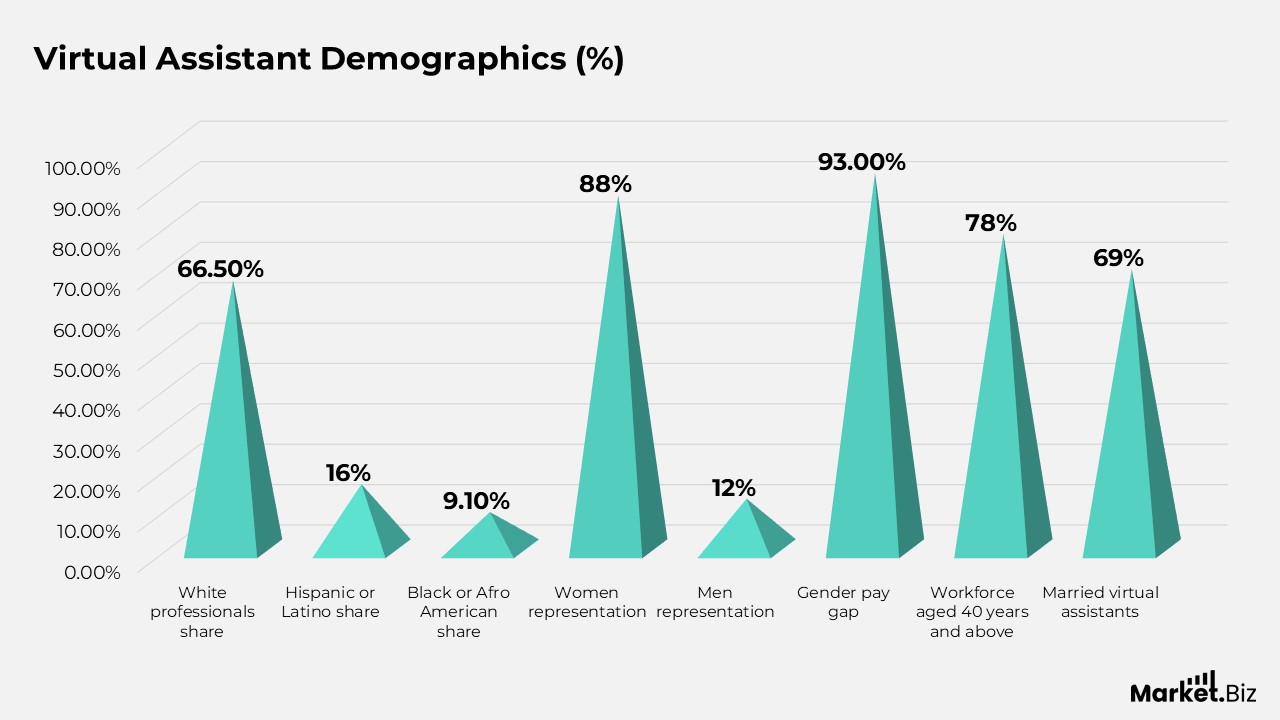
- White professionals constitute the largest share of the virtual assistant workforce, accounting for 66.5% of the total population.
- Diversity within the profession continues to expand, with 16% identifying as Hispanic or Latino and 9.1% identifying as Black or African American.
- Gender representation remains heavily skewed, as women comprise 87.6% of virtual assistants, while men account for 12.4%.
- A measurable gender pay gap persists in the profession, with women earning approximately 93 cents per dollar compared to their male counterparts.
- Income levels vary by ethnicity, with Asian virtual assistants reporting the highest average earnings, while White virtual assistants record the lowest average annual income at USD 43,074.
- The age distribution indicates a mature workforce, with individuals aged 40 and above accounting for 78% of the virtual assistant population.
- Personal demographics indicate stability within the profession, with 69.3% of virtual assistants reporting being married.
(Sources: Metrigy Research Corp, Statista)
Latest Virtual Assistant Salary and Earnings Statistics
- The average annual compensation for a virtual assistant in the US stands at approximately USD 39,915, reflecting steady earning potential in remote support roles.
- In 2024, virtual assistants earn an average hourly wage of around USD 19.19, positioning the role competitively within the remote workforce.
- Entry-level virtual assistants typically receive an annual salary close to USD 29,000, highlighting accessible entry points into the profession.
- Hourly billing rates for virtual assistants in the US commonly range between USD 13 and USD 25, depending on skill set and experience.
- The highest average virtual assistant salaries are recorded in Hawaii (USD 53,760), Washington (USD 53,236), and Alaska (USD 52,452).
- Among major employers, IBM offers the highest virtual assistant salaries.
- Virtual assistants earn comparatively higher wages in the US than in most global markets.
- Compensation models remain predominantly hourly, with 87.7% of virtual assistants paid on an hourly basis.
- Freelance engagement is widespread, with 68% of virtual assistants working with multiple clients or managing several contracts simultaneously.
(Sources: Insidea, Statista)
Latest Virtual Assistant Career and Education Statistics
- Data entry emerges as the most common technical skill, appearing on 9.3% of virtual assistant resumes.
- Customer service ranks second among hard skills, appearing on 7.8% of resumes.
- Email management is closely followed, featured on 7.6% of virtual assistant profiles.
- Interpersonal, organisational, and writing skills are the most common soft skills across the profession.
- The average virtual assistant resume contains approximately 412 words, indicating concise, role-focused documentation.
- Resume length typically averages 0.9 pages, based on a standard of 450 words per page.
- Educational attainment remains strong, with 54% holding a bachelor’s degree, followed by 22% with associate degrees and 9% with high school diplomas.
- Moreover, the Philippines and India serve as major virtual assistant sourcing hubs, offering cost-effective plans starting at around USD 400 per month.
- US-based expert virtual assistants earn monthly incomes exceeding USD 4,000, reflecting premium demand for specialized skills.
- Trust and reliability remain key hiring challenges, cited by 41% of users.
- Employment structures lean toward stability, with 59% of virtual assistants working full-time.
- Nearly 45% of virtual assistants hold a bachelor’s degree, reinforcing the profession’s skilled workforce profile.
(Sources: Insidea, Statista)
Latest Virtual Assistant Productivity and Work Impact Statistics
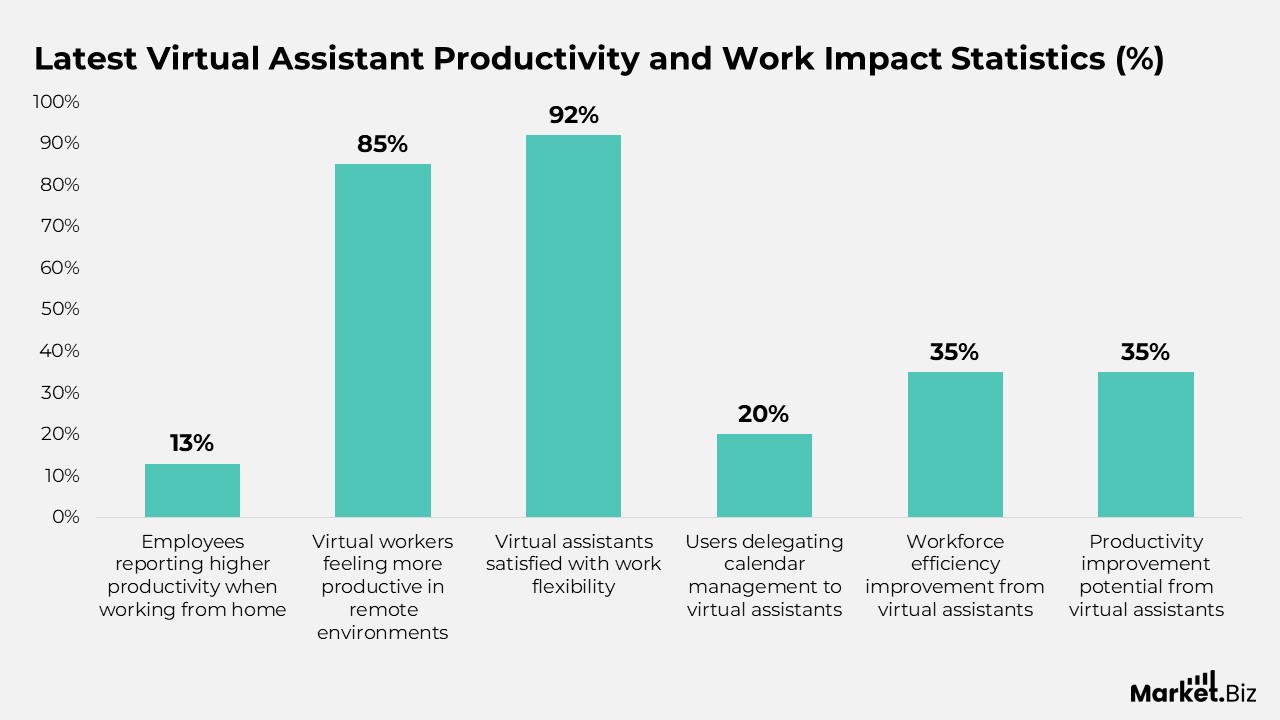
- Productivity gains from remote work remain evident, as 13% of employees report improved output when working from home.
- Perceived productivity is significantly higher among virtual workers, with 85% reporting greater productivity in remote environments.
- Despite flexible schedules, most virtual assistants work approximately 20 hours per week.
- Work flexibility satisfaction remains extremely high, with 92% of virtual assistants strongly approving of their working arrangements.
- Companies save an average of 22 minutes per day by leveraging virtual assistant support for routine tasks.
- Calendar management represents a common delegated function, assigned by over 20% of virtual assistant users.
- Workforce efficiency improvements linked to virtual assistants reach up to 35%, highlighting their role in operational optimization.
- Overall productivity enhancement potential from virtual assistants is estimated at up to 35%, reinforcing their value in modern workforce strategies.
(Sources: Insidea, Statista)
Conclusion
The statistics on intelligent virtual assistants clearly indicate a market that has progressed from early experimentation to widespread operational integration across enterprises and consumer environments. Strong adoption among large organizations, rising penetration in small and midsize businesses, and the dominant contribution of North America underscore the strategic relevance of virtual assistants in modern digital workflows.
The data consistently points to tangible benefits, particularly in productivity enhancement, operating cost reduction, and process efficiency, positioning intelligent virtual assistants as a core component of digital operations rather than a supplementary tool. In parallel, workforce and demographic insights reveal a well-established, highly educated, and predominantly remote talent pool underpinning the virtual assistant ecosystem.
The shift toward virtual work models, combined with significant cost advantages over traditional employment structures, further reinforces long-term adoption momentum. At the same time, the statistics highlight remaining challenges, including uneven depth of usage, security considerations, and governance requirements, which organizations continue to address as implementations mature.
Taken together, the findings reflect a market on a strong growth trajectory, supported by economic value, technological advancement, and evolving work practices. As capabilities expand and trust in AI-driven systems deepens, intelligent virtual assistants are expected to assume an increasingly integral role in scalable, flexible, and efficient digital business models.
FAQ’s
Intelligent virtual assistant statistics show strong, expanding adoption across enterprises and consumers, with large organisations leading deployments and small and midsize businesses rapidly increasing usage. The data reflects a shift from experimental use to operational integration across multiple business functions.
North America accounts for the highest share of intelligent virtual assistant adoption, driven by advanced digital infrastructure, early enterprise AI adoption, and the strong presence of leading technology providers.
Usage statistics indicate that Google Assistant holds the highest usage share, reflecting its deep integration across smartphones, smart devices, and everyday digital services.
The statistics highlight productivity improvement, cost reduction, faster task execution, and workforce flexibility as the primary benefits. Many organisations report significant operating cost savings and improved efficiency through the deployment of assistants.
Data shows that intelligent virtual assistants can reduce operational expenses by up to 78%, while employers may save thousands of dollars annually compared to traditional full-time, on-site staffing models.

