









Introduction
Lingerie Statistics: The lingerie market in modern times exceeds mere undergarments; it represents a multifaceted, global industry influenced by changing consumer preferences, the growth of product categories (including bras, panties, shapewear, and loungewear), the rise of digital retail, a focus on inclusivity, and shifts in lifestyle.
Recent statistics indicate that the market includes tens of billions of US dollars worldwide; however, the underlying structure, including product shares, distribution channels, regional adoption, and demographic segmentation, unveils the true commercial and cultural dynamics.
In this article, we provide an overview of the global lingerie market for the years 2020–2025, highlighting key segment shares, distribution channels, demographics, and emerging trends. Our objective is to show not only the market’s size but also its composition and ongoing evolution.
Editor’s Choice
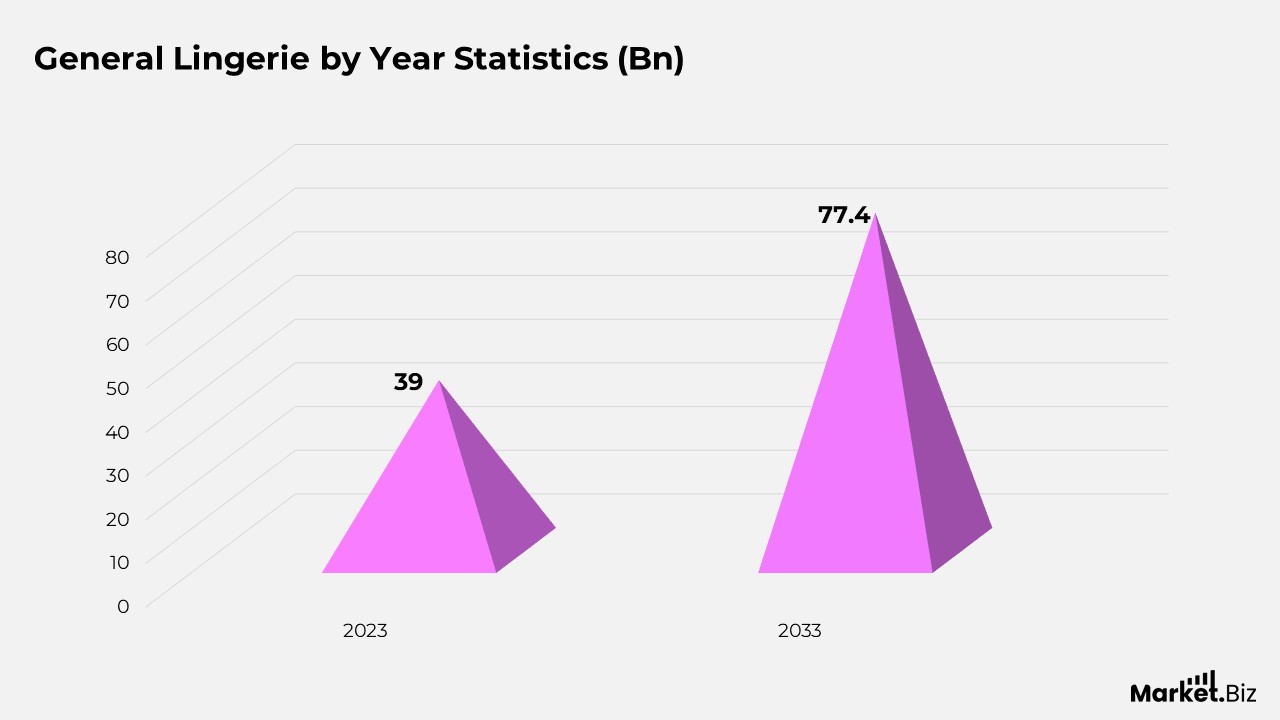
- The Lingerie Market was assessed at USD 39 billion in 2023 and is anticipated to attain USD 77.4 billion by 2033, reflecting a CAGR of 7.1%.
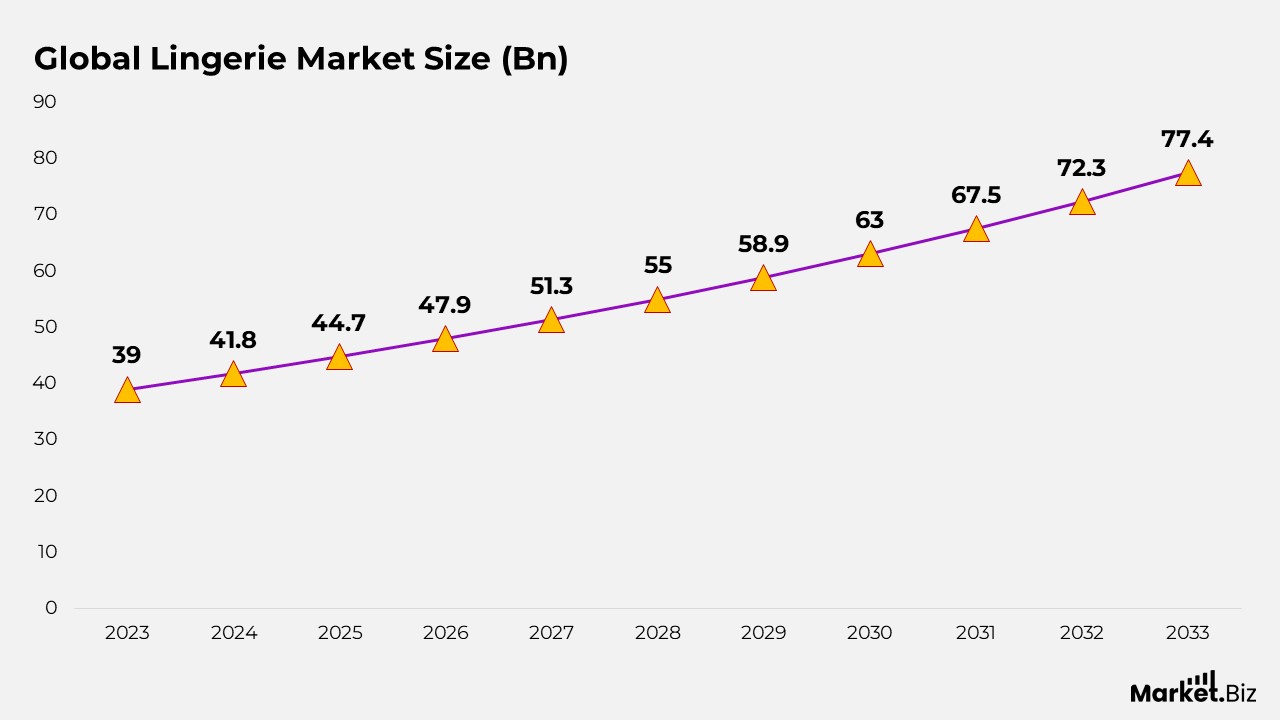
- In 2025, the global lingerie market is valued at USD 44.7 billion.
- In the comprehensive market analysis, offline (brick-and-mortar) retail represented 60.98% of total sales in 2024.
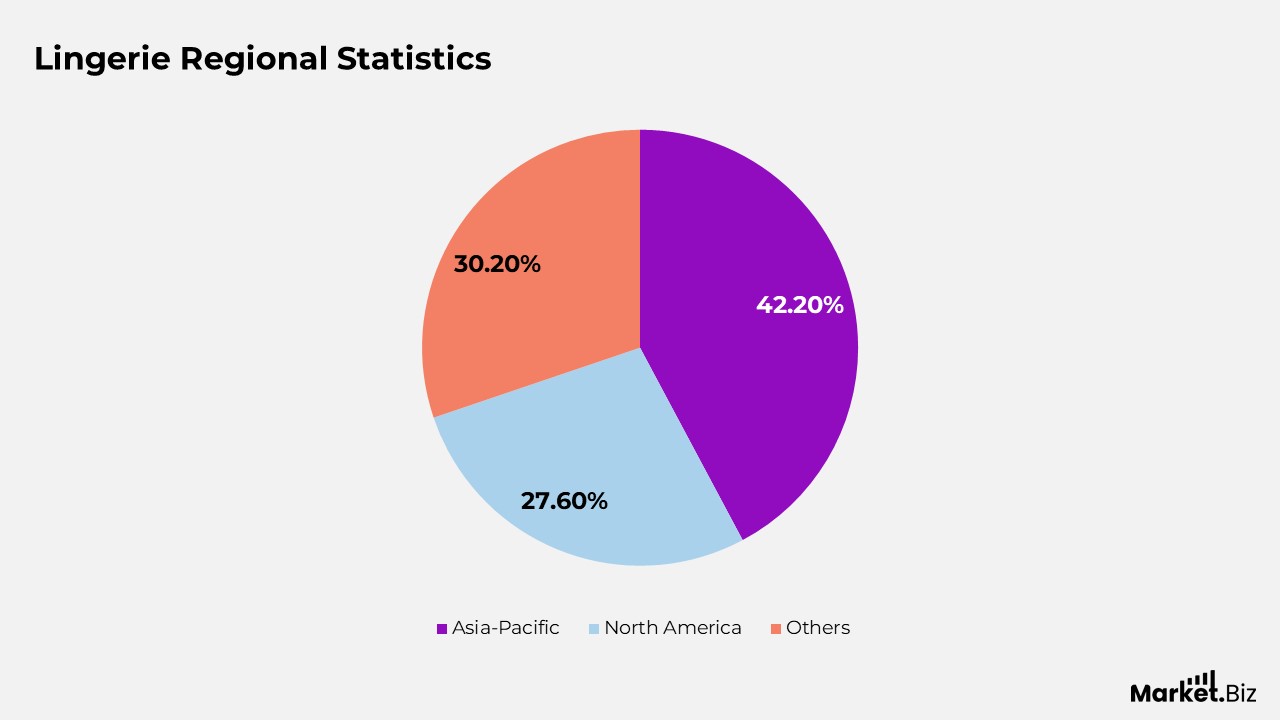
- According to a significant report, the Asia-Pacific (APAC) region represented 42.20% of the global lingerie market in 2024, establishing it as the largest regional market.
General Lingerie Statistics
- The Lingerie Market was assessed at USD 39 billion in 2023 and is anticipated to attain USD 77.4 billion by 2033, reflecting a CAGR of 7.1%.
- In 2023, Briefs held the largest share of the type segment at 52.3%, propelled by comfort and a broad consumer preference.
- In 2023, Multi-Brand Stores emerged as the leading distribution channel with 62.%, capitalising on variety and consumer accessibility.
- In 2023, the Online Channel was expected to expand at a rate of 6.7%, driven by the growing adoption of digital retail.
- In 2023, the APAC region dominated with a 35% market share, amounting to USD 13.65 billion, underscoring strong regional demand.
Statistics of the Lingerie Market
- According to a detailed estimate, the global lingerie market was valued at USD 94.63 billion in 2024.
- According to Market.us, which has a narrower product scope, places the 2024 value at USD 41.8 billion.
- In 2025, the global lingerie market is valued at USD 44.7 billion.
- The significant disparity between these two figures highlights differing definitions; some reports consider only essential intimates, while others encompass shapewear, loungewear, and related categories.
- A mid-range estimate from a different analytics firm suggests that the size for 2024 is approximately USD 90.0 billion.
- The variation among sources emphasises an important methodological consideration: the inclusivity of definitions, whether one is referring to just core bras and panties or the entire intimate apparel range.
- For business planning, many brands regard the lower-end estimate as the ‘core market’ and the higher-end estimate as the ‘total available market (TAM).’
Lingerie Market by Product Type Statistics
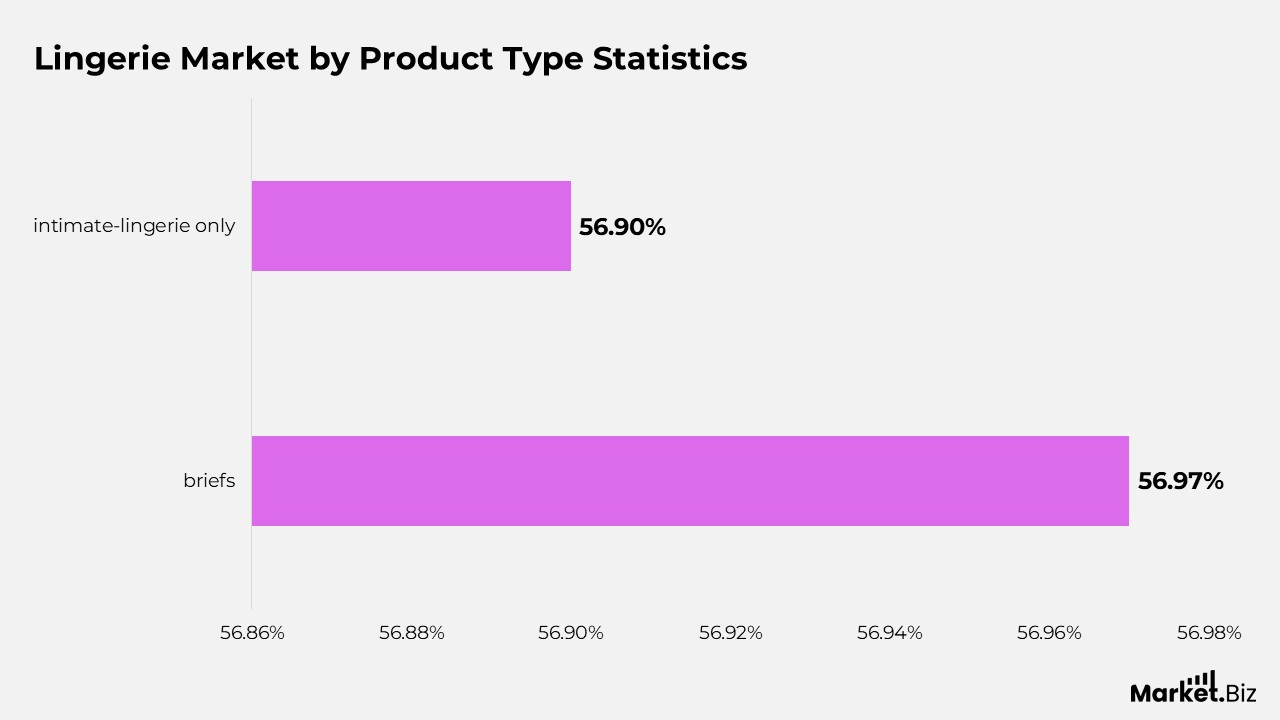
- In a comprehensive analysis, “briefs” (underwear/panties) accounted for 56.97% of global lingerie revenue in 2024, marking it as the largest individual product subsegment.
- In a more focused report on “intimate-lingerie only” for 2023, briefs similarly dominated with a 56.9% market share.
- This indicates a robust and consistent global preference for basic underwear over items driven more by fashion or functionality.
- At the same time, other product categories (bras, shapewear, and “others”) constitute the remaining 43–44%, showcasing some variety while clearly highlighting the predominance of essentials.
- Industry insights point to a transition towards comfort-oriented, wire-free, and seamless underwear, such as bralettes and everyday basics, particularly in the post-pandemic landscape where consumers increasingly prioritise comfort and practicality.
- The movement towards inclusive sizing and more accommodating fits is also broadening the product range, prompting brands to provide larger size options beyond the conventional “SML.”
Lingerie Distribution & Consumer Behaviour
- In the comprehensive market analysis, offline (brick-and-mortar) retail represented 60.98% of total sales in 2024.
- Nevertheless, online/e-commerce is expanding at a quicker pace than offline, with many brands relying on robust online growth attributed to convenience, privacy, and a wider selection of sizes and colours.
- In 2023, the more specific “intimate lingerie” category, offline, still maintained a dominant share: 61.6%.
- Speciality stores, aka physical locations dedicated to foundation garments, secured 58.4% of shapewear revenue in 2024.
- Consumer motivations vary by channel: offline is still favoured for fitting and tactile experiences (particularly for bras and shapewear), while online provides privacy, a wider array of options, and convenient delivery.
- Brands are increasingly implementing omnichannel strategies, integrating online, speciality-store, and department-store presences, to attract various buyer segments.
Regional Statistics
- According to a significant report, the Asia-Pacific (APAC) region represented 42.20% of the global lingerie market in 2024, establishing it as the largest regional market.
- Another source estimates APAC’s share at 32.35% for 2024 based on a more restricted market definition, yet it still underscores its leading position.
- The elevated share in APAC is attributed to a substantial female population, increasing disposable incomes, urbanization, and the rapid expansion of e-commerce, particularly in nations such as India and China.
- In the 2023 report on “intimate lingerie,” North America held a 27.6% share, indicating a steady demand in developed markets for traditional intimates.
- Additionally, there is a notable consumer demographic trend: numerous reports indicate that the largest purchasing group consists of individuals aged 25–44, typically working professionals who seek a balance between comfort and style.
- Emerging markets in APAC, Latin America, and certain regions of the Middle East are becoming increasingly significant. The growth in these areas is fueled by first-time underwear purchasers, a rising awareness of fashion, and enhancements in retail infrastructure.
Lingerie Consumers’ Choice Statistics
- Basic underwear continues to represent the largest segment worldwide, probably because of its everyday necessity, cost-effectiveness, and straightforward production process.
- A rising number of consumers are now favoring comfort-oriented and seamless designs instead of structured or heavily fashionable items, a trend noted in various market studies.
- The availability of inclusive sizing is becoming more prevalent; brands that have broadened their size offerings have noted a greater engagement with demographics that were previously overlooked.
Shapewear Market Growth Statistics
- The global shapewear market was projected to reach USD 2.73 billion in 2024.
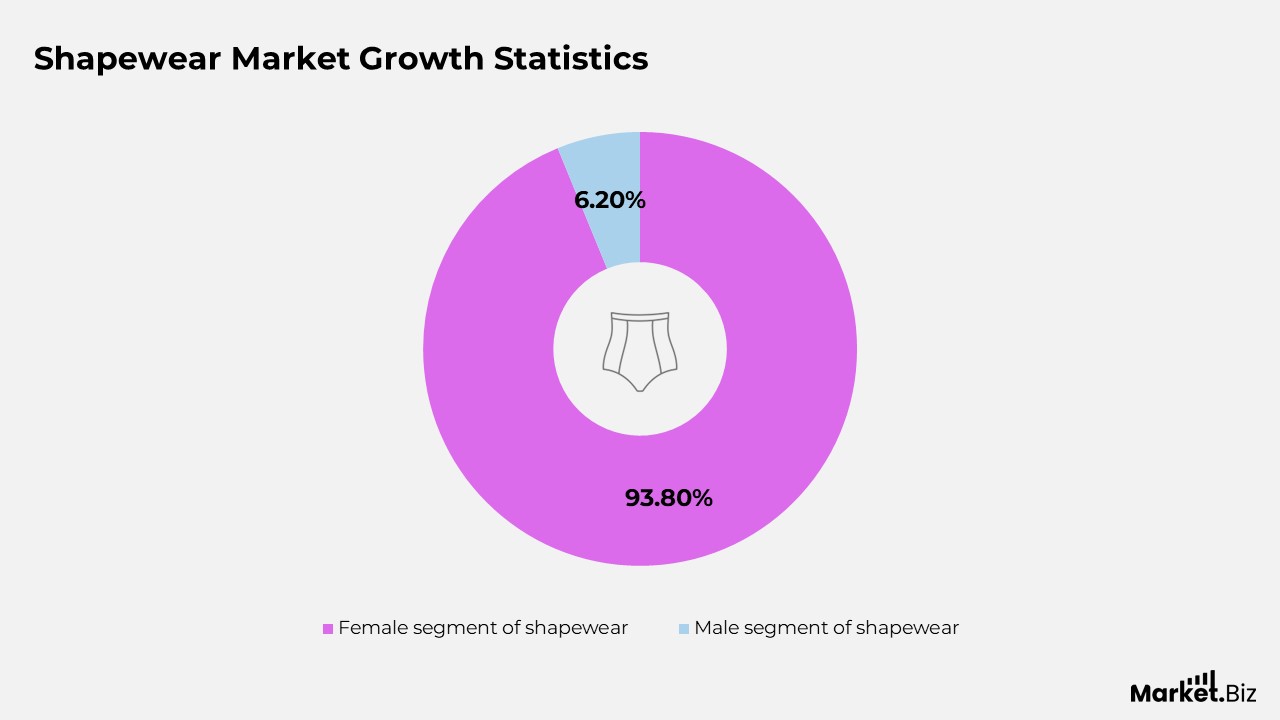
- In 2024, the female segment of shapewear constituted 93.8% of total sales, indicating that women continue to be the primary consumers of shapewear worldwide.
- Speciality stores emerged as the foremost distribution channel for shapewear in 2024, capturing a 58.4% market share, which highlights the significance of personal consultation and fitting for compression garments.
- In 2024, North America accounted for 38.6% of the global shapewear revenue, reflecting a robust regional foundation likely influenced by higher disposable incomes and a well-established retail infrastructure.
- Market analysis attributes the growth of shapewear to increasing body awareness, the impact of social media, and the blending of fashion with functionality. Consumers are progressively viewing shapewear as an integral part of their daily attire rather than solely for special events.
- Considering its relatively modest size in comparison to core intimate apparel, shapewear represents a high-growth, high-margin niche that is appealing to brands seeking to expand beyond basic offerings.
Lingerie Recent Development
- In February 2024, Bold & Bae Fashion, a startup located in Mumbai, unveiled a premium line of lingerie and casual wear, targeting contemporary women aged 14 to 44.
- In October 2024, Bali, the leading bra brand in America, launched the Bali Breathe collection, emphasising comfort and sophistication.
- In September 2024, Bravissimo, a lingerie brand from the UK that serves women with larger bust sizes, was purchased by Wacoal Europe.
Lingerie Future Prediction
- The estimated size of the lingerie market is projected to be USD 44.7 billion in 2025, with expectations to grow to USD 63 billion by 2030, reflecting a compound annual growth rate (CAGR) of 3.26% throughout the forecast period.
Conclusion
Lingerie Statistics: The global lingerie market is extensive yet diverse: depending on the definitions used, its size in 2024 is estimated to be between approximately USD 45 billion and nearly USD 90–95 billion.
Core underwear continues to be the largest segment in terms of volume; however, changes in consumer preferences, such as comfort, inclusivity, and functionality, are propelling growth in shapewear, wireless bras, and everyday intimates.
The distribution landscape is changing: offline retail remains essential for purchases that require a proper fit, while online sales are expanding rapidly, particularly in areas where e-commerce is becoming more prevalent. The Asia-Pacific region is notable for being the largest market, whereas North America serves as a stable foundation, resulting in a market that is both global and regionally varied.
For brands and retailers, achieving success increasingly relies on product diversity, size inclusivity, a multi-channel approach, and the ability to adapt to evolving consumer values regarding comfort, body positivity, and convenience.