









Introduction
Luxury Goods Statistics: Luxury items include premium, exclusive products such as fashion apparel, luxury vehicles, and fine wines, primarily targeting wealthy consumers who desire status and exceptional experiences.
This sector is significantly influenced by brand reputation, quality of craftsmanship, and a feeling of exclusivity, which are essential for attracting and keeping customers with substantial disposable income.
Distribution methods generally consist of proprietary boutiques, high-end retailers, and, increasingly, online sales channels. Challenges like economic volatility and changing consumer preferences towards sustainability are countered by opportunities in digital advancements and the growth of global markets. Grasping these dynamics is vital for successfully navigating the competitive environment and ensuring brand relevance in the changing luxury goods industry.
Editor’s Choice
- The global luxury goods market is anticipated to generate revenue of USD 418.89 billion by 2028.
- The global luxury goods market has exhibited a dynamic growth pattern and resilience over the past few years, achieving a CAGR of 3.22%.
- In 2018, the luxury eyewear market was valued at USD 19.0 billion.
- In 2018, the average revenue per capita was recorded at USD 38.87, which increased to USD 41.09 in 2019.
- In FY2020, the sector experienced a decline in the growth of luxury goods sales, registering a negative growth rate of -11%.
General Luxury Goods Statistics
- The global luxury goods market is anticipated to generate revenue of USD 418.89 billion by 2028.
- The projection for 2027 indicates that online sales will continue to increase, reaching 18.2%.
- Conversely, offline sales are expected to decline further to 81.8%, illustrating a persistent transition towards digital platforms within the luxury goods sector.
- The global luxury goods market is marked by the presence of numerous well-known brands, each possessing different market shares.
- Chanel leads the market with a 6% share.
- This market also shows considerable revenue contributions from various nations.
- The United States stands at the forefront with a notable revenue of USD 77,820 million.
- In 2022, the top luxury brands globally were valued at impressive amounts,
- Louis Vuitton, which hails from France, ranked first with a brand value of USD 124,273 million.
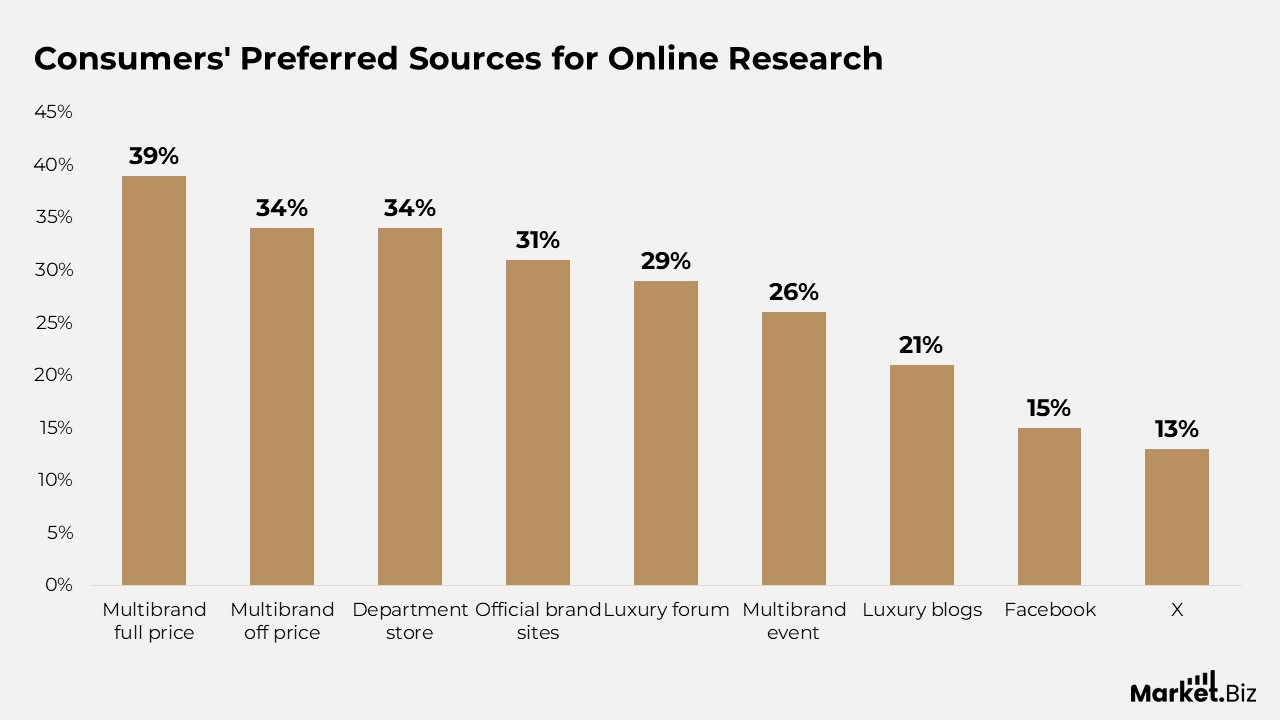
- When researching online prior to purchasing luxury goods, consumers show a preference for diverse sources.
- Multi-brand full-price websites are the most popular, with 39% of respondents stating they utilise these platforms for their research.
- In 2020, luxury brands in France encountered several major challenges, as noted by industry experts.
- The primary challenge was the dedication to corporate social responsibility (CSR), emphasised by 63% of respondents.
Market Size Statistics of Luxury Goods
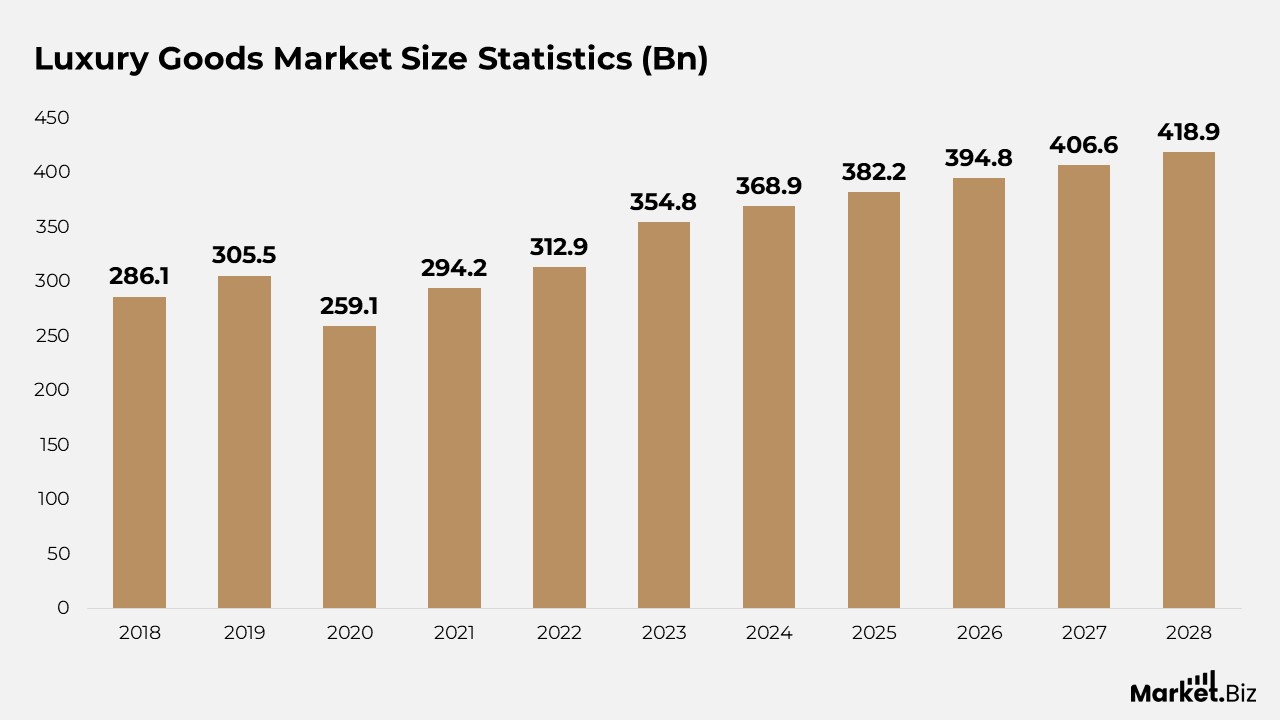
- The global luxury goods market has exhibited a dynamic growth pattern and resilience over the past few years, achieving a CAGR of 3.22%.
- In 2018, the market produced revenues amounting to USD 286.11 billion, which rose to USD 305.46 billion in 2019.
- Nevertheless, 2020 experienced a downturn to USD 259.14 billion, likely attributable to the effects of the COVID-19 pandemic.
- A recovery was observed in 2021, with revenues increasing to USD 294.24 billion.
- This positive trend continued into 2022, as the market reached USD 312.91 billion.
- The favourable trend extends into 2023, with projected revenues of USD 354.81 billion, and further growth is expected in the subsequent years.
- By 2024, the market is anticipated to generate USD 368.94 billion, rising to USD 382.20 billion in 2025.
- The market’s growth is projected to persist, with revenues expected to hit USD 394.75 billion in 2026, USD 406.55 billion in 2027, and USD 418.89 billion in 2028.
- This steady growth highlights the resilience and expanding consumer base for luxury goods on a global scale.
Luxury Goods Market Type Statistics
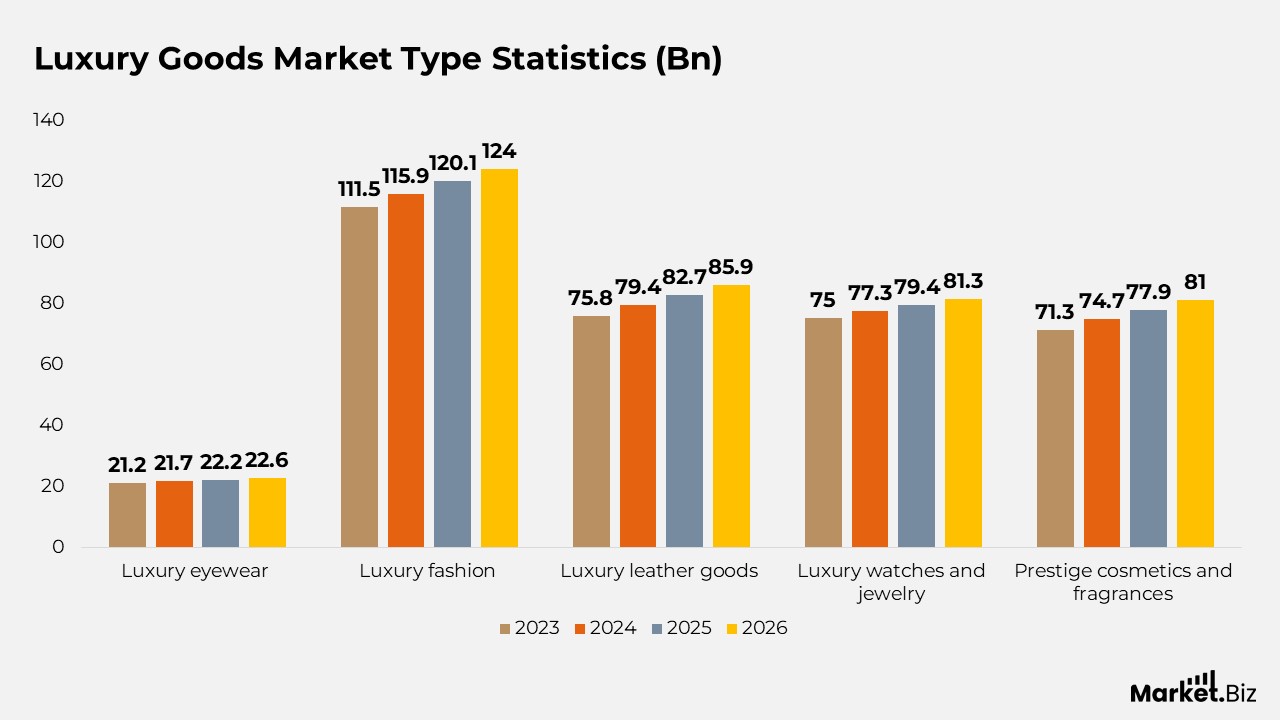
- In 2018, the luxury eyewear market was valued at USD 19.0 billion.
- Luxury fashion was valued at USD 90.58 billion, while leather goods reached USD 56.67 billion.
- The combined value of luxury jewellery and watches was USD 62.57 billion, and fragrances and prestige cosmetics amounted to USD 57.32 billion.
- By 2019, these values had risen to USD 19.6 billion, USD 95.82 billion, USD 62.15 billion, USD 66.82 billion, and USD 61.11 billion, respectively.
- It is noteworthy that in 2020, luxury eyewear declined to USD 15.6 billion, and luxury fashion decreased to USD 85.56 billion.
- Nevertheless, in 2021, with luxury eyewear increasing to USD 17.6 billion.
- Luxury leather goods touched USD 62.74 billion.
- In 2022, luxury fashion achieved a value of USD 97.33 billion, while prestige cosmetics and fragrances reached USD 62.39 billion.
- The trend experienced a significant acceleration in 2023.
- Luxury eyewear is valued at USD 21.2 billion.
- Luxury watches and jewellery at USD 74.97 billion.
- Forecasts for 2024 suggest continued growth. Luxury fashion is projected to attain USD 115.9 billion, while leather goods are expected to reach USD 79.36 billion.
- By 2025, these segments are anticipated to expand to USD 22.2 billion for eyewear.
- USD 82.71 billion for leather goods.
- The market is projected to keep growing until 2026 and beyond. Luxury fashion is expected to reach USD 124 billion, leather goods USD 85.92 billion, and prestige cosmetics and fragrances are anticipated to reach USD 80.97 billion.
Luxury Goods Revenue Statistics
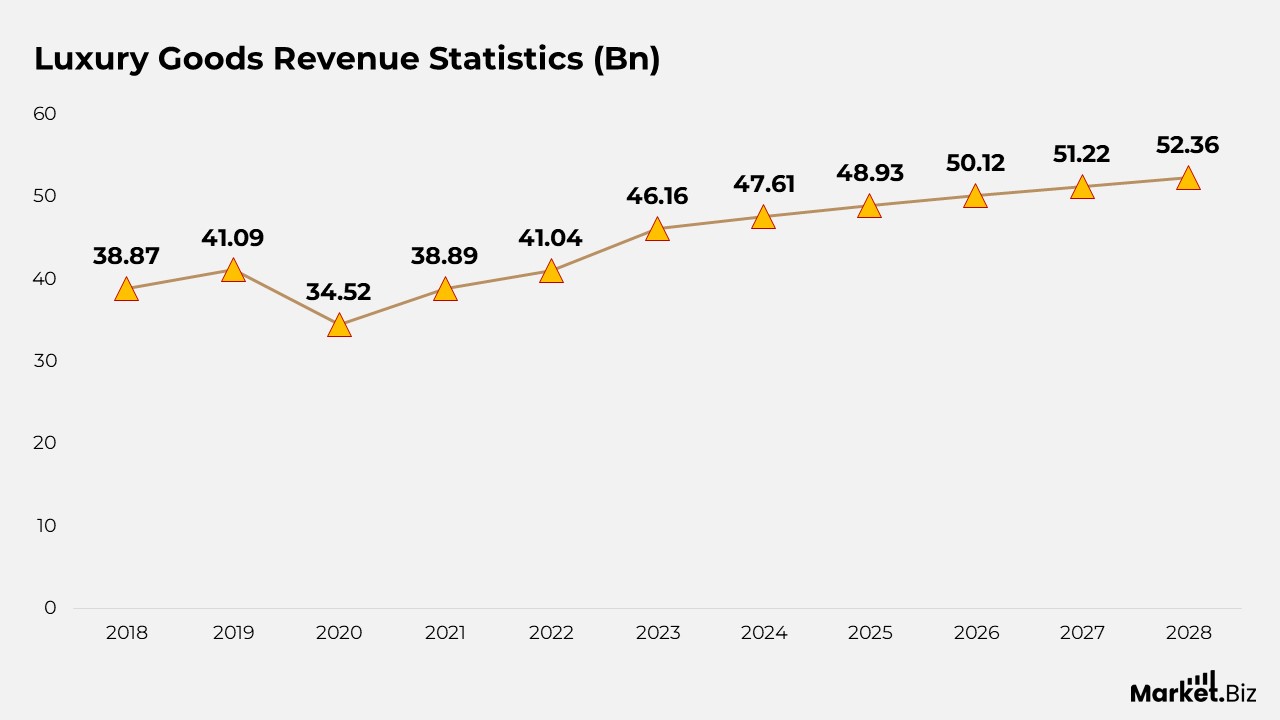
- In 2018, the average revenue per capita was recorded at USD 38.87, which increased to USD 41.09 in 2019.
- The year 2020 experienced a decline to USD 34.52, likely as a result of the economic effects of the COVID-19 pandemic.
- Nevertheless, a recovery was observed in 2021, with the average revenue per capita rising to USD 38.89.
- This favorable trend persisted in 2022, reaching USD 41.04, and further accelerated in 2023, climbing to USD 46.16.
- Forecasts for the upcoming years suggest ongoing growth, with the average revenue per capita projected to attain USD 47.61 in 2024 and USD 48.93 in 2025.
- By 2026, it is expected to increase to USD 50.12, followed by USD 51.22 in 2027 and USD 52.36 in 2028.
Country Statistics Luxury Goods Revenue
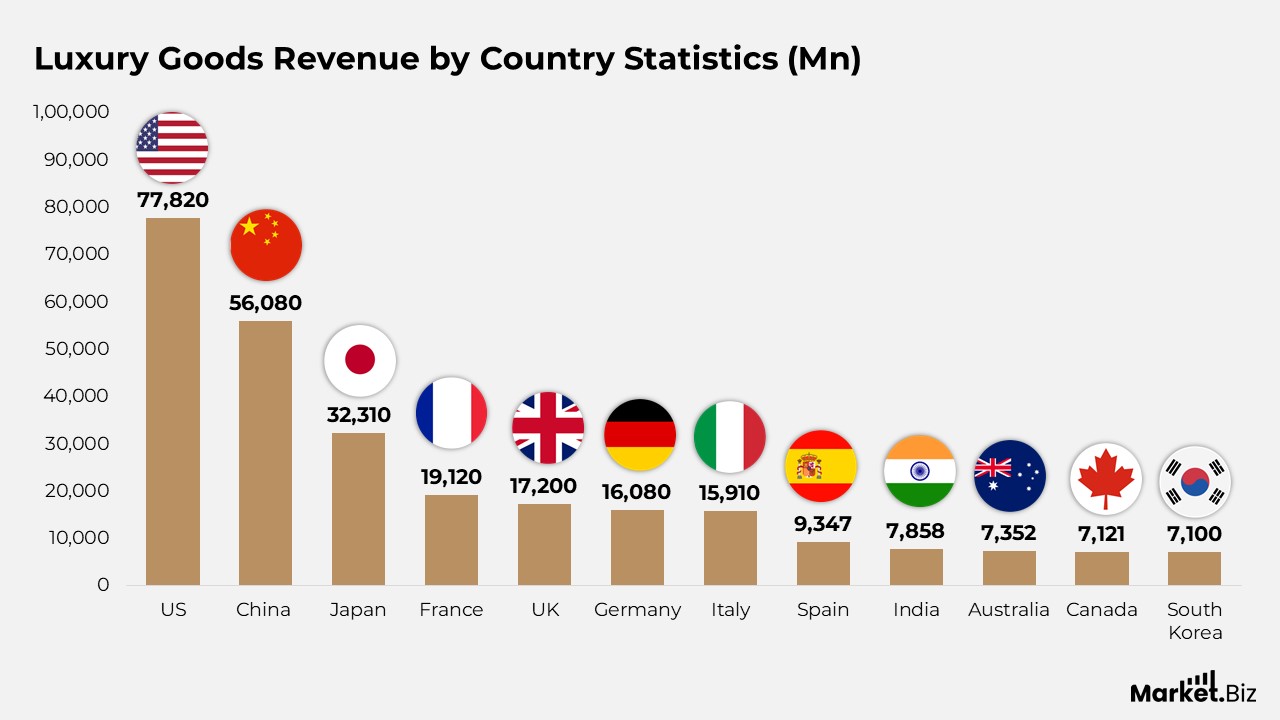
- The United States leads the market with a substantial revenue of USD 77,820 million, followed by China with USD 56,080 million.
- Japan contributes USD 32,310 million to the market, while France generates USD 19,120 million.
- The United Kingdom and Germany follow closely with revenues of USD 17,200 million and USD 16,080 million, respectively.
- Italy also makes a notable contribution of USD 15,910 million.
- In Spain, the luxury goods market revenue stands at USD 9,347 million.
- India, Australia, and Canada contribute USD 7,858 million, USD 7,352 million, and USD 7,121 million, respectively.
- South Korea also holds a significant share with a revenue of USD 7,100 million.
Luxury Goods Sales Statistics
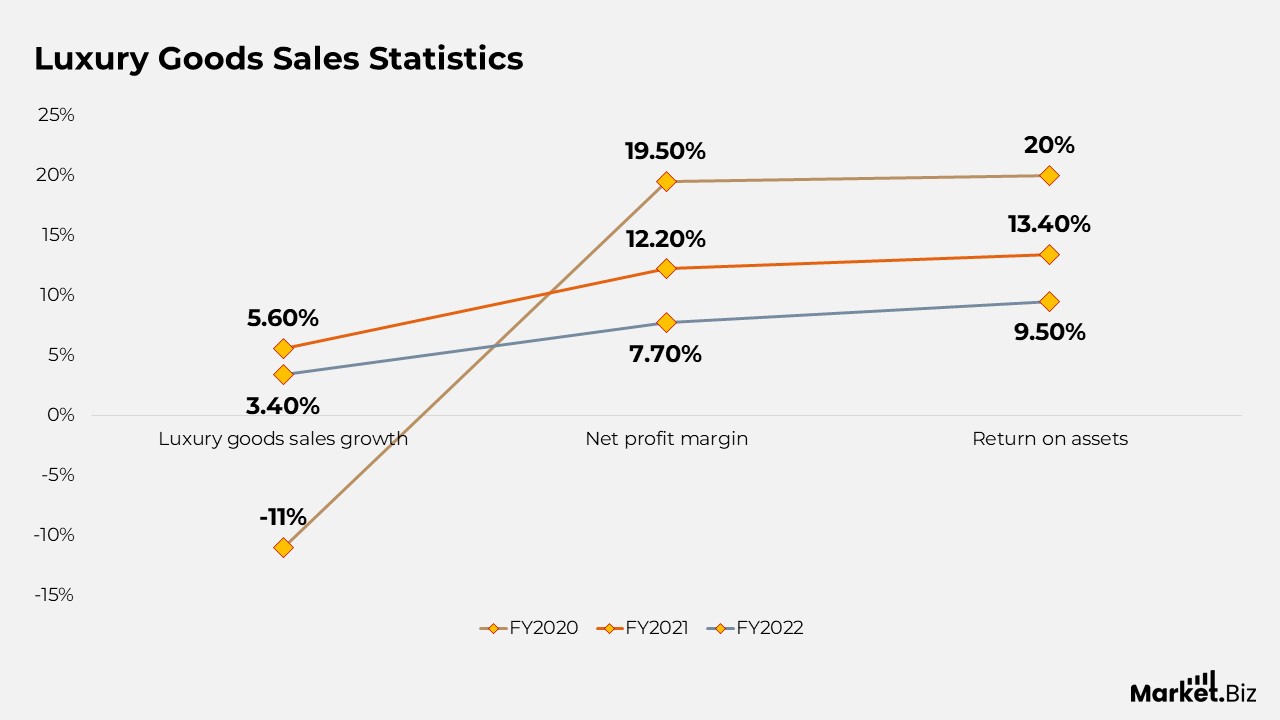
- In FY2020, the sector experienced a decline in the growth of luxury goods sales, registering a negative growth rate of -11%.
- With luxury goods sales growth rebounding to 19.50%, this positive trend continued into FY2022 with an additional increase of 20%.
- Net profit margins also showed significant improvement during this period.
- In the fiscal year 2020, the net profit margin was recorded at 5.60%. However, this amount more than doubled by the fiscal year 2021, achieving 12.20%, and continued to rise to 13.40% in the fiscal year 2022.
- Similarly, the return on assets (ROA) saw a notable rise. In FY2020, the ROA was 3.40%, indicating modest returns relative to the assets employed.
- This metric experienced considerable enhancement in FY2021, rising to 7.70%, and further increased to 9.50% in FY2022.
Luxury Goods Brands Statistics
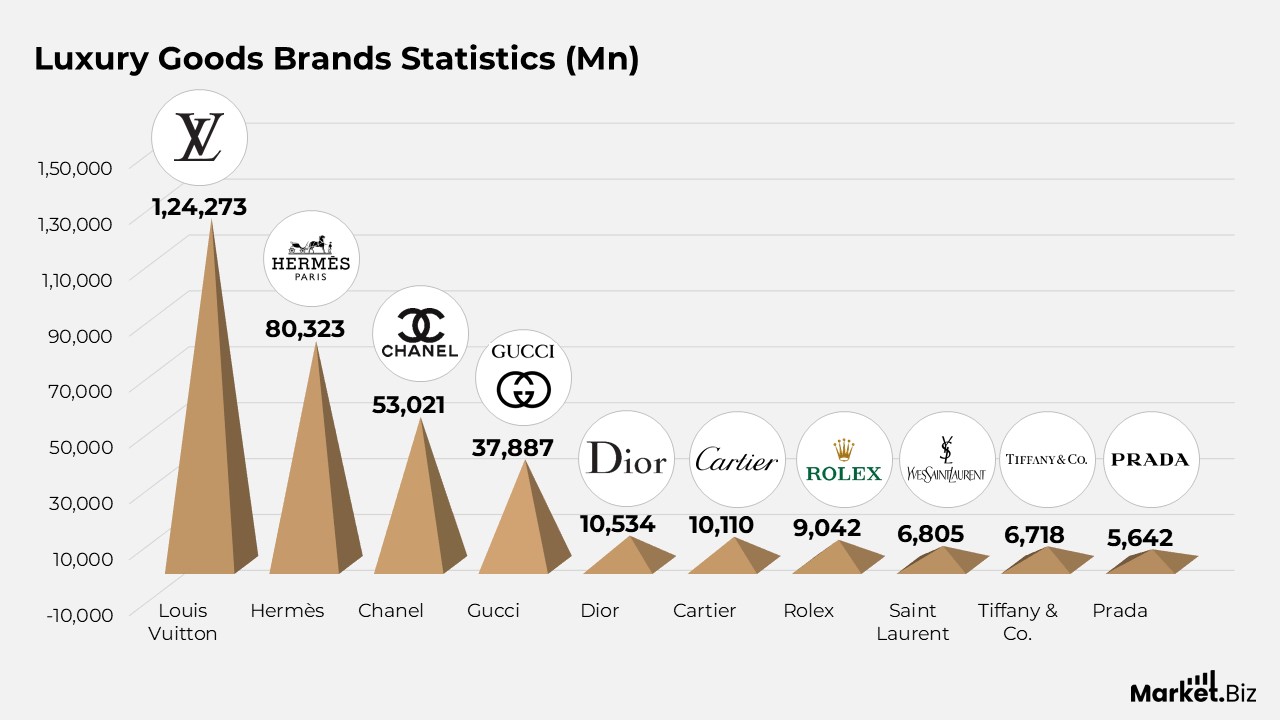
- Louis Vuitton, which hails from France, has reached the pinnacle with a brand value of USD 124,273 million.
- Another brand from France, Hermès, has claimed the second position with a value of USD 80,323 million.
- Chanel, also originating in France, has secured the third spot with a brand value of USD 53,021 million. The Italian brand Gucci was evaluated at USD 37,887 million.
- Among the French brands, Dior is valued at USD 10,534 million, while Cartier holds a brand value of USD 10,110 million.
- Rolex, headquartered in the UK, held a brand value of USD 9,042 million. Saint Laurent, and hailing from France, was valued at USD 6,805 million.
Age Statistics of Luxury Goods Consumers
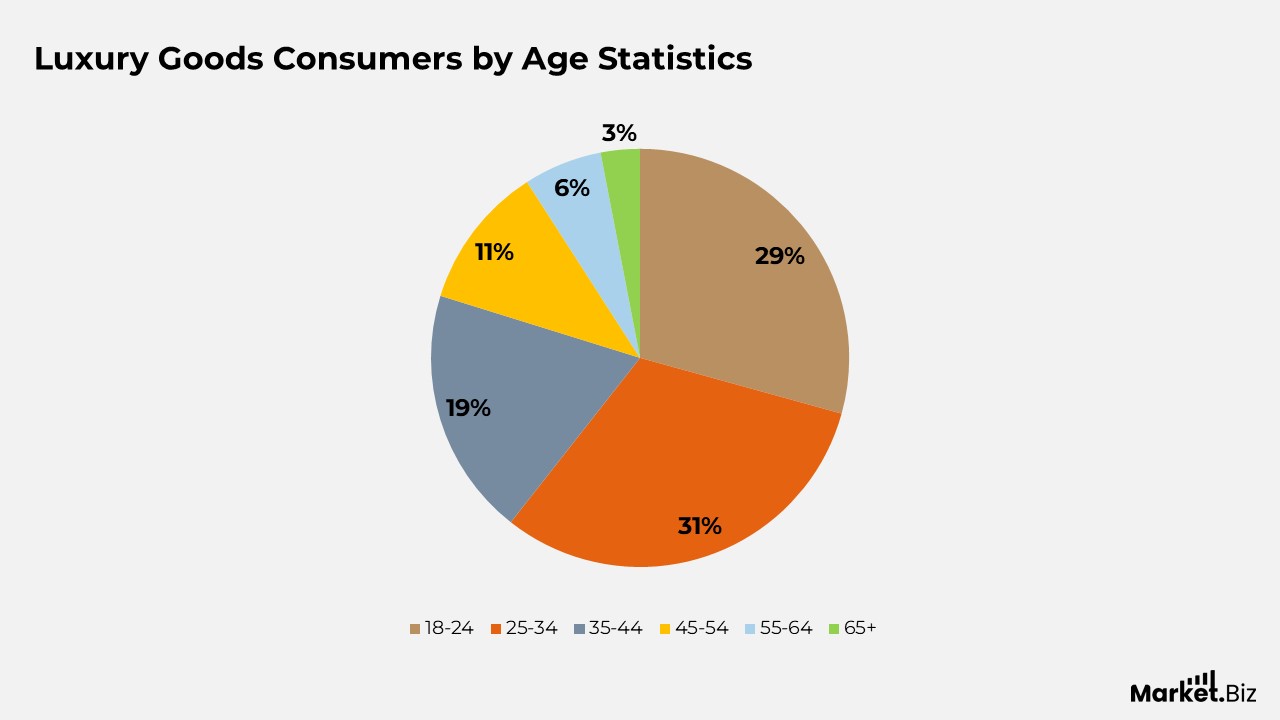
- In 2020, the distribution of visitors to online luxury brands in the United States exhibited considerable variation among different age demographics.
- The 25-34 age group constituted the largest segment of visitors, representing 31% of the overall online audience.
- This was closely trailed by the 18-24 age group, which made up 29% of the visitors.
- The 35-44 age group accounted for 19% of the online luxury brand visitors.
- Individuals aged 45-54 represented 11%, while those in the 55-64 age bracket comprised 6% of the audience.
- The smallest proportion of visitors, at 3%, was from the 65 and older demographic.
Luxury Goods Consumers by Gender Statistics
- Women are increasingly recognizing luxury purchases as indicators of both personal and professional success, with a notable percentage spending over £50,000 annually, outpacing their male counterparts by 10%.
- Factors such as the desire to signal success (35%) and the inclination for self-reward (33%) motivate these acquisitions.
- Almost two-thirds (62%) of women purchase luxury items mainly for themselves, fueled by a quest for self-indulgence and moments of joy.
- For more than 40% of women, luxury is characterized by quality, craftsmanship, and durability, and they are also attracted to special promotions (40%), luxury shopping during overseas travel (35%), and celebrating significant milestones (31%).
- Although men make fewer personal purchases, they are 13% more likely to brag about their acquisitions.
Luxury Products Consumer Behaviour Statistics
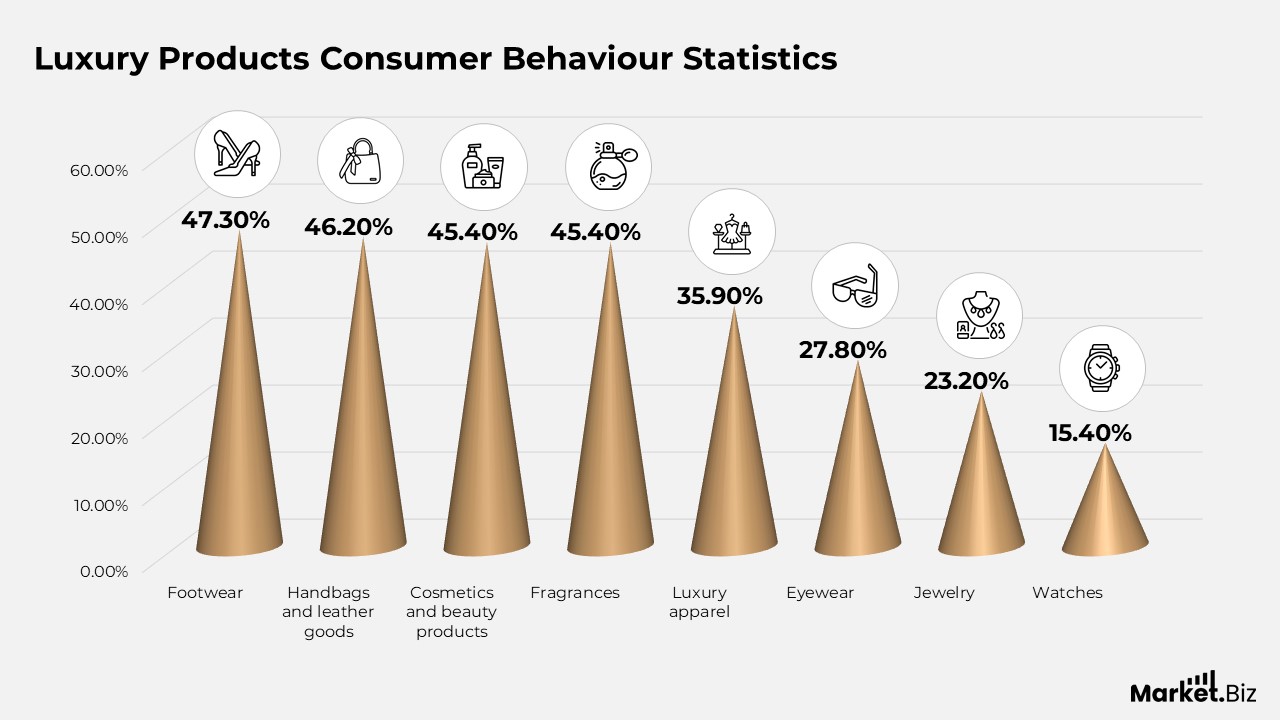
- The category that garnered the most interest was Luxury Footwear, which includes luxury shoes and boots, with 47.3% of participants reporting a purchase.
- Following closely were Leather Handbags and leather goods, such as purses, belts, backpacks, and wallets, with 46.2% of respondents.
- Cosmetics and beauty products, which encompass makeup, haircare, skincare, and fragrances, attracted 45.4% of those surveyed.
- Luxury apparel, comprising dresses, suits, separates, sleepwear, and swimwear, was acquired by 35.9% of luxury consumers.
- Eyewear was selected by 27.8% of respondents, while jewellery was purchased by 23.2%.
- Watches represented a less frequent luxury purchase, with only 15.4% of respondents, followed by other accessories, including scarves, hats, and gloves, at 11.2%.
- A minor segment of respondents, 1.9%, reported purchases in other unspecified categories.
Consumers’ Preferred Sources for Online Research
- Multi-brand full-price sites are the most preferred choice, with 39% of participants indicating their use of these platforms for research purposes.
- Off-price websites and department stores are also quite popular, with each being preferred by 34% of the participants.
- Official brand websites attract 31% of luxury consumers for their research requirements.
- Luxury forums are utilised by 29% of participants, while multi-brand events are the preference of 26%.
- Luxury blogs are a research source for 21% of participants.
- Social media platforms are less favoured, with Twitter being used by 13%, Facebook by 15%, and other social media platforms by 12% of participants.
Luxury Goods Recent Development
- At the beginning of 2023, LVMH finalised its acquisition of Tiffany & Co. for $15.8 billion.
- Kering purchased a 40% share in Richard Mille, a luxury watchmaker, for $400 million in the middle of 2023.
- At the end of 2023, Gucci introduced a new sustainable luxury collection crafted from eco-friendly materials and employing ethical production methods.
- Throughout 2023, Chanel pledged $1 billion towards sustainability initiatives over the forthcoming five years.
- In early 2024, Hermès secured $500 million to enhance its manufacturing facilities and boost production capacity to satisfy the increasing demand for its luxury products.
Luxury Goods Future Prediction
- Luxury items are expected to experience a resurgence in 2026, as Bain & Co. predicts a growth rate of 3-5% following stagnant sales in 2025.
- This anticipated growth is attributed to wealthy consumers in the United States and China, the introduction of innovative leadership at prominent brands such as Gucci and Dior, and a heightened emphasis on quality, exclusivity, and digital integration.
Conclusion
Luxury Goods Statistics: The luxury goods market represents a dynamic and evolving sector recognised for its high-quality, exclusive products that demand luxury and premium prices.
Despite facing challenges such as the need to maintain brand exclusivity, ensure sustainability, and navigate complex international regulations, the industry continues to prosper. Prominent brands such as Louis Vuitton, Hermès, and Chanel are at the forefront in terms of market value and consumer trust.
The emergence of e-commerce and the impact of younger generations, including Millennials and Gen Z, are reshaping market dynamics. It has become essential to emphasise corporate social responsibility and sustainable practices, aligning with the values of socially conscious consumers. The future success of the sector hinges on innovation, adaptability, and robust consumer engagement.
FAQs
While billionaires may be the face of the luxury lifestyle, it is, in fact, ordinary individuals who drive the industry; approximately 75% of luxury expenditures are attributed to the middle and lower classes.
The top ten markets for luxury goods represent 83 percent of total sales and include Brazil, China, France, Germany, Italy, Japan, Russia, Spain, Switzerland, the United Kingdom, and the United States.
Louis Vuitton consistently holds the position of the most valuable luxury brand in the world, recognized for its iconic monogram, legacy in travel products, and high demand, closely followed by other giants such as Hermès, Chanel, and Gucci, with luxury conglomerates like LVMH and Richemont owning numerous prominent brands. Rankings may vary slightly depending on the report (brand value versus market capitalization), but Louis Vuitton, Hermès, Chanel, and Gucci are nearly always the primary competitors.