









Introduction
Frozen Pizza Statistics: Frozen pizza, a common household item across the globe, provides both convenience and a range of options. It generally consists of a crust topped with various ingredients and is sold in cardboard packaging. The manufacturing process includes preparing the dough, applying toppings, flash-freezing the product, and then packaging it.
With its widespread availability in grocery stores and online food delivery services, frozen pizza is offered in many varieties, such as gluten-free and vegetarian selections.
Branding and marketing play a crucial role in influencing consumer preferences in a competitive environment where both established brands and new entrants compete for market share through innovative approaches and pricing tactics. Gaining an understanding of these fundamentals offers valuable insights into the larger context of the frozen pizza sector, encompassing market trends and potential growth avenues.
Editor’s Choice
- The worldwide revenue for the frozen pizza market amounted to USD 20.4 billion in 2023.
- Non-vegetarian pizzas contribute $19.03 billion and vegetarian pizzas $11.77 billion.
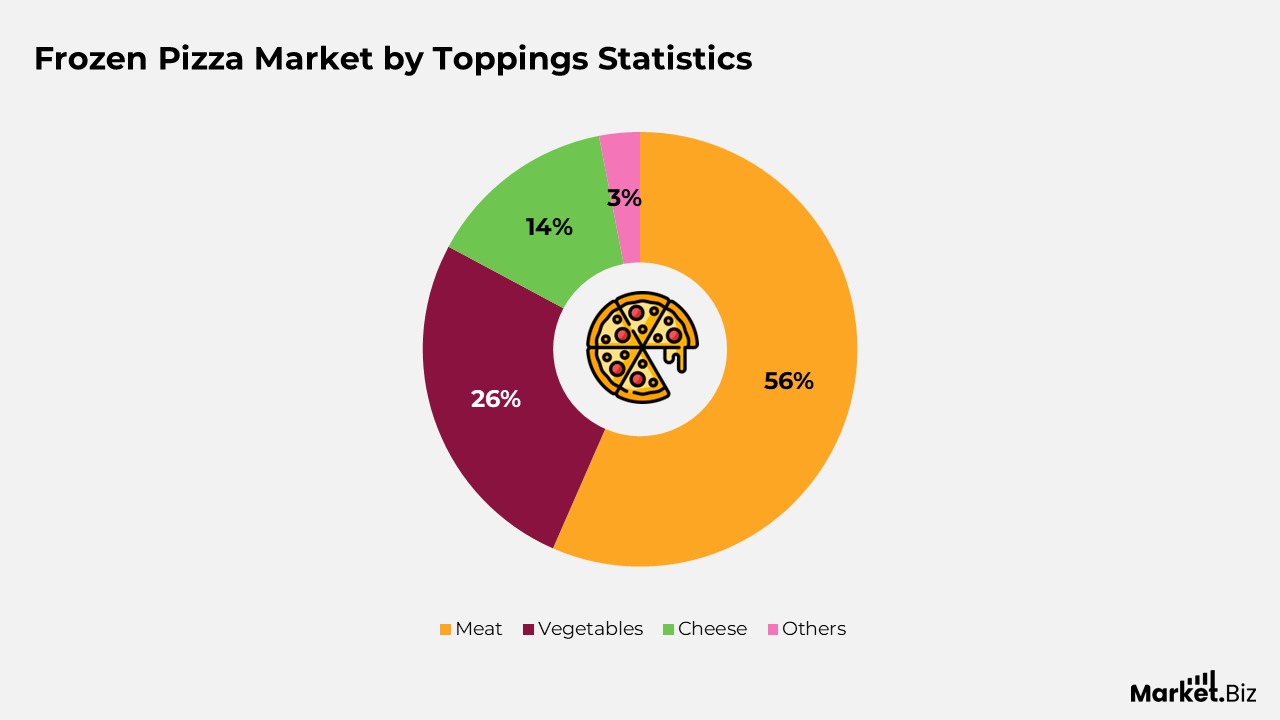
- According to the most recent data, meat toppings lead the market with a substantial 56% share, demonstrating a strong consumer preference for protein-rich options.
- Sales of frozen pizza increased by 11%, a rise attributed to intensified promotional activities by retailers.
- Between 2014 and 2015, there was a slight increase in consumption, with numbers rising from 198.14 million to 198.65 million.
General Frozen Pizza Statistics
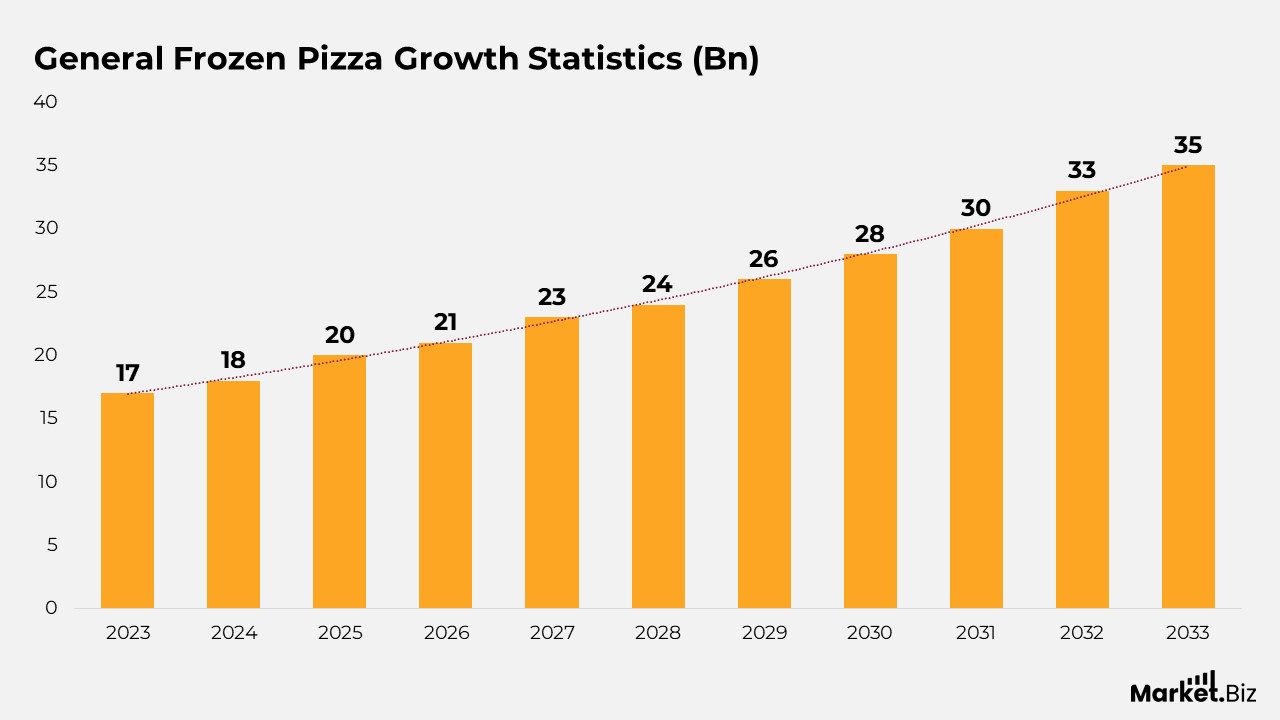
- The worldwide revenue for the frozen pizza market amounted to USD 20.4 billion in 2023.
- By 2029, it is projected that the revenue will grow to USD 30.8 billion, and non-vegetarian pizzas accounting for $19.03 billion and vegetarian pizzas for USD 11.77 billion.
- According to the most recent data, meat toppings hold a significant market share of 56%, reflecting a strong consumer preference for protein-rich options.
- In 2023, DiGiorno achieved the highest level of brand awareness in the U.S., reaching 84%.
- According to Circana’s data for the 52 weeks concluding on April 23, 2023, the frozen pizza subcategory in the United States experienced a notable rise of 10.7% in dollar sales, amounting to $6.8 billion across diverse retail channels including grocery, drug, and mass market.
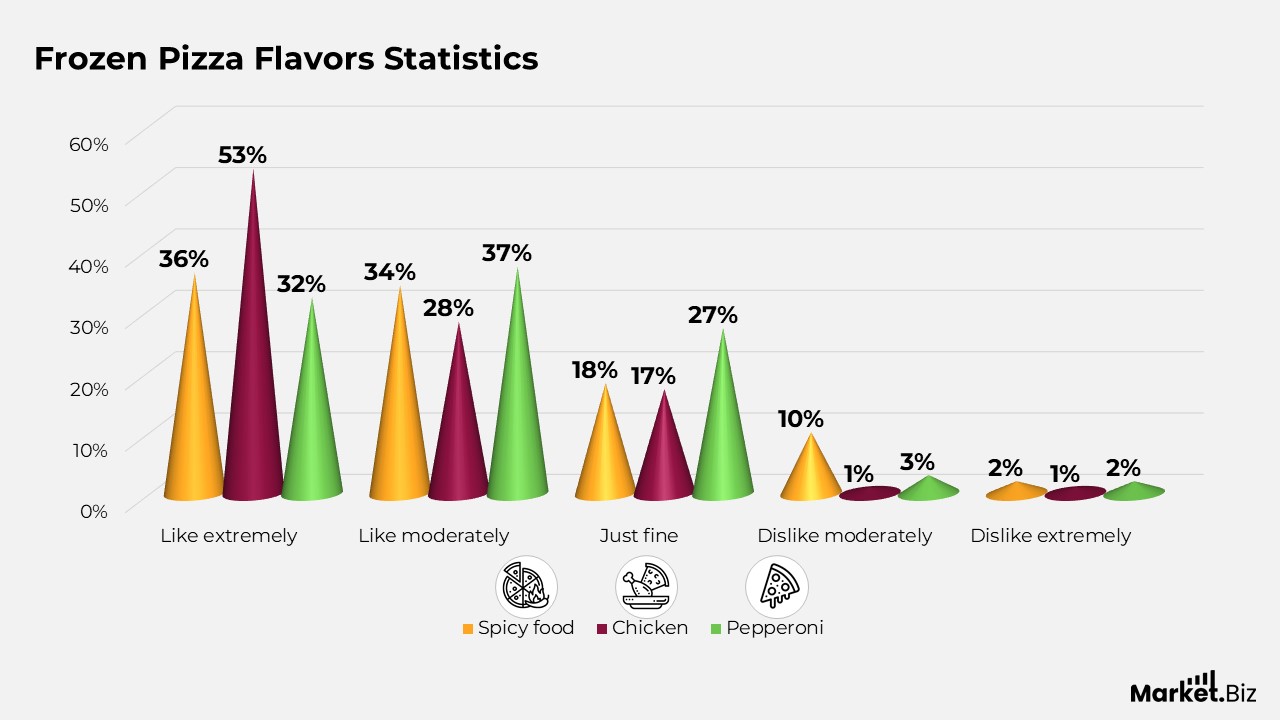
- Among the surveyed individuals, 36% expressed a strong preference for spicy food, 53% showed a preference for chicken, and 32% indicated a marked preference for pepperoni.
- Approximately 60% of consumers reported that they consume frozen or delivered pizza either once a week or every two to three months.
Frozen Pizza Market Size Statistics
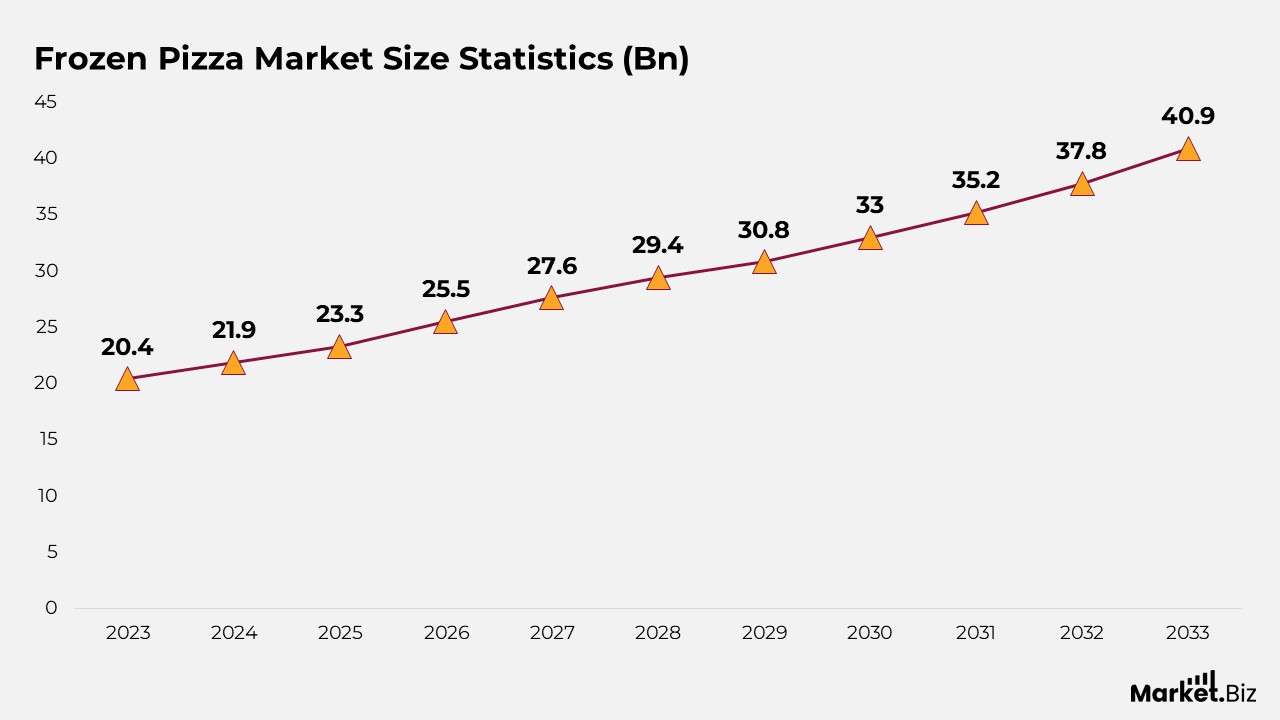
- The global frozen pizza market has experienced a consistent increase in revenue over the years, achieving a compound annual growth rate (CAGR) of 7.4%. In 2023, the revenue reached USD 20.4 billion.
- By 2024, the revenue rose to USD 21.9 billion, indicating a significant advancement.
- This upward trend persisted, with revenues increasing to USD 23.3 billion in 2025 and USD 25.5 billion in 2026.
- The market experienced considerable growth, exceeding USD 27.6 billion in 2027 and USD 29.4 billion in 2028.
- The upward trend continued, with revenues reaching $33 billion in 2030 and escalating to $35.2 billion in 2031.
- By 2032, the revenue surged to USD 37.8 billion, underscoring substantial growth potential.
- This favorable trend is anticipated to persist, with revenue forecasts estimating USD 40.9 billion in 2033.
Frozen Pizza Market by Type Statistics
- In 2023, the overall market revenue was recorded at USD 20.4 billion, with non-vegetarian pizzas making $12.61 billion and vegetarian pizzas contributing $7.79 billion.
- This trend persisted as the market grew to $21.9 billion in 2024, where non-vegetarian revenue reached $13.53 billion and vegetarian revenue amounted to $8.37 billion.
- By 2025, the market is projected to attain $23.3 billion.
- Non-vegetarian pizzas represent $14.40 billion, and vegetarian pizzas account for $8.90 billion.
- The growth trend continued, with market revenue increasing to $25.5 billion in 2026, $27.6 billion in 2027, and $29.4 billion in 2028.
- In 2029, the revenue hit $30.8 billion.
- Non-vegetarian pizzas contribute $19.03 billion and vegetarian pizzas $11.77 billion.
- This upward trend persisted into 2030 and 2031, with the market reaching $33 billion and $35.2 billion, respectively, before peaking at $40.9 billion in 2033.
Pizza Market by Toppings Statistics
- According to the most recent data, meat toppings lead the market with a substantial 56% share, demonstrating a strong consumer preference for protein-rich options.
- Trailing behind are vegetable toppings, which account for a significant 26% share, highlighting the increasing demand for healthier and plant-based alternatives.
- Cheese toppings, celebrated for their traditional appeal, capture a commendable 14% market share.
- In contrast, other toppings together constitute 3% of the market share, indicating a smaller yet still noteworthy niche within the industry.
Frozen Pizza Brands Statistics
- DiGiorno achieved the highest level of brand awareness at 84%, closely trailed by Red Baron at 83% and Totino’s Party Pizza at 82%.
- Tony’s and Stouffer’s also received significant recognition, with brand awareness percentages of 77% and 76%, respectively.
- Further down the list, California Pizza Kitchen, Tombstone, and Freschetta held commendable positions, with awareness levels ranging from 73% to 54%.
- Meanwhile, some niche brands, such as Palermo’s and Amy’s, exhibited moderate awareness at 33% and 37%, respectively, while others like CAULIFLOWER and Wild Mike’s lagged slightly behind.
Frozen Pizza Sales and Prices Statistics
- Sales of frozen pizza increased by 11%, a rise attributed to intensified promotional activities by retailers.
- As a result, at pizza restaurants, 13% of customers chose frozen or non-restaurant pizza due to inflation, according to a recent report from the marketing firm Vericast.
- Moreover, the leading four pizza companies saw a 3% reduction in their market share.
- Data from Circana for the 52 weeks ending April 23, 2023, indicates that the frozen pizza subcategory in the United States experienced a notable increase of 10.7% in dollar sales, amounting to $6.8 billion through various retail channels, including drug, grocery, and mass market.
- Conversely, unit sales declined by 2.8%, totalling less than 1.4 billion units sold. The price per unit significantly increased by 13.9%, reaching $4.94.
- In contrast, the smaller subcategories of frozen pizza crusts, toppings encountered difficulties, with dollar sales decreasing by 1.5% to $44.1 million and 11.2% to $6.2 million, respectively.
- The dollar sales for whole pizzas rose sharply by 16.3% to $1.2 billion, with unit sales growing by 8.7% to 160.7 million. This growth coincided with a 7.0% increase in price, reaching $7.50 per pizza.
Pizza Consumption Statistics
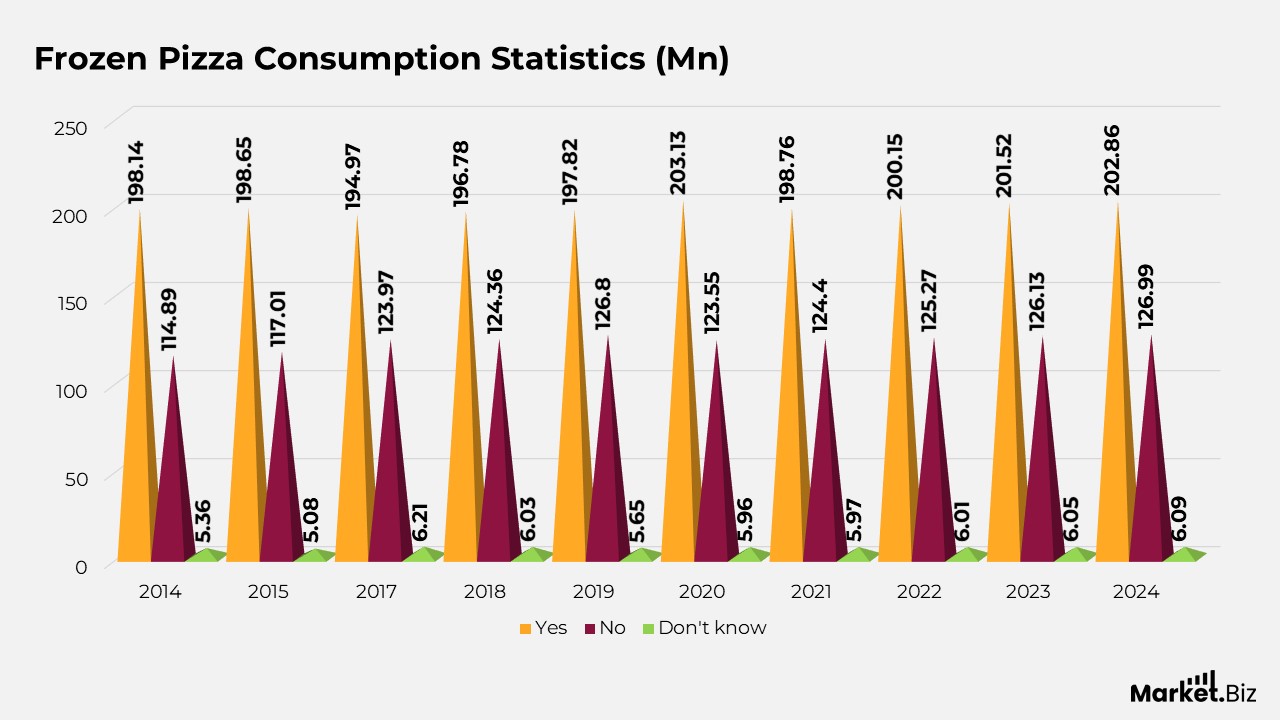
- Between 2014 and 2015, there was a slight increase in consumption, with numbers rising from 198.14 million to 198.65 million.
- Although there were minor fluctuations in the following years, the overall trend indicates a consistent demand for frozen pizzas.
- Significantly, 2020 experienced a marked increase, with consumption reaching 203.13 million, likely influenced by changes in lifestyle and the convenience of frozen food options during the COVID-19 pandemic.
- In the years that followed, from 2021 to 2024, a similar pattern was observed, with consumption figures remaining around the 200 million threshold.
Frozen Pizza Flavors Statistics
- An analysis of customer first choice for frozen pizza flavors was conducted across three categories: chicken, spicy food, and pepperoni.
- The findings, expressed in percentages, illustrate clear trends. Among the participants, 36% expressed a strong preference for spicy food, 53% preferred chicken, and 32% showed a significant inclination towards pepperoni.
- In terms of moderate preferences, 34% moderately liked spicy food, 28% favored chicken, and 37% preferred pepperoni.
- Additionally, 18% considered spicy food acceptable, with 17% for chicken and 27% for pepperoni.
- A level of disinterest was observed, with 10% indicating a moderate dislike for spicy food, 1% for chicken, and 3% for pepperoni.
- A very small percentage, specifically 2% for spicy food and 1% for both chicken and pepperoni, reported an extreme dislike.
Frozen Pizza Recent Statistics
- In April 2023, Nestlé and PAI revealed a collaborative venture aimed at enhancing their footprint in the European frozen pizza sector.
- Continuing its growth strategy, Nestlé finalised the purchase of a controlling interest in a high-end chocolate firm in Brazil in September 2023.
- The incorporation of advanced freezing technologies and innovative packaging solutions is designed to prolong shelf life and preserve product quality throughout storage and transit, thereby ensuring customer satisfaction and minimising food waste.
Conclusion
Frozen Pizza Statistics: In conclusion, the frozen pizza industry continues to flourish and evolve, driven by factors such as convenience, cost-effectiveness, and shifting consumer preferences. Consistent growth in both revenue and consumption is apparent, bolstered by robust branding and enhanced marketing efforts from retailers.
Advancements in flavor diversity, packaging, and production technologies have expanded its appeal and enhanced sustainability. Despite facing challenges such as inflation, frozen pizza remains a favored option due to its convenience.
Looking forward, the sector presents opportunities for growth through continuous innovation, strategic partnerships, and focused marketing initiatives. Overall, the outlook for the frozen pizza market is optimistic, as it is well-positioned to satisfy the evolving demands of consumers worldwide.
FAQ’s
Frozen pizza can generally be stored in the freezer for several months. It is advisable to refer to the packaging for specific storage guidelines, but typically, it is recommended to consume frozen pizza within 3-6 months to ensure the best taste and quality.
Indeed, the majority of frozen pizzas are pre-cooked. They are intended to be thoroughly heated in either the oven or microwave prior to consumption. It is important to follow the guidelines provided on the wrapping to guarantee that the pizza is heated uniformly and attains a safe internal temperature.
Although an oven is the preferred method for cooking a frozen pizza, it is feasible to prepare it using alternative appliances, such as a toaster oven or grill. It is essential to modify the cooking time and method based on the appliance utilized to ensure that the pizza is heated evenly and fully cooked.