








Introduction
Black Pellets Statistics: Black pellets represent a sophisticated form of torrefied biomass fuels, exhibiting greater energy density and water resistance compared to conventional pellets.
They serve as a cleaner alternative to coal in power generation, contributing to substantial market growth with a compound annual growth rate (CAGR) of 12-15%. Europe is at the forefront of consumption, propelled by renewable energy mandates, and demonstrating encouraging statistics for market development towards sustainability.
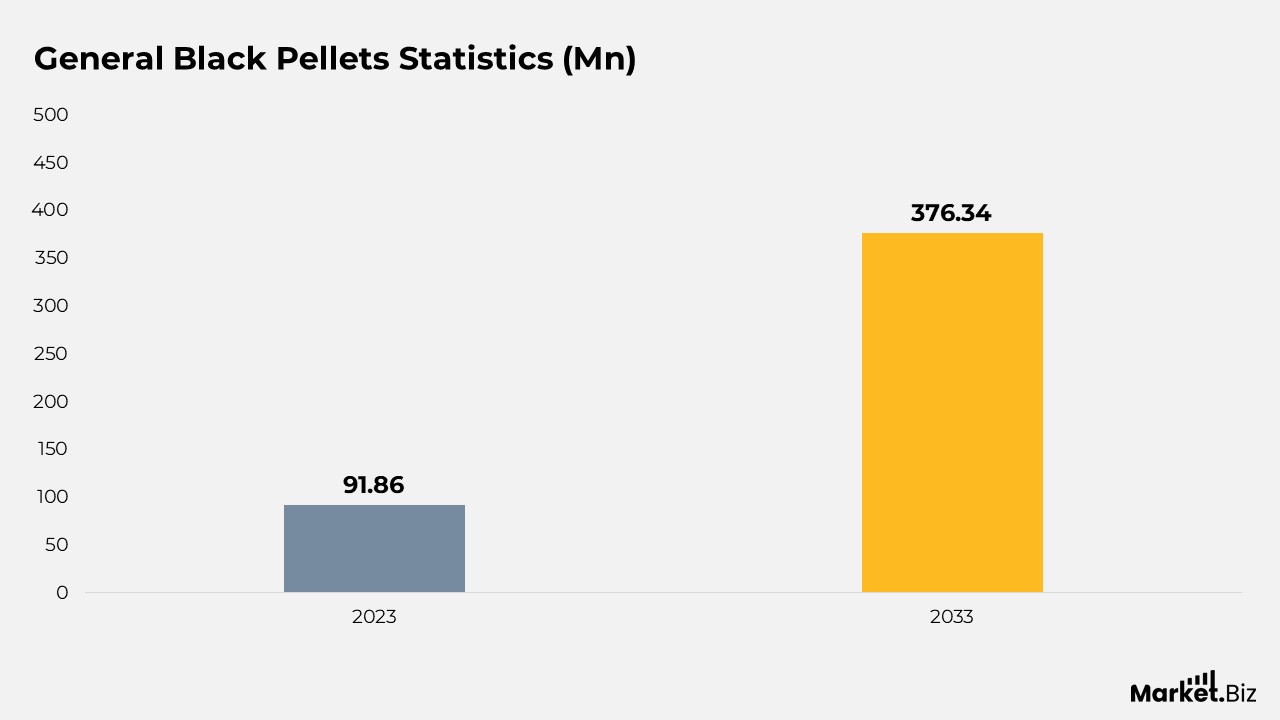
The global Black Pellets Market is set for significant expansion, with projections indicating that the market size will grow from USD 91.86 million in 2023 to around USD 376.34 million by 2033.
This growth corresponds to a compound annual growth rate (CAGR) of 15.3% throughout the forecast period. The remarkable increase is attributed to various factors, such as the rising demand for renewable energy, advancements in biomass technology, and the implementation of stringent environmental regulations.
Editor’s Choice
- The black pellets market was valued at USD 91.86 million in 2023.
- Among the various types of black pellets, the torrefaction type represented the largest revenue share at 53.6%.
- The pellet size varies from 0.8 to 3.5 mm, with an absolute accuracy of ±0.1 mm.
- In 2023, wood chips represented a 45.2% share of the market, appreciated for their sustainability and quality.
General Black Pellets Statistics
- The global market for black pellets was valued at USD 91.86 million in 2023.
- It is anticipated that the global black pellets market will reach USD 376.34 million by 2033.
- Among the various types of black pellets, the torrefaction type represented the largest revenue share at 53.6%.
- In terms of feedstock types, wood residue held the most significant market share, accounting for 64.3%.
- In terms of applications, the generation of heat accounted for the most significant share of the black pellets market, representing 54.9%.
- When considering end-users, the residential sector led the market with a share of 44.5%.
- The European Union’s renewable energy directive requires that by 2030, 32% of the energy consumed within the EU must originate from renewable sources, thereby increasing the demand for black pellets.
Global Black Pellets Statistics
- The incorporation of water (20%) and a reduced drying duration (4 hours) led to the formation of pellets with an elevated moisture content (3.34%), enhanced thermal conductivity, and improved particle organisation, which resulted in increased density and energy density.
- Black pellets demonstrated remarkable durability (>98%) irrespective of moisture levels and drying duration, signifying robust particle adhesion.
- Charcoal fines, combined with rice starch, present a viable alternative for residential heating, particularly the T3 treatment (20% moisture content, 4 hours drying), which fulfils the necessary criteria for application and commercialisation.
- The nation ranks as the ninth largest rice producer globally, with an estimated annual national consumption of 11.5 million tons.
- The pellet size varies from 0.8 to 3.5 mm, with an absolute accuracy of ±0.1 mm.
- The force measuring capacity reaches up to 250 cN, with an absolute accuracy of ±2 cN.
- Consequently, black pellets can completely substitute fossil coal in smaller units and replace up to 70% in larger units.
- Idemitsu intends to boost its black pellet production to 300,000 t/yr within three years following the commencement of the first plant, with a long-term goal of reaching 3 million t/yr by 2030.
- Black pellets were manufactured using two different water ratios (10 or 20%) and drying times of either 4 or 6 hours.
- The inclusion of water facilitated improved thermal conductivity and particle organisation, yielding pellets with a durability exceeding 98%.
- Brazil is notable on the global front as the largest producer and consumer of charcoal, contributing to 12% of worldwide production.
Black Pellets Market Statistics
- The Black Pellets Market is projected to expand at a compound annual growth rate (CAGR) of 15.3%, reaching a value of USD 434.7 million by the year 2033, up from USD 104.7 million in 2023.
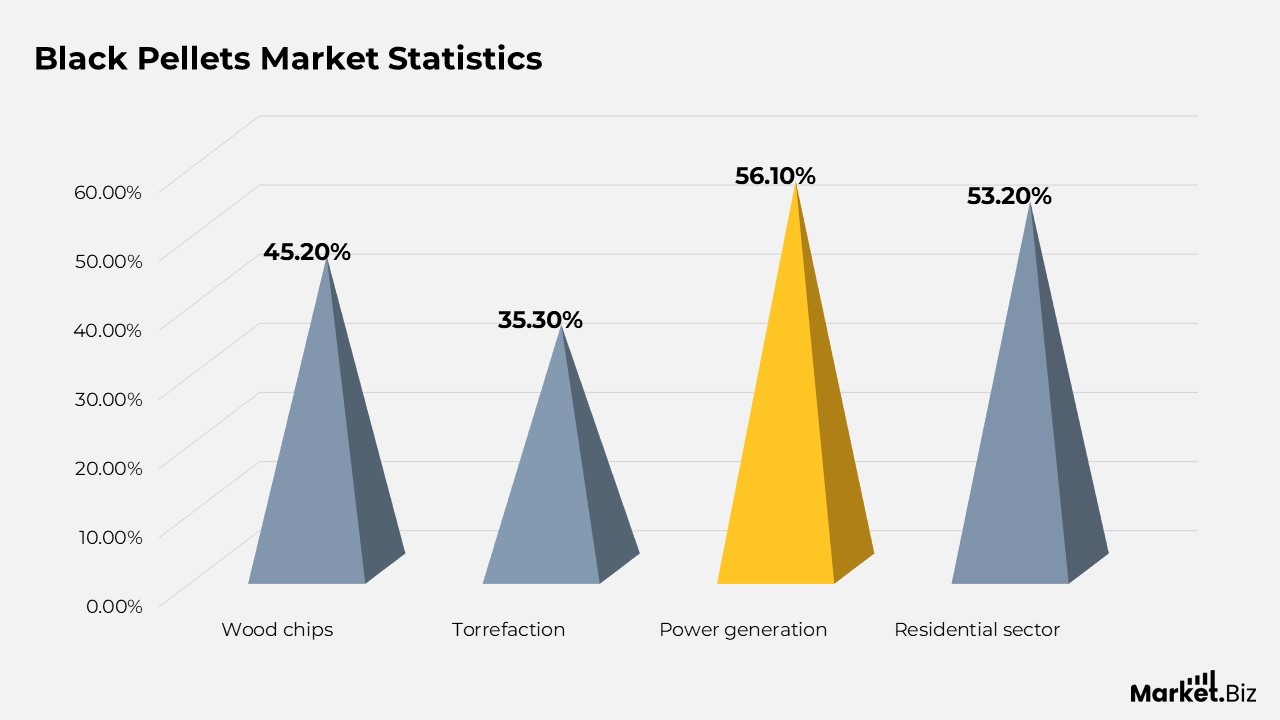
- In 2023, wood chips represented a 45.2% share of the market, appreciated for their sustainability and quality.
- The torrefaction process accounted for 35.3% of the market share in 2023, contributing to the enhancement of black pellet quality.
- Power generation made up 56.1% of the market in 2023, driven by factors such as efficiency and environmental friendliness.
- The residential sector represented 53.2% of the market in 2023, reflecting an increase in usage.
- The market growth is propelled by a strong demand for cleaner energy, efficiency, and global efforts to reduce emissions.
- However, high initial costs and regulatory uncertainties present challenges to adoption.
- In 2022, the Asia-Pacific region led with a 35.1% market share, while the United States was the dominant player in North America.
Recent Development
- The global market for black pellets was estimated to be valued at approximately $90-100 million in 2023, with expectations for substantial growth driven by rigorous renewable energy regulations such as EU RED II and the necessity to substitute fossil fuels.
- The inaugural commercial-scale FlashTor® black pellet facility, developed by TTCL and Blackwood Technology in Thailand, commenced production in late 2024, with the objective of fulfilling large-scale demand.
- In November 2024, Blackwood Technology initiated operations at the first commercial FlashTor® black pellet plant in Thailand, producing both standard black pellets intended for power generation and SuperBlack™ pellets designed for metallurgical applications.
Black Pellets Future Prediction
- Reports indicate that valuations differ yet demonstrate robust growth, with forecasts estimating figures in the hundreds of millions to exceeding $2 billion by the years 2032-2033.
- The outlook for black pellets appears favourable, propelled by the worldwide transition to renewable energy sources; the market is anticipated to expand considerably (CAGRs approximately 15%), leading up to 2033.
Conclusion
The market for black pellets is set to experience substantial growth as worldwide initiatives to shift towards renewable energy sources gain momentum. Due to their superior energy density, hydrophobic characteristics, and compatibility with current coal infrastructure, black pellets offer a practical substitute for conventional fossil fuels. The rising use of these pellets for co-firing in coal power facilities, especially in Europe and Asia, underscores their increasing significance in lowering carbon emissions and advancing sustainability objectives.
FAQs
Black Pellets refers to a thermally-treated biofuel pellet designed to replace fossil coal in the generation of heat and power. These pellets can be manufactured from virtually all cellulosic materials, including wood, wood by-products, and agricultural residues.
The diameters range from 6 to 10 mm, with the length being 4 to 5 times the diameter. The bulk density exceeds 600 kg/m3. The density of wood pellets is between 1.1 and 1.4 kg/m3, although a density of 0.8 to 1.1 kg/m3 is more cost-effective for use in industrial boilers.
Black pellets represent a form of renewable biomass fuel that can substitute for fossil coal in power generation, leading to a significant decrease in carbon emissions. Steam-exploded black pellets are considered safer, more economical, and provide greater energy output compared to traditional “white” biomass pellets.

