








Introduction
3D Printing Statistics: 3D Printing has emerged as a revolutionary technology, transforming various industries by enabling the creation of intricate, customized products with enhanced efficiency and precision. As a form of additive manufacturing, it builds objects layer by layer, making it a versatile solution across sectors such as healthcare, aerospace, automotive, and consumer goods.
A significant benefit of 3D Printing is its ability to reduce production costs, minimize material waste, and accelerate the design-to-production process. This has led to its widespread adoption, especially in prototyping and small-scale manufacturing. In healthcare, 3D Printing is being used to create personalized prosthetics, implants, and even bioprinted tissues, demonstrating its transformative potential.
The technology is also set to improve supply chains and manufacturing processes by offering more flexible, on-demand production solutions. As 3D printing technology advances, its capacity for innovation continues to grow, promising to reshape industries and contribute to more sustainable production practices.
Editor’s Choice
- Analysts forecast rapid growth for the 3D printing industry, with annual growth rates expected between 18% and 27%.
- In 2021, approximately 2.2 million 3D printer units were shipped.
- The leading 3D printer manufacturers include Desktop Metal, HP Inc., Autodesk, 3D Systems, and Proto Labs, with Autodesk’s market value exceeding $68.2 billion.
- Investor confidence is high, with venture capital funding for 3D printing startups surpassing $300 million in 2018.
- Over 23% of companies using 3D Printing invested more than $100K in the technology in 2020.
- When asked about the advantages of 3D Printing, 69% of respondents cited its ability to create complex geometrical objects, 52% valued quick product iteration, and 41% emphasized mass customization capabilities.
- Among companies that use 3D Printing, 38% consider it their main activity, 18% have dedicated in-house departments, and 16% employ 3D printing across multiple departments.
- 66% of research and education organizations use in-house 3D printers.
- 47% of schools and universities have incorporated 3D Printing into their educational programs.
- About 51% of the manufacturing and engineering industries use 3D printers for testing and prototyping parts.
- In 2020, 43% of UK businesses improved their investment in 3D printing machines.
- Approximately 17% of the aerospace and defense industry used 3D-printed parts in 2020.
General 3D Printing Statistics
- 52% of global 3D printing businesses are located in Europe.
- 33% of companies cite budget constraints as the primary barrier to 3D printing adoption.
- The estimated market value for 3D Printing in the UK is £468 million, positioning it as the second-largest market in Europe and the fifth-largest globally.
- 22% of businesses use 3D Printing to reduce manufacturing waste, while 38% anticipate improvements in sustainability and recyclability within the next 3-5 years.
- 61% of 3D printer users plan to increase their investment in the technology, while 36% intend to maintain their current spending levels.
- Customers spend an average of over £8,000 annually on 3D Printing, with 23% spending approximately £80,000.
- 55% of respondents identified cost as the main barrier preventing wider adoption of 3D Printing.
- German suppliers dominate the PBF metal additive manufacturing (AM) systems market, accounting for 62% of all installations worldwide.
- 93% of 3D printer users report gaining a competitive advantage from using the technology.
- 22% of users have experienced a 30%-50% reduction in development time thanks to 3D printing.
Moreover
- 61% of 3D printer users plan to boost their investment, while 36% plan to maintain current spending.
- Customers spend an average of US$8,000 per year on 3D Printing, with 23% spending around US$80,000.
- The construction sector is expected to save US$20 billion annually from 3D Printing by 2025.
- Fused Deposition Modeling technology captured 46% of the 3D printing machine market.
- 75 companies specializing in 3D Printing produce between 1,001 and 10,000 parts each year, while a smaller group manufactures between 10,000 and 50,000 parts annually.
- A significant 68% of businesses primarily leverage 3D Printing for prototyping and pre-production manufacturing.
- In 2020, 59% of survey respondents indicated they used 3D Printing for proof of concept, making it the second most common application.
- 40% of businesses involved in 3D Printing utilize the technology for producing functional parts, and 26% employ it to create tools.
- 27% of companies use 3D Printing for manufacturing finished consumer goods.
- Companies that have made substantial investments in 3D Printing reported using the technology for small batch production in 70% of cases, large batch production in 49%, and mass manufacturing in 18%.
- One of the advantages of 3D Printing is its potential to reduce material waste by up to 95%.
(Source: Kooc Media Ltd., G2.com, Inc., Toner Buzz, Statista)
Evolution of 3D Printing Technology
- The concept of 3D Printing was first introduced in 1945 by science fiction writer Murray Leinster (William Fitzgerald Jenkins).
- In 1971, Johannes F. Gottwald filed the first patent for rapid prototyping and on-demand controlled manufacturing.
- A 1974 article in New Scientist introduced the 3D printing concept, authored by chemist David Edward Hugh Jones.
- In 1980, Hideo Kodama of the Nagoya Municipal Industrial Research Institute documented the creation of printed solid models, pioneering additive techniques for building 3D plastic models using photo-hardening thermoset polymers.
- 1984 marked the filing of the first 3D printing patent by American inventor William Masters, which laid the foundation for many modern 3D printing systems, under the name Computer Automated Manufacturing Process and System.
- In 1984, 3D Systems co-founder filed a patent for a stereolithography fabrication system (STL).
- 1987 saw the launch of the first commercial 3D printer by 3D Systems Corporation.
- In 1988, Stratasys co-founder Steven Scott Crump patented Fused Deposition Modeling (FDM).
- Stratasys introduced its first FDM machine to the market in 1992.
Moreover
- In 1992, 3D Systems launched the first stereolithographic apparatus (SLA) printer.
- The Fraunhofer Society, a German research institution, developed the selective laser melting (SLM) process for metal additive manufacturing in 1995.
- The first 3D-printed organ, a bladder, was transplanted into a human in 1999.
- In 2014, Morriston Hospital in Swansea used 3D-printed parts to reconstruct the face of a man injured in a motorbike accident.
- In 2018, a 2-year-old boy’s life was saved by a 3D-printed kidney, created by Tri-Tech 3D in London.
- The world’s first 3D robotic aircraft was printed in 2010.
- In 2011, Kor Ecologic designed the world’s first 3D-printed car, the Urbee.
- In 2014, WinSun, a Shanghai-based company, printed a five-story apartment building.
- At the end of 2015, aerospace giant Airbus delivered an A350 XWB aircraft to Qatar Airways, incorporating over 1,000 3D-printed parts.
- 2016 saw the first 3D-printed fuel nozzles used in an Airbus engine, resulting in a 255 kg weight reduction.
- In 2017, General Electric Aviation developed a helicopter engine using 3D Printing, replacing 900 parts with just 16.
- 2018 witnessed the use of 3D printing technology to create a matrix for cell immobilization in fermentation.
- In November 2021, Moorfields Eye Hospital in London used the world’s first 3D-printed eye for a patient.
(Source: 3D Printing Geek, DemandSage, G2.com, Inc.)
3D Printing Market Size
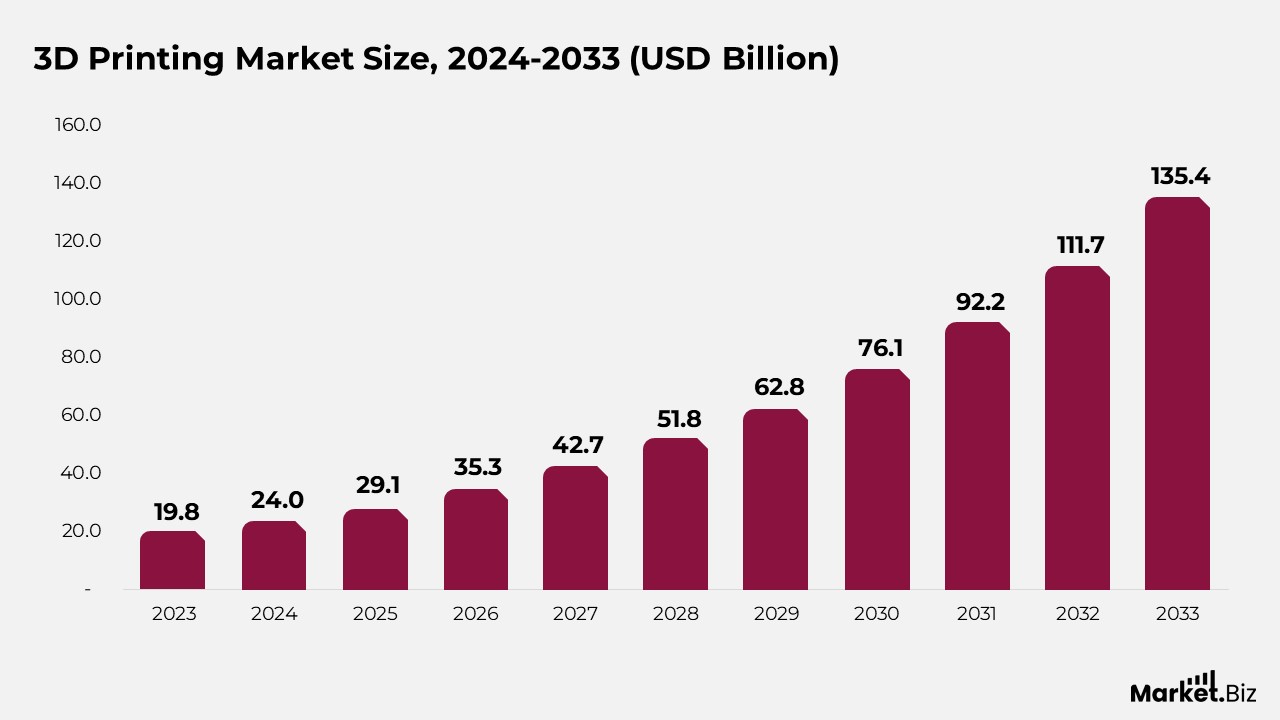
- According to Market.us, the 3D printing market is expected to rise from $24.0 billion in 2024 to $135.4 billion by 2033, representing a compound annual growth rate (CAGR) of 21.2% from 2024 to 2033.
- The market is driven by advancements in technology and increased adoption across various industries, with 3D Printing’s versatility being a key growth factor, reducing time and costs in manufacturing.
- In 2023, the hardware segment dominated the 3D printing market, holding more than 67% of the market share due to the essential role of printers, scanners, and other devices in production.
- In 2023, the industrial 3D printer segment led the market with more than 75% of the share, primarily driven by its widespread use in automotive, aerospace, and healthcare sectors for high-volume manufacturing.
- In 2023, the Stereolithography (SLA) segment held a dominant position with over 11% of the market share, thanks to its precision and excellent surface finish for applications in dental, medical, and jewellery design.
- In 2023, the prototyping segment led the market with more than 54% of the share, as 3D Printing is ideal for rapid prototype creation, enabling faster design iterations and development.
Moreover
- In 2023, the automotive segment within Industrial 3D Printing held more than 61% of the market share, driven by the industry’s increasing reliance on 3D Printing to optimize production, enhance customization, and reduce lead times.
- In 2023, the metal segment captured more than 53% of the 3D printing market, largely due to its adoption in aerospace, automotive, and healthcare industries for its precision and efficiency.
- The United States leads the global 3D printing market with a value of $3.1 billion, representing 22% of the global market.
- Europe is home to 52% of all 3D printing businesses, with the UK being the second-largest market in Europe, valued at £468 million, making it the fifth-largest market globally.
- By 2030, the global 3D printing market is projected to grow at an annual rate of 20.8%, potentially reaching $62.76 billion (£48.88 billion).
- The 3D printing market in the UK is anticipated to reach £685 million by 2026, growing at a CAGR of around 10%.
(Source: Market.us)
3D Printing Medical Implants Market Size
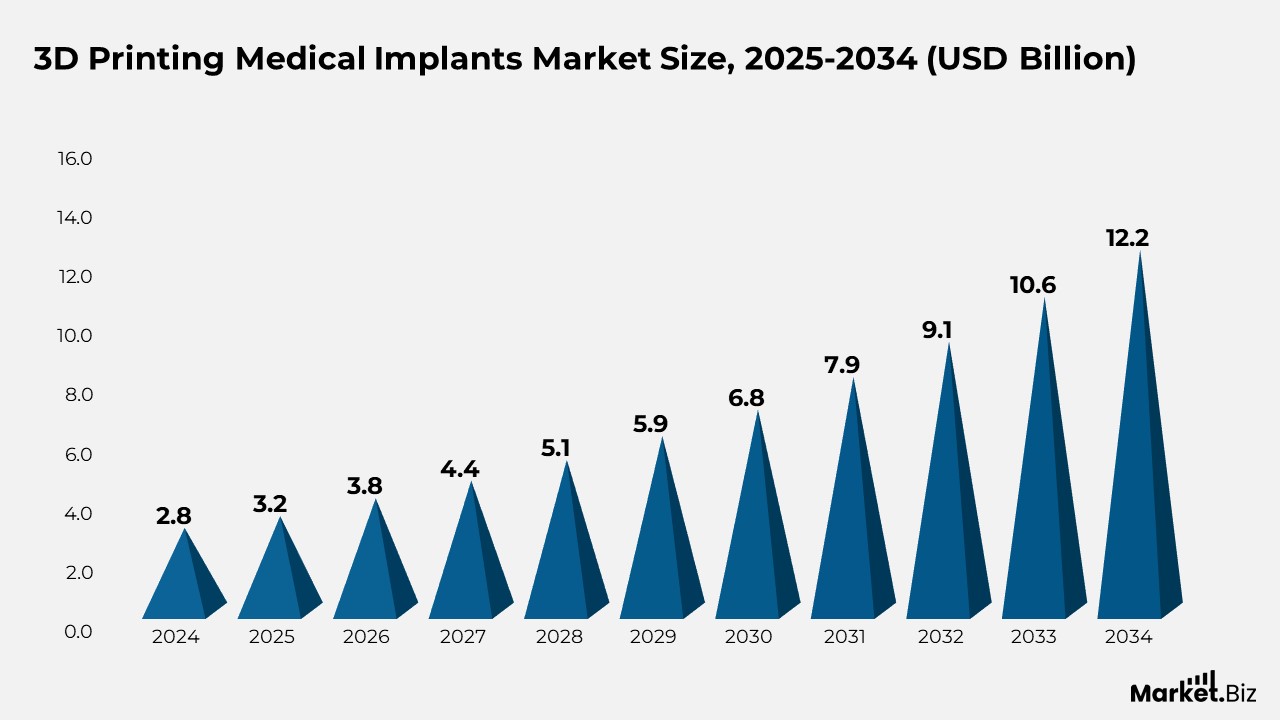
- According to Market.us, the 3D printing medical implants market is expected to grow from $3.2 billion in 2025 to $12.2 billion by 2034, representing a compound annual growth rate (CAGR) of 15.9% from 2025 to 2034.
- The market growth is driven by technological advancements, increasing demand for personalized healthcare solutions, and the rising prevalence of chronic diseases, with 3D Printing enhancing precision and customization in medical implants.
- The utilization of metal materials in 3D Printing for medical implants held a 54.2% share in 2024, with titanium alloys, cobalt-chromium alloys, and stainless steel being preferred for their mechanical properties, biocompatibility, and customization.
- The dental segment led the 3D printing medical implants market with a 36.6% share in 2024, revolutionizing implantology by offering high precision, customization, and efficiency tailored to individual patient anatomies.
- Laser Beam Melting (LBM), a subset of Selective Laser Melting (SLM), dominated the 3D printing medical implants market with a 43.0% share in 2024, offering precision and versatility in producing complex, patient-specific implants.
- Hospitals and surgical centers were the largest end-users in the 3D printing medical implants market, holding 41.8% share in 2024, driven by the technology’s ability to enhance precision, reduce costs, and personalize care.
(Source: Market.us)
3D Printing Usage
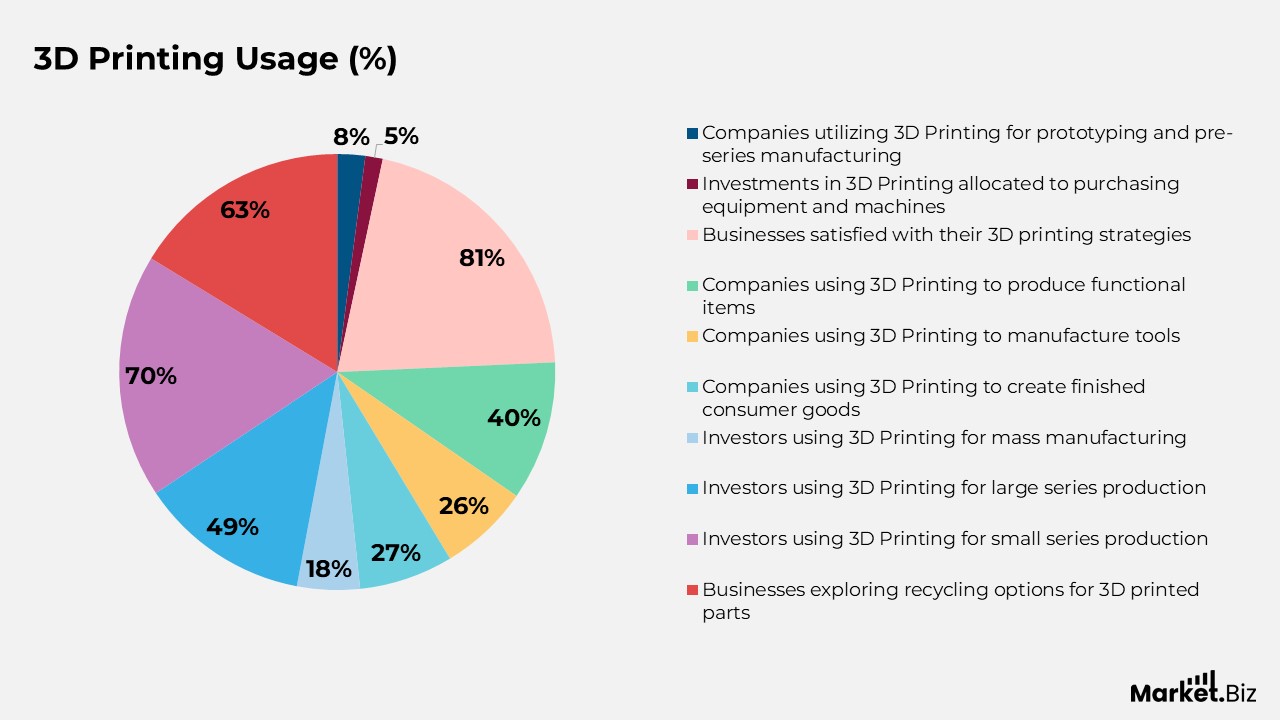
- 8% of companies utilizing 3D Printing primarily use it for prototyping and pre-series manufacturing.
- Only 5% of investments in 3D Printing go toward purchasing equipment and machines.
- 81% of businesses are satisfied with their 3D printing strategies and intend to continue utilizing the technology in the coming years.
- In the first half of 2024, China exported 680,000 3D printers to the U.S., accounting for 37.2% of total exports.
- Germany ranked as the second-largest exporter, shipping 360,000 units. Other significant markets included the UK, Russia, the Netherlands, Japan, Australia, South Korea, Brazil, Canada, and Austria.
- 40% of companies using 3D Printing produce functional items, while 26% manufacture tools.
- 27% of businesses apply 3D Printing for creating finished consumer goods.
- Various materials such as polymers, resins, metals, cement, and even certain ceramics are used in 3D Printing. Food products, including chocolate and purees, are also created using additive manufacturing in fine dining.
- For businesses that heavily invest in 3D Printing, 18% use it for mass manufacturing, 49% for large series production, and 70% for small series production.
- Adidas manufactures 4DFWD running shoes with 3D-printed soles, showcasing the potential of 3D Printing in large-scale production.
- 3D Printing has the potential to reduce waste by up to 95%.
- 63% of businesses are exploring options for recycling 3D printed parts.
(Source: Statista, G2.com, Inc.)
3D Printing Technologies
- Fused Deposition Modeling, also known as Fused Filament Fabrication (FFF), like HP’s Multi Jet Fusion, is the most widely adopted 3D printing technology.
- Among companies using FDM/FFF, 71% employ the technology in-house.
- Stereolithography (SLA) was once a dominant 3D printing technology, but faster technologies are increasingly replacing it. In 2020, the SLA market was valued at $1.6 billion.
- Selective Laser Sintering (SLS) ranks as the 2nd most popular technology. However, 42% of its users outsource the service rather than handling it in-house.
(Source: G2.com, Inc., Statista)
Challenges and Opportunities in 3D Printing
- 55% of companies believe that 3D Printing can enhance the flexibility of their supply chains by simplifying logistics, transport, and inventory management. With 3D Printing, it’s increasingly possible to ship products as digital files rather than physical ones.
- 69% of 3D printing users agree that for the technology to progress, it needs to become more reliable and have a lower cost of entry. 29% of respondents cite a lack of confidence in the technology’s reliability as a major deterrent on a per-project basis.
- 71% of companies feel they lack the necessary knowledge or training to implement 3D printing technology effectively.
- The 3D printing market faces significant constraints due to the high costs of both the technology itself and the materials required.
- Speed and scalability remain key obstacles for industries adopting 3D Printing. For instance, while aerospace companies may need only 100 components a month, the automotive industry requires thousands. This discrepancy results in slower adoption in the automotive sector compared to other industries.
- Some analysts have raised concerns about how traditional intellectual property protections will evolve in response to the widespread use of 3D Printing.
- International 3D printing standards and quality control represent a significant challenge for the market. Governing bodies will likely need to establish these standards to ensure consistent quality and reliability moving forward.
(Source: G2.com, Inc., Statista)
Applications of 3D Printing
- Prototyping accounts for 67% of 3D printing applications.
- 21% of 3D Printing is used for producing end-use parts.
- Tooling purposes make up 6% of 3D printing applications.
- 4% of 3D Printing is dedicated to creating aesthetic parts.
- The remaining 2% of 3D printing applications fall under other categories.
(Source: Proto Labs, Inc.)
3D Printing Across Key Industries
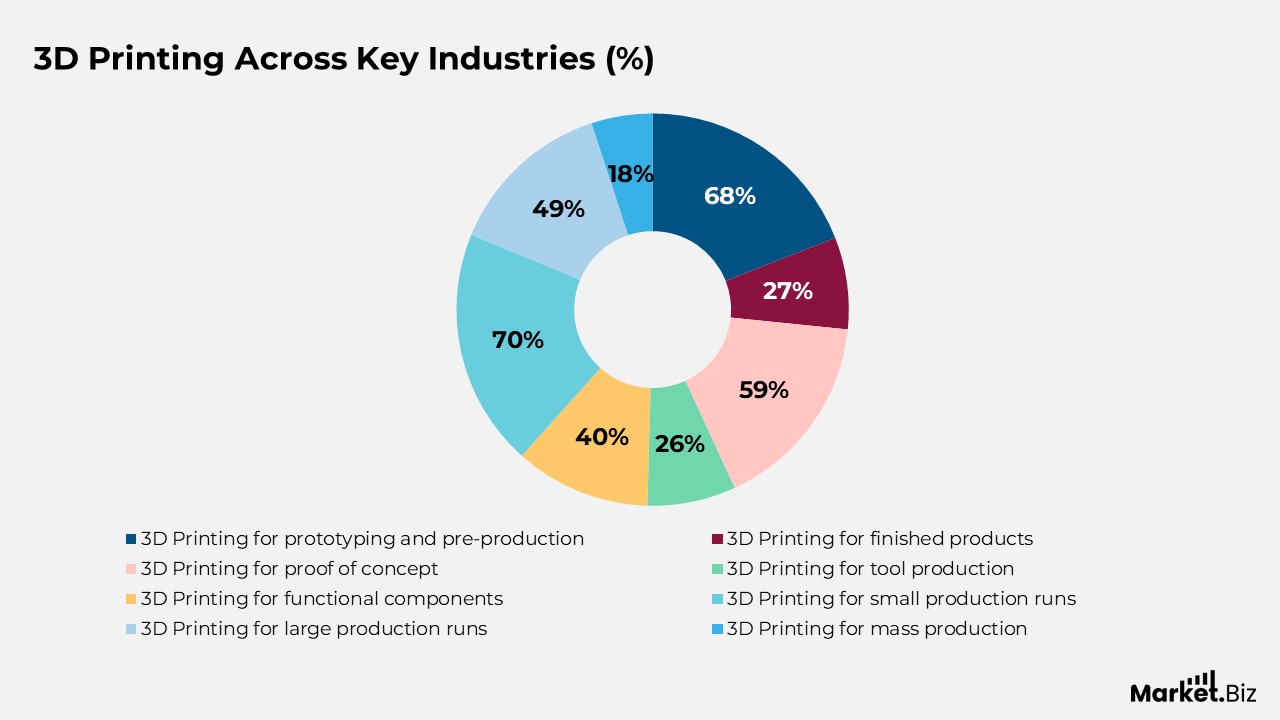
- 68% of companies utilizing 3D Printing use it primarily for prototyping and pre-production processes.
- 27% of companies produce finished consumer products through 3D Printing.
- 59% of companies leverage 3D Printing for proof of concept development.
- 26% of companies rely on 3D Printing for tool production.
- 40% of companies use 3D Printing to manufacture functional components.
- Adidas utilizes 3D Printing to mass-produce running shoes, including the soles of its 4DFWD model.
- Firms that heavily invest in 3D printing report utilizing it for small production runs 70% of the time, large runs 49%, and mass production 18%.
- The molds and tooling segment of the 3D printing market, valued at US$5.2 billion in 2020, is projected to expand to US$20 billion within the next decade.
(Source: G2.com, Inc., Kooc Media Ltd., Statista)
Conclusion
3D Printing has become a game-changing technology with a broad range of applications across industries such as healthcare, aerospace, automotive, and manufacturing. Continuous improvements in 3D printing techniques, along with their ability to produce intricate, tailored, and cost-efficient solutions, have significantly accelerated market growth.
The integration of 3D Printing has led to groundbreaking innovations, including 3D-printed organs, personalized medical implants, and even 3D-printed aircraft components, showcasing its potential to transform conventional manufacturing processes. With rising investments, increased adoption, and rapid technological advancements, the future of 3D Printing looks bright.
Its ability to improve precision, reduce waste, and enhance sustainability makes it a vital tool for the manufacturing sector. As industries continue to harness their capabilities, 3D Printing is set to redefine production, unlocking new possibilities and pushing the limits of innovation.
FAQ’s
3D Printing is extensively utilized across industries like healthcare, aerospace, automotive, consumer goods, and manufacturing. Its applications range from creating customized products to cutting production costs, boosting efficiency, and enabling rapid prototyping.
The 3D printing market is projected to grow at an annual rate between 18% and 27%, driven by continuous technological advancements and increasing adoption across various sectors.
Around 2.2 million 3D printer units were shipped globally in 2021, showcasing the growing integration of the technology across industries.
Leading companies in the 3D printing industry include AutoDesk, HP Inc., 3D Systems, Desktop Metal, and Proto Labs. AutoDesk, for instance, has a market valuation of over $68.2 billion.
On average, businesses spend more than £8,000 annually on 3D printing technology, with 23% of customers investing up to £80,000 annually.