









Introduction
Gaming statistics offer a clear view of how digital entertainment has evolved into a powerful global industry that influences culture, technology, and consumer behavior. What once began as a niche hobby has expanded across mobile devices, consoles, PCs, and cloud platforms, reaching audiences of all ages and demographics.
Mobile gaming leads in engagement due to widespread smartphone adoption, while console and PC gaming continue to attract users seeking immersive, competitive experiences. The growth of multiplayer ecosystems, esports, and live streaming has transformed gaming into a social and professional platform, supported by monetization models such as subscriptions and in-game purchases.
As emerging technologies like virtual reality, cloud gaming, and AI-driven personalization gain momentum, gaming statistics play a critical role in helping businesses and stakeholders understand user trends, revenue dynamics, and future growth opportunities in this rapidly evolving digital landscape.
Editor’s Choice
- In 2024, 80% of gamers aged 16 to 24 participated in online gaming activities.
- Among gamers aged 65 and above, 48% played online games, making this group the lowest in online participation yet still highly engaged.
- In the UK, 50% of women identify themselves as gamers, compared with 57% of men.
- Mobile phones remain the leading gaming device, with 34% of players stating that smartphones are their primary gaming platform.
- Nearly six out of 10 UK gamers report that playing video games helps them feel happier.
- The global esports market is expected to generate $5.93 billion in revenue by 2029.
- Dota 2 ranks as the most popular esports title globally, recording a cumulative tournament prize pool of $6.84 million between January and June 2025.
- Chinese esports players are the highest earners worldwide, with combined winnings exceeding $320 million.
- In 2025, mobile game downloads reached 50.4 billion, a 7.2% decline from 2024, according to Sensor Tower.
- Global mobile consumer spending totalled $81.7 billion in 2025, up 1.3% from the previous year, according to Sensor Tower.
- Total gaming hours worldwide reached 444 billion in 2025, representing a 0.9% year-over-year growth, based on Sensor Tower data.
- The global gaming industry generated $188.8 billion in revenue in 2025, up 3.4% compared with 2024, according to Newzoo.
- Mobile gaming continues to dominate industry revenues, accounting for approximately $103 billion, or 55% of total market revenue. In comparison, console gaming accounted for $45.9 billion (24%) and PC gaming for $39.9 billion (21%), according to Newzoo.
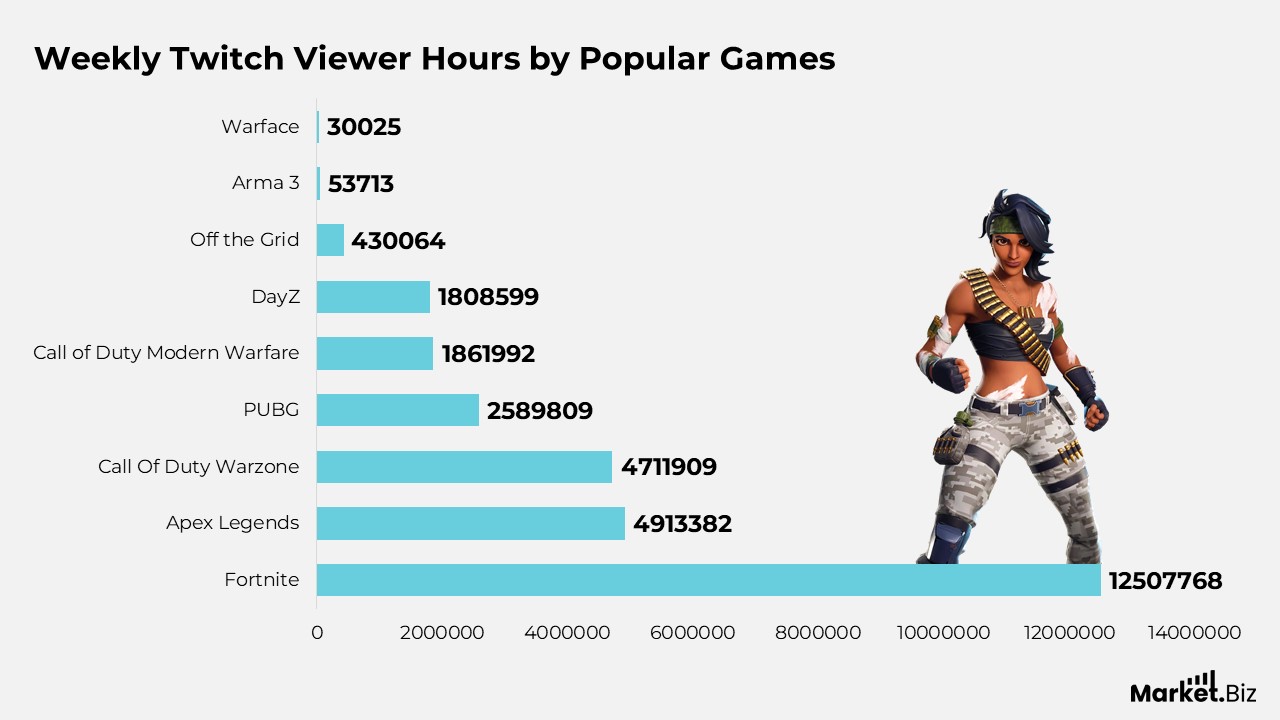
Weekly Twitch Viewer Hours by Popular Games
- Fortnite recorded 12,507,768 weekly viewer hours on Twitch, making it the most-watched game on the list.
- Apex Legends generated 4,913,382 weekly viewer hours, ranking second in audience engagement.
- Call of Duty Warzone attracted 4,711,909 viewer hours during the week.
- PUBG achieved 2,589,809 weekly viewer hours on the platform.
- Call of Duty Modern Warfare accumulated 1,861,992 weekly viewer hours.
- DayZ followed closely with 1,808,599 weekly viewer hours.
- Off the Grid recorded 430,064 viewer hours for the week.
- Arma 3 reached 53,713 weekly viewer hours.
- Warface registered 30,025 weekly viewer hours on Twitch.
(Sources: uswitch, Statista)
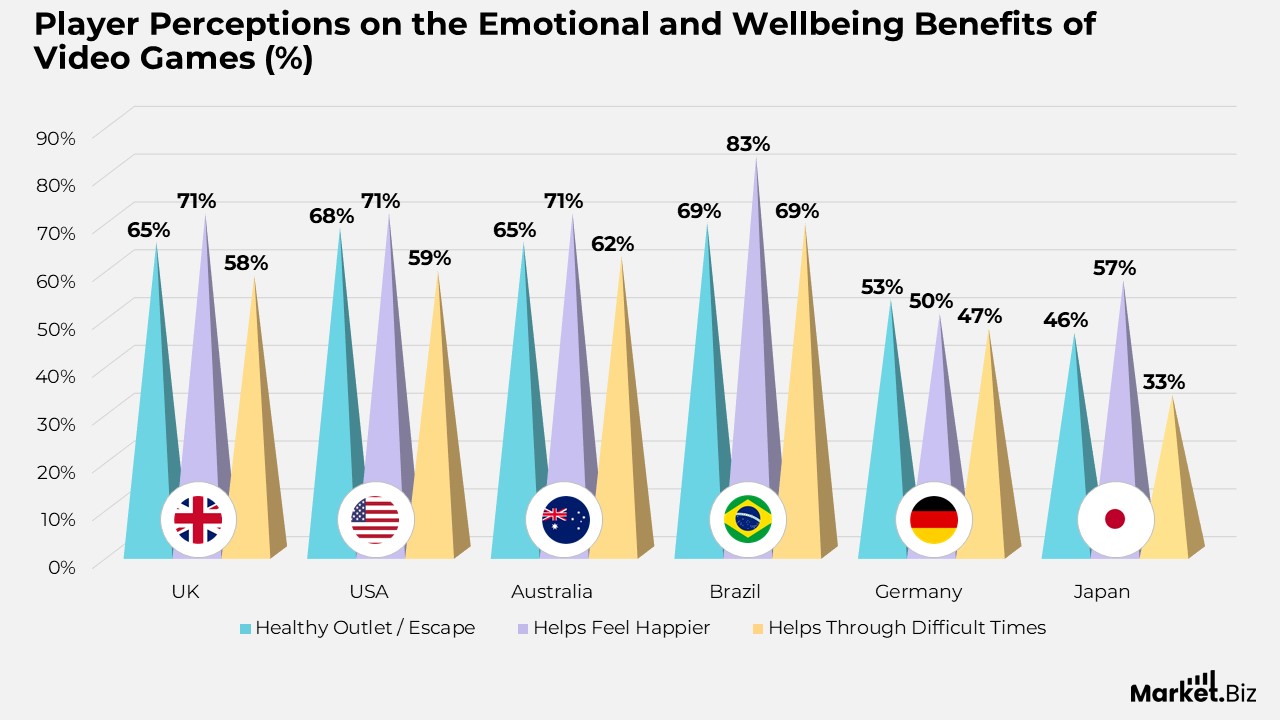
Player Perceptions on the Emotional and Well-being Benefits of Video Games
- In the UK, 65% of players say gaming provides a healthy outlet from everyday challenges, 71% report that it helps them feel happier, and 58% believe it supports them through difficult times.
- In the USA, 68% view gaming as a healthy escape, 71% say it makes them feel happier, and 59% feel it helps them cope with tough moments in life.
- In Australia, 65% consider gaming a positive outlet, 71% associate it with feeling happier, and 62% say it helps them manage challenging periods.
- In Brazil, 69% see gaming as a healthy distraction, 83% say it helps them feel happier, and 69% believe it helps them during difficult times.
- In Germany, 53% say gaming provides relief from daily pressures, 50% feel it makes them happier, and 47% believe it helps them through personal challenges.
- In Japan, 46% view gaming as a healthy outlet, 57% say it contributes to happiness, and 33% feel it helps them navigate difficult situations.
(Sources: uswitch, Statista)
UK Online Gaming and Global Esports Key Statistics
- The global online gaming industry is projected to generate $29.48 billion in revenue in 2025, reflecting continued annual growth from previous years.
- Industry revenue has more than doubled from $13.85 billion in 2017 to $27.97 billion in 2024, with only a slight 0.08% dip between 2021 and 2022.
- By 2030, global online gaming revenue is expected to reach $37.22 billion, indicating steady long-term expansion.
- The UK had 10.84 million online gamers in 2023, and this figure is forecast to rise to 11.56 million by 2027, marking a 6.64% increase.
- Among major markets, the USA is projected to record the strongest gamer growth between 2023 and 2027, rising by 9.18% or 6.62 million players, while China is expected to grow at a slower rate of 2.7%.
- In 2024, just under two-thirds of UK gamers played online, slightly down from 68% the previous year.
- Online participation is highest among younger players: 80% of those aged 16 to 24 play online, compared to 48% of those aged 65 and over.
- In the UK gaming population, men account for 52% and women for 48%, with 57% of men and 50% of women playing video games in 2024.
- Mobile phones remain the most popular gaming device in the UK, with 34% of gamers using smartphones as their primary platform in 2024.
- VR and wearable gaming devices reached a 5% penetration rate in 2024, while tablet usage declined from 20% in 2020 to 14% in 2024.
Moreover
- Regarding player sentiment, over 60% of UK gamers say gaming makes them feel happier, 65% consider it a healthy outlet, and 58% believe it helps them through difficult times.
- Brazilian gamers show the strongest positive sentiment, with 83% saying gaming makes them happier. In comparison, Japanese gamers report the lowest agreement: 46% see it as a healthy outlet, and 33% say it helps in tough periods.
- The most commonly cited drawback in gaming is excessive in-game advertising, identified by 55% of players as a major negative, followed by bugs and glitches at 42%.
- The global esports market is projected to reach $4.78 billion in 2025 and grow to $5.93 billion by 2029.
- Esports revenue has more than tripled from $1.18 billion in 2017 to $3.75 billion in 2023.
- Dota 2 ranks as the most lucrative esports title, with a cumulative prize pool of $6.84 million between January and June 2025, nearly $2 million more than Counter Strike 2 at $4.93 million.
- Additional titles with over $1 million in prize money during the first half of 2025 include Rocket League, Apex Legends, Street Fighter 6, and League of Legends.
- Team Liquid remains the highest-earning esports team globally, with total earnings of $54,861,978 across 2,956 tournaments, averaging $18,560 per event.
- Other leading teams include OG with $38,740,932, Team Spirit with $33,926,603, Evil Geniuses with $28,567,424, and Natus Vincere with $23,832,465 in total prize earnings.
(Sources: uswitch, Statista)
Top Earning Countries in Global Esports by Player Winnings
- China ranks first globally, with total player earnings of $322,749,915 generated by 9,147 esports players.
- The United States ranks second, recording combined player winnings of $291,006,059 across 28,586 competitors.
- Korea stands third, with overall esports earnings reaching $153,945,590 from 5,949 players.
- Russia ranks fourth, where 5,657 players have accumulated total winnings of $92,402,056.
- Brazil completes the top five, with 5,736 players earning a combined $69,671,895 in esports prize money.
(Sources: uswitch, Statista)
Top Individual Esports Players by Total Career Earnings
- Denmark’s Johan Sundstein, known by the game ID N0tail, ranks first with total career earnings of $7,184,163.
- Finland’s Jesse Vainikka, competing under the name JerAx, holds second place with cumulative winnings of $6,486,624.
- Australia’s Anathan Pham, widely recognized as ana, has secured $6,024,412 in total esports earnings, placing third.
- Russia’s Yaroslav Naidenov, known in competition as Miphoshka, ranks fourth with overall earnings of $6,011,771.
- France’s Sébastien Debs, competing as Ceb, completes the top five with career prize money totaling $5,949,443.
(Sources: uswitch, Statista)
Most Watched Esports Tournaments by Peak Viewers Worldwide
- The League of Legends 2024 World Championship recorded the highest peak viewership, with 6.86 million.
- The League of Legends 2023 World Championship followed closely with a peak audience of 6.40 million.
- Free Fire World Series 2021 Singapore attracted 5.41 million peak viewers.
- The League of Legends 2022 World Championship reached a peak of 5.15 million viewers.
- Mobile Legends M5 World Championship achieved 5.07 million peak viewers.
- Mobile Legends M4 World Championship registered 4.27 million viewers at its peak.
- Mobile Legends M6 World Championship recorded 4.13 million peak viewers.
- The League of Legends 2021 World Championship reached a peak audience of 4.02 million.
- Mobile Legends MPL Indonesia Season 14 saw 4.01 million peak viewers.
- The League of Legends 2019 World Championship rounded out the list with 3.99 million peak viewers.
(Sources: uswitch, Statista)
Mobile Gaming by Generation Statistics
- Gen Alpha leads mobile gaming participation with 94% actively playing, followed closely by Gen Z at 92%, Millennials at 88%, and Gen X at 72%.
- 79% of players engage with user-generated content and have played at least one user-generated game.
- Adventure games are the most popular genre among Gen Alpha (54%), Gen Z (45%), and Millennials (44%), while Gen X (46%) and Baby Boomers (50%) show a stronger preference for puzzle games.
- Competitive elements attract 71% of younger players, while 68% are motivated by cooperative and social gameplay experiences.
- Generational definitions include: Gen Alpha, born in the early 2010s or later; Gen Z, born between 1995 and 2009; Millennials, born between 1981 and 1994; and Gen X, born between 1965 and 1980.
Mobile Gaming Motivations
- 52% of players turn to mobile games to prevent or reduce boredom.
- 50% use mobile gaming as a way to escape stress or avoid unpleasant tasks.
- 45% play to develop new skills or challenge themselves.
- 21% engage in gaming for creativity or role-play experiences.
- 18% are motivated by competition, while 14% play to socialize with others.
Social Connections Through Gaming Statistics
- 78% of gamers believe video games can help introduce people to new friends.
- 49% report meeting new people through gaming.
- Another 49% say games help them stay connected with family and friends.
- 39% have formed a close friendship, relationship, or partnership through gaming.
Cross-Platform Play Trends
- Nearly 50% of gamers play across multiple platforms.
- 15% identify as tri-platform players, regularly switching between console, PC, and mobile devices.
- Among tri-platform gamers, 61% are male, and 46% are in the 10-25 age group.
- Adventure games are the preferred genre for 68% of tri-platform players.
Mobile Gaming Retention Statistics
- On Day 1 retention, Midcore games lead at 41.98%, followed by Hybridcasual at 40.11%, Hypercasual at 38.03%, and Casual at 31.01%.
- By Day 7, Midcore games retain 20.96% of players, Hybridcasual 16.08%, Casual 15.20%, and Hypercasual 13.25%.
- On Day 30, Midcore titles maintain the highest retention at 11.45%, compared to Casual at 7.48%, Hybridcasual at 5.86%, and Hypercasual at 4.63%.
(Sources: uswitch, Statista)
Global Gaming Industry Participation and Revenue Statistics
- There are approximately 3.32 billion active video game players worldwide.
- Global gaming market revenue is projected to reach $564.27 billion in 2026.
- Asia leads the world in total active video gamers, followed by Europe and Latin America.
- The United States is home to more than 3,000 professional esports players.
- 53% of males identify as gamers.
- Around 52% of gamers subscribe to at least one gaming service.
(Sources: uswitch, Statista)
Global Gamer Population Growth by Year
- In 2015, the global gamer population stood at 2.03 billion.
- In 2016, the number increased to 2.17 billion, adding 140 million new gamers and recording a growth rate of 6.9%.
- In 2017, the total reached 2.33 billion, up 160 million players and 7.37% year over year.
- In 2018, the gamer base expanded to 2.49 billion, up 160 million, marking 6.87% growth.
- In 2019, the total climbed to 2.64 billion, up by 150 million, representing a 6.02% increase.
- In 2020, the number grew to 2.81 billion, adding 170 million gamers and achieving 6.44% annual growth.
- In 2021, the global gamer population reached 2.96 billion, an increase of 150 million, with growth slowing to 5.34%.
- In 2022, the total rose to 3.09 billion, adding 130 million new gamers and recording 4.39% growth.
- In 2023, the gamer base expanded further to 3.22 billion, with 130 million additional players and 4.21% growth.
- In 2024, the global gaming population reached 3.32 billion, up 100 million from 2023 and reflecting a 3.11% year-over-year growth rate.
(Sources: uswitch, Statista)
Leading Countries by Number of Esports Players
- The United States leads globally with 3,430 registered esports players.
- China ranks second, reporting 1,582 esports competitors.
- 1,398 professional players closely follow Brazil.
- South Korea has 933 esports players actively competing.
- France records 918 esports participants.
- Australia and Russia are tied, each with 884 players.
- The United Kingdom has 880 esports players.
- Germany reports 821 active esports competitors.
- Saudi Arabia completes the list with 689 esports players.
(Sources: uswitch, Statista)
Conclusion
Current gaming statistics underline the scale and maturity of the global gaming landscape. Gaming has firmly established itself as a core component of digital entertainment across multiple demographics and geographies. Participation spans generations, with strong engagement from younger audiences and increasing involvement from older age groups, reflecting the broad appeal of interactive content.
Financial indicators also point to sustained expansion, as global revenues continue to rise and mobile gaming maintains its leadership position in overall earnings. Esports has strengthened its global footprint through growing prize pools, expanding professional player bases, and record-setting viewership figures. Meanwhile, subscription models, cross-platform access, and community-driven content are enhancing user retention and long-term engagement.
In summary, the data illustrate a robust and adaptive industry that continues to evolve with technological advances and consumer behaviour. As connectivity improves and new gaming formats emerge, the sector is well positioned to maintain steady growth, diversify its monetisation strategies, and deepen its role in the global digital economy.
FAQ’s
Gaming statistics refer to data that measures the size, growth, engagement levels, revenue performance, and user behavior within the video game industry. These insights help businesses, developers, investors, and analysts understand market trends and player preferences.
The global gaming community includes billions of active players across mobile, console, and PC platforms. Participation continues to expand as internet access and smartphone adoption increase worldwide.
Mobile gaming currently leads in overall revenue, supported by widespread smartphone usage, in-app purchases, and free-to-play monetisation models. Console and PC gaming also continue to contribute strongly to revenue.