









Introduction
Blockchain Statistics: Blockchain technology has rapidly emerged as a game-changing innovation, transforming sectors such as finance, supply chain management, healthcare, and beyond. Its decentralized and secure architecture offers a powerful solution to issues related to data integrity, transparency, and fraud prevention.
By enabling direct peer-to-peer transactions without intermediaries, blockchain improves efficiency and reduces operational costs. This technology is at the forefront of digital transformation, enabling the creation of decentralised applications (dApps), smart contracts, and cryptocurrency platforms. As both businesses and governments continue to explore their capabilities, blockchain is set to revolutionize industries by providing more secure, transparent, and efficient systems.
With ongoing technological advancements and increasing regulatory frameworks, blockchain is poised to play a crucial role in shaping the future of digital economies, fostering trust, and transforming traditional business models.
Editor’s Choice
- As of March 2023, more than 85 million users worldwide are utilizing Bitcoin block explorer blockchain.com wallets.
- The global number of blockchain wallets has exceeded 170 million, including users from both Blockchain.com and Coinbase.
- Currently, approximately 25% of the world’s population owns Bitcoin.
- Moving securities to a blockchain platform could potentially save between $17 billion and $24 billion annually in global trading processing fees.
- 16% of Americans report having invested in, traded, or used cryptocurrency at some point.
- Financial institutions have the potential to reduce their annual costs by up to $11.2 billion through the use of blockchain technology.
- As of March 2023, daily Bitcoin transactions reached a total of 336,600.
- According to a Deloitte survey, 86% of people believe that blockchain technology can significantly enhance the shift toward more touchless business processes.
- Transferring securities to blockchain platforms could reduce annual global trade processing costs by $17 billion to $24 billion.
- 10% of the global population currently owns some form of cryptocurrency.
- More than 45 regulators worldwide utilize Chainalysis for blockchain analytics.
(Source: Blockchain.com, Pew Research Center, Hootsuite)
Types of Blockchain
- Private blockchain
- Public blockchain:
- Hybrid blockchain
- Consortium blockchain
(Source: Global Technology Industry Association)
General Blockchain Statistics
- A Deloitte survey reveals that 86% of people believe blockchain technology will facilitate the transition to more touchless business operations.
- By 2025, 55% of healthcare applications are expected to incorporate blockchain for commercial use.
- The same research found that 91% of respondents anticipate a significant, verifiable return on their blockchain investments within the next five years.
- Blockchain technology is projected to save financial institutions up to $12 billion annually.
- Approximately 3.9% of the global population actively uses blockchain.
- The Solana blockchain leads in activity, with an average of 1.5 million transactions per day.
- Ethereum is the most developed blockchain, hosting over 5,000 projects.
- There are more than 82 million Bitcoin wallets in existence.
- As of February 2021, the blockchain recorded a total of 620.369 million transactions.
- Global spending on blockchain development services and solutions reached $6.6 billion in 2021.
- More than 20 countries have either adopted or are actively researching the concept of a national cryptocurrency.
- 24% of companies are projected to invest between $5 million and $10 million in blockchain technology in 2021.
(Source: Deloitte, PwC, Forbes, Finances Online, BIS, UPay)
Automotive Blockchain Market Size
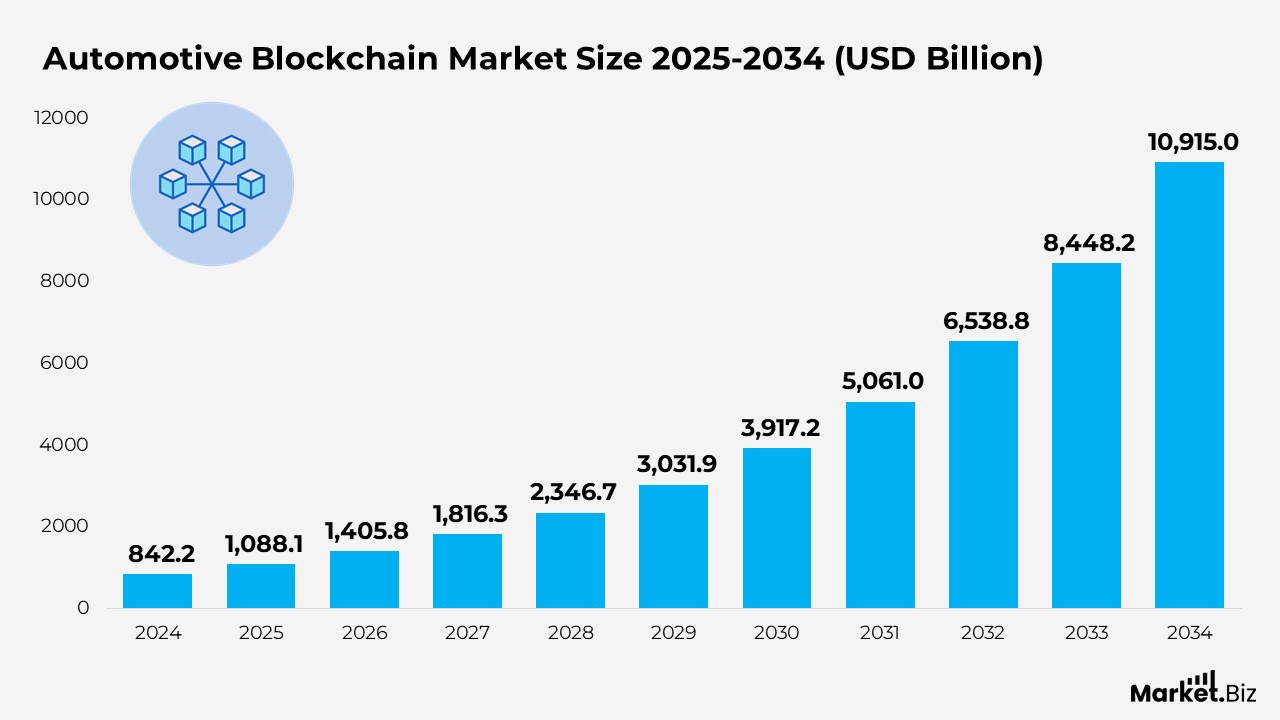
- According to Market.us, the global automotive blockchain market is projected to generate $1,088.1 billion in 2025, growing to $6,538.2 billion by 2032, with a compound annual growth rate (CAGR) of 26.8% between 2025 and 2032.
- The growing demand for transparency and security in vehicle transactions and records drives the automotive blockchain market.
- In 2024, the Private Blockchain segment led the market, holding a share of over 56% due to its enhanced security features for sensitive automotive data.
- The Smart Contracts segment dominated the market, accounting for more than 35% of the share, thanks to its ability to automate and streamline transactions across the industry.
- The Infrastructure and Protocols segment captured more than 44% share, driven by its foundational role in implementing blockchain across automotive applications.
- The Personal Mobility segment held a leading position with over 47% share, driven by the increasing use of blockchain for enhanced vehicle security and management.
- The OEMs segment captured more than 40% of the market, underscoring their pivotal role in integrating blockchain technology into automotive production and supply chains.
- North America dominated the automotive blockchain market in 2024, accounting for more than 39% of the market share, with revenues reaching approximately USD 328 million.
(Source: Market.us)
Blockchain Technology Market Size
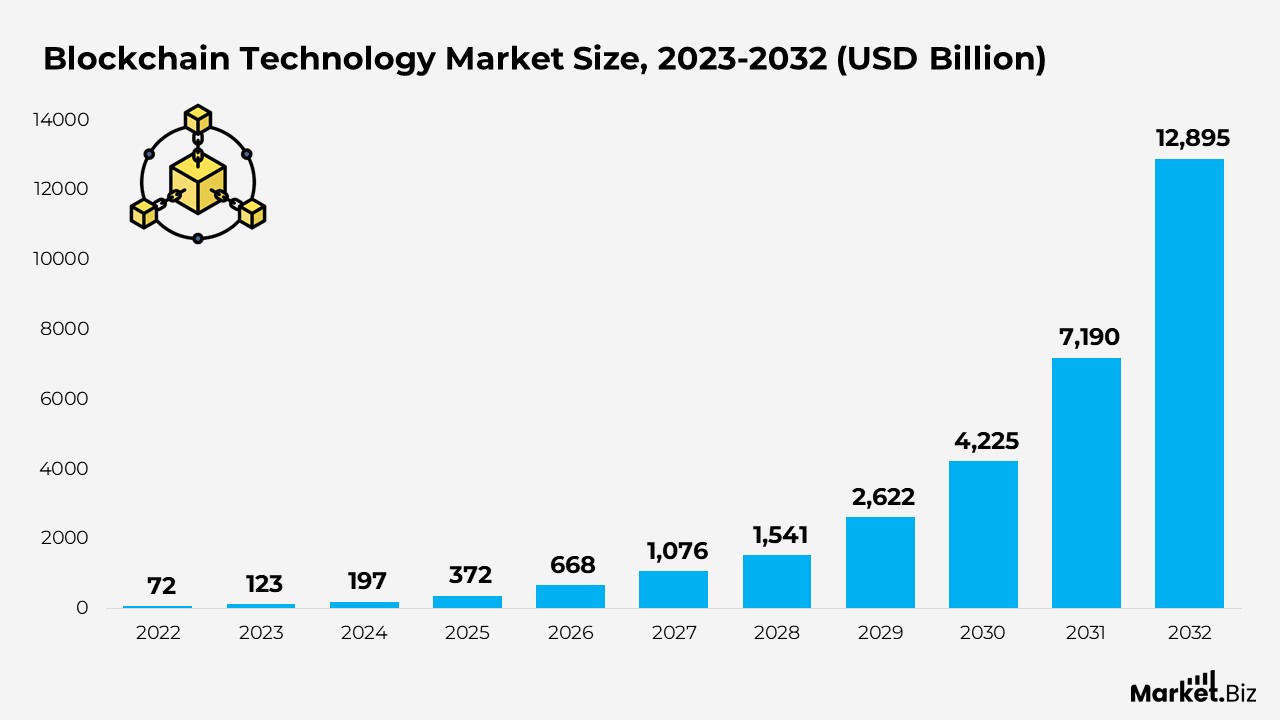
- The global blockchain technology market is expected to increase from $123 billion in 2023 to $12,895 billion by 2032, reflecting a compound annual growth rate (CAGR) of 68% from 2023 to 2032.
- The growth of the blockchain technology market is driven by the increasing recognition of its benefits and the growing need for secure and transparent systems.
- In 2022, the Public Cloud segment led the market, accounting for over 62% of the share due to its scalability, cost-effectiveness, and ease of access.
- The Infrastructure & Protocols segment captured a share of more than 65.4% in 2022, driven by its foundational role in the blockchain ecosystem.
- The Payments segment held over 44% share in 2022, thanks to blockchain’s advantages in enhancing security, transparency, and reducing transaction costs.
- The Large Enterprise segment dominated the market in 2022, with over 68.5% share due to its widespread adoption of blockchain solutions.
- The Banking, Financial Services, and Insurance (BFSI) segment led the market, accounting for over 40% of the share in 2022, driven by the need for security and transparency in financial transactions.
- North America held more than 39% of the global blockchain technology market in 2022, with a demand valued at USD 28 billion in 2023.
(Source: Market.us)
Blockchain Trends
The primary factor driving blockchain adoption is secure data sharing, with enhanced access to transactions and financial products also playing a significant role in its growth.
- Nearly 80% of central banks globally are exploring the development of their cryptocurrency.
- Blockchain technology is projected to generate over $3.1 trillion in business value by 2030.
- The Internet of Things (IoT) market is expected to reach $1,463.2 billion by 2027.
- In a Deloitte survey, 68% of CEOs identified data privacy and security as the most critical areas for accelerating blockchain adoption.
- According to Deloitte, 86% of experienced technology teams acknowledge the significant benefits provided by blockchain.
- 52% of financial services institutions (FSIs) believe blockchain would be highly beneficial for customer verification.
- South Korea’s blockchain market, valued at $20.1 billion in 2016, is projected to reach $356.2 billion by 2023.
- Over 100 Chinese enterprises are currently offering blockchain applications in the market.
- By 2025, 55% of healthcare applications are anticipated to integrate blockchain. More than $270 billion worth of assets have been transferred using blockchain technology.
- The blockchain gaming industry is projected to reach a market value of $39.7 billion by 2025.
- 53% of C-level executives consider blockchain to be an essential part of corporate infrastructure.
- By 2026, the food and agriculture sectors are expected to reach a value of $1.48 billion through the adoption of blockchain technology.
- Below are the top ten companies leveraging blockchain technology.
| Companies | Blockchain Network Used |
|---|---|
| Adobe | Ethereum |
| Andreessen Horowitz | Ethereum, BitcoinFlow, Solana, Near, Arweave, Celo, and others |
| Allianz | Corda, Hyperledger Fabric |
| Anthem | Hyperledger Fabric |
| Ant Group | Antchain |
| A.P. Moller—Maersk | TradeLens, Hyperledger Fabric |
| Aon | Corda |
| BHP | MineHub, Hyperledger Fabric |
| Baidu | XuperChain |
| Block | Bitcoin. |
(Sources: Deloitte, Coindesk, Economic Times, Binance, Statista, PwC)
Cryptocurrency Statistics
- Over the past three years, the number of cryptocurrency users has surged by 415 million.
- There are currently more than 617 million cryptocurrency users worldwide, representing a 100 million increase from 2023 when the total stood at 517 million.
- Since the beginning of 2021, the number of cryptocurrency users has grown by over 377%.
- As of now, there are 10,025 cryptocurrencies in existence, with over 20,000 having been launched to date, although only 50% remain active.
- The global cryptocurrency market is projected to generate US$85.7 billion in revenue by 2025.
- The market is expected to demonstrate a compound annual growth rate (CAGR) of 11.01% between 2025 and 2026, reaching an estimated US$95.1 billion by 2026.
- The average revenue per user in the cryptocurrency market is forecasted to be US$92.9 in 2025.
- The United States is projected to lead in revenue generation in the cryptocurrency market, with an estimated $16.1 billion in revenue by 2025.
- By 2026, the global cryptocurrency user base is expected to reach 962.92 million users.
- The user penetration rate in the cryptocurrency market is estimated to be 11.82% in 2025, with a slight increase to 12.24% by 2026.
- As of 2024, global cryptocurrency ownership is projected to average 6.8%, with over 560 million crypto owners worldwide.
Moreover
- As of February 2021, there were approximately 1.193 million Ethereum transactions per day. In addition to digital currency sales, Ethereum facilitates the creation of smart contracts.
- 61% of cryptocurrency owners are male, while 39% are female.
- Approximately 34% of cryptocurrency owners fall within the 25-34 age group.
- 65% of cryptocurrency owners have expressed an interest in using cryptocurrency for payments.
- Binance ($28.85 billion), HBTC ($14.44 billion), and Hydax Exchange ($12.19 billion) are the top three cryptocurrency exchanges by trading volume, with Dsdaq ($11.97 billion), ZG.com ($11.5 billion), and Xheta Global ($11.07 billion) also being significant players.
- The United States leads the world in the number of crypto ATMs, with 14,112 ATMs, accounting for 83.2% of the global market. Europe follows with 1,258 ATMs (7.4%), and Canada ranks third with 1,246 ATMs (7.3%).
- According to the Global Crypto Adoption Index, the leading countries in crypto adoption are Ukraine, Russia, Venezuela, China, Kenya, the United States, South Africa, Nigeria, Colombia, and Vietnam.
- As of February 21, 2021, the total number of Bitcoin transactions stood at 272,006, with approximately 330,000 transactions in December 2020 and 400,000 in January 2021.
(Source: CNBC LLC, Global Crypto Adoption Index, Coin ATM Radar, Triple A Technologies Pte. Ltd, Statista, DemandSage, Chainalysis )
Global Blockchain Spending Overview
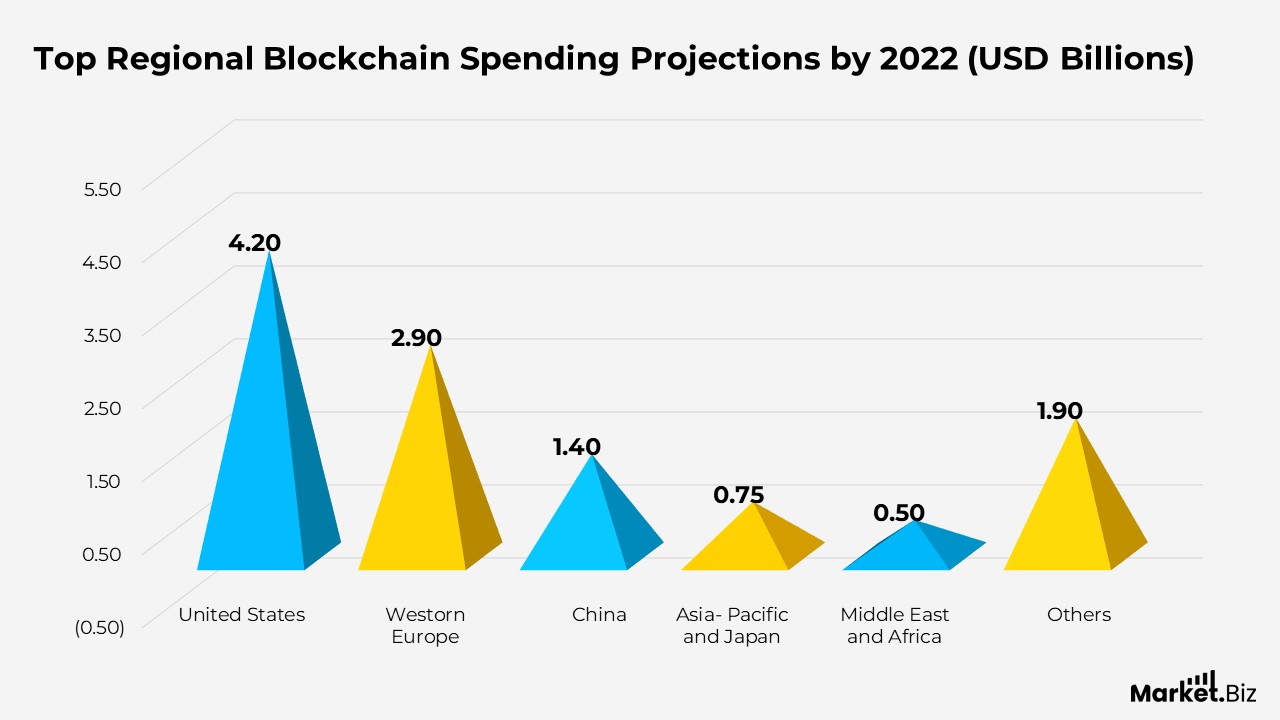
- In 2022, the United States is expected to allocate $4.2 billion toward blockchain solutions, positioning it as the largest regional spender.
- Following the U.S., Western Europe is projected to spend approximately $2.9 billion, while China is expected to spend $1.4 billion.
- The Asia Pacific and Japan regions are estimated to invest $0.75 billion, while the Middle East and Africa are expected to spend around $0.5 billion. The remaining regions will collectively account for $1.9 billion.
- Blockchain expenditure from the automotive sector is forecasted to increase significantly, rising from $849.5 million in 2019 to $14.731 billion by 2025.
- In 2021, global investment in blockchain solutions is projected to total $6.6 billion, with future estimates predicting this figure will approach $19 billion by 2024.
Top Regional Blockchain Spending Projections
(Source: International Data Corporation, Statista, Cision)
Ethereum Blockchain Statistics
- On March 18, 2023, the Ethereum blockchain processed an average of 1.043 million transactions per day.
- As of March 2023, there are 120.45 million Ethereum in circulation.
- Unlike Bitcoin, Ethereum does not have a set supply limit.
- Ethereum holds 63.4% of the entire decentralized finance (DeFi) market.
- As of March 16, 2023, there are 413,904 active Ethereum addresses.
- The most frequently used Ethereum blockchain address is associated with OpenSea.
- Together, Ethereum and Bitcoin account for more than 50% of the cryptocurrency market share.
- As of the latest data, the price of Ethereum stands at $1064.81.
- There are four primary types of digital ledger networks: Private blockchain, Public blockchain, Hybrid blockchain, and Consortium blockchain.
- The Ethereum network hosts over 3,000 decentralized applications (DApps).
(Sources: Ycharts, Statista, Coindesk, Coinmarketcap)
Bitcoin Ownership
- As of March 2023, 85 million users have created Bitcoin wallets on Blockchain.com, marking a 102% increase in user numbers compared to the previous year and a 42 million rise since 2019.
- The Bitcoin blockchain reached 464.83 Gigabytes in size by March 2023, a significant rise from 1.02 Gigabytes in February 2012.
- Coinbase, another popular platform, boasts over 108 million Bitcoin users, which translates to approximately 193 million Bitcoin wallets globally.
- By 2023, it is expected that over 90% of all Bitcoins will have been mined.
- The total number of Bitcoins in circulation is limited to 21 million.
- A single Bitcoin transaction consumes 2,188 kilowatt-hours of electricity, which is vastly higher than the 148.63 kilowatt-hours used by 100,000 VISA transactions.
- The last Bitcoin is estimated to be mined in 2140.
- The FBI holds 1.5% of the total Bitcoin supply worldwide.
- As of March 18, 2023, the price of Bitcoin stands at $27,344.60.
(Sources: Blockchain, Statista, Tech Mahindra)
Bitcoin Blockchain Statistics
- On average, over 20,000 Bitcoin transactions are completed each day as of March 2023.
- Genesis Coin leads as the world’s top manufacturer of Bitcoin ATMs.
- Blockchain.com has 85 million Bitcoin wallet users worldwide as of March 2023.
- The United States hosts 11,386 of these Bitcoin ATMs, representing 89.4% of the global total.
- MicroStrategy holds the largest Bitcoin reserve among publicly traded companies.
- There are 14,915 Bitcoin ATMs in operation globally.
(Sources: Statista
Demographics of Blockchain
Gender
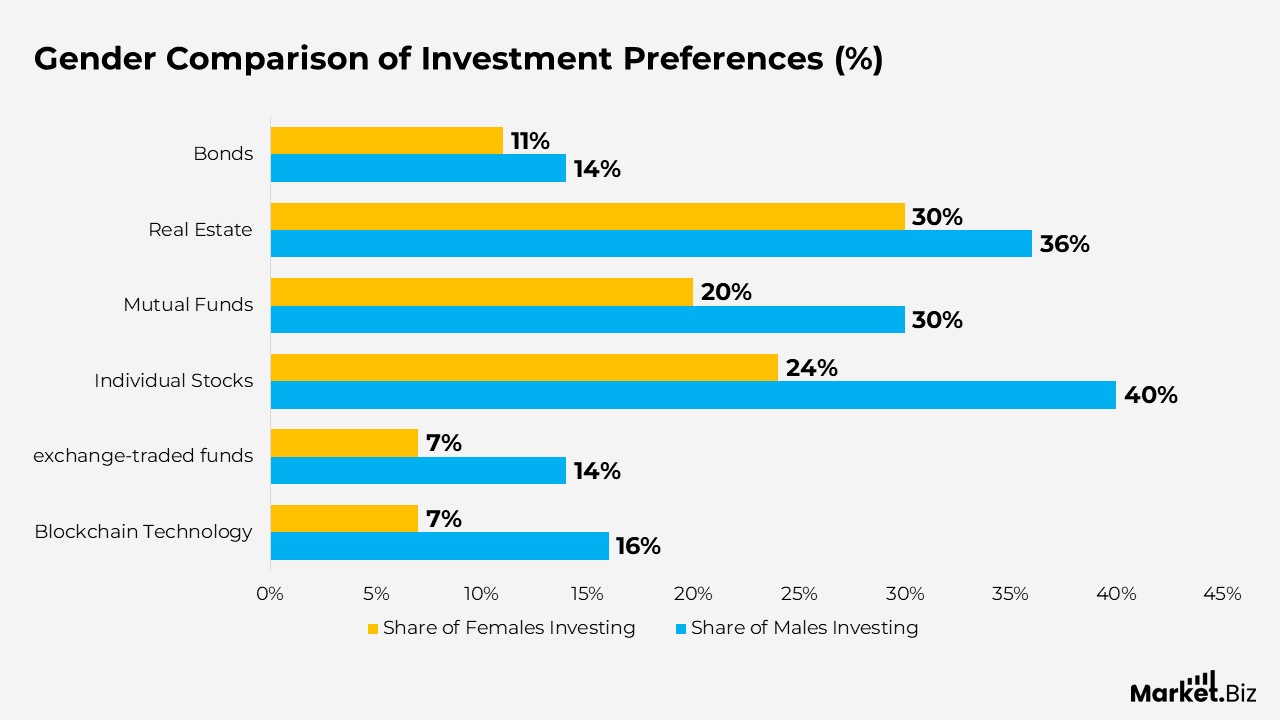
- According to a survey by CNBC and Acorn, 16% of men and 7% of women have invested in blockchain technology.
- 22% of males reported having used cryptocurrencies, compared to just 10% of females.
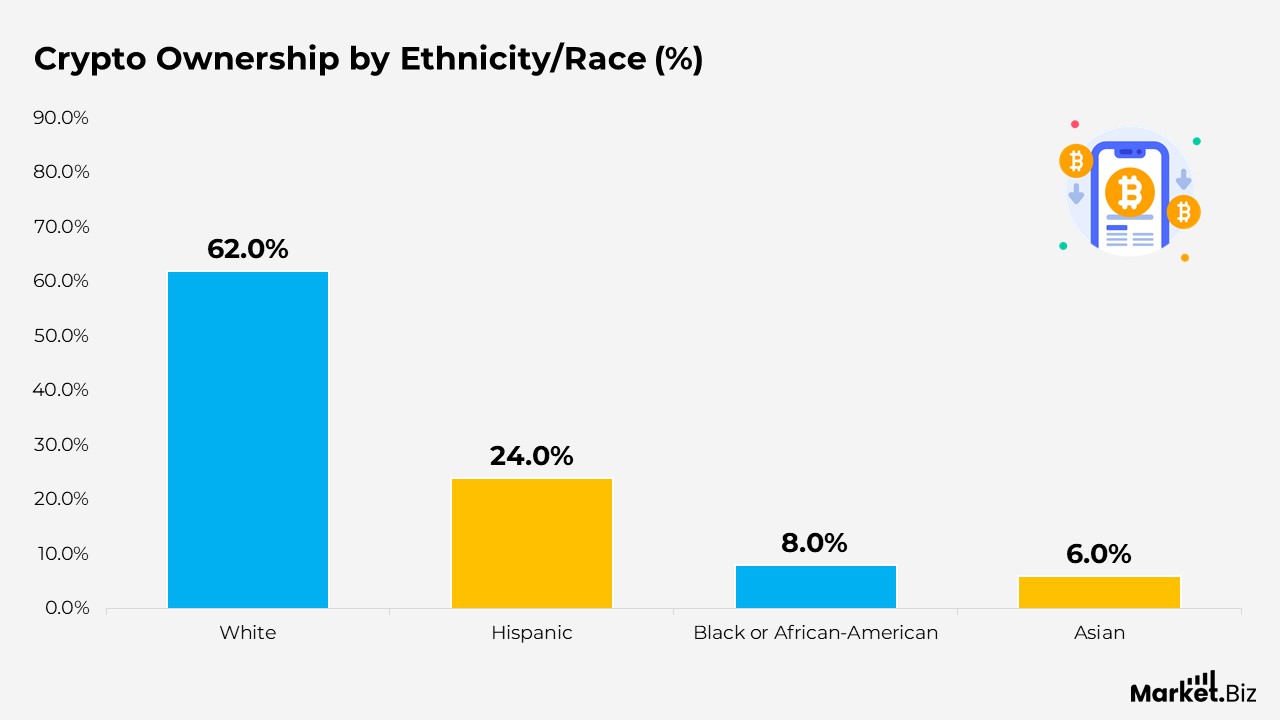
Race
(Sources: DemandSage, Science Direct, Morning Consult)
Top Blockchain Companies
- Bitcoin is the most expensive cryptocurrency, valued at over $55,000 per coin as of February 2021, earning it the title of the “currency of the future.”
- The leading blockchain and cryptocurrency companies in China include Bitmain Technologies, with $450 million in total equity funding; Hyperchain, which has raised $249 million; and Jixin Blockchain, which has secured $100 million.
- In the U.S., IBM holds the most blockchain patents, with 185 active patent families, followed by Bank of America (74 patents), Ant Financial (78 patents), Walmart (50 patents), and Mastercard (48 patents) as of 2019.
- The professional services sector is expected to experience the highest growth in blockchain spending, with a compound annual growth rate (CAGR) of 54%. This is followed by the healthcare sector, at 43.9%, and state and local governments, at 48.2%.
(Source: Statista, CB Insights)
Conclusion
Blockchain technology is rapidly advancing, transforming industries such as finance, healthcare, and more. As its adoption expands, major players like Bitcoin, Ethereum, and other leading blockchain companies are redefining the landscape through substantial investments and innovations. The technology’s ability to enhance security, transparency, and operational efficiency is driving its widespread adoption across various sectors.
With increasing investments in blockchain, the growth of patents, and broader global adoption, the outlook for blockchain remains positive, positioning it as a vital force in both traditional and emerging markets. As technology continues to mature, its influence on business operations, financial systems, and governance is poised to expand, unlocking new opportunities for innovation and economic growth.
FAQ’s
Blockchain technology is a decentralized digital ledger that records transactions across multiple computers. This system ensures transparency, security, and data integrity, all without relying on intermediaries.
As of March 2023, there are approximately 85 million individual Bitcoin wallet users on Blockchain.com.
Blockchain’s increasing adoption is fueled by its ability to improve security, transparency, and operational efficiency. It eliminates intermediaries, facilitates decentralized systems, and builds trust in digital transactions, making it a highly appealing solution for various industries.
Blockchain enhances security by employing cryptographic methods and decentralized validation to ensure data integrity and authenticity. Each block is securely connected to the preceding one, making it nearly impossible to alter past transactions without being detected.
Bitcoin is considered the most expensive cryptocurrency due to its pioneering role, limited supply (with a cap of 21 million coins), and strong recognition. Its decentralized structure and status as a store of value contribute to its high market price.
Ethereum stands out as the most advanced blockchain thanks to its well-developed ecosystem, which includes decentralized applications (DApps), smart contracts, and a thriving development community. Ethereum serves as the foundation for numerous projects, particularly in the rapidly growing DeFi (Decentralised Finance) space.