









Introduction
Cryptocurrency Mining Statistics: The procedure of authenticating and validating payments on the blockchain platform, as well as incorporating them into the blockchain database, is referred to as cryptocurrency mining. This is a fundamental characteristic of numerous cryptocurrencies, including Bitcoin and Ethereum.
In traditional financial systems, banks or central governments maintain a ledger to document transactions. Conversely, in decentralized cryptocurrencies like Bitcoin, a network of computers collectively upholds the record through a distributed technology known as Blockchain.
Statistics related to cryptocurrency mining indicate a substantial, energy-intensive industry dedicated to validating transactions through powerful computers that solve intricate puzzles.
Major statistics underscore enormous energy consumption (comparable to that of small nations), significant growth in the hardware market, rising hash rates, and considerable environmental repercussions stemming from energy usage and electronic waste.
Additionally, statistics monitor reward halvings (such as those of Bitcoin) that reduce miner pay-outs over time and stimulate technological competition. Key metrics encompass energy (TWh), hash rate (TH/s), hardware expenses (ASICs, GPUs), and geographical distribution based on low electricity costs.
Editor’s Choice
- Bitcoin mining currently accounts for about 0.55% of the global electricity demand, a slight decrease attributed to enhanced efficiencies.
- By mid-2025, the estimated global electricity consumption for Bitcoin mining is projected to reach 168.3 TWh.
- The cryptocurrency mining sector is valued at $2.75 billion in 2025. With an anticipated compound annual growth rate (CAGR) of 13.2% extending through 2035.
- As of April 2025, Bitfarms has achieved an energy efficiency of 22.5 W/TH, reflecting an improvement of over 40% year-on-year.
- Bitcoin’s daily energy requirement is approximately 18.9 GWh, leading to an annualised consumption of 172 TWh.
- A consumer survey conducted in 2025 indicates that 32% of American adults now possess cryptocurrency. Which is more than double the figure from two years prior.
- Currently, there are over 10,300 active cryptocurrencies, with Ethereum and Tether still lagging behind Bitcoin in terms of market capitalisation.
Historical Facts about Cryptocurrency Mining
- Satoshi Nakamoto secretly created and launched Bitcoin in 2009, marking it as the first cryptocurrency in the world.
- Other significant cryptocurrencies, including Litecoin, Swiftcoin, and Namecoin, emerged in the market in 2011.
- In 2011, Kraken, a cryptocurrency trading platform, was established.
- Coinbase rapidly established itself as one of the primary Bitcoin exchanges in June 2012.
- Initially released in 2013, Dogecoin (DOGE) was intended as a parody of cryptocurrencies like Bitcoin and Litecoin.
- By March 2018, however, the term cryptocurrency had been recognised and included in the Merriam-Webster Dictionary as an official word.
- In 2017, Coinbase became the first major cryptocurrency exchange to go public by being listed on Nasdaq.
General Cryptocurrency Mining Statistics
- As of 2023, it is anticipated that the market share of cryptocurrency will increase by $37.87 billion.
- In the same year, the average revenue per user in the cryptocurrency market is projected to be $56.19.
- Meanwhile, user penetration in 2023 is estimated to be around 8.8%, and it is expected to rise to 12.5% by 2027.
- The annual growth rate for revenue from 2023 to 2027 is forecasted to be 14.40%.
- By the end of 2027, the revenue is expected to reach $64.87 billion.
- Although there are no formal regulations governing it, cryptocurrency ranks as the eighth largest economy.
- The market capitalization of Bitcoin is approximately USD 741 billion.
- Bitcoin continues to be one of the most widely used cryptocurrencies.
- As of March 2023, there are nearly 22,932 different cryptocurrencies available.
- Globally, in 2023, there will be over 420 million cryptocurrency users in the United States, which will account for a 13.7% market share.
- The valuation of Bitcoin is around $5.1 billion, with Litecoin and Peercoin also ranking among the top 10.
- While confidence in decentralized digital currencies is nearly universal at 100%. About 67% of millennials consider Bitcoin to be a safe-haven asset.
- Daily trading volume in cryptocurrency is expected to decline by $62.1 billion in 2023.
- More than 50% of cryptocurrency investors are seeking income.
- The top ten cryptocurrencies represent 84% of the total market value of cryptocurrencies.
- The popularity of cryptocurrencies is evident, as there is a social media post related to them every two seconds.
Cryptocurrency Mining Market Statistics
- The worldwide cryptocurrency mining industry was valued at over $7 billion in 2020.
- The global market for cryptocurrency mining equipment is anticipated to expand to $60.56 billion by 2029.
- By 2025, the market is projected to attain a value of $50.13 billion, indicating consistent growth.
- The sector is predicted to experience a compound annual growth rate (CAGR) of 6.3% during this timeframe.
- The Global Digital Currency Market is expected to reach approximately USD 76.9 billion by 2032.
Cryptocurrency Mining by Country Statistics
- In 2018, the number of cryptocurrency users in the UK surged by 600%. With only 3% of the population engaging in cryptocurrency usage.
- Nigeria leads in the volume of Google search results for the term “cryptocurrency”.
- In the United States, Bitcoin stands as the most favored cryptocurrency, representing 72% of all cryptocurrency transactions.
- A total of 79% of cryptocurrency users in the UK have made a bet on Bitcoin.
- Africa possesses the smallest cryptocurrency market compared to other continents. Having received $8 billion in bitcoins and recorded 8.1 billion in blockchain transactions.
- Professional traders dominate the East Asian cryptocurrency market, controlling over 90% of the trading volume, which exceeds $2000 in cryptocurrency.
- By the start of 2025, there will be more than 2000 blockchain projects from US corporations in development.
Growth Statistics of Cryptocurrency Mining
- In 2025, global demand for digital assets increased by 18%, fueled by institutional adoption and a greater utilization in emerging markets.
- Bitcoin miners generated $11.2 billion in 2025, with mining rewards experiencing a year-over-year growth of 7.1%.
- Next-generation ASICs enhanced hash rate performance by 35% compared to previous models, thereby improving profit margins for major mining operations.
- The expanded application of blockchain technology in industries such as supply chain and banking stimulated mining activities to fulfill validation requirements.
- As electricity costs rose, 45% of mining companies in 2025 began to depend solely on renewable energy sources.
- In 2025, more defined cryptocurrency regulations in the United States, European Union, and Canada fostered investments in institutional-scale mining.
Cryptocurrency Mining Revenue Statistics
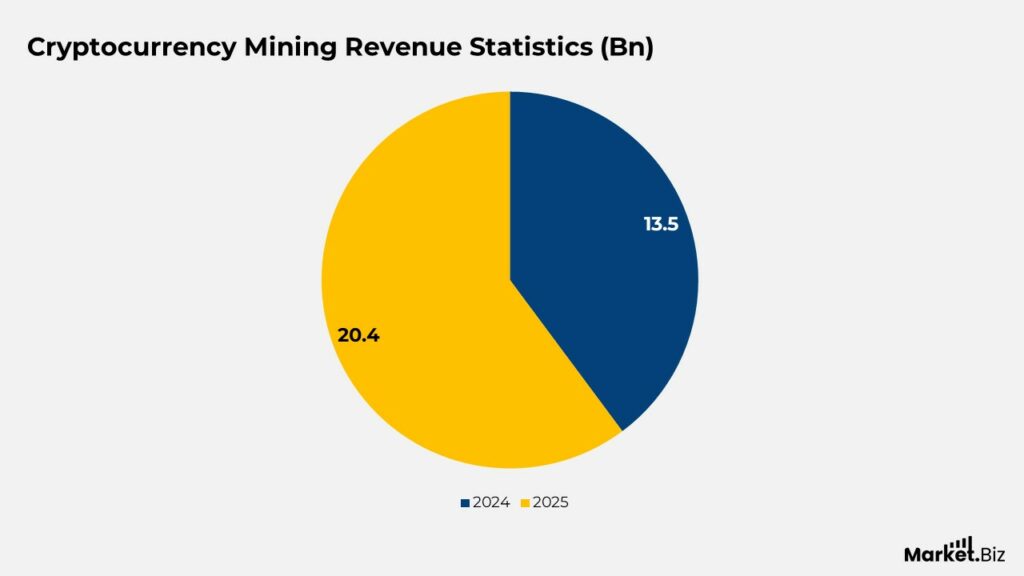
- Total mining revenue is expected to reach $20.4 billion by 2025, reflecting a 9% increase from 2024.
- Bitcoin mining constituted 66% of the global revenue, generating an estimated $13.5 billion this year.
- Ethereum staking rewards are projected to be around $2.1 billion in 2025, ensuring strong returns for validators following the Merge.
- Altcoin mining revenue exceeded $2.9 billion, driven by tokens like Litecoin, Kaspa, and Monero.
- Participation in mining pools saw an additional 17% increase in 2025, as smaller operations adopt shared reward models.
- The demand for mining-backed validation remained robust for NFTs and DeFi platforms, especially on proof-of-work compatible chains.
- Global investments in mining hardware are anticipated to reach $4.5 billion in 2025, indicating a 12.5% annual growth as infrastructure continues to expand.
Cryptocurrency Mining Energy Consumption Statistics
- In early 2025, Bitcoin mining’s energy consumption reached around 105 TWh, which is comparable to the energy usage of countries such as Sweden.
- In 2025, global carbon emissions from mining decreased by 9.5%, attributed to the increased implementation of clean energy infrastructure.
- The global utilisation of renewable energy in mining rose to 62%, driven by policy mandates and energy pricing strategies.
- Hydropower and solar energy continue to be the primary sources, accounting for over 74% of renewable energy-based mining operations in North America.
- By 2025, the average cost of power for mining one Bitcoin in the United States rose to $17,100, which has tightened profit margins for smaller mining operators.
- China’s ban on mining persists, leading to a significant shift in operations, with more than 68% relocating to energy-efficient areas such as Iceland and Paraguay.
- Technological advancements in emission-reducing hardware, including immersion cooling systems, have resulted in a 14% reduction in mining energy consumption, thereby enhancing operational efficiency.
ASIC, GPU, and Cloud Statistics
- ASIC miners have now achieved speeds of up to 150 TH/s, more than doubling the performance of previous models and establishing dominance in Bitcoin mining efficiency.
- GPU mining continues to be essential for Ethereum Classic, Ravencoin, and other cryptocurrencies, with NVIDIA’s RTX 5000 series and AMD’s RDNA 4 leading in performance.
- Cloud mining services experienced a 19% growth in 2025, with platforms such as Genesis Mining and NiceHash capturing significant market share among users who do not own hardware.
- The adoption of mining rig rental platforms has surged, providing users with low-capital access to remote hash power and enabling automated profit switching.
- FPGA mining saw increased adoption in 2025 for cryptocurrencies utilizing niche algorithms, offering a combination of flexibility and moderate efficiency.
- Improvements in algorithm optimizations have enhanced overall mining efficiency by 17%, with tools like CGMiner, BFGMiner, and newer AI-driven suites contributing to better results.
Bitcoin Mining Cost by Region Statistics
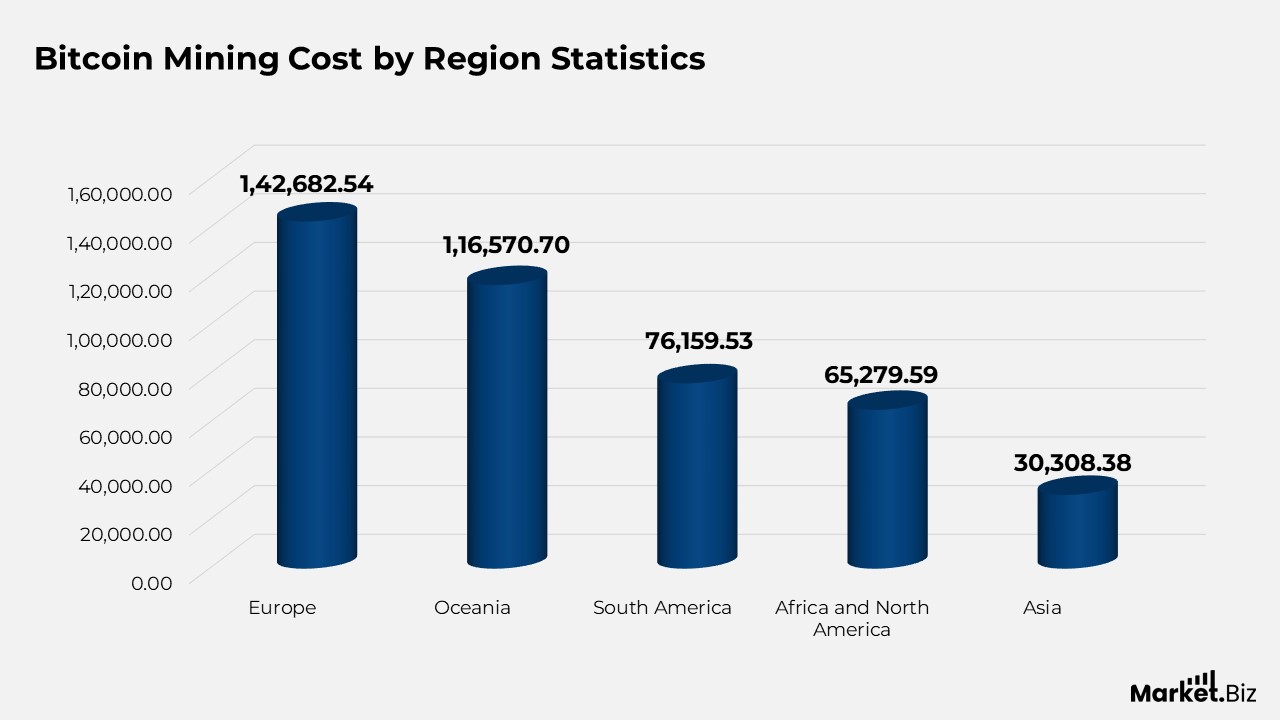
- Europe incurs the highest expense for mining a single Bitcoin, amounting to $142,682.54, rendering it the least cost-effective area for this activity.
- Oceania ranks next, with a significant cost of $116,570.70 for each Bitcoin mined.
- South America occupies the third position, with an average mining cost of $76,159.53.
- Both Africa and North America share the same mining cost of $65,279.59 per Bitcoin.
- Asia stands out as the most economical region, with a mining cost of merely $30,308.38 for each Bitcoin.
Bitcoin Mining Pool Statistics
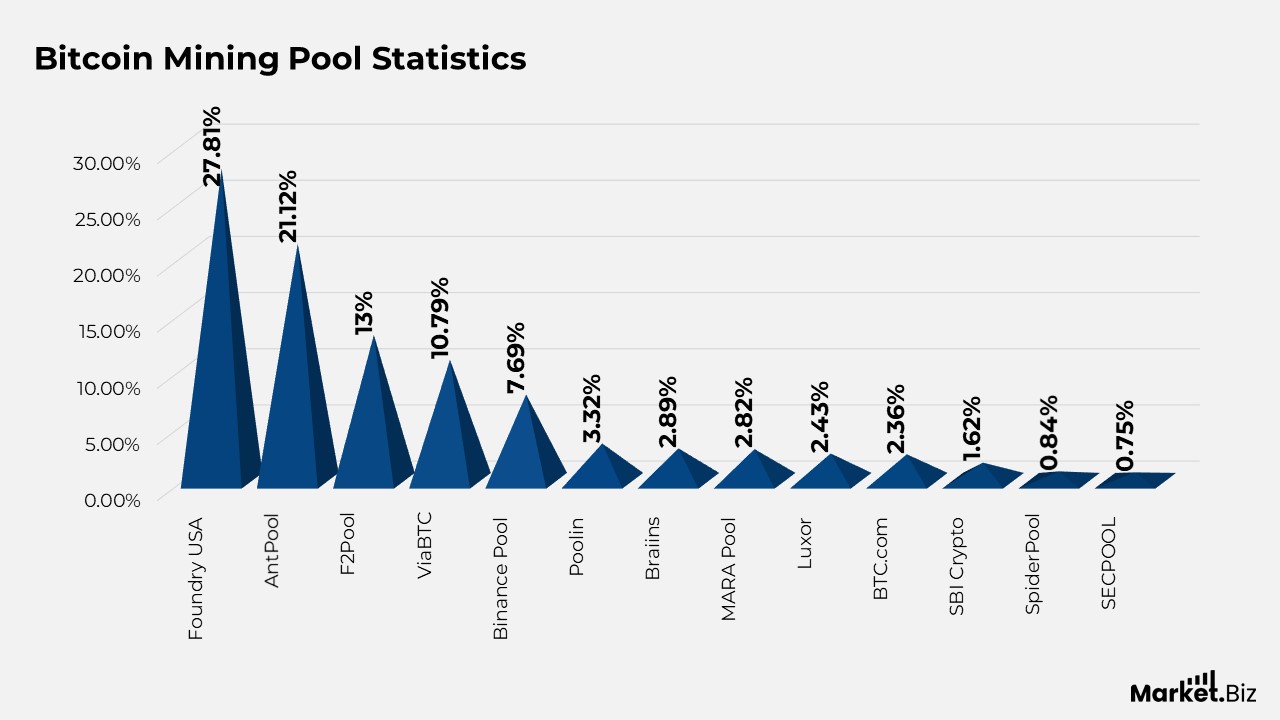
- Foundry USA dominates the global mining pool sector with a 27.81% market share, establishing itself as the foremost contributor to Bitcoin block production.
- AntPool secures the second position with a 21.12% share, underscoring its significant role in the Bitcoin mining landscape.
- F2Pool closely follows with a 13% share, preserving its status among the top three mining pools globally.
- ViaBTC commands 10.79% of the mining market, reflecting a consistent operational scale.
- Binance Pool possesses a 7.69% share, supported by the extensive infrastructure of the exchange.
- Smaller pools such as Poolin (3.32%), Braiins Pool (2.89%), and MARA Pool (2.82%) continue to make meaningful contributions to the network.
- Other noteworthy mentions include Luxor (2.43%), BTC.com (2.36%), and SBI Crypto (1.62%).
- Pools with a share of less than 1% include SpiderPool (0.84%), SECPOOL (0.75%), and Carbon Negative (0.64%).
Cryptocurrency Mining Recent Development
- Hive Digital announced a revenue of $33.8 million for the second quarter of 2025, driven by a rise in Bitcoin reserves and mining production.
- Phoenix Group achieved a remarkable 198% increase in revenue compared to the previous year, totaling $124 million as it expanded its operations throughout the Middle East and North Africa.
- Bitfarms divested its Paraguay mining facility for $92 million, redirecting the funds towards new locations in Texas and North Dakota.
- The proposed electricity tax for mining in Nebraska for 2025 is projected to affect as much as 12% of the state’s mining capacity, leading to significant opposition from the industry.
Cryptocurrency Mining Future Predictions
- The worldwide cryptocurrency market is anticipated to experience significant growth during the projected timeframe of 2023-2028.
- The Global Digital Currency Market is projected to reach a value of approximately USD 76.9 billion by the year 2032.
Conclusion
The cryptocurrency mining sector is a rapidly changing domain, influenced by technological progress, regulatory changes, and an increasing focus on sustainability. From user trends to worldwide revenue sources, mining is adapting to fulfill the requirements of a more digital society.
As areas such as North America and Europe take the lead in sustainable practices, while nations like Kazakhstan and Russia enhance efficiency through economical energy solutions, the industry mirrors a global transition towards innovation and eco-friendly initiatives. The upcoming years promise even more significant transformations, particularly as new technologies and methodologies arise to tackle the urgent need for both profitability and environmental stewardship in cryptocurrency mining.
FAQ’s
Crypto mining involves the use of high-performance computers to tackle intricate mathematical problems, which serve to validate transactions and incorporate them as new “blocks” into a blockchain. This process secures the network while rewarding miners with new coins and transaction fees. Miners engage in competition to discover the solution, employing substantial processing power (Proof-of-Work). The miner who succeeds in adding the block initiates the cycle anew, thereby ensuring decentralisation and mitigating fraud, such as double-spending.
Indeed. Crypto mining has the potential to be profitable; however, miners must take into account various factors, including electricity expenses, mining difficulty, and prevailing market conditions. Each of these elements can greatly influence overall profitability. The cost of electricity is particularly high, as mining operations require considerable power.
Bitcoin stands as the most prominent and arguably the most advantageous cryptocurrency to mine for future profits, although it necessitates a considerable initial investment. It is likely that one will require a specialised ASIC miner and may need to participate in a mining pool to achieve consistent rewards.