









Introduction
Virtual Events Statistics: The rise of virtual events has revolutionized how organizations organize conferences, trade shows, and meetings, providing a more accessible and budget-friendly alternative to traditional face-to-face gatherings. As digital technologies evolve, these events have become increasingly interactive and immersive, allowing participants from around the world to join without geographical limitations.
The transition to digital platforms has been fueled by the growing preference for remote communication and a focus on flexibility and convenience. Virtual events have emerged as a key tool for expanding reach, boosting participant engagement, and nurturing valuable connections. As this trend continues to gain momentum, virtual events are becoming a crucial element of business strategies, enabling organizations to engage, collaborate, and strengthen relationships in an increasingly digital world.
Editor’s Choice
- A staggering 99% of companies surveyed consider webinars a crucial part of their marketing strategy.
- According to a May 2020 survey of B2B marketers, 49% of respondents typically host 20 to 30 virtual events annually.
- Live video streaming is particularly popular among broadcasters and media companies, who account for 30% of its usage.
- While one-third of people find virtual events engaging, only 23% believe virtual conferences offer something truly unique.
- The biggest challenges in virtual events are maintaining audience engagement and fostering interaction.
- The primary key performance indicator (KPI) for virtual events is attendee engagement and satisfaction.
- 74% of event marketers offer free access to virtual events.
- The industries most engaged in webinars are Education (11%), Software & Tech (29%), and Financial Services (14%).
- 55% of people register for webinars during the final week leading up to the event.
- Virtual event statistics reveal that nearly 44% of webinars have fewer than 25 participants.
General Virtual Event Statistics
- The main reason individuals attend virtual events is to gain more insight into the company and its products.
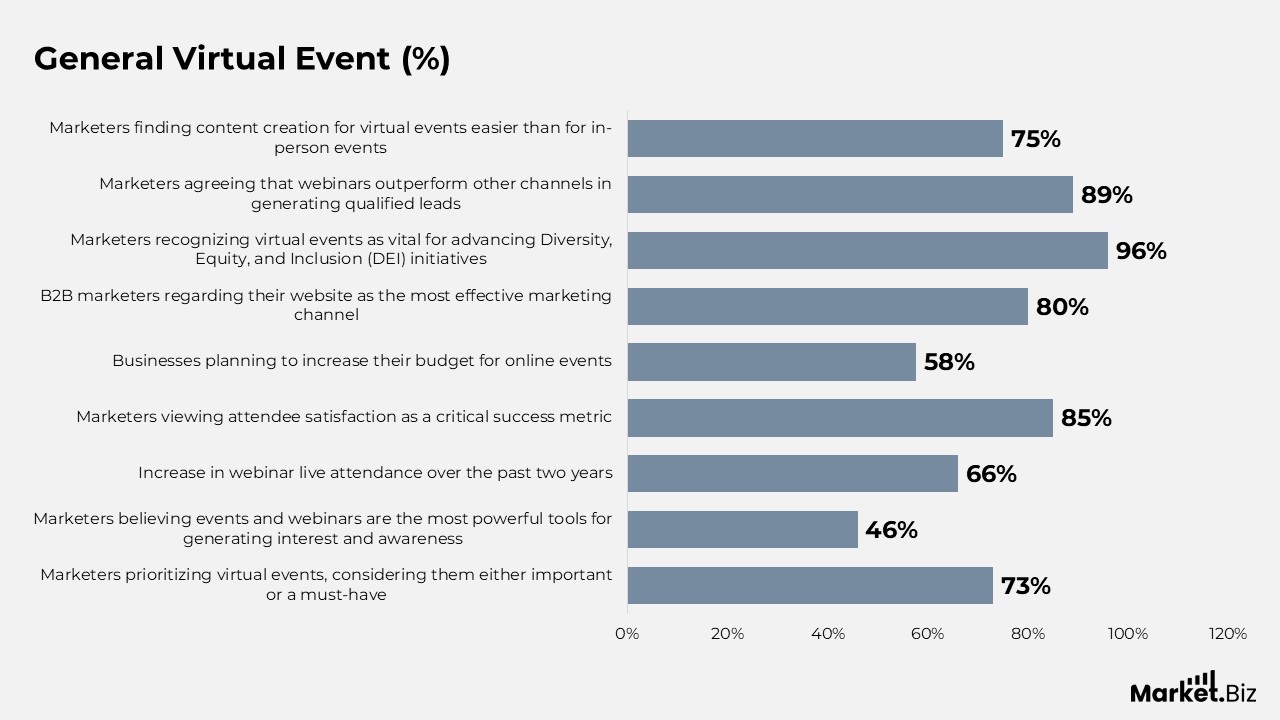
- 73% of marketers prioritize virtual events, considering them either important or an absolute must-have.
- 46% of marketers believe events and webinars are the most powerful tools for generating interest and awareness about their products and services.
- Over the past two years, webinar live attendance has surged by 66%.
- The average hourly wage for US Virtual Event Planners is $30.45.
- 85% of marketers view attendee satisfaction as a critical success metric.
- For virtual events77% achieve superior lead generation outcomes, 90% of marketers report increased attendance, and 83% see heightened brand awareness.
- 57.7% of businesses plan to increase their budget allocation for online events.
- 80% of B2B marketers regard their website as the most effective marketing channel.
- 96% of marketers recognize virtual events as a vital tool for advancing Diversity, Equity, and Inclusion (DEI) initiatives.
- 89% of marketers agree that webinars outperform other channels in generating qualified leads.
- 75% of marketers find content creation for virtual events easier than for in-person events.
(Source: Passive Secrets, LLC, Statista)
Virtual Event Promotion Statistics
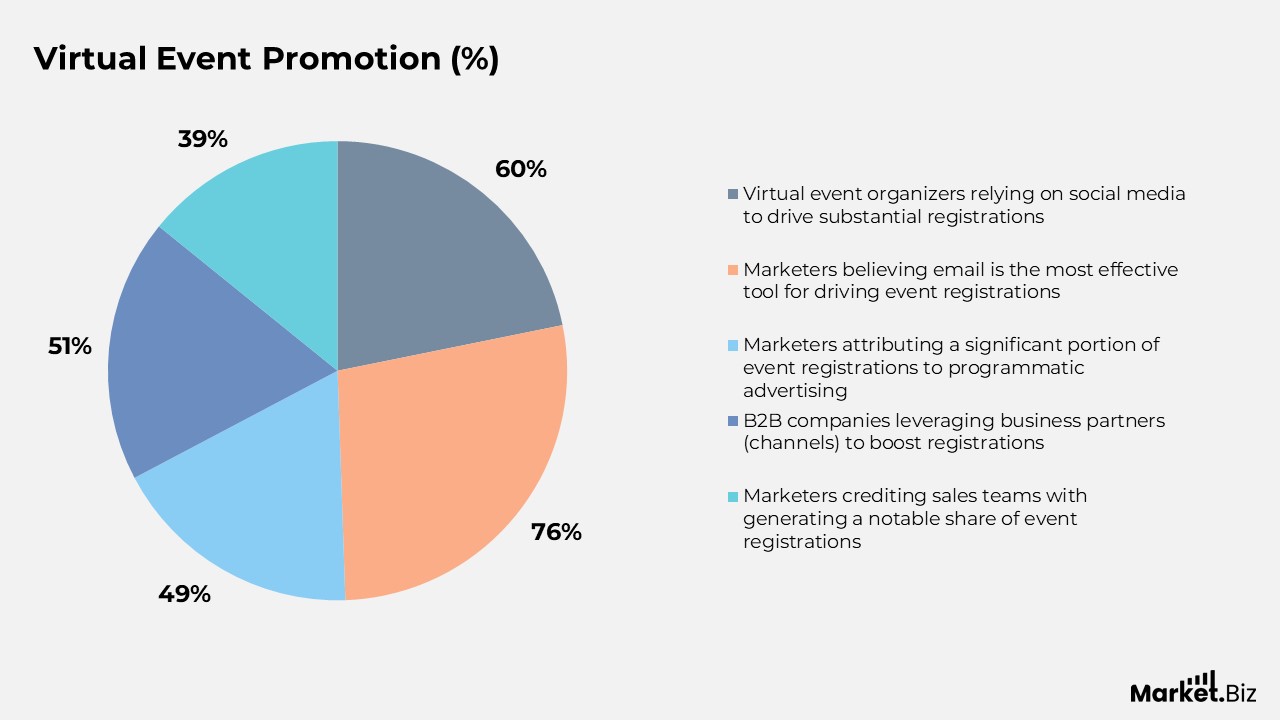
- 60% of virtual event organizers rely on social media to drive substantial registrations.
- 76% of marketers believe email is the most effective tool for driving event registrations.
- 49% of marketers attribute a significant portion of event registrations to programmatic advertising.
- 51% of B2B companies leverage their business partners (channels) to boost registrations.
- 39% of marketers credit their sales teams with generating a notable share of event registrations.
- B2B marketers primarily focus on targeting decision-makers for their virtual events.
- The typical sponsorship package for a virtual event costs $8,456.
- Chatbots have proven to be an effective method for increasing event registrations.
- The average length of the promotional period for virtual events is 3.5 weeks.
- C-level virtual events typically have a promotional period lasting 6 weeks.
(Source: Markletic, Statistics)
What Makes Virtual Events So Popular?
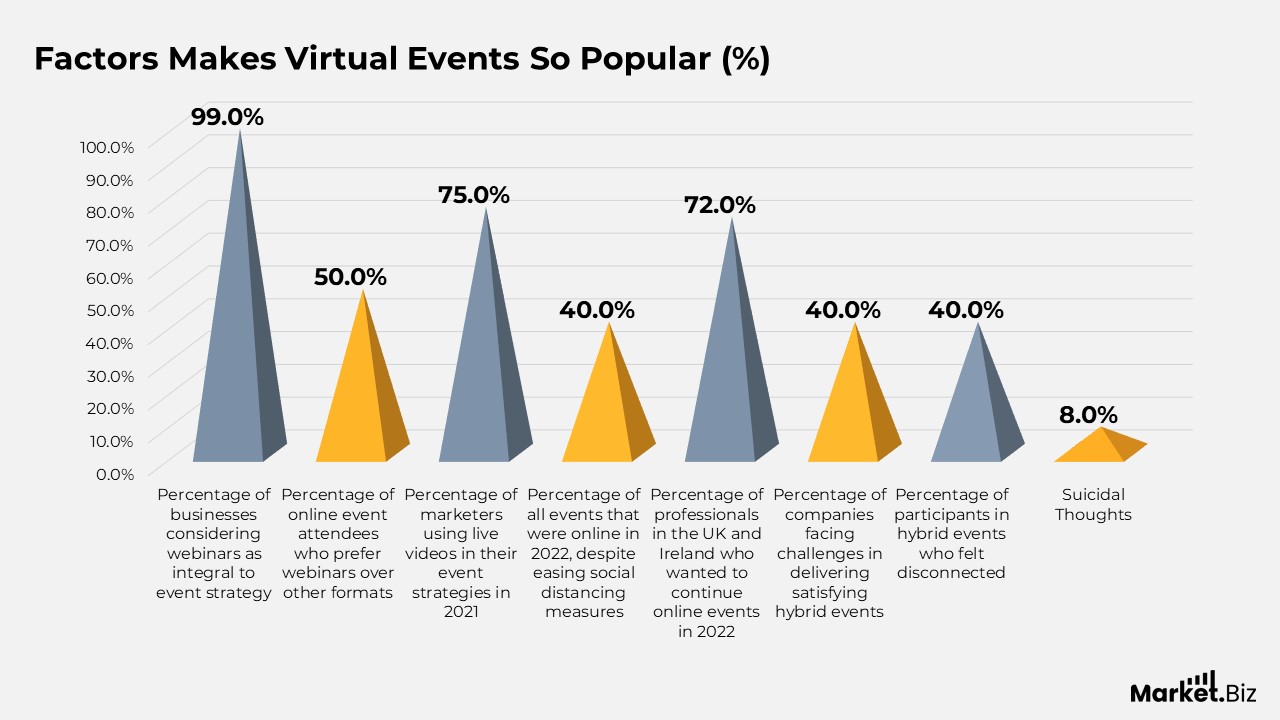
- A significant 99% of businesses consider webinars to be an integral part of their event strategy.
- Half of online event attendees express a preference for webinars over other formats.
- In 2021, 75% of marketers incorporated live videos into their event strategies.
- By 2022, online events accounted for 40% of all events, even as social distancing measures eased. The appeal of online events was largely due to the convenience of participating from any location, with 72% of professionals in the UK and Ireland expressing a desire to continue engaging in online events.
- The future of events is expected to include a blend of virtual, in-person, and hybrid formats.
- LinkedIn’s live stream viewership saw a remarkable increase of over 400% in 2020, as reported by TrueList.
- While hybrid events are gaining interest, many companies face challenges in delivering a fulfilling experience.
- Close to 40% of participants in hybrid events reported feeling disconnected from the experience.
(Source: Forbes, G2.com, Inc., Statista)
Virtual Events Satisfaction and Attendence Engagement
- 45% of registrants for virtual events are likely to attend live sessions, according to event organizers.
- A primary goal for 91% of respondents hosting virtual events is to keep their members connected.
- 49% of marketers believe that audience engagement is the key factor in making virtual events successful.
- To assess attendee satisfaction, 90% of virtual event organizers rely on surveys.
- 70% of event organizers consider high-quality microphones essential for a successful event.
- According to 76% of marketers, email is the most effective tool for driving event registrations.
- The average no-show rate for virtual events is 35%, slightly higher than that of in-person events.
- More than 80% of people participate in virtual events primarily for educational purposes.
- Networking is the second most common reason for attending virtual events, just as it is for in-person events.
- 46% of event marketers indicate that the primary goal of virtual events is to enhance lead generation and nurturing.
- 68% of B2B marketers report that live events are the most effective at generating leads.
- On average, online attendees look at 68% of a session lasting 20 minutes or longer.
- As much as 68% of attendees rewatch content from events they have previously attended.
- The two main challenges faced in virtual events are audience engagement and interaction.
- Technical issues affect 38% of marketers when hosting virtual events.
- 4% of virtual event marketers state that the average cost per attendee ranges between $500 and $1000.
(Source: wildapricot, arizton, wpamelia, LLCBuddy, Marketic, SocialMediaHat, Marketing Charts, Bizzabo, Vimeo)
Virtual Event Market Size
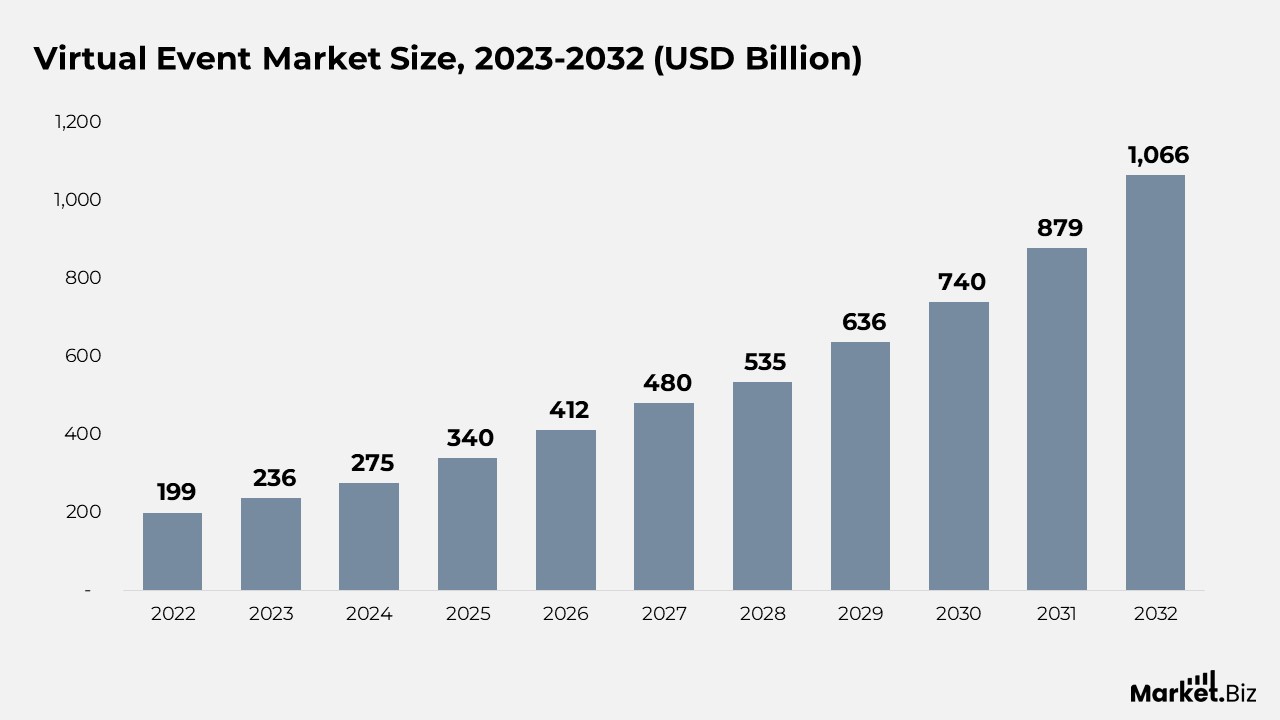
- According to Market.us, the virtual event market is expected to rise from $236 billion in 2023 to $1,066 billion by 2032, representing a CAGR of 18.8% from 2023 to 2032.
- The growth of the virtual event market is driven by the need for organizations to operate amidst restrictions on physical gatherings and the increasing globalization of business.
- In 2022, the external segment dominated the market, capturing a larger share compared to the internal and extended segments due to organizations’ preference for engaging with a global audience.
- In 2022, the Communication segment led the market, driven by the rising demand for seamless, real-time communication in both corporate and personal settings.
- In 2022, the Enterprises segment held a dominant market position, driven by businesses’ growing reliance on virtual events for conferences, product launches, and employee training.
- North America accounted for the largest market share, with 38.4% of the global virtual event market, supported by advanced infrastructure and adoption of new technologies, particularly in healthcare digital platforms.
(Source: Market.us)
Webinar Statistics
- On average, webinars generate between 500 and 1,000 leads.
- The average conversion rate for webinar attendees is 55%.
- In 2020, the global webinar market size reached $1.57 billion.
- Over 50% of B2B professionals report watching webinars every week.
- According to customers, the most popular feature in webinars is on-demand viewing.
- Up to 57% of marketers host more than 50 webinars annually, with this number expected to increase as remote work grows.
- Around 15% of webinar registrations come through social media platforms like Twitter, Facebook, and LinkedIn.
- Typically, webinars see 40% to 50% attendance rates, with up to 45% of views occurring within the 10 days after the webinar.
- 91% of marketers using webinars consider them an effective and essential part of their marketing strategy.
- Webinars have proven effective for sales, with 2% to 5% of attendees making a purchase right after the webinar.
- Up to 73% of B2B webinar attendees become capable mains, making webinars one of the most cost-effective online events.
(Source: Zippia, Thrive My Way, Growth Marketing Pro, Statista)
Hybrid Events Statistics
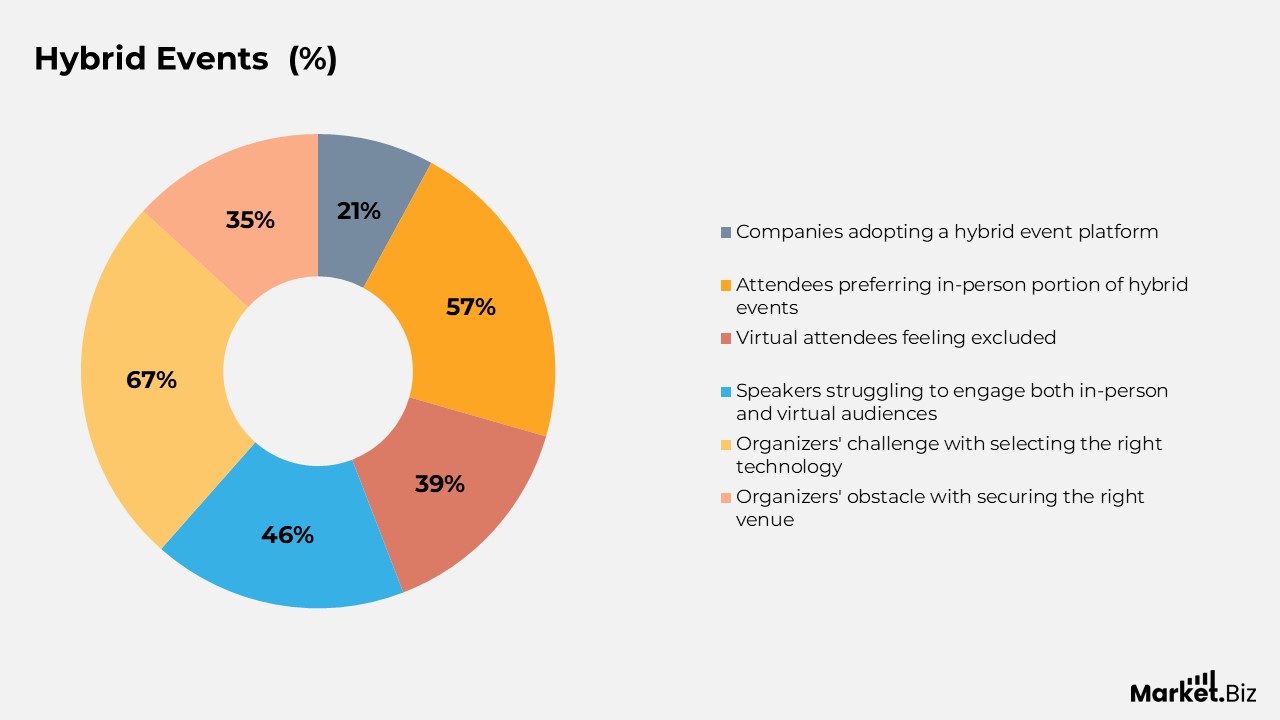
- 21% of companies are working towards adopting a hybrid event platform.
- 57% of attendees prefer attending the in-person portion of hybrid events over the virtual segment.
- 39% of virtual attendees at hybrid events reported feeling excluded.
- 46% of event organizers mentioned that speakers struggled to engage both in-person and virtual audiences simultaneously.
- For 67% of event organizers, selecting the right technology remains a key challenge, while 35% find securing the right venue to be their biggest obstacle.
(Source: Cvent, Markletic, Truelist, Statista, Findstack)
Virtual Event Technology
- 32% of respondents who chose not to host virtual events cited the lack of proper technological infrastructure as the main reason.
- 70% of event organizers believe that having good microphones is critical to a successful event, rating microphones higher than cameras, which 60% of marketers consider important.
- 89% of businesses using event technology save an average of 200 hours per year, with 20% of businesses saving 360 hours or more annually.
- The biggest frustration with virtual events is poor connection quality.
- 90% of event marketers agree that technology plays a significant role in the success of their events.
(Source: WildApricot, Markletic, Bizzabo)
How Virtual Event Platforms and Features Are Being Used?
- 37% of event organizers encounter technical difficulties as a significant challenge in virtual events.
- 30% of organizers face difficulties with engaging their audience effectively.
- 27% of virtual event organizers point to a lack of knowledge or experience with the format as a major obstacle.
- 17% of events suffer from low attendance.
- 15% of organizers are limited by restricted budgets when planning virtual events.
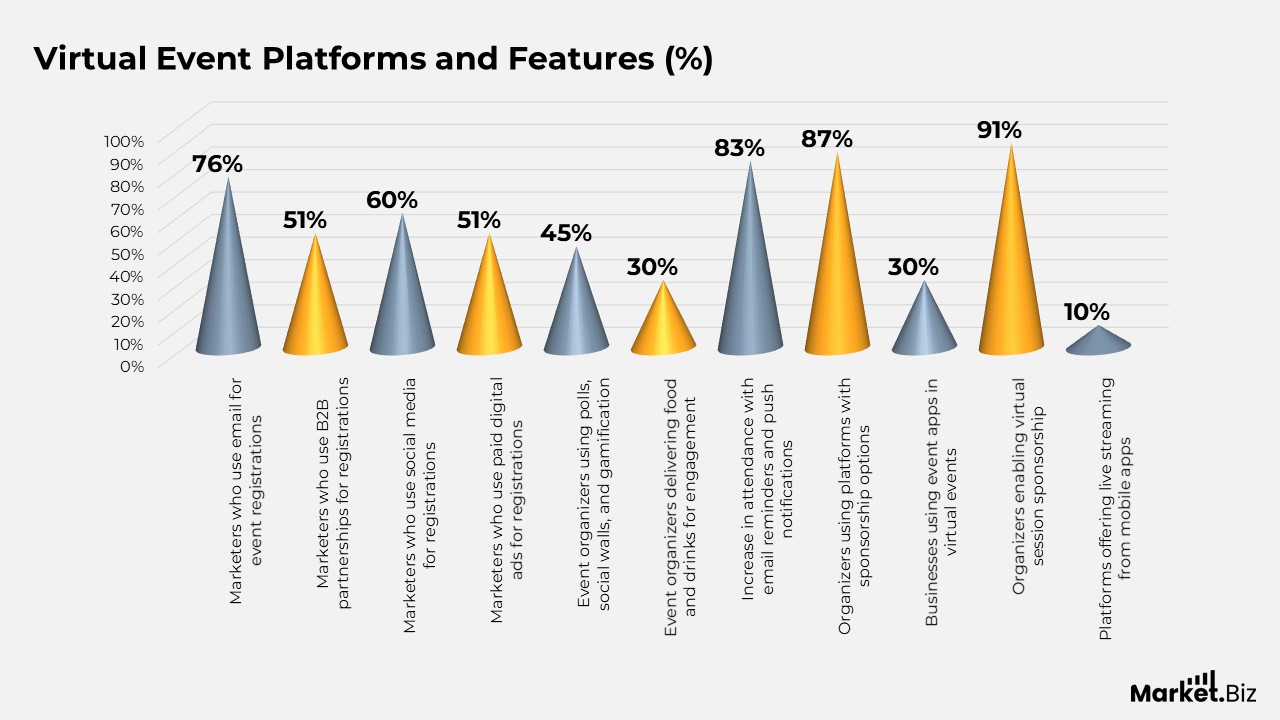
- 76% of marketers believe email is the most effective channel for driving event registrations, followed by B2B partnerships (51%), social media (60%), and paid digital advertising (51%).
- 45% of event organizers use tools like polls, social walls, and gamification to keep virtual attendees engaged during events, with 30% delivering food and beverages to enhance engagement.
- Over 80% of virtual event organizers increased audience interaction by using polls during events.
- Sending email reminders and push notifications 1 day and 1 hour before the event resulted in an 83% increase in attendance.
- 87% of organizers choose virtual event platforms that offer sponsorship opportunities through virtual booth features.
- The maximum number of live cameras displayed on screen should be limited to 5, as this is easier to manage in terms of muting, focusing on the speaker, and presentations, considering laptop and phone screen sizes.
- 30% of businesses use event apps in virtual events.
- 91% of event organizers enable virtual session sponsorship to boost revenue.
- Event organizers have experienced a 320x growth in event analytics for post-event analysis and tracking ROI.
- Only 10% of virtual event platforms offer live streaming from mobile apps.
(Source: AMEX, Markletic, Nunify, Event App Bible)
Virtual Events Industry Trends
- 4% of meeting and event professionals report that overall budgets increased in 2022, and over 80% have reintegrated in-person components.
- Only 3% of marketing leaders plan to conduct “the same number or more” virtual events in 2022.
- 99% of companies view webinars as critical to their marketing strategies.
- 81% of brand marketers expect their post-pandemic experiential marketing budgets to either match or exceed pre-pandemic levels.
- Twitch dominates the live-streaming space, hosting 90% of the world’s content, followed by YouTube and Facebook.
- 79% of companies plan to host events with an online component, even as in-person events resume.
- 67% of organizations faced challenges in delivering tangible networking experiences at virtual events in 2021.
- 90% of events have adopted e-tickets since 2020.
- The top three challenges faced by the APAC region with virtual events were a lack of engagement, tech issues, and insufficient knowledge of the format or technology.
- 43% of companies in North America have implemented specific virtual and hybrid event policies, 40% in Europe, 49% in Central/South America, and 56% in APAC.
(Source: Amex, Forrester, Statista, Eventmarketer, Geekswire, MarTech, Eventbrite)
Virtual Event Costs Statistics
- 74% of event marketers do not charge attendees for virtual events.
- Hosting a small virtual event with 10–100 participants typically costs between $50 and $250 per month. For larger events with 500 to 2500+ attendees, costs range from $625 to $8,000 monthly.
- 33.7% of event marketers report that the typical cost per attendee for virtual events is between $500 and $1,000.
- The average cost of a sponsorship package for a virtual event is $8,456.
- 87% of event planners prefer using platforms that provide virtual booth sponsorship opportunities.
- Around 32% of businesses identify pricing as the biggest challenge they face with hybrid events.
- Hosting smaller virtual events for 250 or fewer attendees typically costs between $3,000 and $15,000, while larger events can range from $5,000 to $30,000.
- Only 10% of virtual events are monetized, compared to over 25% of hybrid or in-person events.
- 57.7% of businesses intend to increase their budget for online events, while 35.4% are uncertain about their future spending.
- 74% of B2B virtual event organizers require approximately six months to achieve a positive return on investment (ROI).
(Source: Markletic, Statista, Bizzabo, Skift, Communique Conferencing, Inc.)
Conclusion
Virtual events have emerged as a vital tool for marketers, driving higher attendance, better lead generation, and greater brand visibility. The increasing significance of webinars and online events underscores their role in achieving key business objectives, especially in promoting Diversity, Equity, and Inclusion (DEI) efforts.
The rise in participation signals a shift toward digital engagement platforms, with businesses placing greater emphasis on enhancing attendee satisfaction. As more organizations look to increase their investment in online events, the future of virtual events looks promising, offering extensive opportunities for broader reach and deeper audience engagement.
FAQ’s
Virtual events provide multiple benefits, such as greater attendance, improved lead generation, and enhanced brand visibility. They create opportunities to engage a wider audience and achieve business goals, especially in promoting Diversity, Equity, and Inclusion (DEI) initiatives.
Webinars and virtual events are effective tools for sparking interest and capturing qualified leads. Marketers have found success in leveraging these events to connect with potential customers, build relationships, and drive conversions.
The increasing dependence on digital platforms underscores the need for businesses to engage with their audiences effectively. Virtual events enable companies to reach a larger audience, improve attendee satisfaction, and maintain connections with customers worldwide.
Participation in virtual events has grown significantly, with more people attending online events compared to traditional in-person ones. The rising demand for flexible and accessible digital engagement options drives this shift.
Attendee satisfaction is a key indicator of virtual event success. Companies are focusing on this aspect to ensure positive experiences, leading to higher engagement, repeat attendance, and enhanced brand loyalty.