









Introduction
Voice Search Statistics: Voice search has quickly evolved into a powerful force in digital interactions, fueled by the widespread use of voice-activated technologies such as smartphones, smart speakers, and virtual assistants.
As more consumers turn to voice commands instead of traditional text searches, businesses must adjust their strategies to remain competitive. Voice search statistics offer valuable insights into user behavior, industry trends, and usage patterns, helping companies optimize their online presence to cater to this growing demand.
By analyzing these statistics, businesses can fine-tune their content and services to meet the needs of a voice-first digital world, ensuring they stay relevant and accessible in an ever-changing marketplace.
Editor’s Choice
- Approximately 20.5% of the global population utilizes voice search.
- The number of voice assistants in custom worldwide is expected to reach 8.4 billion.
- In the United States, 153.5 million people are anticipated to use voice assistants.
- Siri has approximately 86.5 million active users in the U.S.
- Around 27% of users rely on voice search through their mobile devices.
- In the U.S., 38.8 million people (13.6% of the population) use smart speakers for shopping-related tasks.
- Local and near me searches make up 76% of all voice searches, and this number is projected to rise as more people use voice search to locate nearby businesses.
- Voice search assistants provide accurate answers to 93.7% of queries.
- On average, voice search result pages load in 4.6 seconds.
- Over 1 billion voice searches are made each month.
- 41% of voice search results feature snippets.
- 76% of consumers use voice search to discover local businesses.
- Around 3.25 billion people globally use voice-activated assistants and search.
- Voice searches surpass 1 billion each month.
- Voice search has already generated over $2 billion in sales.
- 50% of the U.S. population engages in daily voice searches.
- 43% of people shop online using voice-enabled devices.
- 71% of consumers prefer using voice search over typing their queries.
- 55% of people use voice search to find nearby businesses.
- 51% of online shoppers use voice search for product research before purchasing.
- 50% of voice search results are derived from featured snippets.
- By 2023, voice commerce is projected to exceed $80 billion annually.
(Source: Demand Sage, Invoca Inc., Semrush Inc., Techjury, Aovup, Luigi’s Box, Upcity, Ready Cloud, Palo Creative, Web Fx)
Voice Search Usage Statistics
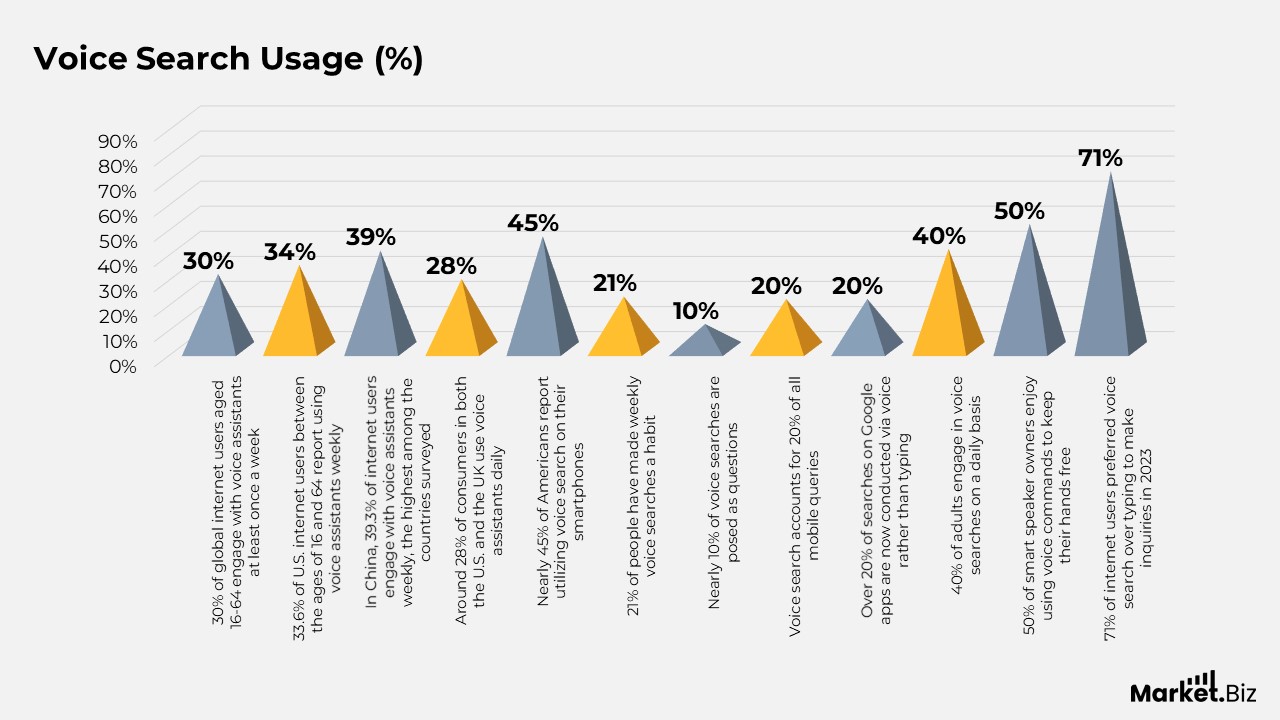
- 30% of global internet users aged 16-64 engage with voice assistants at least once a week.
- By 2024, approximately 98 million people in the U.S. are expected to own a smart speaker in their household.
- 33.6% of U.S. internet users between the ages of 16 and 64 report using voice assistants weekly.
- On average, a higher percentage of men use voice assistants at least once a week compared to women.
- In China, 39.3% of internet workers involve with voice assistants weekly, the highest among the countries surveyed.
- Around 28% of consumers in both the U.S. and the UK use voice assistants daily.
- Nearly 45% of Americans report utilizing voice search on their smartphones.
- By 2024, approximately 86.1 million U.S. smart speaker users will actively ask questions via voice, an increase from 80.2 million in 2022.
- 21% of people have made weekly voice searches a habit.
Moreover
- Google has expanded its mobile voice search capabilities to over 60 languages, breaking down language barriers.
- Voice search responses are typically brief, averaging around 29 words.
- Nearly 10% of voice searches are posed as questions.
- Voice search accounts for 20% of all mobile queries.
- Over 20% of searches on Google apps are now conducted via voice rather than typing.
- By the end of 2023, voice search-driven sales could reach $40 billion.
- Voice search is becoming increasingly prevalent, with over 4 billion digital assistants in use worldwide.
- Voice shopping is projected to generate $80 billion annually by 2023.
- 40% of adults engage in voice searches daily.
- 50% of smart speaker owners enjoy using voice commands to keep their hands free.
- The voice recognition market is expected to grow to $26.8 billion by 2025.
- 71% of internet users preferred voice search over typing to make inquiries in 2023.
- 50% of U.S. consumers reported using voice search daily in 2022.
(Source: Semrush Inc, Backlinko, eMarketer, Vixen Labs, DataReportal, Synup, G2.com, Inc.)
Voice Search SEO Statistics
- After reviewing 10,000 Google Home search results, Brian Dean found that the average page load time for voice search results is 4.6 seconds.
- Voice search results typically contain an average of 29 words.
- Websites with strong domain authority and backlink profiles tend to perform better in voice search rankings.
- Content that is highly shared on social platforms ranks well in voice search, with average results receiving 1,199 Facebook shares and 44 Tweets.
- The majority of voice search results are written in a conversational tone, typically at a 9th-grade reading level, making them easy to understand.
- 40.7% of all voice search responses are sourced from Featured Snippets.
- Google voice search result pages have an average word count of 2,312 words.
- Dentists are the top industry group optimizing for voice search.
- Consumer protection agencies are the least optimized group for voice search.
(Source: Semrush Inc, Backlinko, eMarketer, Vixen Labs, DataReportal, Search Engine Watch)
Voice Search Market Size
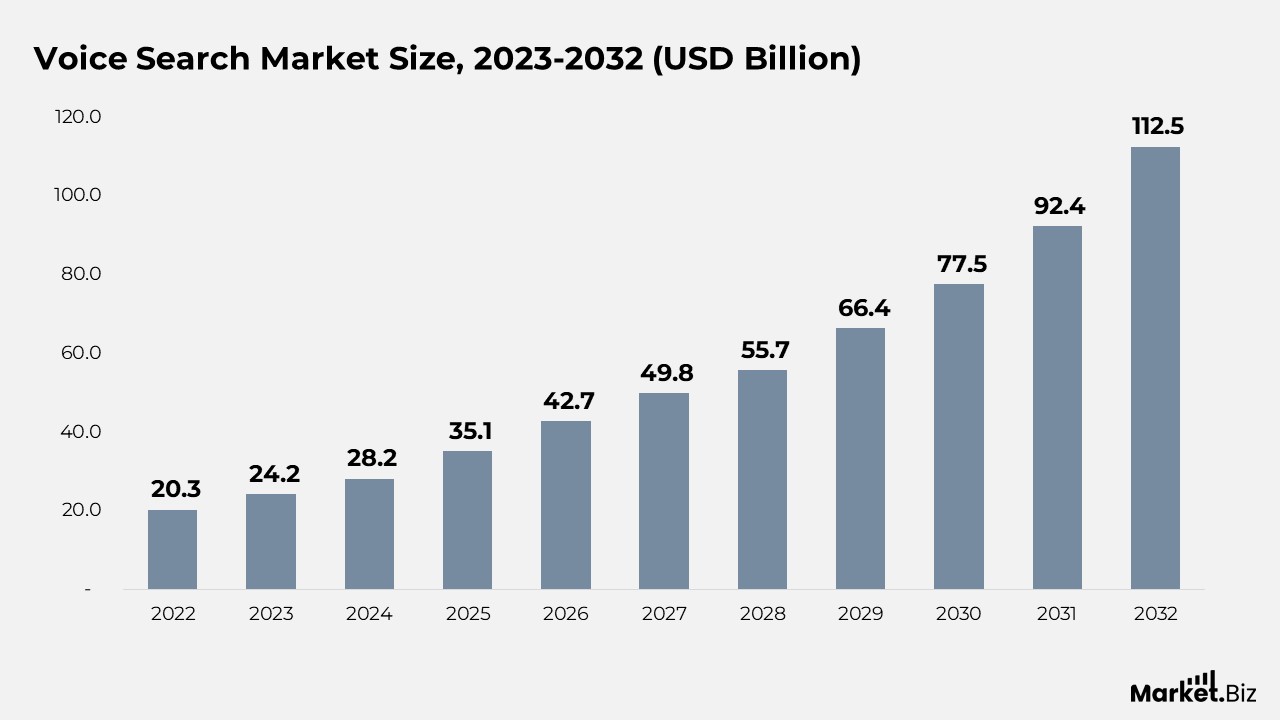
- According to Market.us, the global voice search market is expected to rise from $24.2 billion in 2023 to $112.5 billion by 2032, representing a CAGR of 19.2% from 2023 to 2032.
- The growth of the voice search market is driven by the increasing adoption of voice-enabled devices, like Amazon Echo and Google Home, which provide easy access to information, entertainment, and smart home controls.
- The speech recognition section holds the largest market share globally, accounting for 66% due to its widespread use in smartphones and smart automobiles.
- The cloud deployment segment leads the global voice search market with a 59% market share and is expected to continue growing during the forecast period.
- The non-AI-based segment is the largest by technology, holding 73% of the market share, with steady growth anticipated due to its previous market presence and accessibility.
- The healthcare sector is the largest industry vertical for voice search, commanding 29% of the market share, driven by efficient data gathering in Electronic Health Records (EHR).
- North America leads the voice search market with a 33% share in 2022 and is expected to grow at a high CAGR during the forecast period from 2023 to 2032.
- Europe is seeing a boost in voice search adoption, particularly in e-commerce and retail automation.
- The Asia-Pacific region is forecasted to show the highest CAGR from 2023 to 2032, driven by the increasing use of voice-enabled devices in the region.
(Source: Market.us)
AI Voice Cloning Market Size
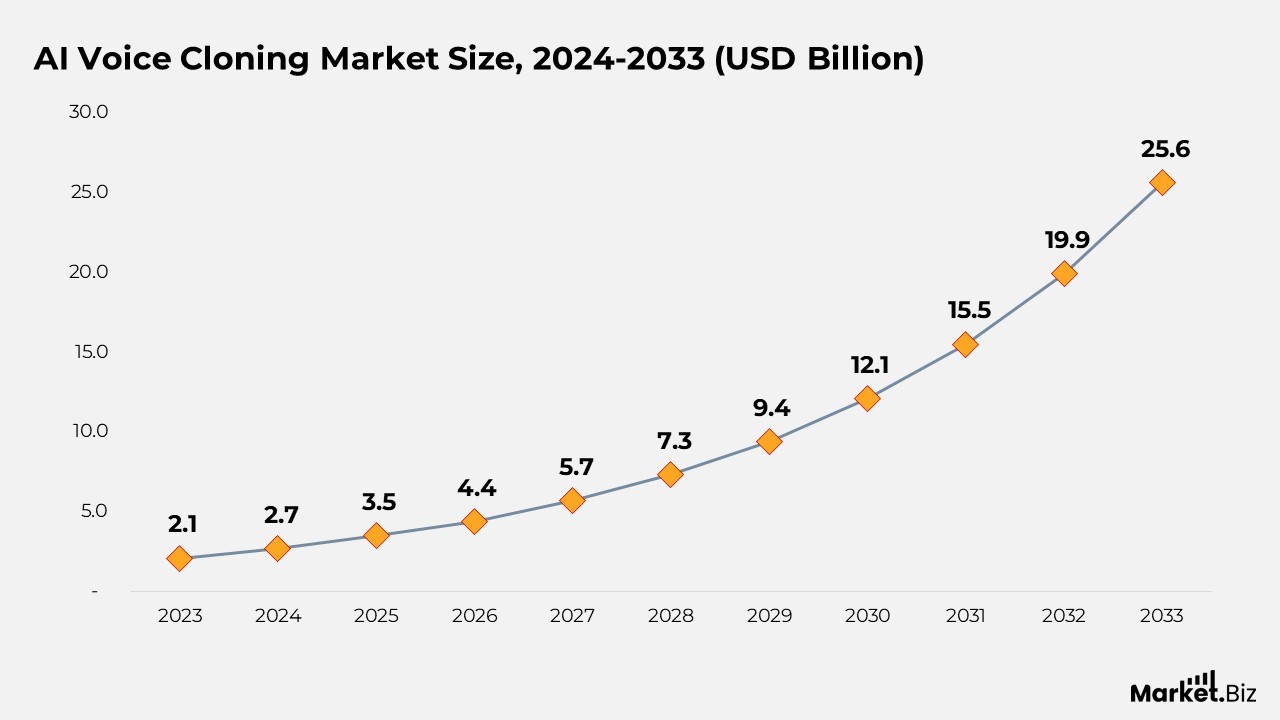
- According to Market.us, the AI voice cloning market is expected to rise from $2.7 billion in 2024 to $25.6 billion by 2033, representing a CAGR of 28.4% from 2024 to 2033.
- The AI voice cloning market is growing rapidly due to advancements in sectors like entertainment, healthcare, and customer service, with improvements in speech synthesis and AI driving this expansion.
- The software component dominates the AI voice cloning market with a 68.5% share, as it plays a crucial role in creating, customizing, and deploying voice cloning technologies.
- The on-premises deployment perfect holds a 64% part in the AI voice cloning market, favored by organizations for its focus on security, data control, and customization.
- Audiobooks and podcasting are the leading applications of AI voice cloning technology, capturing 18.5% of the market, driven by rising consumer demand for personalized audio content.
- In vertical analysis, Media & Entertainment leads the AI voice cloning market with a 25.6% share, driven by the need for innovative audio content that engages audiences.
- North America dominates the AI voice cloning market with a 43.4% share, amounting to USD 0.91 billion, supported by strong technological infrastructure and investment in AI research.
- There has been a rise in the malicious use of AI, particularly in voice cloning for scams, with cybercrime cases in Delhi surging from 345 in 2021 to 685 in 2022, highlighting the growing threat of AI-driven fraud.
(Source: Market.us)
Voice Search Shopping Statistics
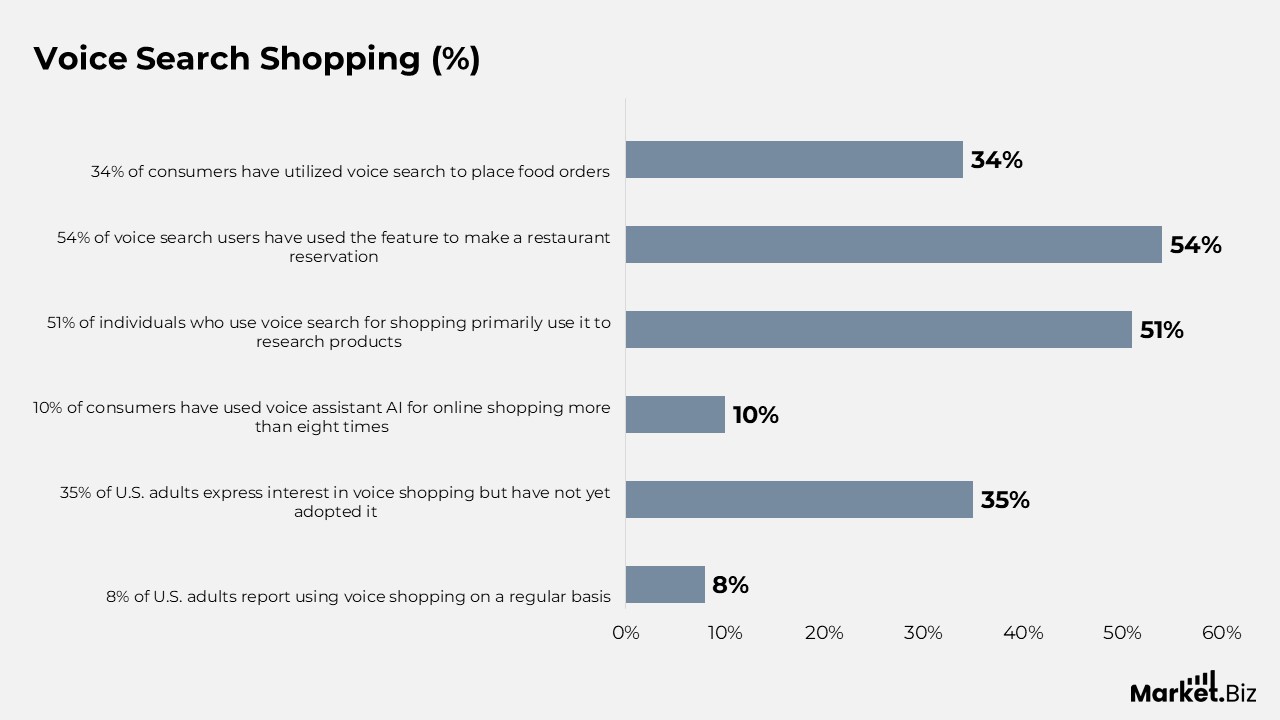
- 8% of U.S. adults report using voice shopping regularly.
- 35% of U.S. adults express interest in voice shopping but have not yet adopted it.
- 10% of consumers have used a voice assistant AI for online shopping more than eight times.
- 51% of individuals who use voice search for shopping primarily use it to research products.
- 54% of voice search users have used the feature to make a restaurant reservation.
- 34% of consumers have utilised voice search to place food orders.
- Global voice assistant-driven purchases on smart devices have reached a total transaction value of $164 billion.
(Source: Digital Silk, Statista)
Voice Assistant Statistics
- As of the most recent data, there are approximately 4.2 billion voice assistants in use worldwide.
- In 2022, 46.9% of U.S. grown-ups used a voice assistant, with this number expected to rise to 48.2% by 2025.
- In 2022, the U.S. had 142 million voice assistant users, and this number is predicted to increase to 157.1 million by 2026.
- The voice assistant application market was valued at $3.53 billion in 2022 and is projected to grow at a rate of 28.7% annually from 2023 to 2029.
- Siri and Google Assistant are the leading voice assistants, each holding a 36% market share among users.
- Voice assistants are capable of answering 93.7% of search queries accurately on average.
- 72% of individuals use voice search through their digital assistants.
- 93% of consumers report satisfaction with their voice assistants.
- 35% of Americans rely on voice assistants daily to check the weather and news.
(Source: Statista, Demand Sage, PWC, Search Engine Journal, Serp Watch, Truelist)
Voice Commerce Statistics
- Voice commerce sales totalled $1.8 billion last year and are projected to reach $40 billion by 2022.
- 22% of U.S. smart speaker owners have made purchases using their devices.
- While 5% of consumers currently use voice shopping, this figure is expected to rise to 50% by 2022.
- In 2017, grocery shopping represented 20% of voice shopping, compared to 8% for clothing purchases.
- 52% of voice-activated speaker owners are interested in receiving information about deals, sales, and promotions from brands, while 39% would like access to business information.
(Source: OC&C Strategy Consultants, WordStream, Edison Research, MoffettNathanson)
Voice Search Using Google Assistant
- Based on a digital assistant IQ test of 800 questions, Google Assistant provided the most accurate answers with an accuracy score of 86%.
- Google projected that the Assistant would be available on one billion devices, up from 500 million in May 2018.
- Active users of Google Assistant grew 4 times over the past year.
- Google Assistant now supports nearly 30 languages across 80 countries, and it is also multilingual.
- Google Assistant is compatible with over 10,000 smart home devices from 1,600 well-known brands.
- This year, Google Assistant added eight new voices, including British and Australian accents in the U.S.
- In the Google app, 20% of searches are now conducted via voice.
- Google Assistant is expected to be able to automatically detect the user’s language, similar to Google Translate, serving 95% of Android users.
(Source: Loup Ventures, Google, The Verge)
Voice Search Using Amazon’s Alexa
- Alexa provided 61% accurate answers.
- Over 100 million devices with Alexa have been sold, as stated by Amazon’s SVP of Devices and Services.
- At the IFA tech show in Berlin, Amazon executive Daniel Rausch revealed that Alexa has expressed more than 100 million jokes and sung “Happy Birthday” millions of times.
- Alexa is now compatible with over 20,000 devices.
- The number of voice apps (referred to as “skills”) for Alexa has grown from 130 at launch to 80,000 by December 2018.
- There are hundreds of thousands of developers from over 180 countries contributing to Alexa’s development.
- 20% of consumers with an Alexa-enabled device have used it to find deals or track their online purchases.
- Amazon has sold approximately 50 million Alexa devices.
- 85% of consumers who use voice search end up selecting the products recommended by Amazon.
(Source: Loup Ventures, The Verge, CNET, Statista, The Next Web, Quora Creative)
Voice Search and Local Business Statistics
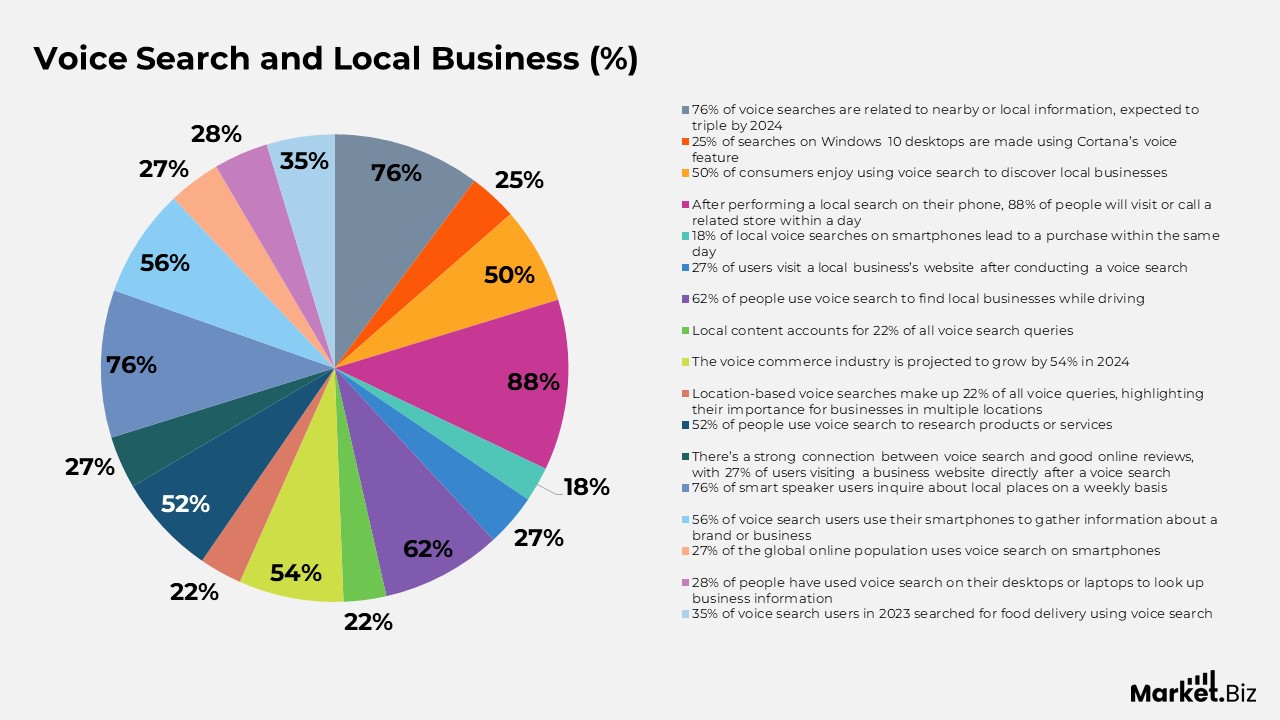
- 76% of voice searches are related to nearby or local information, and this figure is expected to triple by 2024.
- Voice searches on mobile devices are 3 times more likely to be for local information compared to text-based searches.
- 25% of searches on Windows 10 desktops are made using Cortana’s voice feature.
- 50% of consumers enjoy using voice search to discover local businesses.
- 82% of smartphone users use search engines to find local shops, with 58% discovering local businesses through voice search.
- After performing a local search on their phone, 88% of people will visit or call a related store within a day.
- 18% of local voice searches on smartphones lead to a purchase on the same day.
- 27% of users visit a local business’s website after conducting a voice search.
- 1 in 4 individuals are open to using voice search to invention local shops.
- Over 50% of customers have looked up local business information using voice search in the past year.
- 62% of people use voice search to find local businesses while driving.
- Local content accounts for 22% of all voice search queries.
More Stats
- One-third of clicks from Google examinations go to the snack pack of local business listings.
- The voice commerce industry is projected to grow by 54% in 2024.
- Location-based voice searches make up 22% of all voice queries, highlighting their importance for businesses in multiple locations.
- Online reviews play a key role in voice searches for local businesses, as they can encourage consumers to spend up to 31% more.
- 52% of people use voice search to research products or services.
- There’s a strong connection between voice search and good online reviews, with 27% of users visiting a business website directly after a voice search.
- 76% of smart speaker users inquire about local places every week.
- 56% of voice search users use their smartphones to gather information about a brand or business.
- 27% of the global online population uses voice search on smartphones.
- 28% of people have used voice search on their desktops or laptops to look up business information.
- 35% of voice search users in 2023 searched for food delivery using voice search.
(Source: Doofinder, G2.com, Inc.)
Voice Search Usage in Daily Life and at Home
- Smart speaker users typically request about 11 different tasks each week.
- More than half of users find interacting with a voice-activated speaker to be natural.
- 25% of smart speaker owners have made purchases using voice commands.
- 41% of U.S. adults use voice search daily.
- By 2021, nearly 90 million Americans had smart speakers in their homes.
- 34% of individuals who don’t currently own a smart speaker are considering purchasing one soon.
- The number of households with smart speakers is projected to reach 93 million by 2027.
- It is estimated that 75% of homes will have smart speaker devices by 2025.
(Source: Doofinder, G2.com, Inc.)
Consumer Preferences For Voice Search
- One of the top three reasons people purchase smart speakers is the convenience of asking questions without the need to type.
- The most common devices for using voice assistants are smart TVs (34%), smart speakers (35%), and smartphones (56%). On average, smart speaker owners use voice commands for 11 different tasks weekly.
- 38% of people find voice ads more engaging and less intrusive compared to ads on TV, social media, or in print.
- 72% of voice search users depend on digital assistants, while 36% utilize their TV or smart home devices for voice searches.
- 80% of online shoppers express satisfaction with voice search services, and 39% recommend them to others.
- For 73% of users, accuracy is the main challenge with voice search technology, and 66% find issues with accents or dialects to be significant barriers.
- Over 41% of digital assistant users are concerned about being listened to or recorded, and 64% have accidentally triggered a voice assistant in the past month.
(Source: Doofinder, G2.com, Inc.)
Conclusion
The rapid expansion of voice search technology is transforming the digital landscape, driving a notable shift toward voice-activated devices such as smart speakers, smartphones, and virtual assistants.
The growing adoption of voice search across various industries, including e-commerce and healthcare, underscores its rising impact on consumer behavior and business strategies.
As voice recognition technology advances, businesses are increasingly refining their digital content and approaches to cater to the needs of voice-first users. With voice search becoming a dominant aspect of digital interactions, it’s clear that the future of online search and user engagement will be driven by voice.
As this trend continues to accelerate, companies that embrace voice search optimization early on will gain a competitive advantage in an ever-evolving market.
FAQ’s
Voice search is growing rapidly, with projections indicating that by 2024, 50% of all searches will be conducted via voice. The widespread implementation of voice-enabled devices such as smart speakers, smartphones, and virtual assistants is driving this trend.
Around 58% of consumers use voice search on their smartphones to find local businesses. By 2025, voice search on mobile devices is expected to account for 30% of all searches.
By 2024, it’s estimated that 27% of global consumers will use voice search for making online purchases, reflecting the growing shift towards voice-assisted e-commerce.
Voice recognition technology has significantly advanced, with platforms like Google Assistant and Siri now achieving an accuracy rate of over 95% in understanding and processing voice commands.
By 2023, an estimated 55% of businesses will have optimized their websites for voice search in response to the rising demand for voice-activated search functionalities.
Voice search is gaining traction across various industries, including e-commerce, healthcare, customer service, and entertainment, as each sector looks to leverage voice technology to enhance user experiences and improve operational efficiency.