









Introduction
eSports Statistics: eSports has rapidly transformed from a niche gaming pastime into a global competitive entertainment force, driven by advanced streaming platforms, high-speed connectivity, and a growing infrastructure of professional teams, tournaments, and sponsors. Rising viewership, expanding prize pools, and increased commercial investment highlight the industry’s accelerating momentum.
eSports statistics offer essential insights into player engagement, audience behavior, market revenues, and emerging technology trends, revealing how competitive gaming is reshaping digital entertainment and positioning itself as one of the most influential sectors of the future.
Editor’s Choice
- The U.S. currently has around 3,530 active eSports players, reflecting a strong competitive ecosystem.
- The Asia-Pacific region accounts for more than 57% of global esports viewership, making it the industry’s dominant market.
- China and the Philippines together account for roughly 40% of the worldwide esports fanbase.
- There are about 540 million esports fans globally today.
- Asia accounts for 57% of all esports viewers, while North America accounts for around 12%.
- Men represent approximately 72% of the global esports audience.
- India’s esports viewership is expanding rapidly, growing at nearly 50% annually.
- Esports viewership grew 11.7% in 2020, reaching 496 million total viewers.
- Around 4.4 million monthly esports players were active on Twitch in 2020.
- Professional esports players earned an average income of about $5,000 in 2020.
- Investment in esports surged to $4.5 billion in 2018, marking a major funding milestone.
- The esports industry was projected to achieve $1.5 billion in market value by 2023.
- About 42% of viewers report enjoying the advertisements shown during streams.
- The 2024 League of Legends World Championship reached a record 6.86 million peak viewers, the highest ever for any esports event.
- The esports fanbase is expected to climb to 640.8 million by 2025, nearly doubling from 2020 levels.
- Sponsorships and media rights generate around 65% of esports revenue, with sponsorship alone contributing $837.3 million.
- The U.S. leads in esports revenue ($870 million in 2023) and in the number of professional players (3,399+).
- Dota 2 offered the largest prize pool in 2024 at $23.86 million, second only to its own 2021 record, exceeding $40 million.
(Source: Association for Advancing Automation, McKinsey, StudioRed.com)
eSports Audience Evolution
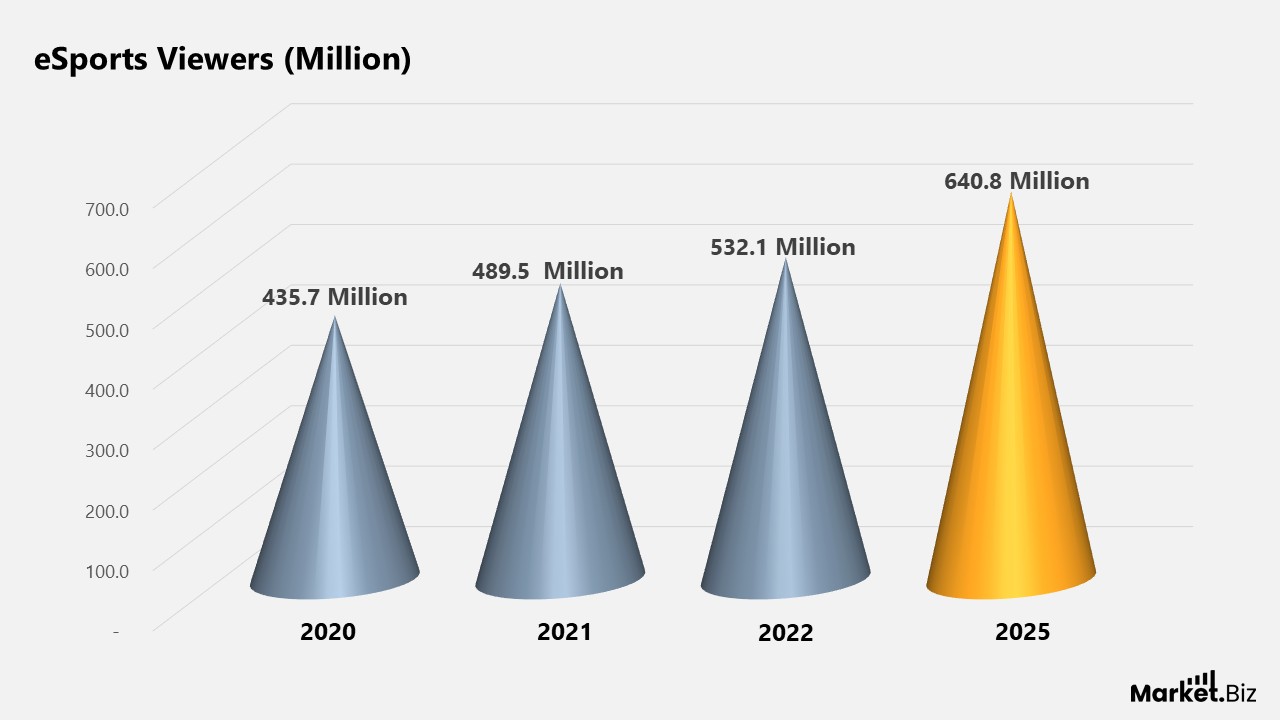
- In 2022, the esports audience climbed to 532.1 million, continuing its strong growth trajectory.
- Viewership reached 489.5 million in 2021, reflecting increasing engagement across streaming platforms and competitive events.
- In 2020, global esports viewers totalled 435.7 million, marking the beginning of a significant upward surge in audience size.
(Source: DemandSage, Statista)
Global eSports Viewership Breakdown
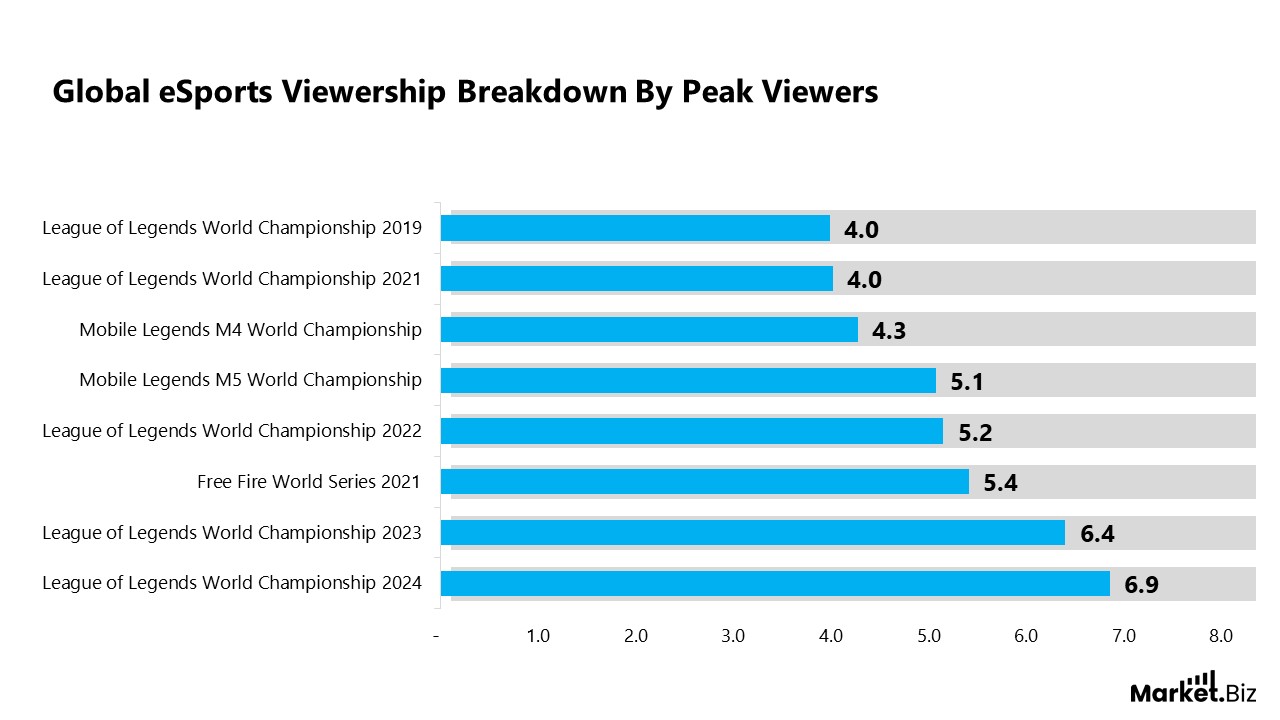
- By 2025, occasional esports viewers are projected to reach 322.7 million, while dedicated fans are expected to climb to 318.1 million, showing a balanced rise in casual and committed audiences.
- In 2022, the esports ecosystem recorded 270.9 million casual viewers alongside 261.2 million regular viewers, highlighting strong global engagement.
- For 2021, occasional viewership reached 249.5 million, with fanatic or frequent viewers totaling 240 million, marking steady annual growth.
- In 2020, esports attracted 220.5 million casual viewers and 215.2 million regular fans, forming the foundation for the sharp expansion seen in later years.
(Source: TheCricketPanda Betting Apps, DemandSage)
Global eSports Viewership Breakdown
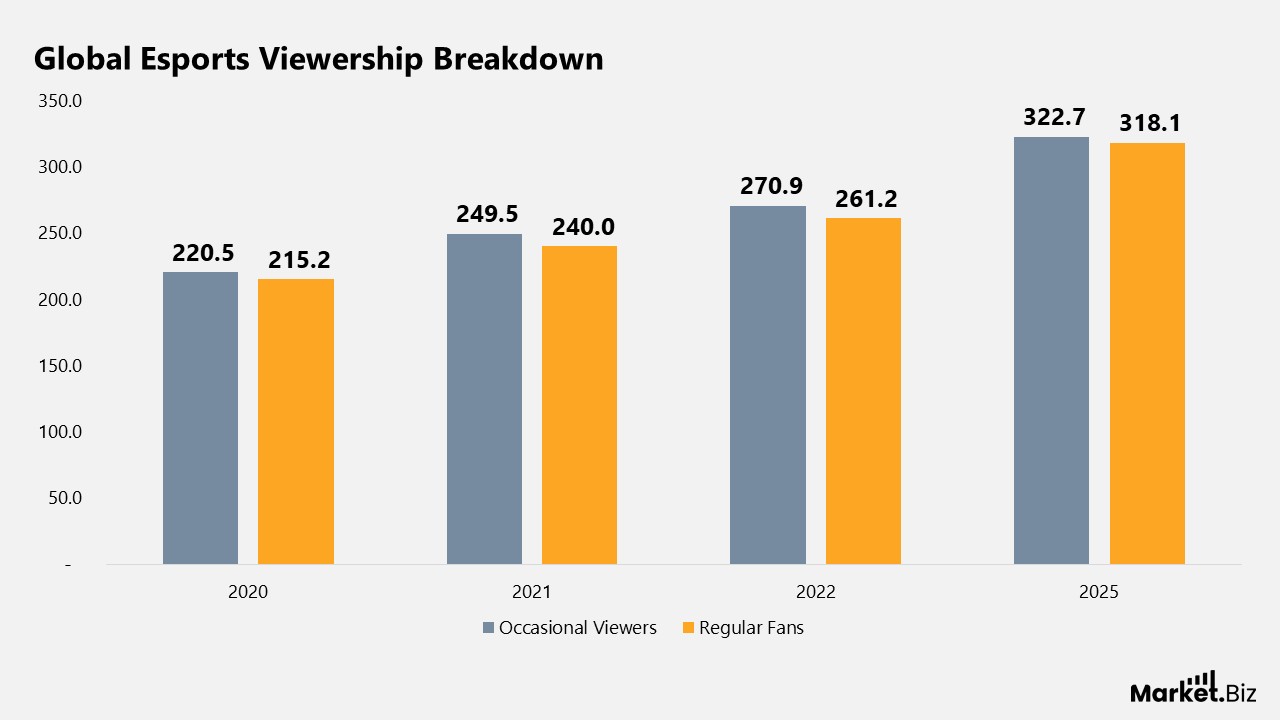
- The League of Legends World Championship 2024 set a new peak record with 6.86 million viewers, marking the highest audience ever recorded for an esports event.
- The 2023 League of Legends World Championship followed strongly, reaching 6.4 million peak viewers.
- The Free Fire World Series 2021 saw a remarkable surge, hitting 5.41 million viewers at its peak.
- The League of Legends World Championship 2022 attracted 5.15 million peak viewers, highlighting consistent global interest.
- The Mobile Legends M5 World Championship reached 5.07 million peak viewers, reflecting rapid momentum in mobile esports.
- The Mobile Legends M4 World Championship reached 4.27 million viewers at its peak.
- The League of Legends World Championship 2021 recorded 4.02 million peak viewers, maintaining strong engagement across regions.
- The League of Legends World Championship 2019 reached 3.99 million at peak, setting early benchmarks for future audience growth.
(Source: Statista, DemandSage)
Global eSports Audience Growth by Viewer Type
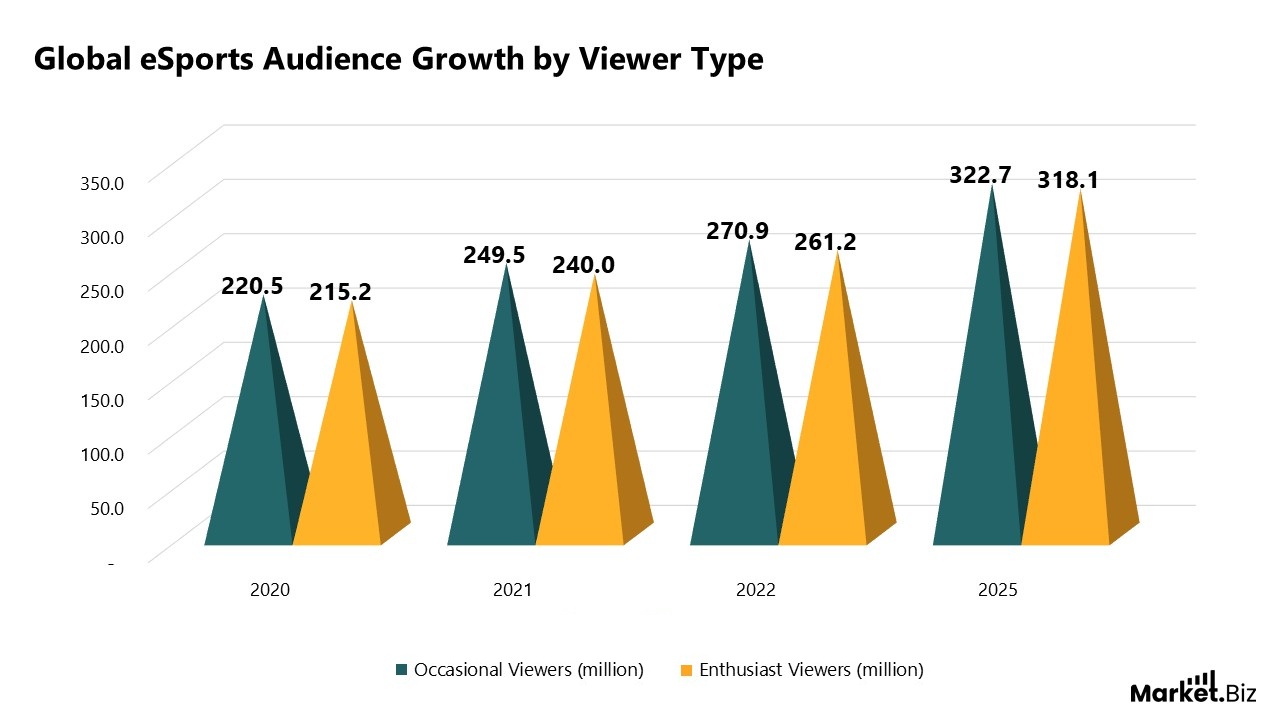
- In 2020, global esports audiences included 220.5 million occasional viewers and 215.2 million esports enthusiasts, marking the start of a strong upward trend.
- By 2021, occasional viewers increased to 249.5 million, while dedicated enthusiasts grew to 240 million, reflecting expanding global engagement.
- In 2022, the audience continued rising, with 270.9 million occasional viewers and 261.2 million regular esports followers.
- The forecast for 2025 shows a major jump, with occasional viewers expected to reach 322.7 million and enthusiasts to hit 318.1 million, signalling near-equal growth for both fan groups.
(Source: Statista, DemandSage)
eSports Viewership Power Ranking
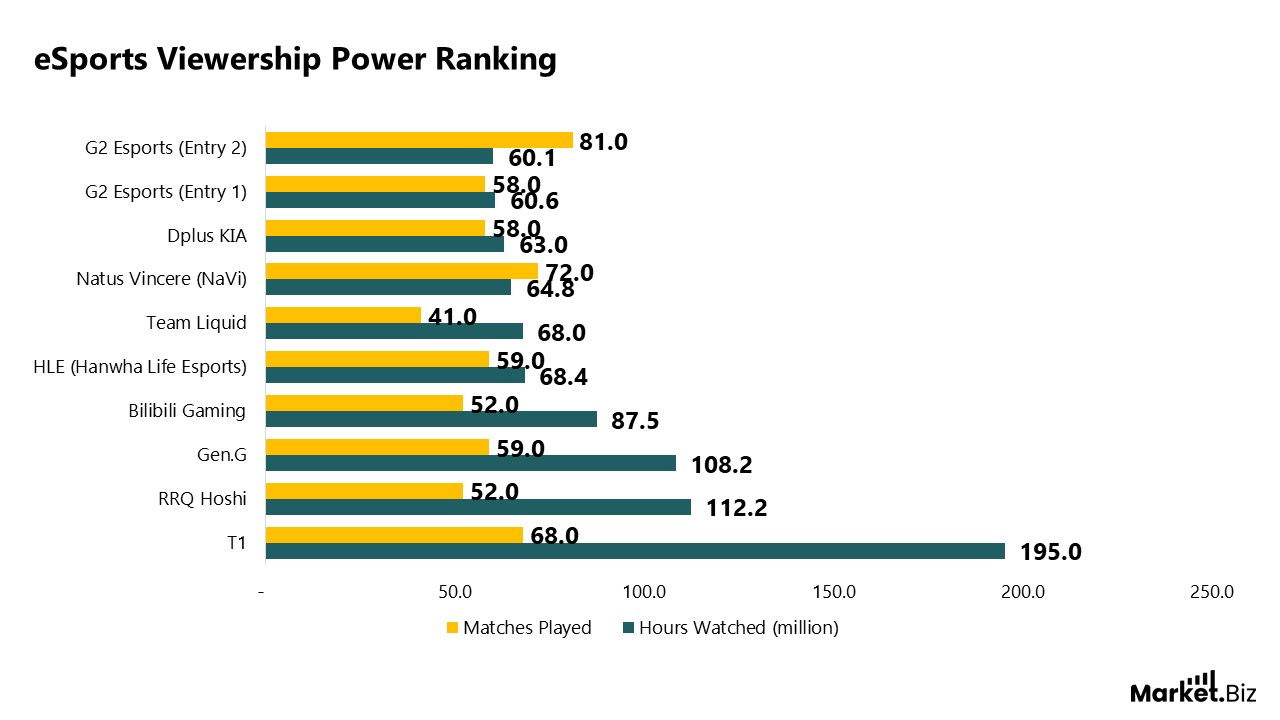
- T1 dominated global viewership in 2024 with 195.04 million hours watched across 68 matches, making it the year’s most-watched esports team.
- RRQ Hoshi followed in second place, drawing 112.22 million hours of watch time over 52 matches.
- Gen.G secured third position with 108.22 million viewing hours from 59 matches, reflecting strong audience engagement.
- Bilibili Gaming ranked fourth, accumulating 87.52 million watch hours across 52 matches.
- HLE (Hanwha Life Esports) earned fifth place with 68.37 million viewing hours from 59 matches.
- Team Liquid claimed sixth place after generating 67.95 million hours watched over 41 matches.
- Natus Vincere (NaVi) followed closely with 64.84 million hours viewed across 72 matches.
- Dplus KIA attracted 62.99 million hours of watch time across 58 matches.
- G2 Esports appeared twice in the rankings; its first entry logged 60.64 million viewing hours from 58 matches.
- G2 Esports’ second entry completed the top ten with 60.11 million hours watched across 81 matches.
(Source: Statista, SQ Magazine)
eSports Fans and Casual Viewers
- In 2019, the esports community included 197 million dedicated fans, while casual viewers reached 200.8 million, marking steady early engagement.
- By 2020, the number of esports fans rose to 215.4 million, with casual watchers increasing to 220.5 million, reflecting growing global interest.
- In 2021, esports fans expanded further to 234 million, and casual viewership climbed to 240 million, continuing the upward momentum in audience growth.
(Source: Newzoo Play Today)
eSports Audience Demographics & Viewership Trends
- The global esports audience reached 523 million viewers in 2022, and forecasts suggest the total will surpass 640 million by 2025.
- By the end of 2024, esports viewership is expected to include 285 million frequent watchers and around 291.6 million occasional viewers worldwide.
- Among global esports viewers, 32% are between ages 16–24, 30% fall within 25–34, 19% are 35–44, 10% fall between 45–54, and 6% are 55–64.
- Esports audiences are becoming more inclusive, with women now making up 35% of fans in 2024, up from 28% in 2016.
- In Europe, men watch esports more often, yet women spend 48% more on esports merchandise than men.
- In the United States, the average esports viewer is 29 years old, showing strong millennial engagement.
- Over 60% of esports fans aged 18–34 report watching esports at least once per week, reflecting high loyalty and engagement.
- In 2022, 81% of esports viewing time was attributed to non-mobile games, showing dominance of PC and console titles.
- By 2025, mobile esports are expected to represent 45% of total esports viewership as mobile gaming continues to expand globally.
- Twitch remains the leading esports streaming platform, surpassing 1.9 billion viewing hours in January 2024 alone.
(Source: Newzoo Play Today, Statista, GlobalWebIndex, Gitnux, Playtoday, Earthweb, Esports)
Most Popular eSports Games Statistics
- League of Legends continued to dominate global esports in 2024 with a peak audience of 2,656,938 viewers, making it the most-watched esports title of the year.
- Mobile Legends emerged as the leading mobile esports title in 2024, with an impressive peak viewership of 1,865,928.
- Counter-Strike has remained the top game by active team participation since 2016, with 6,294 teams competing.
- Counter-Strike: Global Offensive attracted over 1 million streamers in 2020, underscoring its strong global community.
- Tom Clancy’s Rainbow Six Siege led all esports games in prize pool value in 2024, exceeding $4.2 million.
- Fortnite ranked third globally in esports prize pool size, amassing a total exceeding $117 million.
- Dota 2 maintained its status as one of the most lucrative esports titles, with 4,810 players competing in 1,855 tournaments and generating cumulative prize pools of over $340 million in 2023.
- In Asia, Valorant accounted for 65.8% of the region’s 151.4 million watch hours, underscoring its overwhelming popularity.
- Valorant also became Asia’s fastest-growing esports title, generating 6.8 million more watch hours in 2023 than in the previous year.
- Despite its strong presence in the U.S., Counter-Strike (CS: GO and CS2 combined) accounted for only 2.5% of Asia’s total esports watch time in 2023.
(Source: ESCharts, Esports Charts, Esports Earnings, Mandala AI)
eSports Champions & Big Winners Statistics
- Team Liquid, established in the Netherlands in 2000, has accumulated more than $45 million in competitive esports winnings, ranking among the highest-earning organizations globally.
- Johan Sundstein, widely known as “N0tail,” remains the top-earning esports athlete, with career earnings surpassing $7.18 million, driven largely by major Dota 2 victories.
- As of 2024, Team Falcons leads the competitive scene in annual earnings, securing $1.08 million across 17 tournaments.
- Taiwan’s Wang Yuan-hao, known by the alias UMA, achieved an impressive milestone by earning $1 million in 2024 alone.
- The United States ranks first in esports player earnings for 2024, with total winnings reaching $4.4 million across 1,335 competing players.
- Top-tier esports professionals earn substantial monthly salaries, typically ranging between $10,000 and $15,000, while lower-tier competitors earn significantly less.
- Sasha Hostyn stands as the highest-earning female esports competitor, with cumulative winnings exceeding $450,000.
- T1’s superstar player, Lee “Faker” Sang Hyeok, continues to be the team’s standout earner, surpassing $1 million in prize winnings and solidifying his legendary status.
- Top Esports achieved the highest win rate of 2024, recording a 78% success rate with 29 wins and 8 losses during the LPL Spring season.
- The youngest professional gamer on record, Lil Poison, began playing competitively at just 2 years old, earning a place in gaming history.
(Source: Esports Earnings, Exploding Topics, Esportearnings, Play Today, GOL, WatchMojo, Mandala AI)
Highest-Paid Male eSports Athletes Worldwide Statistics
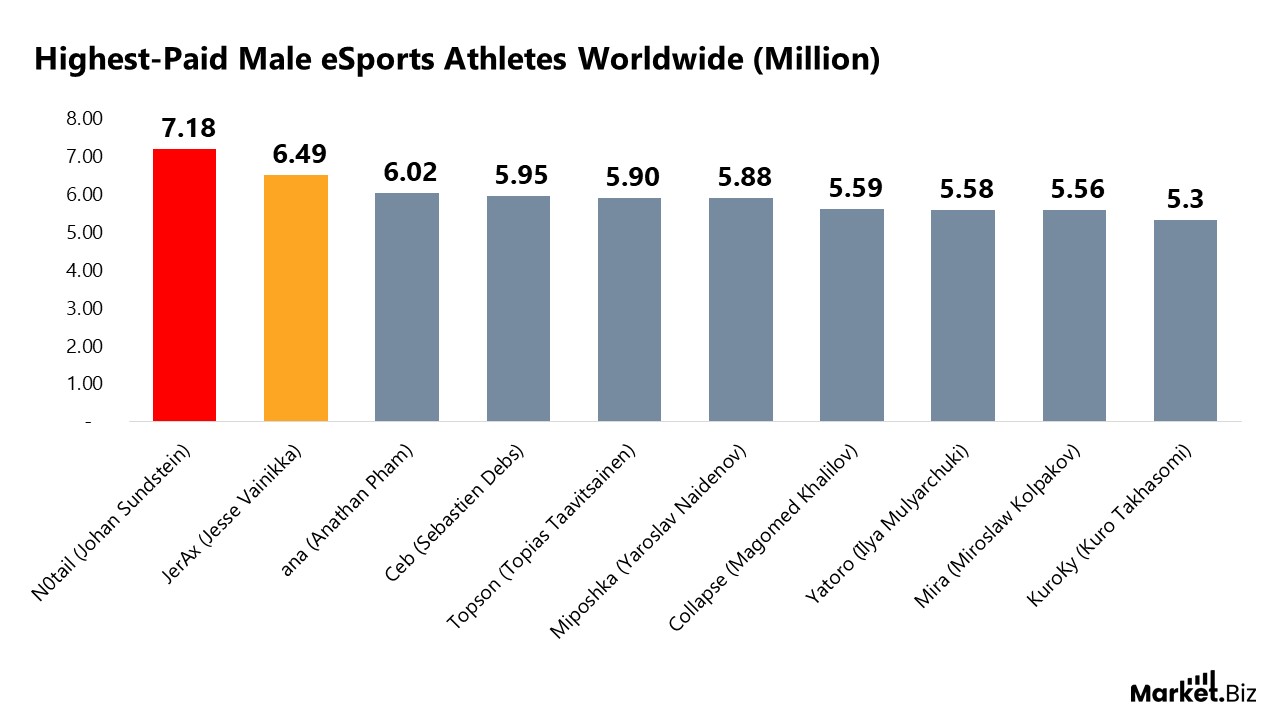
- N0tail (Johan Sundstein) leads all male esports competitors with career earnings totaling $7.18 million, placing him at the top of the global rankings.
- JerAx (Jesse Vainikka) follows in second place, having accumulated $6.49 million through elite tournament performances.
- Ana (Anathan Pham) holds third position with total winnings of $6.02 million, reflecting his major contributions to championship victories.
- Ceb (Sebastien Debs) ranks closely behind with career earnings of $5.95 million, cementing his legacy in professional esports.
- Topson (Topias Taavitsainen) has secured $5.9 million in tournament winnings, making him one of the most successful players in esports history.
- Miposhka (Yaroslav Naidenov) has earned $5.88 million, placing him among the top-performing esports athletes.
- Collapse (Magomed Khalilov) follows with notable earnings totaling $5.59 million.
- Yatoro (Ilya Mulyarchuki) has accumulated $5.58 million, continuing to rise as a dominant figure in competition.
- Mira (Miroslaw Kolpakov) joins the list with total winnings of $5.56 million, reflecting consistent high-level performance.
- KuroKy (Kuro Takhasomi) completes the top ten with career earnings reaching $5.3 million, highlighting his long-standing impact in the esports scene.
(Source: Statista, DemandSage)
The Most Successful Female Players in eSports History
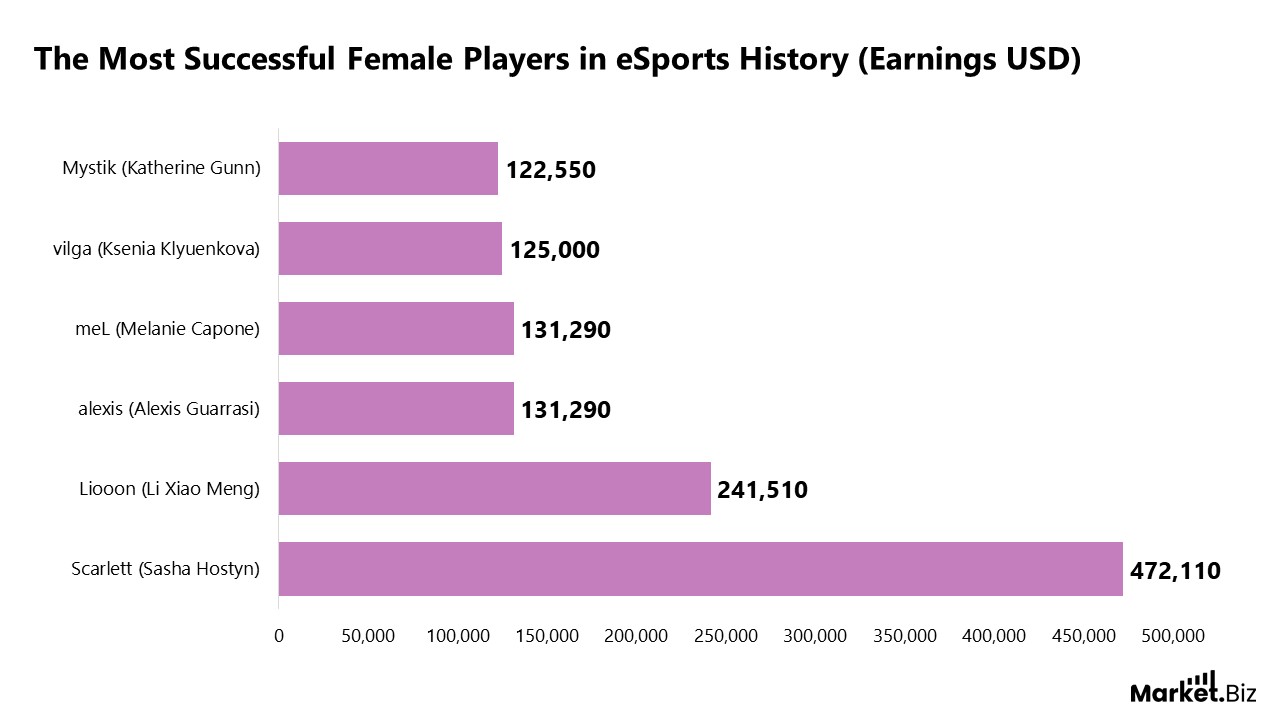
- Scarlett (Sasha Hostyn) leads all female esports competitors with total career earnings of $472,110, making her the most successful woman in esports history.
- Liooon (Li Xiao Meng) ranks second, having earned $241,510 through standout performances in international tournaments.
- Alexis (Alexis Guarrasi) holds third place with cumulative winnings of $131,290, reflecting her strong presence in competitive play.
- Mel (Melanie Capone) shares the same earnings milestone of $131,290, tying her with Alexis among the top female earners.
- Vilga (Ksenia Klyuenkova) follows with $125,000 in prize money, earned across years of high-level competition.
- Mystik (Katherine Gunn) completes the list with career earnings of $122,550, establishing herself as a long-standing figure in women’s esports.
(Source: Statista, DemandSage)
The Most Successful eSports Organizations by Prize Money
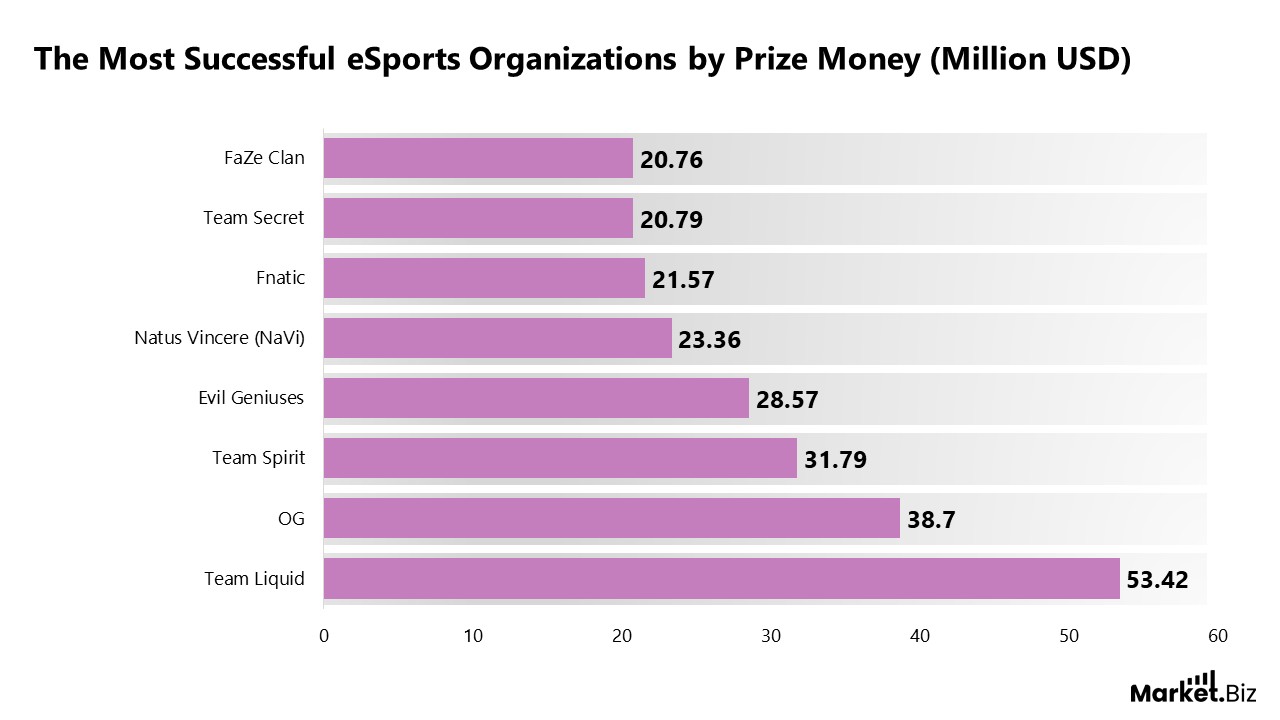
- Team Liquid leads the global rankings with total esports winnings of $53.42 million, representing Europe’s strongest competitive presence.
- OG follows in second place, securing $38.7 million in prize money from major tournament victories across Europe.
- Team Spirit ranks third, having earned $31.79 million, solidifying Russia’s strong position in top-tier esports competition.
- Evil Geniuses is the highest-earning North American organization on the list, with total winnings reaching $28.57 million.
- Natus Vincere (NaVi) from Ukraine has accumulated $23.36 million in prize money, reflecting years of consistent performance across multiple esports titles.
- Fnatic, representing the United Kingdom, has earned $21.57 million in prize money, making it one of Europe’s most established esports teams.
- Team Secret has amassed $20.79 million in prize money, reinforcing its impact in global competitive gaming.
- FaZe Clan, a powerhouse from the United States, follows closely with $20.76 million in total earnings.
- Virtus.pro from Russia has achieved $20.45 million in prize winnings, maintaining a strong legacy in esports.
- Paris Saint-Germain Esports completes the list with $19.8 million, showcasing France’s growing footprint in the esports landscape.
(Source: Statista, DemandSage)
Global Ranking of eSports Organizations by Revenue
- TSM leads all esports organizations globally with an estimated revenue of $540 million, making it the industry leader.
- 100 Thieves follows closely with $460 million in revenue, driven by its competitive teams, apparel brand, and media presence.
- Team Liquid holds third place, generating $440 million through esports competition, partnerships, and global expansion.
- FaZe Clan continues to rank among the industry’s biggest earners with $400 million in revenue across gaming, lifestyle, and entertainment.
- Cloud9 secures $380 million in funding, supported by its long-standing competitive success and strong sponsorship ecosystem.
- G2 Esports reports $340 million in revenue, underscoring its influence across multiple esports titles.
- Fnatic reaches $260 million in valuation, reflecting its longstanding presence in European esports.
- Gen.G records $250 million in revenue, driven by its international teams and market reach across Asia and North America.
- NRG generates approximately $240 million in revenue, highlighting the growth of U.S.-based esports organizations.
- T1 rounds out the list with $220 million, supported by its strong fanbase and championship legacy, particularly in League of Legends
(Source: Statista, DemandSage)
Conclusion
eSports Statistics: eSports statistics highlight an industry that continues to expand rapidly, driven by rising global viewership, increased participation, and strong financial growth across teams, tournaments, and streaming ecosystems.
The consistent increase in audience numbers, the rapid momentum of mobile esports, and the growing diversity within the fanbase reflect esports becoming a central part of modern digital entertainment.
Economic indicators such as prize money, player earnings, and organizational revenue show how professional and financially influential the industry has become. Demographic insights also reveal a young and highly engaged community that plays a significant role in shaping future entertainment trends.
Taken together, these patterns show that esports is not only growing at a remarkable pace but is also becoming an important cultural and economic force in the global entertainment landscape.
FAQ’s
Esports statistics reflect a sector experiencing strong, sustained expansion, as evidenced by rising global audiences, increased player participation, and growing financial backing from sponsors, media companies, and organisations. These trends show how competitive gaming is evolving from a niche interest into a major global entertainment field.
Viewership figures act as a central indicator of the vitality and appeal of the esports ecosystem. As audiences increase, the industry benefits from higher sponsorship value, more commercially successful tournaments, stronger team profitability, and greater cultural recognition, enhancing overall market stability.
Demographic data reveals who is engaging with esports and the motivations behind their participation. Information on age groups, gender distribution, regional differences, and viewing behaviours enables organisations to refine marketing strategies, develop more relevant content, and identify emerging audience segments.
Prize money and player earnings offer a clear picture of the financial strength of the competitive gaming ecosystem. These statistics highlight the games and teams that attract the highest levels of investment, reflecting the increasing professionalism of esports and the economic feasibility of pursuing it as a career.
Competitive metrics such as win percentages, total watch hours, and tournament outcomes influence team reputation and fan loyalty. These indicators also determine sponsorship appeal and competitive rankings, helping stakeholders assess the current landscape and predict future performance trends.