








Introduction
Mobile Banking Statistics: Mobile banking has quickly become one of the most essential digital financial tools, reshaping how people manage their finances, conduct transactions, and access banking services.
As smartphone usage expands, mobile networks improve, and digital payment systems become more secure. Mobile banking adoption continues to grow across both mature and emerging markets. Whether it’s checking balances, sending money, paying bills, or managing investments, users increasingly depend on mobile apps for their everyday financial activities.
Mobile banking statistics provide valuable insight into this shift toward digital-first banking, revealing changes in adoption trends, security expectations, transaction behavior, generational differences, and regional expansion.
As financial institutions advance their digital offerings and consumers seek greater convenience. Mobile banking is now a fundamental part of the global financial ecosystem, shaping the future of digital finance and customer engagement.
Editor’s Choice
- By 2025, the number of mobile banking users reached 2.17 billion, a 35% increase from 2020.
- Mobile banking adoption in North America reached 61%, with consistent growth across key financial markets.
- In Europe, mobile banking usage reached 76%, with leading nations such as Norway, Denmark, and Sweden achieving adoption rates above 87%.
- Worldwide mobile banking revenue grew to USD 1.92 trillion in 2025, reflecting a 28% year-over-year increase.
- The Asia-Pacific region generated USD 740 billion in mobile banking revenue, positioning it as the top-performing market globally.
- Europe’s mobile banking sector expanded to USD 445 billion, largely driven by strong activity in Germany, the UK, and France.
- Latin America experienced rapid expansion, posting 29% annual growth and reaching USD 172 billion in 2025.
- In Africa, digital banking revenue increased by USD 58 billion. Supported by mobile-first platforms that contributed to a 43% boost in adoption across the region.
Global Mobile Banking Adoption Rates by Country
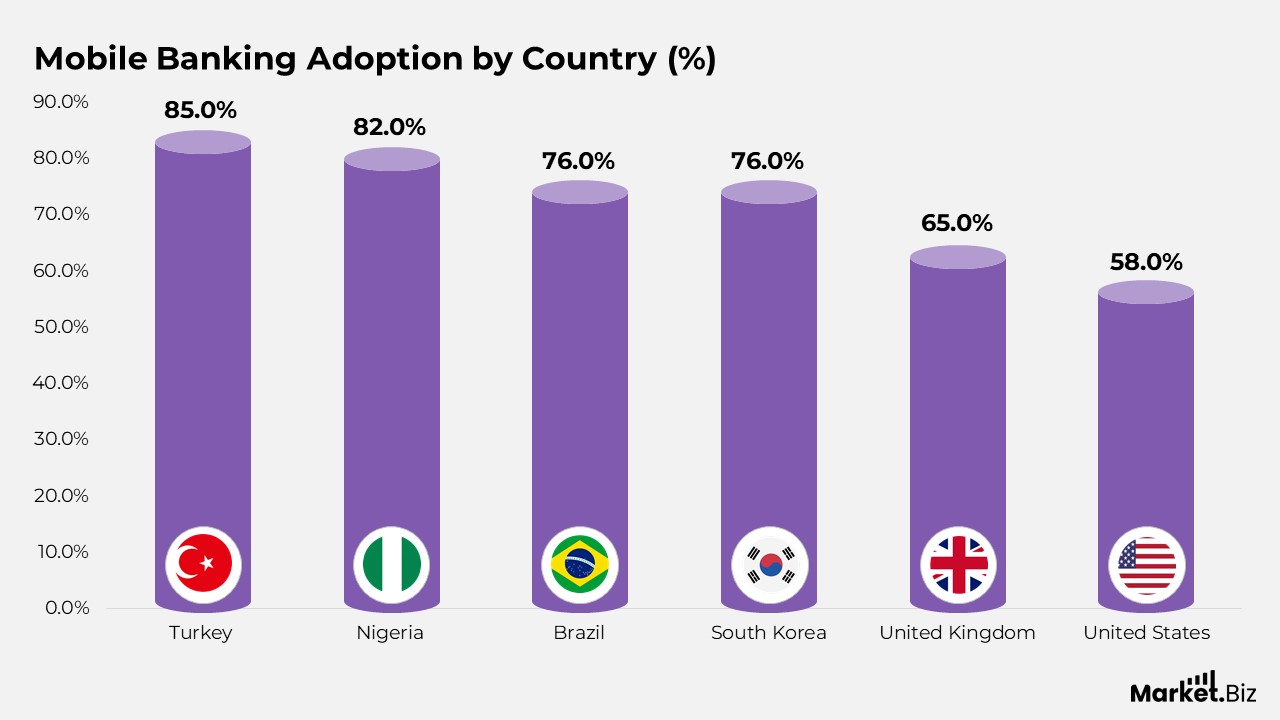
- Turkey leads the world, with 85% of its population actively using mobile banking services.
- Nigeria follows with an impressive 82% adoption, reflecting the country’s fast-moving shift toward digital financial solutions.
- Brazil and South Korea each record 76% mobile banking usage, demonstrating strong uptake across both Asian and South American markets.
- In the United Kingdom, mobile banking adoption has reached 65%, with steady, consistent growth.
- The United States, despite its technological leadership, reports a relatively lower 58% adoption rate. Signaling considerable potential for further expansion in mobile banking.
(Source: vpnAlert, CoinLaw)
Global Mobile Banking Usage Statistics
- By 2025, mobile banking reached 66% global penetration, with the fastest adoption occurring in Nigeria, India, and Bangladesh, fueled by low-cost smartphones and rapid fintech expansion.
- In North America, mobile banking usage increased to 61% in 2025, rising from 58% in 2023. Supported by the rollout of 5G, AI-driven banking apps, and integration of financial services into non-bank platforms.
- Mobile payments accounted for 49% of all digital banking transactions worldwide in 2025. Signalling a widespread shift toward mobile-first financial behaviour.
- Across Latin America, mobile banking adoption surged 46% from 2021 to 2025. With Mexico, Brazil, and Colombia driving growth through digital wallets and real-time payment infrastructures.
- The Middle East and Africa recorded a substantial 74% year-over-year increase in mobile banking adoption between 2023 and 2025. Propelled by financial inclusion programs, fintech collaborations, and expanding smartphone access.
- Europe remains a strong mobile banking region, with more than 69% of people in countries such as the UK, Germany, and France relying on mobile platforms for everyday financial activities.
- In Southeast Asia, mobile banking usage climbed 56% by 2025. With Vietnam, Indonesia, and the Philippines showing notable adoption of QR-based payments, super apps, and digital-only banks.
(Source: vpnAlert, CoinLaw)
General Mobile Banking Statistics
- In early 2023, 63% of individuals with bank accounts handled their banking activities through a smartphone or tablet.
- A year later, in 1Q 2024, the same 63% of account holders continued to rely on mobile devices for their everyday banking needs.
- Overall, 71% of consumers say they prefer using either a mobile app or a computer to manage their bank accounts, underscoring the shift away from in-branch banking.
- By 2024, nearly 59% of people were actively using their mobile phones to oversee and manage their financial accounts.
- Around 25% of mobile banking users have taken the next step by applying for financial products such as credit cards, savings accounts, or loans directly within mobile apps, showing their rising trust in digital channels for major financial decisions.
- 53% of customers feel frustrated when they cannot respond to mobile messages from their bank, indicating a strong demand for seamless, two-way digital communication.
(Source: G2.com, Inc.)
Mobile Banking Acceptance by Demographics
- In the United States, 80% of millennials use mobile banking as their main method of managing finances, compared to 30% of baby boomers.
- Gen Zis rapidly increasing participation, with 72% of users aged 18–24 actively expending mobile banking apps, creating them the fastest-growing demographic.
- Among baby boomers, mobile banking adoption rose from 15% in 2018 to 30%, reflecting increasing comfort with digital financial tools.
- Women are adopting mobile banking at accelerating rates, with 55% of female users in Asia and 45% in Africa reporting active usage.
- Globally, 60% of urban residents now use mobile banking, with major metropolitan areas in India and China among the highest-growth areas.
- In the US, 40% of mobile banking users are aged 25-34, making older millennials the largest active demographic group.
(Source: vpnAlert, CoinLaw)
How Mobile Banking Influences Customer Retention and Loyalty
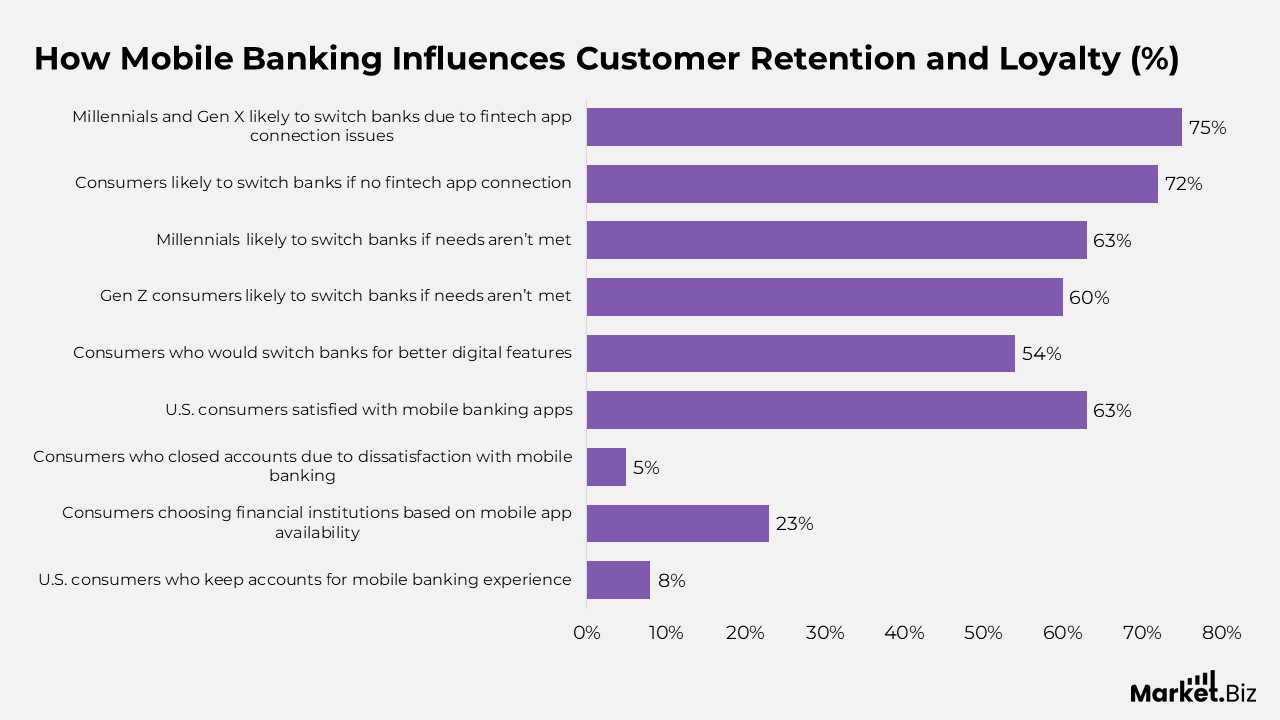
- Around 8% of U.S. consumers say they keep their oldest financial account primarily because of a strong online or mobile banking experience.
- Mobile banking apps rank as the top consideration when choosing a financial institution, with 23% of consumers selecting “offers a mobile banking app” as their most important deciding factor.
- Among consumers who have closed a financial account in the past, fewer than 5% cite dissatisfaction with mobile banking as the reason.
- 63% of U.S. consumers report being satisfied with their overall mobile banking app experience.
- More than half 54% say they would switch to a new financial provider if their current bank failed to deliver their most desired digital features.
- Younger customers show even stronger expectations: 60% of Gen Z and 63% of Millennials say they would move to a different provider if their needs weren’t met.
- If a bank does not support connectivity to popular fintech apps, 72% of U.S. consumers would look for a different institution, with this figure rising to 75% among Millennials and Gen X users.
- Digitally engaged customers are 2.7 times more likely to remain loyal to their financial institution compared to less engaged users.
(Source: vpnAlert, CoinLaw, Consumer Research on Digital and Mobile Banking (2022); MX Digital and Mobile Banking Use Cases)
General Usage Patterns of Mobile Banking by Generation Statistics
- 58% of Millennials use mobile apps for financial tasks at least once per day, increasing to 85% weekly.
- 63% of Millennials have 3 or more finance-related apps, and 15% have 6 or more.
- 23% of Baby Boomers never use mobile apps for financial tasks, and one-third have no financial apps installed.
- 43% of Gen X completes financial tasks daily via mobile apps, and 49% have 3 or more financial apps.
- 48% of Gen Z perform daily finance tasks on mobile apps, compared with 58% of Millennials.
- Among Gen Z, 47% have 1–2 finance apps, 39% have 3–5, and 10% have six or more.
(Source: What is Financial Wellness?, MX Technologies, Inc.)
Most Desired Mobile Banking Features by Generation Statistics
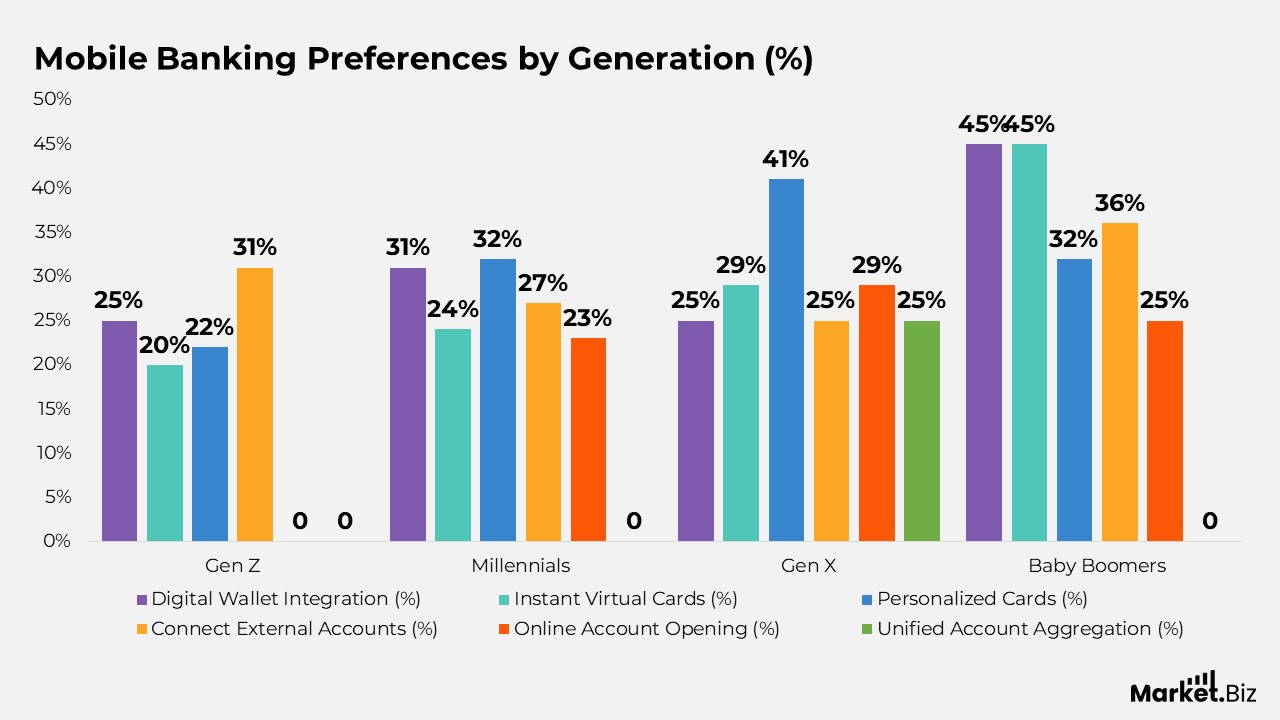
Gen Z
- 31% want to connect external accounts for a single financial view.
- 25% prefer digital wallet integration.
- 22% want personalized card options.
- 20% want instant issuance of virtual cards.
- 19% prioritize paperless statements.
Millennials
- 32% prioritize personalized cards.
- 31% want digital wallet compatibility.
- 27% seek the ability to link outside financial accounts.
- 24% prefer instant virtual cards.
- 23% want online account opening.
Gen X
- 41% prefer personalized cards above all.
- 29% want online account opening.
- 29% prefer instant virtual cards.
- 25% want digital wallet integration.
- 25% want unified account aggregation.
Baby Boomers
- 45% prioritize digital wallet integration.
- 45% want instant virtual cards.
- 36% want to connect outside financial accounts.
- 32% prefer personalized cards.
- 25% value for online account opening.
(Source: What is Financial Wellness?,; What Consumers Want from Financial Providers; Consumer Research on Digital and Mobile Banking; Consumer Money Matters, MX Technologies, Inc.)
Mobile Banking, Open Finance & Account Connectivity Trends Statistics
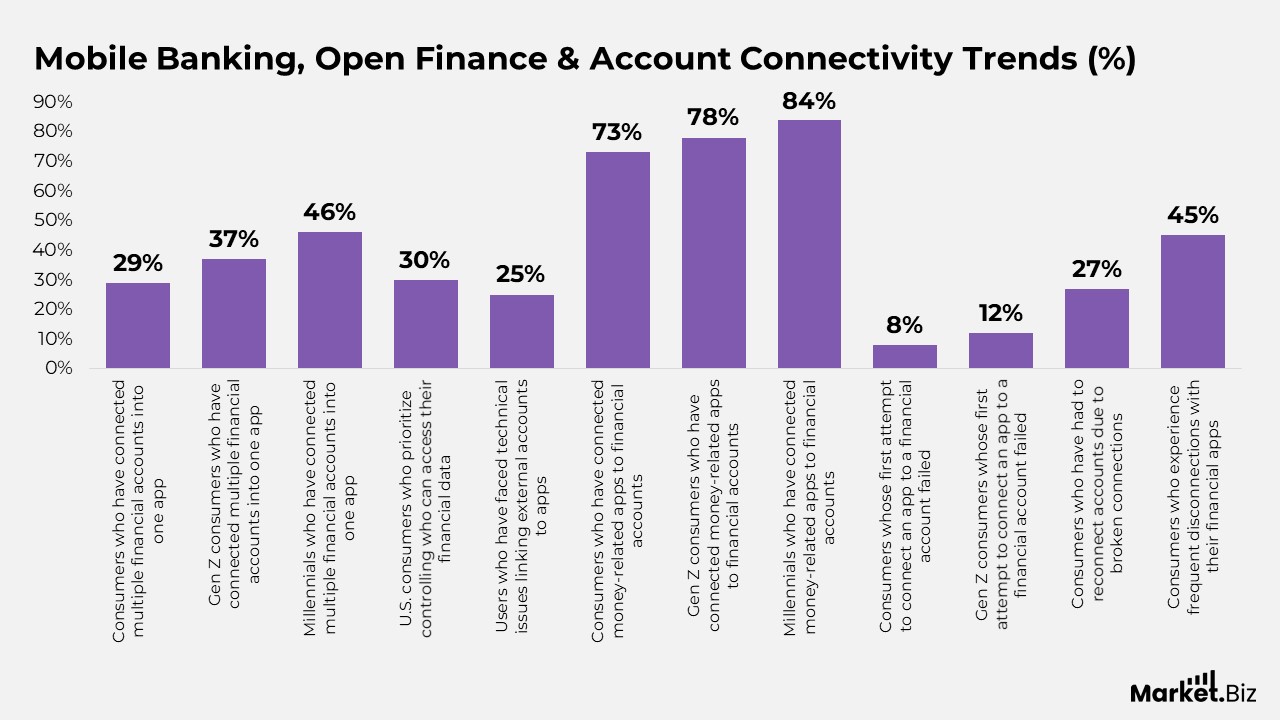
- 29% of consumers have connected multiple financial accounts into one app, rising to 37% for Gen Z and 46% for Millennials.
- 30% of U.S. consumers say controlling who can access their financial data is essential for mobile banking.
- 1 in 4 users have faced technical issues linking external accounts to financial apps.
- 73% of consumers have connected money apps to their financial accounts, with the highest rates among Gen Z (78%) and Millennials (84%).
- 8% say their first attempt to connect an app to a financial account did not go smoothly; this rises to 12% for Gen Z.
- 27% have had to reconnect accounts due to broken connections.
- 45% of those who experience disconnections say these issues happen frequently.
(Source: MX Technologies, Inc.)
Mobile Banking App User Engagement Statistics
- Consumer banking apps surpassed 2 billion downloads by mid-2025, marking a 5.1% yearly increase, and now see more than 500 million downloads per quarter.
- Top-performing mobile banks complete over 80% of routine interactions within the app, improving user convenience and deepening loyalty.
- 90% of users rely on mobile banking apps to check account balances, while 79% review recent transactions, emphasizing the importance of real-time dashboards.
- Among Millennials, mobile banking is nearly universal, with 97% using banking apps compared to 89% of all consumers.
- The average smartphone user engages with 30 apps per month, and 51% check apps 1–10 times a day, highlighting significant engagement potential for financial apps.
(Source: SQ Magazine, Statista)
Technological Innovations in Mobile Banking Statistics
- 68% of global banks are using AI by 2025 to power chatbots, automate customer support, and provide personalized financial planning tools, significantly improving operational efficiency and customer engagement.
- Voice banking adoption has risen to 43% in 2025, with Millennials and Gen Z leading the trend. Voice-enabled transactions, balance inquiries, and spending summaries are now standard features.
- Blockchain integration is now part of 28% of mobile banking platforms in 2025, primarily for secure smart contracts, identity verification, and fraud prevention.
- The adoption of 5G technology has enhanced mobile banking transaction quickness and user experience by 46% in 2025, enabling faster biometric authentication and real-time payments.
- Cloud-based banking is now implemented by 78% of financial institutions globally, providing faster feature rollouts, improved uptime, and greater scalability of digital services.
- Personalized banking services, powered by AI and big data analytics, now cater to 66% of mobile banking users, offering tailored savings plans, credit offers, and investment insights based on real-time data.
- The use of wearable banking apps has surged to 54% in 2025, with smartwatches being the preferred device for hands-free banking access and everyday transactions.
(Source: CoinLaw)
Security Challenges and Fraud Detection in Mobile Banking Statistics
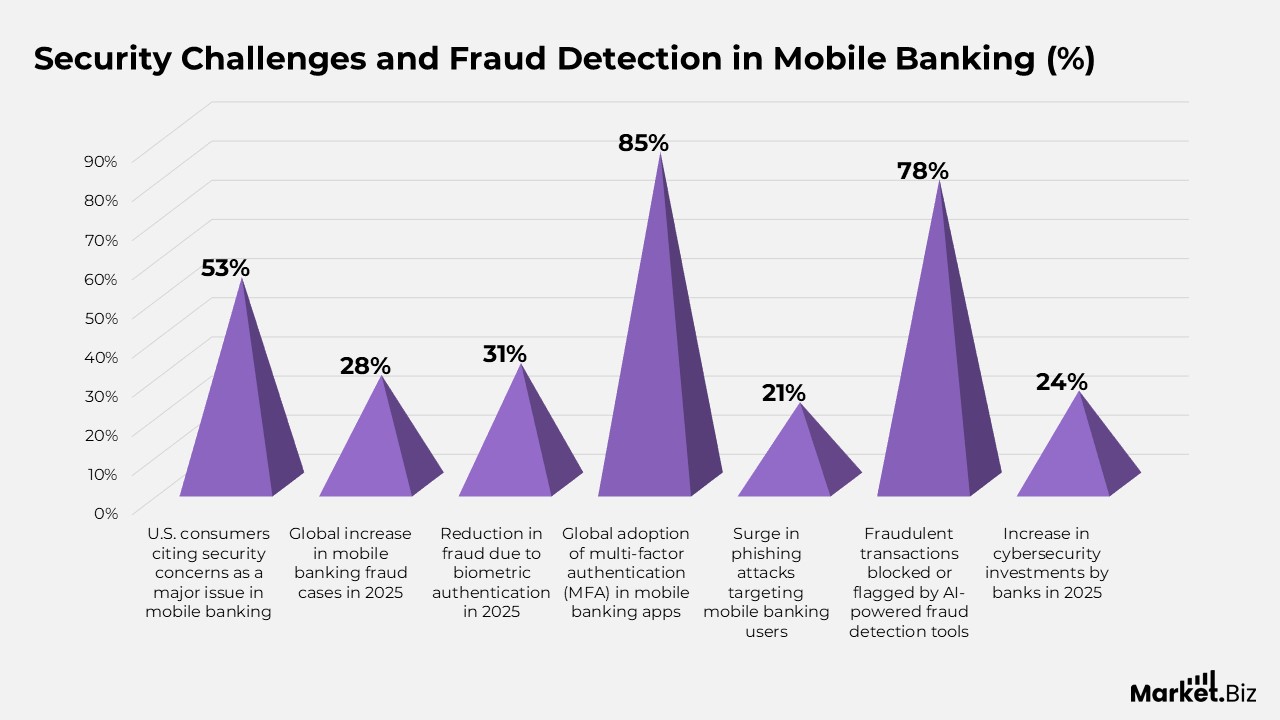
- 53% of U.S. consumers still cite security concerns as a major issue in mobile banking in 2025, despite the growing adoption of real-time fraud-prevention systems.
- Mobile banking fraud cases increased by 28% globally in 2025. As cybercriminals exploit real-time payments and deepfake technologies to perpetrate financial scams.
- Biometric authentication has helped reduce fraud by 31% in 2025. With over 80% of global users now using fingerprint or facial recognition to access banking apps.
- Multi-factor authentication (MFA) is now used by 85% of mobile banking apps globally. Making it one of the most widely adopted security protocols for consumers in 2025.
- Phishing attacks targeting mobile banking users surged by 21%. Driven by more personalized and AI-generated scam messages across SMS and messaging apps.
- AI-powered fraud detection tools blocked or flagged 78% of fraudulent transactions in mobile banking in 2025. Leveraging behavioural analytics and real-time anomaly detection.
- Banks’ cybersecurity investments increased by 24% in 2025, with a focus on endpoint protection, real-time monitoring, and customer education programs to prevent fraud.
(Source: CoinLaw)
Conclusion
Mobile Banking Statistics: Mobile banking has evolved into a cornerstone of the global financial landscape, with increasing adoption and engagement across diverse regions and user groups. The integration of AI and 5G technologies is transforming the way consumers manage their financial activities, providing real-time assistance, tailored services, and enhanced security.
As mobile applications continue to improve functionalities such as fraud detection, account management, and budgeting tools, they are reshaping how users interact with their financial institutions. With billions of downloads and consistent growth, mobile banking usage is set to continue its upward trajectory.
Moreover, Financial institutions that embrace AI and 5G to deliver seamless, secure, and personalized banking experiences are positioning themselves for sustained success and fostering customer loyalty in an increasingly mobile-first world.
The future of mobile banking will be shaped by increased automation, deeper integration, and innovations centred on the user, ultimately transforming the digital banking sector in the years ahead.
FAQ’s
Mobile banking has become a cornerstone of the global financial system, largely driven by the widespread use of smartphones and the rapid advancement of digital technologies. This shift marks a departure from traditional banking, offering users the convenience of accessing a range of financial services anytime and anywhere.
The convergence of AI and 5G is accelerating the evolution of mobile banking. AI enhances the user experience by personalizing services, automating customer support, and improving fraud detection through sophisticated data analysis. Meanwhile, 5G improves the speed, reliability, and efficiency of mobile banking services, enabling real-time transactions and more seamless user interactions.
Generational differences play a significant role in how mobile banking is adopted and used. Gen Z and Millennials, who have grown up in the digital era, are more likely to embrace mobile banking for its convenience, speed, and real-time capabilities. These groups also have heightened expectations for personalized services, enhanced security, and seamless integration with other digital tools, such as fintech apps and digital wallets.
Mobile banking apps are becoming the focal point for consumer engagement due to their ability to provide a convenient, accessible, and secure platform for managing financial activities. These apps allow users to handle basic banking functions, such as checking balances and transferring funds, while also offering more advanced features, including budgeting tools, investment management, and real-time financial insights.