








Introduction
Photography Statistics: Photography has evolved into a fundamental aspect of modern communication, extending well beyond personal photos to play a pivotal role in fields such as marketing, journalism, and social media.
As digital technology and smartphone cameras advance, photography has become an everyday practice for millions, not just a professional skill. With visual content now at the heart of online engagement, platforms like Instagram and TikTok have driven a surge in both amateur and professional photography.
Photography statistics offer valuable insights into emerging trends, showcasing changes in equipment choices, usage habits, and the increasing importance of visual storytelling. These data not only illustrate photography’s influence on culture and business but also provide a glimpse into the future of the ever-evolving digital imagery landscape.
Editor’s Choice
- The global photography market was valued at around $100 billion in 2022.
- More than 70% of professional photographers generate over 50% of their income from commercial photography work.
- In 2023, the number of professional photographers worldwide surpassed 1.2 million.
- Smartphone cameras account for nearly 85% of all consumer photography.
- The total number of photos taken globally each year has exceeded 1.2 trillion.
- Portrait photography continues to be the most popular niche, making up 40% of professional photo sessions.
- 65% of photographers use social media platforms to market their services.
- The average annual income of amateur photographers is approximately $3,000.
- Drone photography services have seen a 25% increase since 2022.
- The global photo printing market is expected to reach $45 billion by 2025.
- The average cost for a professional wedding photographer is around $2,500 per wedding.
- Over 60% of consumers prefer to order prints online rather than purchasing them in-store.
- The number of online photo printing services grew by 30% in 2023.
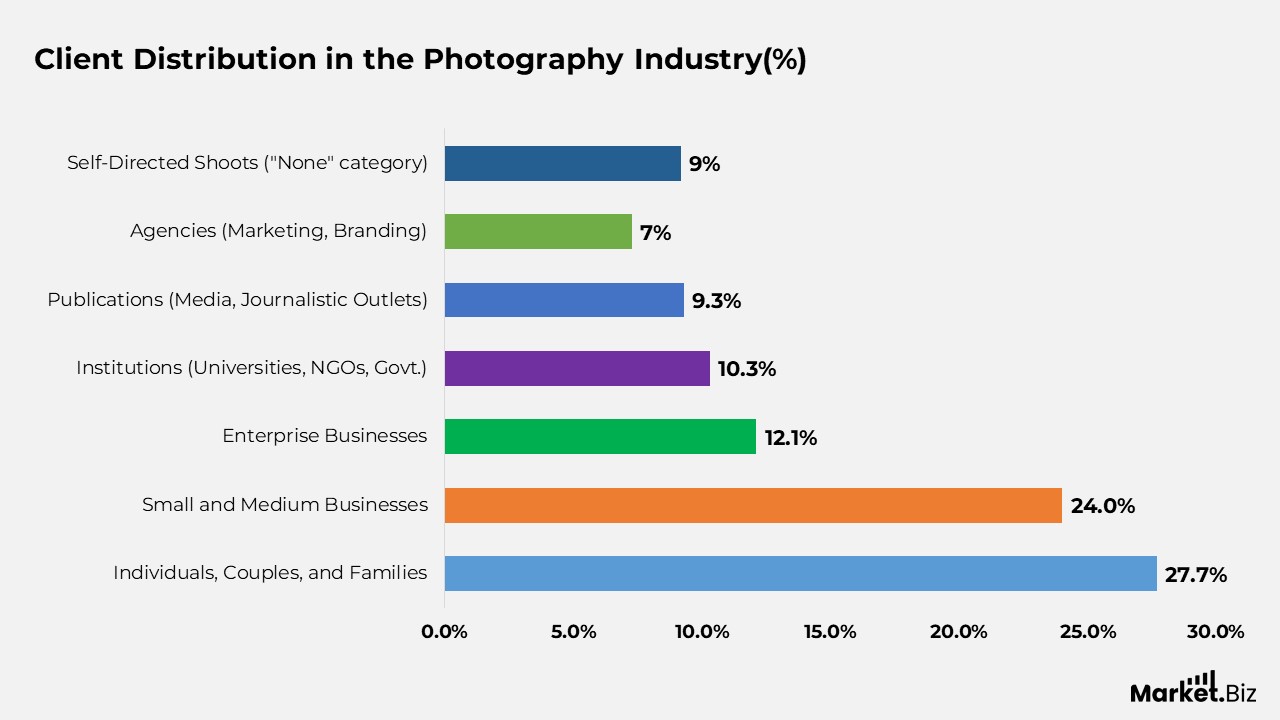
Client Distribution in the Photography Industry
- The majority of clients are individuals, couples, and families, accounting for 27.7% of the total.
- Small and medium businesses make up 24% of the client base.
- Enterprise businesses represent 12.1% of clients.
- Institutions, such as universities, NGOs, and government entities, account for 10.3%.
- Publications, including media and journalistic outlets, contribute 9.3% of clients.
- Agencies, involved in marketing or branding, make up 7.3% of the client base.
- A small portion, 9.2%, falls into the “None” category, where shoots are self-directed.
(Source: Zenfolio, State of the Photography Industry Survey Report)
Preferred Focal Lengths for Photography Lenses
- Among all photography specialties, zoom lenses are favored over prime lenses.
- The most popular focal length is 24-70mm, which ranks as the top choice for photographers.
- 70-200mm is the second most preferred focal length.
- 50mm follows closely as the third most popular focal length for photographers.
(Source: Zenfolio, State of the Photography Industry Survey Report)
Top Lenses by Photography Specialty
- Portrait photography commonly uses 85mm, 50mm, and 24-70mm lenses.
- Landscape photographers prefer 24-70mm, 16-35mm, and 70-200mm lenses.
- For Wedding photography, the favored lenses are 24-70mm, 70-200mm, and 400mm.
- Sports photographers typically use 70-200mm, 400mm, and 300mm lenses.
- Commercial photography often uses 70-200mm, 85mm, and 50mm lenses.
- In Event photography, popular choices include 24-70mm, 70-200mm, and 50mm lenses.
- Documentary photographers prefer 24-70mm, 35mm, and 50mm lenses.
- For Fine Art photography, 24-70mm, 50mm, and 35mm lenses are widely used.
- Fashion/Beauty photographers typically favor 24-70mm, 85mm, and 70-200mm lenses.
- Family photography often involves 24-70mm, 70-200mm, and 50mm lenses.
- Wildlife photographers rely on 500mm, 600mm, and 400mm lenses.
- For Lifestyle photography, 24-70mm, 50mm, and 35mm lenses are commonly used.
- Travel photographers prefer 24-70mm, 16-35mm, and 35mm lenses.
- Real Estate photographers frequently use 16-35mm, 24-70mm, and 50mm lenses.
- Editorial photography typically involves 24-70mm, 50mm, and 105mm lenses.
- For Product photography, 50mm, 24-70mm, and 105mm lenses are often preferred.
- Food photographers typically rely on 24-70mm, 50mm, and 105mm lenses.
- In Baby photography, 24-70mm, 50mm, and 35mm lenses are widely used.
- Still Life photography commonly uses 50mm, 24-70mm, and 35mm lenses.
- Boudoir photographers often opt for 50mm, 85mm, and 35mm lenses.
- School photography typically involves 24-70mm, 70-200mm, and 85mm lenses.
(Source: Zenfolio, State of the Photography Industry Survey Report)
Camera Brand Preferences by Employment Type in Photography
- Part-time self-employed photographers predominantly favor Canon, which holds 45.28% of the market share. Nikon comes in second, accounting for 30.05% of the market. Sony follows with 10.8%, while Fujifilm, Phone cameras, and other brands collectively contribute a smaller portion of the total preference.
- Full-time self-employed photographers also show a clear preference for Canon, which captures 48.86% of the market. Sony is the next most popular choice, with 29.56%, while Nikon secures 11.31% of the market share. Other brands, including Fujifilm and Phone cameras, represent a modest share of this segment.
- Among full-time employed photographers, Canon continues its dominance, securing 57.5% of the market. Sony follows with 21.25%, while Nikon accounts for 11.25%. Other brands, such as Fujifilm and Phone cameras, occupy the remaining market share, indicating a general preference for Canon across various employment sectors within the photography industry.
(Source: Zenfolio, State of the Photography Industry Survey Report)
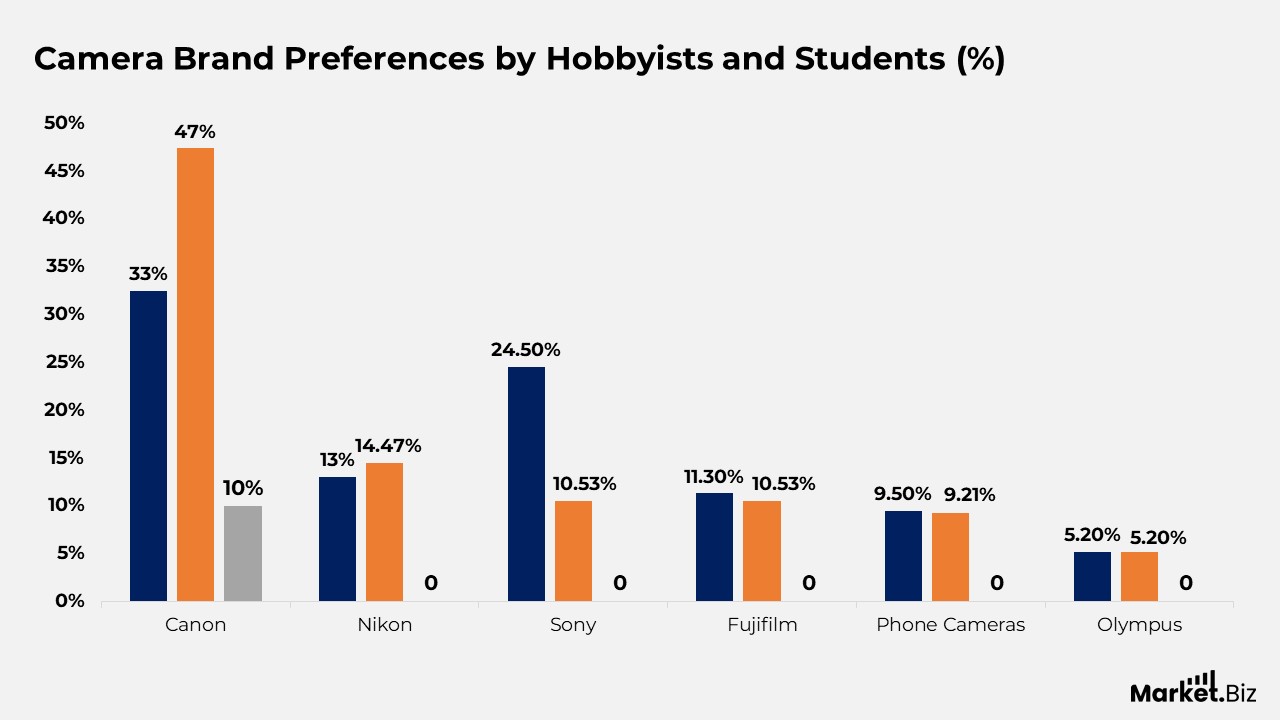
Camera Brand Preferences by Hobbyists and Students
- Hobbyist photographers primarily choose Canon, which leads with 32.5% of the market share, followed by Sony at 24.5% and Nikon at 13%. Fujifilm also has a notable presence with 11.3%, while Phone and Olympus each account for smaller shares of 9.5% and 5.2%, respectively.
- Students in photography lean heavily towards Canon, which dominates with 47.37% of the market share. Nikon and Sony both hold 14.47% and 10.53%, respectively. Fujifilm also has a decent following with 10.53%, while Phone and Olympus account for 9.21% and 5.2%, respectively.
- It is noted that 10% of students and hobbyists embrace mobile photography, while full-time and part-time professionals tend to prefer standard photography equipment over mobile phones.
(Source: Zenfolio, State of the Photography Industry Survey Report)
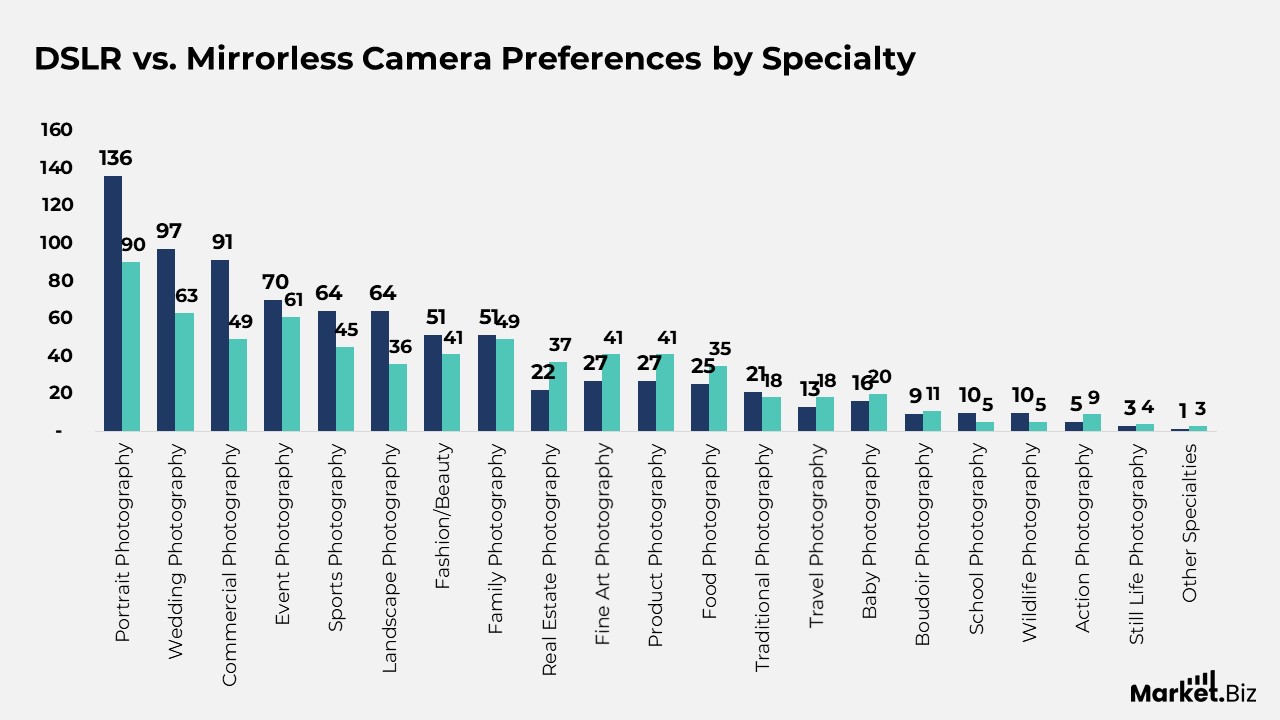
DSLR vs. Mirrorless Camera Preferences by Specialty
- Portrait photographers largely prefer DSLR, with 136 DSLR users compared to 90 using Mirrorless cameras.
- In Wedding photography, DSLR takes the lead with 97 users, while Mirrorless cameras have 63.
- For Commercial photography, DSLR dominates with 91 users, while Mirrorless has 49.
- Event photography sees DSLR leading at 70, with Mirrorless at 61.
- Sports photographers choose DSLR (64) over Mirrorless (45).
- Landscape photography also prefers DSLR with 64 compared to 36 for Mirrorless.
- In Fashion/Beauty, DSLR still holds a significant share (51) compared to Mirrorless at 41.
- Family photographers show a more balanced preference with Mirrorless (49) and DSLR (51).
- For Real Estate, Mirrorless holds a slight edge with 37, while DSLR has 22.
- Fine Art photography sees Mirrorless leading with 41, while DSLR has 27.
- Product photographers show a greater preference for Mirrorless with 41, while DSLR has 27.
- Food photography sees Mirrorless (35) edging out DSLR (25).
- Traditional photography has DSLR at 21 and Mirrorless at 18.
- Travel photographers show a clear preference for Mirrorless (18) over DSLR (13).
- Baby photography slightly favors Mirrorless with 20, while DSLR follows at 16.
- Boudoir photography shows Mirrorless leading with 11 compared to DSLR at 9.
- In School photography, DSLR (10) is slightly ahead of Mirrorless (5).
- Wildlife photographers have a higher preference for DSLR (10) over Mirrorless (5).
- Action photography sees Mirrorless dominating with 9 against DSLR (5).
- For Still Life photography, Mirrorless is preferred at 4, while DSLR users are at 3.
- Other specialties have Mirrorless (3) and DSLR (1).
(Source: Zenfolio, State of the Photography Industry Survey Report)
Consumer Behavior and Photography Preferences
- Smartphone cameras are responsible for about 85% of all consumer photography, making them the most widely used tool for capturing images.
- Over 1.2 trillion photos are taken globally each year globally, illustrating the growing prevalence of photography in daily life.
- 65% of photographers utilize social media to promote and market their services, with Instagram being the dominant platform, used by 82% of professionals.
- More than 60% of consumers prefer to order photo prints online rather than purchasing them in-store, signaling a shift towards digital convenience.
- On average, people in the U.S. take about 750 photos per year, underscoring the widespread engagement in personal photography.
(Source: Zipdo)
Industry Growth, Education, and Market Dynamics in Photography
- The global number of professional photographers surpassed 1.2 million in 2023, reflecting continued growth in the industry.
- Drone photography services have experienced a 25% increase since 2022, highlighting the rising demand for aerial imagery.
- The number of online photo printing services expanded by 30% in 2023, showcasing a shift towards digital printing solutions.
- Nearly 50% of professional photographers manage their own studios, reflecting a strong trend toward independent entrepreneurship in the field.
- The use of AI editing tools in photography surged by 60% in 2023, as professionals adopt new technologies for image enhancement.
- The demand for 3D photography in commercial applications has grown by 45% since 2021, indicating its increasing utility in various industries.
- 55% of photographers work as freelancers, while 40% are employed by companies or studios, showing a healthy mix of independent and salaried roles in the industry.
- Camera rental services grew by 20% in the past year, reflecting a surge in demand for high-end, short-term equipment use.
- In 2023, 65% of photography businesses reported increased revenue compared to the previous year, signaling a positive growth trend.
- Approximately 30% of professional photographers are women, demonstrating a gradual increase in gender diversity within the industry.
Moreover
- The demand for family portrait sessions rose by 15% in the past year, reflecting a shift towards personal and family-focused photography.
- 80% of professional photographers believe online portfolios are essential for client acquisition, emphasizing the importance of digital presence.
- The use of cloud-based storage solutions among photographers increased by 50% in 2023, highlighting the shift towards more secure and accessible storage options.
- 30% of new camera sales are mirrorless models, reflecting a growing consumer preference for lighter, more versatile camera systems.
- The global professional photography services market is projected to grow at 6% annually through 2028, indicating steady market expansion.
- The average budget for a commercial photoshoot ranges from $2,000 to $10,000, depending on the scale and scope of the project.
- The number of online courses and tutorials for photography rose by 40% in 2023, signaling an increased interest in skill development and learning.
- A growing trend of sustainable and eco-friendly photography products is emerging, with 35% of companies expected to adopt green practices by 2024.
- The average age of professional photographers has risen to 43 years, reflecting demographic shifts in the workforce.
- In 2023, 68% of photographers reported an increase in demand for aerial and drone photography, showing the growing popularity of this niche.
- New photography app downloads grew by 55% globally in 2023, indicating strong consumer interest in photography apps and tools.
(Source: Zipdo)
Photography, AI, and Job Market Trends
- In a 2023 U.S. survey, 16% of respondents aged 35-44 found generative AI images used by brands and advertisers to be extremely appealing.
- 12% of younger respondents, aged 18-34, expressed strong appeal for generative AI images used by influencers in social media ads.
- 48% of U.S. participants in 2023 opposed the use of Photoshop or generative AI for altering faces and people in social media advertising.
- A survey of 620 votes revealed that 33% of photographers face the risk of job automation in the next 20 years, placing them in the low-risk bracket (21-40%) for job automation.
- Since 2022, over 15 billion images have been created using text-to-image algorithms, matching the total amount produced by traditional photography over 150 years.
- 58% of survey respondents are already using AI in photo editing, while 15.56% are open to trying it, even though they’ve never used an AI photo editor, and 13% remain skeptical.
- 58% of respondents enjoy using AI for image editing, primarily because it significantly saves time.
Moreover
- By August 2023, 15.5 billion images had been created using artificial intelligence, with daily additions amounting to about 34 million.
- Since its launch, DALLE-2 has facilitated the creation of an average of 34 million images daily.
- Adobe Firefly, integrated into Adobe Photoshop, generated 1 billion images within just 3 months of its release, becoming the fastest-growing product in its category.
- Around 80% of all AI-generated images, approximately 12.59 billion, have been produced using open-source platforms, notably Stable Diffusion.
- In Texas, photographers earn an average of $33,280 per year, with starting salaries at $29,120 and seasoned professionals earning up to $53,789.
- The Dallas-Fort Worth-Arlington metro area employs 1,410 photographers who earn an average of $18.74 per hour, translating to an annual income of $38,970.
- Texas ranks 31st among U.S. states in photographer salaries, with an average income of $29,945 annually. Salaries range from around $20,000 in the lowest decile to $44,000 in the highest.
(Source: Studio Pod)
Stock Photo Sites and Their Photo Collections
- Shutterstock leads the stock photo industry with 444 million images available.
- Alamy follows closely with 357 million photos in its collection.
- Adobe Stock hosts 313 million images, making it one of the largest platforms for high-quality stock photos.
- Depositphotos offers 256 million images, catering to various stock photography needs.
- 123RF has a collection of 210 million photos, positioning it as a significant player in the market.
- Getty Images boasts a portfolio of 202 million images, renowned for its editorial and creative stock offerings.
- iStock features 140 million images, a popular choice for budget-conscious stock image seekers.
- Bigstock provides 117 million photos, serving a broad range of clients with diverse needs.
- Pond5 offers 94 million images, focusing mainly on video content, but also a substantial collection of photos.
- Canstockphoto maintains a collection of 60 million images, catering to various professional and personal stock photography uses.
Moreover
- Pixta hosts 54.3 million images, covering diverse categories of stock photography.
- Freepik provides 47 million images, offering both free and paid resources for creatives.
- YayImages holds 13.5 million photos, a growing platform for stock image buyers.
- Stock Photo Secrets offers 9 million images, specializing in niche markets.
- Envato Elements has 8.5 million images, including in its subscription-based service for design professionals.
- Vecteezy provides 6 million images, focused on vector graphics and stock photos.
- Unsplash offers 4 million free high-quality stock photos, known for its creative commons-licensed content.
- Crestock has 2.5 million photos in its collection, specializing in both affordable and premium stock images.
- Pexels offers 2 million free stock photos, emphasizing a wide selection of creative commons images.
- Pixabay provides 2 million images, offering high-quality, royalty-free stock photos.
- Stocksy offers 1.8 million curated, high-quality photos for editorial and commercial use.
- Stock Unlimited has 1 million photos in its library, offering subscription-based access to its stock image collection.
(Source: Photutorial)
Conclusion
Photography Statistics: The photography industry is undergoing a significant transformation, propelled by technological advancements and shifting consumer trends.
While mobile photography continues to rise in popularity, with smartphones becoming the go-to choice for casual users, professional photographers still prefer high-quality DSLR and mirrorless cameras. Social media platforms like Instagram and TikTok have driven the demand for visually compelling content, solidifying photography’s role in modern communication and branding.
Canon and Nikon remain dominant in camera brand preferences, although brands like Sony and Fujifilm are increasingly gaining traction. When it comes to lenses, zoom lenses such as 24-70mm and 70-200mm are favored over prime lenses, reflecting a demand for versatility in various photography specialties. Mirrorless cameras are also gaining ground, especially in fields like portrait, commercial, and wedding photography, where portability and ease of use are essential.
As visual content continues to be a key driver in both personal and professional spaces, staying on top of these industry trends and preferences is vital. The integration of new technologies and evolving consumer needs will shape the future of photography, making it more accessible and adaptable than ever before.
FAQ’s
Canon and Nikon continue to dominate the photography market, with Sony and Fujifilm also gaining popularity. There is a clear shift towards mirrorless cameras, particularly in portrait, commercial, and wedding photography, due to their portability and advanced features. However, DSLR cameras remain widely used for their consistent reliability and superior image quality.
Mobile photography has seen a significant rise, with more people opting for smartphones over traditional cameras. As smartphone camera technology improves, it has made photography more accessible to casual users and driven the popularity of visual content on social media platforms such as Instagram and TikTok, where high-quality images are in high demand.
Zoom lenses, particularly those in the 24-70mm and 70-200mm ranges, are the most commonly used by professional photographers due to their versatility. While prime lenses like the 50mm remain popular for specialized uses like portraiture, zoom lenses are generally favored for events, portraits, and various other photography styles.
Social media platforms such as Instagram, TikTok, and Pinterest have dramatically shaped the photography industry by driving the demand for high-quality visuals. These platforms have turned photography into a key medium for personal expression, marketing, and branding, pushing photographers to create more engaging and visually impactful content.
DSLR cameras are still favored for their durability and exceptional image quality, but mirrorless cameras are becoming increasingly popular due to their lighter design, faster autofocus, and cutting-edge features. Mirrorless cameras are especially favored in portrait, commercial, and wedding photography, where portability and convenience are essential.

