









Introduction
AI Cyber Attack Statistics: AI-driven cyberattacks are rapidly emerging as a major threat in the digital world, with cybercriminals utilizing advanced technologies to circumvent traditional security defenses.
By leveraging artificial intelligence (AI) and machine learning, attackers can automate their operations, making these threats quicker, more complex, and increasingly difficult to detect. These AI-enhanced cyberattacks range from phishing and data breaches to more intricate threats such as deepfakes and AI-generated malware.
As reliance on digital platforms grows among businesses, governments, and individuals, the potential consequences of AI-powered cyberattacks have become more severe, causing significant financial, reputational, and operational damage. With AI, attackers can pinpoint vulnerabilities, predict behavior, and exploit weaknesses with remarkable accuracy.
As the frequency and sophistication of these attacks rise, the development of AI-based cybersecurity solutions is advancing to counter these risks and provide real-time defence. Tracking AI cyber attack statistics is essential for designing effective defense strategies and staying ahead of the evolving cyber threat landscape.
Editor’s Choice
- AI-driven cyberattacks targeted 87% oforganizations in the past year.
- The AI cybersecurity market is valued at approximately $30 billion.
- More than 80% of phishing emails now incorporate some form of AI.
- Deepfake fraud attacks have surged by over 2,000% since 2022.
- Nearly 75% of victims of AI voice scams have suffered financial losses.
- 56% of business leaders believe AI will give cybercriminals a significant advantage.
- 68% of cyber threat analysts’ information suggests that AI-generated phishing efforts are more difficult to detect in 2025 compared to previous years.
- The number of AI-enabled cyberattacks globally increased by 47% in 2025.
- The financial services industry was the most targeted sector in 2025, accounting for 33% of all AI-driven incidents.
- In 2025, the normal cost of an AI-powered data breach exceeded $5.72 million, a 13% increase compared to the previous year.
- As of 2025, 41% of ransomware families now feature AI components to deliver adaptive payloads.
- Synthetic media attacks, including deepfakes, increased by 62% year-over-year in 2025, with a significant number targeting enterprise verification systems.
Moreover
- North America saw the largest regional increase in AI-related breaches, with a 39% year-over-year rise in 2025.
- Phishing attacks have surged by 1,265%, largely due to the rise of generative AI tools.
- The number of AI-enabled cyberattacks globally increased by 47% in 2025.
- In a red-teaming competition involving AI agents, over 60,000 out of 1.8 million prompt-injection attacks succeeded in causing policy violations, such as data access or illicit actions.
- Breach volume reached record levels in 2025, with Verizon’s DBIR analyzing 22,052 occurrences and 12,195 confirmed breaches, the largest dataset to date, with 68% involving a human element like phishing or social engineering.
- The average cost of an AI-powered breach in 2025 was $5.72 million, up 13% from previous years.
- AI is accelerating social engineering tactics, with Microsoft’s Cyber Signals 2025 recording a 46% rise in AI-generated phishing content, and SlashNext noting a 25% increase in phishing messages that avoid old filters.
Further
- AI is increasingly used on both sides of cyber threats. 51% of enterprises now use AI or automation in their security operations, reducing their average breach costs by $1.8 million compared to those without AI-powered defenses.
- Exposed AI infrastructure is becoming a significant risk. Trend Micro’s mid-2025 scans revealed over 200 unprotected Chroma servers and 3,000+ AI components publicly exposed online, facilitating data theft or model poisoning.
- 78% of CISOs report that AI-powered threats now have a significant impact on their organizations.
- According to the Cisco 2025 Cybersecurity Readiness Index, 86% of business leaders with cybersecurity responsibilities reported experiencing at least one AI-related incident over the past year.
- Voice, website and video spoofing have gone mainstream. The FBI’s 2025 IC3 report recorded a 37% increase in AI-assisted business email compromise and hundreds of deepfake-based scams linking cloned voices of executives and officials.
- 87% of organizations have skilled an AI-driven cyberattack in the past year.
- 82.6% of phishing emails now incorporate AI in some form, such as text generation or obfuscation.
- It is estimated that AI generates 80% of phishing attacks or uses AI tools to enhance their effectiveness.
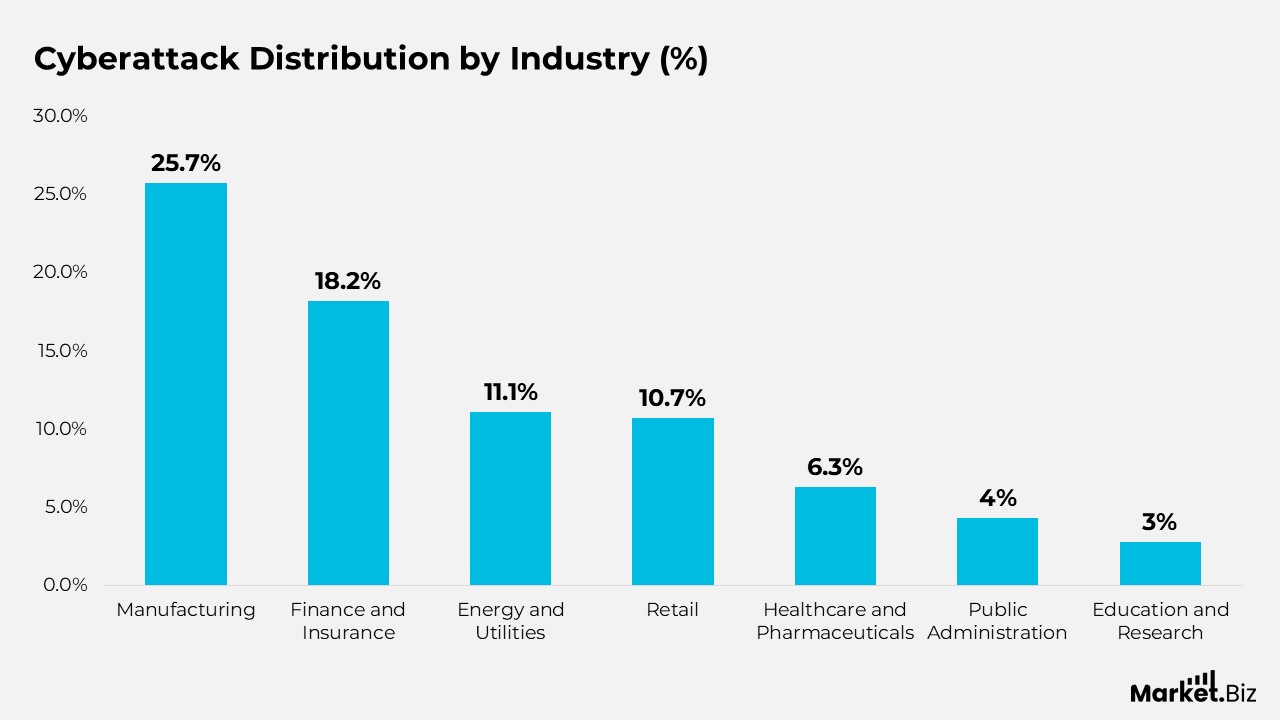
Cyberattack Distribution by Industry
- The Manufacturing sector is the most targeted, accounting for 25.7% of all cyberattacks, representing more than a quarter of total incidents.
- Finance and Insurance follow closely, experiencing 18.2% of the attack share, highlighting the sector’s vulnerability due to sensitive data and assets.
- The Energy and Utilities industries face 11.1% of attacks, reflecting the growing threats to critical infrastructure.
- The Retail sector is heavily impacted, accounting for 10.7% of cyberattacks, likely due to high transaction volumes and the exposure of customer data.
- Healthcare and Pharmaceuticals represent 6.3% of attacks, as attackers target patient data and medical systems.
- Public Administration accounts for 4.3%, indicating that government services are also susceptible to targeted cyber threats.
- Education and Research institutions experience 2.8% of all cyberattacks, with increasing risks associated with academic data and open network environments.
(Source: Statista, SQ Magazine, Ace Cloud Hosting)
Global Rise in AI-Driven Cyber Attack Statistics
- Global AI-driven cyberattacks are anticipated to exceed 28 million incidents in 2025.
- Even with AI-powered defences, enterprises still faced breaches in 29% of cases in 2025, indicating that attackers are keeping pace with defences.
- 92 countries reported AI-related attack activity in 2025, reflecting the increasing global reach and impact of these cyber threats.
- The average detection time for AI-assisted breaches reduced to 11 minutes in 2025, highlighting faster response times to AI-driven threats.
- In 2025, 35% of botnet operations used machine learning algorithms to evade detection and adapt in real time.
- The healthcare sector saw a 76% rise in targeted AI attacks in 2025, largely driven by the automation of ransomware deployment.
- AI-powered distributed denial-of-service (DDoS) attacks reached a record high of 2.1 million unique incidents in 2025.
- 57% of SOC analysts in 2025 reported that traditional threat intelligence is insufficient to handle AI-accelerated attacks.
- 20% of all cyberattacks in 2025 involved AI-enhanced confusion, such as synthetic traffic group or polymorphic code.
- 52% of AI attacks in 2025 used public LLMs to generate phishing contented or script payloads.
- 14% of main corporate breaches in 2025 were fully autonomous, meaning no human hacker occurred after the AI initiated the attack.
(Source: Statista, SQ Magazine, Ace Cloud Hosting )
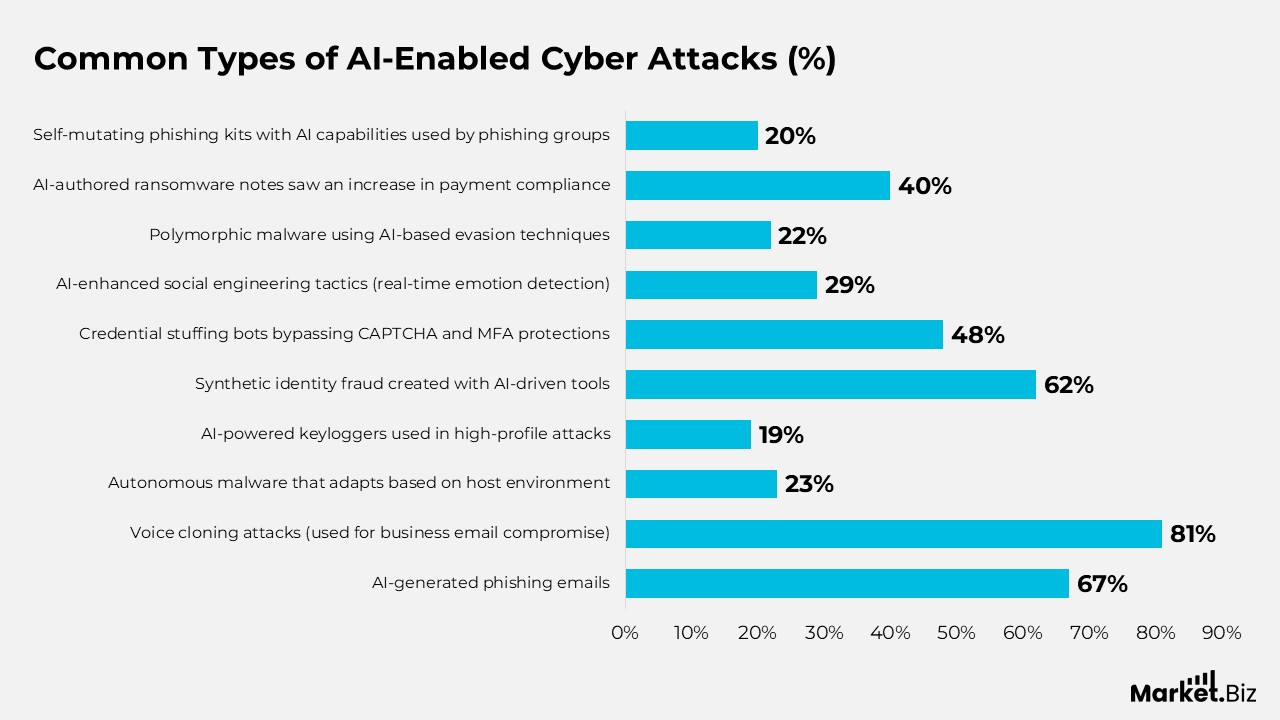
Common Forms of AI-Powered Cyber Attacks Statistics
- The use of AI-generated phishing emails grown by 67% in 2025, with enhanced personalization complete context-sensitive writing and behavioral mimicry.
- Voice cloning outbreaks, commonly used in business email compromise (BEC), saw an 81% increase in 2025.
- Autonomous malware, which adapts according to the host environment, reached for 23% of malware payloads in 2025.
- In 2025, AI-powered keyloggers were involved in 19% of high-profile spasms, utilizing behavior breakdown to obscure input logging.
- Synthetic identity fraud, often enabled by AI-driven data synthesis tools, rushed by 62% in 2025.
- Credential stuffing bots, skilled with reinforcement learning, bypassed MFA and CAPTCHA protections in 48% of tests in 2025.
- AI-improved social engineering tactics, including real-time emotion detection, were involved in 29% of data breach investigations in 2025.
- Polymorphic malware, which rewrites itself using AI-based evasion methods, now represents 22% of advanced persistent threats in 2025.
- AI-authored ransomware notes saw a 40% increase in payment compliance due to more persuasive language and tone in 2025.
- Self-mutating phishing kits with AI competences are now employed by 1 in 5 phishing clutches in 2025.
(Source: Statista, SQ Magazine, Ace Cloud Hosting )
Financial Consequences of AI-Driven Cybercrime
- Small- and mid-sized enterprises expended 27% more on cyber event response in 2025 due to AI-specific threats.
- In 2025, insurance payouts for AI-driven outbreaks increased by 22%, putting pressure on cyber liability insurers worldwide.
- Ransomware campaigns employing AI-generated intervention bots reduced the average negotiation time to 3.4 days in 2025, leading to faster payment cycles.
- Organizations expending legacy security tools faced an regular 42% higher cost per instance in 2025 compared to those with AI-resilient organizations.
- 45% of corporations stated budget reallocations in 2025 to statement AI-related threat qualification specifically.
- AI-aided insider threats caused over $2.4 billion in injuries in 2025, primarily due to machine learning systems recognizing exploitable access roles.
- The financial sector alone lost $28.6 billion globally in 2025 due to AI-improved fraud and data breaches.
- AI-powered fraud detection tools saved enterprises an estimated $11 billion in potential losses in 2025, highlighting AI’s dual-edged impact.
(Source: Statista, SQ Magazine)
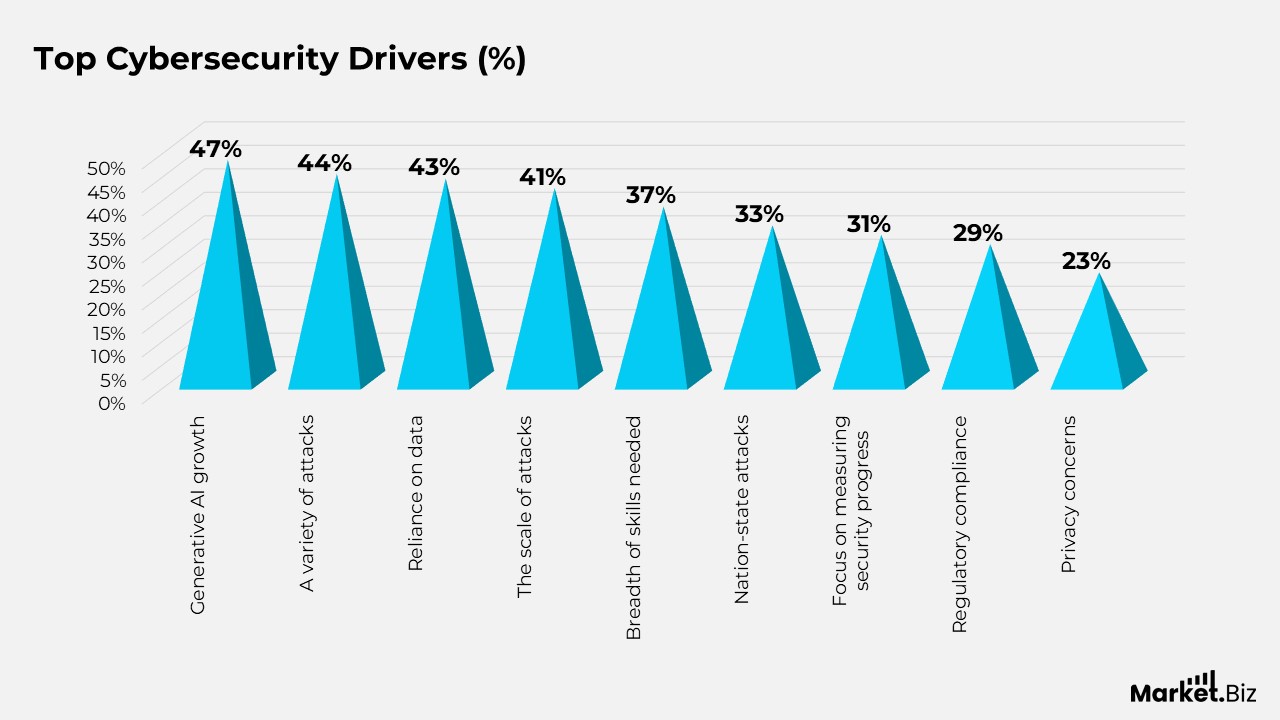
Cybersecurity Drivers
- Generative AI growth is the leading factor influencing cybersecurity priorities, cited by 47% of respondents.
- A wide variety of attacks ranks second, affecting 44% of strategies due to the increasing sophistication of cyber threats.
- 43% of professionals express concern over reliance on data, emphasizing the risks tied to data-intensive systems and analytics.
- The scale of attacks drives decision-making for 41% of professionals, highlighting the growing frequency and impact of breaches.
- 37% of respondents stress the need for a broader skillset, reflecting the growing cybersecurity skills gap.
- 33% of respondents highlight the growing concern of nation-state attacks, emphasizing the geopolitical risks associated with cyber threats.
- 31% focus on measuring security progress, underlining the need for better metrics and accountability in cybersecurity.
- 29% are influenced by regulatory compliance, driven by the compression of global data protection regulations.
- Lastly, 23% cite privacy concerns as a driver, as consumer awareness and expectations continue to rise.
(Source: Statista, SQ Magazine, Senhasegura)
AI Adoption in Ransomware and Malware
- In 2025, 41% of active ransomware families integrated AI modules, enabling adaptive behavior in their attacks.
- Autonomous ransomware, capable of lateral movement without human involvement, was responsible for 19% of breaches in 2025.
- AI-crafted malware variants saw an 18% higher success rate in bypassing endpoint detection systems in 2025.
- Malware using reinforcement learning adapted to sandbox environments in 11 seconds, a significant reduction from 22 seconds in the previous year.
- Smart payload delivery, where AI customizes malicious code based on system types, was observed in 24% of cases in 2025.
- In 2025, 18% of Trojans utilized AI for persistence, enabling them to avoid reboots and evade standard removal techniques.
- AI-embedded steganography was employed in 13% of malware campaigns in 2025 to conceal payloads within images and video files.
- The use of AI for code mutation resulted in an average of 21 unique variants per malware family in 2025.
- Ransomware-as-a-service (RaaS) providers offering AI-driven encryption tools grew by 34% in the underground economy in 2025.
- AI-generated obfuscation layers delayed reverse engineering by an average of 3.2 days in 2025, hindering forensic teams’ efforts.
(Source: Statista, SQ Magazine, Business Standard, Senhasegura)
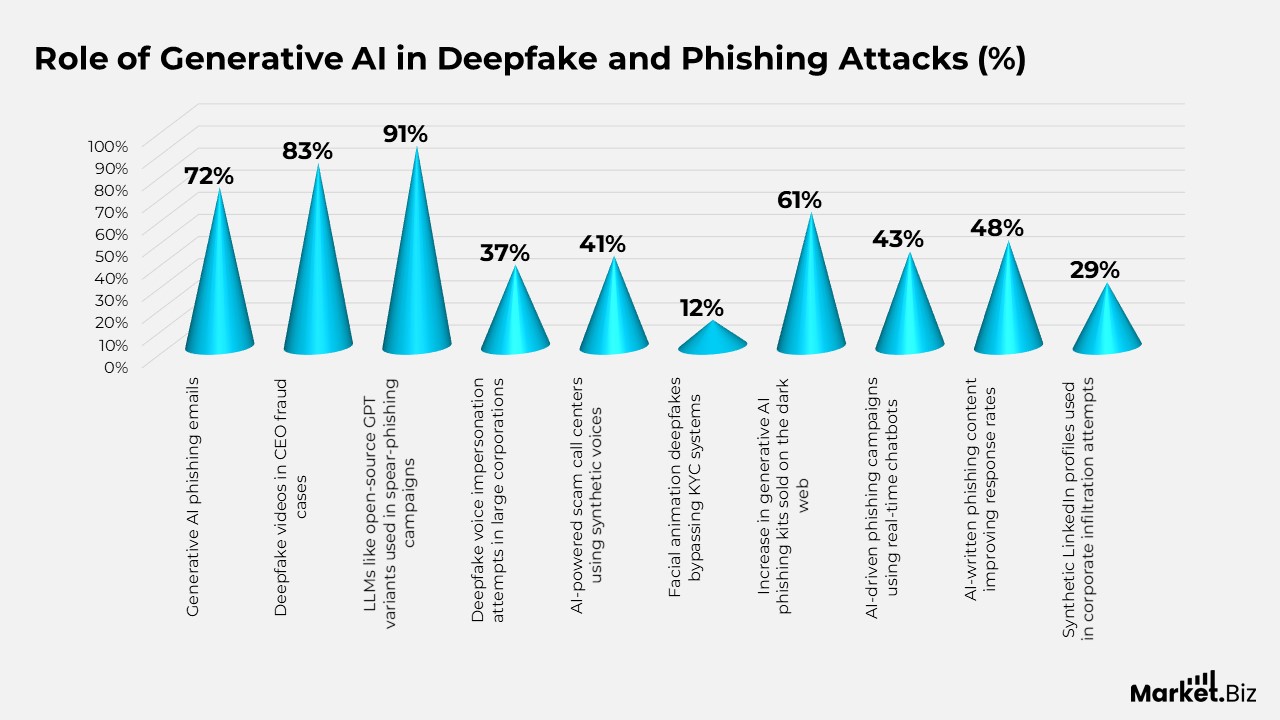
Role of Generative AI in Deepfake and Phishing Attacks
- In 2025, generative AI phishing emails had a 72% open rate, nearly double that of traditional phishing attempts.
- The use of deepfake videos in CEO fraud cases rose by 83% in 2025, resulting in an estimated $1.1 billion in direct losses.
- LLMs, like open-source GPT variants, were used to craft 91% of noticed spear-phishing campaigns in 2025.
- In 2025, 37% of large corporations reported at least one instance of deepfake voice impersonation attempts.
- AI-powered scam call centers using synthetic voices increased consumer fraud by 41% in 2025.
- Facial animation deepfakes targeting KYC (Know Your Customer) systems bypassed verification in 12% of cases tested in 2025.
- The value of generative AI phishing kits sold on the dark web increased by 61% in 2025, reflecting the growing demand for advanced deception tools.
- 43% of AI-driven phishing campaigns used real-time chatbots to extend user engagement in 2025.
- AI-written phishing content now mimics emotional tone and urgency, improving response rates by 48% in 2025.
- Synthetic LinkedIn profiles created using generative AI were used in 29% of corporate infiltration efforts in 2025.
(Source: Statista, SQ Magazine, Business Standard, Senhasegura)
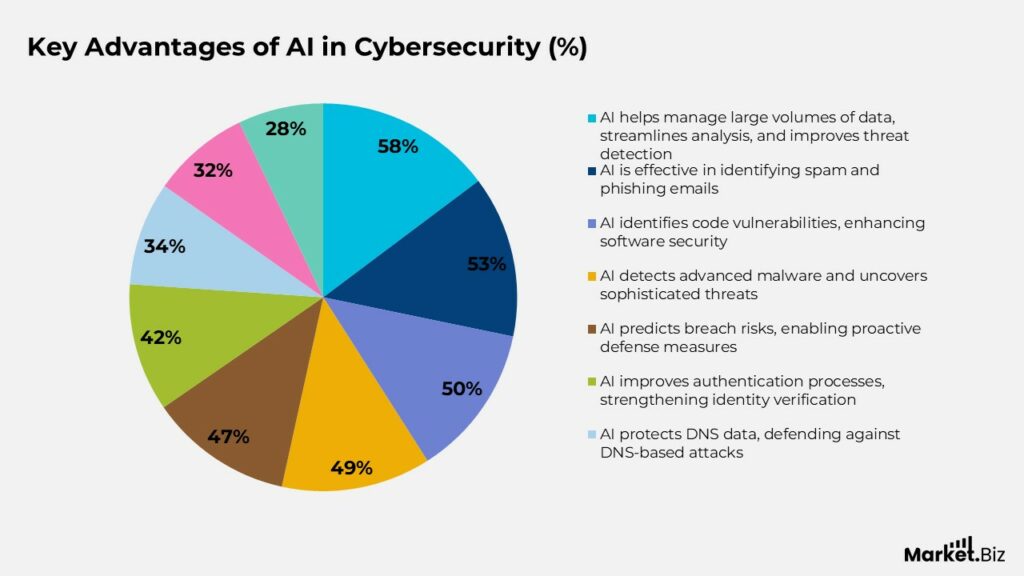
Key Advantages of AI in Cybersecurity
- 58% of professionals highlight that AI helps manage large volumes of data, streamlines analysis, and improves threat detection capabilities.
- 53% find AI highly effective in identifying spam and phishing emails, thereby reducing the risk of social engineering attacks.
- 50% use AI to identify code vulnerabilities, improving software security during development.
- 49% rely on AI to detect advanced malware and uncover sophisticated threats more quickly.
- 47% believe that AI is crucial for predicting breach risks, enabling more proactive defence measures.
- 42% appreciate AI’s role in improving authentication processes, thus strengthening identity verification.
- 34% of respondents use AI to protect DNS data, selecting defenses against DNS-based attacks.
- 32% benefit from AI’s ability to pinpoint the location of a breach, enabling quicker incident response.
- 28% say that AI supports the development of anti-malware software, improving automated security processes.
(Source: SQ Magazine, Beyond Identity)
AI-Driven Cybersecurity Incidents and Regulatory Responses
- Confirmed AI-related holes get hold of 16,200 episodes in 2025, marking a 49% increase compared to the previous year.
- The average breach reside time for AI-driven spasms was 63 days in 2025, compared to 72 days for traditional breaches.
- The major single AI-originated breach in 2025 negotiated 228 million records from a global telecom provider.
- Finance and Healthcare sectors together held for 55% of the AI-related breach volume in 2025.
- In 2025, 12% of SEC filings from publicly traded businesses disclosed AI-related attacks.
- 72% of plotted CISOs stated that AI-specific incident following had develop a standard reportage metric in 2025.
- 21% of breaches in 2025 involved multi-stage AI automation, creating attribution and repression more complex.
- Cloud service providers saw a 34% increase in breach volume tied to AI exploitation in 2025.
- 41% of all zero-day activities in 2025 were discovered through AI-assisted reverse engineering by attackers.
- The top 5 breached industries in 2025 were healthcare, finance, education, retail, and logistics.
(Source: SQ Magazine, Beyond Identity)
Conclusion
AI Cyber Attack Statistics: The rise of AI-driven cyberattacks marks a significant shift in the threat landscape, as cybercriminals leverage advanced technologies to execute increasingly sophisticated, autonomous attacks.
From AI-powered phishing and deepfake scams to autonomous malware and ransomware, the ability of cyber adversaries to innovate and adapt in real time poses a serious challenge for traditional cybersecurity defences. As AI continues to evolve, its use in both attacking and defending systems will only intensify.
As these threats grow in scale and complexity, organizations must prioritise AI-enhanced security measures to stay ahead of malicious actors. The statistics highlight the urgent need for continuous innovation and adaptation in cybersecurity strategies to protect against the rapidly evolving nature of AI-driven cybercrime.
FAQ’s
AI plays a central role in making cyberattacks more sophisticated, faster, and autonomous. It is used to automate attacks, create convincing deepfakes, generate personalized phishing attempts, and adapt malware to evade detection, making it increasingly difficult for traditional defences to keep up.
AI-driven cyberattacks have escalated in both scale and complexity. AI technologies are now used to mimic human behavior in phishing attacks, create convincing synthetic identities, and launch autonomous attacks with minimal human intervention. The use of AI has led to a dramatic rise in cyberattacks, including more advanced evasion tactics such as AI-based obfuscation and polymorphic malware.
The financial services sector is often the most targeted, followed by manufacturing, healthcare, retail, and energy. These industries are attractive targets due to the sensitive data they hold, the potential for financial gain, and, in the case of healthcare, the increasing reliance on digital systems that are vulnerable to AI-driven threats.
Common AI-driven attacks include phishing emails that mimic behaviour, deepfake videos used for fraud, AI-powered ransomware, credential stuffing, and social engineering tactics. AI is also used in the development of polymorphic malware that adapts to evade detection and in voice cloning attacks used for business email compromise.
AI-driven attacks lead to substantial financial losses, increased operational disruption, and reputational damage. The cost of data breaches and ransomware attacks powered by AI continues to rise, with some companies seeing millions of dollars in damages. Furthermore, AI-enhanced attacks are harder to detect and mitigate, requiring businesses to evolve their cybersecurity strategies continuously.