









Introduction
Alzheimer Disease Statistics: Alzheimer’s disease is a degenerative neurological condition that affects millions of individuals across the globe. As the leading cause of dementia, it significantly impairs cognitive functions, including memory, reasoning, and the ability to perform daily activities. This condition primarily affects the older population, with its incidence steadily increasing as global demographics shift toward an aging population.
Analysing the statistics related to Alzheimer’s disease is crucial for understanding its widespread effects on public health, healthcare infrastructure, and society at large. By examining these figures, we can better understand the scale of the disease, its impact across populations, and the challenges posed by its rising prevalence, thereby highlighting the urgent need for enhanced awareness, targeted research, and improved care.
Editor’s Choice
- Over the past two decades, the mortality rate attributed to Alzheimer’s disease has seen a staggering increase of nearly 150%, with one in three adults now dying from Alzheimer’s or another form of dementia.
- Currently, 60% of those living with dementia reside in low- and middle-income nations; however, by 2050, this proportion is expected to increase to 71%, highlighting a growing burden on healthcare systems in these regions.
- A new case of dementia is diagnosed globally every 3 seconds, underlining the urgency for early detection and intervention strategies.
- Up to 75% of individuals with dementia worldwide remain undiagnosed, pointing to gaps in diagnosis and care that need to be addressed to improve outcomes.
- Public concern about dementia is widespread, with nearly 80% of the general population expressing fear of developing dementia at some point in their lives. However, 1 in 4 people believe little can be done to prevent the disease, reflecting a need for greater awareness and preventive strategies.
- Alarmingly, about 62% of healthcare professionals globally incorrectly perceive dementia as a normal part of aging, indicating a lack of proper understanding and training in recognizing and diagnosing the condition.
Alzheimer’s Disease Therapeutics Market Size
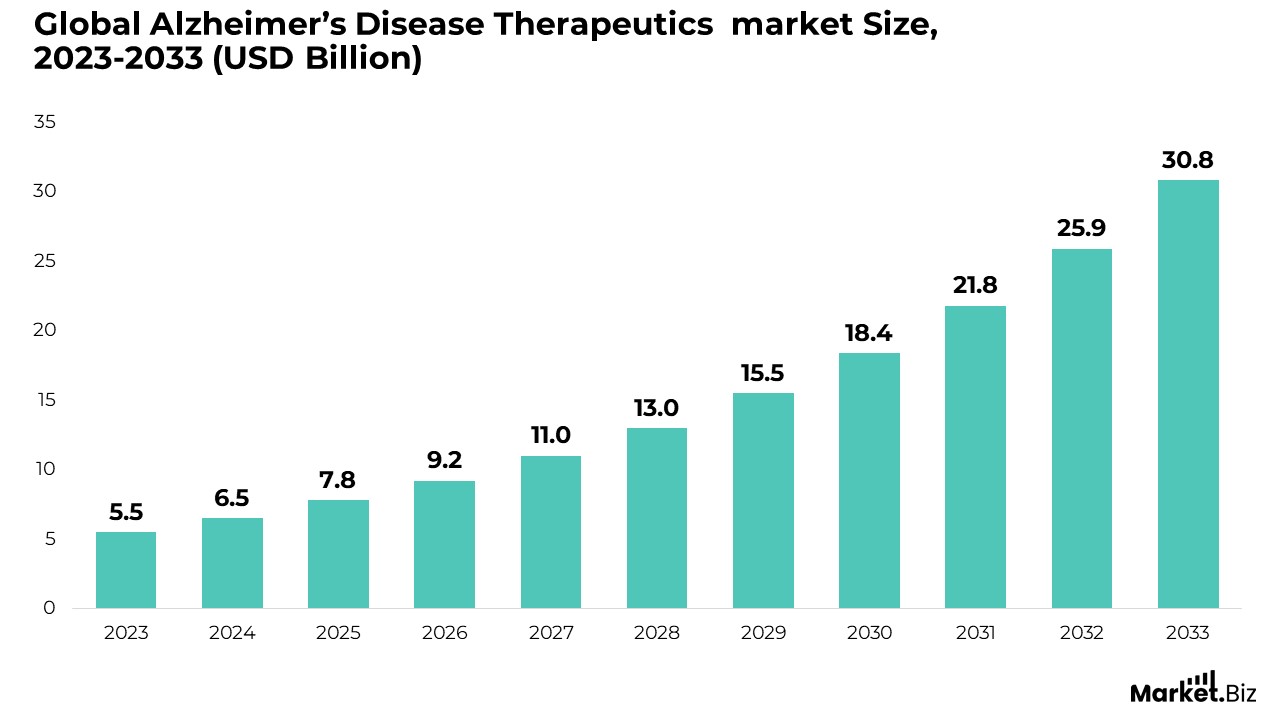
- According to Market.us, the global market for Alzheimer’s disease therapeutics is projected to grow from $7.8 billion in 2025 to $170.8 billion by 2032, reflecting a compound annual growth rate (CAGR) of 18.8% from 2024 to 2033.
- The cholinesterase inhibitor segment accounted for the largest revenue share of 53.2% in 2023, maintaining its position as the cornerstone treatment for Alzheimer’s disease (AD). These drugs work by preventing the breakdown of acetylcholine, a key neurotransmitter involved in memory and cognitive function.
- Mild cognitive impairment (MCI) accounted for 33.7% of the market share, a significant portion driven by its high prevalence, particularly among the aging population. This condition often serves as a precursor to more severe cognitive decline, further emphasizing the need for early intervention.
- The oral segment accounted for 58.1% of total market revenue in 2023, with drugs such as donepezil, rivastigmine, galantamine, and memantine being the most commonly prescribed treatments for AD. Their ease of administration plays a key role in their widespread use.
- Hospital pharmacies led the market, holding a dominant 56.4% share, primarily due to the rising hospitalisation rates among patients with AD. The demand for specialised care and pharmaceutical management in hospital settings continues to drive this trend.
- North America accounted for the largest regional revenue share, at 42.5%, in 2023. This dominance is attributed to the region’s robust research efforts on AD treatments, government initiatives, and funding, which further boost the market.
- The Asia-Pacific region is poised for significant growth, driven by rising research activities focused on discovering new treatments for Alzheimer’s disease. Increasing public awareness about AD is also expected to propel regional market expansion.
(Source: Market.us)
Symptoms and Signs of Alzheimer’s Disease
- Loss of Memory that interferes with daily activities
- Frequent misplacement of items
- Fluctuations in personality, mood, or behavior
- Trouble completing familiar tasks
- Difficulty managing finances or paying bills
- The decline in judgment and decision-making
(Source: Centers for Disease Control and Prevention)
Alzheimer’s Disease Statistics
- As of 2022, over 55 million people worldwide are living with dementia. This number is projected to rise to 139 million by 2050, with the most significant growth occurring in low- and middle-income countries.
- A significant 35% of dementia caregivers worldwide have hidden the diagnosis of a family member, pointing to the stigma and emotional burden associated with the condition.
- More than half of global caregivers report that their health has deteriorated due to their caregiving responsibilities, despite expressing satisfaction and positive feelings about their caregiving roles. This emphasizes the need for better support systems for caregivers.
- Women are disproportionately affected by Alzheimer’s disease, with approximately two-thirds of diagnosed cases existing in women. It is projected that through age 65, one in five women will progress to Alzheimer’s, which underscores the significance of gender-specific research and care strategies.
- In 2022, the global cost of dementia was estimated at US$ 1.3 trillion. This cost is projected to nearly double, reaching US$ 2.8 trillion by 2030, reflecting the growing financial burden on economies and the healthcare system as dementia prevalence increases.
(Source: Alzheimer’s Disease International, World Health Organization)
Alzheimer’s Disease Mortality Rates Statistics
- The age-adjusted mortality rate for deaths due to Alzheimer’s disease and additional dementias was 117 per 100,000 individuals in 2021.
- This represents a decline in mortality rates compared to the higher levels seen in 2020.
- The oldest age group exhibited the highest age-consistent death rates.
- Between females, the mortality rate in the oldest age group was 5,494 per 100,000.
- Among males, the mortality rate in the eldest age group was 3,990 per 100,000.
- These figures underscore the strong correlation between age and the mortality impact of Alzheimer’s and related dementias.
(Source: nr-scotland_)
Active Alzheimer’s Disease Trials in the Pipeline by Product Type
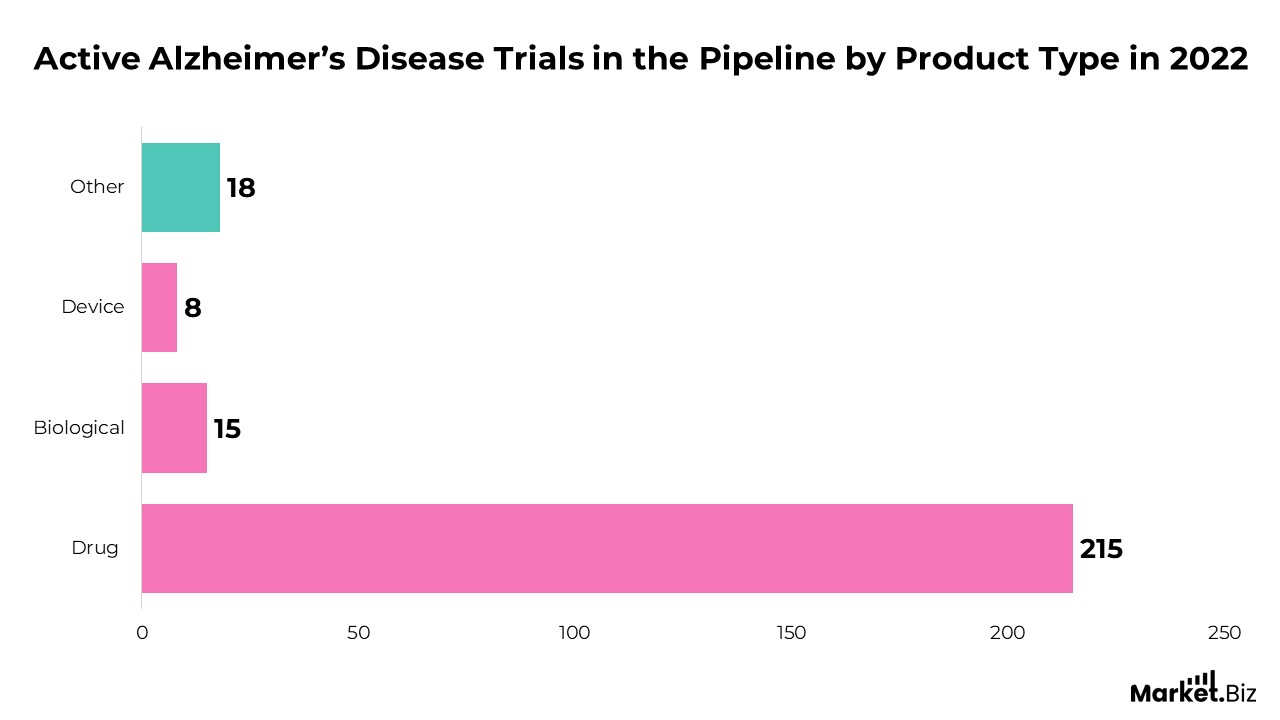
- As of 2022, there were 256 active Alzheimer’s disease trials in the global pipeline.
- The majority, with 215 trials, were focused on drug therapies.
- This underscores the strong focus on pharmacological treatments in the quest for effective Alzheimer’s disease therapies.
(Source: Statista)
Demographics of Alzheimer’s Disease
Age
- The Alzheimer’s Association estimated that in 2022, roughly 6.5 million people aged 65 or older in the U.S. were living with Alzheimer’s disease.
- Among this population, 73% were aged 75 or older, highlighting the disease’s higher prevalence among older adults.
- People diagnosed with Alzheimer’s before the age of 70 are double as likely to die before 80 compared to those without the condition.
- After turning 65, the chances of developing Alzheimer’s double every five years, and by the time a person reaches 80, one in six individuals is affected by dementia, which often includes Alzheimer’s.
(Source: Population Reference Bureau, Alzheimer’s Disease International, Alzheimer’s Society)
Employment
- 27% of individuals diagnosed with Alzheimer’s disease are employed, reflecting the challenges they face in maintaining a job while managing cognitive decline.
- The majority, 69.8%, of individuals with Alzheimer’s are retired, which is consistent with the fact that the disease primarily affects older populations, with its prevalence rising significantly after the age of 65.
- These statistics highlight the significant impact of Alzheimer’s disease on work and retirement, with most individuals being unable to continue working due to the progression of the condition.
(Source: National Institute of Health, Market.us)
Education
- The prevalence of Alzheimer’s disease among people with high school learning is 12.7%.
- Between those with a trade/vocational education, the occurrence drops to 6.3%.
- People with approximately a college education have a prevalence rate of 25.4%.
- For those holding a subordinate degree, the occurrence of Alzheimer’s disease is 17.5%.
- The prevalence rate is 20.9% among people with a bachelor’s degree.
- Among people with a master’s degree, the occurrence is 15.9%.
- Those with a doctoral degree have the lowest occurrence rate, at just 1.5%.
(Source: National Institute of Health)
Statistics on Alzheimer’s Caregivers
- A significant number of caregivers for individuals with Alzheimer’s and other forms of dementia are unpaid, with an estimated 11 million Americans offering their support without compensation. In 2021, these unpaid caregivers provided a remarkable 16 billion hours of care, equivalent to $272 billion in dementia care services.
- The majority of dementia caregivers are women, with over one-third being daughters who care for their parents.
- Approximately 30% of caregivers are 65 or older, often nearing retirement.
- Two-thirds of caregivers reside with the individuals they care for, providing support to those living with dementia nearby.
(Source: Alzheimer’s Association)
Economic and Societal Impact of Alzheimer’s Disease
- Medicare beneficiaries with Alzheimer’s disease or other dementias are more likely to have additional chronic conditions, such as heart disease, diabetes, and kidney disease, compared to those without dementia.
- A meta-analysis of various studies suggests that chronic diseases like diabetes, cardiovascular disease, depression, and inflammatory bowel disease could be associated with an increased risk of developing Alzheimer’s in different populations.
- According to the 2022 Alzheimer’s Association report, an estimated 11.3 million family and unpaid caregivers provided approximately 16 billion hours of informal, unpaid care, valued at around $271.6 billion.
- A study by Kelley et al. found that the average cost of informal care for patients with dementia was more than double the cost of care for those without dementia. In 2015 dollars, dementia care costs $83,022 compared to $38,272 for non-dementia patients. Adjusted for inflation, this corresponds to $102,385 for patients with dementia and $47,198 for patients without dementia in 2022.
- The total lifetime cost of care for a person with dementia is estimated to be $412,936 in 2022 dollars. Of these costs, 70% are borne by family caregivers, including unpaid caregiving and out-of-pocket expenses for home health support and medications.
- Beyond the financial burden, family caregivers of individuals with Alzheimer’s face chronic stressors, which can lead to adverse health consequences. Women account for 58% of all dementia caregivers, and 42% of caregivers have a household income of $50,000 or less, highlighting the economic strain faced by many.
(Source: Frontiers in Aging Neuroscience, Alzheimer’s Association)
Statistics on Alzheimer’s Disease by Country/Region
The U.S
- In the United States, Alzheimer’s disease remains a significant health challenge, affecting millions of individuals, particularly among the aging population.
- Approximately 7.2 million Americans aged 65 and older will live with Alzheimer’s disease in 2022, with 74% of them being 75 years or older. This highlights the strong correlation between aging and the onset of Alzheimer’s.
- Nearly one in nine people, or 11% of those aged 65 and older, are diagnosed with Alzheimer’s, making it one of the most common neurodegenerative conditions in the older.
- Women are disproportionately unnatural by Alzheimer’s, with nearly two-thirds of individuals diagnosed being female. This reflects biological and socio-cultural factors that contribute to the higher incidence in women.
- When looking at racial disparities, elder Black Americans are nearly twice as likely to develop Alzheimer’s or other forms of dementia associated with their White counterparts, signaling a significant health equity gap in care and awareness.
- Similarly, older Hispanics face a heightened risk, being about 1.5 times more likely to develop Alzheimer’s or related dementias compared to older Whites. These disparities underscore the need for targeted interventions and research.
- While Alzheimer’s is most common in older adults, it can also affect people younger than 65. Though prevalence studies are limited, research suggests that around 110 out of every 100,000 people aged 30 to 64, or approximately 200,000 Americans, experience younger-onset dementia.
- The estimated total lifetime cost of care for an individual with dementia is approximately $405,262. Of this amount, 70% is covered by family caregivers, including unpaid caregiving and out-of-pocket expenses.
(Source: Alzheimer’s Association)
Canada
- Approximately 750,000 Canadians are currently living with Alzheimer’s disease or other forms of dementia. In 2022, Alzheimer’s disease was recognized as the ninth leading cause of death in the country.
- Looking ahead, researchers estimate that by 2030, the number of people in Canada living with dementia will approach 1 million, with projections indicating that more than 1.7 million Canadians will be affected by dementia by 2050.
- Every day, more than 414 Canadians are diagnosed with dementia, which averages to more than 17 new cases every hour. This highlights the rapidly increasing prevalence of the condition.
- By 2030, it is anticipated that the number of people living with dementia in Canada could rise by 65% compared to 2020, growing from 597,300 to approximately 990,600.
- Over the next three decades, the number of Canadians living with dementia is expected to increase by an astounding 187% from 2020 to 2050, with more than 1.7 million individuals projected to be affected by 2050.
- The total healthcare and out-of-pocket costs related to dementia care in Canada are projected to reach $16.6 billion by 2021, underscoring the financial strain on families and healthcare systems.
- Women are disproportionately affected by dementia, representing 72% of those living with Alzheimer’s disease and other dementias in Canada.
(Source: Alzheimer Society Canada, Statistics Canada)
The U.K.
- In 2023, there were approximately 982,000 people in the UK were living with dementia, a number that continues to rise each year.
- Dementia, specifically Alzheimer’s disease, has emerged as the main cause of death in the United Kingdom, surpassing other major health conditions.
- The financial burden of dementia care is substantial, with the annual cost to the UK economy amounting to around £34.7 billion, covering healthcare, caregiving, and associated services.
- Around 700,000 people in the UK are acting as informal caregivers, providing care for loved ones with dementia, often without formal support or compensation.
- Due to the country’s aging population, the prevalence of dementia in the UK is expected to rise significantly in the coming decades, placing increasing demands on healthcare and social services.
- There are notable regional variations in dementia prevalence across the UK, with some areas seeing higher rates than others, possibly due to socioeconomic, environmental, and healthcare access factors.
- Projections suggest that the number of individuals living with dementia in the UK will exceed 1 million by 2030, highlighting the urgent need for expanded healthcare resources, research, and public awareness.
(Source: Alzheimer Society)
Australia
- In 2023, approximately 411,100 people in Australia were living with dementia, a number that continues to rise as the population ages.
- Dementia has become the main cause of death in Australia, surpassing both heart disease and cancer, reflecting its growing prevalence and the need for more focused public health strategies.
- The number of Australians living with dementia is expected to rise to 590,000 by 2028, and projections suggest that over 1.1 million people could be affected by the disease by 2058, marking a significant increase in future cases.
- Unpaid caregivers are crucial in dementia care, providing an estimated 1.6 billion hours yearly. These caregivers often face emotional, physical, and financial strains while supporting their loved ones.
- The total economic cost of dementia in Australia is approximately $15 billion annually, reflecting the significant healthcare, caregiving, and support costs associated with the disease.
- In the 2022–23 period, there were more than 12.1 million hospital admissions in Australia. Dementia was the primary cause for about 26,300 of these hospitalizations, or roughly 2 in every 1,000 admissions, highlighting its growing impact on the healthcare system.
(Source: Australian Institute of Health and Welfare, Dementia Research Community, Dementia Australia)
Japan
- An estimated 5.8 million people in Japan are currently living with dementia, a number that continues to rise as the country’s older population expands.
- Dementia is one of the leading causes of disability and dependency among older adults in Japan, highlighting the substantial challenges it presents to individuals, families, and caregivers.
- Projections indicate that the number of people with dementia in Japan will increase to 7.3 million by 2025, marking a significant rise in cases that will place increasing demands on healthcare and social support systems.
- The total economic cost of dementia in Japan was estimated at ¥15.4 trillion, or approximately $139 billion, reflecting the heavy financial burden associated with dementia care and support services.
- The number of unpaid caregivers in Japan is expected to grow to 8 million by 2030, emphasizing family members’ vital role in providing care and the increasing strain on these caregivers.
(Source: World Alzheimer Report)
Funding for Dementia Research
- The Alzheimer’s Society has announced unprecedented investment in dementia research for 2024, underscoring its strong commitment to advancing the understanding and treatment of Alzheimer’s disease. This initiative includes a new annual grant cycle and the blood biomarker challenge to foster innovative breakthroughs.
- In addition to these efforts, 2024 is expected to be a pivotal year for dementia treatment, with regulatory decisions on Lecanemab and Donanemab anticipated in the UK. These decisions could represent a significant turning point in the availability of novel treatments, offering new hope to those affected by Alzheimer’s disease.
Conclusion
Alzheimer’s Disease Statistics: Alzheimer’s disease continues to be a major global health challenge, significantly affecting individuals, families, and healthcare systems alike. With its prevalence rising steadily, the disease now impacts millions around the world. As the population ages, the demand for enhanced care, ongoing research, and more effective treatments becomes even more urgent.
The strain on caregivers and healthcare resources highlights the critical need for early detection, sustained research investment, and greater public awareness. To mitigate the effects of Alzheimer’s, it is crucial to focus on advancing care strategies, supporting caregivers, and achieving breakthroughs in treatment options, ensuring a more hopeful future for those affected.
FAQ’s
Alzheimer’s disease is a progressive neurological disorder that damages the brain, leading to a gradual decline in memory, thinking, and behavior. It is the leading cause of dementia, with symptoms typically worsening over time, ultimately affecting an individual’s ability to carry out daily activities.
Alzheimer’s disease is influenced by several risk factors, with the most prominent being age, genetics, and family history. Lifestyle choices, such as poor diet, physical inactivity, and the presence of chronic conditions like heart disease and diabetes, also significantly contribute to the likelihood of developing the disease.
Alzheimer’s disease places a considerable burden on healthcare systems worldwide. It results in substantial costs associated with long-term care and medical treatment. As a leading cause of death and disability, healthcare providers must anticipate the growing need for resources and care services as the disease continues to affect an aging population.
Early detection of Alzheimer’s disease enables individuals and families to better plan for the future and explore available treatment options. Additionally, it can help slow disease progression, providing patients with more time to manage symptoms. It also alleviates caregivers’ emotional and financial strain, allowing for more effective care management.
Various governments and organizations are increasing their investments in Alzheimer’s research. For instance, in the U.S., the National Institutes of Health (NIH) allocated USD 3.7 billion 2024 for Alzheimer’s research to advance therapies and ultimately find a cure.

