









Introduction
Graphics Processing Units Statistics: A Graphics Processing Unit (GPU) is a dedicated chip designed for parallel computation, excelling in the simultaneous processing of extensive datasets. Initially developed for rendering graphics, it has become essential for artificial intelligence, machine learning, scientific computing, and gaming due to its thousands of small cores, in contrast to the few powerful cores of a CPU. This makes it particularly suitable for tasks that require extensive mathematical operations.
Statistics indicate its increasing significance, with applications that extend well beyond visual displays into intricate data-driven sectors. Graphics Processing Units (GPUs) have become an integral part of contemporary computing systems. They are vital in a variety of areas, including graphics rendering, scientific simulations, and artificial intelligence. The main purpose of GPUs is to manage the substantial computational demands associated with rendering high-resolution graphics and intricate visual effects.
Initially intended to enhance graphical computations for visual rendering, GPUs have transformed into highly parallel processors capable of executing complex mathematical calculations. This transformation has led to their utilisation in various fields such as gaming, machine learning, scientific research, and beyond.
Editor’s Choice
- In 2022, the global GPU market was assessed at 40 billion U.S. dollars. With projections indicating it will reach 400 billion U.S. dollars by 2032.
- The GPU market in China was valued at USD 10.08 billion in 2024, with an expected CAGR of 30.8%.
- In 2019, the leading players in the global graphics processing unit (GPU) market generated a total revenue of 18.2 billion U.S. dollars.
- A significant and cohesive register file is central to the architecture, comprising 32,768 registers.
- The Radeon RX 6900 XT showed a render time of 93.98 seconds. Whereas the Intel Core i7-12700KF had a render time of 270.93 seconds.
- Built on Nvidia’s Ampere architecture, the RTX A5000 features a setup of 8192 CUDA cores.
General Graphics Processing Units Statistics
- In 2022, the global GPU market was assessed at 40 billion U.S. dollars. With projections indicating it will reach 400 billion U.S. dollars by 2032.
- With a compound annual growth rate (CAGR) of 25% anticipated from 2023 to 2032.
- In 2019, the leading players in the global graphics processing unit (GPU) market generated a total revenue of 18.2 billion U.S. dollars.
- The year 1993 marked NVIDIA’s entry into this field. However, it was not until 1997 that they achieved significant recognition by introducing the first Graphics Processing Unit (GPU).
- This innovation combined 3D acceleration with traditional 2D and video acceleration.
- The NVIDIA Titan RTX stands out as a premier gaming GPU. Celebrated for its remarkable capability in managing complex deep-learning tasks. It features 4608 CUDA cores and 576 Tensor cores.
- Produced by PNY, the NVIDIA Quadro RTX 8000 is recognised as the most powerful graphics card globally, specifically engineered for deep learning matrix multiplications.
- Most GPUs are proficient at gaming on displays with resolutions of 1440p Quad HD (QHD).
- A higher refresh rate enhances the display and contributes to a more immersive VR experience.
Graphics Processing Units Market Statistics
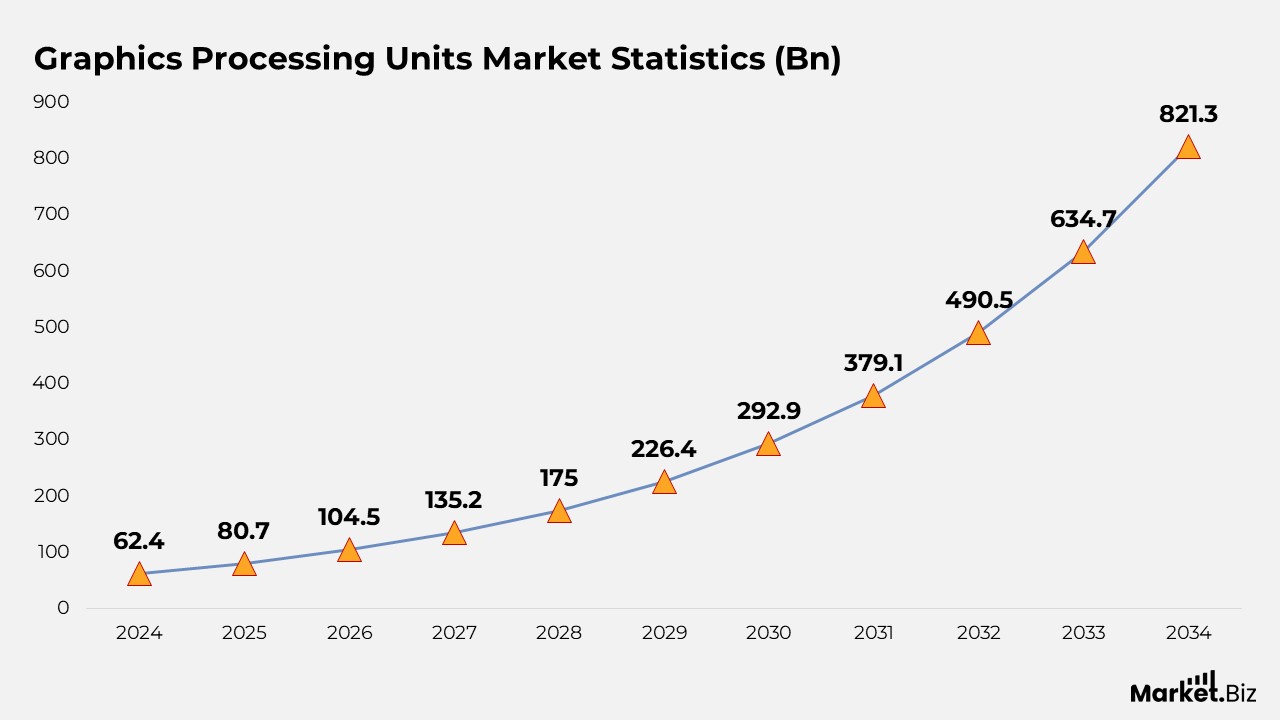
- The Global GPU Market is projected to reach approximately USD 821.3 billion by 2034. Increasing from USD 62.4 billion in 2024, it is anticipated to grow at a CAGR of 29.40% during the forecast period from 2025 to 2034.
- Moreover ,in 2024, the Integrated GPU segment maintained a leading market position, accounting for over 69.7% of the global GPU market.
- The Mobile Devices segment also secured a significant position in 2024 within the GPU market, holding more than 32.7% of the market share.
- In 2024, the Asia-Pacific region dominated the global GPU market. Capturing over 42.1% of the market share, with revenues totalling USD 26.2 billion.
- The GPU market in China was valued at USD 10.08 billion in 2024, with an expected CAGR of 30.8%.
Players’ Statistics of Graphics Processing Units
- In 2019, the leading players in the global graphics processing unit (GPU) market generated a total revenue of 18.2 billion U.S. dollars.
- Projections suggest that this amount is expected to rise to 35.3 billion U.S. dollars by 2025.
- Moreover, this significant increase sharply contrasts with the 8.1 billion U.S. dollars in revenue earned collectively by the top three vendors in 2015.
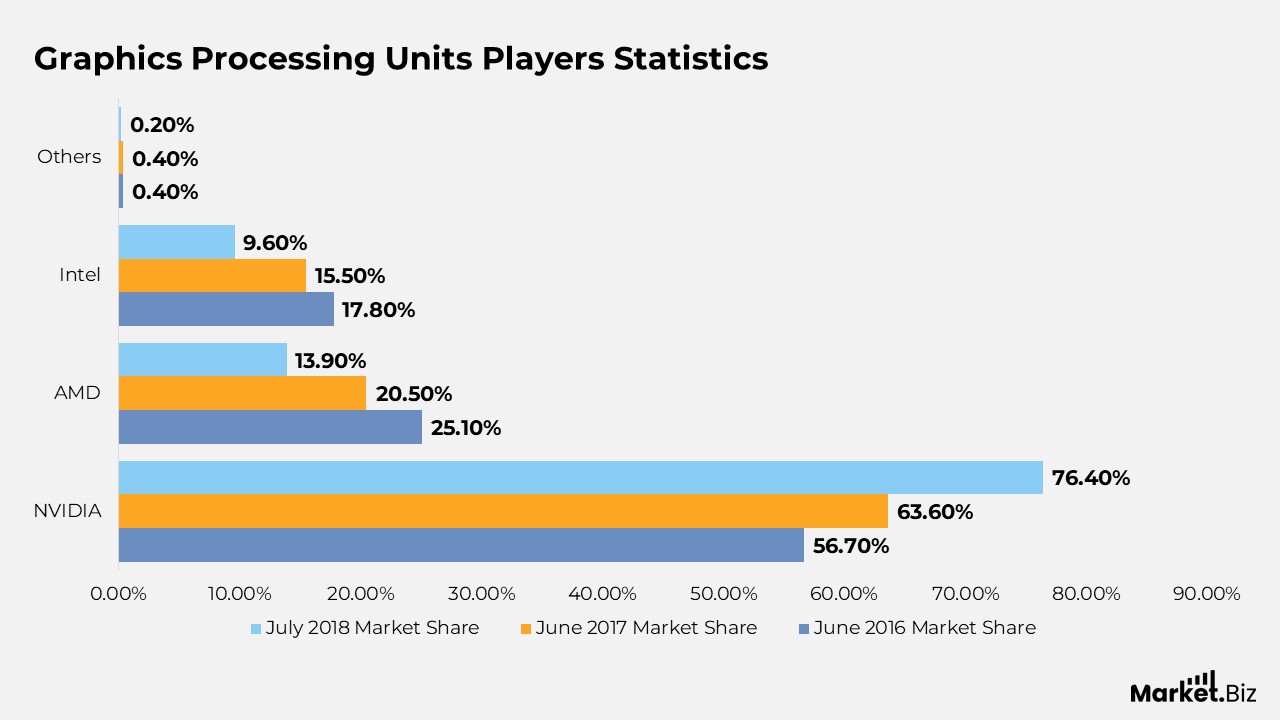
- In the gaming industry, as of June 2016, NVIDIA commanded a substantial market share of 56.7%. Which grew to 63.6% by June 2017 and reached an impressive 76.4% by July 2018.
- Conversely, AMD held a 25.1% market share in June 2016. Which fell to 20.5% in June 2017 and further decreased to 13.9% by July 2018.
- At the same time, Intel’s market share was recorded at 17.8% in June 2016, declined to 15.5% in June 2017, and further diminished to 9.6% by July 2018.
- Other companies together accounted for a minimal market share of 0.4% in June 2016.
- This figure remained steady at 0.4% in June 2017 before decreasing to 0.2% by July 2018.
Graphics Processing Units Architecture Statistics
- A significant and cohesive register file is central to the architecture, comprising 32,768 registers.
- This complex architecture includes 16 Streaming Multiprocessors (SMs), each equipped with a 128KB register file.
- With an allocation of 32 cores for each SM, this setup results in a total of 2MB distributed uniformly across the chip.
- In addition to this configuration, there are 48 warps. Which correspond to 1,536 threads per SM, seamlessly integrated into the architecture. This is further enhanced by the provision of 21 registers for each thread.
- Moreover, the memory system is structured with multiple banks, facilitating efficient memory management.
- A remarkably high bandwidth capacity greatly enhances this strategic configuration, achieving an impressive 8,000 GB/s.
- The architecture features a flexible shared and Level 1 (L1) memory configuration.
- The memory architecture is characterised by low latency, functioning within a range of 20 to 30 cycles.
CPU and Graphics Processing Units Statistics
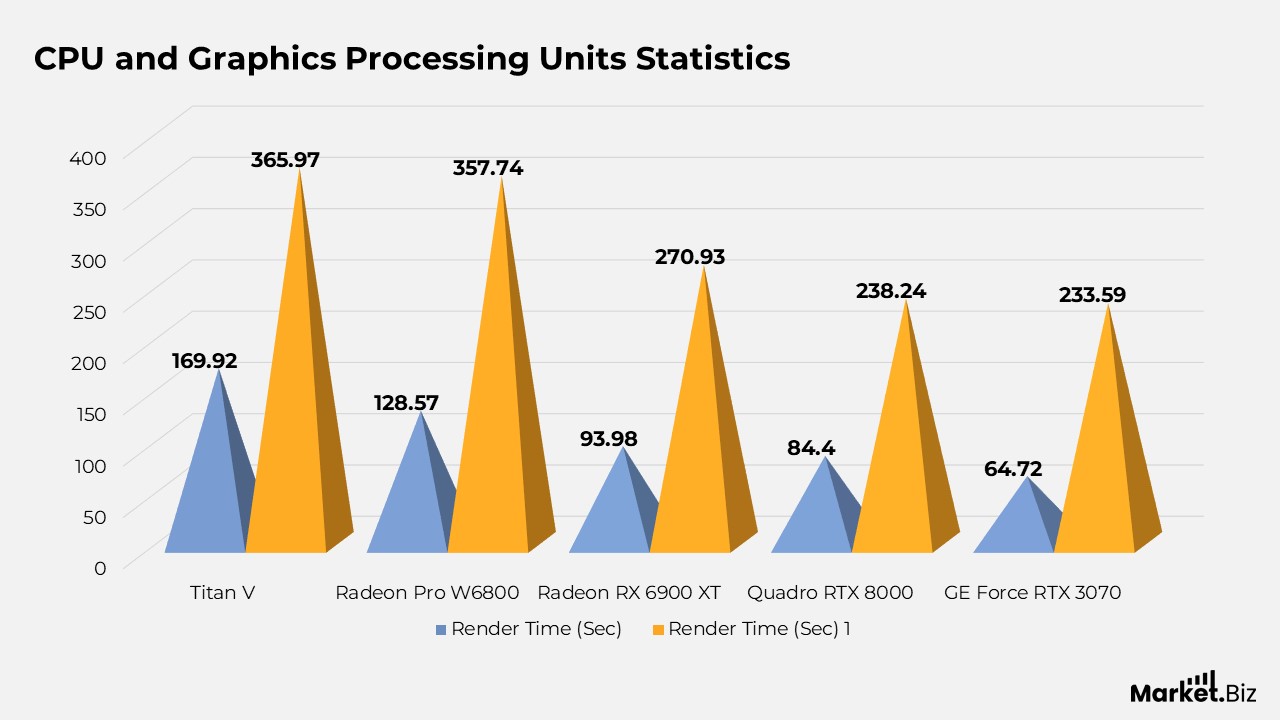
- Further, in a comparative analysis of rendering times, various combinations of GPUs and CPUs are essential.
- The rendering performance of the GE Force RTX 3070 was highlighted with a time of 64.72 seconds. In contrast, the Intel Core i9-12900K displayed a render time of 233.59 seconds.
- Similarly, the Quadro RTX 8000 recorded a render time of 84.4 seconds. Compared to 238.24 seconds for the AMD Ryzen 9 3950X 16-core processor.
- Moreover, the Radeon RX 6900 XT showed a render time of 93.98 seconds, whereas the Intel Core i7-12700KF had a render time of 270.93 seconds.
- Finally, the Titan V exhibited a render time of 169.92 seconds. Contrasting with the render time of 365.97 seconds for the AMD Ryzen 7 5800X 8-core processor.
GPU Cryptocurrency Mining Statistics
- The AMD Radeon RX 5700 XT is capable of mining various cryptocurrencies, including ETH, RVN, GRIN, XHV, ZEL, ETC, and BEAM, with a power consumption of 225 watts.
- Built on Nvidia’s Ampere architecture, the RTX A5000 features a setup of 8192 CUDA cores.
- Further, it comes with 24GB of GDDR6 memory and a 384-bit memory interface.
- Moreover, it achieves a boost clock speed of up to 1.75 GHz while its maximum power consumption is 230W.
Graphics Processing Units: Recent Development
- NVIDIA successfully concluded its $40 billion acquisition of Arm Holdings in 2024.
- In January 2024, AMD launched the Radeon RX 7900 XT, which provides improved graphics performance and reduced power consumption.
- In late 2023, AMD completed its $35 billion acquisition of Xilinx. This merger is intended to integrate AMD’s GPUs with Xilinx’s FPGA technology to create sophisticated computing solutions for AI and data centers.
- In 2023, Intel declared a $3 billion investment in research and development focused on its GPU technologies.
Graphics Processing Units: Future Predictions
- The trajectory of GPUs indicates significant expansion fueled by artificial intelligence, data centers, and immersive gaming experiences (AR/VR). Innovations are concentrating on specialized cores (Tensor Cores), enhanced memory (HBM, UMA), and improved energy efficiency.
- By the year 2027, it is anticipated that the GPU market will surpass $200 billion. Largely propelled by AI training and inference, augmented reality (AR), virtual reality (VR), and next-generation gaming.
Conclusion
Graphics Processing Units Statistics: Since the inception of monochrome display adapters, graphics processing units (GPUs) have transformed into robust components capable of complex 2D and 3D graphics rendering, deep learning, and scientific calculations. NVIDIA has been instrumental in this evolution, particularly with innovations such as the GeForce 256, which laid the groundwork for contemporary GPUs.
The increase in GPU sales, fueled by cryptocurrency mining, highlighted their adaptability beyond the realm of gaming. The launch of high-performance GPUs like the RTX 3090 and the Tesla V100 showcased their capabilities in gaming, artificial intelligence, and scientific computing. As the market continues to expand and diversify, GPUs remain fundamental to technological progress across various sectors.
FAQ’s
2.5 GHz to 3.5 GHz is adequate for daily tasks. 3.5 GHz to 4.0 GHz is ideal for gaming and more intensive applications. Frequencies of 4.0 GHz and higher are exceptional for high-performance requirements.
The graphics card crisis represents merely one aspect of the chain reaction initiated by AI; the limited availability of storage has already impacted the entire PC industry supply chain. The Chief Financial Officer of Lenovo Group disclosed that the company has raised its component inventory levels by about 50% to address the shortage.
A GPU’s physical lifespan is often 5-10+ years with good care, but its practical relevance for demanding tasks like high-end gaming typically lasts only 3-5 years before becoming outdated by newer games and tech, with factors like heavy use (mining, rendering, overclocking) and cooling significantly affecting longevity.

