








Introduction
Automotive Sensors Statistics: Automotive sensors function as the “eyes and ears” of contemporary vehicles, transforming physical inputs such as temperature, pressure, and motion into electrical signals. This transformation is propelling significant market expansion, driven by ADAS (Advanced Driver-Assistance Systems), EVs (Electric Vehicles), and autonomous technologies.
The global market is anticipated to reach tens of billions by 2030 and is experiencing rapid growth at double-digit CAGRs as more sensors, including MEMS for speed and camera/LiDAR for safety, are integrated into vehicles to enhance safety, efficiency, and performance, with the Asia-Pacific region leading in demand.
Automotive sensors are compact yet powerful elements that facilitate the advancement of the modern automotive sector. They act as the sensory organs of the vehicle, continuously gathering and relaying data to optimise performance, safety, and efficiency. These sensors are strategically located throughout the vehicle, measuring various parameters such as temperature, pressure, speed, and emissions, and are essential for the operation of critical systems.
From improving engine performance and emissions management to enabling advanced driver-assistance features, automotive sensors are central to innovation within the automotive industry. They play a crucial role in achieving objectives like enhanced fuel efficiency, lower emissions, and improved safety, making them vital components in the development of smarter and more interconnected vehicles.
Editor’s Choice
- The automotive sensors market has exhibited strong growth, achieving a CAGR of 10.1%.
- Starting at $21 billion in 2022, the market has consistently progressed year after year.
- Europe closely follows, possessing a significant share of 24.40%.
- Sensata Technologies also holds a significant position, with a 9% market share.
- By 2017, the revenue had climbed to $5.4 billion, then to $5.6 billion in 2018, $5.9 billion in 2019, and $6.2 billion in 2020.
- In 2023, the market revenue rose to $2,748 million, followed by an increase to $2,934 million in 2024.
- In 2023, the global landscape observed a 16% increase in the number of interconnected IoT (Internet of Things) devices, culminating in a total of 16.7 billion devices.
General Automotive Sensors Statistics
- The automotive sensors market has exhibited strong growth, achieving a CAGR of 10.1%.
- The automotive sensors market was valued at $21 billion in 2022.
- The Asia-Pacific (APAC) region is particularly noteworthy, commanding the largest market share at 46.80%, which underscores its significant presence and growth potential.
- Robert Bosch GmbH is at the forefront, holding a considerable market share of 16%, closely followed by DENSO Corporation, which possesses a substantial share of 14%.
- As people spend more time at home, there is a growing demand for smart devices, and the IoT sector is experiencing upward momentum, with projections indicating that IoT device sensors will reach $43 billion by 2025.
- In 2023, the global landscape saw a 16% increase in the number of interconnected IoT (Internet of Things) devices, totalling 16.7 billion devices.
- The McKinsey Institute forecasts a strong annual growth rate of approximately 30% in Level 2 advanced driver assistance systems (ADAS) through 2025, primarily driven by regulatory requirements that necessitate the integration of these sensors in new vehicles.
- The expected advancement of proximity sensors in vehicles is significant, with an increase from four types in a vehicle to nine by the year 2040.
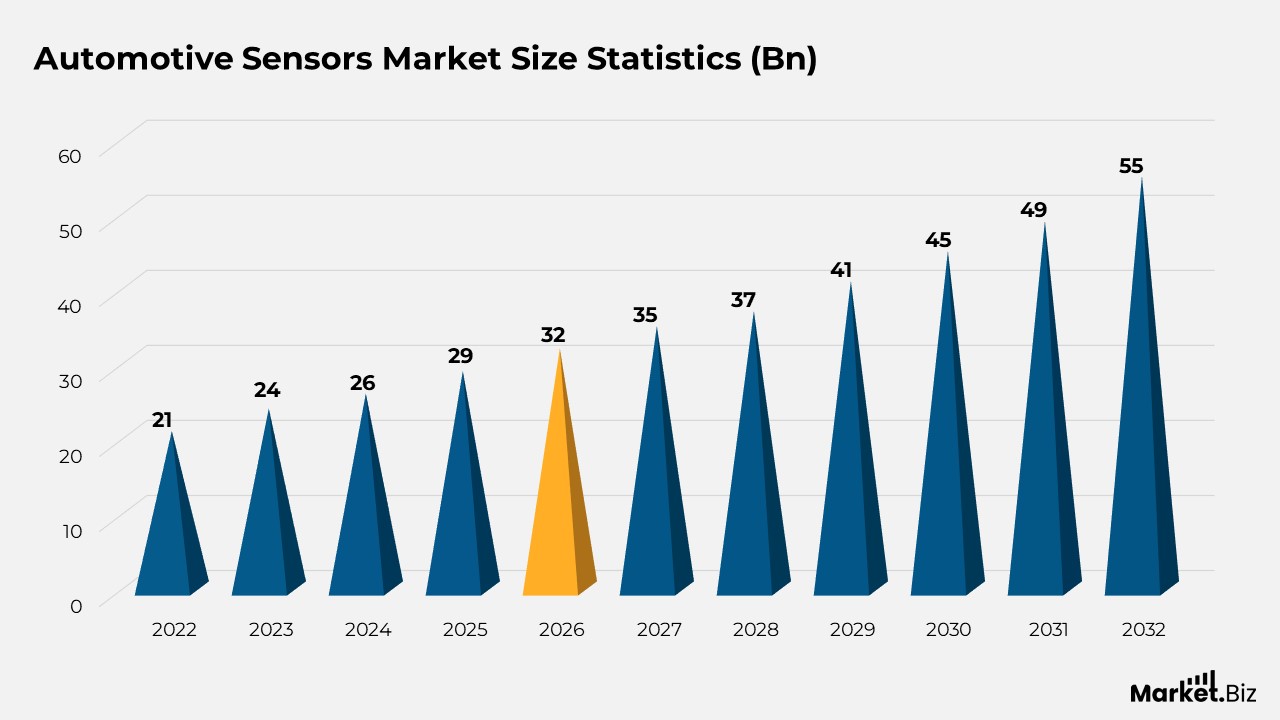
Automotive Sensors Market Size Statistics
- Starting at $21 billion in 2022, the market has consistently progressed year after year.
- In 2023, market revenue had increased to $24 billion, followed by $26 billion in 2024.
- The growth continued, with revenues reaching $29 billion in 2025, $32 billion in 2026, and $35 billion in 2027.
- This upward trend persisted, culminating in $37 billion in 2028, $41 billion in 2029, and $45 billion in 2030.
- The market is anticipated to sustain its growth, with projected revenues of $49 billion in 2031 and $55 billion in 2032.
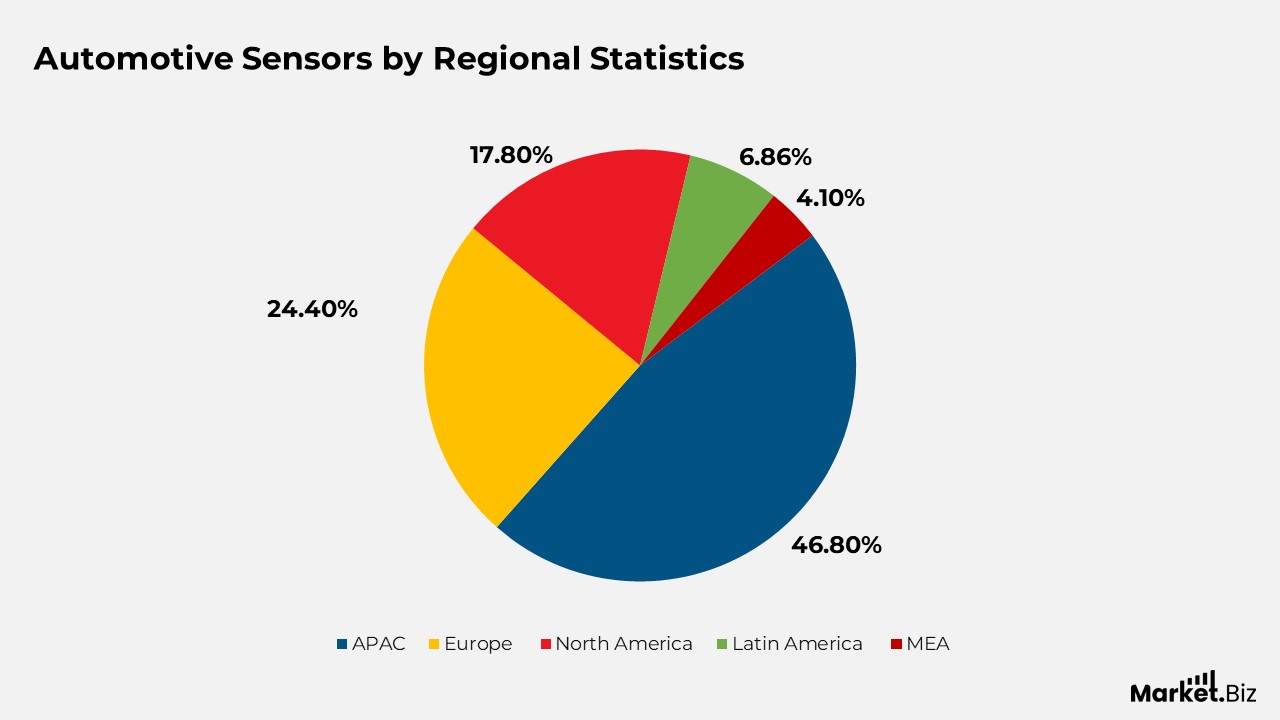
Regional Statistics By Automotive Sensors
- The regional examination of the automotive sensors market indicates a varied distribution of market share across different geographical areas.
- It represents roughly 17.80% of the market in North America, indicating a considerable presence in this area.
- Europe closely follows, possessing a significant share of 24.40%.
- Nevertheless, the Asia-Pacific (APAC) region distinctly stands out, commanding the largest market share at 46.80%.
- Latin America retains a smaller yet noteworthy segment of the market at 6.86%, while the Middle East and Africa (MEA) region contributes 4.10% to the overall market share.
Automotive Sensors Market Key Players Statistics
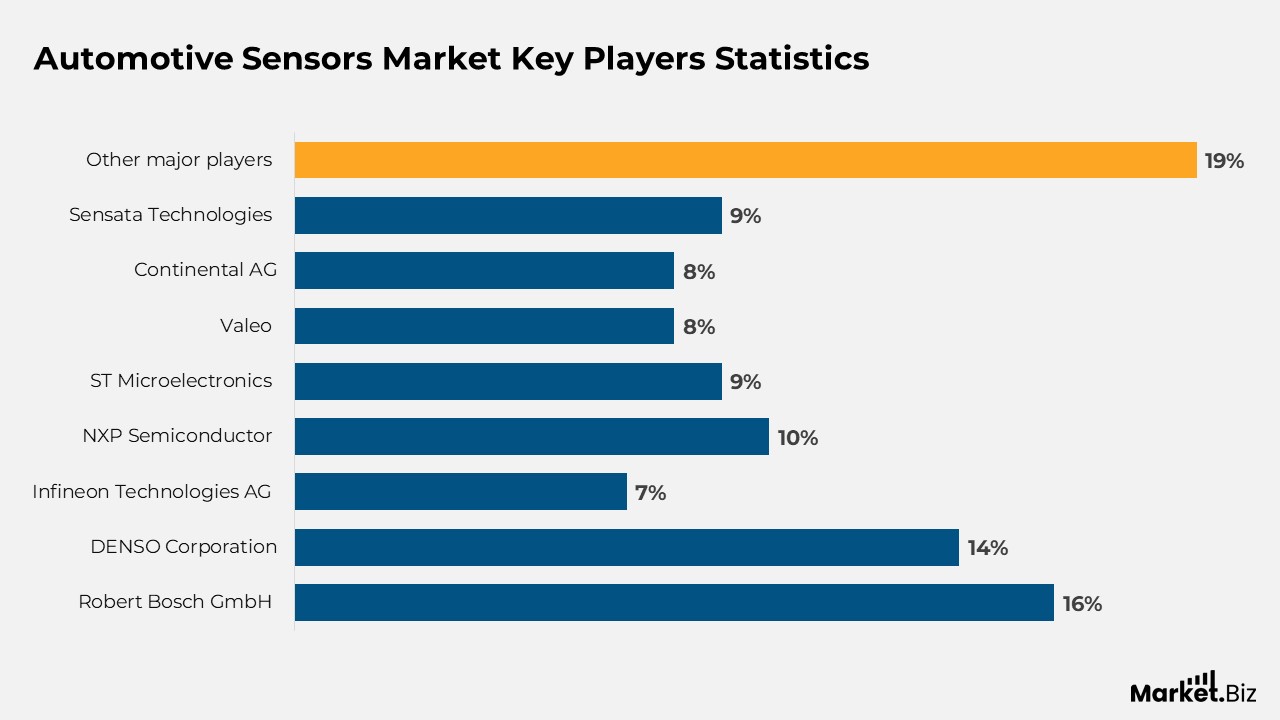
- Robert Bosch GmbH is at the forefront with a notable market share of 16%. This is closely followed by DENSO Corporation, which possesses a considerable share of 14%.
- Infineon Technologies AG and NXP Semiconductor account for 7% and 10% of the market, respectively, highlighting their significant roles.
- ST Microelectronics and Valeo each account for 9% of the market share. Whereas Continental AG holds 8% of the market in conjunction with Valeo.
- Sensata Technologies also holds a significant position, with a 9% market share.
- Furthermore, other major players collectively constitute 19% of the market, indicating a diverse array of influential entities shaping the industry.
Temperature Sensors Statistics
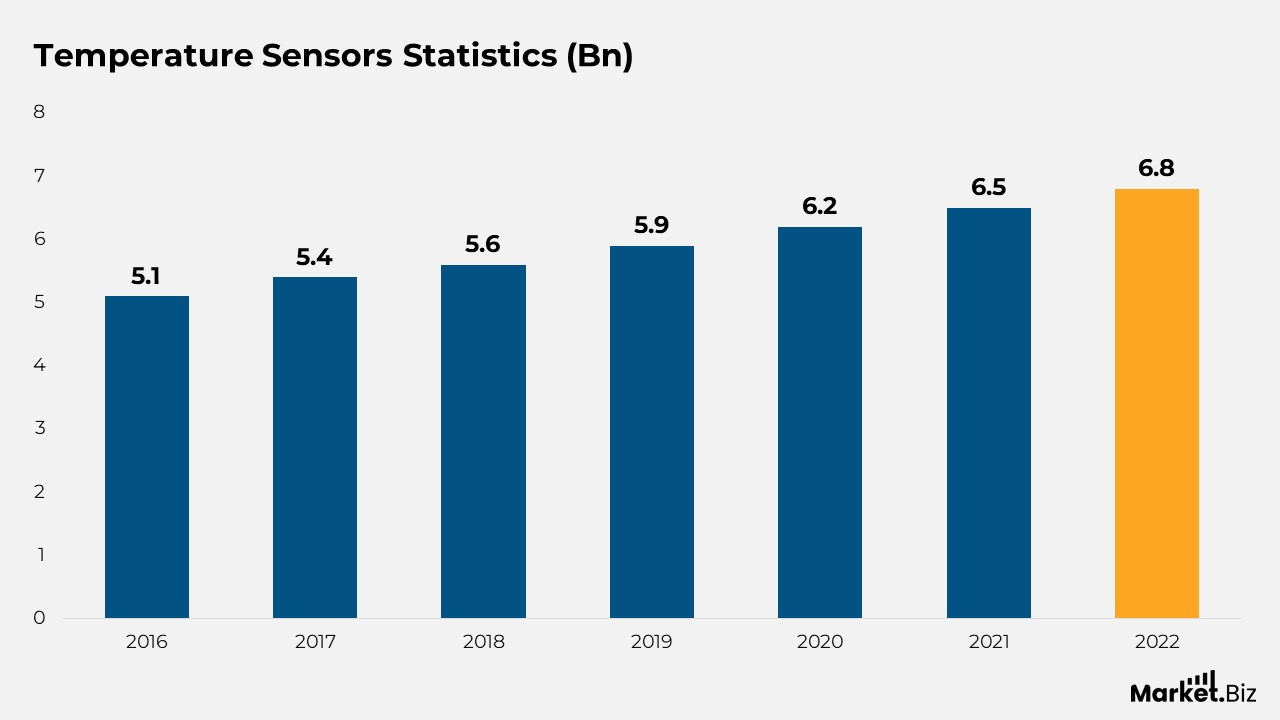
- In 2016, the market produced around $5.13 billion, which steadily grew over the subsequent years.
- By 2017, the revenue had climbed to $5.4 billion, then to $5.6 billion in 2018, $5.9 billion in 2019, and $6.2 billion in 2020.
- This upward trend persisted into 2021, with revenue hitting $6.5 billion and further increasing to $6.79 billion in 2022.
Pressure Sensors Statistics
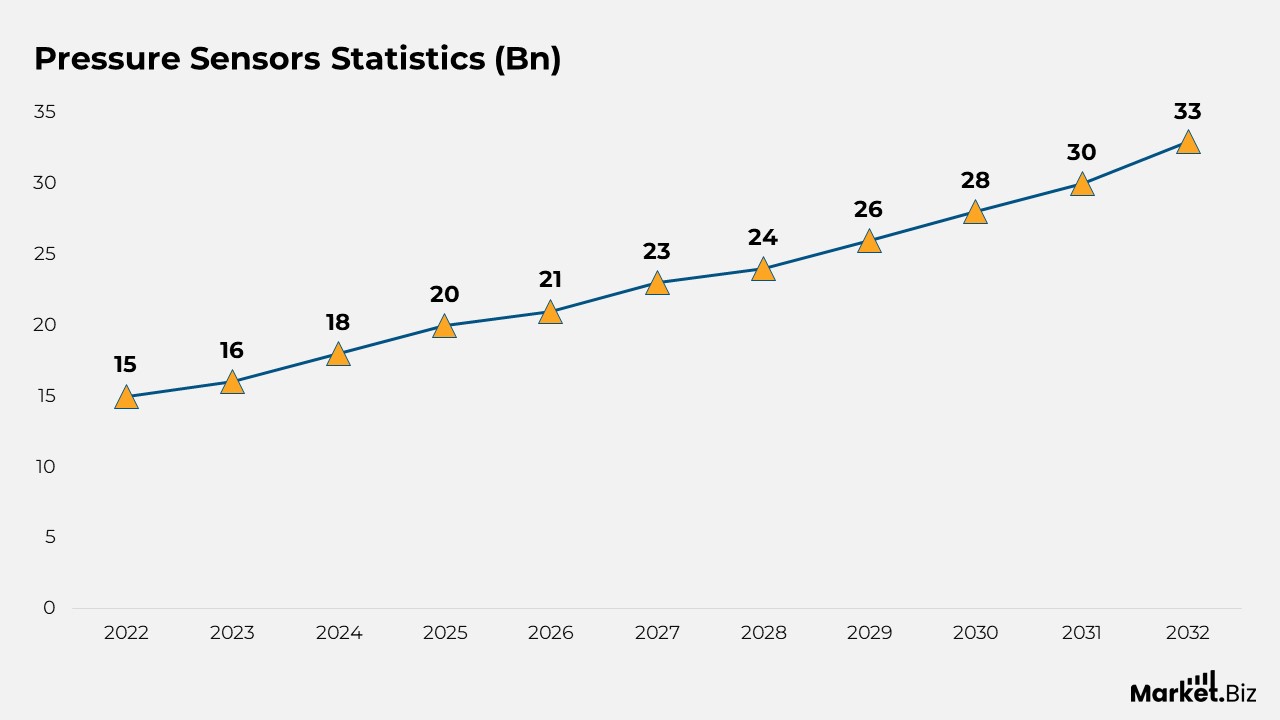
- In 2022, the revenue of the market was $15 billion, with projections indicating an increase to $16 billion in 2023.
- The market’s growth is expected to further accelerate in the following years. With revenue anticipated to reach $18 billion in 2024, $20 billion in 2025, and $21 billion in 2026.
- The pattern of consistent growth persists throughout the forecast period. With revenue projections estimating $23 billion in 2027, $24 billion in 2028, $26 billion in 2029, $28 billion in 2030, $30 billion in 2031, and $33 billion in 2032.
Gas Sensors Statistics
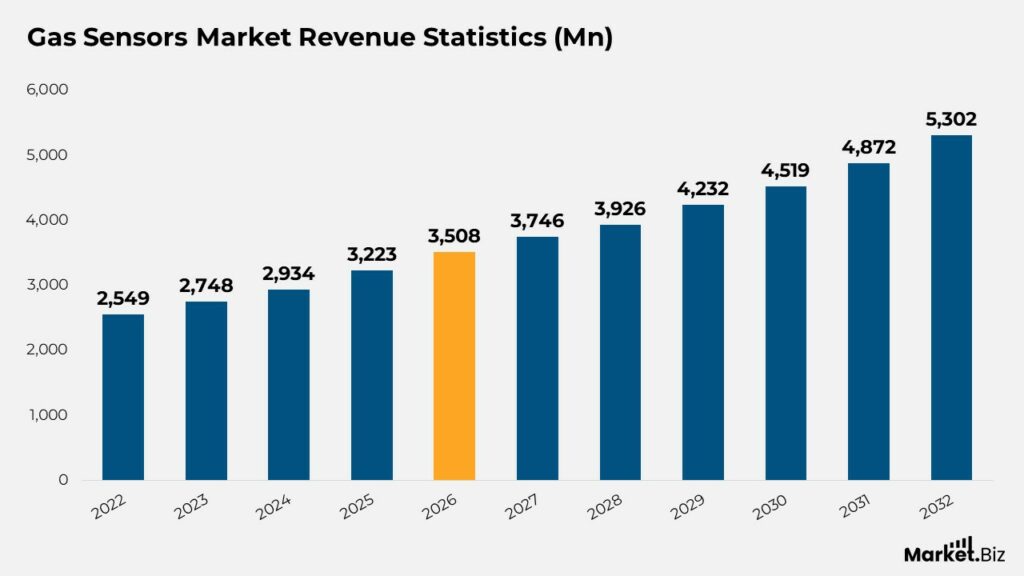
- The revenue generated by the gas sensors market has shown a steady upward trajectory. It began at $2,549 million in 2022 and has been increasing each year.
- In 2023, the market revenue rose to $2,748 million, followed by an increase to $2,934 million in 2024.
- The growth trend continued with revenue figures of $3,223 million in 2025, $3,508 million in 2026, and $3,746 million in 2027.
- The upward trend persisted, with revenue reaching $3,926 million in 2028, $4,232 million in 2029, and $4,519 million in 2030.
- The market is expected to grow further, with revenue projected to hit $4,872 million in 2031 and $5,302 million in 2032.
IoT Connections by Automotive Sensors Statistics
- In 2023, the global landscape observed a 16% increase in the number of interconnected IoT (Internet of Things) devices. Culminating in a total of 16.7 billion devices.
- This upward trajectory is expected to continue. With projections suggesting that by 2027, the worldwide total of IoT connections will surpass 29 billion.
- China has positioned itself as a significant player in the IoT device sector, demonstrating considerable growth in cellular IoT connections.
- Among all IoT connections, Wi-Fi represents 31%, with the integration of advanced Wi-Fi 6 and Wi-Fi 6E technologies facilitating more efficient communication among IoT devices, especially within smart homes, buildings, and healthcare environments.
- Bluetooth comprises 27% of global IoT connections.
- Bluetooth Low Energy (BLE) is favored for battery-operated IoT devices, including smart home sensors and asset trackers.
- Cellular IoT encompasses technologies such as 2G, 3G, 4G, 5G, LTE-M, and NB-IoT, contributing to nearly 20% of worldwide IoT connections.
- The implementation of more sophisticated technologies within cellular IoT, such as LTE-M and NB-IoT, has significantly contributed to its growth.
Automotive Sensors: Recent Development
- At the start of 2023, Bosch acquired SBG Systems, a company that focuses on inertial sensors and positioning systems, for a total of $450 million.
- Sensata Technologies finalised its acquisition of Xirgo Technologies, a company specialising in telematics and data analytics solutions, for $400 million towards the end of 2023.
- In 2023, Aptiv, a global technology company, secured $500 million in funding to accelerate the development of its next-generation sensor technology designed for autonomous vehicles and advanced driver-assistance systems.
- The US Department of Transportation released an updated policy concerning autonomous vehicles in early 2024.
Automotive Sensors Future Predictions
- The worldwide automotive sensor market is anticipated to attain nearly $37.65 billion by 2027. With a compound annual growth rate (CAGR) exceeding 10%.
- The global automotive sensors market is expected to expand at a compound annual growth rate (CAGR) of approximately 15% from 2023 to 2028.
Conclusion
In summary, automotive sensors are becoming increasingly essential in the automotive sector, propelled by technological innovations and evolving consumer demands. These sensors play a crucial role in enhancing vehicle performance, safety, and connectivity, leading to consistent market expansion and growing revenues. The rise of advanced driver assistance systems (ADAS) and the growth of the Internet of Things (IoT) highlight the significance of sensors in contemporary vehicles.
As the automotive environment transforms, a wider array of advanced sensor types and systems will be vital to vehicles. With regulatory focuses shifting towards safety and autonomous driving features.
Looking forward to 2030 and beyond, the energy consumption and production methods of sensors will undergo heightened examination, given their increasing incorporation into vehicles. Automotive sensors are fundamental in shaping the future of the automotive industry. From improving safety to facilitating more intelligent and efficient vehicles.
FAQ’s
A MAF sensor quantifies the volume of air drawn into the engine. Conversely, a MAP sensor measures the air pressure within the intake manifold.
An oxygen sensor, which assesses the oxygen levels in exhaust emissions, plays a vital role in ensuring an optimal air-fuel mixture for enhanced performance, reduced emissions, and improved fuel efficiency.
Examples such as Advanced Driver Assistance Systems (ADAS), Human Machine Interface (HMI), and in-vehicle infotainment (IVI) illustrate how AI contributes to vehicle safety and user engagement. Additionally, the integration of sensor data through AI enhances safety and offers valuable insights for both drivers and passengers.