









Introduction
Semiconductor IP Statistics: Semiconductor Intellectual Property (IP) comprises pre-designed and validated components utilised in the manufacturing of semiconductor chips. These components, including processors and memory modules, are protected by intellectual property rights, thereby alleviating the burden and costs for chip designers.
Semiconductor IP finds application across multiple sectors, such as consumer electronics, automotive technology, and industrial automation, among others. It can be customised to meet specific requirements, and its reliability is established through thorough testing. Users enjoy flexibility in licensing Semiconductor IP, with choices including royalties, permanent licenses, and subscription models.
The worldwide market for semiconductor intellectual property (IP) is propelled by the increasing demand for System on Chip (SoC) designs, 5G technology, artificial intelligence (AI), and Internet of Things (IoT) devices. This market focuses on pre-verified, reusable, and licensable logic components, such as processors and memory, which expedite the development of chips.
Editor’s Choice
- In the year 2023, the Semiconductor IP market generated a revenue of USD 6.4 billion.
- Total semiconductor trade surged from $294 billion to a staggering $1.655 trillion, representing a remarkable 463% increase.
- R&D spending in the semiconductor industry surged from $15.7 billion to $64.5 billion, a notable 311% increase.
- Royalty-based intellectual property sources dominate the market, holding a significant 70% share.
- Arm Holdings Ltd. is recognised as the leading entity with a significant market share of 41%, which reflects its strong position within the industry.
- North America is at the forefront with a considerable market share of 31%, underscoring its significance in the industry.
- As per the 2020 IPnest Semiconductor Design IP Statement. Arteris IP was positioned 12th among the largest semiconductor IP companies worldwide.
General Semiconductor IP Statistics
- In the year 2023, the Semiconductor IP market generated a revenue of USD 6.4 billion.
- Royalty-based IP sources constitute the largest segment of this market, commanding a considerable 70% share.
- Arm Holdings Ltd. emerges as the leading entity, possessing a significant 41% market share, which underscores its crucial role in the industry.
- North America dominates with a remarkable 31.0% market share, highlighting its significance in the sector.
- Soft Semiconductor Intellectual Property is generally offered in high-level programming languages like C++, RTL, Verilog, or VHDL, and occasionally as a netlist.
- Connectivity SIP, which is also referred to as standards SIP. Complies with particular standards such as PCI, USB, IEEE1394 (often called “Firewire”), IrDA, Bluetooth, or 802.11.
- As per the 2020 IPnest Semiconductor Design IP Report. Arteris IP was positioned 12th among the largest semiconductor IP firms globally.
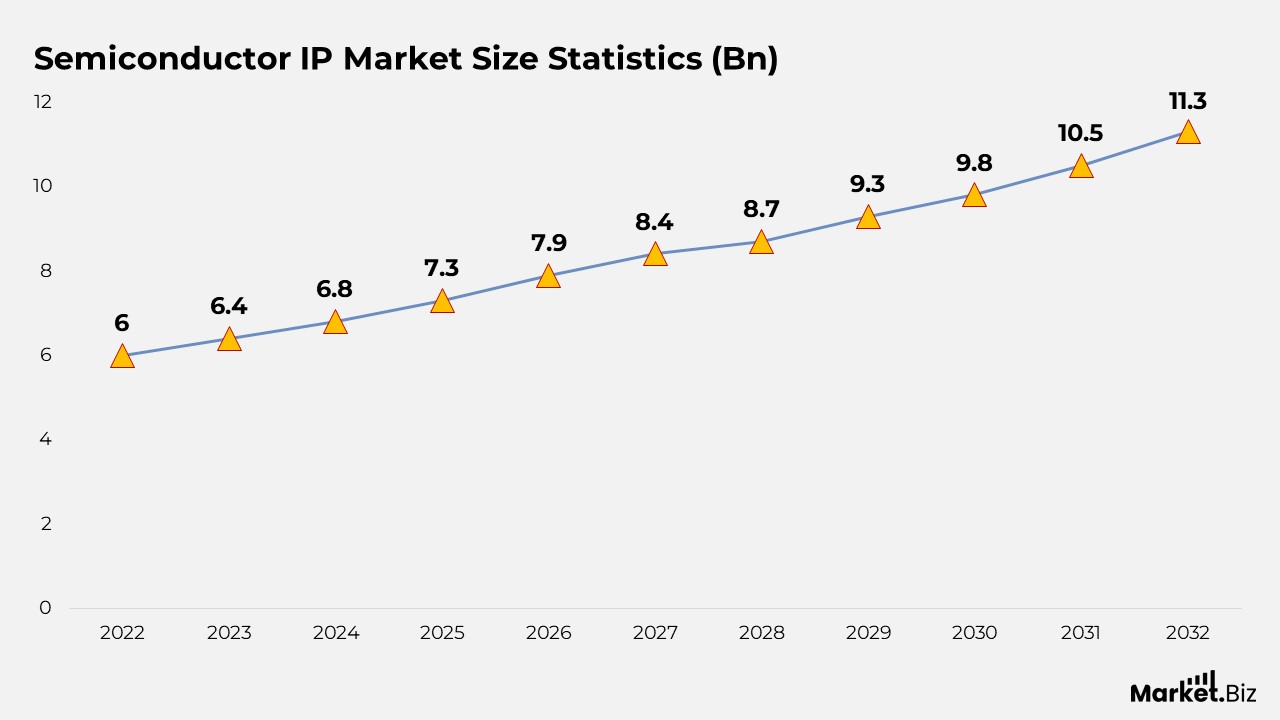
Semiconductor IP Market Size Statistics
- In 2022, the market revenue was recorded at USD 6.0 billion, which signifies the beginning of this upward trajectory.
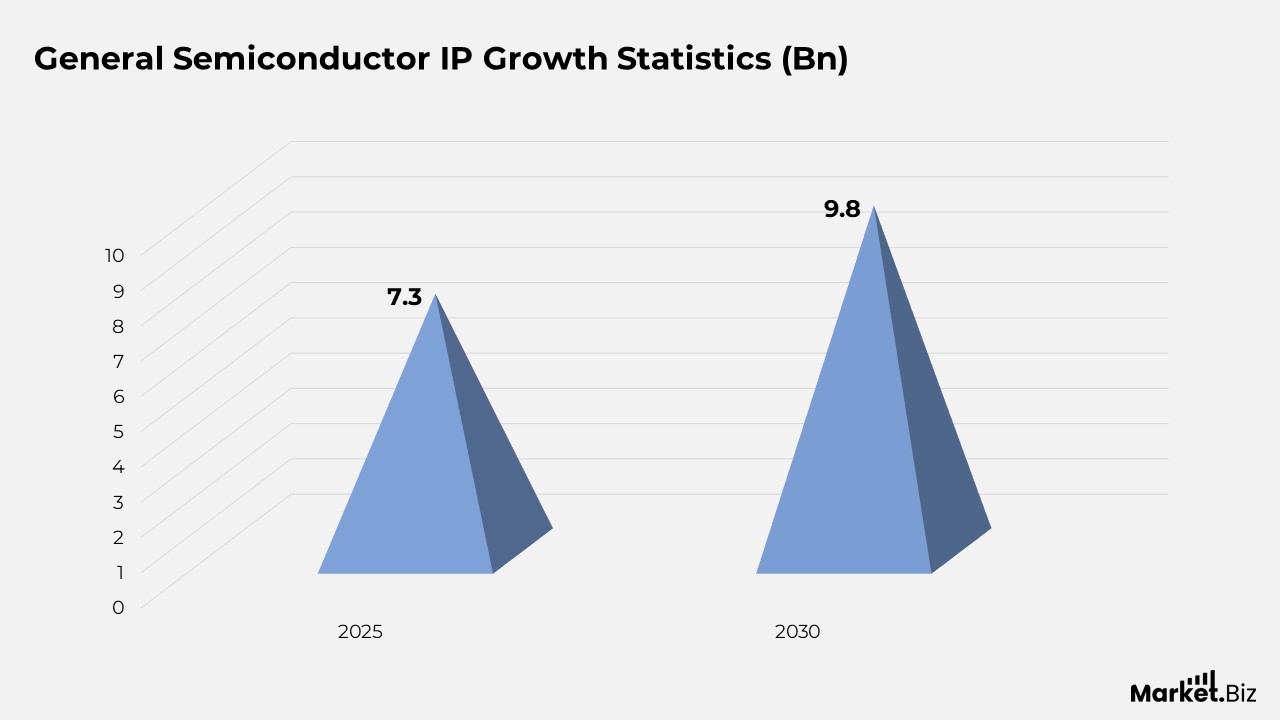
- The following years are expected to experience a steady yet significant growth. Revenues are projected to reach USD 6.4 billion in 2023, USD 6.8 billion in 2024, and further increase to USD 7.3 billion in 2025.
- This favorable trend is anticipated to persist. Revenues are forecasted to attain USD 7.9 billion in 2026 and USD 8.4 billion in 2027.
- As we move into the latter part of the 2020s, the market is expected to reach even higher levels. Revenue estimates suggest figures of USD 8.7 billion in 2028, USD 9.3 billion in 2029, and USD 9.8 billion in 2030.
- Looking ahead, the Semiconductor IP market is projected to surpass the USD 10 billion threshold by 2031. It is expected to reach USD 10.5 billion and maintain its vigorous growth, with forecasts indicating revenues of USD 11.3 billion in 2032.
Statistics of the Semiconductor Industry
- Total semiconductor trade surged from $294 billion to a staggering $1.655 trillion, representing a remarkable 463% increase.
- Cell phone subscriptions per 100 people witnessed an exponential rise, soaring from 2 to 104.9, a staggering 3,371% increase.
- Internet users per 100 people displayed an even more impressive growth, surging from 1.19 to 49.7, a remarkable 4,076% jump.
- The global semiconductor market’s total revenue increased substantially from $132 billion to $412 billion, marking a 212% rise.
- Semiconductor production experienced substantial expansion, with the total number of units produced soaring from 215 billion to 932 billion, a significant 333% increase.
- Transistor production witnessed an astonishing leap from 29.1 quadrillion to 262 sextillion, a staggering 900,343,543% growth.
- The average number of transistors per semiconductor surged from 135,237 to an astonishing 2,809,901,908, an extraordinary 2,077,661% increase.
- PC processor speeds experienced a notable advancement, with single-core speeds increasing from 133 MHz to 2,300 MHz, and quad-core speeds demonstrating a remarkable 1,629% increase.
- Furthermore, IC wafer capacity expanded significantly from 51.9 million to 230.5 million, marking a 344% growth.
- R&D spending in the semiconductor industry surged from $15.7 billion to $64.5 billion, a notable 311% increase.
- Process technology node reduced drastically from 350 nanometers to 7 nanometers, indicating a -98% change.
- Finally, the semiconductor content per electronic system increased from 18.8% to 26.3%. Reflecting a 40% growth during this transformative period in the semiconductor sector.
Semiconductor IP by IP Source Statistics
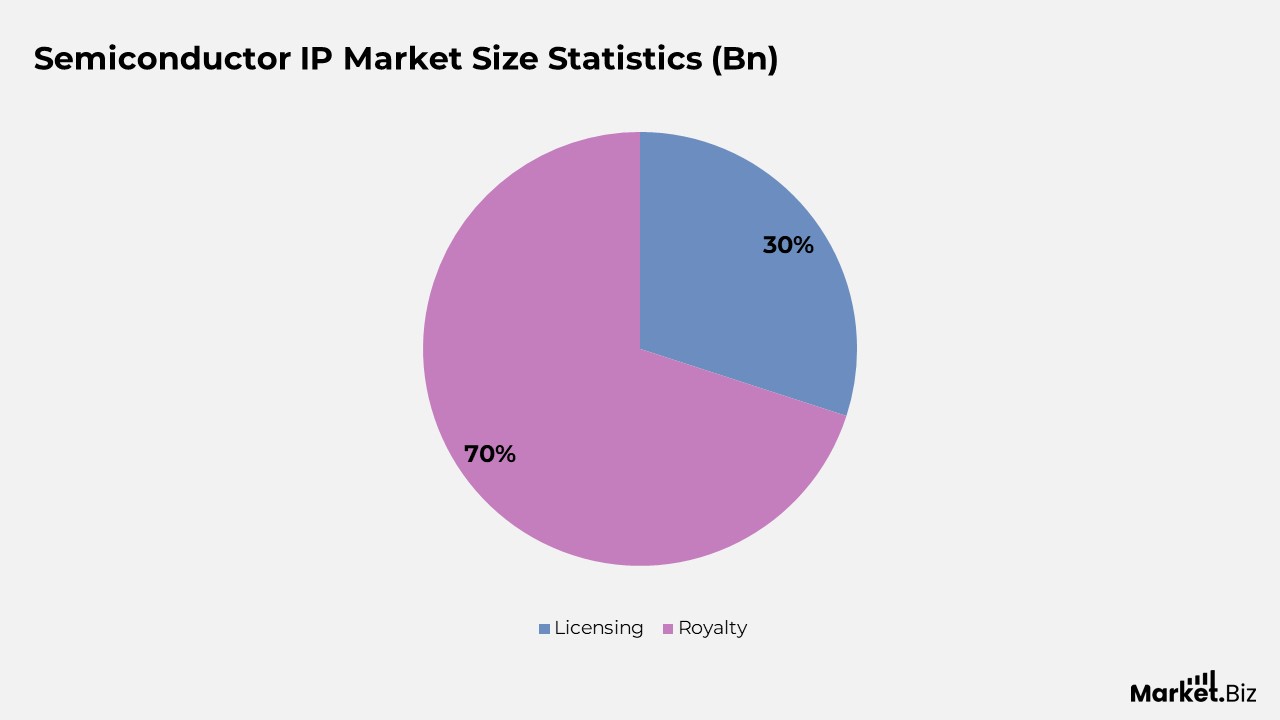
- Royalty-based intellectual property sources dominate the market, holding a significant 70% share.
- In this framework, users are required to pay royalties that correspond to the volume of production utilizing the intellectual property, making it a widely adopted option within the industry.
- Conversely, licensing models account for a 30% share of the market.
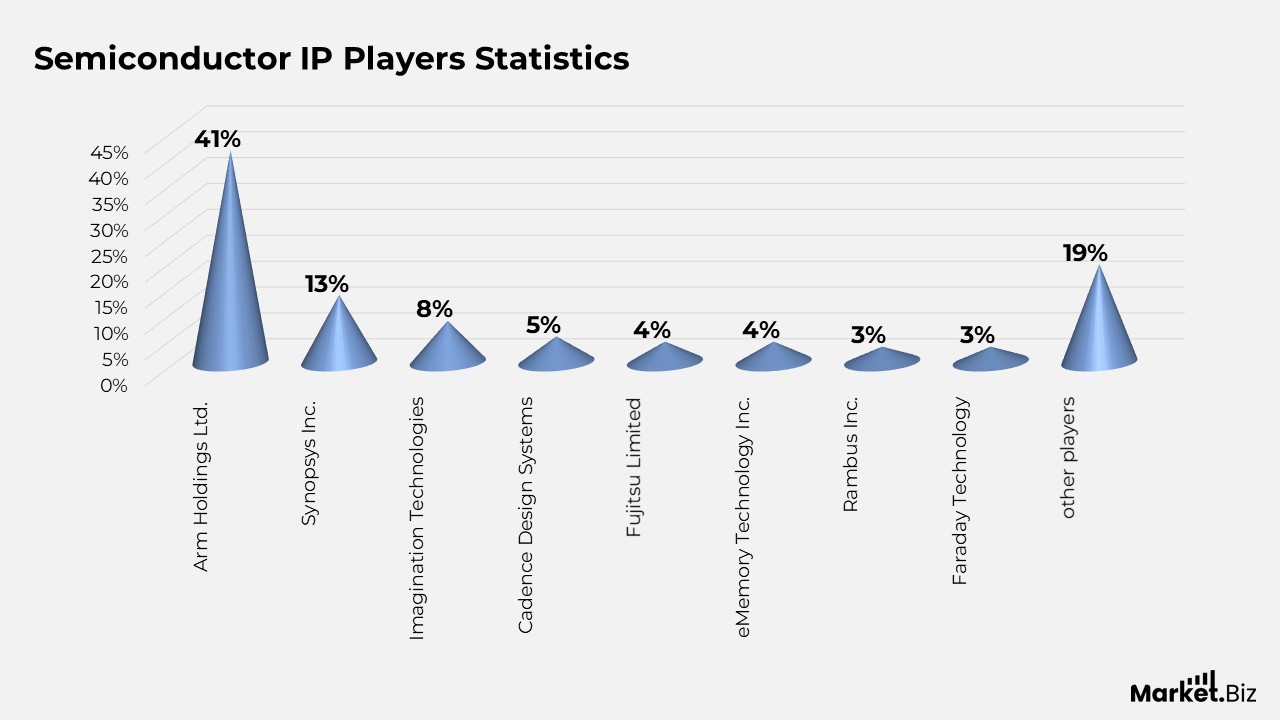
Statistics of Semiconductor IP Players
- Arm Holdings Ltd. is recognised as the leading entity with a significant market share of 41%, which reflects its strong position within the industry.
- In second place, Synopsys Inc. commands a noteworthy 13% market share, highlighting its impact in the Semiconductor IP domain.
- Cadence Design Systems, Inc., Imagination Technologies, and Fujitsu Limited each play a crucial role, holding market shares of 5%, 8%, and 4%, respectively.
- Additionally, eMemory Technology Inc., Faraday Technology Corporation, and Rambus Inc. contribute meaningfully. With market shares of 4%, 3%, and 3%, respectively.
- Collectively, these major players influence the competitive environment, while other participants together represent 19% of the market share.
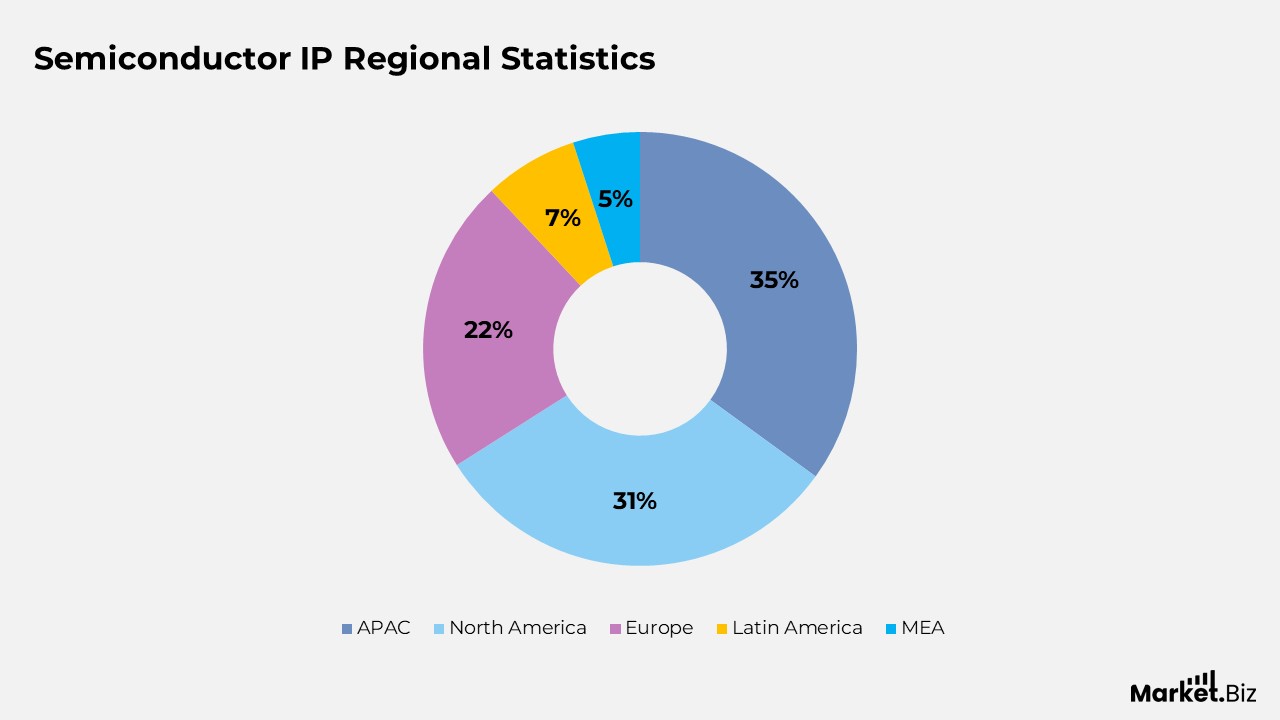
Semiconductor IP Regional Statistics
- North America is at the forefront with a considerable market share of 31%, underscoring its significance in the industry.
- Europe closely trails with a notable market share of 22%, signifying a strong presence in the semiconductor IP field.
- The Asia-Pacific (APAC) region occupies the largest segment of the market with 34.6%, highlighting its role as a central hub for the development and consumption of semiconductor IP.
- Latin America and the Middle East & Africa (MEA) regions account for market shares of 7.4% and 5%, respectively.
Semiconductor Vendors Statistics
- As per the 2020 IPnest Semiconductor Design IP Statement, Arteris IP was positioned 12th among the largest semiconductor IP companies worldwide.
- In the Chip Infrastructure market segment, which focuses primarily on on-chip interconnect IP, Arteris IP protected the 2nd position, trailing only Arm Holdings.
- Arteris IP witnessed substantial revenue growth each year, ranking as the 2nd highest in this regard among the top 15 semiconductor IP companies.
- With a revenue of $34 million in 2019, Arteris IP obtained a significant 31.3% share of the interconnect IP market.
- This growth was propelled by its achievements across various global regions and its extensive product portfolio, which features Ncore Cache Coherent Interconnect, FlexNoC Interconnect, and CodaCache Last Level Cache IP.
- These IP solutions have found widespread application in advanced sectors, including automotive, 5G, machine learning, and infrastructure SoCs.
Types of Semiconductor IP Statistics
- Hard SIP
- Soft SIP
- Foundation SIP
- Memory SIP
Semiconductor IP Recent Development
- In the year 2023, Synopsys, a prominent supplier of semiconductor IP solutions, purchased eSilicon for a sum of $750 million.
- In 2023, SiFive, a firm dedicated to RISC-V semiconductor IP, secured $175 million in a Series E funding round.
- Arm Holdings declared a merger with Ampere Computing, a company that specialises in server processors, for a total of $1.5 billion in 2024.
- In 2025, it was anticipated that 40% of semiconductor IP solutions would incorporate AI and machine learning functionalities.
Semiconductor IP Future Predictions
- The RISC-V open-source architecture is increasingly popular. With an expected 30% of semiconductor IP designs expected to embrace RISC-V standards by the end of 2026.
- The Semiconductor IP market is expected to exceed the USD 10 billion mark by 2031. It is projected to achieve USD 10.5 billion and continue its robust growth. With predictions suggesting revenues of USD 11.3 billion in 2032.
Conclusion
In conclusion, semiconductor Intellectual Property (IP) serves as a fundamental element of the semiconductor sector, promoting innovation, swift development, and effective product introductions.
The historical perspective highlights the industry’s extraordinary expansion and evolution, characterised by significant growth in trade volume, internet utilisation, and semiconductor market earnings, along with remarkable technological advancements.
Prominent IP providers such as Arteris IP and Faraday Technology Corporation have made significant contributions. Addressing a wide range of applications, including automotive and 5G. The flexibility of semiconductor IP remains essential, ensuring it continues to drive innovation across multiple industries.
FAQ’s
Semiconductor IP denotes pre-designed and validated components utilised in the production of semiconductor chips. These components include processors, memory blocks, and communication interfaces. They are safeguarded by intellectual property rights and are crucial for chip designers to conserve time and resources.
Semiconductor IP refers to intellectual property blocks or pre-designed and pre-verified components used in the creation of semiconductor chips or integrated circuits (ICs)
In the rapidly changing and dynamic semiconductor sector, achieving success depends on the capacity to assess, evaluate, and enhance performance. Key Performance Indicators (KPIs) are fundamental to this process, offering actionable insights that inform decision-making, foster innovation, and promote operational excellence