









Introduction
AI Industry Statistics: The AI industry has experienced significant growth in recent years, driven by advancements in machine learning, deep learning, and natural language processing. The increasing integration of AI across industries such as healthcare, finance, automotive, and retail is propelling this rapid expansion.
Companies are making substantial investments in AI to improve efficiency, reduce costs, and provide more tailored customer experiences. The potential of AI to transform business operations is vast, ranging from enhancing decision-making with predictive analytics to optimizing supply chains.
In healthcare, AI-driven diagnostics and treatment suggestions are transforming patient care, while the automotive sector is advancing with innovations in autonomous driving. As AI technologies continue to evolve, their influence is expected to grow, reshaping industries and unlocking new avenues for innovation, positioning it as one of the most transformative sectors of the 21st century.
Editor’s Choice
- AI is projected to add $15.7 trillion to the global economy by 2030.
- 55% of Americans use AI regularly.
- 65% of organizations have integrated generative AI into at least one business function.
- 77% of devices in use today incorporate some form of AI technology.
- 83% of companies consider AI a key priority in their business strategies.
- Around 90% of businesses leverage AI to stay competitive in their respective industries.
- 64% of businesses believe that AI can significantly enhance productivity.
- 48% of businesses use AI to manage and analyze big data effectively.
- By 2025, an estimated 97 million people will be employed in the AI sector.
- 90% of organizations support AI adoption to gain a competitive edge.
- Netflix generates $1 billion annually from its AI-driven personalized recommendation system.
- 38% of healthcare providers use AI in their diagnostic processes.
- 77% of devices in circulation feature AI integration.
- By 2025, AI may displace 85 million jobs but create 97 million new ones, resulting in a net gain of 12 million jobs.
- 88% of non-users are unsure about how generative AI will impact their lives.
- AI’s contribution to the global economy is expected to reach $15.7 trillion by 2030.
- 63% of organizations worldwide plan to implement AI within the next 3 years.
- Only one-third of consumers believe they are using AI platforms, though actual usage stands at 77%.
- The AI market is anticipated to grow by at least 120% year-over-year.
- In 2024, the global AI market is projected to grow by 33% year-over-year.
Artificial Intelligence (AI) Adoption Across Various Industries
- 52% of telephone companies are using AI chatbots.
- 4 in 5 retail executives plan to adopt AI automation by 2025.
- 75.7% of digital marketers rely on AI tools to carry out their tasks.
- 25% of companies in the travel and hospitality industry have integrated chatbot technology.
- 12% of companies in healthcare, information services, and manufacturing are using AI, while only 4% in construction and retail have adopted it.
- By 2027, AI adoption is expected to boost the banking industry’s revenue by $1 billion.
- The automotive sector has seen a 48% increase in the adoption of machine learning technologies.
- 38% of medical professionals utilize computer assistance for diagnoses.
- Netflix saved $1 billion through the adoption of machine learning technology.
- 36% of executives state that the primary reason for adopting AI is to optimize and automate internal business processes.
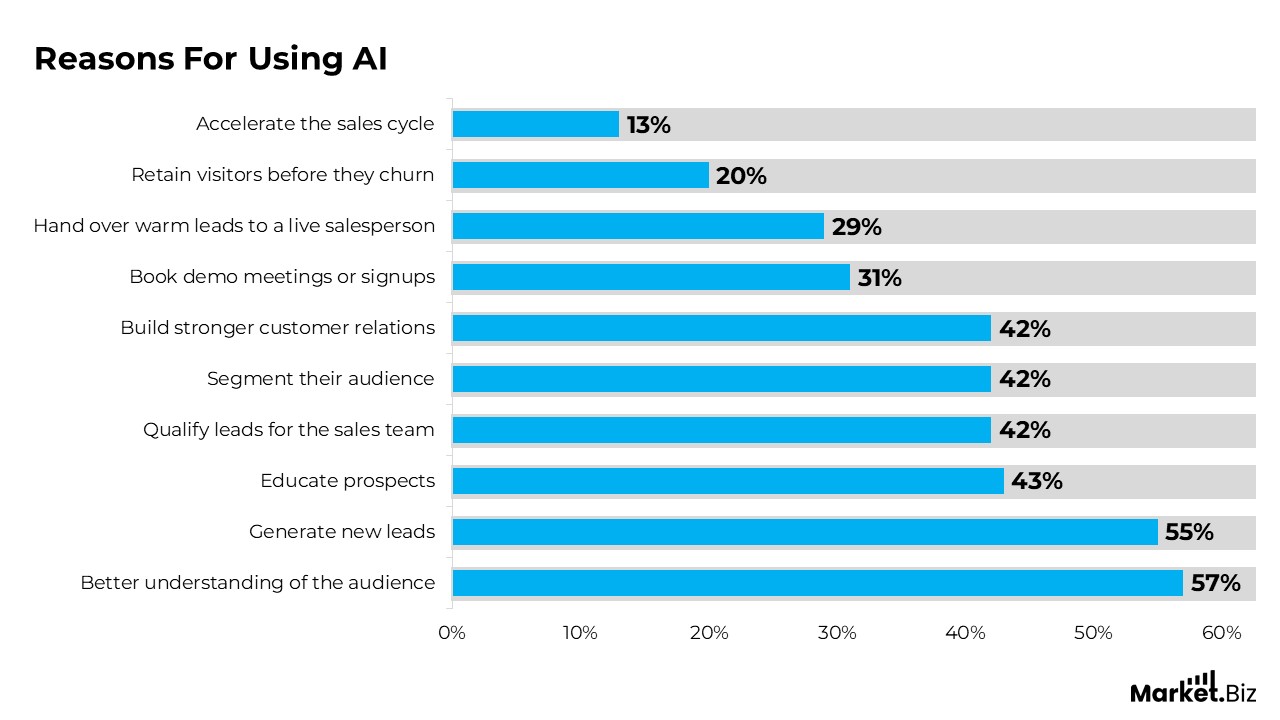
- 55% of B2B marketers use chatbots to generate new leads.
- 16% of sales professionals utilize AI for research purposes.
- 18% of sales professionals use generative AI to create AI-generated content.
- 14% of sales professionals rely on AI for data analysis and reporting.
- 79% of corporate strategists view AI as essential for their company’s success in the next two years.
- 20% of industries integrate AI in service operations and corporate finance.
- 79% of customer service professionals consider AI automation vital for their business strategy.
- Over 3 in 10 financial services companies incorporate AI into product development.
- Nearly 3 in 5 marketers believe that AI will revolutionize the marketing industry.
(Source: DemandSage, Gartner, Statista, Semrush, Authority Hacker, Hubspot, Missive, AI Business)
Adoption and Usage of Artificial Intelligence Statistics
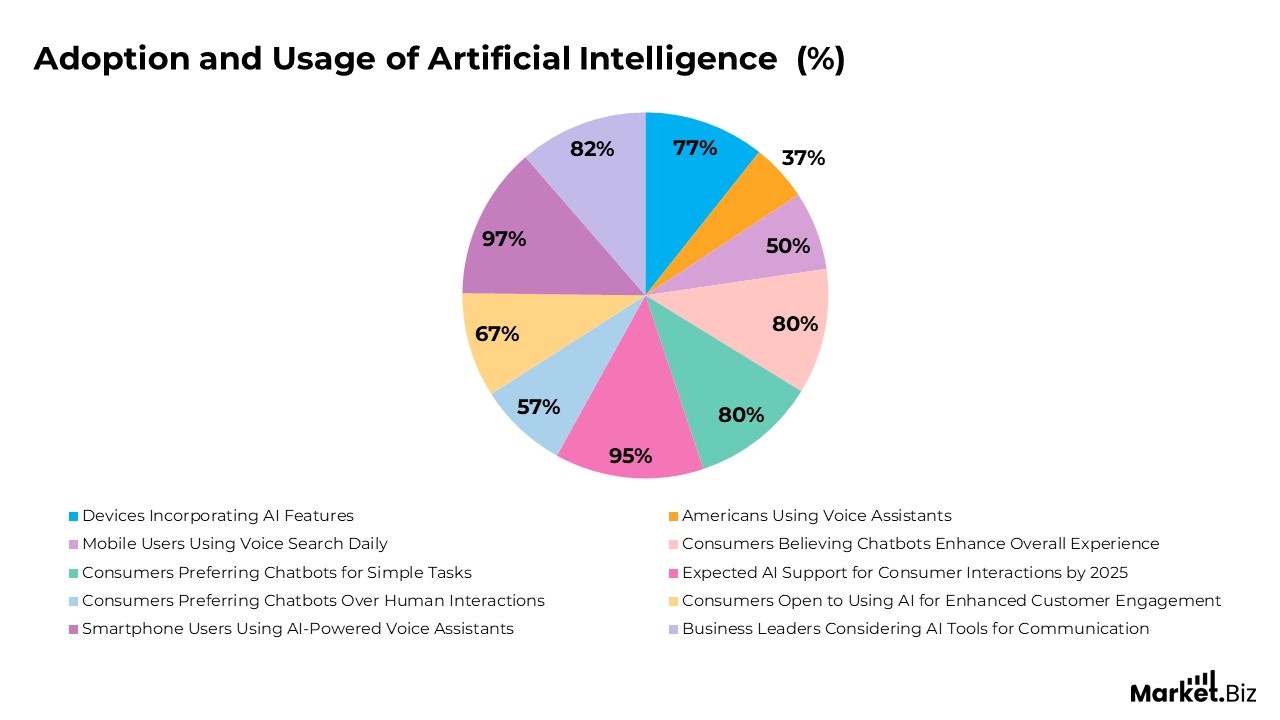
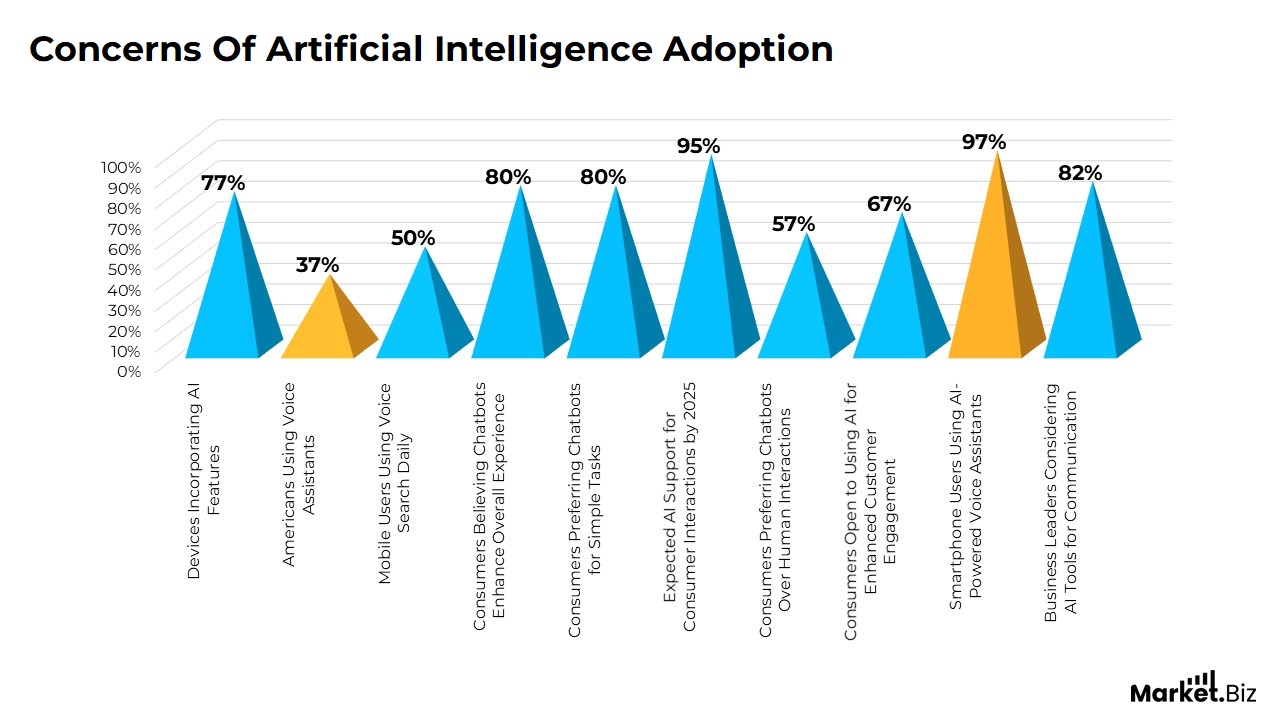
- 77% of devices in use today incorporate AI features.
- 36.6% of Americans use voice assistants, and 50% of mobile users use voice search daily.
- 4 in 5 consumers believe chatbots can enhance their overall experience.
- For simple tasks like booking appointments or checking account balances, 80% of consumers prefer using chatbots.
- By 2025, it’s expected that AI will support 95% of consumer interactions.
- 57% of consumers prefer chatbot interactions, while 43% favor human interactions.
- Two-thirds of consumers are open to using AI to enhance customer engagement.
- 97% of smartphone users leverage AI-powered voice assistants.
- According to 82% of business leaders, using AI tools to communicate with colleagues is considered.
- The number of digital voice assistants is projected to reach 8.4 billion.
(Source: DemandSage, Authority Hacker, CMS Wire, Statista, Forbes, Tech.co)
Artificial Intelligence Adoption in the Workplace
- Over 90% of organizations view AI as essential for gaining a competitive edge.
- 64% of business owners are confident that AI will help boost productivity.
- 73% of U.S. companies have incorporated AI into certain segments of their business operations.
- More than half of businesses (54%) have actively adopted AI within just one year of ChatGPT’s launch.
- Today, about one-third of business operations are automated and managed by machines.
- Companies that implement AI see an average revenue increase of 6% to 10%.
- With AI adoption, employee productivity is expected to grow by 1.5% over the next decade.
- Approximately 80% of businesses consider AI a key component of their strategy.
- 35% of businesses are concerned about the lack of technical knowledge and skills needed to use AI effectively.
- 85.1% of users utilize AI for generating blog content.
- 83% of businesses prioritize AI as a central focus in their operations.
- 44% of business leaders report increased productivity with the adoption of AI.
- 9% of workers in the U.S. use generative AI daily.
(Source: World Economic Forum, DemandSage, Forbes, Social Shepherd, MIT SLogan School Authority Hacker, PwC, Statista)
Artificial Intelligence Market Size
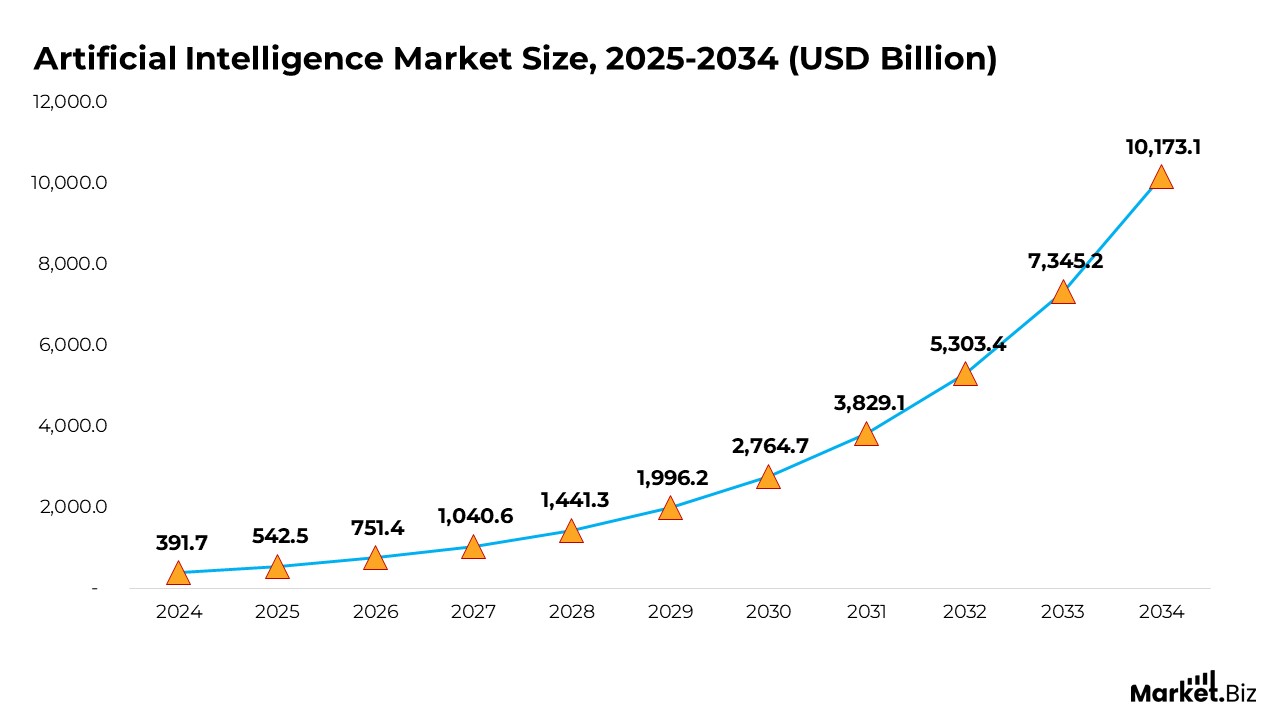
- According to Market.us, the artificial intelligence market is expected to rise from $542.5 billion in 2025 to $10,173.1 billion by 2034, representing a compound annual growth rate (CAGR) of 38.5% from 2025 to 2034.
- The AI market is driven by the increased adoption across sectors like healthcare, automotive, finance, and retail, along with advancements in computing power and data availability.
- In 2023, the Software segment dominated the AI market, holding more than 43.7% of the market share.
- In 2023, Cloud-based solutions captured over 64.6% of the AI market, owing to their scalability, flexibility, and cost-efficiency.
- In 2023, Machine Learning (ML) held a dominant position in AI, representing 41.1% of the market.
- In 2023, the healthcare segment led the AI industry with 15.9% of the market share, driven by AI’s transformative role in patient care and diagnostics.
- In 2023, North America led the global AI market with a share of 38.9%, equating to approximately USD 97.25 billion in revenue.
- In China, 58% of companies actively deploy AI technologies, with 30% evaluating further integration, contrasting with 25% of U.S. companies adopting AI.
- A survey by Forbes Advisor shows 24% of business owners are concerned about AI’s impact on website traffic.
- Research from the World Economic Forum predicts AI could create 97 million new jobs, alleviating concerns about workforce displacement due to automation.
- By 2035, AI adoption in the manufacturing sector is expected to generate $3.8 trillion in financial gains, according to Accenture.
- OpenAI’s valuation is approaching $90 billion as of October 2023, reflecting strong market confidence in generative AI technologies.
- AI-related investments in American startups grew to 25% in 2023, up from 12% between 2018 and 2022.
(Source: Market.us)
Artificial Intelligence in Oncology Market Size
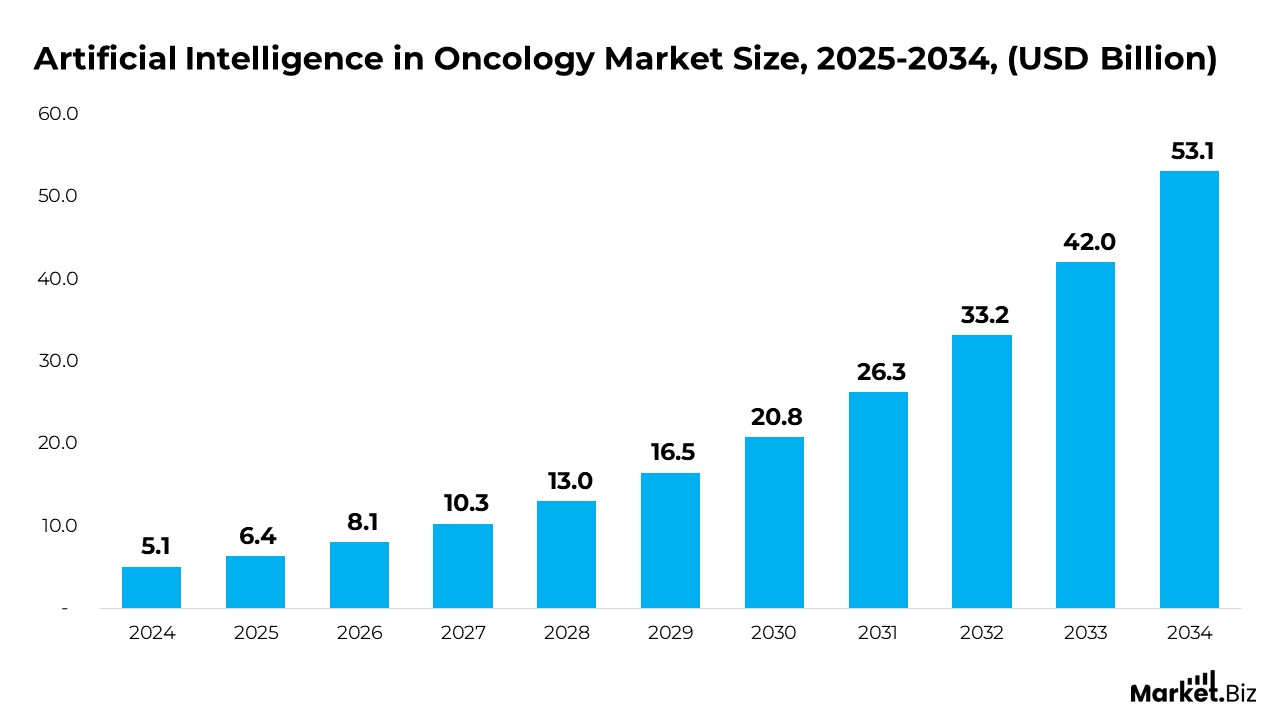
- According to Market.us, the artificial intelligence in oncology market is expected to rise from $6.4 billion in 2025 to $53.1 billion by 2034, representing a compound annual growth rate (CAGR) of 26.4% from 2025 to 2034.
- The growth of AI in the oncology market is driven by the rising prevalence of cancer and increased adoption of AI for diagnosis, treatment, and data analysis, reducing the burden on healthcare providers.
- The software solutions segment accounted for 43% of the total revenue in the global AI in oncology market in 2022.
- The radiation oncology, diagnostic imaging, and interventional radiology market is expected to grow at a profitable rate of 36.8% during the forecast period due to innovative treatments for accurate tumor detection.
- The other segment, including bladder cancer, cervical cancer, liver cancer, skin cancer, and uterine cancer, represented 30% of the market share in 2022.
- The chemotherapy segment is expected to dominate the market, holding 36% of the revenue share during the forecast period.
- North America is projected to be the largest market, with 58% market share, driven by strong digital infrastructure, supportive government policies, and increased reimbursements.
- The AI in oncology market in APAC is expected to hold a 39% revenue share by 2031, driven by a growing geriatric population and increased digitalization in healthcare facilities in countries like Japan and India.
(Source: Market.us)
Public Trust and Perception of Artificial Intelligence
(Source: Pew Research Center, National University)
- 9 in 10 students are interested in learning more about AI in school.
- Over half (54%) of people can distinguish between human and AI-generated content.
- 54% of consumers believe AI could enhance the customer experience.
- Around 67% of people would prefer using ChatGPT over Google for certain tasks.
- 50% of consumers have an optimistic view of AI.
- 39% of respondents believe current AI technology is safe and secure.
- 57% of Gen Z and 62% of millennials are more excited about AI, compared to only 30% of boomers. Most individuals are more concerned than excited about AI, with 51% of men and 40% of women expressing excitement over concern.
- 65% of consumers trust businesses that use AI.
- 21% of consumers are neutral about businesses adopting AI.
- 14% of consumers do not trust businesses that utilize AI.
- 78% of respondents feel the benefits of generative AI outweigh the risks.
- 80% of people are concerned about AI being used for cyberattacks.
- 74% are concerned about AI’s role in creating deceptive political ads.
- 54% of consumers believe AI will improve written content quality.
- 4.1% of people surveyed think AI will have no benefits.
- 12.4% believe AI will not have any potential drawbacks.
- A Pew Research study found 39% of adults are comfortable with healthcare providers using AI.
- 51% of people believe AI would help reduce racial and ethnic bias in healthcare, 40% think AI would help reduce errors in healthcare, and 38% believe AI can improve healthcare outcomes.
Investment in Artificial Intelligence
- The AI technology market was valued at approximately $200 billion in 2023, with projections indicating it will surpass $1.8 trillion by 2030.
- AI startups enjoy significantly higher valuations than non-AI startups, with a 60% higher valuation at the B-series funding stage compared to their non-AI counterparts.
- In the first quarter of 2024, AI-focused startups raised $12.2 billion across 1,166 deals, marking a modest 4% increase from $11.7 billion invested in 1,072 deals during Q4 2023.
- In February 2024, AI companies received $4.7 billion in venture funding, accounting for more than 20% of the total venture capital invested that month, more than doubling the $2.1 billion invested in February 2023.
- Funding for AI experienced a massive surge in 2023, with investments in generative AI alone reaching $25.2 billion, an increase of nearly eight times compared to the previous year.
- In 2022, the AI industry saw substantial investment growth, with 1,392 AI companies receiving more than $1.5 million in funding, led by the United States with 542 companies, followed by the European Union and the United Kingdom with 293, and China with 160 companies.
(Source: Statista, DigitalOcean, LLC., Stanford AI Index Report, Our World in Data and AI Index Report)
Generative AI in the Retail Sector
- 3% of retail organizations report that generative AI is a topic of discussion in their boardrooms.
- The percentage of retail employees using generative AI is expected to increase from 36% in 2023 to 45% by 2025, reflecting a 9% growth over the two years.
- 62% of retail organizations have set up a dedicated team and budget to integrate generative AI into their future product and service development plans.
- 50% of retailers prioritize client experience as the primary focus of their generative AI strategy, while 35% focus on employee involvement and 15% on operational efficiency.
- The top 3 practical use cases of generative AI in retail are generating personalized responses for agents to create a conversational digital shopping assistant (29%), quickly emailing or messaging customers (31%), and creating personalized promotions for loyalty members (27%).
(Source: Capgemini Research Institute, Salesforce and Retail AI Council)
Future of Work Artificial Intelligence Statistics
- 5% of respondents believe that AI and machine learning tools make their job easier.
- 31% of respondents do not view AI and machine learning tools as a threat to their job.
- 63% of respondents indicate that their company does not have a ChatGPT/generative AI usage policy in place.
- 66.2% of respondents report that their companies have at least one internal AI use case live.
- 75% of Americans believe that AI implementation will lead to job losses in the U.S. within the next decade.
- Shortly, 39% of organizations expect Generative AI to increase their workforce size, while 22% foresee a reduction in headcount, likely due to the growing demand for AI and data professionals.
- More than half (51%) of respondents believe AI will have a positive impact on their job in the next five years, while 25% expect no impact, 16% anticipate a negative impact, and 8% are uncertain.
(Source: DigitalOcean, Retool, Gallup, Deloitte, Google, and Ipsos, DigitalOcean, LLC.)
Concerns Of Artificial Intelligence Adoption
- Only 47% of people globally believe AI companies adequately protect personal data.
- Over 40% of current AI users trust the information provided by AI tools.
- Only about 14% of AI users “completely” trust the information generated by AI.
- Nearly 40% of adults have experimented with generative AI, with 50% of Gen Z and millennials compared to just 22% of Baby Boomers.
- 85% of people took at least one action on data security concerns in the past year, an increase from 79% in 2023.
- Among surveyed IT professionals, 31% trust AI-driven IT systems to make autonomous decisions without human oversight, while 44% do not.
- 70% of Australians believe AI regulation is necessary, but only 30% think current laws and safeguards are sufficient to ensure AI use is safe.
- Only 13% of organizations have hired AI ethics specialists to guide responsible AI development.
- Large Language Models (LLMs), including GPT-4 and Claude 3 Sonnet, designed to be unbiased, continue to show implicit bias, such as favoring men for leadership roles.
(Source: Stanford University, KPMG, McKinsey, Deloitte, Attest, ITSM)
Conclusion
The AI industry is rapidly advancing, propelled by breakthroughs in machine learning, natural language processing, and other emerging technologies. As AI applications expand across industries such as healthcare, finance, retail, and education, their transformative capabilities are becoming increasingly apparent.
With global investments in AI at an all-time high, businesses are harnessing AI to streamline operations, enhance customer experiences, and foster innovation.
However, despite its remarkable progress, challenges persist, particularly in the areas of data privacy, ethics, and the shortage of skilled professionals. Nonetheless, AI adoption is set to rise significantly across industries, particularly in fields like automation, predictive analytics, and personalized services.
As AI continues to evolve, it will reshape business models and consumer interactions, leading to a new era of digital transformation. With tremendous potential for innovation and value creation, AI remains a crucial area for ongoing investment and research in the years ahead.
FAQ’s
The AI industry is experiencing significant growth, fueled by advancements in machine learning, natural language processing, and automation. AI technologies are increasingly being applied across various sectors, including healthcare, finance, retail, and education.
AI is rapidly being integrated into industries such as healthcare, finance, retail, and education. These sectors are utilizing AI for automation, predictive analytics, and to enhance the customer experience.
AI improves business operations by automating repetitive tasks, streamlining workflows, predicting trends, and offering personalized customer experiences. This results in higher operational efficiency, cost reduction, and better decision-making.
Despite its rapid growth, the AI industry faces challenges, including concerns about data privacy, ethical issues, and a lack of qualified AI professionals. Overcoming these obstacles is crucial for the long-term success of AI.
AI adoption is anticipated to increase significantly in sectors like automation, predictive analytics, and personalized services. Industries such as manufacturing, logistics, and customer service are also increasingly incorporating AI technologies.
AI is revolutionizing consumer interactions by providing tailored experiences, enhancing customer service with AI-powered chatbots, and offering personalized product recommendations based on consumer behavior.