








Introduction
Bring Your Own Device (BYOD) Statistics: Bring Your Own Device (BYOD) has emerged as a game-changer in the workplace, enabling employees to use their personal devices for work-related tasks. This approach offers greater flexibility, allowing employees to work from almost anywhere with tools they are already comfortable using, which often results in increased productivity.
Additionally, BYOD helps organizations cut costs by eliminating the need to provide company-owned devices. However, this shift comes with notable challenges, particularly regarding data security and privacy. To safeguard sensitive information, companies must adopt strong security practices, such as mobile device management (MDM).
Despite these challenges, the advantages of BYOD, such as better work-life balance and enhanced collaboration, make it a compelling choice for many organizations. As businesses continue to embrace flexible work arrangements, the adoption of BYOD is likely to increase, provided that robust security frameworks are in place. Ultimately, the success of BYOD depends on achieving a balance between flexibility and data security.
Editor’s Choice
- Nearly 95% of organizations allow some form of personal devices in the workplace.
- 82% of companies have already adopted a BYOD policy.
- 69% of IT leaders in the U.S. view BYOD as a beneficial move for their organization.
- Businesses can reduce costs by up to 11% by shifting from employer-provided devices (EPD) to BYOD.
- On average, employees use 2.5 devices for work, with 66% utilizing smartphones.
- Over 80% of companies actively promote the BYOD trend.
- 67% of employees use personal devices for work purposes, regardless of company policies.
- Using personal devices for work can enhance productivity by up to 55% and increase employee satisfaction by 56%.
- 39% of organizations list security concerns as the top obstacle to adopting BYOD.
- A BYOD-enabled employee generates an additional $350 in value each year.
- Employees with BYOD arrangements typically work an additional 2 hours weekly.
- 87% of businesses rely on employees’ ability to access business apps via their smartphones.
- 69% of IT professionals in the U.S. consider BYOD to be a positive strategy for their companies.
(Source: JumpCloud, Exploding Topics, Techjury, Jobera, EnigmaSoft Ltd)
General BYOD Statistics
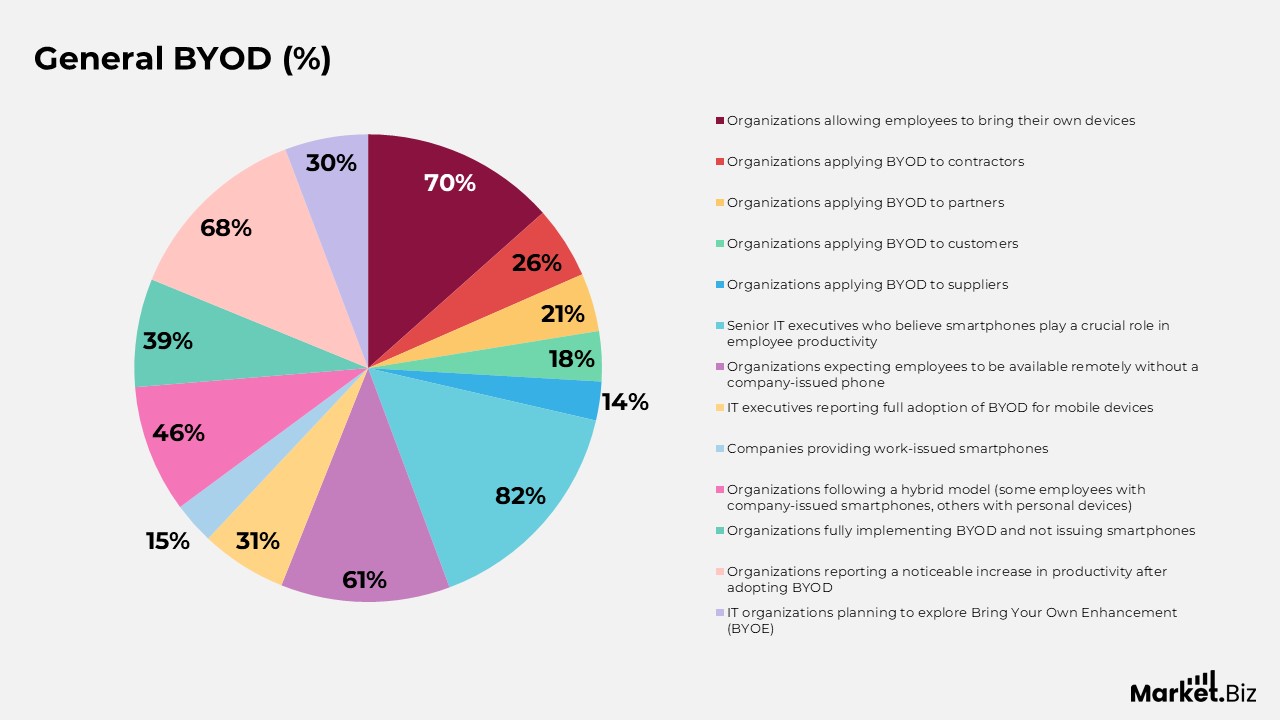
- A survey of 271 cybersecurity professionals revealed that 70% of organizations allow employees to bring their own devices to work.
- BYOD extends beyond employees, with 26% of organizations applying the policy to contractors, 21% to partners, 18% to customers, and 14% to suppliers.
- 82% of senior IT directors have faith that smartphones play a crucial role in employee productivity and enable faster decision-making.
- 61% of organizations expect employees to be available remotely, even if they do not provide a company-issued phone.
- 31% of IT executives report that their organizations have fully embraced BYOD for mobile devices.
- Only 15% of companies currently provide employees with work-issued smartphones.
- 46% of organizations follow a hybrid model, issuing smartphones to some employees while others use their personal devices, while 39% are entirely BYOD and do not issue any smartphones.
- Companies can save up to $341 per employee by switching from company-issued to BYOD smartphones.
- 68% of organisations report a noticeable increase in productivity after adopting BYOD policies.
- 30% of IT organisations plan to explore the concept of Bring Your Own Enhancement (BYOE) shortly.
(Source: Gartner, Samsung, Cybersecurity Insiders, Semrush Inc. )
BYOD (Bring Your Own Device) Security Market Size
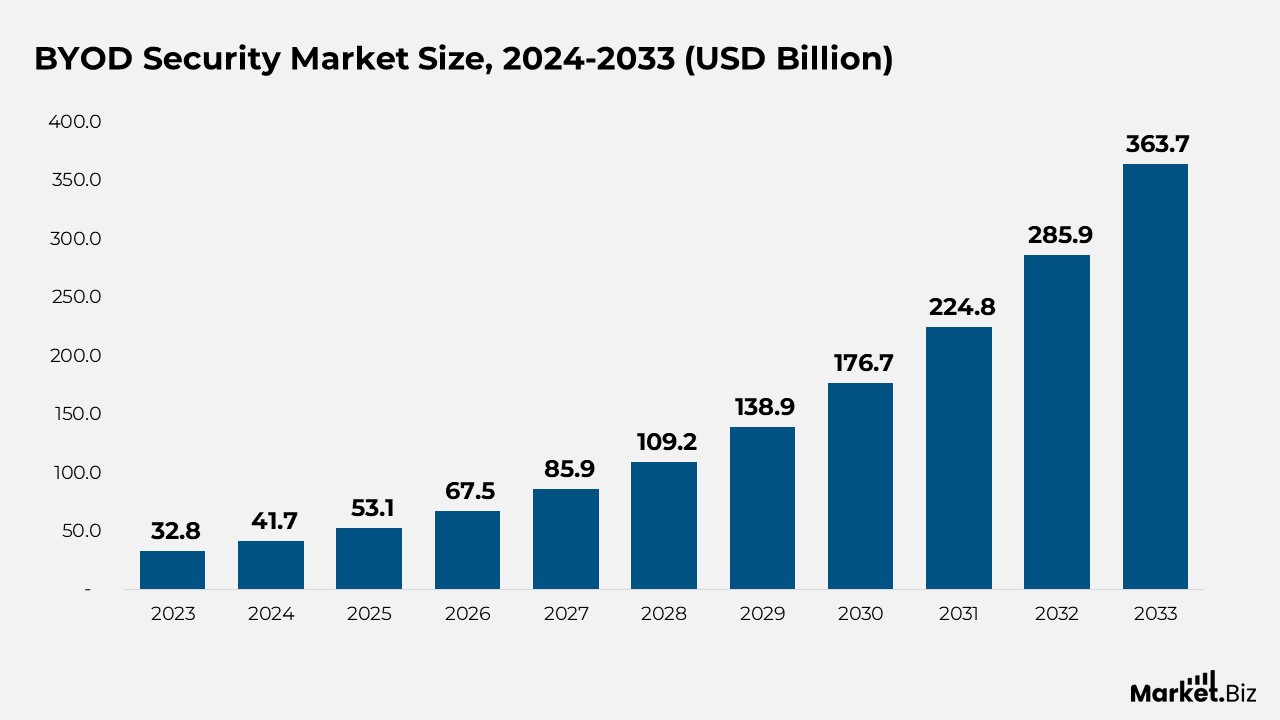
- According to Market.us, the bring your own device security market is expected to rise from $41.7 billion in 2024 to $363.7 billion by 2033, representing a compound annual growth rate (CAGR) of 27.2% from 2024 to 2033.
- The BYOD market growth is driven by the rise of remote work policies, affordable personal devices, and increased efficiency and employee satisfaction, as employees enjoy flexibility and cost savings while using familiar technology.
- In 2023, the laptop segment dominated the BYOD security market with more than 42.5% market share, due to laptops’ versatility in handling complex work tasks and their importance in remote work settings.
- In 2023, the mobile data Security segment held a leading position in BYOD security, capturing over 47.4% market share, as the increasing amount of sensitive data accessed and stored on mobile devices drives the need for enhanced security and compliance.
- In 2023, the large enterprises segment led the BYOD security market with more than 58.3% share, due to the scale of their IT infrastructures, which require robust security measures to manage vast amounts of data across multiple platforms.
- In 2023, North America held the largest share in the BYOD security market, with 36.4% market share and revenues of USD 11.9 billion, attributed to the region’s advanced technological infrastructure, high adoption of mobile technology, and a strong emphasis on cybersecurity.
- The global BYOD market is valued at nearly $100 billion, with 82% of organizations having a BYOD program, as the demand for flexible work solutions and cost-effective strategies continues to drive its adoption.
- 68% of organizations report increased productivity after adopting BYOD policies, with employees benefiting from increased mobility and the ability to work from various locations, leading to better work outcomes.
- Companies can save up to $341 per employee by switching to BYOD with personal smartphones, as the reduced need for employer-provided devices leads to significant cost reductions in hardware and maintenance.
(Source: Market.us)
BYOD (Bring Your Own Device) Market Size
- According to Market.us, the global BYOD (Bring Your Own Device) market is expected to rise from $1,122.9 billion in 2025 to $277.5 billion by 2034, representing a compound annual growth rate (CAGR) of 15% from 2025 to 2034.
- BYOD programs can be implemented through smartphones, tablets, and laptops, with smartphones accounting for over 50% of the overall revenue in 2021. Mobile technology developers have created numerous applications similar to well-known programs like Microsoft Word, Excel, and PowerPoint.
- In 2021, mid-to-large-sized businesses contributed 75% of the revenue share. This is primarily due to enhanced resources and the development of advanced communication networks that offer robust security features. The growth of small businesses is also expected to rise steadily, outpacing the global average.
- North America accounted for more than 28% of the total revenue in the BYOD market in 2021, and the region is expected to maintain its leadership throughout the forecast period. The widespread adoption of remote work policies by companies in the U.S. has significantly boosted BYOD penetration in the region.
- BYOD programs, implemented through smartphones, tablets, and laptops, saw smartphones leading with over 50% of the overall revenue in 2021. This is due to the development of mobile applications that replicate popular software like Microsoft Word, Excel, and PowerPoint.
- Mid-to-large-sized businesses represented 75% of the revenue share in 2021, benefiting from increased resources and the growth of secure communication networks. The small business sector is expected to grow at a faster pace than the global average.
- In 2021, North America’s BYOD market accounted for over 28% of total market revenue, with expectations for continued dominance in the future. The surge in remote work policies across U.S. companies has driven high BYOD adoption in the region.
(Source: Market.us)
BYOD Usage Statistics
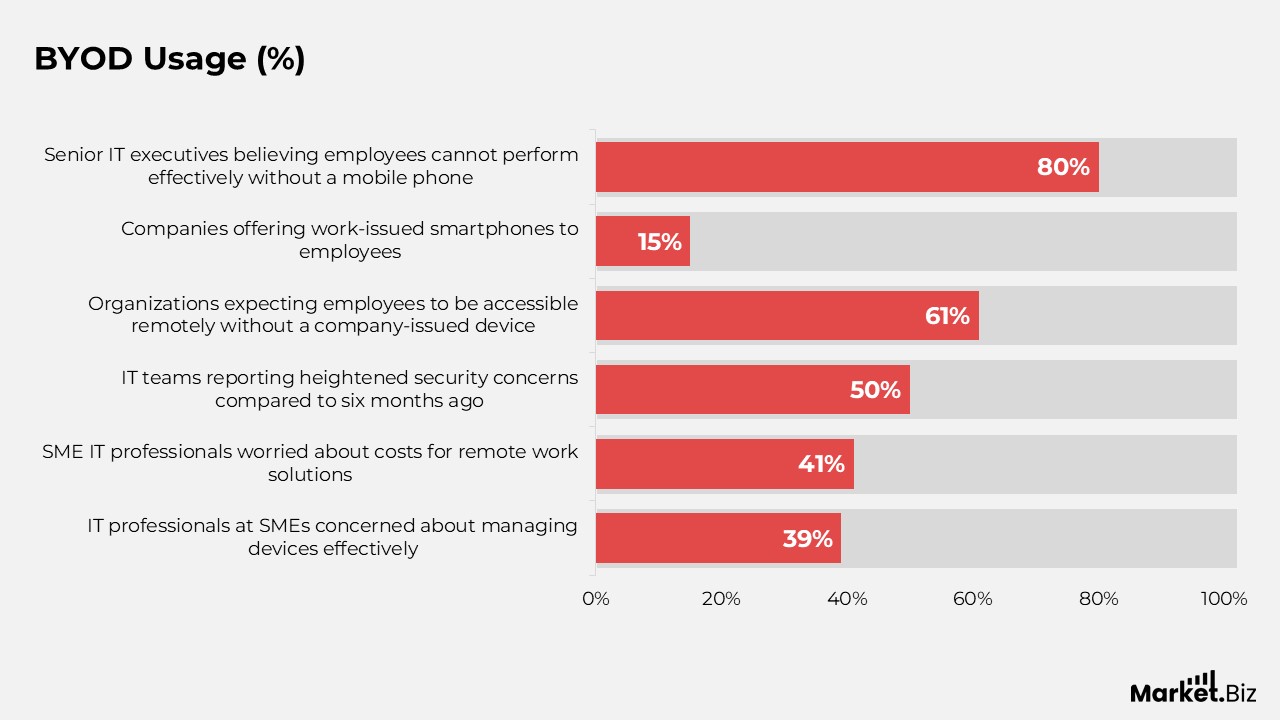
- 39% of IT professionals at small- to medium-sized enterprises (SMEs) express concerns about managing devices effectively.
- 41% of SME IT professionals worry about the costs associated with solutions necessary to support remote work.
- Half of IT teams report heightened concern about their organization’s security posture compared to six months ago.
- 61% of organizations expect employees to be accessible remotely, even if they do not provide a company-issued device for this purpose.
- Only 15% of companies offer employees a work-issued smartphone.
- 80% of senior IT executives believe that employees cannot perform their duties effectively without a mobile phone.
- Organizations that emphasize mobile workflows are more likely to supply devices to their employees.
- Companies that provide devices to over 20% of their workforce tend to have well-developed mobile enablement strategies and report the most value from mobile workflows.
- Businesses can save up to $341 per employee by transitioning from work-issued smartphones to a BYOD policy.
- The average cost to enable BYOD per employee is under $900 annually.
(Source: JumpCloud Inc., Statista)
BYOD Adoption
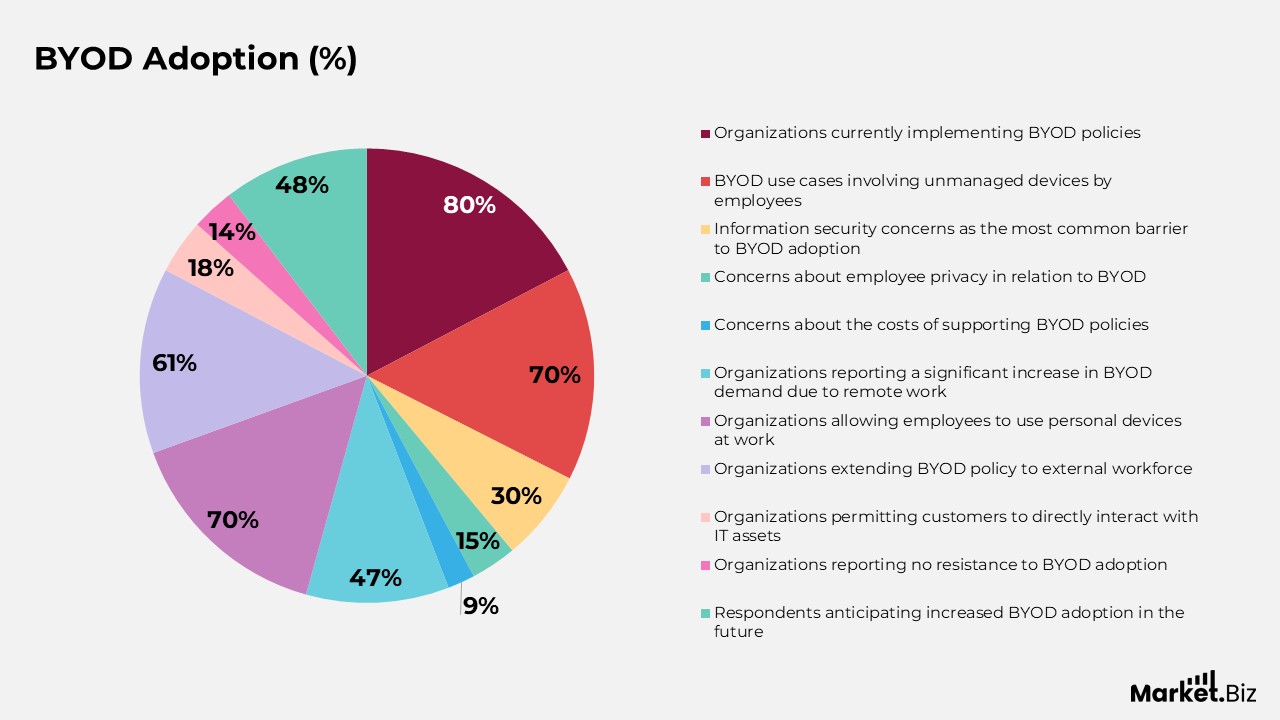
- Over 80% of organizations currently implement BYOD policies.
- 70% of BYOD use cases involve employees bringing unmanaged devices into the workplace, but contractors, business partners, customers, and suppliers are also part of the trend.
- Information security concerns are the most common barrier to BYOD adoption, cited by 30% of respondents.
- 15% of respondents express concerns regarding employee privacy concerning BYOD.
- 9% of respondents are worried about the costs associated with supporting BYOD policies.
- Nearly 47% of organizations report a significant increase in BYOD demand due to the rise of remote work.
- 70% of organizations allow employees to use their personal devices at work.
- 61% of organizations extend the BYOD policy to their external workforce, enabling personal device use for work.
- 18% of organizations permit customers to interact with IT assets directly.
- Only 14% of organizations report no resistance to the adoption of BYOD.
- 48% of respondents anticipate increased BYOD adoption in the future, with nearly half of them expecting it to rise dramatically.
(Source: JumpCloud Inc., Statista)
BYOD Benefits
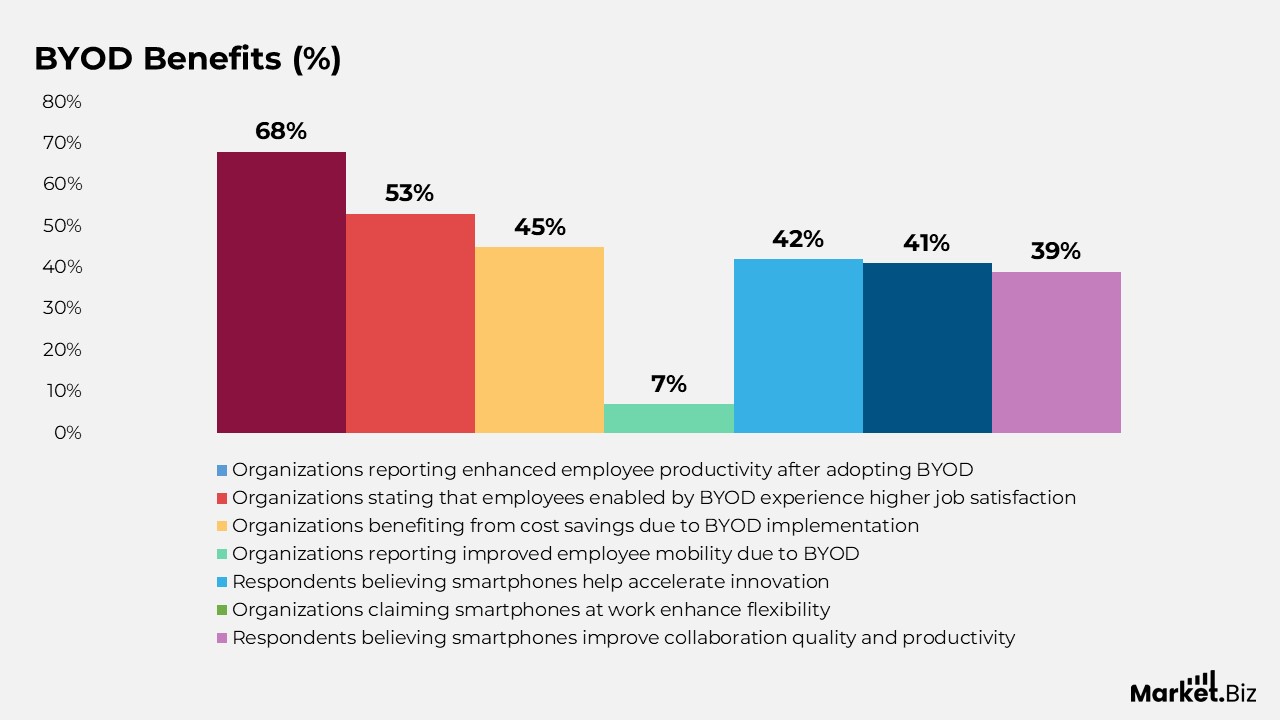
- 68% of organizations report enhanced employee productivity following the adoption of BYOD policies.
- 53% of organizations state that employees enabled by BYOD experience higher job satisfaction.
- 45% of organizations benefit from cost savings thanks to the implementation of BYOD.
- 7% of organizations report that BYOD has improved employee mobility within the company.
- 42% of respondents believe smartphones help accelerate innovation.
- 41% of organizations claim that using smartphones at work enhances flexibility.
- 39% of respondents believe smartphones improve collaboration quality and increase productivity.
- Over a third of respondents say that BYOD policies positively impact employees’ work-life balance.
- Employees gain almost an hour of work time daily by using smartphones to perform tasks.
- This time savings equate to over 240 hours annually, contributing to a 34% increase in efficiency.
(Source: Semrush, JumpCloud Inc., Statista)
Employee BYOD Statistics
- 50.3% of employees are reported to use BYOD (Bring Your Own Device) policies.
- 80% of employees prefer to use separate devices for work and personal purposes.
- 61% of companies expect their employees to be available remotely, even if the company does not provide a work phone.
- Businesses can save over US$300 per employee annually by implementing a mobile BYOD program.
- Only 15% of companies currently provide employees with company-issued smartphones.
- 46% of companies offer smartphones to certain employees, adopting a hybrid model.
(Source: Semrush, Jobera, Statista)
Trends in BYOD
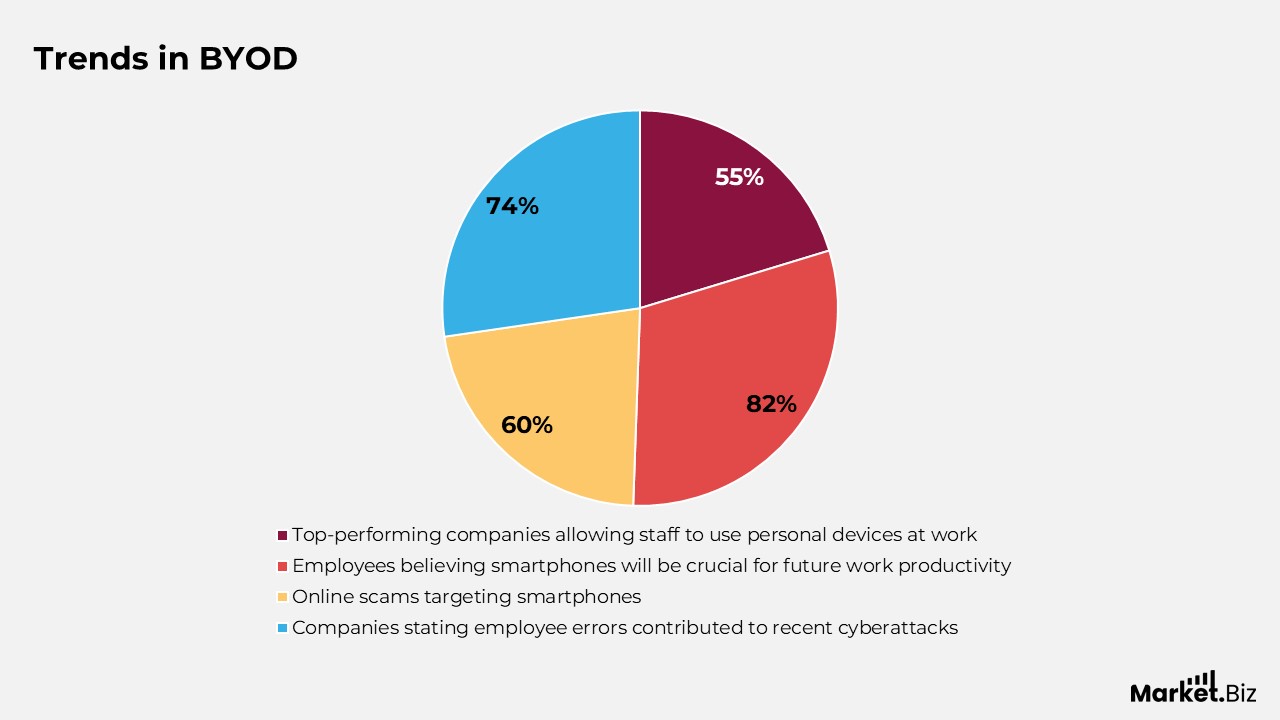
- 55% of top-performing companies already allow staff to use personal devices at work.
- More than half of high-performing businesses, especially those focusing on customer experience, permit employees to use their personal phones or laptops.
- Many organizations have established clear policies and remain aligned with modern workplace trends.
- 82% of employees believe smartphones will be crucial for future work productivity.
- According to IBM, most workers feel that smartphones will significantly enhance their productivity at work.
- Some employees have already started using their smartphones to accomplish more tasks.
- 60% of online scams now target smartphones.
- As smartphone usage increases, so do the threats. Hackers often exploit phones using fraudulent messages or stolen passwords.
- Strong security measures are essential, as people increasingly use their phones for sensitive activities like banking.
- 74% of companies state that employee errors contributed to recent cyberattacks.
- Even with enhanced cybersecurity tools, many businesses continue to struggle due to negligent behavior, especially as more companies adopt BYOD policies.
- Around 86% of businesses acknowledge that their security systems still require improvement, and 57% have recently experienced a cyber incident.
(Source: Kooc Media Ltd., Statista, International Business Machines Corporation)
BYOD Security Concerns
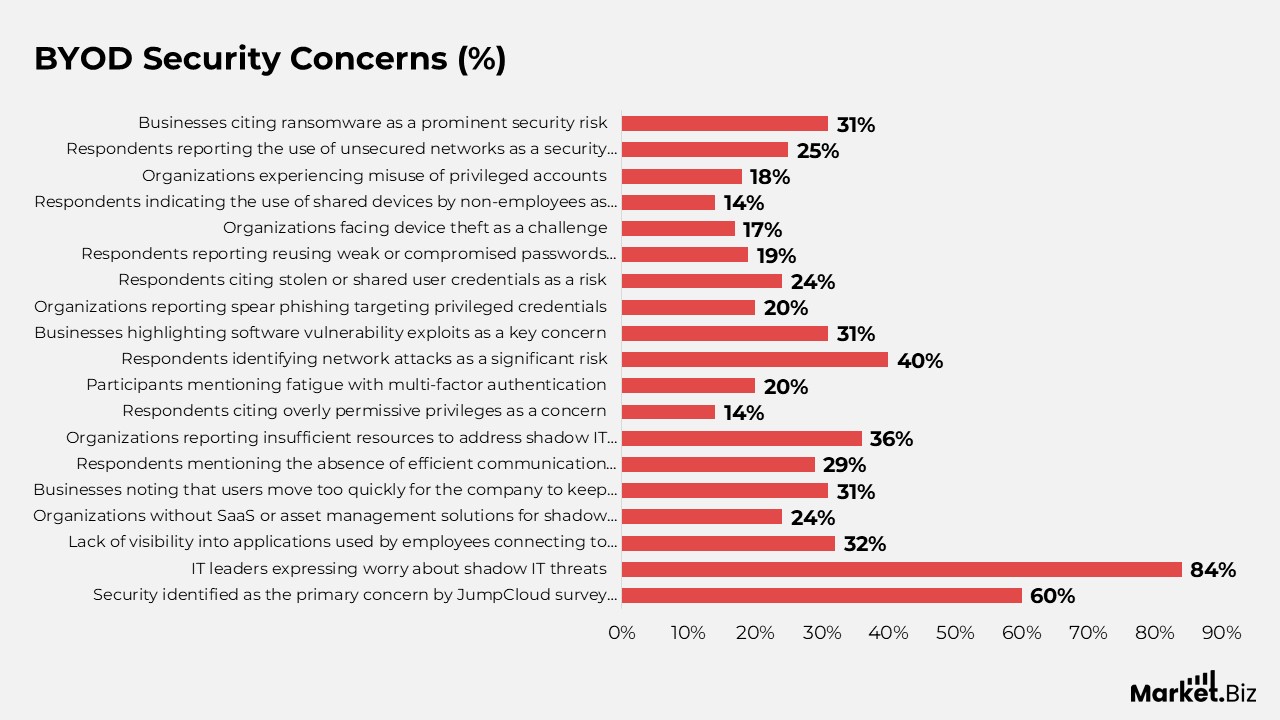
- 60% of JumpCloud survey participants identified security as their primary concern.
- 84% of IT leaders expressed worry about threats related to shadow IT.
- Network attacks, software vulnerabilities, and ransomware were also highlighted as major security issues tied to BYOD (Bring Your Own Device) policies.
- Over 20% of organizations confirmed their digital assets were infected with malware due to unmanaged device connections within the past year.
- Almost half of the respondents were uncertain whether their organizations faced similar issues, suggesting the actual number could be significantly higher.
- A lack of visibility into the applications used by employees connecting to company resources was cited by 32% of respondents.
- 24% of organizations reported the absence of SaaS or asset management solutions to tackle shadow IT concerns.
- 31% of businesses noted that users move too quickly for the company to keep up with their demands.
- 29% of respondents mentioned the absence of efficient communication channels with business partners to establish core policies.
- 36% of organizations reported insufficient resources to address shadow IT threats while also managing other high-priority concerns.
- 14% of respondents cited overly permissive privileges as a major concern.
- 20% of participants mentioned fatigue with multi-factor authentication.
- 40% of respondents identified network attacks as a significant risk.
- 31% of businesses highlighted software vulnerability exploits as a key concern.
- 20% of organizations reported spear phishing targeting privileged credentials.
- 24% of respondents cited stolen or shared user credentials as a risk.
- 19% of respondents reported reusing weak or compromised passwords across multiple applications.
- 17% of organizations faced device theft as a challenge.
- 14% of respondents indicated the use of shared devices by non-employees as a concern.
- 18% of organizations experienced misuse of privileged accounts.
- 25% of respondents reported the use of unsecured networks as a security threat.
- 31% of businesses cited ransomware as a prominent security risk.
(Source: Verizon, JumpCloud Inc., Statista, FinancesOnline, PurpleSec, G2.com, Inc.)
Conclusion
The Bring Your Own Device (BYOD) trend has become a key component of contemporary workplaces, with numerous organizations acknowledging its advantages, such as enhanced productivity, greater job satisfaction, and cost reductions. A notable portion of high-performing companies have already adopted BYOD policies, permitting employees to utilize their personal devices for work, which fosters flexibility and drives innovation.
However, as BYOD adoption increases, so do the associated security risks, including employee errors, cyberattacks, and the need for more robust security protocols. To address these challenges, organizations must implement strong cybersecurity measures, establish clear policies, and maintain continuous oversight to ensure a safe and productive BYOD environment.
As smartphones and personal devices continue to play a pivotal role in enhancing work productivity, safeguarding these devices becomes an imperative.
FAQ’s
BYOD is the practice where employees are allowed to use their personal devices, such as smartphones, tablets, and laptops, for work-related tasks. This policy enables employees to access company resources from their personal devices, providing increased flexibility and productivity.
BYOD offers several advantages, including:
Improved productivity: Employees work more efficiently because they are comfortable with their personal devices.
Cost savings: Companies can reduce expenses by not needing to purchase and maintain devices for employees.
Greater job satisfaction: Employees prefer using devices they are familiar with.
Enhanced flexibility and mobility: BYOD supports remote work and enables employees to access work data from anywhere.
Some common security risks with BYOD include:
Data breaches: Personal devices may not have the same level of security as company-provided devices.
Loss of control: It can be challenging for companies to monitor and control the data employees store and access on their devices.
Malware and phishing attacks: Employees may unknowingly expose company data to malicious software or phishing attempts.
Unsecured networks: Personal devices may connect to unsecured Wi-Fi networks, putting sensitive company data at risk.
Companies can enhance the security of their BYOD setup by: Implementing Mobile Device Management (MDM): MDM tools help monitor and secure personal devices, ensuring compliance with company policies
Establishing clear BYOD guidelines: Outline acceptable use, security protocols, and specific guidelines for personal devices.
Using strong passwords and multi-factor authentication (MFA): These practices help strengthen security and prevent unauthorized access.
Regularly updating devices: Ensure that software and security patches are updated on all devices to protect against vulnerabilities.
Most BYOD policies include smartphones, tablets, laptops, and, in some cases, wearable devices. The devices allowed must meet the company’s security standards and be compatible with its infrastructure.