








Introduction
Buy Now Pay Later Statistics: BNPL services have quickly gained momentum, reshaping both the retail and financial industries. This payment approach enables consumers to buy products and pay in installments, often without interest if settled within a designated period. It has become particularly popular among younger generations, fueled by digitalization and the growing desire for flexible, interest-free payment options.
BNPL providers like Klarna, Affirm, and Afterpay have leveraged the e-commerce boom to offer a smooth and efficient checkout process. As the BNPL market continues to expand, data shows its influence on consumer behavior and financial institutions. However, concerns over rising consumer debt have prompted heightened regulatory attention on the sector.
Editor’s Choice
- 60% of people globally have used BNPL services at least once.
- As of 2022, approximately 360 million people worldwide are active users of BNPL services.
- 66% of BNPL users have expressed concerns regarding the financial risks associated with using these services.
- Over 200 companies currently offer BNPL services across various platforms.
- The number of BNPL users globally is projected to exceed 900 million by 2027.
- 36.8% of Gen-Z consumers have adopted BNPL as a preferred payment method.
- BNPL ranks as the 5th most popular payment method on e-commerce websites.
- 47% of BNPL users report using this payment method frequently.
- PayPal Credit leads the BNPL apps, with 57% of users preferring it.
- 18% of BNPL users in the U.S. have missed at least one payment.
- 16% of individuals aged 18 to 34 are regular users of BNPL services.
- Sweden holds the largest market share in the global BNPL sector.
- Klarna boasts nearly 150 million active users.
- Clothing items are the most frequently purchased through BNPL services.
- Nearly 50% of U.S. citizens express interest in using BNPL services.
General Buy Now Pay Later Statistics
- As of 2022, an estimated 360 million people worldwide are using BNPL services.
- The number of BNPL users is projected to reach 900 million by 2027, reflecting a 157% increase.
- Approximately 1 in 5 BNPL users is based in the U.S.
- Recent data indicates that 60% of people have tried a BNPL service.
- Nearly 46% of individuals are likely making payments through BNPL services at present.
- 66% of people perceive BNPL services as financially risky.
- Gen Z is the largest user group for BNPL, with adoption expected to rise from 36.8% in 2021 to 47.4% by 2025.
- By the end of 2025, 52% of U.S. consumers are expected to have used a BNPL service at least once.
- In the UK, 42% of adults are projected to have used BNPL services by 2025.
- 37% of Australians will use BNPL for online purchases by 2025, marking an 11% year-on-year growth.
- In the U.S., 59% of Gen Z and 58% of Millennials are expected to use BNPL by 2025, with these generations driving its growth.
- 47.4% of BNPL users in 2025 will be from Gen Z, while 40.6% will be Millennials, showing their dominant role in the user base.
- The average BNPL purchase in 2025 will be around $142, with some platforms offering longer payment terms for higher-value items.
- 58% of BNPL users rely on it to afford items they otherwise couldn’t purchase.
- Almost 53% of individuals who haven’t used BNPL are planning to try it within the next year.
- Retailers offering BNPL options reported a 30% increase in sales volume by the end of 2022.
(Source: Statista, DemandSage, Semrush Inc., Coin Law, Motley Fool Money, ChargeAfter)
Buy Now Pay Later Market Size
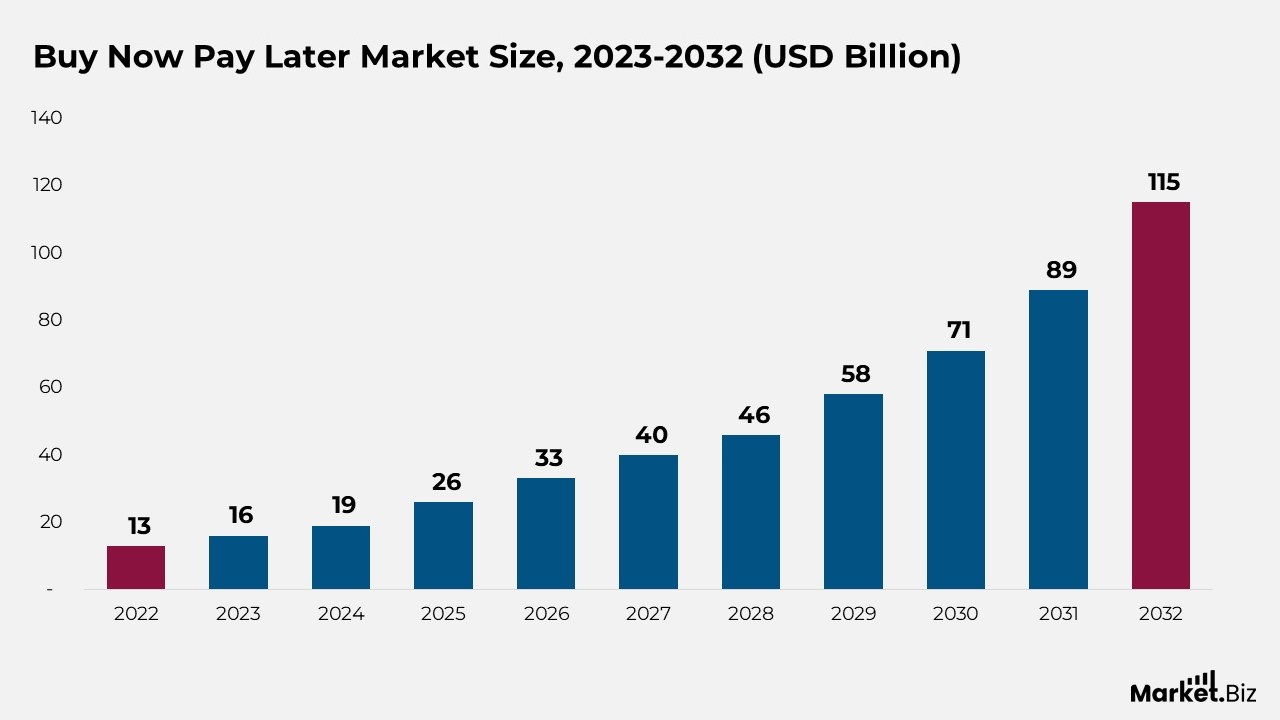
- According to Market.us, the buy now pay later market is expected to rise from $16 billion in 2023 to $115 billion by 2032, representing a compound annual growth rate (CAGR) of 25.3% from 2023 to 2032.
- The BNPL market growth is driven by increasing demand for flexible payments, e-commerce adoption, and interest-free installment plans, especially among younger consumers like millennials and Generation Z.
- In 2022, the online segment led the BNPL market with a 62% share, fueled by the rise of e-commerce and online shopping convenience.
- In 2022, large enterprises held a dominant 61% share in the BNPL market, supported by their financial resources and large customer bases.
- In 2022, the retail segment captured 71.3% of the BNPL market, reflecting the alignment between retail shopping and BNPL services.
- North America dominated the BNPL market in 2022, holding a 32% share with revenues of approximately USD 4.6 billion, thanks to high e-commerce penetration and digital payment infrastructure.
- According to a February 2023 survey by Forbes Advisor, only 9% of Americans used cash for shopping, showing a significant decline in cash transactions.
- A substantial 54% of shoppers now primarily use debit and credit cards for purchases, highlighting the shift to digital payments.
- Data from Adobe Analytics during the 2023 Amazon Prime Day Sale revealed a 20% increase in consumer preference for BNPL options compared to the previous year, indicating growing interest in flexible payment methods.
(Source: Market.us)
BNPL Fraud Prevention Market Size
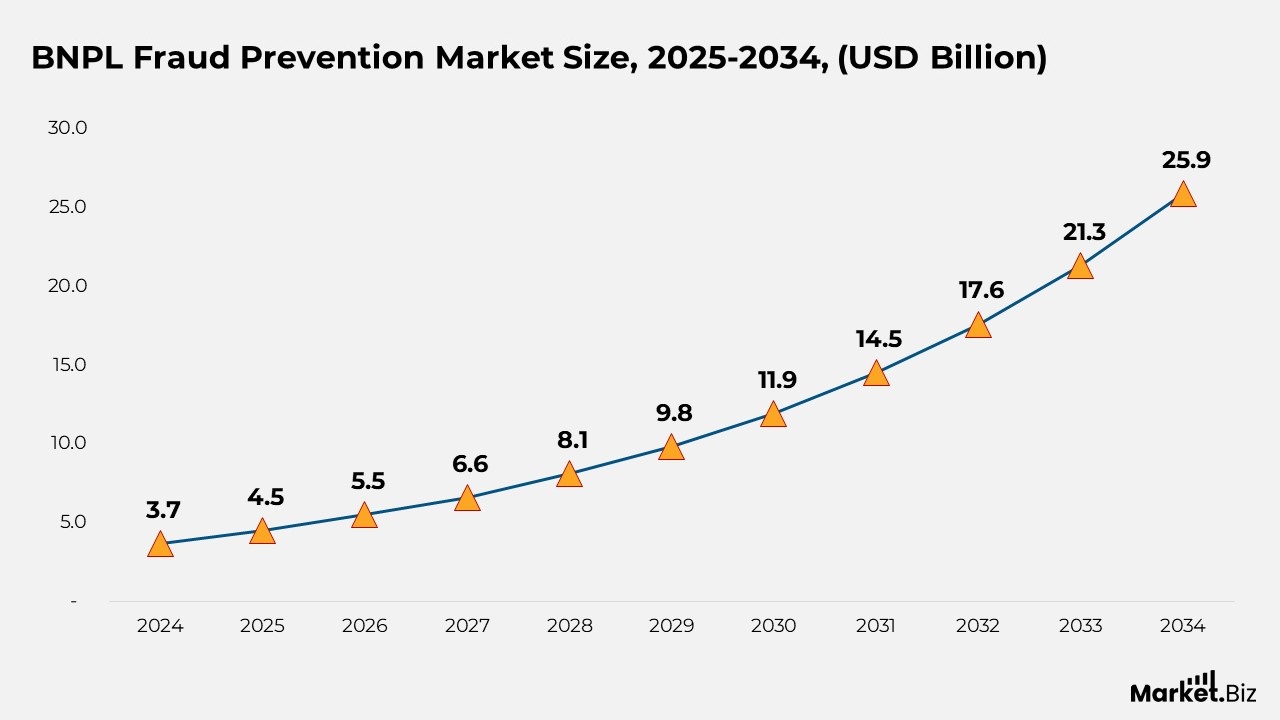
- According to Market.us, the BNPLFP market is expected to rise from $4.5 billion in 2025 to $25.9 billion by 2034, representing a compound annual growth rate (CAGR) of 21.5% from 2025 to 2034.
- The BNPL fraud prevention market is driven by the global adoption of BNPL services, increased online shopping, growing consumer interest in BNPL financing, and rising concerns over digital fraud.
- In 2024, the solutions segment managed the BNPL fraud prevention market with a 70.5% share, encompassing technologies like identity verification, transaction monitoring, and AI-driven fraud prevention tools.
- In 2024, the on-premise deployment segment captured 57.3% of the market share, favored by large enterprises and financial institutions seeking greater control over data and security.
- In 2024, the new account abuse segment dominated the market with a 28.8% share, driven by the surge in online retail and financial services, which often serve as entry points for fraudulent activities.
- In 2024, North America held 40.6% of the BNPL fraud prevention market with revenues of approximately USD 1.5 billion, fueled by advanced financial infrastructure and rapid tech adoption.
- In 2024, the U.S. BNPLFP market was estimated at USD 1.20 billion, with a projected CAGR of 19.4%, driven by rising consumer demand for flexible payment options.
- With 55.8% of Americans using BNPL services, about 181 million individuals are at risk, especially due to 45% of users reusing passwords across multiple platforms.
- BNPL fraud is on the rise, with 23% of U.S. consumers experiencing application fraud in 2021, where their data was subjected to open fraudulent BNPL accounts.
- 45% of BNPL users admit to using the same login credentials across different accounts, making it easier for fraudsters to hijack identities and create fake profiles.
- 22% of consumers innocently signed up for fraudulent BNPL accounts, and 20% experienced account takeovers.
(Source: Market.us)
Buy Now Pay Later Users
- A 2022 study found that over 360 million people worldwide used BNPL as a payment option.
- The number of BNPL users is expected to grow by 157%, reaching 900 million globally by 2027.
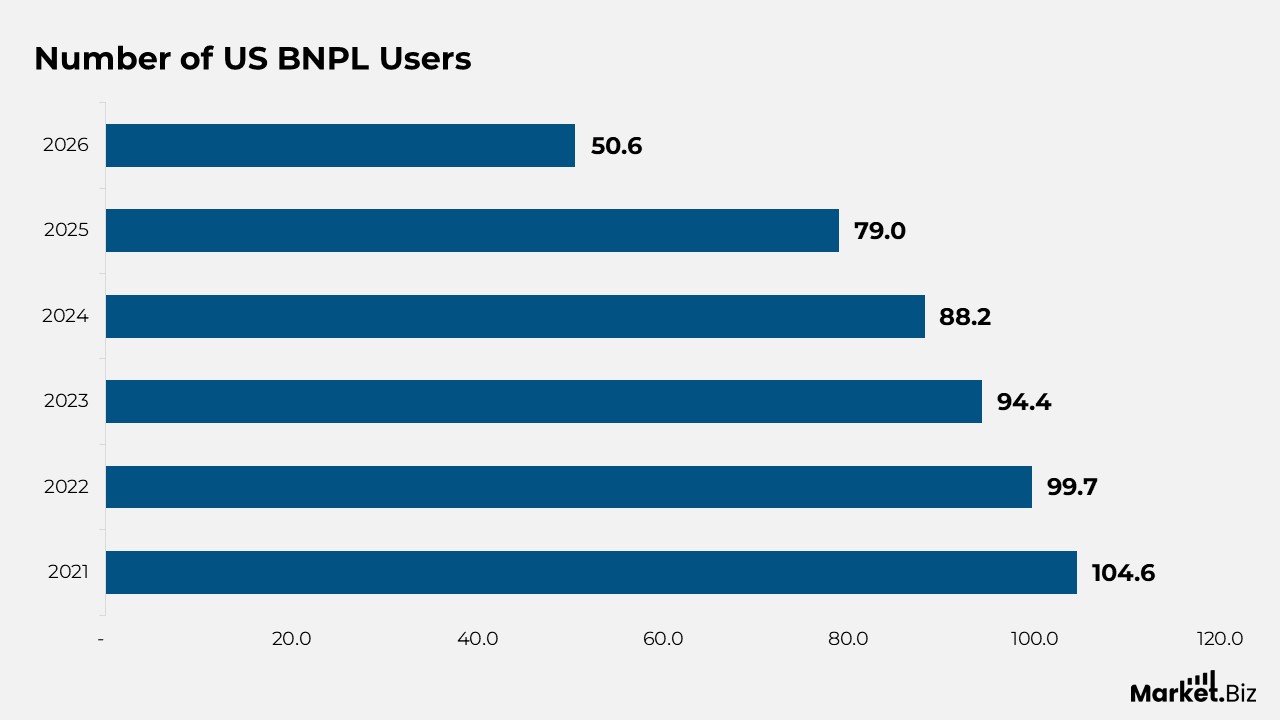
- In the U.S., BNPL users numbered 88.2 million in 2023, with projections showing a 7.1% year-on-year growth, reaching 94.4 million users.
- These users are anticipated to spend approximately $81 billion on goods and services using BNPL in 2023.
- By the end of 2026, the number of BNPL users in the U.S. is expected to reach 105 million.
- The rise in BNPL adoption is primarily driven by the flexibility it offers and growing awareness among consumers in the U.S.
- By 2026, the number of BNPL users in the U.S. is projected to reach 104.6 million, reflecting a 4.9% increase.
- In 2025, the U.S. BNPL user base is expected to grow to 99.7 million, marking a 5.6% rise.
- By the end of 2024, BNPL users in the U.S. are anticipated to total 94.4 million, indicating a 7.1% growth.
- In 2023, there were 88.2 million U.S. BNPL users, showing an 11.7% increase.
- In 2022, the U.S. had 79 million BNPL users, representing a 56.1% growth.
- In 2021, the U.S. BNPL user base was 50.6 million, demonstrating a remarkable 102.3% year-on-year growth.
(Source: Statista, DemandSage, Insider Intelligence)
Buy Now Pay Later Usage Statistics
- About 1 in 3 of BNPL users take advantage of the service every month.
- 29% of BNPL users regularly use the service, with at least one transaction each month.
- A total of 80% of BNPL users access the service a minimum of once every six months.
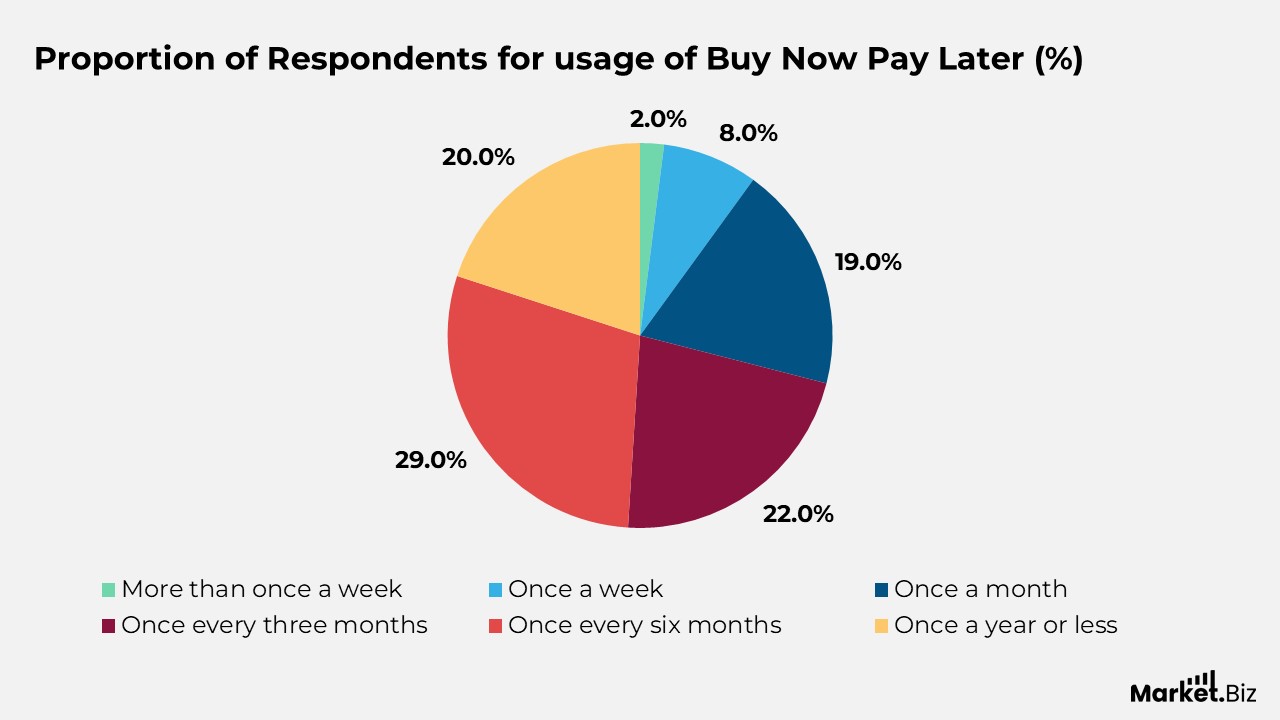
- 2% of respondents use BNPL more than once per week.
- 8% of users make BNPL transactions weekly.
- 19% of BNPL users engage with the service monthly.
- 22% of respondents utilize BNPL every three months.
- 29% of consumers use BNPL once every six months.
- 20% of users make BNPL purchases only once a year or less.
(Source: Statista, DemandSage, C+R Research)
Consumer Preferences – BNPL vs. Credit Cards vs. Debit Cards
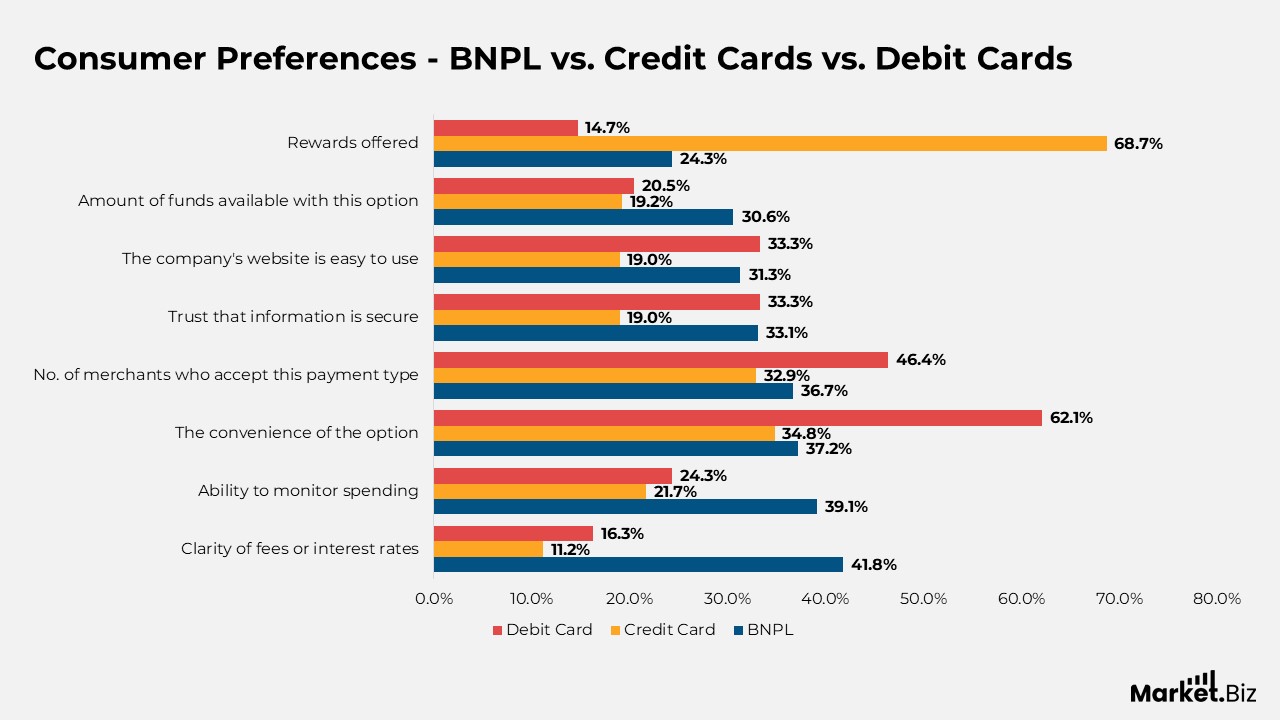
- 41.8% of BNPL users appreciate the clarity of fees or interest rates, compared to 11.2% for credit card users and 16.3% for debit card users.
- 39.1% of BNPL users value the ability to monitor spending, while 21.7% of credit card users and 24.3% of debit card users prioritize this feature.
- 37.2% of BNPL users find the convenience of the option appealing, whereas 34.8% of credit card users and 62.1% of debit card users focus on convenience.
- 36.7% of BNPL users are attracted by the number of merchants accepting this payment type, in comparison to 32.9% for credit card users and 46.4% for debit card users.
- 33.1% of BNPL users trust that their information is secure, while 19% of credit card users and 33.3% of debit card users share the same confidence.
- 31.3% of BNPL users appreciate that the company’s website is easy to navigate, compared to 19% for credit card users and 33.3% for debit card users.
- 30.6% of BNPL users are satisfied with the amount of funds available, while 19.2% of credit card users and 20.5% of debit card users agree.
- 24.3% of BNPL users value the rewards offered, while a significant 68.7% of credit card users and 14.7% of debit card users prioritize rewards.
(Source: Statista, DemandSage)
Which Products Are Most Frequently Bought with BNPL?
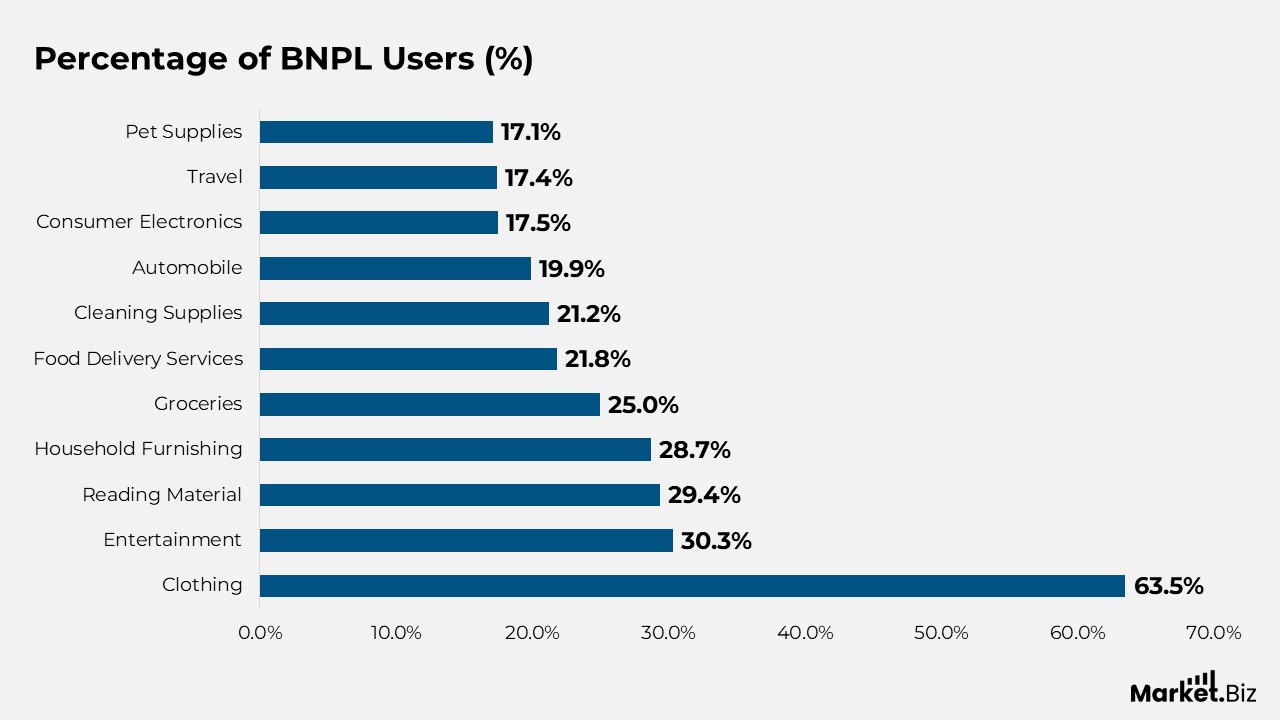
- Clothing tops the list, with 63.5% of BNPL users purchasing apparel.
- Entertainment ranks second, with 30.3% of BNPL users choosing this category.
- Reading material is a popular BNPL category, representing 29.4% of purchases.
- Household furnishings make up 28.7% of BNPL spending.
- Groceries account for 25% of BNPL transactions.
- Food delivery services are used by 21.8% of BNPL users.
- Cleaning supplies contribute to 21.2% of BNPL purchases.
- Automobiles make up 19.9% of transactions using BNPL.
- Consumer electronics are bought by 17.5% of BNPL users.
- Travel accounts for 17.4% of BNPL spending.
- Pet supplies make up 17.1% of BNPL purchases.
(Source: Statista, DemandSage, Semrush Inc.)
How Frequently Consumers Use BNPL for Online Shopping?
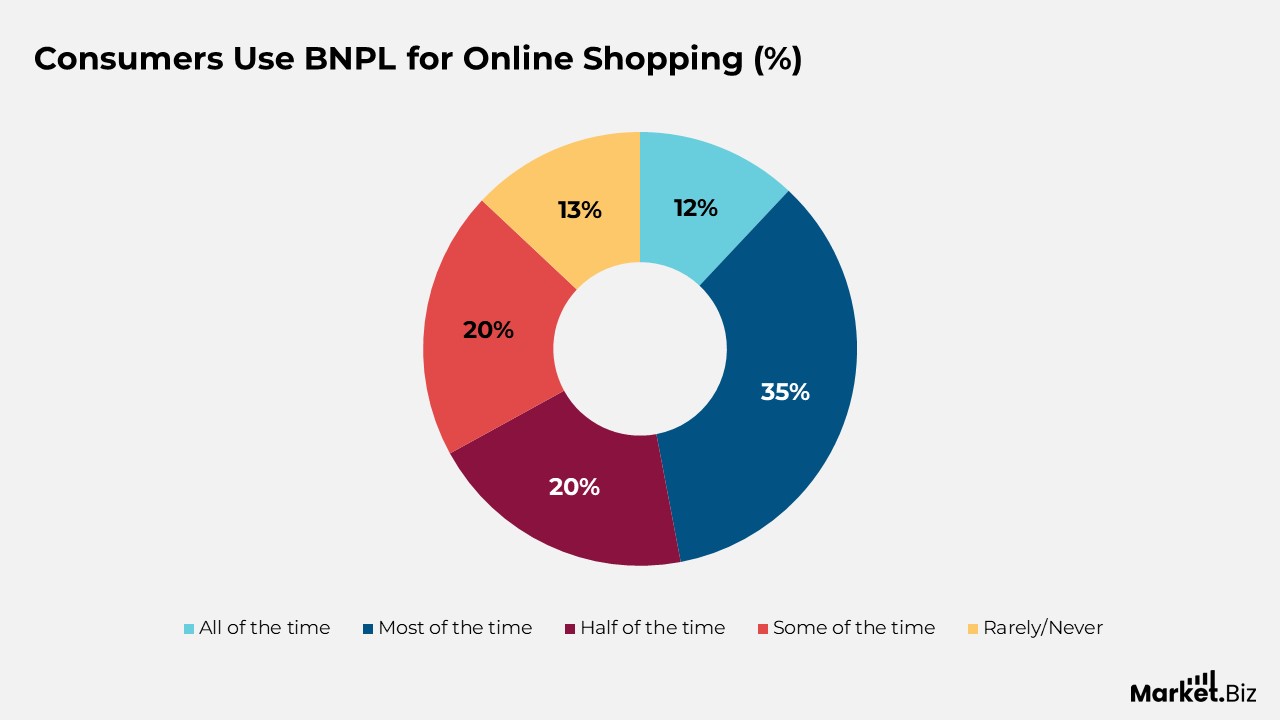
- 12% of consumers always use BNPL when shopping online.
- 35% of consumers frequently use BNPL for online purchases.
- 20% of consumers use BNPL about half of the time during online shopping.
- 20% of consumers occasionally use BNPL for online purchases.
- 13% of consumers seldom or never use BNPL when shopping online.
(Source: Semrush Inc., DemandSage)
Reasons for Consumers to Prefer Buy Now Pay Later (BNPL) Services
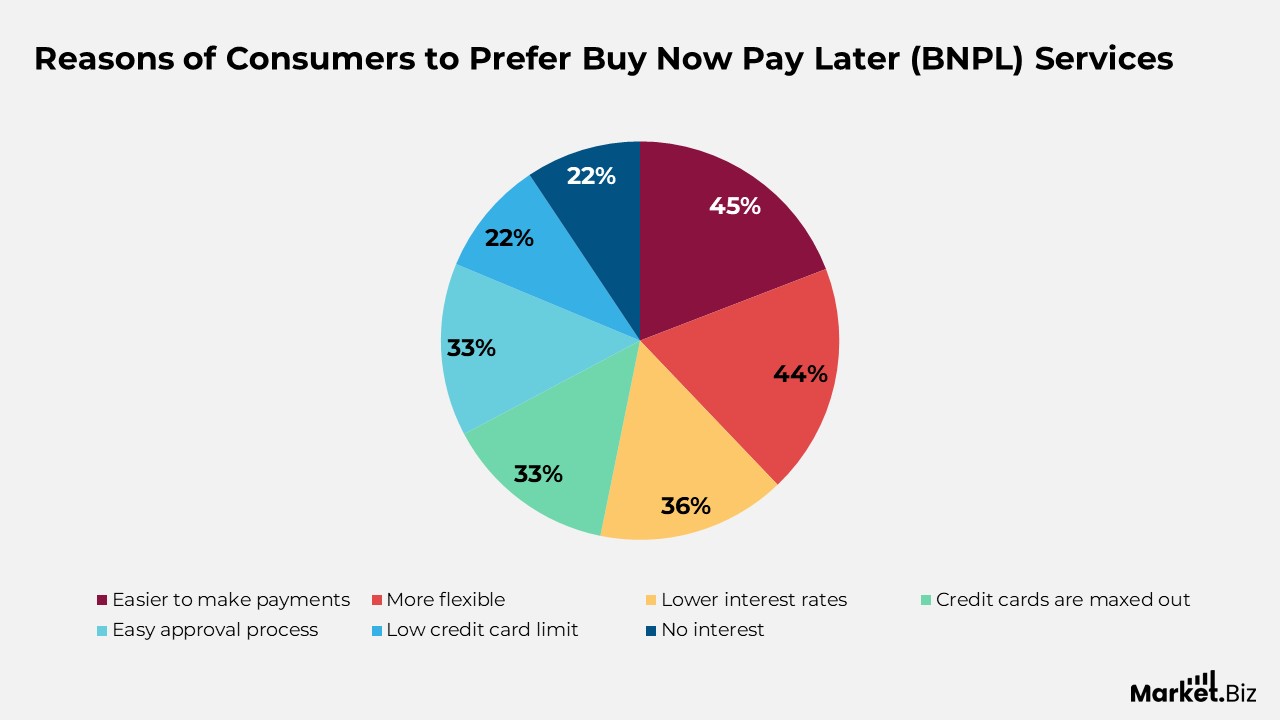
- 45% of users prefer BNPL as it simplifies the payment process.
- 44% of users select BNPL for its enhanced flexibility.
- 36% of users choose BNPL because of its lower interest rates.
- 33% of users turn to BNPL when their credit cards are maxed out.
- 33% of users appreciate BNPL for its straightforward approval process.
- 22% of users use BNPL due to having a low credit card limit.
- 22% of users favor BNPL because it offers interest-free payments.
(Source: Semrush Inc., Statista, C+R Research)
BNPL Spending Patterns
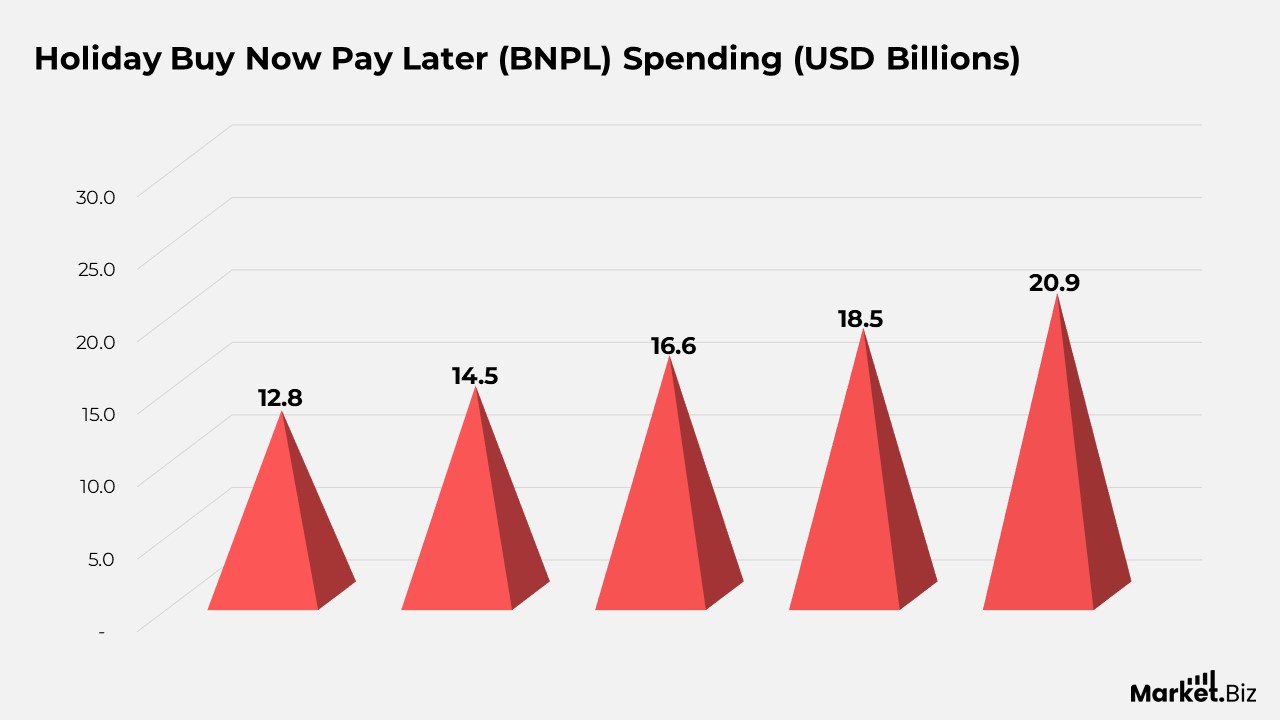
- 48% of shoppers aged 25 to 34 have used BNPL to purchase home appliances, which is 29.7% higher than the overall average across all age groups.
- 30% of BNPL purchases are for electronics, making it the second maximum common category for BNPL spending.
- 62% of 18 to 24-year-olds purchasing consumer electronics have used BNPL for video game console purchases.
- BNPL usage for everyday purchases like gas, groceries, and utilities reached $229.2 million in 2021, marking a 434% increase from 2020.
- In 2019, apparel and beauty products accounted for 80.1% of BNPL payments, but by 2021, this had dropped to 58.6%.
- Globally, 73% of BNPL revenue comes from retail.
- BNPL usage for retail purchases is expected to grow by 26.1% annually through 2030.
(Source: Adopbe, Federal Reserve Bank of New York, Capital One Shopping, Statista, C+R Research)
Most Popular BNPL Platforms Among Consumers
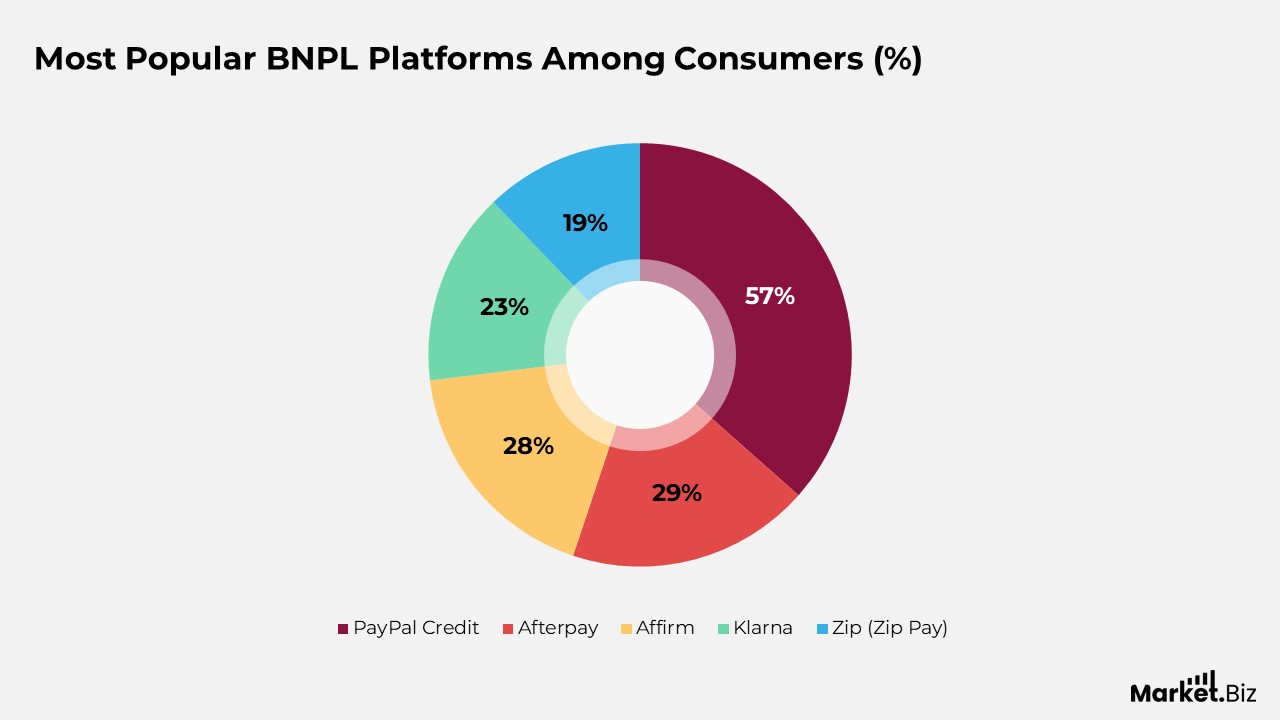
- 57% of consumers rely on PayPal Credit for BNPL transactions.
- 29% of consumers choose Afterpay for their BNPL purchases.
- 28% of consumers prefer Affirm as their BNPL platform.
- 23% of consumers utilize Klarna for their Buy Now Pay Later needs.
- 19% of consumers select Zip (Zip Pay) as their BNPL provider.
(Source: Bankrate, LLC, C+R Research)
Demographics of Buy Now Pay Later
Age
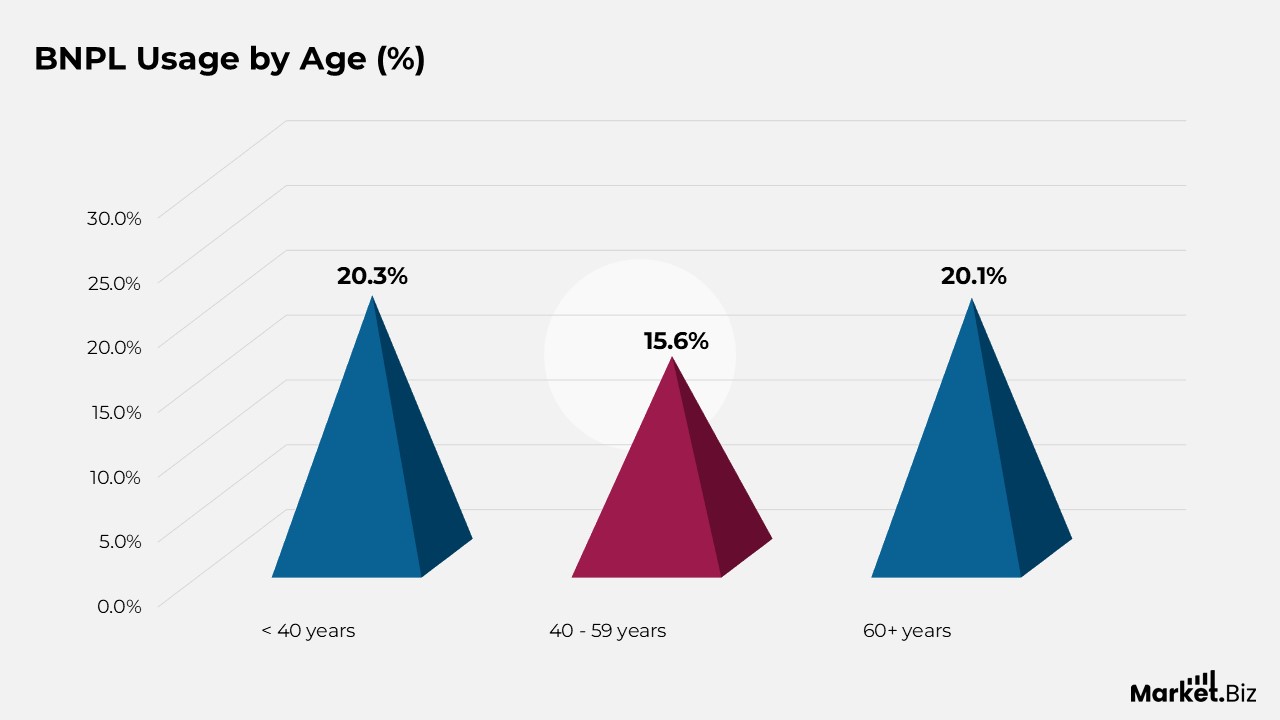
- 20.3% of people under the age of 40 use BNPL services.
- The usage rate decreases to 15.6% for individuals aged 40 to 59.
- 20.1% of consumers aged 60 and older take advantage of BNPL services.
(Source: Federal Reserve Bank of New York, Evolution Finance, Inc.)
Gender
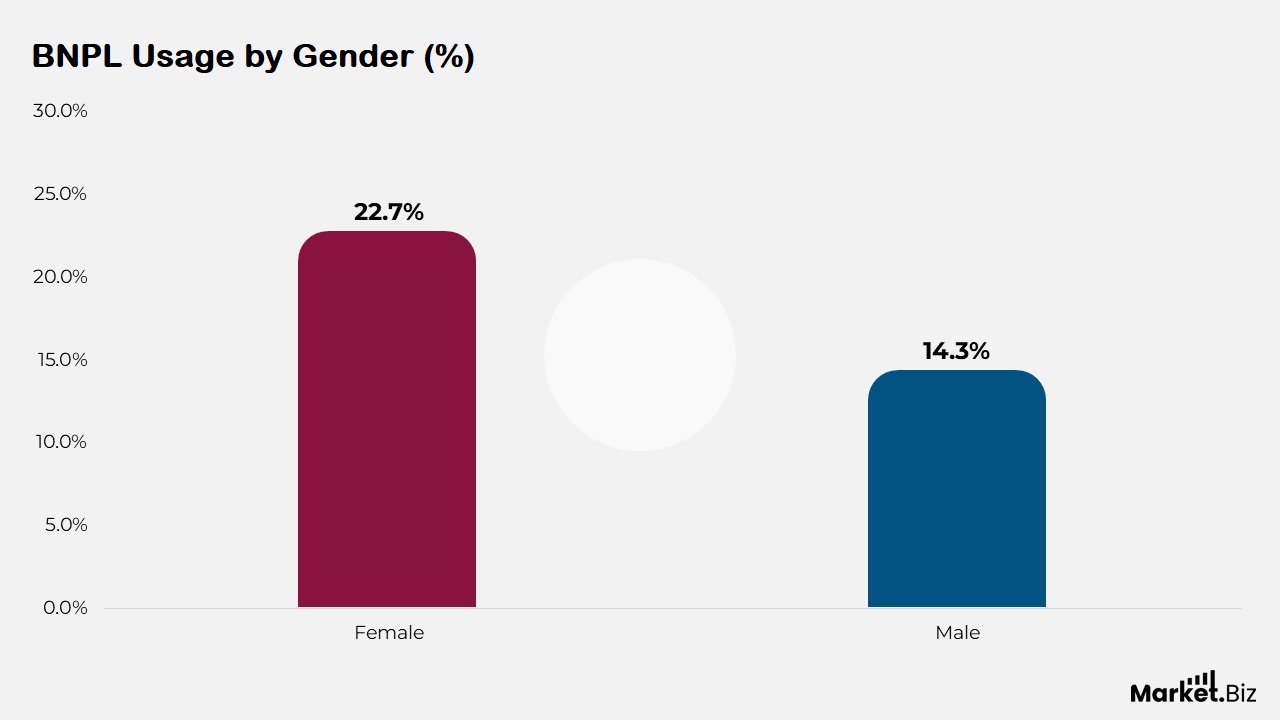
(Source: Federal Reserve Bank of New York, Evolution Finance, Inc.)
Credit Score
- 42.5% of individuals report a credit score under 620.
- 23.8% fall in the 620-719 score range.
- 14.2% have a credit score between 720 and 760.
- 11.6% possess a credit score above 760.
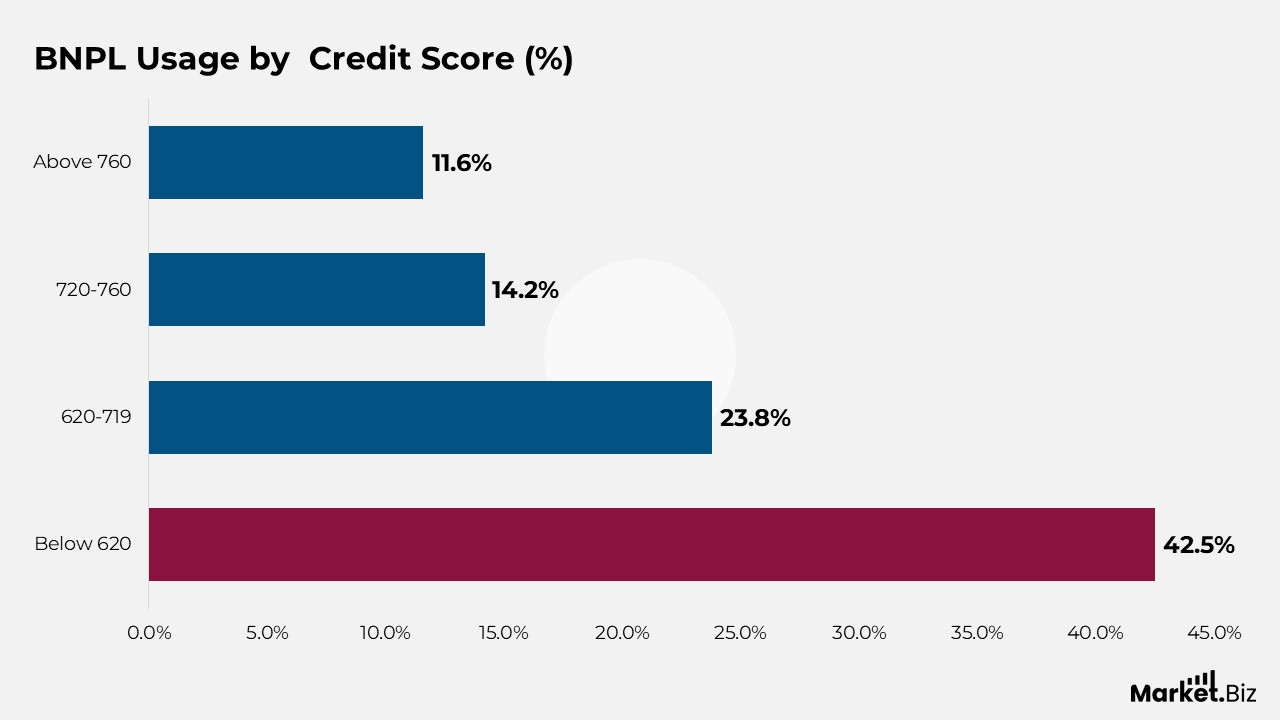
(Source: Federal Reserve Bank of New York, Evolution Finance, Inc.)
Challenges Faced by Buy-Now-Pay-Later Services
- 66% of Buy Now, Pay Later (BNPL) users are concerned about its financial risks.
- One major issue is that BNPL purchases often don’t appear on credit reports, making it difficult to track total debt and potentially leading to overspending and financial troubles. This highlights the need for better awareness of responsible borrowing.
- 34% of Americans who spend on BNPL have missed at minimum one payment, which can result in late fees and harm their credit scores.
- The delayed payment nature of BNPL encourages many shoppers, particularly younger ones, to spend beyond their means, increasing their risk of accumulating debt.
- The BNPL market is highly competitive, with over 200 companies offering BNPL services worldwide.
- Major players like Apple and JPMorgan Chase have entered the BNPL market, leveraging their strong financial backing and customer networks, making it more challenging for smaller companies to survive. According to Moody’s, many smaller BNPL providers may need to merge, sell, or shut down due to the intense competition.
- Retailers that accept BNPL payments could soon face merchant fees ranging from 2% to 8% per transaction.
- If these fees continue to rise, fewer businesses may be inclined to offer BNPL, potentially slowing industry growth and creating difficulties for BNPL providers to remain in operation.
(Source: superteamhq.com, Coolest Gadgets, Kooc Media Ltd.)
Conclusion
The Buy Now Pay Later (BNPL) market is rapidly expanding, with strong adoption driven primarily by younger generations like Millennials and Gen Z.
The growing popularity of BNPL is largely due to the flexibility it provides, allowing consumers to manage larger purchases more easily. While BNPL offers convenience and increased purchasing power, concerns about its financial risks persist, as many consumers perceive it as a potentially risky payment option.
Moreover, a large number of people have embraced BNPL, with many continuing to use it for regular payments. Retailers have also benefited from offering BNPL services, seeing increased sales driven by consumer demand for flexible payment methods.
As the BNPL market continues to grow, addressing challenges such as fraud prevention and financial education will be essential to ensuring its long-term success and sustainability.
FAQ’s
Buy Now Pay Later (BNPL) is a payment option that allows consumers to purchase goods or services and pay for them in installments, often without interest if paid within a specified period. It’s a popular choice among younger consumers, offering an easy way to manage larger purchases without immediate full payment.
Gen Z and Millennials are the key user groups for BNPL services. Gen Z, in particular, shows high adoption rates, and they are expected to remain a major driver of growth in the BNPL market. Millennials also play a significant role in this trend.
While BNPL offers flexibility, it also poses financial risks, especially if payments aren’t managed well. Many consumers worry about overspending and accumulating debt. According to studies, 66% of BNPL users consider it financially risky, particularly when payments are missed or budgets aren’t carefully planned.
Around 58% of BNPL users rely on the service to afford items that they might not be able to purchase outright. This highlights the role of BNPL in helping consumers manage their finances and make larger purchases more accessible.