








Introduction
Dark Web Statistics: In recent years, the dark web has gained increasing prominence, drawing attention from security professionals and the public alike. Operating beneath the surface web, the dark web offers users anonymity and privacy, but it also serves as a hub for illegal activities such as cybercrime, drug trafficking, and data breaches.
Dark web statistics provide valuable insights into its growth, user demographics, and the shifting nature of its use, encompassing both legitimate and illicit activities. These figures underscore the risks and opportunities associated with the dark web’s rise, prompting law enforcement and businesses to take proactive steps to monitor and reduce its threats.
Gaining an understanding of these statistics is essential for addressing the challenges posed by the dark web and formulating strategies to mitigate its potential risks.
Editor’s Choice
- The deep web and dark web together make up 96% of the internet, with the dark web accounting for a smaller portion of this vast segment compared to the deep web.
- In 2023, the dark web saw an average of 2.5 million daily visitors, with this number steadily increasing to 2.7 million daily users by April 2023.
- Germany overtook the United States in 2023 to become the leading country in terms of daily Tor users, with the U.S. now ranked second, followed by Finland, India, and Russia.
- As of 2020, nearly 57% of the content on the dark web is illegal, covering areas such as violence, extremist platforms, illegal marketplaces, drugs, and cybercrime forums.
- The dark web’s most valuable illegal digital products for sale in April 2023 include cryptocurrency accounts, online banking information, and e-wallets.
- The U.S. remains at the top of the global rankings for data breach costs, averaging $9.44 million per breach.
- In April 2023, cybercriminals could purchase the details of a credit card with a $5,000 balance for as little as $110.
Moreover
- DDoS and malware attacks continue to thrive on the dark web, with the cost of purchasing 1,000 threatinstalls priced at $1,800.
- In 2023, the dark web made up 6% of the total global internet space.
- The average cost of a direct buyer-seller drug transaction on the darknet was $8,441 in 2021.
- Bitcoin was the most widely used currency on the darknet in 2021.
- In 2022, valid U.S. credit card information was available for as low as $17 on the darknet.
- 90% of users on hacking forums were seeking to purchase hacking services.
- The Hidden Wiki remained one of the most popular search engines on the darknet in 2022.
- In 2022, Darknet hackers exposed social security data from the Washington licensing system.
- Ransomware and cryptocurrency-related crimes on the dark web experienced a surge of nearly $176 million in 2023, compared to the previous year.
- Global cyberattacks increased by 38% in 2022 compared to 2021, reflecting a sharp rise in cybercriminal activity.
General Dark Web Statistics
- The hidden web is estimated to be 400 times larger than the surface web we access daily.
- The Dark Web represents only a small portion of the entire dark net.
- While the precise size of the Dark Web remains unclear, it is estimated to account for around 5% of the internet.
- Reports indicate that 28% of the BRICS countries are used to the dark net.
- 56.8% of the content on the dark net is illegal, according to dark Web statistics.
- On the dark web, 1,000 premium-quality malware attacks are priced at $5,000.
- Phishing remains one of the most popular methods used to steal financial data on the dark web.
- The technology industry has the highest volume of exposed credentials on the internet.
- The United States accounts for 60% of the weapon sales on the dark web, with Europe following at 25%.
- The top 60 websites on the internet are over 750 TB in size.
- Around 70% of the requests on the Dark Web are related to individuals seeking contact with criminals.
Moreover
- As of 2022, over 1.2 million payment card details were leaked onto the Dark Web.
- Leading eCommerce platforms like Zalando and Mercado Libre were found mentioned on the deep web, with around 1,000 mentions as of December 2022.
- By 2022, 52% of U.S. companies had implemented a dark web threat intelligence policy.
- As of June 2022, e-wallets and verified cryptocurrency accounts were among the most expensive illegal digital goods available on the dark web.
- In the U.S., the most challenging data to collect from the dark web in 2022 included strategic intelligence, followed by operational and tactical intelligence.
- 65% of active cybercriminals leverage dark web data to execute cyberattacks, according to dark web statistics.
- 80% of email data has been leaked onto the dark web.
- Demographic statistics for the dark web reveal that male users significantly outnumber female users.
- 78% of global users rely on commercial threat intelligence as their primary source of threat information.
- As of 2022, around 4,000 domains were found on the dark web impersonating Amazon or Alibaba.
(Source: Statista, Tulane University, Enterprise Apps Today, Eftsure, Graphus)
Categories of Dark Web Users
- Whistleblowers
- Drug Traffickers
- Cybercriminals
- Doxxers
- Insider Threats
- Threat Intelligence Analysts
- Hacktivists
- Users with Unlawful Sexual Intent
- State-Sponsored Actors
- Cyberbullies
- Cyberterrorists
- Activists and Protesters
- Corporations
- Journalists Grassroots Organizers
- Script Kiddies and Other Hackers
(Source: Gen Digital Inc.)
Dark Web Intelligence Market Size
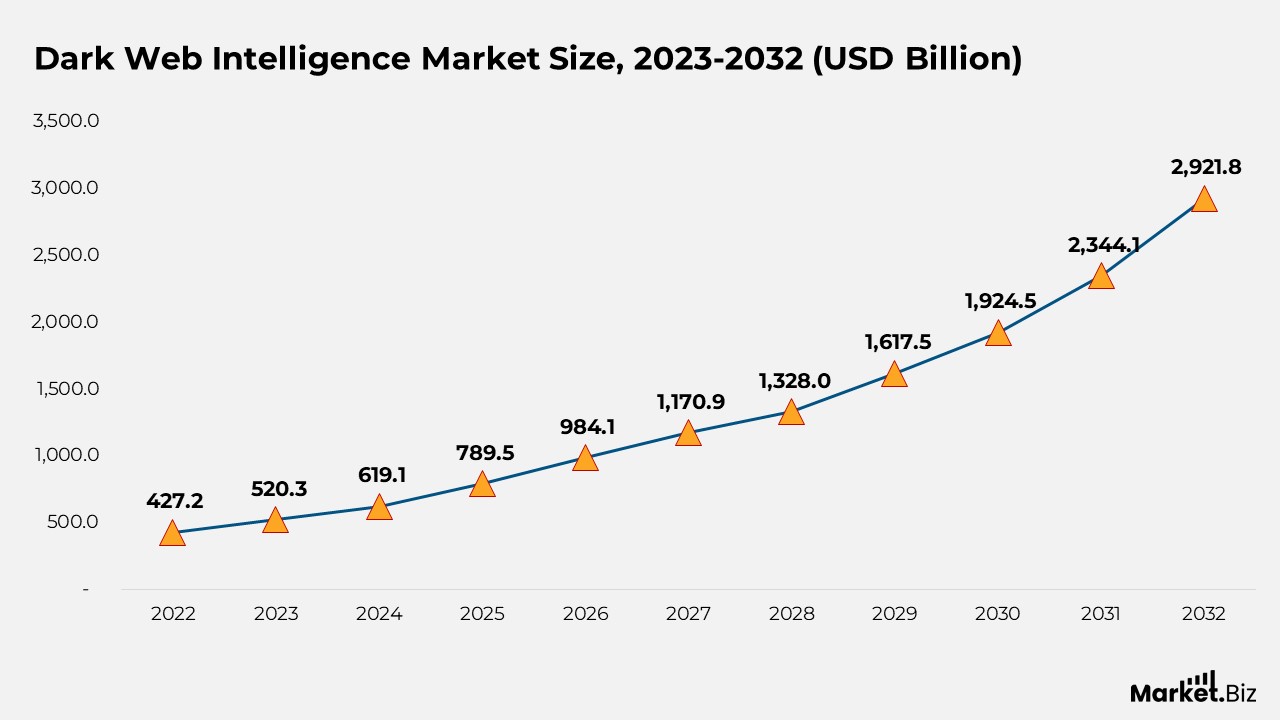
- According to Market.us, the Dark web intelligence market is expected to rise from $520.3 billion in 2023 to $2,921.8 billion by 2032, representing a compound annual growth rate (CAGR) of 21.8% from 2023 to 2032.
- The global dark web intelligence market is expanding due to the rise in cybercriminal activity, supported by alarming statistics.
- On-premise deployment mode is gaining traction in the dark web intelligence market due to its emphasis on data security and infrastructure control.
- Dark web intelligence solutions dominate the market, offering essential tools for monitoring, analyzing, and mitigating cyber threats.
- The IT and telecommunications sector is growing rapidly as dark web intelligence aids in identifying emerging cyber threats and preventing attacks.
- North America leads the global dark web intelligence market, holding a revenue share of 36.7%, with significant growth anticipated through industries like BFSI, IT, and healthcare.
- Stolen account credentials on the dark web surged by 82% in 2022, reaching 15 billion stolen credentials, according to 4iQ.
- Identity theft remains the top crime on the dark web, reaching for above 65% of activities, as described by Sixgill.
- Credit card fraud is a significant issue on the dark web, constituting 15% of activities.
- The availability of card dumps increased by 6% from 2021, surpassing 192 million in 2022, with an average credit limit of $8,700, according to Sixgill.
(Source: Market.us)
Number of Tor Users
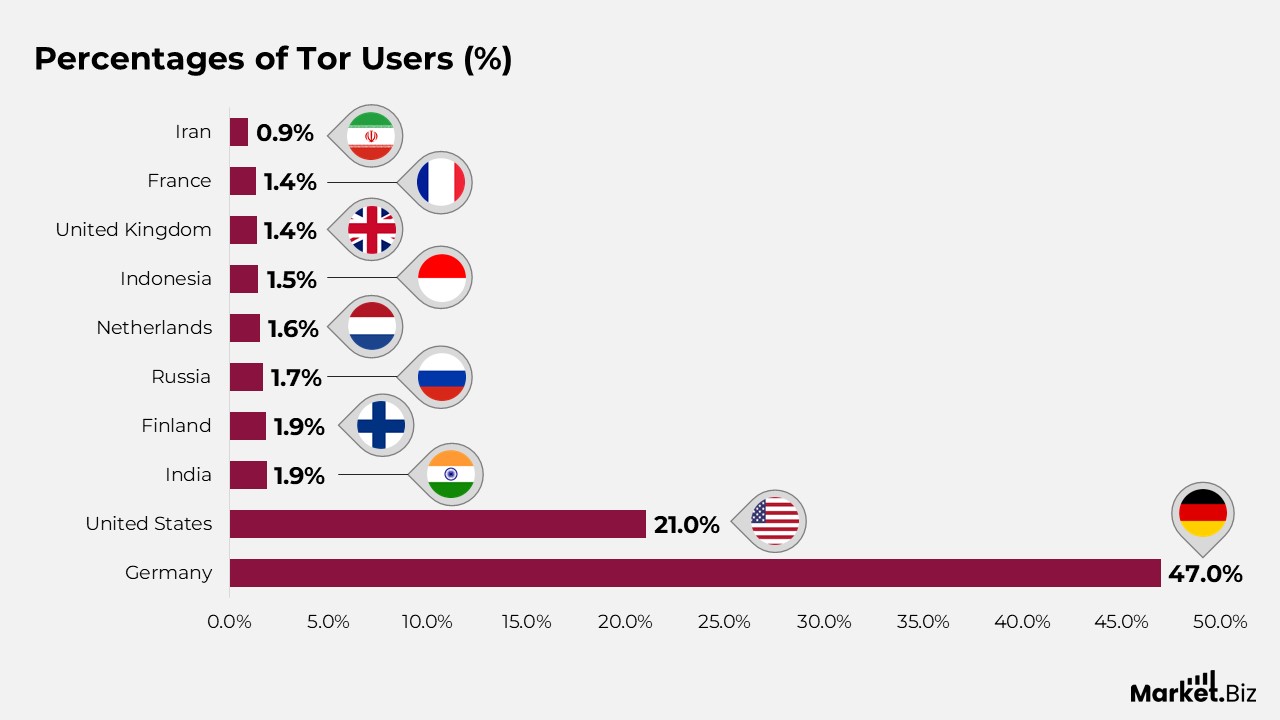
- In 2023, approximately 550,000 people in the United States used the Tor network daily, making up just over 20% of the platform’s worldwide daily userbase.
- Germany led with 47% of the daily usage.
- The United States came next, accounting for 21% of global Tor traffic.
- India contributed 1.89%, followed closely by Finland at 1.86%.
- Russia represented 1.72% of daily users.
- The Netherlands accounted for 1.55%, while Indonesia made up 1.48%.
- TheUnitedKingdom had 1.39%, slightly ahead of France with 1.38%.
- Iran had the smallest share, representing 0.94% of global daily usage.
(Source: Gen Digital Inc., Statista)
Darknet Data Breach Statistics
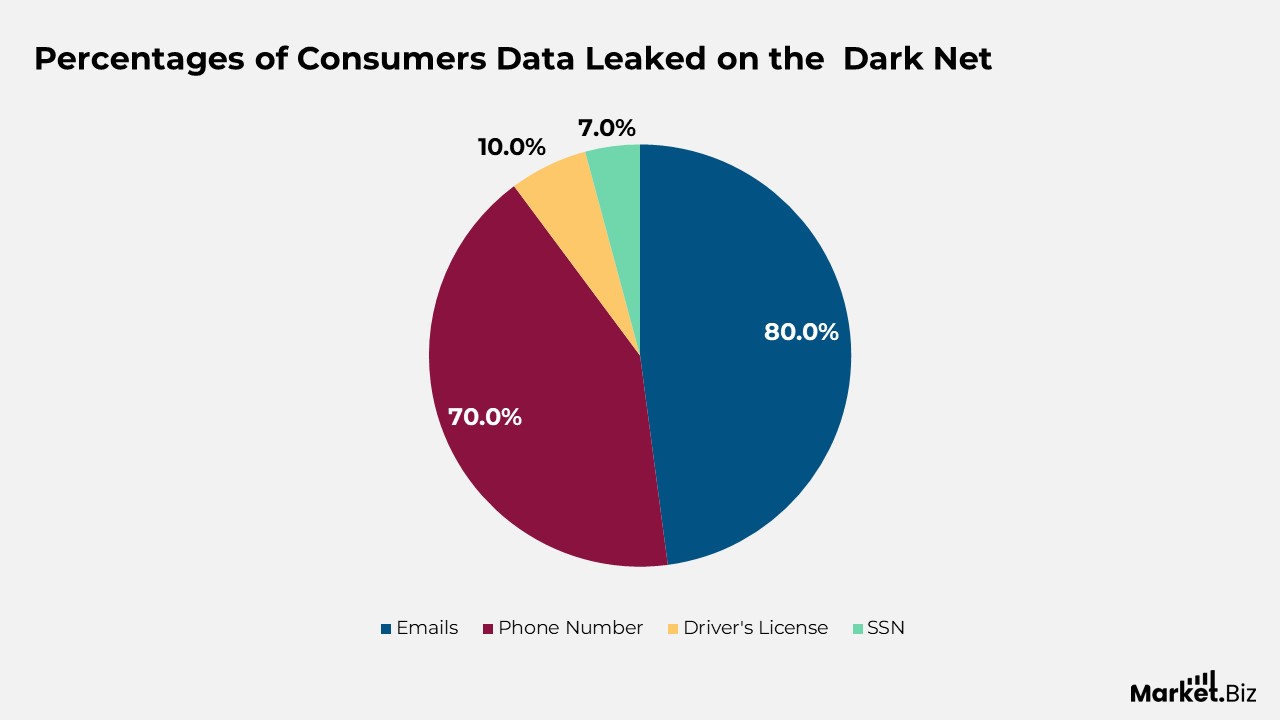
- In 2021, 80% of consumers’ email information was exposed on the darknet.
- 70% of consumer phone numbers were also compromised, along with 10% of driver’s license information and 7% of social security numbers being leaked.
- In 2021, stolen data from 543 million employees of Fortune 1000 companies was found circulating on the darknet.
- Over 1.2 million payment card details were leaked onto the darknet in 2022.
- In 2021, 90% of users on hacking forums were seeking to purchase hacking services.
- In 2022, Darknet hackers exposed sensitive social security data from the Washington licensing system.
(Source: vpnAlert.com, EarthWeb, ivacy.com, Soocial, Darknet Hackers)
User Perspectives on Dark Web Usage
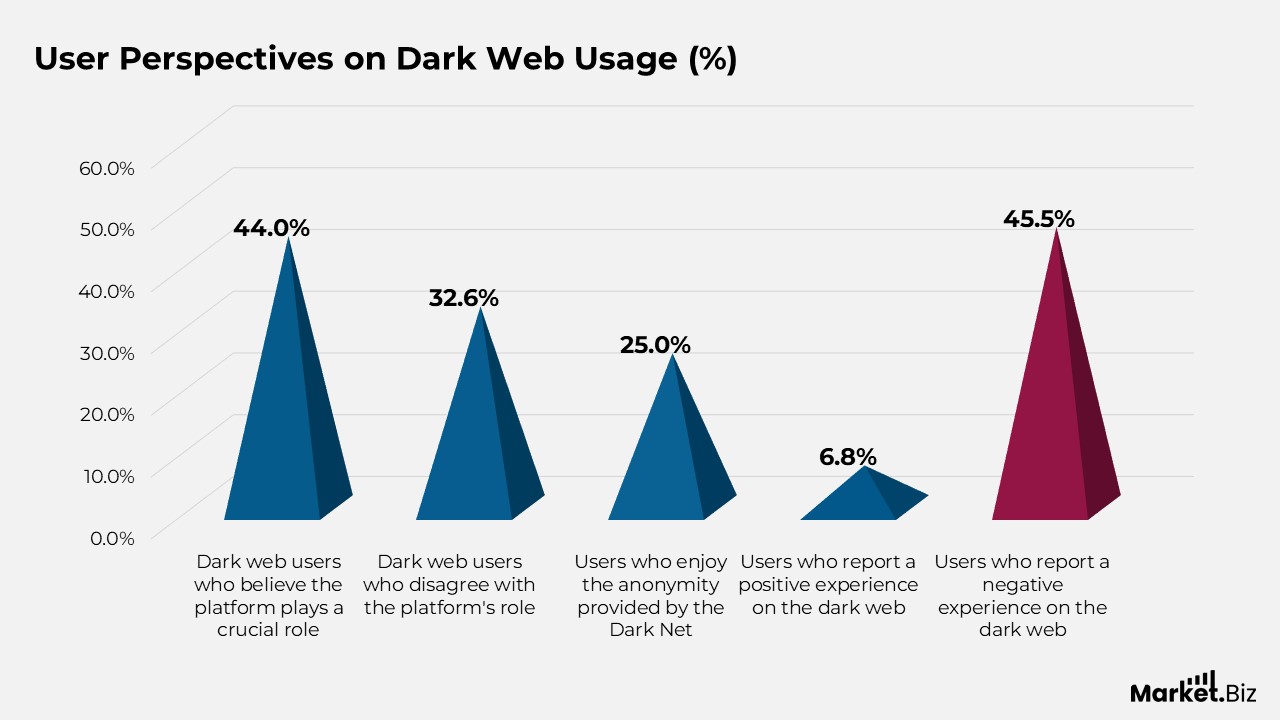
- 44% of dark web users believe the platform plays a crucial role in today’s world, while 32.56% disagree.
- 25% of users enjoy the anonymity provided by the Dark Net.
- 6.82% of users report a positive experience on the dark web, while 45.45% have had a negative experience.
(Source: Kooc Media Ltd., Statista)
Malware Statistics
- In 2024, the average ransom payment surged by 500%, reaching $2 million.
- 59% of organizations experienced an attack in 2024.
- Even among smaller companies with revenue under $10 million, 47% fell victim to ransomware in the past year.
- The average recovery cost from a malware attack climbed to $2.73 million in 2024, nearly $1 million higher than in 2023.
- Ransom demands are escalating, with 63% of demands exceeding $1 million, and 30% surpassing $5 million.
- The most frequent root causes of attacks include 32% from exploited vulnerabilities, 29% from compromised credentials, and 23% from malicious emails.
- 560,000 new pieces of malware are identified every day.
- Over 1 billion malware programs currently exist.
- 58% of all computer malware is Trojans.
- Every minute, 4 companies become victims of ransomware attacks.
- Approximately every second computer in China is infested with some form of malware.
- Iran has the maximum mobile malware infection rate, at 30.3%.
- Android devices are 50 times more likely to be sick with malware than iOS devices.
- Over the past decade, malware infections have increased by 87%.
- The cost of cybercrime is expected to reach $8 trillion in 2023.
- 84% of code bases contain open-source vulnerabilities.
(Source: Spacelift, Inc., ASTRA IT, Inc.)
DDoS Statistics
- DDoS attacks saw a staggering 807% increase over the nine years leading to 2022, with quarterly incidents rising from approximately 325,000 in Q1 2013 to around 2.9 million in Q1 2022.
- Netscout’s analysis revealed that there were approximately 13 million DDoS attacks in 2022, setting a new record for attack frequency.
- In 2022, the number of DDoS attacks grew by 74% year-over-year (YoY).
- Early projections indicate that DDoS incidents are expected to continue rising in 2023. Lumen Technologies successfully mitigated over 8,600 DDoS attacks in Q1, marking a 40% YoY increase and the second busiest quarter in two years.
- Q1 2023 witnessed a 47% rise in attacks compared to the same period in 2022.
- On a global scale, organizations mitigated an average of 29.3 DDoS attacks per day in Q4 2022, which is 4 times the number mitigated in the same period in 2021.
- Cisco forecasted that global DDoS attacks would increase from 7.9 million annually in 2018 to 15.4 million in 2023, based on historical data and projections through 2020.
(Source: StationX)
Dark Web Statistics – By Category
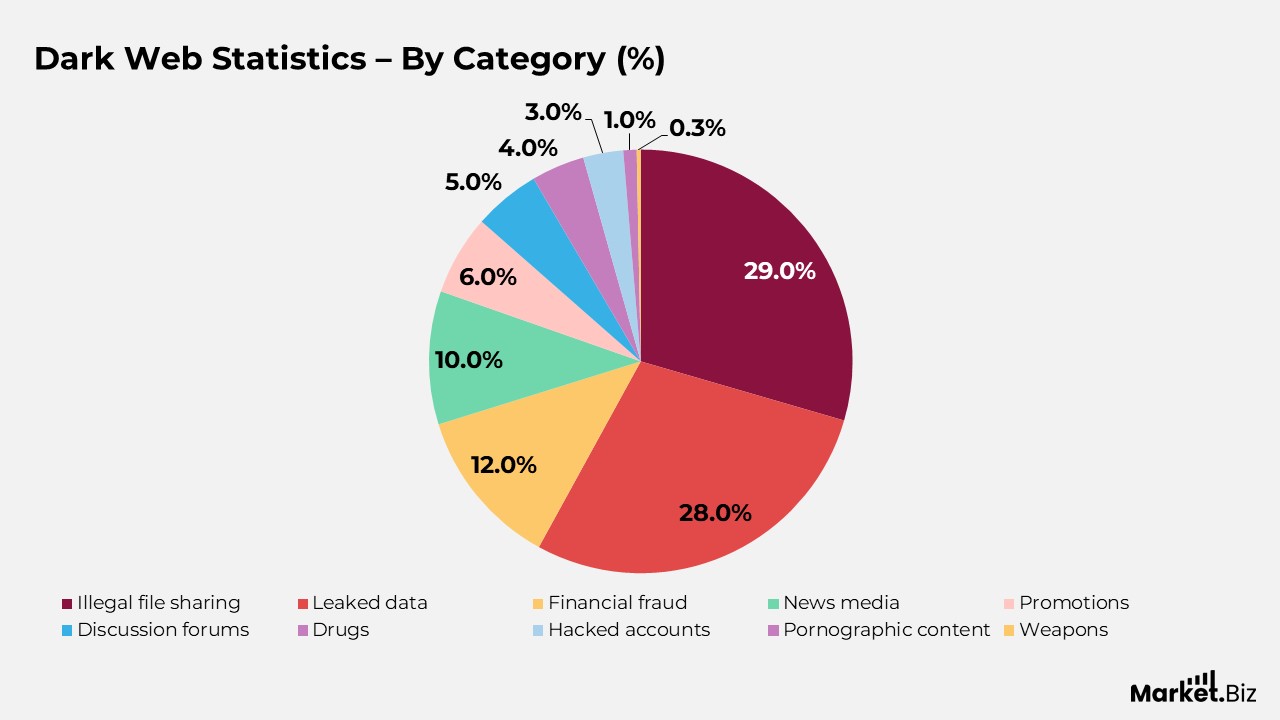
- Weapons account for 0.3% of the Dark Web’s illegal activities.
- Pornographic content makes up 1% of the Dark Web.
- Hacked accounts represent 3% of Dark Web activity.
- Drugs are involved in 4% of the Dark Web’s operations.
- Discussion forums contribute 5% to the Dark Web.
- Promotions amount to 6% of the Dark Web’s activities.
- News media make up 10% of Dark Web content.
- Financial fraud is responsible for 12% of the Dark Web.
- Leaked data constitutes 28% of the Dark Web’s activities.
- Illegal file sharing dominates with 29% of Dark Web content.
(Source: Kooc Media Ltd., Statista)
Challenges Faced from the Dark Web
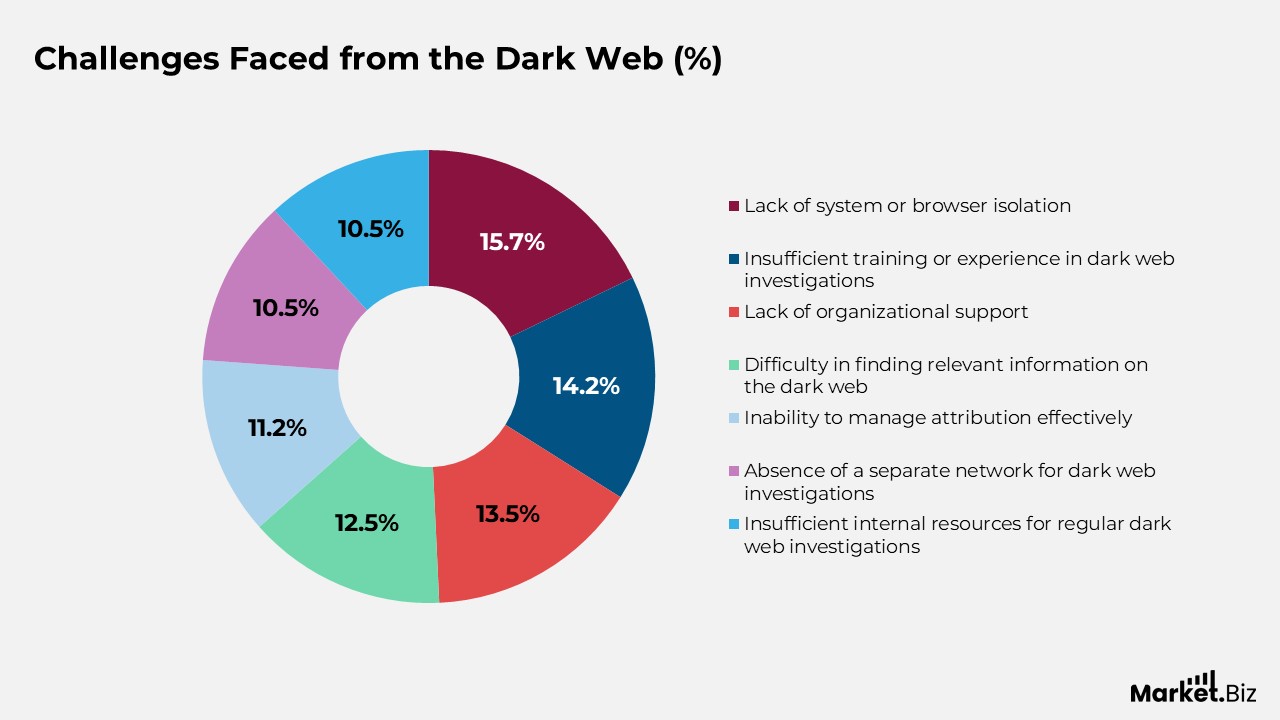
- Lack of system or browser isolation contributes to 15.7% of vulnerabilities.
- Insufficient training or experience in dark web investigations caused 14.2% of challenges.
- Lack of organizational support, impacting 13.5% of cases.
- Difficulty in finding relevant information on the dark web is responsible for 12.5% of issues.
- Inability to manage attribution effectively, affecting 11.2% of investigations.
- Absence of a separate network for dark web investigations contributes to 10.5% of the challenges.
- Insufficient internal resources for regular dark web investigations, accounting for 10.5% of the challenges.
(Source: Kooc Media Ltd., Statista)
Conclusion
The dark web continues to be a central hub for illicit activities, with significant amounts of sensitive data being exposed. Personal details, including email addresses, phone numbers, and social security numbers, along with corporate data, are regularly compromised and leaked.
The rising frequency of stolen data and the growing demand for hacking services highlight the pressing need for enhanced cybersecurity and tighter regulations.
As individuals and businesses increasingly face the threat of data breaches, it is crucial to stay alert, implement strong security measures, and increase awareness of the dangers tied to the dark web.
FAQ’s
The dark web is known for leaking various types of sensitive data, including personal information like email addresses, phone numbers, social security numbers, and driver’s license details. Corporate data, including employee information and payment card data, is also frequently compromised.
A significant amount of consumer data is exposed on the Dark Web, with many personal details such as email addresses, phone numbers, and social security numbers being leaked. In 2021, a substantial amount of personal and email information was discovered circulating within this hidden part of the internet.
Businesses are at high risk from the dark web, with data breaches affecting employee personal information. Stolen corporate data, impacting millions of employees, has been found in dark web forums, posing serious risks to a company’s reputation, legal standing, and financial health.
The demand for hacking services on the Dark Web is significant. In 2021, a large portion of users on hacking forums were searching for and purchasing hacking services, which highlights the Dark Web’s increasing role in cybercrime activities.
The Dark Web is home to a wide range of actors, including hackers, cybercriminals, activists, and even state-backed groups. These individuals are involved in various illegal activities, such as data theft, cyberattacks, and identity fraud.