









Introduction
Gig Economy Workforce Statistics: There is hardly any time when gig economy will serve as a powerful thrust in the global labour market as these days. In 2024, average more than 36% workers in the United States are working as freelancers or work on contracts, or use platforms to get a job. Flexible working fills industries such as transportation, IT, creative services, and education; it pours more than $1.2 trillion into the economy in USA.
The global gig economy is estimated to cross over $455 billion in 2025 through digital platforms in response to changing work preferences. Most such workers in the world are from millennials and Gen Z, who prefer seeking freedom, some extra bucks, and work formats that can offer more options to work, offering the possibility of doing so from home.
As employment models change, the stats on gig workers will open up ways for businesses, policymakers, and economists to know better how to engage within this segment and develop the policy around it.
Editor’s Choice
- Contributed to the US economy so far is $1.2 trillion by 36% of gig workers.
- It is projected that the gig economy will have an annual growth rate of 17.4%, thereby possibly generating around $455 billion in 2025.
- Millennial workers lead in inhabiting the gig economy, with 44% identifying themselves as gig workers.
- Just about 47% believe that gig jobs should be their main source of income, whereas 53% have classified gig jobs as secondary sources of income, although this is quite a lot in the gig pool of workers in the United States.
- Indeed, 65% of gig workers that rely on multiple platforms view diverse small jobs for an economic lifeline.
- Almost all gig employees remain attached through digitisation, with such individualisation going global.
- Full-time freelance workers with prowess can rake in between $1200 and $7500 monthly.
- 52% of gig workers do not have healthcare and pension plans.
- Globally, 3-4% of GDP is contributed by the gig economy.
- The Asia Pacific region is showing growth, with significant contributions from India and China.
- AI and automation can increase productivity by 70-80% of gig workers.
- The gig economy will have accumulative around 003.4 billion by 2030, of which approximately 60% aged between 20-39 this captures the millennial and awful Generation Z group.
General Gig Economy Workforce Statistics
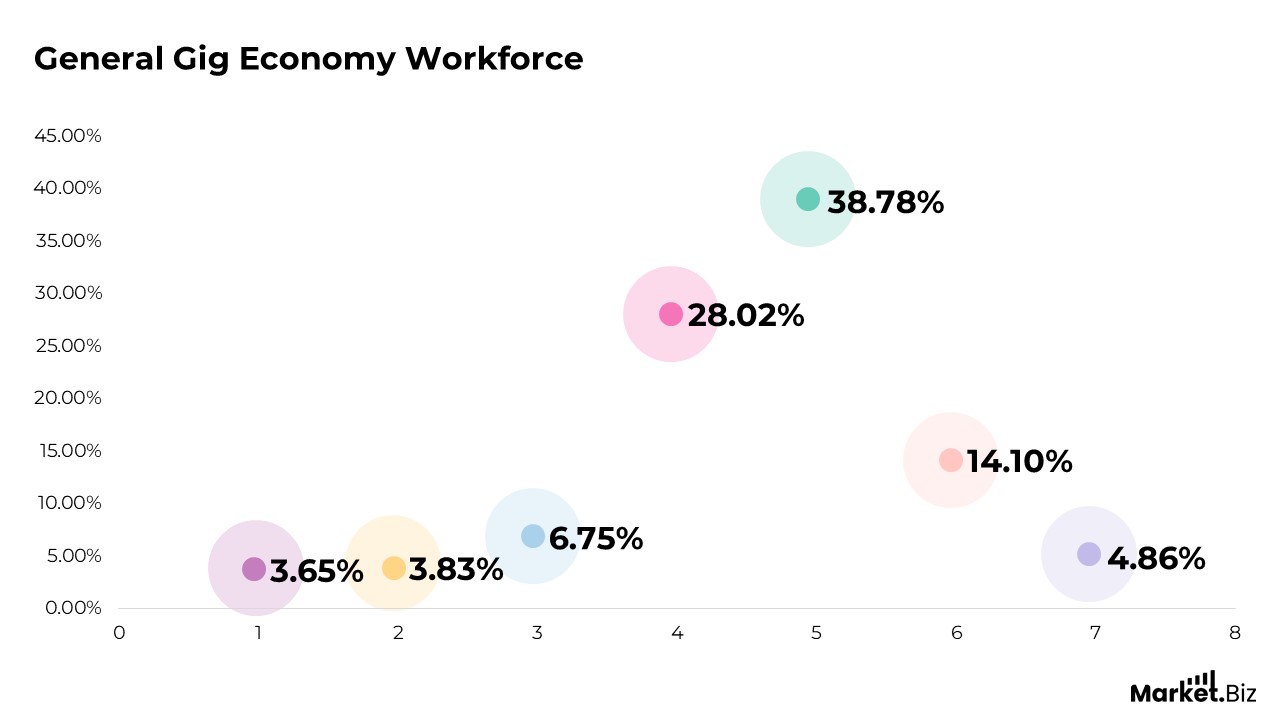
- An important segment of the labour market forms with 36% temporaries in the United States-‘working on-demand’.
- The international gig economy has been pushing pace since it is estimated at $455 billion; it is expected to grow rapidly in 2025.
- Millennials form 44% of all gig workers thus being the largest demographic group in the gig economy.
- Gig workers contribute over $l.2 trillion every year into the U. S. economy, which goes to prove their economic strength.
- About 47% of gig workers engage in gig work as a primary source of income, whereas 44% of gig workers engage in gig work as a supplemental source of income.
- The gig economy across the globe has witnessed a substantial increase in freelance work, the figure being 25% over during the last ten years.
- Among the other developing countries, 48% of workforce participation is in gig or freelance, which also speaks about strong growth in these developing markets.
- About 65% of gig workers earn their money through multiple platforms to reap the benefits of availing of more than one opportunity.
Moreover
- It accounts for 39% of the gig economy but participation rates differ among sectors and geographic areas.
- 80% of gig work can be done on the Internet while having a worldwide freelance market.
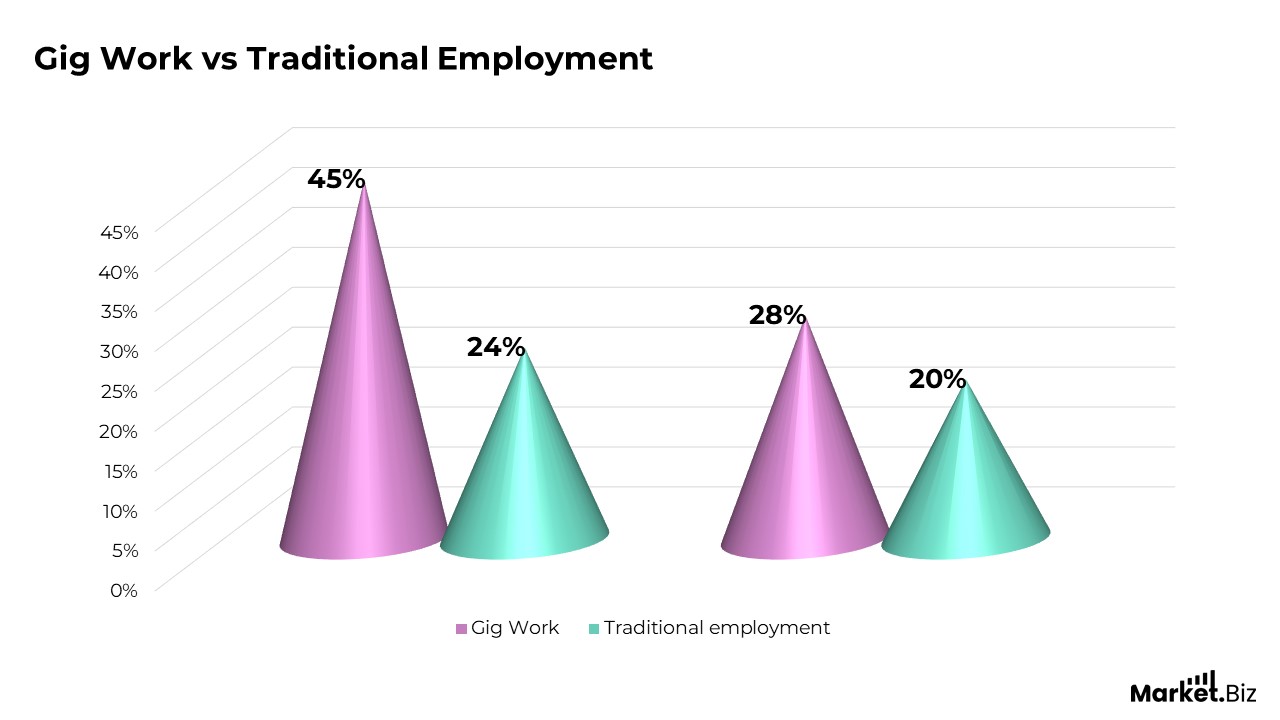
- Almost 70% of gig workers in creative industrial areas state that their job satisfaction is much higher as compared to traditional employment.
- Some full-time gig workers in high-skilled areas make $7,500 each month, showing their income potential.
- 52% of gig workers in the U. S. state they have no traditional employment benefits like healthcare or retirement plans.
- Cross-border freelancing has grown 50% from the year 2020, with the increasing search for professionals in Eastern Europe and South Asia.
- Uber and Upwork (two of the largest platforms in the gig economy) reported a 45% increase in user registrations over the last five years.
- More than 60% of all gig workers switched to digital gigs during the COVID-19 pandemic, demonstrating how resilient this sector is.
(Source: Zippia, WP-Content)
Global Gig Economy Market
Market Size and Growth
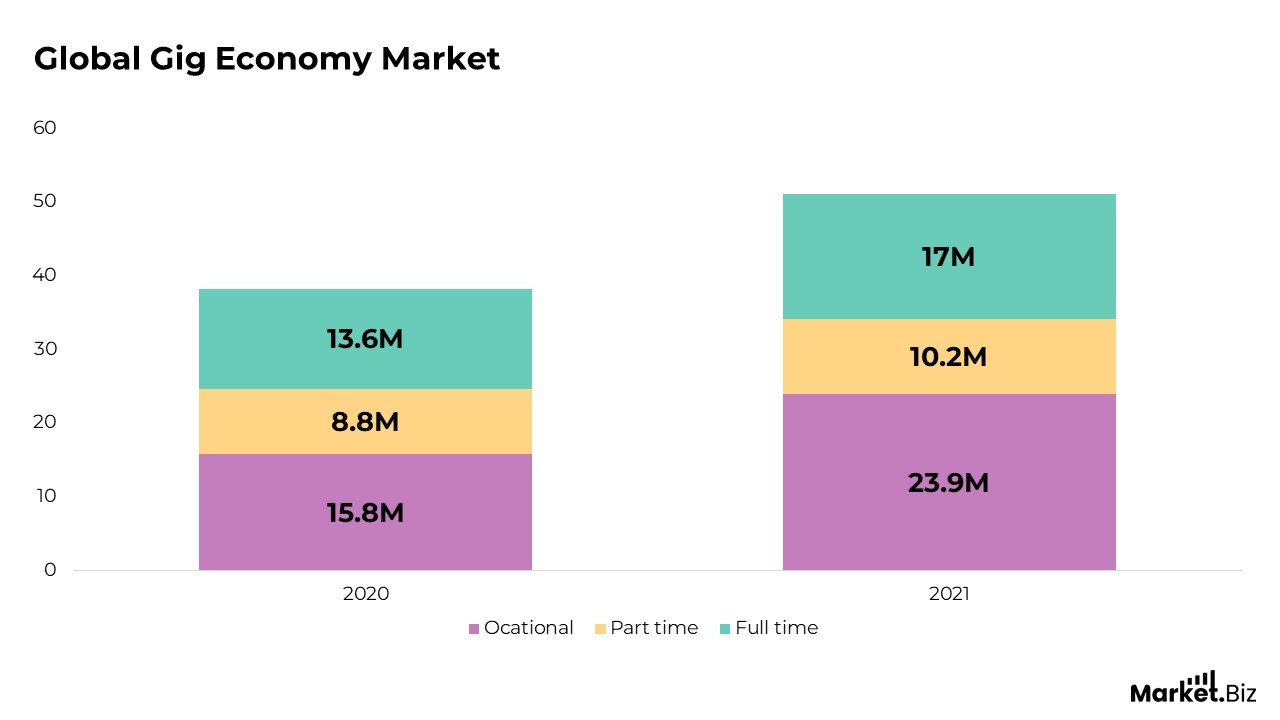
- The future of the world gig economy is argued to achieve $455 billion at 2025 due to increasing platform work.
- The fastest-growing region in gig economy is Asia-Pacific, with India and China proving most substantial growth of the markets.
- North America remains the largest, with more than $200 billion of the global annual contribution to the gig economy.
- By the end of 2030, it is anticipated that over 1.5 billion people will be engaged as gig workers in the world, signifying the widespread adoption of gig work.
- Online gig platforms improved by 30% yearly, with Uber, Fiverr, and Upwork heading the domain as far as market share is concerned.
- Gig economy probably is to contribute nearly 3-4% of the global GDP, reflecting its fast-growing influence into national economies.
- Latin America has seen its number of gig workers increase by 55% over the last five years, due to digitalization.
- Around 17.4% CAGR is expected from the gig economy revenues from 2021-2025, thereby representing the fast-moving trend of market adoption.
- 33% of the workforce in its developed markets like the U.S. will soon be freelancers, signalling a shift from traditional employment.
- The global demand for freelance talent in IT and creative sectors has surged, with software development and design seeing the highest demand.
(Source: Zippia, WP-Content)
Key Drivers and Challenges
- The main driver of the gig economy is technology-with mobile apps and AI-based platforms changing the face of the market.
- That pandemic has hastened the move toward remote gigs, with more than 60% of workers engaging in gig platforms in 2020.
- Millennials and Gen Z continue to be the greatest contributors to drive the growth of the gig economy, with flexibility in work schedules being their primary goal.
- Some places, such as Spain and Italy, experienced a significant rise in freelance work as a result of high unemployment figures, which forced people to take up gigs.
- The million-list of users on platforms such as Toptal, Freelancer.com, and Fiverr are just some of the millions now alive on earth, where the gig ecosystem further increases.
- There are still many legal and regulatory challenges, with California, the EU, and Australia rolling out policies on the classification of gig workers.
- Thirty percent of gig workers refer to a platform for their earnings, hence have little control over earnings predictability, which is a recurrent concern with income.
- Healthcare, retirement plans, and not being treated like regular employees are among the most burning issues for 53% of gig workers globally.
- Gig workers compete for positions at the top because demand for skills continues to beat unemployment in markets like technology and other creative industries.
- It is also a matter of environmental impact that gig work is in the transportation sector. Calls for better environmental sustainability from gig platforms are mounting.
Part-Time vs. Full-Time Gig Work
Part time work:
- 26% of gig workers consider gig work as the major portion of their income source, while 74% do gig work part-time.
- Full-time gig workers earn an average of $3,500-$7,500 per month depending on the industry and their skill level.
- Average earnings are $1,200 for part-time gig workers who earn the majority of their income from other sources.
- Full-time gig workers form about 11% of the U.S. workforce while the others are into part-time engagement.
- Millennials prefer to have full-time gig work, constituting 45% of the group for gig economy participants.
- A report shows that full-time gig workers often have high job satisfaction, having 63% higher levels of satisfaction compared to 48% belonging to part-timers.
- Part-time gig work usually has individuals engaged in it for an alternative flexible schedule with 58% of part-timers citing flexibility as their motivation.
- 37% of the full-time gig workers are in high-skill domains like technology, consulting, and the creative industries.
Examples
- Rideshare Driver
- Food Delivery Driver
- Freelance Writer or Blogger
- Online Tutor
- Pet Sitter/Dog Walker
- Retail Worker
- Event Staff
Full-time work
- The majority of part-time gig workers have a full-time job, at 57% earning money in gig work and a full-time job.
- Full-time gig workers need to accept much more income volatility; 35% report equity differences month-to-month.
- Among the part-time gig workers, the majority, 60%, prefer the independence and flexibility of gigs without attachments to full-time work.
- Gig workers under 30, those mostly work full-time, with 48% of this demographic using such work as the main source of employment.
- About 66% of those who engage in gig work in part-time work are in the types of gig jobs listed such as delivery, transportation, and customer service.
- Full-time gig work entails greater tax burdens and self-employment taxes, thus shaping financial plans among workers.
Examples
- Freelance Software Developer
- Consultant
- Full-Time Content Creator
- Freelance Digital Marketer
- Full-Time Writer/Editor
- Video Editor
Benefits of Gig Economy Workforce
- Despite the benefits of improved lifestyle and working environment, gig workers seem to have with great flexibility being the primary motivator with 72% insisting on the ability to fix their own hours.
- Gig workers choose to maintain a work-life balance since 63% of them declare to manage their personal hours more judiciously than people with ordinary jobs.
- More earning opportunities exist for skilled gig workers, from the top freelancers getting more than $100,000 annually for high-demand services.
- One of the great features of autonomy is to choose one’s own projects, with 68% of gig workers preferring independence as opposed to an environment with structure.
- The ecosystems help a lot in promoting entrepreneurship, with about 40% of gig workers setting up their businesses and/or side ventures.
- Set on the backdrop of a powerful global platform, gig workers can access international markets, with about 50% of freelancers working on cross-border-based projects.
- On-the-job skills are acquired rather fast since gig workers participate in several different jobs all at once, sharpening their skills through exposure to various industries.
Further
- Supplementary income is stated as a benefit, as 58% of part-time gig workers use extra money to top up their full-time jobs or pay off bills.
- Time not commuting is an average gain of 10-12 hours per week, allowing for better personal productivity for gig workers.
- Various income sources help to lessen financial risks, as 33% of gig workers earn from multiple platforms or projects at the same time.
- Reports suggest that gig jobs are more satisfactory, with 62% of gig workers claiming higher fulfilment than traditional jobs.
- Employers benefit from a wide talent pool with free access to global manpower, to interact with diversified clientele, even enhancing professional networking and opportunities.
- The gig economy encourages innovative and creative problem-solving; 48% of project workers engaged in technology and design fields find innovative solutions.
- In effect, also saving them $4,000 per annum on average in commuting and office expenses, these gig workers have low overheads if they work away from the premises or even from their homes on remote shores.
Challenges of the Gig Economy Workforce
- Income instability represents a significant problem since the majority i.e. 30% of gig workers are unsure of their monthly earnings.
- Benefits of employment are unavailable in 53% of the cases for gig workers, effecting them not to have health insurance, pension plans, or paid leaves.
- Low job security, with 65% of gig workers determining that their income sources are questionable with regard to sustainability.
- Isolation is very common because 40% of gig workers feel they are not part of a team and this reduces networking and career progression.
- Vague tax obligations cause confusion here as 45% of gig workers do not know the correct procedure to report income and deductions.
- Legal challenges continue among a majority 70% of gig workers who uncertain with lawful classification between independent contractor and employee.
- Competition is cut-throat, and statistics show that over 500 new freelancers are added in a single day to the already thousand freelancers from platforms like Fiverr and Upwork.
Moreover
- 41% of gig workers face hurdles to raise money or loans because of their non-traditional work status, making it difficult for them to access capital.
- According to 38% of full-time gig workers, these people are reporting that they are stressed because they have many projects to work on at the same time.
- Payment delays are perennial lapses, as reportedly 25% of gig workers get delayed from earning wages for as long as a month.
- Platform charges can take a huge bit of earnings from an income generated, especially since certain gig platforms take as much as 30% of commissions from payments made to workers.
- Limited long-term growth prospects were cited by 52% of gig workers, making it a significant concern regarding their views about career advancement opportunities.
- Inconsistent work availability is a challenge, with 28% of gig workers having absences that actually impede their financial stability.
- Access to such professional development is limited as it is that 40% of gig workers say that they miss the former training and mentorship of the old regular employment.
(Source: Zippia, WP-Content)
Gig Economy by Industry
- The transportation sector is leading the pack in the gig economy, with Uber and Lyft drivers accounting for 30% of the gig workforce in the United States.
- Freelance writing and content creation are briskly progressing; in 2012, 25% of content marketers were now involved with the gig economy.
- Since 2020, the delivery sector which has companies such as DoorDash and UberEats has most seen an expansive increase of 23%.
- Creative services such as graphic design or video production have been among main clear sectors with approximately 21% of gig workers participating in some form of design work.
- Technology has made a considerable portion of high-skill gigs, with software development alone making up 18% of the total world gig work.
- There is growing externalisation of customer service jobs with about 9% of customer service jobs in the U.S. being taken over by gig workers.
- The telemedicine gig is on the increase, now contributing to 5% of the healthcare workforce working in the gig economy.
- Education and tutoring services have gone wild, with up to 10% of K-12 tutors and about 25% of college tutors now taking gig jobs.
- The retail sector is getting gigger by adding shifts on a casual basis, with 36% of gig economy employees adding retail gigs to their earning activities.
- Freelance marketing and advertising are emerging, said to be 15% of gig workers on digital marketing and bloggers.
Gig Economy Demographics
By Age and Generation
- The millennials are 40% of the total gig workers, and most of them rave working independently to have lots of flexibility and autonomy.
- Gen Z is speeding towards the gig economy, making up about 21% of gig workers, which are highly represented along tech and creative industries.
- Approximately 10% of on-demand workers belong to Baby Boomers, who often view these occupations as supplementary income or part-time employment after retirement.
- Such an event is also typical for Generation X, of which 24% of respondents were between 40 and 55 years old, and somewhat managing family and career.
- There are even 30% gig workers below 30 years old in the U.S., which states the commonality of relatively young people going into freelance work.
- Older gig workers aged 50 and above increase their participation in these activities by 20% to earn extra income or flexible retirement options.
- The female gig worker represents 39% of the workforce, with participation rates higher in health, education, and customer service.
- Male gig workers have 61% of the total gig workers in transport and construction.
Geographic Distribution
- North America remains the largest market, with 36% of U.S. workers engaging in the gig economy, especially in urban areas.
- Europe has seen significant growth, with 22% of the workforce in countries like the UK and France engaging in gig work.
- Asia-Pacific is the fastest-growing region, with India and China seeing a 50% increase in gig workers over the past five years.
- Latin America has strong gig economy participation, particularly in Brazil, where 28% of workers are engaged in gig work.
- Sub-Saharan Africa is seeing rapid growth, with countries like Nigeria and South Africa reporting 20% annual increases in gig work participation.
- Remote gig work has become a global trend, with 38% of gig workers performing their tasks from home or a flexible location.
- Urban areas dominate the gig economy, with 70% of gig workers in major cities like New York, London, and Mumbai.
By Income and Work Preferences
- Full-timers working in gig economy spaces earn, depending upon the industry and skill-set, anything from $3,500 to $7,500 monthly.
- Part-time gig workers are known to earn an average monthly amount component of $1,200 that serves to supplement their main livelihood.
- Freelance technological personnel earn up to $100,000 per year with roles in software development, data science, and cybersecurity.
- Creative professionals, whether designers or writers, probably earn wages that vary between $2,500 and $4,000 a month depending on experience and demand.
- Low-skill gig workers in delivery and ridesharing earn from $1,000 to $2,000 on average monthly.
- Income volatility is one major area of concern as 28% of gig workers contend with sizeable fluctuations in their monthly income.
- Thirty-three percent of gig workers say that their income goes to cover necessities such as rent, groceries, and utilities.
- Gig workers in high-demand sectors (like tech, finance, and digital marketing) earn around 30% greater than in low-skill ones.
(Source: Zippia, WP-Content)
AI on Gig Economy Workforce
- The gig economy has never been so favourably positioned with AI-generated platforms reducing the interference of job matching, with 50% of the gig workers now applying AI tools for task assignment.
- About 30% of job assignments have been accomplished faster for the gig workers using AI-powered tools, mainly in tech or freelance services.
- An AI search algorithm at freelance marketplaces such as Upwork and Fiverr enhances the gig worker’s visibility towards better business by up to 25%.
- AI automation such as that applied for transportation increases worker productivity, as was the case of Uber that saw a 20% increase in productivity within its driver-partner network.
- Teaching the skills leverage by AI, AI certification programs help gig workers validate their qualifications, raising earning potential by as much as 35%.
- Machine Learning algorithms analyse gig work demand to enable gig workers in the delivery and rideshare sectors to predict peak earning times, increasing profits by 18%.
- Use of AI tools like chatbots enabled 40% reduction in the time spent on client communication, improving gig workers’ workflow and customer satisfaction.
- AI scheduling in gig work will help workers maximize their time, leading to a 25% increase in work-hour efficiency.
- With automation and AI in the administrative function, the load on the gig worker has reduced by 22%, letting them concentrate on high-impact work.
- Freelance writers using AI tools for writing report a productivity boost from a 40% reduction in their content creation time.
- AI for risk management is mainstream, with platforms using AI to detect fraud and streamline payments, thereby secure for 85% of gig workers.
Future of Gig Economy Workforce
- Now, more workers are shifting to freelance and contract-based jobs, so that the global gig economy can approximate $455 billion in the year 2025, with 17.4% yearly growth. Increasing technology uptake and getting flexible work demand will drive this regarding the shift.
- The gig worker population is projected to touch 1.5 billion by the year 2030, with 60% being millennials and GenZ’s who prefer freedom and flexibility when it comes to work. They utilize digital platforms to seek more and diverse opportunities.
- AI and automation will continue to play a key role in reshaping the gig economy. 80% of gig workers will report increased productivity due to AI tools. More and more, platforms implement machine learning strategies for task allocation along with pricing models.
- Remote work will be a leading indicator of the gig economy since 38% of gig economy workers already work from home. There are also predictions that, in 2025, this will be about 50% of all gig jobs taking place 100% remotely so workers can reach globally by clients and opportunities.
- Almost everything is right above but also for gig economy growth. One-half of all gig workers claim strong support for protection improvements like health and retirement benefits. Policies on worker classification and social security will come from governments.
- The employment of gig economy work is growing, with the migration predicted for emerging areas such as healthcare, education, and sustainability. Freelance work would account for 15% of health professionals by 2030. The need for specialized, short-term services in different industries will increase demand.
Conclusion
You can see that it is changing the values of all global labour with gig economy: with an increase in growth as forecast in several regions and industries, such as new technological advancements (especially from AI and PDS) and big expansion in the market.
Such that the millennial generation and generation Z have always remained largely into the sector due to their need for independence and flexibility, leaving issues like instability of earnings and no benefits to remain bothersome matters, in extension from ever-increasing gig workers. Increasingly more of the new sectors, like health care and education, are going to begin to see freelance workers entering their exchanges.
There is a technology-fuelled transition along with an increased emphasis on the rights of the workers and the changing dynamic of the marketplace, which will further determine prospects of the gig economy.
FAQs
Millennials and Gen Z dominate the gig workforce with 44% of gig workers being millennials who are mainly interested in flexibility and remote work.
Gig economies cut across various industries with transport, IT, creative arts, and health sectors registering high levels of growth in freelancing participation especially through digital platforms.
Full-time gig workers in highly skilled professions earn handsome pay, with some getting paid close to $7,500 a month, while part-time gig workers are reported to be around $2,000 a month.