









Introduction
Department Stores Statistics: The worldwide market for department stores was estimated to be worth approximately $123 billion in 2023, with expectations to expand to between $192 billion and $203 billion by the years 2030 to 2032, reflecting a compound annual growth rate (CAGR) of roughly 5% to 6%.
Department stores function within a global market valued at approximately $120 billion to $129 billion during 2023 to 2024, with significant growth anticipated by 2030 to 2032, driven by factors such as population growth, increasing income levels, urbanization, and the expansion of shopping malls. However, the competitive pressures posed by online retailers remain a significant concern.
Notable trends in the market include the adoption of technology, a diverse range of products, and competitive pricing strategies. While market growth is primarily led by North America, countries like India are also experiencing rapid advancements in their organized retail sectors.
Editor’s Choice
- The global market for department stores is anticipated to reach USD 208.1 billion by the year 2032.
- By 2029, the market size is expected to attain USD 181.3 billion, and this positive trend is set to persist, reaching USD 188.8 billion in 2030.
- In 2023, the global department store industry was dominated by several notable chains, each achieving significant revenue.
- As of April 2023, consumers in South Korea explored different sections of department stores, with specific areas drawing more interest based on the intent of their visit.
- Household goods constituted 12.4%, indicating a robust consumer interest in this sector.
General Department Stores Statistics
- The global market for department stores is anticipated to reach USD 208.1 billion by the year 2032.
- In 2023, the leading players in the global department store sector were major chains, with Macy’s ranking first, generating €21,549 million in revenue.
- As of April 2023, consumers in South Korea emphasized the importance of brand and shop variety, with 45.1% identifying it as the key factor when staying in department stores.
- Between May 2022 and May 2023, Walmart dominated the global market for general merchandise and discount stores, achieving sales of 611.29 billion USD, surpassing its rivals.
- In the fourth quarter of 2023, Costco emerged as the most favored general merchandise department store in the United States, with 69% of survey participants expressing a favorable view.
- In 2020, Canadian consumer perceptions of department stores were diverse, with 68.17% of respondents appreciating the extensive product variety available under one roof.
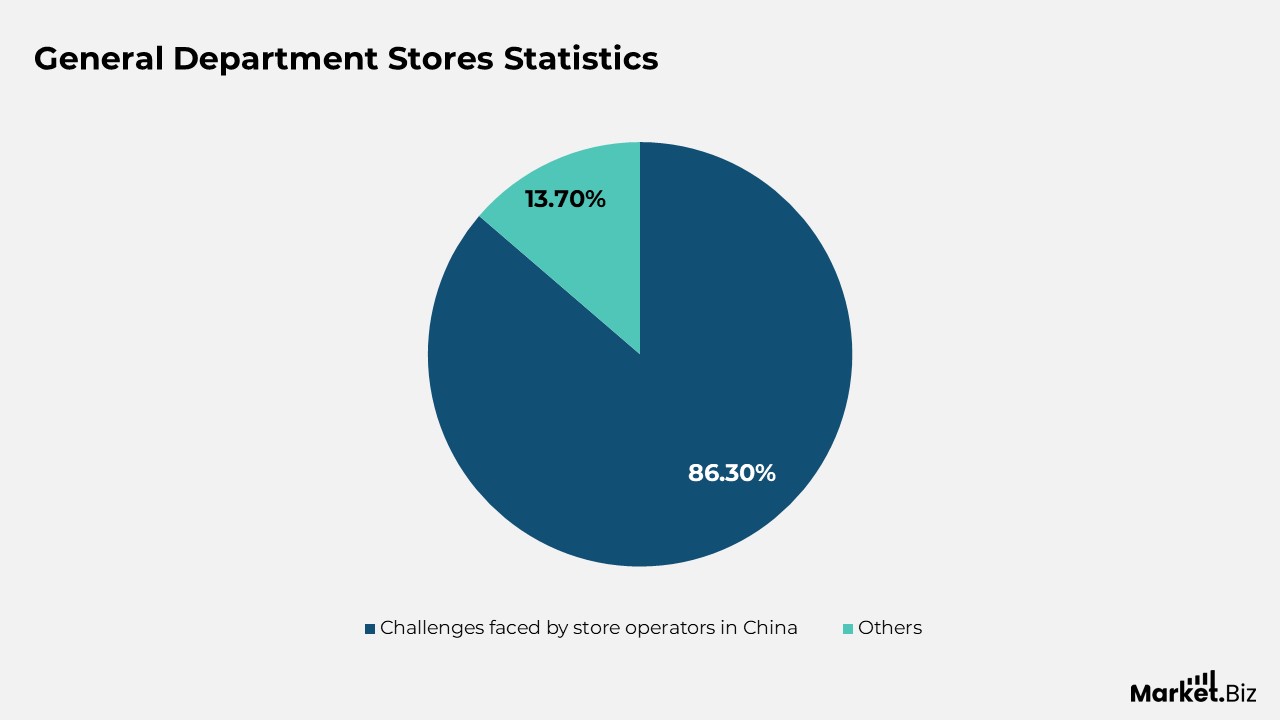
- In 2023, department store operators in China encountered considerable challenges, with 86.3% of businesses reporting that the decline in consumer spending was the most critical issue, influenced by economic pressures and evolving consumption trends.
Department Stores Market Size
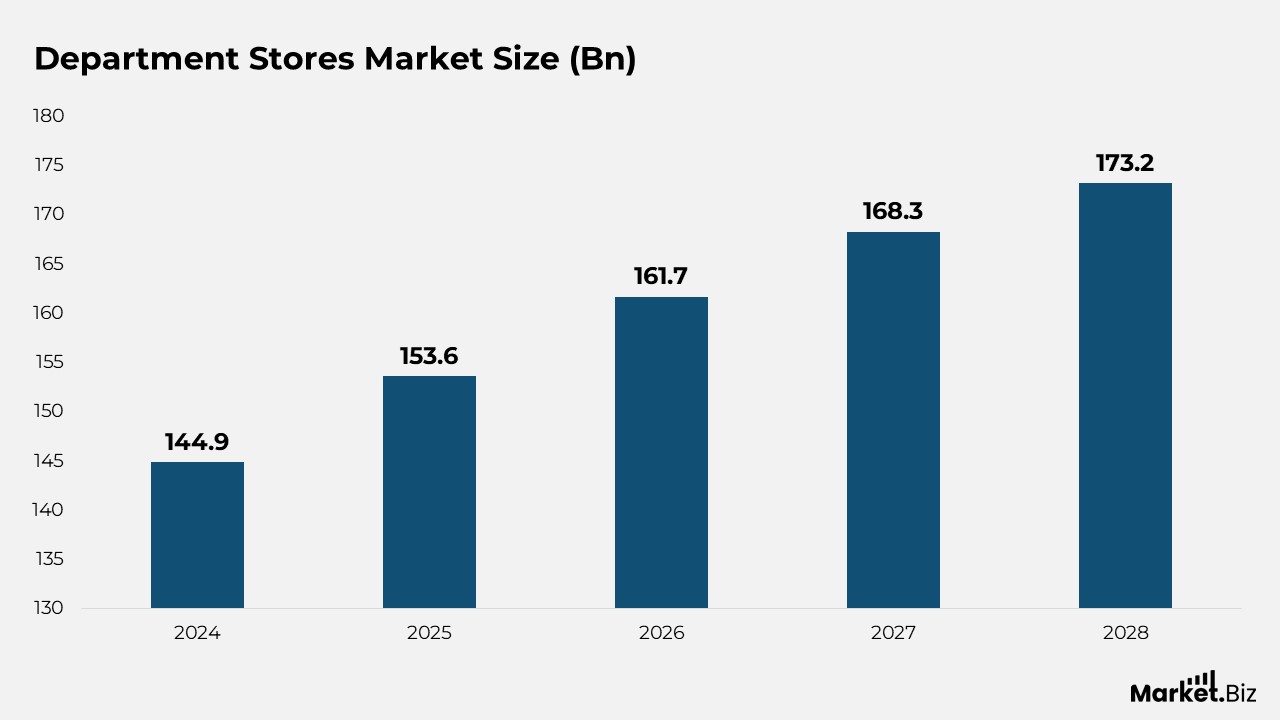
- The global department stores market has shown steady growth over the last few years, achieving a CAGR of 4.7%, culminating in a market size of USD 133.0 billion in 2022.
- This upward trend has persisted into 2023, with the market expanding to USD 139.3 billion, and it is projected to further increase to USD 144.9 billion in 2024.
- Looking forward, the market is anticipated to experience consistent growth, with projections indicating it will reach USD 153.6 billion by 2025 and USD 161.7 billion by 2026.
- The growth trajectory continues in the subsequent years, with forecasts suggesting the market will expand to USD 168.3 billion by 2027 and USD 173.2 billion by 2028.
- By 2029, the market size is expected to attain USD 181.3 billion, and this positive trend is set to persist, reaching USD 188.8 billion in 2030.
- The market is expected to grow further to USD 197.6 billion by 2031, and by 2032, it is projected to reach USD 208.1 billion.
Market Revenue of Department Stores
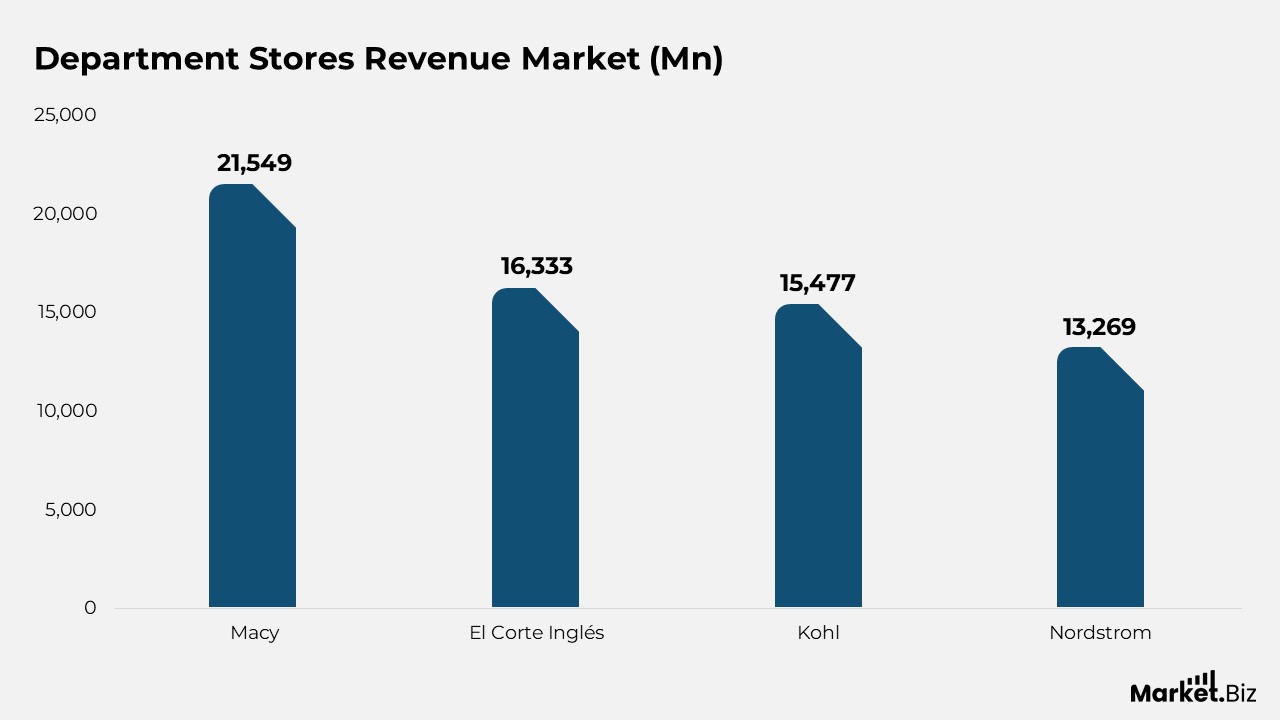
- In 2023, the global department store industry was dominated by several notable chains, each achieving significant revenue.
- Macy’s, the long-established department store based in the U.S., led the rankings with €21,549 million in revenue.
- Following closely was El Corte Inglés, the foremost department store in Spain, which reported €16,333 million in revenue.
- Kohl’s, another prominent retailer from the U.S., generated €15,477 million, while Marks & Spencer, a British retailer, reached €15,435 million.
- Nordstrom, a significant player in the North American market, earned €13,269 million, underscoring its strong foothold in the high-end retail sector.
- Other notable participants included Falabella from Latin America, which recorded €9,730 million, and Signa, an Austrian firm, which generated €8,500 million in revenue.
- Isetan Mitsukoshi, a leading department store group in Japan, earned €7,250 million, and JC Penney, a well-known retailer in the U.S., documented €6,349 million.
- Finally, Hudson’s Bay, another major retailer from Canada, generated €6,425 million in 2023.
Department Stores by Countries
US
- Starting in 2017, there was a noticeable decline in the number of department stores, with 7,651 recorded in that year, followed by a reduction to 7,466 in 2018.
- By 2019, the total had further decreased to 7,163, and the rate of decline intensified in the subsequent years, resulting in only 6,297 stores remaining in 2020, primarily due to the effects of the COVID-19 pandemic and the resulting shift towards online shopping.
- In 2021, the count of department stores dropped to 5,977, and by 2022, it had further diminished to 5,670.
- The downward trend persisted into 2023, with merely 5,349 department stores left, and forecasts indicate that this figure may fall to 5,010 by 2024.
- By 2025, it is anticipated that the number of department stores in the United States will further decline to 4,678, signifying a long-term contraction in the conventional department store model.
China
- In 2012, China boasted 4,342 department stores, and this figure steadily rose in the subsequent years, reaching 4,524 in 2013 and 4,684 in 2014.
- The expansion persisted into 2015, with the count of department stores reaching 4,847, peaking at 6,037 in 2016, as the retail sector experienced rapid growth during that time.
- Nevertheless, the subsequent years witnessed a decline in the number of department stores. In 2017, the total fell to 5,894, and by 2018, it had further decreased to 4,224.
- This downward trend continued with 4,148 stores in 2019 before a recovery occurred in 2020, when the total number increased to 5,732, likely fueled by a resurgence in consumer spending as the nation emerged from the pandemic.
- In 2021, the number of department stores declined to 4,540, and by 2022, it saw a slight uptick to 4,559.
Vietnam
- As of March 2023, Vietnam had a total of 111 department stores distributed across different cities, predominantly situated in major urban areas.
- Ho Chi Minh City, being the largest and most populated city in the country, boasted the highest number of department stores, totaling 24, catering to the city’s diverse and expanding population.
- Following closely is the capital, Ha Noi, which is home to 18 department stores, underscoring its significance as a key cultural and economic center in the northern part of the nation.
Australia
- In the financial year 2023, Australia boasted a total of 174 department stores spread across its states and territories, with a notable concentration in the more densely populated areas.
- Victoria topped the list with 90 department stores, highlighting its role as a significant economic and retail center bolstered by major urban locations like Melbourne.
- New South Wales, which is home to the largest city, Sydney, secured the second position with 39 department stores, emphasizing its critical role in the national retail sector.
- Queensland represented 22 department stores, catering to its expanding population and important cities such as Brisbane and the Gold Coast.
- Western Australia came next with 12 department stores, primarily located in urban centers like Perth.
Most Visited Department Store Sections
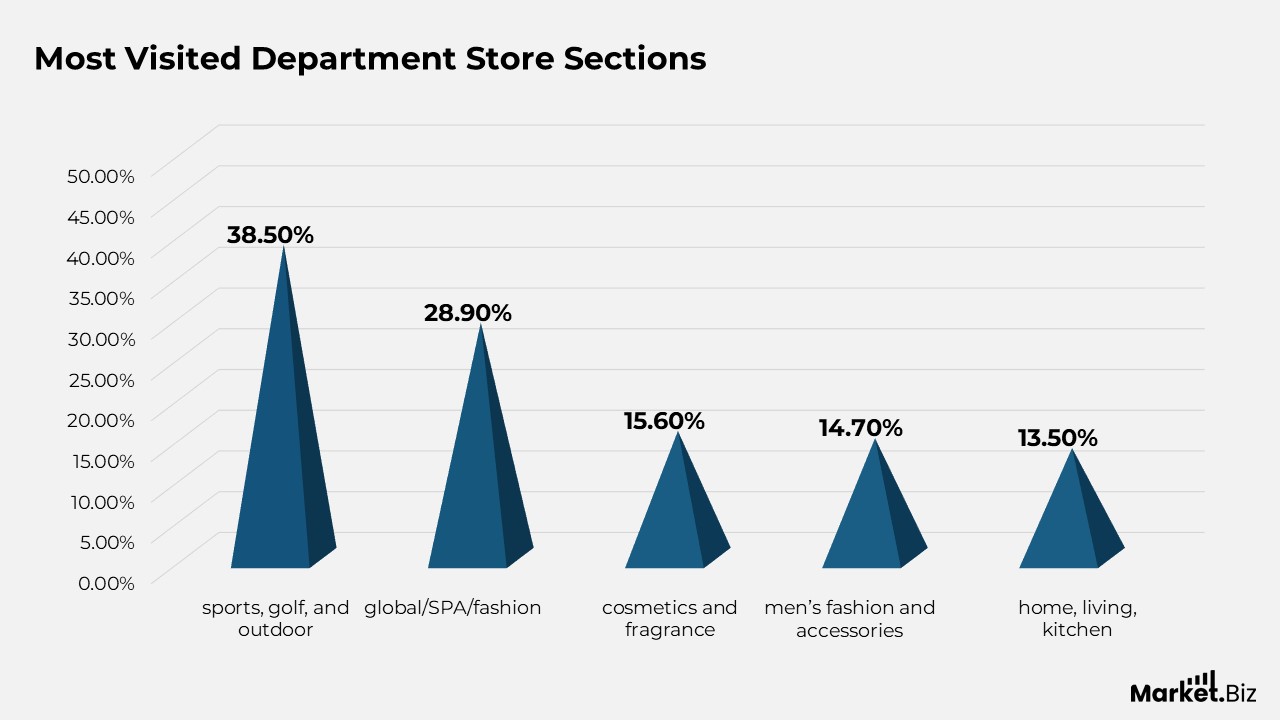
- As of April 2023, consumers in South Korea explored different sections of department stores, with specific areas drawing more interest based on the intent of their visit.
- The sports, golf, and outdoor apparel section emerged as the most popular, with 38.5% of participants dedicating time to it, indicating a growing enthusiasm for fitness and outdoor pursuits.
- The global/SPA/fashion and accessories segment closely trailed with 28.9%, highlighting the appeal of international and fashionable options.
- Other commonly frequented areas comprised specialized restaurants (26.8%) and the food court (25.5%), suggesting that dining plays a crucial role in the shopping experience for numerous consumers.
- The food hall also saw significant popularity, with 25.3% of shoppers visiting to purchase gourmet food products.
- Entertainment sectors drew 18.3%, whereas the foreign luxury fashion and accessories segment achieved 18.2%, indicating a preference for premium, global brands.
- Other significant categories comprised the cosmetics and fragrance segment (15.6%), the men’s fashion and accessories category (14.7%), and the home, living, kitchen, and daily essentials section (13.5%), each catering to different facets of consumers’ lifestyles and shopping needs.
Department Store Product Sales
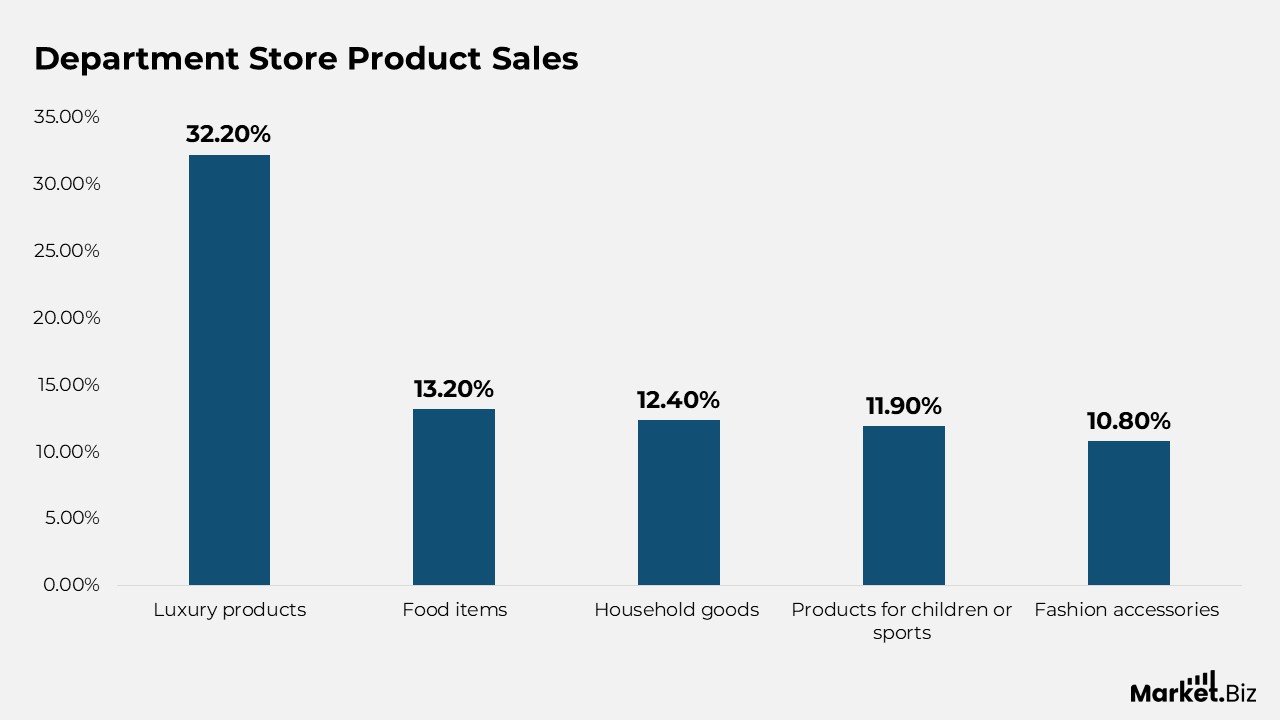
- In 2023, the allocation of total sales within department stores in South Korea was significantly biased towards luxury brands, which represented 32.2% of the overall sales.
- This was succeeded by food items, which accounted for 13.2% of total sales.
- Household goods constituted 12.4%, indicating a robust consumer interest in this sector.
- Products for children or sports made up 11.9% of total sales, while fashion accessories and miscellaneous items contributed 10.8%.
- Women’s formal and casual clothing combined for a total of 14.8%, with formal wear comprising 7.7% and casual clothing 7.1%.
- Conversely, menswear held the smallest proportion at 4.5%.
- This distribution underscores the prevalence of luxury and essential categories within the South Korean department store industry in 2023.
Consumer Behaviour
- In 2020, consumer perceptions regarding department stores in Canada showcased a range of views on their significance and relevance.
- A considerable majority, 68.17% of participants, conveyed their appreciation for the variety available in department stores, highlighting the attractiveness of having diverse product offerings in a single location.
- Conversely, 19.98% of participants valued the additional services that department stores provide, such as personalized assistance and distinctive shopping experiences, underscoring their function beyond mere retail environments.
- Nevertheless, not all feedback was positive. Approximately 13.01% of participants regarded the department store model as outdated, indicating a rising sentiment that these establishments may be having difficulty keeping pace with contemporary retail trends.
- Furthermore, 11.10% of consumers considered department stores excessively large and often a waste of time, implying that their size and layout could hinder efficiency-driven shoppers.
- Finally, 9.14% of participants expressed a preference for acquiring high-end brands directly from their individual stores instead of through department stores, highlighting a potential challenge for department stores in retaining their allure for luxury-focused consumers.
Conclusion
Department store markets are set to experience moderate global growth, propelled by consumer convenience and a broader range of product selections. However, they are confronted with rising competition and changing consumer preferences that lean towards online retail and smaller formats.
Although the total number of physical stores is decreasing in certain areas, such as the U.S., prominent retailers are adjusting by emphasizing integrated online and offline experiences, as well as a variety of product offerings to satisfy customer demands.
FAQs
Department stores typically measure around 250,000 square feet, while a Walmart Supercenter generally falls just under 200,000 square feet. Grocery stores average approximately 30,000 square feet, and drugstores have an average size of 15,000 square feet.
The largest department store globally is the Shinsegae Centum City, located in Busan, South Korea. It spans an impressive 293,905 square meters (3.163 million square feet), as reported by Guinness World Records. This surpasses the size of the former record holder, Macy’s Herald Square in New York City. The establishment features not only retail areas but also a spa, a rooftop garden, and a golf driving range.
By 2026, global sales for department stores are projected to achieve a market size of $3.6 trillion, reflecting an increase of over one trillion dollars compared to figures from 2021, according to Statista. The department store sector in the United States comprises approximately 4,500 stores, generating a total annual revenue of around $70 billion.