









Introduction
Home Improvement Statistics: The home improvement sector has experienced remarkable growth in recent years. It includes the sale of construction materials, appliances, décor, and various home improvements, as well as the services provided by contractors, tradespeople, and other professionals who assist in building, installing, modifying, and upgrading residences.
The homeownership market constitutes a substantial segment of the global economy, with numerous consumers across the globe eager to improve the aesthetic look and functionality of their homes. Recently, there has been a trend towards making homes smarter by incorporating integrated and interconnected devices that automate different functions within the household. In this statistic, we will know more about home improvement trends.
Editor’s Choice
- Sales in the consumer market are anticipated to increase by 3.2% in 2024, which is double the growth rate of the professional market sales.
- According to Home Improvement Industry Statistics, the professional market is projected to outpace the consumer market in growth by the end of 2025.
- Consumer market expenditures are forecasted to reach USD 441.2 billion by 2028, while the professional market could attain USD 213.3 billion.
- Half of the individuals engaged in home renovations allocate $15,000 or more towards their projects.
- According to the 2023 U.S. Houzz and Home Study on renovation trends, the median expenditure by homeowners rose from $18,000 in 2021 to $22,000 in 2022.
- In the first quarter of 2024, home improvement expenditures experienced a 19% increase when compared to the same timeframe in 2023.
- In 2024, 45% of consumers in Europe showed interest in improving the sustainability of their homes.
General Home Improvement Statistics
- Sales in the consumer market are anticipated to increase by 3.2% in 2024, which is double the growth rate of the professional market sales.
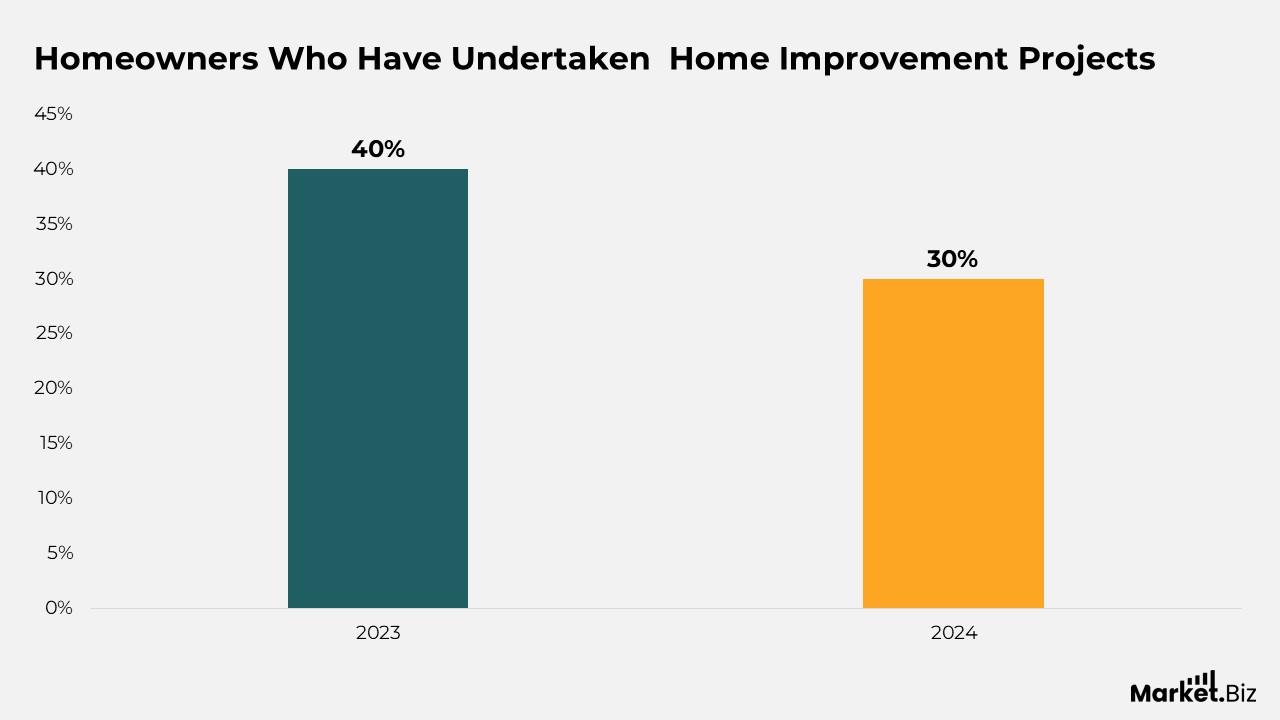
- As of 2023, 40% of homeowners have undertaken more home improvement projects due to high interest rates, and in 2024, nearly 30% of these individuals plan to continue with similar initiatives.
- Data from Google indicates that 46% of homeowners used their savings, 20% relied on credit cards, 7% opted for refinancing, and 5% selected HELOC loans to finance their home improvement expenditures.
- According to Home Improvement Industry Statistics, the professional market is projected to outpace the consumer market in growth by the end of 2025.
- The consumer market is expected to expand at an average annual rate of 3% from 2026 to 2028.
- In contrast, the professional market is predicted to grow by approximately 5% annually during the same timeframe.
- Consumer market expenditures are forecasted to reach USD 441.2 billion by 2028, while the professional market could attain USD 213.3 billion.
- The Joint Center for Housing Studies at Harvard anticipates a decline in home improvement spending from USD 489 billion to USD 452 billion in the upcoming year.
- Current mortgage rates hover around 6%, but a decrease is expected in 2024 and 2025.
- In the first half of 2024, the leading retailers in terms of home improvement market share are Home Depot (17.1%), Lowe’s (15.2%), contractors (10.3%), Amazon (6.4%), and Walmart (4.9%).
Home Renovation Statistics
- Half of the individuals engaged in home renovations allocate $15,000 or more towards their projects.
- In 2022, 55% of homeowners intend to undertake renovations on their properties.
- During their home renovation, 20% of homeowners opted to install security systems.
- Recent homeowners represent only 10% of renovation activities but invest nearly twice the median budget for such projects.
- The leading kitchen styles for 2021 and 2022 include transitional (25%), contemporary (15%), modern (13%), farmhouse (10%), and traditional (9%).
- Sales of outdoor furniture are projected to rise by $195.3 billion from 2021 to 2022.
- A significant 89% of homeowners choose to hire professionals for their renovations instead of opting for DIY solutions.
- In 2021, 65% of homeowners who renovated their properties purchased paint, indicating that smaller renovation projects continue to be favored.
- Although outdoor home upgrades have declined since a surge in 2020, they remain more prevalent than in 2019.
- By the conclusion of 2022, revenue from connected technology products for homes is anticipated to reach $5.94 billion in the United States.
- The appeal of outdoor upgrades fell from 57% to 54% in 2021.
- DIY sales from home improvement stores, hardware stores, and lumberyards were estimated at $537.9 billion at the end of 2021.
Moreover
- 45% of renovators indicate that they undertook kitchen renovations because they finally had the time to do so.
- In the realm of kitchen renovations, most changes are cosmetic rather than essential. In 2022, the primary two motivations for renovations are aesthetic, while the third is related to necessary repairs.
- Long-term homeowners tend to spend more on home renovation projects compared to other homeowners, although they generally engage in fewer projects.
- Sales in hardware stores are projected to reach $67 billion in 2022, reflecting a $4.1 billion increase from 2021.
- In 2020, baby boomers constituted 54% of homeowners who undertook renovations, followed by Generation X at 32%, Millennials at 12%, Older at 3%, and Generation Z at 0.2%.
- A significant 76% of homeowners finance their renovation projects using cash from their savings.
- The primary reasons for projects exceeding their budgets include the higher-than-anticipated costs of products and services, the unexpected complexity of the project, or unforeseen construction issues.
- In 2021, 13% of homeowners opted to renovate a closet space, with half of those undertaking the renovation spending $1,000 or more on the project.
- The most sought-after kitchen renovations include new countertops and backsplashes, with 91% and 86% of renovators, respectively, making these enhancements through 2022.
Length of Home Renovation Projects
- In 2021, the average length of home repair projects among homeowners differed significantly depending on the nature of the project. Kitchen repairs required the most time, with an average planning phase lasting 8.6 months and a construction period of 4.9 months.
- Following kitchen renovations, primary bathroom projects averaged 7.4 months for planning and 3.7 months for construction. Living room repairs had an average planning duration of 7.2 months and a structure time of 3.5 months.
- Laundry room projects typically necessitate a planning period of 7.0 months and a construction duration of 3.3 months.
- Renovations involving entryways, foyers, and mudrooms had a standard planning time of 7.0 months, requiring 3.7 months for construction.
- Guest and other bathroom repairs averaged a planning time of 6.8 months and a construction period of 3.5 months, whereas primary bedroom projects demanded 6.7 months for planning and 3.8 months for construction.
- Dining room renovations required 6.7 months for planning and 3.4 months for construction.
- Garage renovations had an average planning duration of 6.6 months and a construction timeframe of 3.5 months.
Home Improvement Cost by Project Type
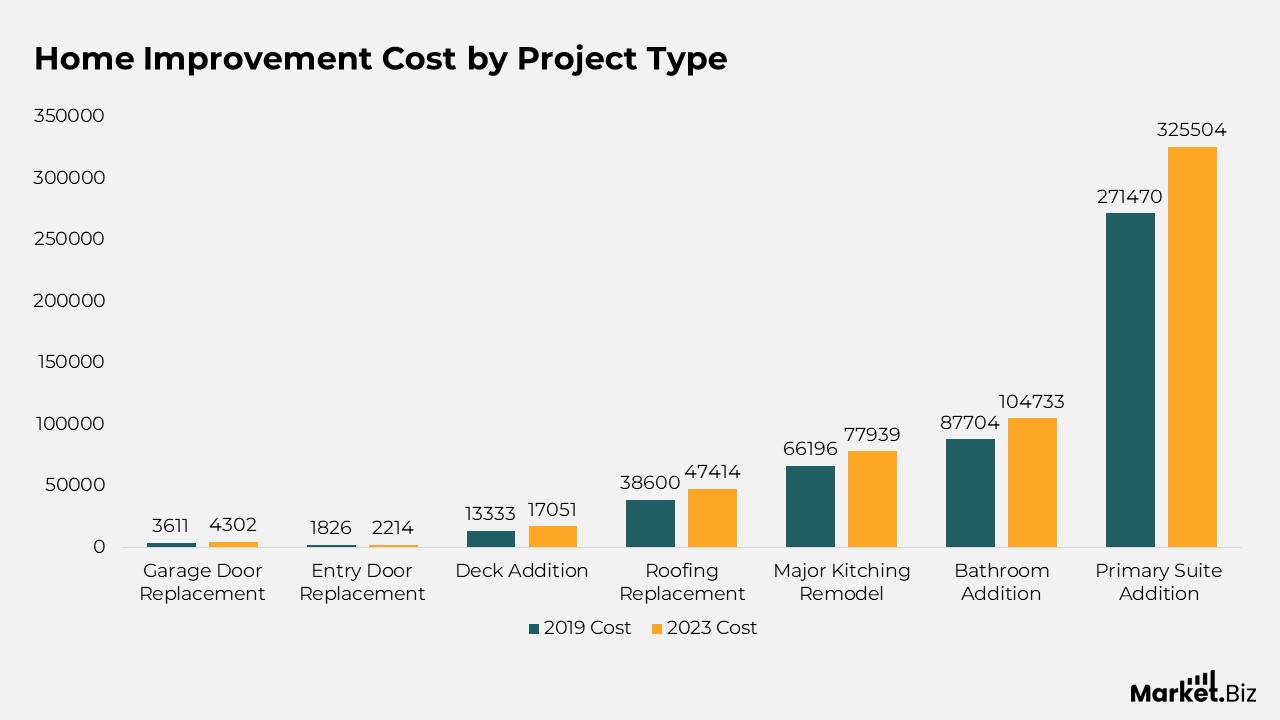
- The expenses associated with home improvement projects have risen considerably over the last five years across various types of projects. Increased demand and reduced availability have led to higher costs for construction labor and building materials.
- According to the 2023 U.S. Houzz and Home Study on renovation trends, the median expenditure by homeowners rose from $18,000 in 2021 to $22,000 in 2022.
- Nevertheless, many consumers have struggled to keep pace with these rising costs. Data from a ConsumerAffairs survey revealed that only 12% of respondents facing significant home repair issues felt confident in their ability to pay for the repairs out of their own pockets.
- The Remodeling Cost vs. Value Report indicates that the average cost of a midrange kitchen remodel was $77,939 in 2023, an increase from $66,196 in 2019, representing an 18% rise.
- A similar trend has been observed across a variety of projects, with the average cost of a midrange bathroom remodel increasing from $20,420 in 2019 to $24,606 in 2023.
- Typically, projects that involve complete room additions or renovations tend to be the most costly. The Remodeling analysis identified the most expensive project as an upscale primary suite addition, which was valued at $325,504 in 2023.
- On the other hand, the least expensive projects involved minimal space, like a steel entry door replacement valued at $2,214 in 2023 or a garage door replacement valued at $4,302.
Brand Usage for Home Improvement
- 24% of individuals are utilizing new brands within this category.
- 23% of individuals are selecting new brands for their external materials.
- 22% of consumers are selecting new brands for their countertops and cabinets.
- 21% of consumers are investigating new brands for their flooring requirements.
- 20% of individuals are embracing new brands in this sector.
- 19% of consumers are experimenting with new brands for outdoor power tools.
- 19% of individuals are considering new brands for windows and doors.
- 19% of consumers are evaluating new brands for interior building supplies.
- 19% of individuals are assessing new brands for their outdoor living necessities.
- 19% of consumers are choosing new brands in the furniture sector.
- 17% of individuals are selecting new brands for décor and interior work.
- 16% of consumers are testing new brands for their tools.
- 16% of individuals are opting for new brands for storage and organization solutions.
- 15% of consumers are pursuing new brands for their lighting requirements.
- 15% of individuals are investigating new brands for lighting accessories.
- 15% of consumers are adopting new brands for paint.
- 15% of individuals are selecting new brands for their paint supplies.
- 14% of consumers are evaluating new brands for supplies and plumbing fixtures.
- 12% of individuals are experimenting with new brands for lawn and garden products.
- 10% of consumers are selecting new brands such as Treated Lumber, Lumber, and Plywood, in this category.
Home Improvement Projects Statistics
- According to statistics from the Home Improvement Industry, kitchen remodels are particularly popular among homeowners, with approximately 27% opting to enhance their kitchens.
- Bathroom renovations are also prevalent, as 25% of homeowners are updating guest bathrooms, while 23% are concentrating on primary bathrooms.
- At the same time, about 30% of homeowners are refreshing their interiors with new paint, and 27% are enhancing functionality by adding new appliances.
- Furthermore, outdoor living spaces are a key focus for 33% of homeowners who are expanding their backyards to create larger and more enjoyable areas.
Consumer Behaviour on Home Improvement
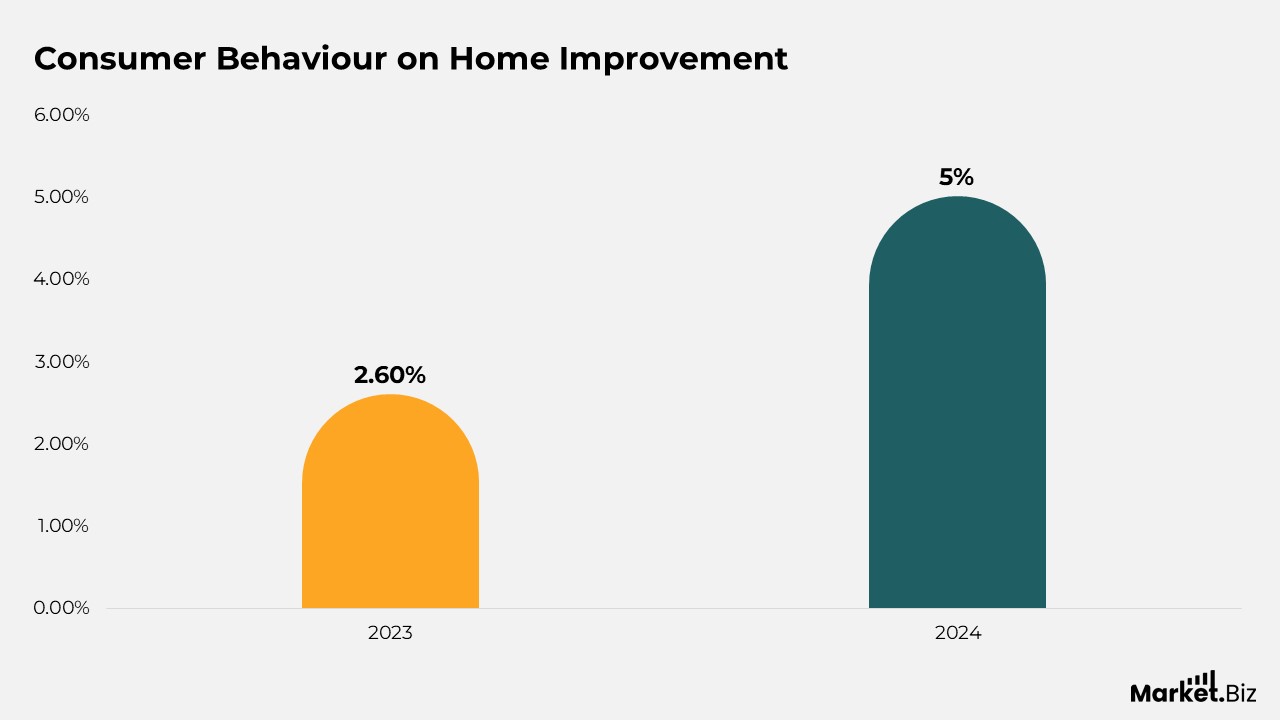
- In the first quarter of 2024, home improvement expenditures experienced a 19% increase when compared to the same timeframe in 2023.
- The proportion of households intending to initiate a home improvement project rose from 17% in Q1 2024 to 23% in Q2 2024.
- In light of economic uncertainties, consumers are prioritizing smaller, more immediate home projects and repairs.
- From January to April 2024, online sales within the home improvement industry surged by 16%, primarily fueled by tools, machinery, and workwear.
- Consumers are prepared to invest more in environmentally sustainable home improvement products.
- Sales in the professional home improvement market are projected to rise by 5.0% in 2024, following a 2.6% decrease in 2023.
Home Improvement Budget
- The 2022 U.S. Houzz and Home Study reveals a significant increase in home improvement budgets in recent years.
- From 2020 to 2021, the median expenditure of homeowners rose by 20%, increasing from $15,000 to $18,000. This represented the first rise in planned renovation spending since 2018.
- Nevertheless, forecasts from Houzz indicate a possible reduction in spending to $15,000 for 2022, although final data has not yet been published.
- Additionally, spending habits differed according to the duration of homeownership. For example, new home buyers allocated as much as $30,000 for renovations, which is double the national median.
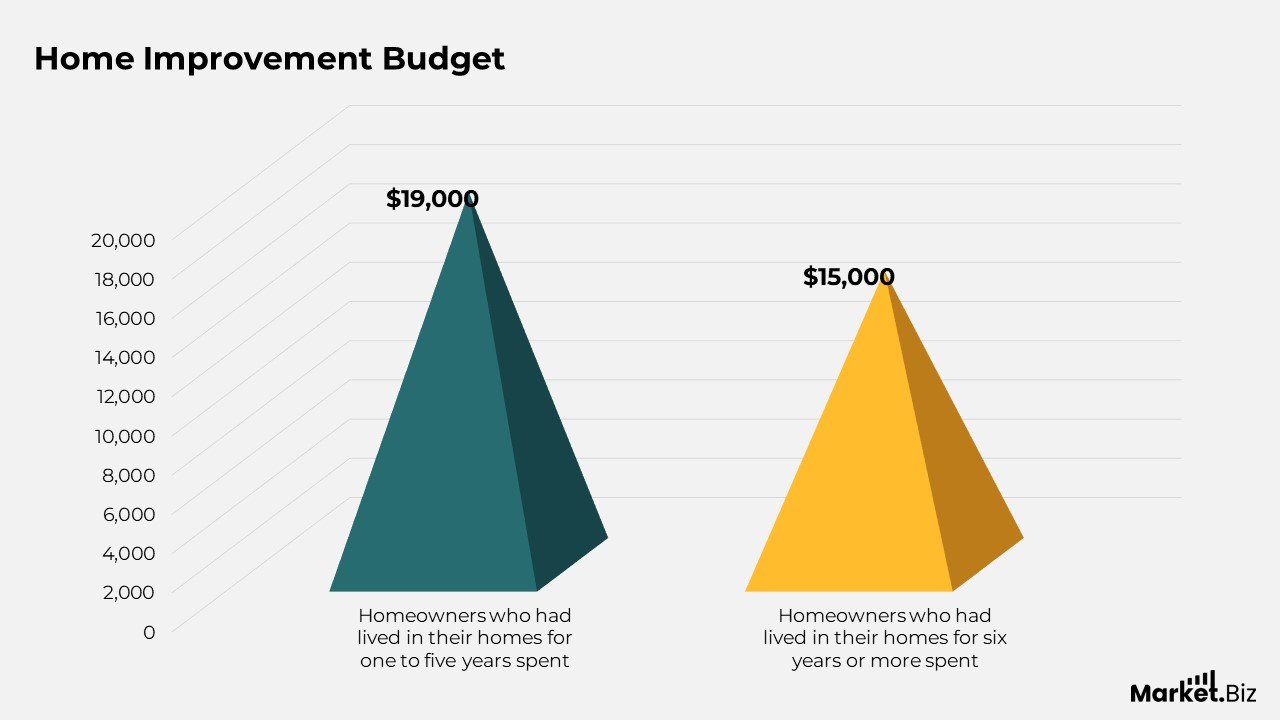
- Homeowners who had lived in their homes for one to five years spent an average of $19,000, while long-term homeowners, those residing in their homes for six years or more, generally conformed to the national average of $15,000.
- Regarding project emphasis, interior room renovations were the primary focus in 2021. Kitchen renovations stood out as the most favored upgrade, receiving the largest budget allocation.
Home Improvement Initiatives
- Industry experts have indicated an average reduction of 13.5% in operating costs during the first year after undertaking green retrofit or renovation initiatives.
- In 2024, 45% of consumers in Europe showed interest in improving the sustainability of their homes.
- The global market for green buildings reached USD 260 billion in 2013, with an estimated 20% of all new commercial real estate construction in the U.S. being classified as green.
- Green retrofitting in residential properties has shown the potential for annual savings of around 1,700 kg of CO₂ emissions for each household.
- In 2020, global searches for “ethical online shopping” surged by 600%, indicating a rising consumer inclination towards sustainable products in the home improvement industry.
- Prominent home improvement retailers have been acknowledged for their initiatives in advocating energy-efficient products and educating their customers.
- Adopting sustainable construction methods can greatly minimize construction waste, which constitutes 34.7% of all waste generated in Europe, thus fostering environmental conservation.
- Reports suggest that consumers are increasingly open to investing in sustainable enhancements for their homes.
- The use of sustainable building materials, including recycled metals and renewable plant-based materials.
Conclusion
The home improvement sector is experiencing continuous growth as homeowners increasingly invest in transforming their spaces to be more functional, comfortable, and stylish. The market is rapidly evolving due to the growing interest in eco-friendly materials, smart technology, and customized designs.
Businesses that align with these trends and provide high-quality products or services have significant opportunities for success. Whether it involves kitchen renovations, energy system upgrades, or simply improving aesthetics, the home improvement industry is rich with potential. Ultimately, it is about crafting homes that genuinely feel like home.
FAQs
Today, the home improvement sector is more robust than it has been in over a decade. In fact, the US home improvement market is estimated to be worth $538 billion each year and is projected to surpass $600 billion by the US of 2025, which is more than twice the value achieved in 2008.
For numerous individuals, it serves as a means to maintain their residence and strengthen family bonds. The home improvement mentality is pleasurable and frequently regarded as therapeutic. It can be undertaken with a partner or as a family endeavor. Home improvement tasks often require a significant amount of time spent collaborating.
The Home Depot and Lowe’s lead the U.S. market, with retail sales significantly outpacing those of Ace Hardware and Menards. Conversely, Ace Hardware was the market leader in terms of the total number of hardware and home improvement retail outlets operating within the nation.

