









Introduction
Learning Management System (LMS) Statistics: Recently, the global Learning Management System (LMS) market has seen substantial growth, largely driven by the growing use of digital education tools across multiple sectors.
An LMS offers a unified platform for delivering, tracking, and managing educational content, providing both businesses and educational institutions with a valuable means to improve their training and development initiatives.
As more organizations and schools invest in digital learning solutions that facilitate remote education, skill enhancement, and performance monitoring, the market continues to expand. This growth is propelled by factors like the increasing popularity of e-learning, the demand for customized learning experiences, and the broader shift toward digital platforms in the workplace.
With the incorporation of Artificial Intelligence (AI), mobile learning, and cloud technologies, LMS platforms are expected to evolve further, delivering advanced features to cater to the diverse needs of both learners and organizations.
Editor’s Choice
- 64% of global Learning & Development professionals agreed that learning and development became a “need to have” rather than just a “nice to have” in 2021.
- 23% of companies have been using the same Learning Management System for more than five years.
- 39% of users consider functionality to be the most important factor when selecting a new LMS.
- 99% of educational institutions provide LMS and tech support for students, though many students have also not established any LMS training or are unaware if they have.
- 33% of global Learning & Development professionals measured in March 2021 expected their budgets to increase, while only 19% anticipated a decrease.
- Google Classroom accounted for 39% of the LMS market share in 2021 compared to other leading LMS platforms.
- According to reports, Moodle is the most popular Learning Management System globally.
- Among the 78% of organizations using an LMS, 33% are looking to upgrade or replace their current technology.
- As of April 2020, 98% of educational institutions transitioned the majority of their classes to online formats.
- 77% of learners reported that their LMS positively impacted satisfaction, productivity, and teaching during the COVID-19 pandemic.
- 25% of organizations surveyed use multiple LMS platforms to meet diverse business requirements.
- Approximately 59.6% of federal, state, and local government agencies utilize corporate LMS products.
- 40% of survey respondents indicated that 20% to 50% of their training budgets are allocated to training administration, including LMS management, while 7.3% spend over 50%.
- 67% of organizations identified user engagement as the primary barrier to adopting technology-enabled compliance training.
(Source: Education Data, Capterra, Docebo, EDUcause, TrustRadius, e-Learning Infographics)
LMS Usage Statistics
- The estimated number of LMS users currently stands at 73.8 million.
- Corporate executives and managers make up the primary users of LMS, with executives holding 65% and managers 35% of the share.
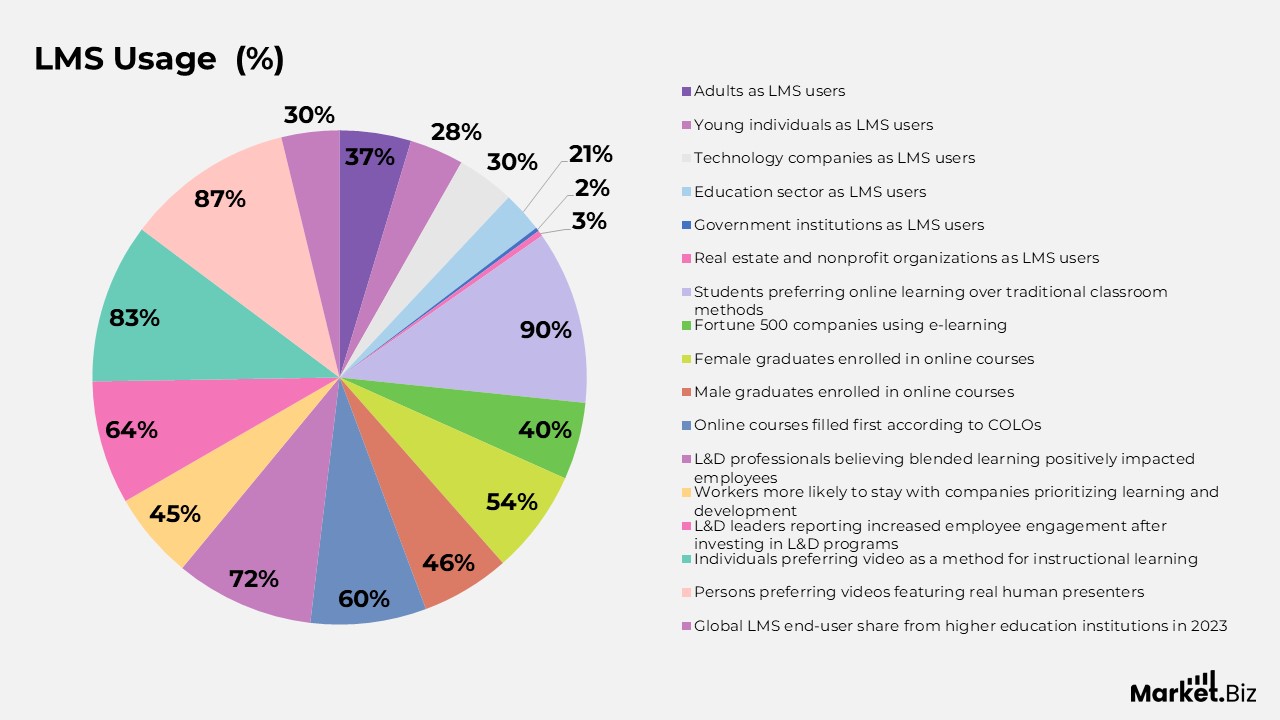
- Adults represent 37% of LMS users, while 28% of users are young individuals.
- Established technology companies account for 30% of LMS users, surpassing the education sector, which holds 21%.
- Government institutions represent a small 2% of the LMS market share.
- Real estate and nonprofit organizations each account for 3% of the LMS market.
- Other industries contributing to the LMS market include healthcare and consulting (7%), technology (12%), manufacturing (9%), and software development companies (4%).
- Approximately 90% of students prefer online learning over traditional classroom methods.
- Over 40% of Fortune 500 companies utilize e-learning to train their employees, with this percentage expected to rise shortly.
- 3.2 million college students are exclusively enrolled in online education courses.
- 3.6 million postsecondary students are enrolled in at least one distance education course.
- The global number of LMS users is estimated to be 73.8 million.
- 30% of all LMS users are from well-established tech companies.
- The education sector holds 21% of the LMS market share.
- 54% of female graduates are enrolled in online courses.
- 46% of male graduates are studying through online courses
- In the U.S., 514,109 students were enrolled in institutions offering exclusively distance education courses for the 2023-2024 academic year.
- A total of 4,982,428 learners were enrolled in distance education courses exclusively.
- According to the ninth CHLOE study, 60% of chief online learning officers (COLOs) reported that online courses were filled first, ahead of on-campus offerings.
- A recent survey found that 72% of L&D professionals believe blended learning has positively impacted employees.
- In the same survey, 45% of workers stated they are more likely to stay with a company that prioritizes employee learning and development.
- 64% of L&D leaders reported increased employee engagement after investing in more learning and development programs.
- Videos play a critical role in LMS, with 83% of individuals preferring video as a method for instructional learning.
- On average, people enjoy videos lasting 10-19 minutes.
- 87% of people prefer videos featuring real human presenters over animated types or AI avatars.
- In 2023, over 30% of global LMS end-user shares came from higher education institutions, with K-12 institutions, corporations, and enterprises following closely behind.
(Source: Hurix, Statista, Integrated Postsecondary Education Data System; Simunich et al.; Rise; Techsmith)
LMS Spending Statistics
- JPMorgan Chase has committed $600 million to enhance the skills of its workforce, while Amazon is investing more than $700 million to provide upskilling opportunities for its employees. PwC plans to allocate $3 billion to upskill its 275,000 employees over the next three to four years.
- A survey conducted in March 2021 revealed that 33% of Learning and Development (L&D) professionals globally expect an increase in their budgets, while only 19% foresee a decrease.
- In 2020, industry experts predicted that the corporate eLearning market would generate $31 billion in revenue.
- The education sector is anticipated to allocate $3.1 billion toward enterprise video by 2022.
- According to a 2021 survey, 73% of L&D professionals plan to reduce spending on instructor-led training (ILT), while 79% aim to increase investments in online learning.
- As of April 2020, 43% of educational institutions reported investments in new online learning resources and tools.
(Source: Statista, Technavio, Ovum, Education Data, Towards Maturity, JPMorgan)
Learning Management System Market Size
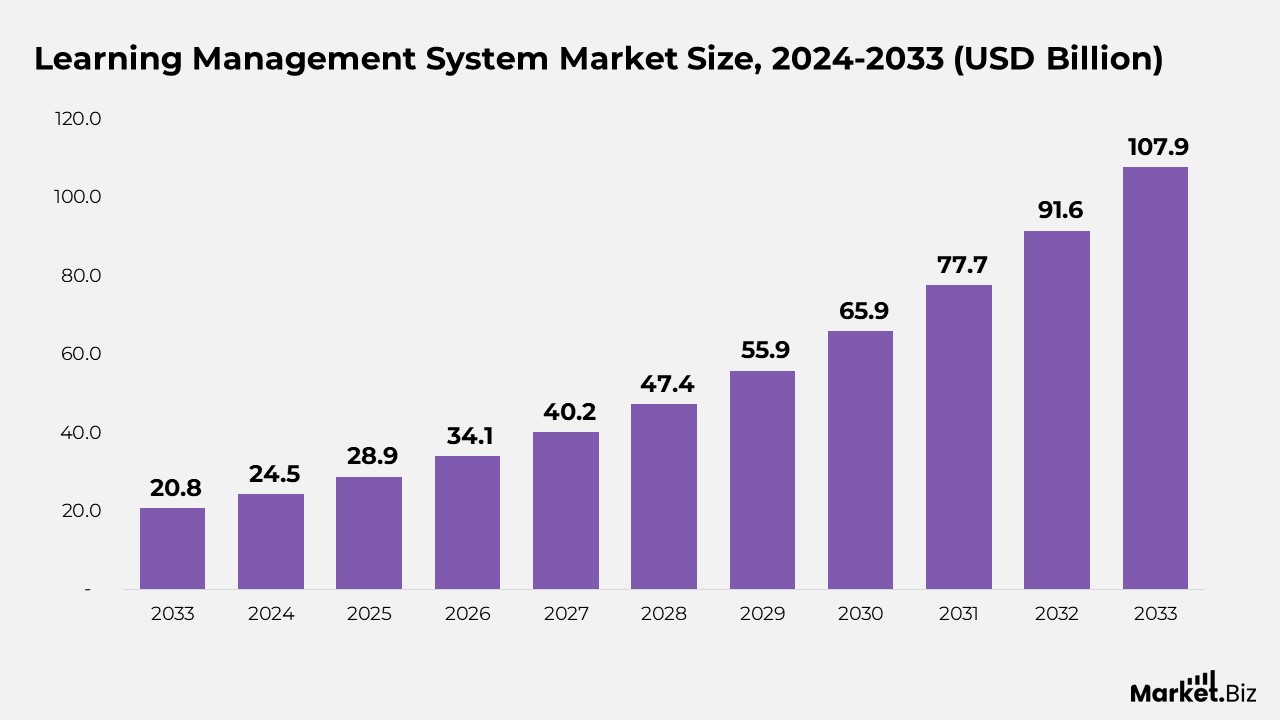
- According to Market.us, the learning management system market is expected to rise from $24.5 billion in 2024 to $107.9 billion by 2033, representing a compound annual growth rate (CAGR) of 17.9% from 2024 to 2033.
- The growth of the LMS market is driven by the increasing adoption of digital learning solutions in educational institutions and corporate sectors, with a focus on cost-effective training and remote learning, especially following global disruptions like the COVID-19 pandemic.
- The solution segment dominated the LMS market in 2023, capturing over 67% of the market share, driven by the growing demand for scalable and efficient e-learning platforms.
- The cloud-based segment led the LMS market in 2023, holding more than 70% of the market share, primarily due to the numerous advantages over traditional on-premises systems.
- The subscription-based segment led the LMS market in 2023, accounting for more than 75% of the market share, owing to its flexibility and scalability, which educational institutions and corporate entities increasingly value.
- The Higher Education segment dominated the LMS market in 2023, capturing over 30% of the market share, driven by the unique needs of higher education institutions.
- North America held a leading market position in the LMS market in 2023, with more than 37% of the market share, supported by strong technological infrastructure and high internet penetration rates. The demand in North America reached US$7.6 billion in 2023, with optimistic growth projections.
- A survey by the American Society for Training and Development revealed that companies with comprehensive training programs experienced a 218% increase in revenue and a 24% rise in profit margins, highlighting the significant impact of E-Learning and LMS on organizational success.
- Spending on external products and services reduced from US$11 billion to US$7.5 billion, while training-related expenses, including travel, facilities, and equipment, dropped from US$29.6 billion to US$23.8 billion. Training payroll saw a 10% increase, reaching US$51.7 billion.
(Source: Market.us)
Benefits of LMS
- Employees who recognize strong opportunities for learning and growth are 2.9 times more likely to be engaged in their work.
- Students participating in online classes retain 5 times more material than those in traditional classroom settings.
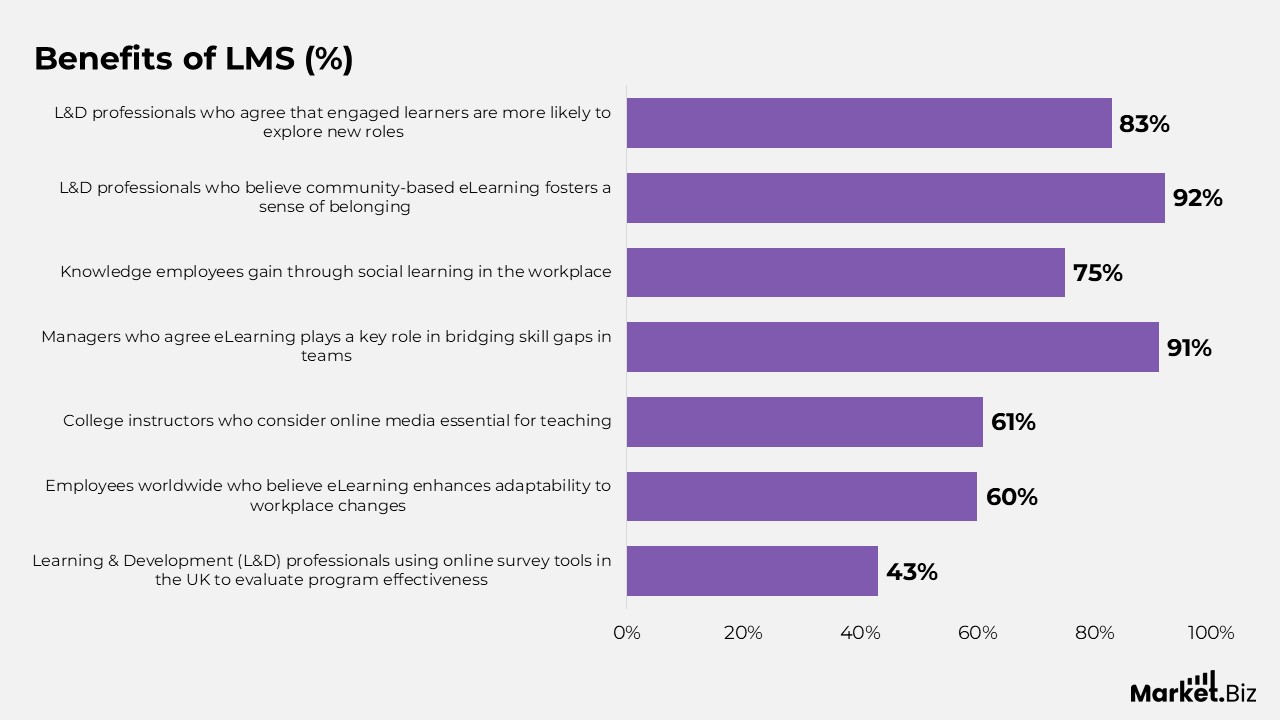
- 43% of Learning and Development (L&D) professionals in the United Kingdom utilize online survey tools to evaluate the effectiveness of their programs.
- 60% of employees worldwide feel that eLearning enhances their ability to adapt to changes in the workplace.
- 61% of college instructors believe online media—such as blogs, videos, and podcasts are essential tools for teaching.
- 91% of managers agree that eLearning plays a significant role in bridging skill gaps within their teams.
- Social learning accounts for at least 75% of the knowledge employees gain in the workplace.
- 92% of L&D professionals believe that community-based eLearning promotes a sense of belonging among learners.
- 83% of L&D professionals agree that involved learners are more likely to explore new roles within their group.
(Source: Statista, International Business Machines Corporation, University of Potomac, Growth Engineering)
LMS Accessibility Statistics
- In January 2024, global installations of educational apps increased by 20% compared to December 2023.
- On January 1, 2024, the installation of language learning apps saw a rise of 26%.
- Educational apps made up 9.56% of all iOS apps on the Apple App Store, ranking as the fourth-largest app category.
- On the Google Play Store, educational apps represented 11.5% of the most popular apps, following mobile gaming apps.
- In a survey conducted by Talent LMS in 2022, 37% of dissatisfied employees stated that giving them more control would make training more effective.
- Additionally, 38% of employees expressed a preference for completing training on a mobile platform.
(Source: Statista Talent LMS, Research.com)
Massive Open Online Courses (MOOC) Statistics
- In 2021, the number of courses exceeded 3,100, with over 500 micro-credentials available.
- By 2024, edX had reached 91 million learners, while Coursera had gained 162 million learners.
- Approximately 40% of Coursera’s top courses focus on AI skills and content, resulting in three million enrollments in AI-related courses in 2024, averaging six enrollments per minute.
- On edX, 450 AI-related programs were offered in 2023, leading to a 424% increase in enrollment in executive education courses related to AI.
(Source: Shah; edX; Coursera, Research.com.)
Impact of Learning Management Systems (LMS) on Academia
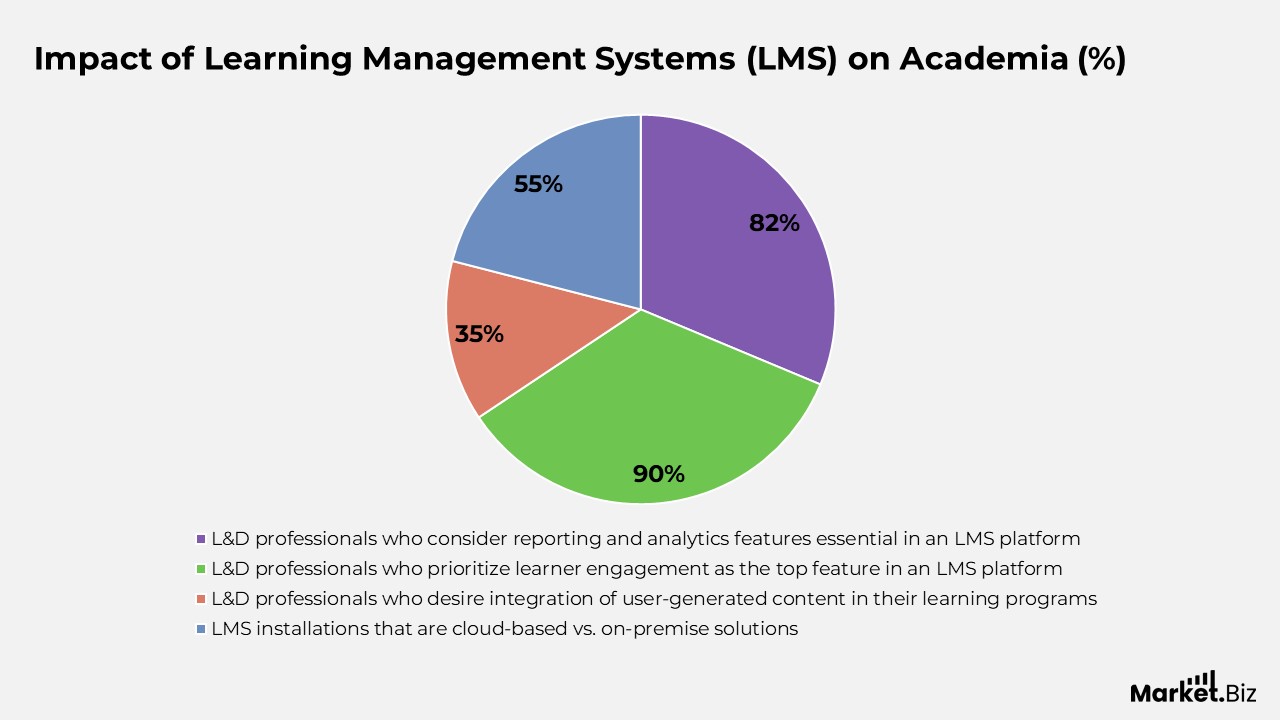
- 82% of L&D professionals consider reporting and analytics features crucial in an LMS platform.
- For 90% of L&D professionals, learner engagement is regarded as the top priority in an LMS platform.
- 35% of L&D professionals express a desire for user-generated content to be integrated into their learning programs.
- 55% of LMS installations are installed on the cloud, while 45% use on-premise solutions.
(Source: Elucian, Research.com, Statista, Learning Technologies, Research.com)
Challenges in Adopting a Learning Management System (LMS)
- In 2024, voters authorized school districts to borrow US$113.5 billion via bonds for construction and technology investments, but limited school funding remains a significant barrier to LMS adoption.
- The financial challenge of LMS adoption can be alleviated by more institutions offering affordable online programs. For example, prospective social workers can benefit from affordable MSW online programs that offer solid returns on investment.
- 15% of U.S. companies plan to allocate part of their budget for LMS acquisition in 2025, according to Training Magazine (2024). Another 15% are setting aside funds for mobile learning initiatives.
- 39% of companies intend to invest in online learning tools and systems in 2025.
- Due to economic uncertainties in 2024, 74% of U.S. firms reduced their budgets, while 38% chose to increase their budgets for purchasing new equipment or technology.
- 86% of U.S. companies do not outsource their LMS administration services, and 54% do not outsource LMS presentation or operations.
(Source: Training Magazine, Research.com, Statista)
Conclusion
The Learning Management System (LMS) market has experienced significant growth and evolution, fueled by advancements in technology, rising demand for remote learning solutions, and the shifting requirements of educational institutions and businesses.
As digital transformation becomes a priority for organizations, LMS platforms are expected to play a key role in improving learning experiences and enhancing knowledge retention. Key trends, including mobile learning, AI-powered personalization, and seamless integration with other enterprise systems, are anticipated to support the continued growth of the LMS market.
The ongoing development of scalable, intuitive platforms will drive demand across a variety of sectors, solidifying LMS as a crucial component in modern education and employee training.
FAQ’s
The Learning Management System (LMS) market has experienced significant growth in recent years, driven by the rising demand for digital learning solutions. As educational institutions and businesses increasingly adopt LMS for remote learning, employee training, and performance management, the market is expected to continue its expansion.
Technological innovations primarily drive the growth of the LMS market, the widespread shift to remote and eLearning models, the growing demand for customized learning experiences, and the integration of artificial intelligence (AI) and mobile learning capabilities.
LMS platforms are widely used across various industries, including education, healthcare, corporate training, government, and retail. These sectors leverage LMS for employee training, compliance management, professional development, and academic learning.
Mobile learning allows learners to access training and educational content from any location, enhancing accessibility and engagement. AI contributes to the LMS by offering personalized learning paths, automating administrative processes, and optimizing content delivery to meet the specific needs of individual learners.
Key trends in the LMS market include the rise of mobile learning, AI-powered personalized learning paths, the use of gamification, microlearning, and the seamless integration of LMS with other enterprise systems, such as HR and talent management platforms.

