









Introduction
Email Marketing Statistics: Email marketing remains one of the most effective and impactful tools for businesses to engage with their audience, drive conversions, and build lasting customer relationships. Known for its cost-effectiveness, personalization capabilities, and direct reach to a broad audience, email remains a dominant force in the digital marketing landscape.
As the industry evolves, staying informed about the latest trends, benchmarks, and statistics is essential for maintaining a competitive edge and optimizing your marketing efforts. Email marketing statistics provide valuable insights into current industry trends, consumer behaviors, and the performance of various campaigns.
From open rates and click-through rates to the rising significance of mobile optimization, these statistics highlight what’s working in email marketing today
Editor’s Choice
- 65% of email users check their inbox 3 times a day.
- 44% of users check their emails primarily to find brand deals.
- 87% of B2B marketers use email marketing to distribute their content.
- The ROI for email marketing is an impressive 4,200%.
- Segmented promotions can increase revenue by up to 760%.
- Automated emails have an open rate 70.5% higher than that of generic emails.
- Emails containing videos see a 300% increase in Click-Through Rates (CTR).
- About 58% of small businesses use digital marketing to connect with their customers.
- For every $1 spent on digital marketing, industries normally earn a $5 return on investment.
- Global digital advertising spending is expected to grow steadily, reaching $734.6 billion by 2025.
- Businesses spend an average of $45.11 per user on social media ads.
- By 2026, smartphones are projected to drive 69% of total ad spending.
- Programmatic advertising is expected to account for 87% of digital ad revenue by 2026.
- Social media ad spending is forecast to exceed $230 billion.
- 93.6% of internet users in the US aged 25 to 44 use email.
General Email Marketing Statistics
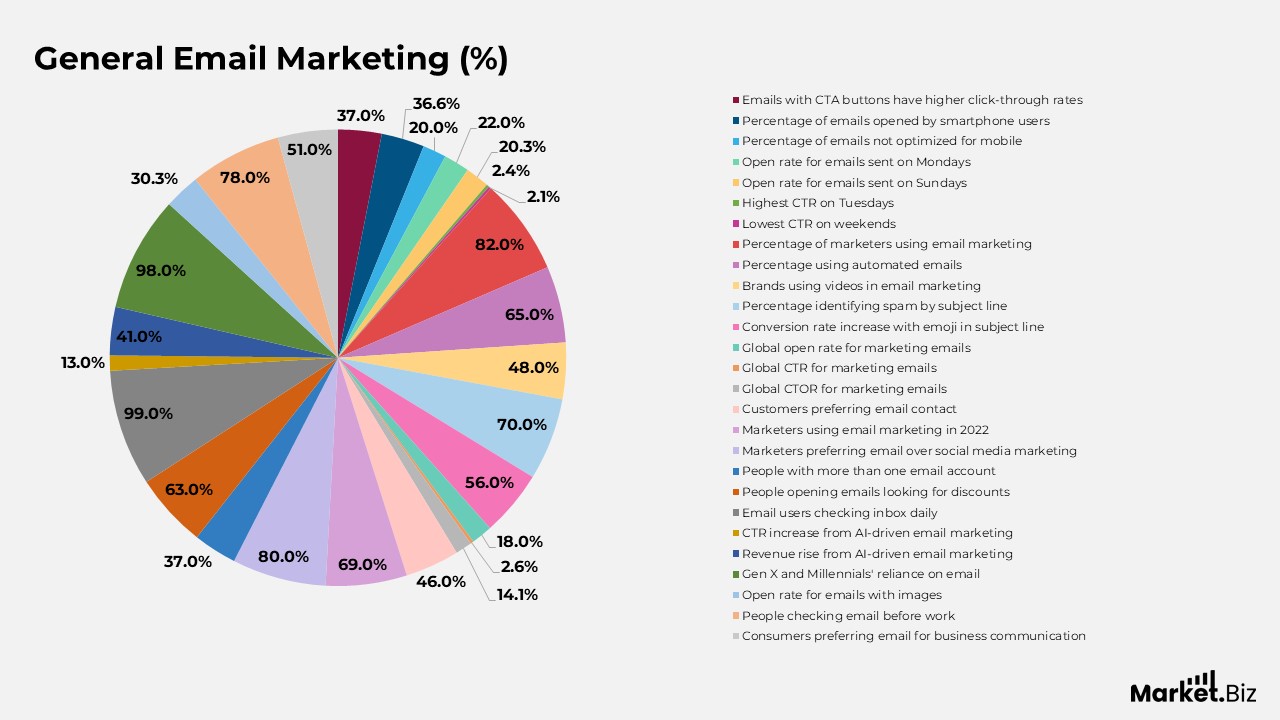
- Emails that include a call-to-action button experience 37% higher click-through rates.
- More than a quarter of emails (36.6%) are opened daily by smartphone users.
- Mobile-optimised emails are the second most common strategy used by email marketers to improve ROI.
- 20% of marketing email campaigns are not optimized for mobile devices.
- The revenue generated from email marketing is estimated to be $8.49 billion.
- Emails sent on Mondays have the maximum open rate, at 22%, while those sent on Sundays have the bottom, at 20.3%.
- Tuesdays see the highest click-through rates (2.4%), while Saturdays and Sundays have the lowest CTR at 2.1%.
- 82% of digital marketers globally use email marketing, with 65% of them incorporating automated emails.
- 48% of brands include videos in their email marketing campaigns.
- Nearly 70% of email recipients can identify spam simply by reading the subject line.
- The conversion rate increases by 56% when an email subject line contains an emoji instead of plain text.
- Marketing emails have an open rate of 18%, a click-through rate (CTR) of 2.6%, and a click-to-open rate (CTOR) of 14.1% globally.
- The unsubscribe rate for marketing emails globally stands at just 0.1%.
- On average, customers spend 10 seconds reading brand emails.
Moreover
- 46% of customers prefer to be contacted by brands through email.
- As of 2025, nearly4.5 billion people worldwide are using email, and this number is expected to exceed4.8 billion by 2027.
- The estimated number of email users is expected to reach 4.73 billion by 2026.
- Professionals check their email an average of 15 times per day, or once every 37 minutes.
- In 2024, 361 billion emails were sent daily.
- In 2022, 69% of marketers continued to rely on email marketing as a main means of distributing content.
- Global email marketing revenue is forecasted to reach $17.9 billion by 2027.
- 4 out of 5 marketers would prefer to give up social media marketing rather than email marketing.
- In 2021, people spent an average of just over 2.5 hours per day on email.
- 37% of individuals have more than one email account.
- 63% of people open emails looking for a discount.
- 99% of email users check their inbox daily.
- AI-driven email marketing yields a 13% increase in click-through rates and a 41% rise in revenue.
- 98% of Gen Xers and Millennials depend on email more than any other generation.
- Emails that include images have a higher open rate, averaging 30.27%.
- 78% of people check their email before going to work, with 11% checking their email immediately upon waking.
- 79% of Millennials and 57% of Gen Z prefer to be contacted by brands via email.
- 51% of consumers believe email is the most convenient and preferred way for businesses to communicate with them.
(Source: DemandSage, Content Marketing Institute, Statista, Oberlo, Harvard Business Review, OptinMonster, WixLXA, Luisa Zhou, Backlinko, HubSpot, Sleep Advisor, SmarterHQ)
Email Usage Trends
- As of 2022, there are more than 4.258 billion active email users worldwide. Statista predicts that this number will rise to nearly 4.4 billion by 2023.
- Over 3.13 million emails are sent every second.
- The global total of email accounts is estimated to surpass 7.9 billion.
- Gmail leads as the most popular email provider, with 1.8 billion active user accounts globally.
- On average, each user has at least 1.86 email accounts.
- In 2021, the total number of emails sent and received globally reached 319.6 billion per day, marking a 4.3% increase from 2020. This number is expected to continue growing in 2022, reaching 333.2 billion daily emails.
- 99% of email users check their inbox daily, with some individuals checking it up to 20 times a day.
- Consumers typically spend an average of 10 seconds reviewing brand emails.
- Checking email is often the first online activity of the day; 58% of users check their email before browsing social media or the news.
- In 2022, 333 billion emails were sent and received daily, with projections indicating this will rise to 392.5 billion by 2026.
- According to a 2024 Statista report, the global number of email users is projected to reach 4.6 billion by 2025, representing an increase of around 600 million users in just five years.
- Email volumes vary by country, with the US sending 9.7 billion emails daily. European countries, such as Ireland, Germany, the Netherlands, the UK, and France, each send over 8 billion emails daily, reflecting the global dominance of email.
(Source: Omnisend, Statista, Porch Group Media, Statista)
Email Marketing Market Size
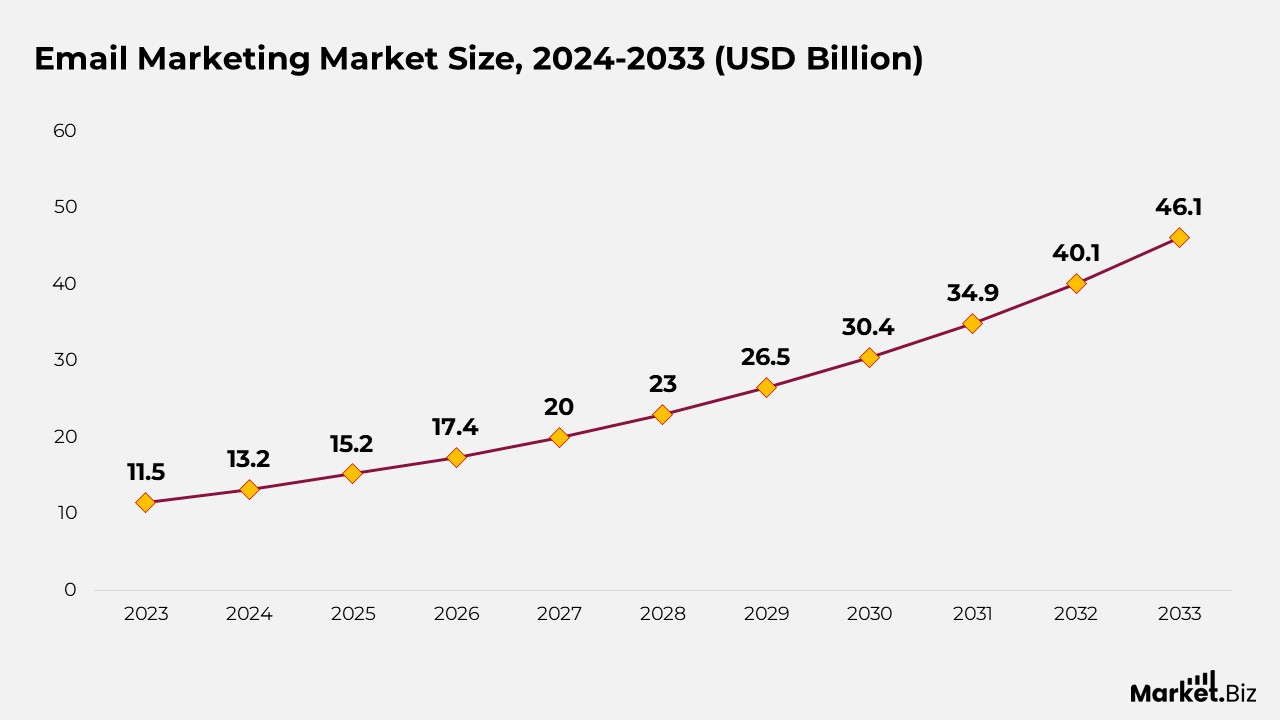
- According to Market.us, the email marketing market is projected to grow from $13.2 billion in 2024 to $46.1 billion by 2033, representing a compound annual growth rate (CAGR) of 14.9% from 2024 to 2033.
- The growth of the email marketing market is driven by the increasing digitalization of business practices and the recognition of its cost-effectiveness and high ROI. As companies see the tangible benefits of email marketing, it’s becoming a cornerstone for both customer acquisition and retention strategies.
- In 2023, Software dominated the Component segment of the Email Marketing Market, holding over 68.1% of the share. This trend is fueled by the growing use of AI-powered and automated email marketing solutions that streamline campaign management and boost efficiency.
- Cloud-based solutions led the Deployment Mode segment in 2023, capturing more than 70.5% of the market share. The scalability, flexibility, and lower upfront costs of cloud solutions make them the go-to choice for businesses looking to enhance their email marketing efforts.
- Large Enterprises captured more than 64.0% of the market share in the organisation size segment in 2023. These businesses typically invest larger marketing budgets into complex email campaigns, resulting in a dominant presence in this segment.
- Retail and E-commerce sectors accounted for 21.9% of the Email Marketing Market’s share in 2023. This growth is driven by the retail industry’s heavy reliance on personalized promotions, targeted offers, and discounts through email marketing campaigns.
Moreover
- North America maintained its leading position in the global email marketing market in 2023, accounting for 36.3% of the market share, valued at USD 4.17 billion. This dominance is attributed to the region’s advanced adoption of marketing technologies, strong investments in AI, and a concentration of leading email marketing platforms.
- On average, email marketing generates $42 in revenue for every $1 spent, showcasing its effectiveness and profitability. This impressive ROI continues to make email one of the most cost-effective digital marketing strategies.
- Email campaigns have an average open rate of 21.33% and a click-through rate of 2.62%, indicating strong engagement among recipients. These rates are significantly higher than those seen in traditional marketing channels, demonstrating the power of email as a direct communication tool.
- The use of calls-to-action in emails has resulted in a 371% increase in click-throughs and a 1617% rise in sales. Research confirms that well-crafted CTAs drive higher user engagement, leading to substantial improvements in campaign outcomes.
- Abandoned cart emails boast an impressive open rate of 45% and a click-through rate of 21%, demonstrating their effectiveness in recovering lost sales. These emails target customers who have shown interest but left without completing a purchase, prompting them to take action.
(Source: Market.us)
Digital Marketing Outsourcing Market Size
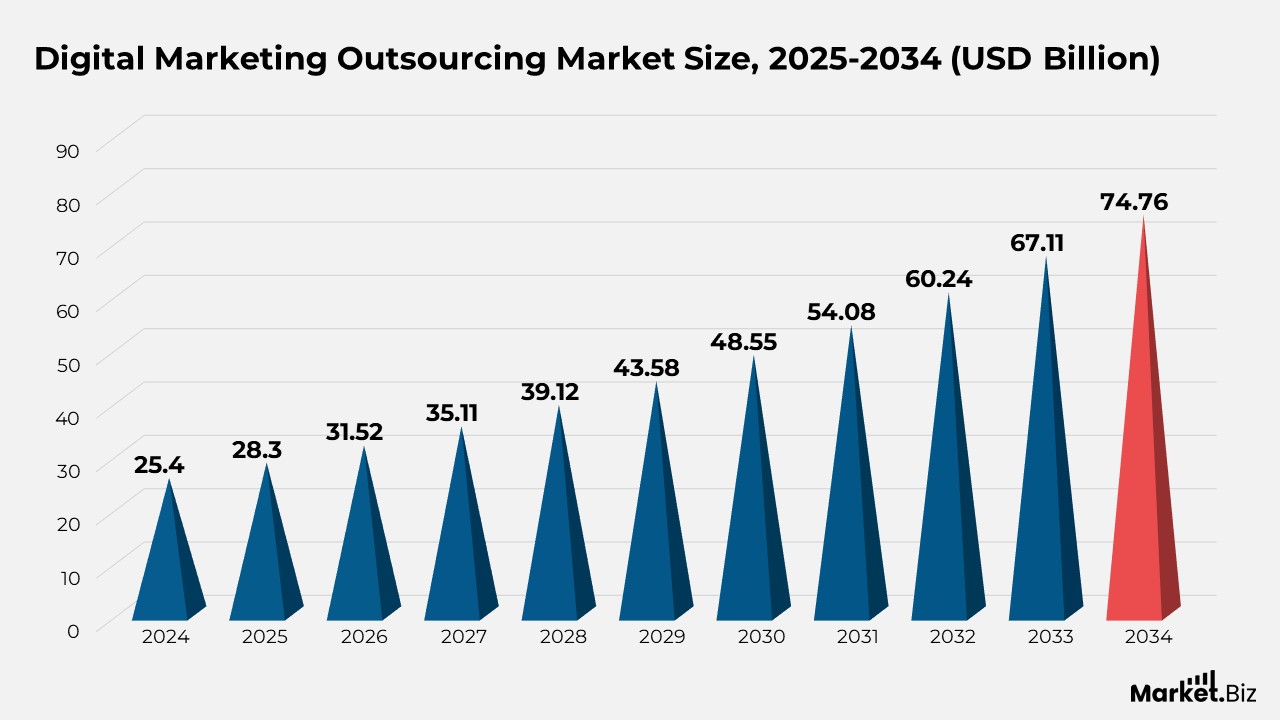
- According to Market.us, the digital marketing outsourcing market is projected to grow from $28.3 billion in 2025 to $74.76 billion by 2034, representing a compound annual growth rate (CAGR) of 11.4% from 2025 to 2034.
- The market growth is driven by the increasing demand for advanced automation and data-driven strategies, as businesses leverage AI-powered analytics, predictive tools, and omnichannel capabilities through outsourcing partners.
- In 2024, the Digital Marketing segment dominated the market, capturing more than 53.7% of the share, highlighting its essential role in navigating the complex digital consumer journey.
- The IT & Telecommunications segment led the market in 2024, with a share of over 23.8%, driven by the industry’s rapid digital transformation and increasing reliance on marketing technologies.
- The US market is expected to reach USD 8.82 billion by 2034, growing at a steady CAGR of 10.3%, indicating continued demand for outsourced digital marketing expertise.
- In 2024, North America held a dominant global market share of 38.6%, generating approximately USD 9.8 billion in revenue.
- According to ExplodingTopics, 92% of G2000 companies utilize IT outsourcing to reduce costs and focus on core areas, reflecting the importance of outsourcing in modern business strategies.
- In the Philippines, outsourcing accounts for 9% of the national GDP, underscoring its significant economic impact.
- About 37% of small businesses outsource at least one function, gaining flexibility and access to specialized expertise.
- China’s outsourcing sector is rapidly growing, with over 1 million new outsourcing employees joining annually, reinforcing its position as a global service hub.
(Source: Market.us)
Email Marketing Return On Investment (ROI)
- Email marketing boasts an impressive 4,200% ROI, demonstrating its significant impact on business success.
- On average, email marketing campaigns generate an ROI me ROI
- Automated emails generate 320% more revenue compared to non-automated emails.
- 51% of marketers consider segmentation one of the most effective strategies for email marketing.
- 60% of consumers have purchased as a result of receiving a promotional email.
- 63% of businesses reduce their email frequency based on consumer engagement.
- The unsubscribe rate for email marketing in 2022 was just 0.1%, reflecting strong engagement.
- Email testing can result in a higher overall return on investment, making it a valuable practice for marketers.
- 87% of brands agree that email marketing contributes significantly to their business success.
- The most successful email marketing campaigns often include message personalization (72%), segmentation (78%), and email automation (71%).
- 59% of Americans believe the majority of the emails they receive are not useful to them.
- Gmail leads as the most popular email client, used by 27.8% of users, closely followed by Apple Mail on the iPhone at 27.6%.
- Personalized emails can increase revenue by up to 760%, showing the power of tailored content.
- 95% of marketing professionals believe email marketing helps them achieve their business goals.
Moreover
- 75% of companies that spend $100 or less on email marketing per month report earning $21 or more for every dollar spent, placing email marketing above all other forms of digital marketing.
- Emails mentioning hobbies, government, or the arts tend to have the highest average open rates.
- Emails that feature image offers see a 10% increase in open rates.
- The average click-through rate (CTR) for email marketing is 3.25%. If your campaigns are performing at or above this rate, you’re doing well.
- Open rates align with CTRs: newsletters have a 40.08% open rate, while triggered emails boast a 45.38% open rate.
- Image-based emails receive a 4.84% CTR, significantly outperforming text-based emails, which have a 1.64% CTR.
- The main reasons customers unsubscribe from marketing emails are receiving too many emails (26%) and finding the content irrelevant (21%).
- Sponsored or co-marketing emails achieve the highest open rates compared to other types of email.
- A survey by The Manifest found that 59% of respondents unsubscribed from emails due to the frequency of emails.
- In 2022, Canada had the highest CTR for marketing emails among major countries, averaging 7.41%.
- Ecommerce businesses saw an average conversion rate of 3% from automated emails in 2022.
- 65% of B2C companies use email marketing software to organize and manage their content.
- 80% of B2C marketers rely on email marketing to nurture their audience.
(Source: Luisa Zhou, HubSpot, OptinMonster, Campaign Monitor, Instapage, Databox, Campaign Monitor, Techjury, Edison Mail, MailChimp, UpCity, MarketingSherpa, Statista, Content Marketing Institute)
Email Automation Performance Statistics
- Approximately 58% of businesses utilise email automation as part of their marketing strategy.
- In 2023, automated emails accounted for 41% of all email-driven orders, despite comprising only 2% of total email sends.
- On average, automated emails achieve an open rate of 42.1%, a click rate of 5.4%, and a conversion rate of 1.9%.
- One in three people who click on an automated email make a purchase.
- Nearly 50% of recipients who click on welcome emails and cart abandonment emails ultimately make a purchase.
- Back-in-stock emails have the highest conversion rate among automated emails, at 5.84%.
- The average conversion rate for welcome emails is 2.74%, while the conversion rate for abandoned cart emails is 2.56%.
- Shipping and order confirmation emails are 22 times more effective than standard campaign emails.
(Source: Forbes, Wix.com, Inc., Omnisend)
Mobile Email Marketing Statistics
- 81% of all email opens occur on mobile devices.
- The average click-through rate for mobile device users is significantly lower than for PC users, with 72.2% of email CTA clicks coming from PC users.
- Around 20% of email marketing campaigns are not optimized for mobile devices.
- One-third of all emails are opened on an iPhone.
- 64% of users primarily use mobile devices to check their emails.
- Apple’s email client holds 49.79% of the market share, followed by Gmail with 28.16%, and Outlook at 7.70%.
- Mobile clients account for 41.6% of email opens, while webmail opens account for 40.6% and desktop opens account for 16.2%.
- About 3 in 5 users check their email while on the go, and 75% use their smartphones most often to access their inbox.
- 35% of business professionals view emails on mobile devices.
- 1.7 billion people use mobile phones as their primary email device.
- 42.3% of users delete emails that aren’t optimized for mobile devices.
- Mobile email views outpace desktop views by up to 3 times.
- 85% of users access their inboxes via mobile devices.
- 36.3% of global email opens occur on mobile devices. Despite this, 20% of marketing campaigns are not optimized for mobile devices.
- 75% of Gmail consumers read their emails on smartphones or tablets.
- Apple’s email app is the most popular platform for mobile email usage.
- Visitors are 65% more likely to view your website after reading a mobile-optimiZed email.
- A majority of email views come from mobile devices (41%), followed by desktop views at 39%
(Source: Porch Group Media, Statista, SuperOffice, Mailchimp, ZeroBounce, Forbes, Litmus)
Email Subject Lines Statistics
- Approximately 47% of people open an email based solely on the subject line.
- On the flip side, 69% of individuals consider emails as spam based solely on the subject line.
- Subject lines with fewer than 70 characters tend to have the highest open rates.
- 42% of individuals first check the sender of the email before deciding to open it.
- 45% of marketers use automation for A/B testing subject lines.
- The most successful email subject lines often include promotional offers, spark curiosity, and are personalized to the recipient’s preferences.
- On the iPhone email app, only the first 30 characters of the subject line are visible.
- Subject lines that contain emojis can increase open rates by 56% compared to subject lines that only contain text.
- Nearly 60% of email opens occur on mobile devices.
- 49% of consumers prefer to receive promotional emails from their favourite brands every week.
- The global average open rate for emails is approximately 27%.
- 63% of people are likely to open an email that includes a discount.
- Fridays see the highest open rate, just under 19%.
- Personalized emails have an open rate of 22.63%.
- 75% of marketers believe that personalized email marketing campaigns lead to higher click-through rates.
- Welcome emails have the highest open rates, reaching 50%.
- Around 22% of email marketing campaigns are opened within the first hour of being sent.
- Companies that send 2 emails per month tend to see higher open rates.
- Recognizing the sender is the most critical factor in whether an email gets opened.
- Emails with preheader text have an open rate of 44.67%, compared to 39.28% for those without a preheader text.
(Source: Shopify, OptinMonster, Statista, HubSpot, Litmus, Campaign Monitor, Yola, GetResponse, Mirabel’s Marketing Manager, Luisa Zhou, Moosend, Act-On, Influencer Marketing Hub, Instapage, Techjury, Mailjet)
Artificial Intelligence (AI) email marketing statistics
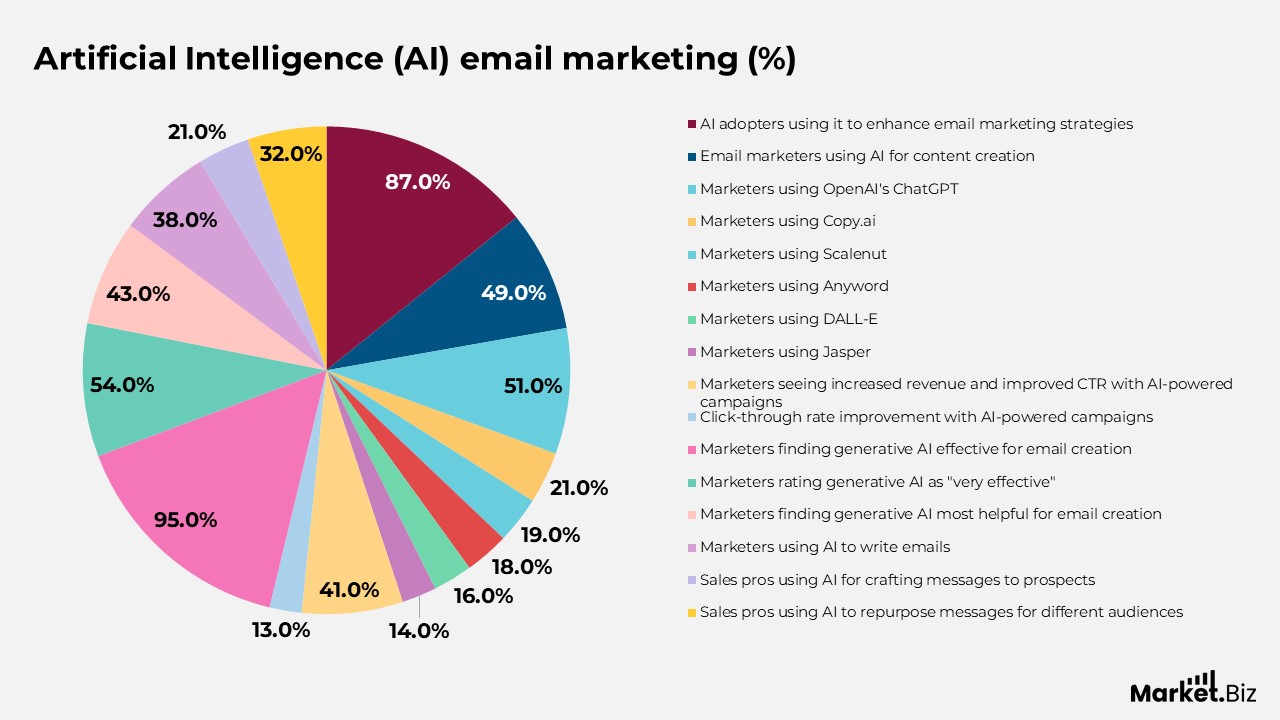
- 87% of AI adopters utilize it to enhance their email marketing strategies.
- 49% of email marketers leverage AI to assist with content creation.
- Among marketers using AI, 51% utilise OpenAI’s ChatGPT, while other popular tools include Copy.ai (21%), Scalenut (19%), Anyword (18%), DALL-E (16%), and Jasper (14%).
- 41% of marketers report an increase in revenue, with click-through rates improving by 13% through AI-powered campaigns.
- 95% of marketers using generative AI for email creation consider it “effective,” with 54% rating it as “very effective.”
- 43% of marketers find generative AI most helpful for creating emails.
- 38% of marketers using AI employ it to write emails.
- 21% of sales professionals using AI say it’s most helpful for crafting messages to prospects, while 32% use it to repurpose messages for different audiences.
(Source: Wix.com, Inc., Statista, Forbes, Adobe, Master of Code, Litmus, HubSpot’s State of Generative AI)
Conclusion
Email marketing remains one of the most powerful and impactful strategies for connecting with customers, boosting conversions, and building brand loyalty. The statistics reflect the growing reliance on email for communication, with billions of users worldwide and substantial revenue generated from email marketing campaigns.
The significance of mobile optimization, tailored content, and well-placed calls-to-action is clear, as they contribute to higher engagement and conversion rates. Furthermore, the integration of AI-driven marketing and the use of multimedia elements, such as videos and emojis, are improving the overall performance of email campaigns.
As companies increasingly adopt automation and data-driven approaches, email marketing will continue to be a key pillar of digital marketing, delivering strong returns on investment and ongoing growth opportunities.
FAQ’s
As of 2025, nearly 4.5 billion people worldwide use email, with projections indicating that this number will surpass 4.8 billion by 2027.
On average, professionals form their email 15 times a day, which equates to roughly every 37 minutes.
Email marketing provides an outstanding 4,200% ROI, meaning businesses generate $42 for every $1 spent on email marketing efforts.
Approximately 20% of marketing emails are not optimized for mobile devices, underscoring the importance of creating mobile-friendly content to boost engagement.
AI-powered email marketing has been proven to increase click-through rates by 13% and enhance revenue by 41%, demonstrating its role in improving campaign personalization and effectiveness.
Emails that incorporate video experience a 300% increase in click-through rates, while image-rich emails have an average open rate of 30.27%.
Emails sent on Mondays typically achieve the highest open rate, at 22%, while those sent on Sundays have the lowest open rate, at 20.3%.
Globally, marketing emails achieve an average click-through rate of 2.6%, with Tuesdays showing the highest CTR at 2.4%.