








Introduction
Sexually Transmitted Diseases Statistics: Sexually Transmitted Diseases (STDs), or Sexually Transmitted Infections (STIs), are a major public health issue globally. These infections are primarily transmitted through sexual activity, affecting people across all genders, ages, and sexual orientations. Over the years, the prevalence of STDs has fluctuated, influenced by factors such as public health initiatives, educational efforts, and access to healthcare.
Examining STD-related statistics is essential for developing effective prevention programs, healthcare policies, and educational campaigns. Key factors such as transmission rates, demographic trends, and the global impact of specific infections like HIV/AIDS, Chlamydia, Gonorrhea, and Syphilis play a vital role in informing healthcare strategies and the distribution of resources.
These statistics help to understand the incidence and prevalence of STDs, their effects across populations, trends observed in recent years, and preventive measures.
Editor’s Choice
- Every day, over 1 million new cases of STDs are acquired globally among people aged 15-49, with the majority of these infections remaining asymptomatic.
- As of 2023, around 39.9 million people worldwide are living with HIV, with Sub-Saharan Africa being the most affected region, representing a significant share of the global HIV burden.
- Chlamydia remains the most commonly reported STD globally, especially among young adults aged 15-24, who account for nearly half of all new cases.
- Adolescents and young adults (ages 15-24) continue to represent the majority of new STD infections, underscoring the need for targeted education, prevention efforts, and regular testing in this age group.
- While advancements are being made in the development of vaccines and treatments for certain STDs, such as Hepatitis B and HPV, challenges remain, particularly with the emergence of drug-resistant gonorrhea strains and the lack of cures for viral infections like HIV and herpes.
Sexually Transmitted Diseases Market Size
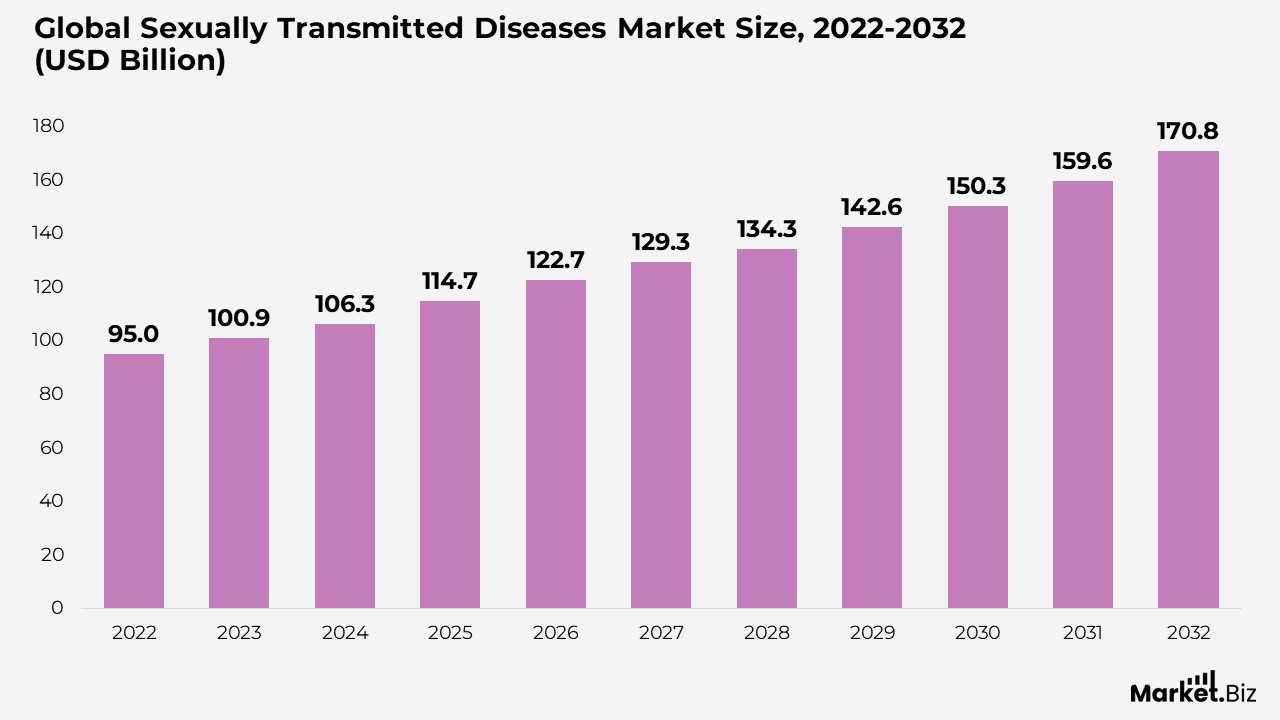
- According to Market.us, the global market for sexually transmitted diseases (STDs) is projected to grow from $114.7 billion in 2025 to $170.8 billion by 2032, reflecting a compound annual growth rate (CAGR) of 6.2% from 2022 to 2032.
- An increase in unprotected sexual activity primarily drives the growth of the STD market, enhanced public awareness and education efforts, growing government initiatives, and rising global prevalence of STDs. Education campaigns and increased patient awareness further increase demand for treatment and testing services.
- In 2022, Chlamydia emerged as the most common type of STD due to limited use of barrier protection and insufficient public awareness. However, syphilis is forecast to experience robust growth, with exceptions indicating that it will represent over 20% of the market by 2022.
- The laboratory testing segment will remain the largest in the global STD testing market during the forecast period. Laboratory-based diagnostics are expected to drive increased demand for STD testing, as most of these tests are conducted in controlled laboratory environments.
- North America, particularly the United States, holds a dominant share of the global STD diagnostics market, accounting for 52.2% of revenue. The region’s market growth is fueled by an increasing demand for STD diagnostic services, heightened awareness, and supportive government policies aimed at improving sexual health.
- China is projected to be the market leader in the Asia-Pacific region, with an expected CAGR of 7.2% from 2022 to 2032. Rising STD awareness, an expanding healthcare infrastructure, and increasing demand for diagnostic services in the region drive this growth.
(Source: Market.us)
Sexually Transmitted Diseases Statistics
- Every day, more than 1 million new curable STIs are acquired globally among individuals aged 15–49, with the majority remaining asymptomatic.
- Approximately 374 million new infections of one of four curable STIs, such as gonorrhea, Chlamydia, trichomoniasis, and syphilis, were detected among people aged 15–49.
- An estimated 8 million adults aged 15–49 were infected with syphilis in 2022.
- Over 500 million people aged 15–49 live with a genital herpes simplex virus infection globally.
- Human papillomavirus infections contribute to more than 311,000 cervical cancer-related deaths annually.
- In 2022, around 1.1 million pregnant people were infected with syphilis, resulting in over 390,000 adverse birth outcomes.
(Source: World Health Organization)
Common Sexually Transmitted Infections
Human Immunodeficiency Virus (HIV)
HIV is a retrovirus that targets the immune system, specifically attacking CD4 cells, which play a vital role in the body’s defense against infections. Over time, HIV weakens the immune system, leaving the affected individual more vulnerable to a range of infections and diseases.
- Since the onset of the epidemic, approximately 88.4 million people (with a range of 71.3 to 112.8 million) have been infected with HIV, and around 42.3 million people (ranging from 35.7 to 51.1 million) have died from HIV-related causes.
- By the end of 2023, an estimated 39.9 million people (ranging from 36.1 to 44.6 million) were living with HIV worldwide.
- The global prevalence of HIV among adults aged 15-49 is approximately 0.7%.
- The WHO African region is the hardest hit, with nearly 1 in every 25 adults (or 3.4%) living with HIV.
(Source: World Health Organization)
Chlamydia
- Chlamydia is a treatable and preventable STI caused by the bacterium Chlamydia trachomatis, primarily transmitted through vaginal, oral, and anal sex.
- According to WHO data from 2024, it is estimated that there were 128.5 million new chlamydia infections worldwide among adults aged 15–49 in 2020.
(Source: World Health Organization)
Syphilis
- The WHO estimated that 8 million adults aged 15 to 49 contracted syphilis in 2022.
- Syphilis is the second leading cause of preventable stillbirths worldwide.
- Each year, over 300,000 fetal and neonatal deaths are linked to syphilis, with complications arising from the infection during pregnancy.
- In addition to these deaths, approximately 215,000 infants face an increased risk of early mortality due to syphilis.
(Source: World Health Organization, National Institute of Health, Market.us)
Herpes
- Herpes is a sexually transmitted infection (STI) caused by the herpes simplex virus, which has two key types: HSV-1 and HSV-2.
- It is estimated that 3.8 billion individuals globally, or 64% of those under age 50, are infected with HSV-1, the primary source of oral herpes.
- Around 520 million individuals aged 15–49 worldwide, or 13% of the population, are projected to have HSV-2, the main cause of genital herpes.
(Source: World Health Organization, National Institute of Health, Market.us)
Statistics on STDs by Country/Region
The U.S.
The United States has consistently recorded high rates of STDs, such as gonorrhea, Chlamydia, and syphilis. The CDC reported a continuous rise in the number of STD cases in recent years.
Chlamydia
- Chlamydia is the most frequently reported STD in the U.S.
- In 2023, more than 2.4 million people with syphilis, Chlamydia, and gonorrhea were reported and identified, including more than 209,000 people with syphilis, over 1.6 million people with Chlamydia, and over 600,000 people with gonorrhea.
- The total count included 3,882 people with congenital syphilis, which comprised 279 neonatal/infant and stillbirth deaths related to the infection.
- The overall number of sexually transmitted infections decreased by 1.8% from 2022 to 2023, following these trends:
- A 7.2% reduction in gonorrhea cases.
- Stable rates for Chlamydia, with less than a one per cent change.
- A 1.0% growth in total syphilis cases, including all stages and congenital syphilis.
Syphilis
- In 2023, a total of 209,253 cases of syphilis (including all stages and congenital syphilis) were reported, marking the top number of cases since 1950, with a 1.0% increase compared to 2022.
- There were 53,007 cases of P&S syphilis, reflecting a 10.2% decrease compared to 2022.
- A total of 53,573 cases of early non-primary non-secondary syphilis were reported, showing a 5.9% decrease from 2022.
- There were 98,791 cases of late or unknown duration syphilis, representing a 12.8% increase compared to 2022.
- The number of congenital syphilis cases reached 3,882, indicating a 3.0% increase from the previous year.
Gonorrhea
- In 2023, the U.S. reported 601,319 gonorrhea cases, making it the second most commonly reported nationally notifiable sexually transmitted infection (STI).
- After reaching a historic low in 2009, gonorrhea rates began to rise through 2021. However, there was a notable 9.2% decline in the overall rate from 2021 to 2022, followed by a further reduction of 7.7% from 2022 to 2023.
- Between 2022 and 2023, gonorrhea rates fell across genders, all age groups, and most racial and Hispanic ethnic groups. This reduction was observed in 40 states nationwide.
- The most significant decrease was observed in women, with a 14.1% drop in gonorrhea cases. Specifically, women aged 20 to 24 experienced a 14.6% reduction, while those aged 25 to 29 saw a 19.2% decrease. Furthermore, women diagnosed outside of STD clinics experienced a 13.0% decline in cases.
- Given that gonococcal infections are often asymptomatic, trends in gonorrhoea case reports are influenced by the underlying incidence of infection and the extent of screening coverage. The recent decline in reported cases may reflect reduced new infections and diminished screening efforts.
Chlamydia
- In 2023, the U.S. saw 1.64 million reported cases of Chlamydia trachomatis infection, making it the most frequently reported nationally notifiable STI that year.
- The reported Chlamydia rate in 2023 was 492.2 cases per 100,000 individuals, similar to the 2021 rate of 495.0 cases per 100,000.
- From 2022 to 2023, the rate of Chlamydia cases increased by 1.3% among men, while a 1.7% decline was observed among women.
- Chlamydia rates continue to be highest among adolescents and young adults. In 2023, individuals aged 15 to 24 accounted for 55.8% of all Chlamydia cases.
(Source: Centers for Disease Control and Prevention (CDC))
Canada
- Canada has seen an increase in STD rates in recent years.
- Canada recorded over 104,000 new cases of Chlamydia, 32,079 new cases of gonorrhea, and 11,516 cases of syphilis in 2021.
- A survey of university students in Canada revealed that only 29% of women and 36% of men expressed concern about STDs despite the rise in cases.
- The survey also found that only 40% of women and 57% of men reported using a condom during their most recent sexual encounter.
(Source: Statista)
Europe
- In 2023, over 41,000 established cases of syphilis were reported across the European Economic Area (EEA). Spain recorded the highest number, with approximately 10,600 cases, followed by Germany, with over 9,100 cases, reflecting significant regional variations in syphilis incidence.
- A total of 100,000 confirmed gonorrhea cases were reported across 28 EU/EEA countries in 2023, with a crude notification rate of 17.9 cases per 100,000 population.
- In 2023, 41,051 confirmed syphilis cases were recorded in 29 EU/EEA Member States, with a crude notification rate of 8.5 cases per 100,000 population.
- In 2022, 37 out of 49 nations in the region, including 26 in the EU, reported a rise in HIV diagnoses compared to 2021, with some nations reaching top numbers in a year.
- A total of 110,486 new HIV diagnoses were reported across 49 of the 53 countries in the region in 2022, with 22,995 cases coming from EU/EEA countries.
- Denmark reported the highest rate of Chlamydia in 2022, with more than 708 cases per 100,000 population. Norway followed with approximately 539 cases per 100,000 population.
- In 2022, nearly 23,000 new HIV diagnoses were recorded across the EEA, marking an increase of almost 4,500 cases compared to 2021. Most cases were reported among individuals aged 30 to 39, with men affected more than women across all age groups.
(Source: Statista, European Centre for Disease Prevention and Control)
India
- India faces a substantial problem of STDs, with HIV/AIDS being particularly prevalent. The nation also accounts for a notable number of cases of gonorrhea, Chlamydia, and syphilis.
- It is estimated that nearly 6% of mature individuals in India are affected by more than one sexually transmitted infection (STI) or reproductive tract infection (RTI).
- This equates to about 30 to 35 million incidents of RTIs/STIs annually in India.
(Source: National Institute of Health, Market. us)
Brazil
- Brazil experiences cases of sexually transmitted diseases, including syphilis, HIV/AIDS, and HPV infections. The nation has introduced various initiatives to tackle these public health challenges.
- A study across 6 Brazilian states revealed the following occurrence rates of STIs among women living with HIV: The study revealed that 2.1% of women living with HIV had Chlamydia. Gonorrhea was found in 0.9% of women living
- with HIV.
- The study likewise recognized a 2.7% prevalence rate for the coinfection of gonorrhea and Chlamydia among women active with HIV.
(Source: National Institute of Health, Market. Us, Statista)
South Africa
- South Africa has one of the highest HIV/AIDS prevalence rates in the world, along with significant rates of other sexually transmitted diseases, including syphilis and gonorrhea.
- In 2022, approximately 7.6 million people in South Africa were living with HIV.
- The adult HIV prevalence rate in South Africa was 17.8% in 2022.
- The country reported 160,000 new HIV infections in 2022.
- There were 45,000 deaths attributed to AIDS in South Africa during the same year.
- A total of 5.7 million individuals were receiving antiretroviral treatment in South Africa.
- The prevalence of HIV among adults aged 15 to 49 was approximately 20% in 2022.
- In 2022, South Africa saw an estimated 2.3 million new gonorrhea cases.
- The country also reported an estimated 1.9 million new cases of Chlamydia and 23,175 new syphilis cases in 2022.
- The estimated number of AIDS-related deaths in South Africa in 2022 reached 85,796.
(Source: Kenya Communications Hub, Statista, NCID, Market.us)
Vaccination for Sexually Transmitted Diseases Statistics
- By 2023, approximately 27% of adolescent girls globally had received at least one dose of the HPV vaccine, marking an increase from 20% in 2022. This growth is largely attributable to the expansion of vaccination programs in Indonesia, Bangladesh, and Nigeria.
- In the WHO European Region, HPV vaccination coverage among females was approximately 32% in 2022, although this figure varied significantly across countries.
- Despite the HPV vaccine’s proven efficacy in preventing several cancers, including cervical, anal, and penile cancers, vaccination rates among boys are still much lower compared to those among girls in many parts of the world.
- Since November 2022, 125 countries have introduced HPV vaccination in their national immunization programs.
- In some high-income countries, adolescent girls’ coverage rates have reached or exceeded 80%.
- According to the WHO, as of September 2021, 84% of countries worldwide had included hepatitis B vaccination in their national immunization programs.
(Source: World Health Organization, National Institute of Health, HPV World, VaccinesWork, WIRED)
Health Education and Promotion of Sexually Transmitted Diseases Statistics
- In September 2024, the American Sexual Health Association (ASHA) introduced National Get Tested Day, offering 250 free Everlywell at-home tests for Chlamydia and Gonorrhea, aiming to raise awareness about the importance of regular testing.
- In July 2023, UNESCO emphasized the significance of health education and prevention in improving the management and governance of the national response to AIDS, STDs, and viral hepatitis. The initiative focused on enhancing prevention efforts, expanding access to services, conducting research, and improving the quality of care for vulnerable populations.
- The U.S. Department of Health and Human Services launched the Sexually Transmitted Infections National Strategic Plan for 2021-2025. This plan serves as a guide for various stakeholders, including public health agencies, healthcare providers, government bodies, community organizations, academic institutions, and the private sector, to develop and expand STI prevention and care programs at local, state, tribal, and national levels over the next five years.
(Source: American Sexual Health Association, UNESCO)
Recent Developments
Product Launches and Approvals
- In April 2023, BioPerfectus introduced the Treponema Pallidum Real-Time PCR Kit and Mycoplasma Hominis Real-Time PCR Kit, designed to detect sexually transmitted diseases that impact many individuals.
- In February 2023, Mylab Discovery Solutions launched the HCV Ab and HIV 1/2 Ab rapid tests to detect sexually transmitted diseases.
Fundings Rounds
- In January 2025, the Health Resources & Services Administration secured $20 million in funding to enhance HIV prevention, testing, and treatment services at health centers.
- STDHealth secured $50 million in Series A funding, with Healthcare Investment Group XYZ leading the round. The funding will be used to expand their network of STD treatment clinics and enhance outreach efforts targeting high-risk populations. The company aims to boost patient visits by 50% over the next year.
Public Health Programs and Initiatives
- Public health organizations initiated campaigns to increase awareness about the prevention, testing, and treatment of STDs, focusing on high-risk groups like adolescents and young adults.
- Government-funded STD clinics broadened their services to offer comprehensive care, including testing, treatment, counseling, and partner notification.
R&D
- Pharmaceutical companies and Research institutions have dedicated resources to developing new vaccines and treatments for STDs, focusing on drug-resistant strains and emerging infections such as antibiotic-resistant gonorrhoea.
- Studies on the transmission and epidemiology dynamics of STDs have provided valuable insights that guide policy decisions and public health interventions aimed at controlling their spread.
Conclusion
Sexually Transmitted Diseases Statistics: In conclusion, sexually transmitted diseases (STDs) remain a major global public health concern, affecting millions of people annually.
Despite advancements in prevention, testing, and treatment, the growing prevalence of certain STDs, the rise of drug-resistant strains, and the disproportionate impact on high-risk populations underscore the continued need for robust public health efforts.
Increased investment in research, enhanced access to healthcare, and focused awareness campaigns are vital for reducing the transmission of STDs and minimizing their long-term health effects.
Ongoing collaboration among governments, healthcare providers, and research organizations is crucial to strengthening prevention measures, improving early diagnosis, and ensuring that effective treatments are widely accessible.
FAQ’s
STDs, or sexually transmitted infections (STIs), are infections that are primarily transmitted through sexual activity, including vaginal, oral, and anal sex. Some STDs can also be spread through shared needles or from mother to child during childbirth or breastfeeding.
The most commonly reported STDs include:
Chlamydia
Herpes (HSV)
Gonorrhea
Syphilis
Human Immunodeficiency Virus (HIV)
Human Papillomavirus (HPV)
STDs are typically spread through sexual contact, including anal, vaginal, and oral sex. Some STDs, like HIV, can also be transmitted by the sharing of needles or from mother to child during childbirth.
Symptoms of STDs can vary greatly. Many STDs have no noticeable symptoms, especially in their early stages. However, common symptoms may include unusual discharge from the vagina or penis, bumps or sores on the genital or oral areas, and itching, pain during sex, and flu-like symptoms.
Preventing STDs can be achieved through the consistent use of dental dams or condoms during sexual activity, vaccination, regular testing for HPV and Hepatitis B, and controlling the number of sexual partners.
While condoms significantly decrease the risk of STD transmission, they are not 100% effective. Some STDs, like HPV and herpes, can be transmitted through skin-to-skin contact, which a condom may not fully cover.

