









Introduction
Snacks Statistics: The global snacks industry is flourishing and consistently growing, providing a wide array of convenient and pleasurable food options. This expansion is fuelled by shifting lifestyles and changing consumer preferences, with snack varieties such as chips, pretzels, popcorn, and nuts gaining popularity.
These snack items are accessible to consumers through multiple channels, including traditional retail stores and online marketplaces. Consumer choices regarding snacks are increasingly shaped by health factors and a heightened focus on sustainability.
In this industry, challenges and opportunities coexist, and competition drives innovation and adaptation to satisfy changing consumer demands. Fuelled by rapid urbanisation, rising disposable incomes, and evolving lifestyles, snacking has emerged as a fundamental part of the diet, representing over 22% of daily energy intake for numerous consumers.
Editor’s Choice
- In 2023, the worldwide revenue for the snacks market was recorded at USD 1,220.9 billion.
- Supermarkets and hypermarkets dominate the market, holding a significant 43% share of the distribution channel.
- The United States is the leading revenue generator, boasting an impressive total of $114 billion.
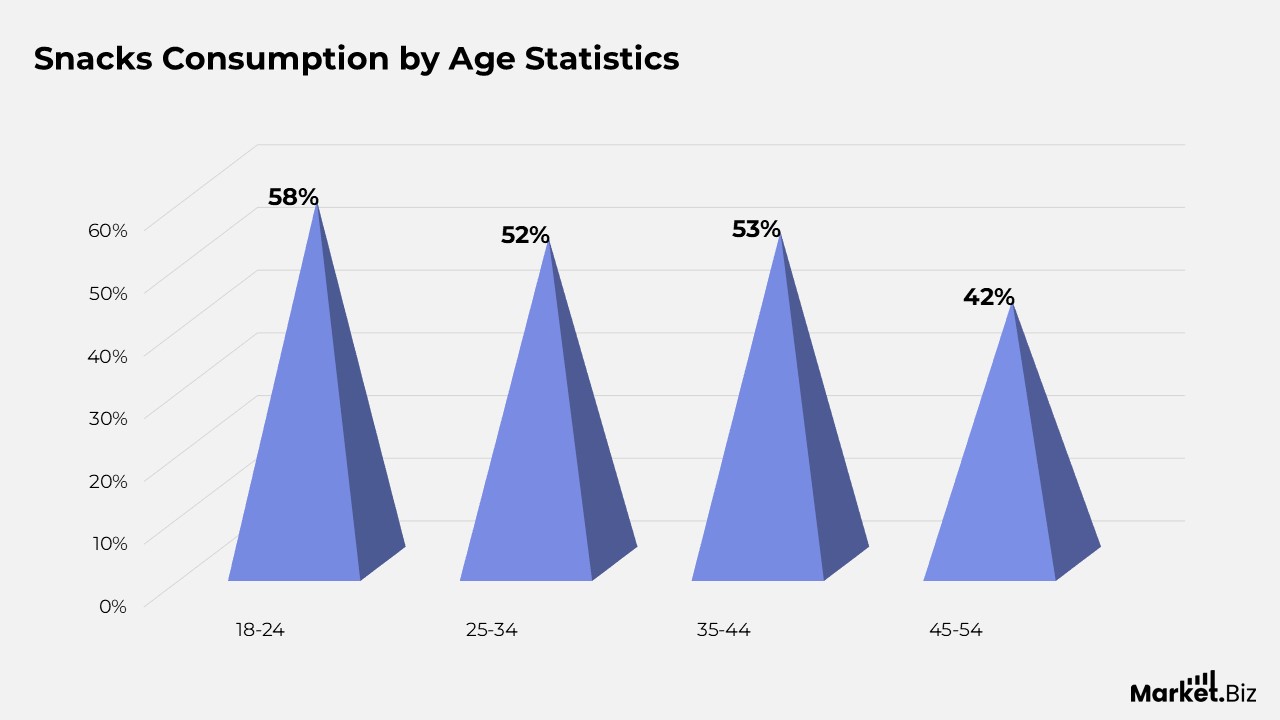
- Among individuals aged 18 to 24, a significant 58% choose snacks as meal substitutes while at home.
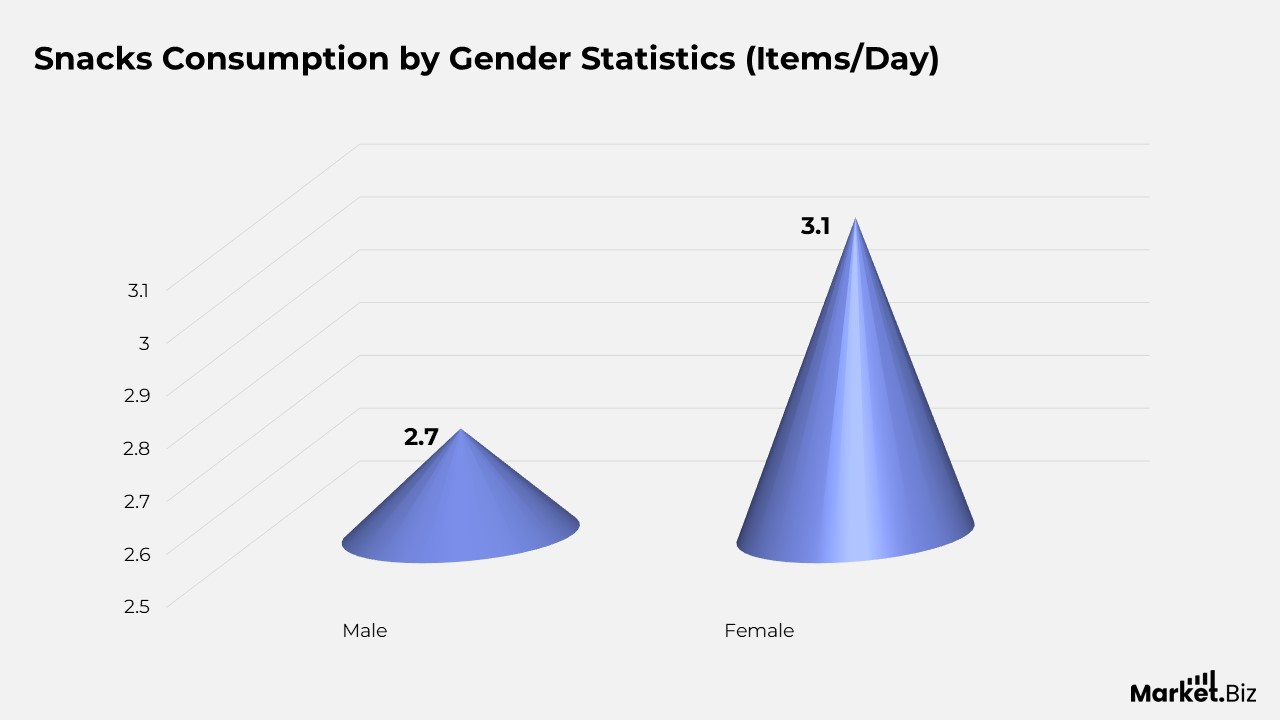
- On average, women generally consume about 3.1 snack items each day, while men usually consume roughly 2.7.
- Worldwide, consumers emphasise the importance of snacks that are free from additives or preservatives (40%) and devoid of artificial ingredients (34%).
General Snacks Statistics
- In 2023, the worldwide revenue for the snacks market was recorded at USD 1,220.9 billion.
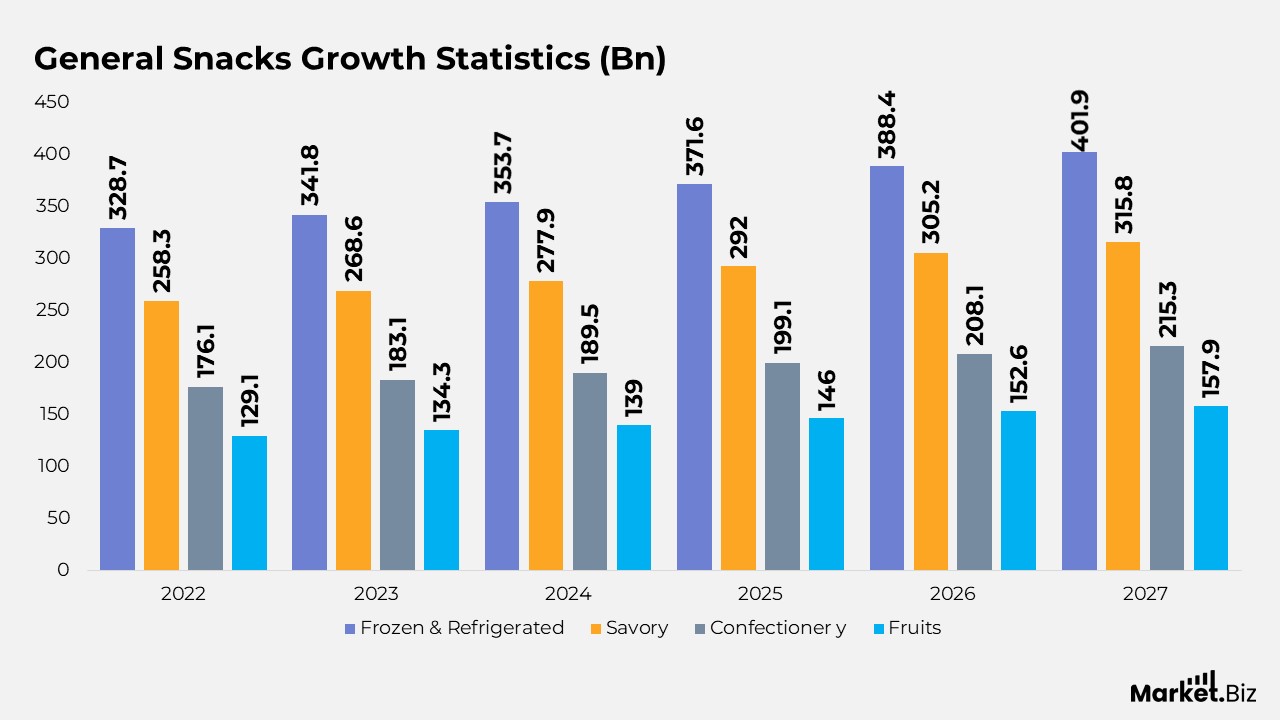
- Projections for 2032 suggest that the total revenue for the snacks market will increase to USD 1,720.7 billion, with frozen and refrigerated snacks accounting for USD 481.8 bn.
- Savory snacks are projected at USD 378.6 bn, fruit snacks at USD 189.3 bn, confectionery at USD 258.1 bn, bakery snacks at USD 137.7 billion, and other products at USD 275.3 billion.
- Supermarkets and hypermarkets dominate the market, holding a significant 43% share of the distribution channel.
- By 2022, the revenue per capita had increased to $34.93 for cookies and crackers, $11.42 for potato chips, and $20.32 for flips, pretzels, and tortilla chips.
- The United States leads in revenue generation, boasting an impressive $114 billion.
- On average, women consume about 3.1 snack items each day, while men consume approximately 2.7.
- Globally, consumers favor snacks that are free from additives or preservatives (40%) and do not contain artificial ingredients (34%).
- Additionally, a significant number prefer snacks with natural ingredients and a clean label (33%) as their primary choice for healthier options.
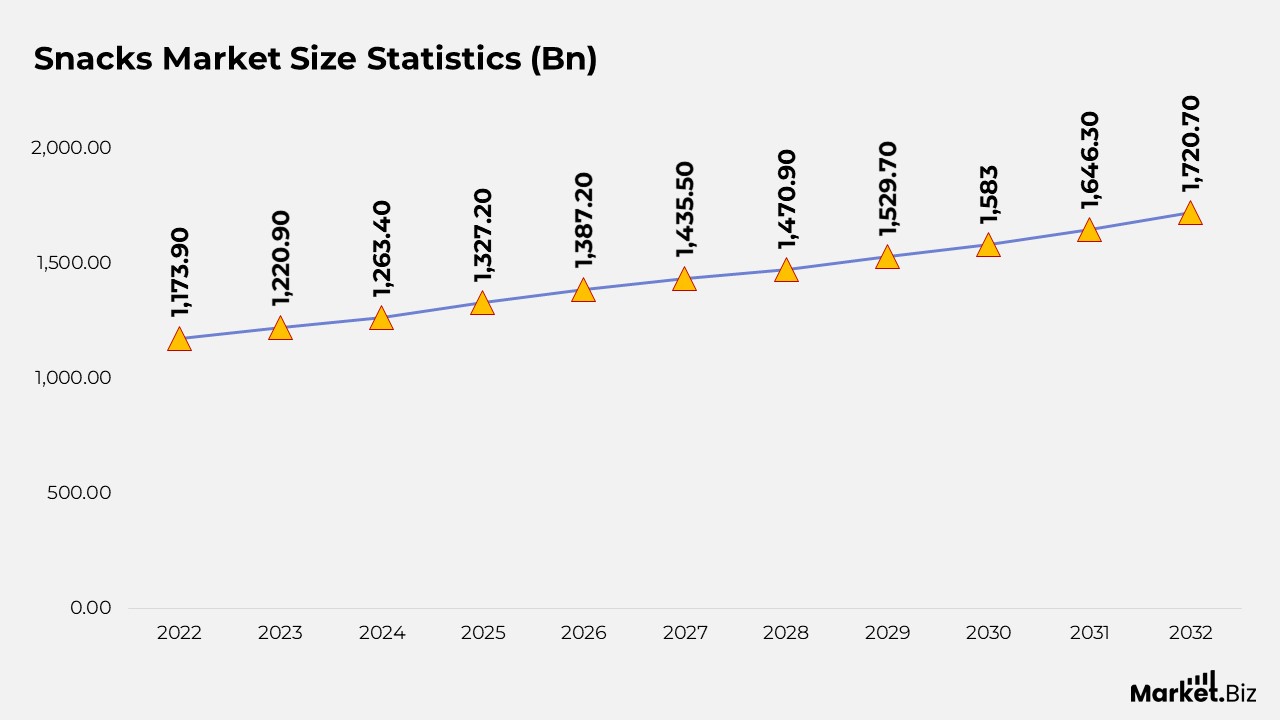
Snacks Market Size Statistics
- In 2022, the market’s revenue was recorded at USD 1,173.9 billion, indicating the onset of this growth trend.
- Subsequently, in 2023, it experienced a notable increase to USD 1,220.9 billion.
- Projections indicate that this upward trend is likely to continue. Expected revenues are estimated to reach USD 1,263.4 billion in 2024 and USD 1,327.2 billion in 2025.
- The market is forecasted to exceed important milestones, with revenues of USD 1,470.9 billion, USD 1,435.5 billion in 2027, and 2028USD 1,387.2 billion in 2026.
- The growth is anticipated to remain robust, achieving USD 1,529.7 billion in 2029 and USD 1,583.0 billion in 2030.
- By 2030s, the global snacks market is expected to sustain its growth, with projected revenues of USD 1,646.3 billion in 2031 and USD 1,720.7 billion in 2032.
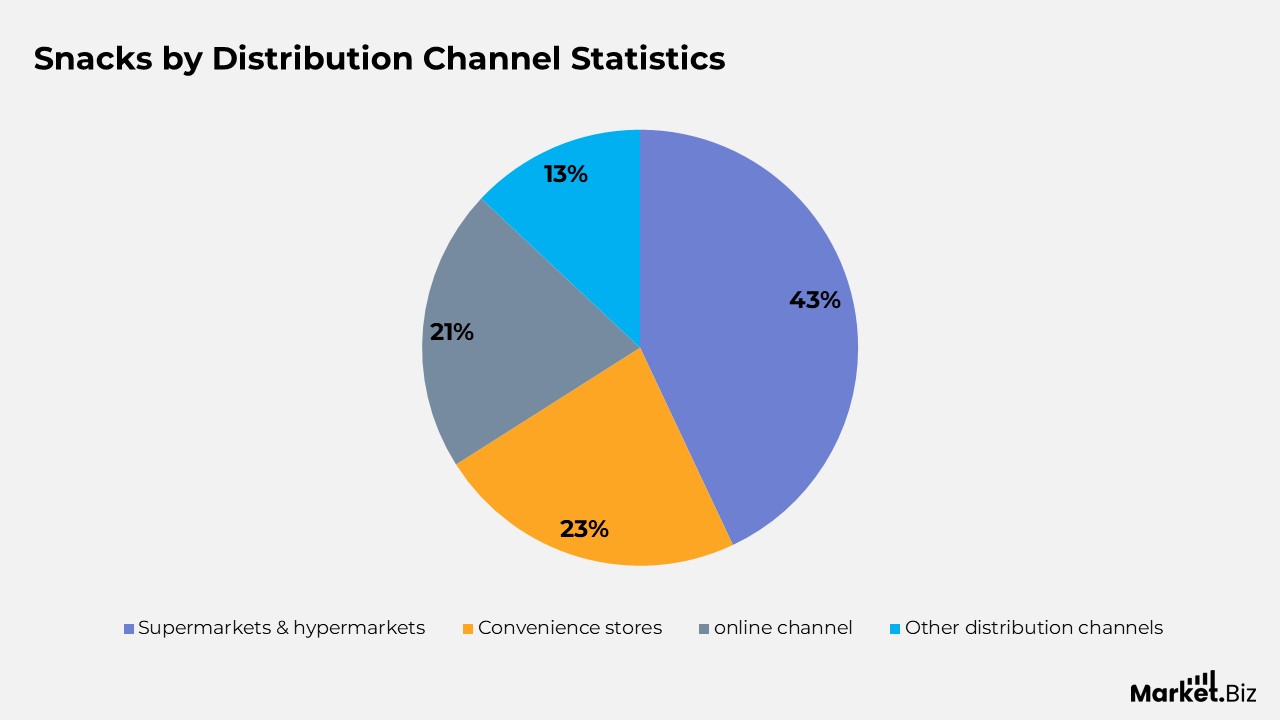
Snacks by Distribution Channel Statistics
- Supermarkets and hypermarkets dominate the market, holding a significant 43% share of the distribution channel.
- Convenience stores are in second place, making up 23% of the market share. This reflects the behavior of consumers who prioritise quick and easy access to snacks.
- The online channel, which accounts for 21% of the market share, has experienced considerable growth, fuelled by the rising trend of e-commerce and the convenience it provides for snack purchases.
- Other distribution channels, which represent 13% of the market share, include a diverse range of retail outlets.
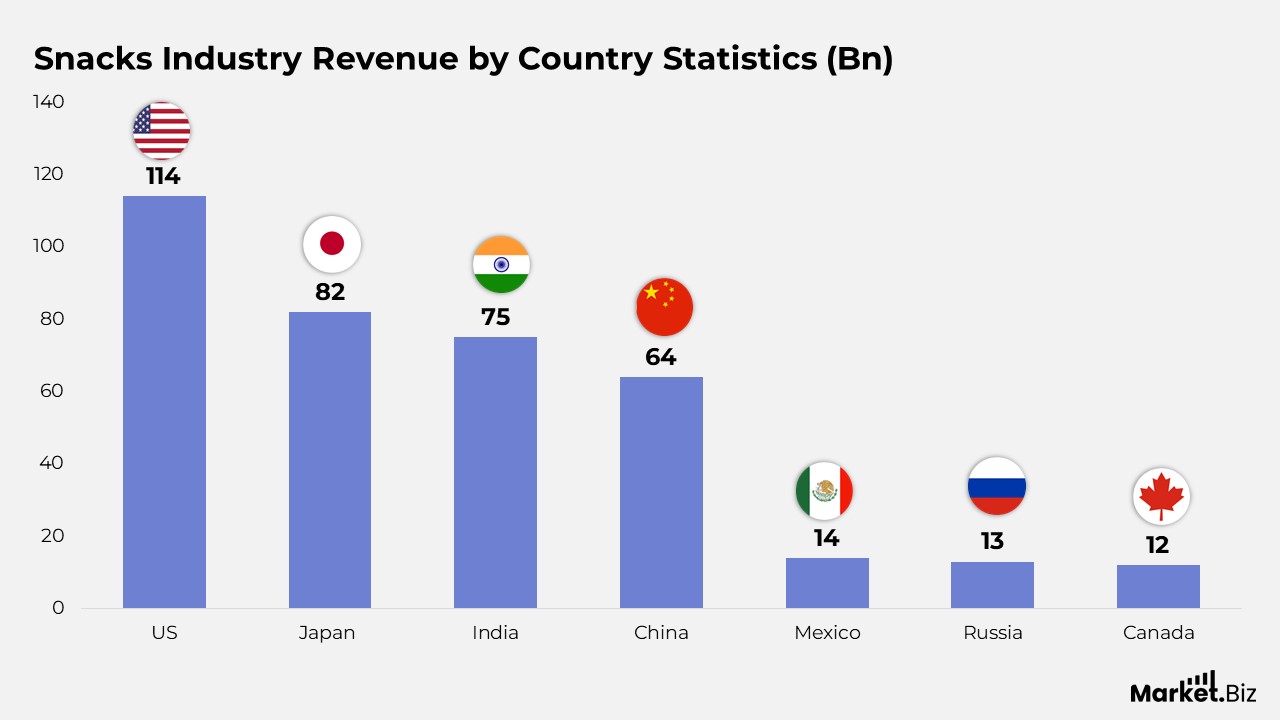
Revenue of the Snacks Industry by Country Statistics
- The United States is the leading revenue generator, boasting an impressive total of $114 billion.
- Japan follows closely, making a significant contribution of $82 billion to the snack industry revenue.
- Emerging markets India and China also provide noteworthy contributions, with revenues of $75 billion and $64 billion, respectively.
- Although smaller in scale, Mexico, Russia, and Canada each contribute to the industry’s overall revenue, with amounts of $14 billion, $13 billion, and $12 billion, respectively.
Snacks Consumption by Age Statistics
- Among individuals aged 18 to 24, a significant 58% choose snacks as meal substitutes while at home, reflecting a strong inclination towards this convenient and rapid dining choice.
- The trend persists among those aged 25 to 34, where 52% of this demographic select snacks as a meal alternative.
- Likewise, individuals within the 35-44 age range also show a preference for meals based on snacks, with 53% adopting this habit.
- Nevertheless, as age progresses, the tendency to utilise snacks as meal replacements slightly declines, with 42% of individuals aged 45 to 54 favoring this method.
Snacks Consumption by Gender Statistics
- On average, women generally consume about 3.1 snack items each day, while men usually consume roughly 2.7.
- Overall, it seems that women derive slightly more enjoyment from indulging in sweets and snacks than men do.
Healthy Snacks Preferences Statistics
- Worldwide, consumers emphasize the importance of snacks that are free from additives or preservatives (40%) and devoid of artificial ingredients (34%).
- Their primary preference for healthier snacks includes those with natural ingredients and a clean label (33%).
- In the United States, there has been an increase in the consumption of protein-enriched snacks across all demographics, with the most notable rise seen in individuals aged 32 to 45.
- When selecting a snack, the element of indulgence frequently influences consumer choices, even among those who are health-conscious.
- This trend accounts for the popularity of dairy products such as yogurt (69%), dairy milk (63%), and cheese (60%), which are favoured globally for their nutritional benefits as well as their indulgent flavours and textures.
- Despite the enduring popularity of traditional indulgent snacks like biscuits, cookies, and brownies (66%), chips (64%), and sweets and chocolate (60%), consumers in Europe, Asia, and the United States are increasingly reducing their intake of these less healthy options.
- In the US, for example, users of protein bars show a keen interest in protein cookies (54%) and protein brownies (48%).
- Additionally, protein chips (43%) and protein pretzels (42%) are also gaining positive attention from current users of protein bars.
Snacks Recent Statistics
- In August 2022, PepsiCo introduced a premium line of potato chips branded as Lays Gourmet. This collection features high-quality ingredients and unique flavours, including truffle parmesan and chilli lime.
- In February 2023, Hostess Holdings launched a new snack brand called Kazbars. This brand is inspired by candy bars and signifies a major innovation in the snack cakes industry.
- SnackNation is a service that delivers snacks, emphasizing healthier options for both offices and residences.
- The company secured $50 mn in its Series C funding round, which was spearheaded by 3L Capital and supported by prominent investors, including Kraft Heinz and General Mills.
Snacks Future Predictions
- Moreover, by the year 2029, it is projected that the global snack market will transform into a highly dynamic and technology-oriented sector, with an estimated worth between approximately USD 350 billion and USD 650 billion.
- By the 2030s, the global snacks market is anticipated to continue its growth trend. With expected revenues of USD 1,646.3 billion in 2031 and USD 1,720.7 billion in 2032.
Conclusion
In conclusion, the snacks industry demonstrates resilience and adaptability, influenced by evolving consumer preferences and lifestyles. It holds a bright future with consistent revenue growth. Consumers prefer a diverse range of snacks, yet health and sustainability are increasingly prioritised.
Challenges encompass compliance with regulations and tackling health issues. Nevertheless, competition encourages innovation, and data analytics is crucial. Ultimately, the snacks industry’s capacity to adapt and meet consumer demands positions it for ongoing success in the global food market.
FAQs
Potato chips consistently rank as America’s preferred snack in nearly every survey. Their appealing combination of crunchiness, saltiness, and straightforwardness makes them the favored option for many snack enthusiasts.
For Gen Z consumers, brands such as Frito-Lay Minis, Goldfish, and Cheez-It dominate the snack market. Convenience plays a significant role, as these snacks, through their packaging design, brand identity, product size, and quantity, enable portion control, sharing with friends, and effortless enjoyment.
Snacks are made available to consumers through a variety of channels, including traditional retail outlets, online shopping platforms, convenience stores, and vending machines.