









Introduction
eLearning Statistics: The eLearning industry has experienced remarkable growth in recent years, driven by technological advancements, changing consumer demands, and a growing preference for flexible learning options. The global shift toward digital platforms and content delivery tools has been fueled by innovations in mobile learning, artificial intelligence, and virtual classrooms, which have made education more accessible, personalized, and scalable.
The growing emphasis on lifelong learning, combined with the need for continuous skill development, has further accelerated the adoption of eLearning solutions across various sectors, including corporate training, higher education, and K-12 education. Additionally, the increasing demand for cost-effective and on-demand learning experiences is expected to drive the industry’s expansion, presenting numerous opportunities for those involved in educational technology.
Editor’s Choice
- 73% of U.S. students express interest in continuing online classes post-pandemic.
- 68% of employees prefer learning while on the job.
- 90% of companies offer some form of digital training to their workforce.
- In just five years, Coursera’s user base has surged by 438%.
- By 2027, the number of online learning platform users is projected to reach 57 million.
- The mobile eLearning market is expected to grow by 25% between 2022 and 2028.
- E-learning has contributed to a 42% increase in revenue for companies.
- Approximately 90% of organizations provide digital learning opportunities to their employees.
- 68% of employees prefer learning and development opportunities at work.
- Over the past five years, Coursera’s registered learners have increased by 438%, reaching a total of 136 million.
- Google’s content is projected to generate $100 million in revenue for Coursera, driving growth in consumer revenue.
- 90% of companies provide online learning programs for their employees.
- A significant 68% of employees prefer to engage in learning, training, and development activities at the workplace.
- Many U.S. businesses have experienced a 42% increase in income following the implementation of e-learning.
- Corporate eLearning requires 40%–60% less time compared to traditional classroom training.
- Nearly 98% of U.S. businesses plan to adopt e-learning in the near future.
(Source: National Center For Education Statistics (NCES), Boot Camp Digital, Devlin Peck, Gauss Development, eLearning Industry, Radixweb)
E-Learning VR Market Size
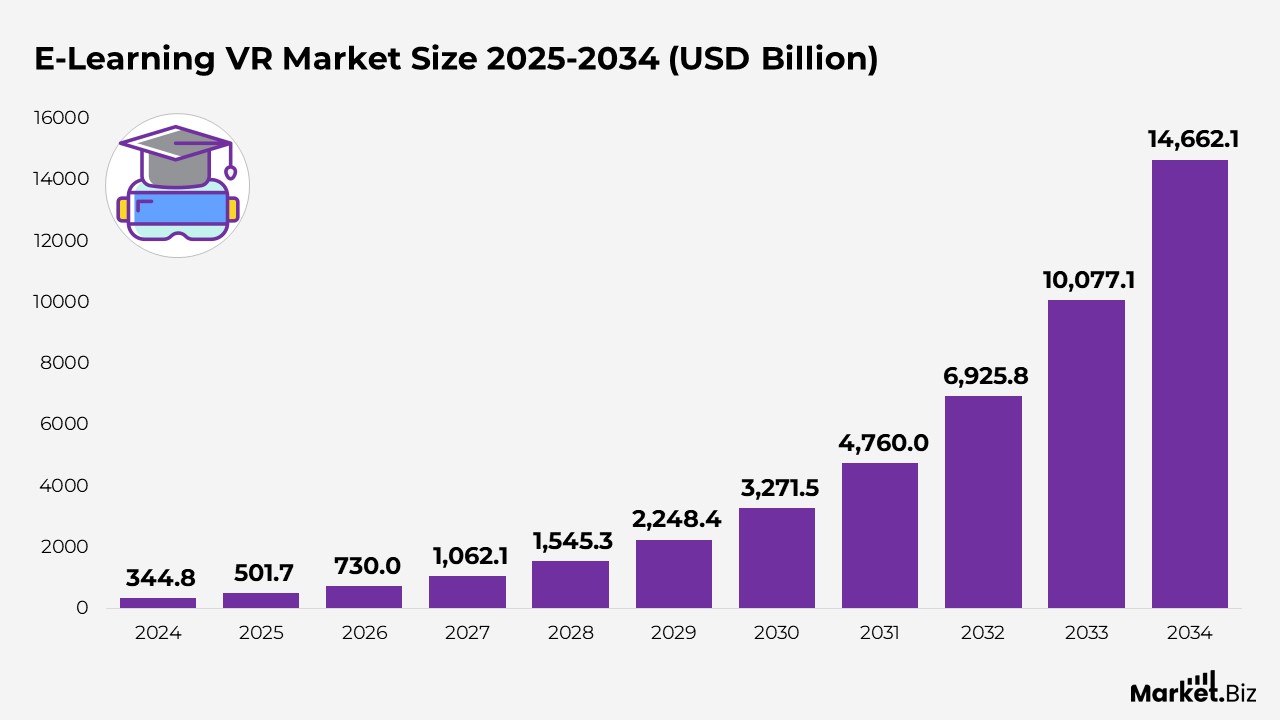
- According to Market.us, the global E-learning VR market is projected to generate $501.7 million in 2025, growing to $14,662.1 million by 2034, with a compound annual growth rate (CAGR) of 45.50% between 2025 and 2034.
- The growth of the eLearning market is driven by the integration of immersive technologies, such as virtual reality (VR), which enhances interactive learning experiences.
- Hardware accounts for 54% of the market share, underscoring the significant role of VR equipment in the education sector.
- Educational institutions account for 40% of the market, highlighting the growing adoption of VR in schools, colleges, and universities.
- North America holds a dominant market share, accounting for over 35% of the global eLearning VR market and generating USD 120.68 million in revenue in 2024.
- The U.S. market is projected to grow at a compound annual growth rate (CAGR) of 43.1%, reflecting strong demand for virtual reality (VR)- based educational solutions.
- Europe accounts for approximately 25% of the global market, with countries such as the UK, Germany, and France increasingly adopting virtual reality (VR) in education.
(Source: Market.us)
AI in eLearning Market Size
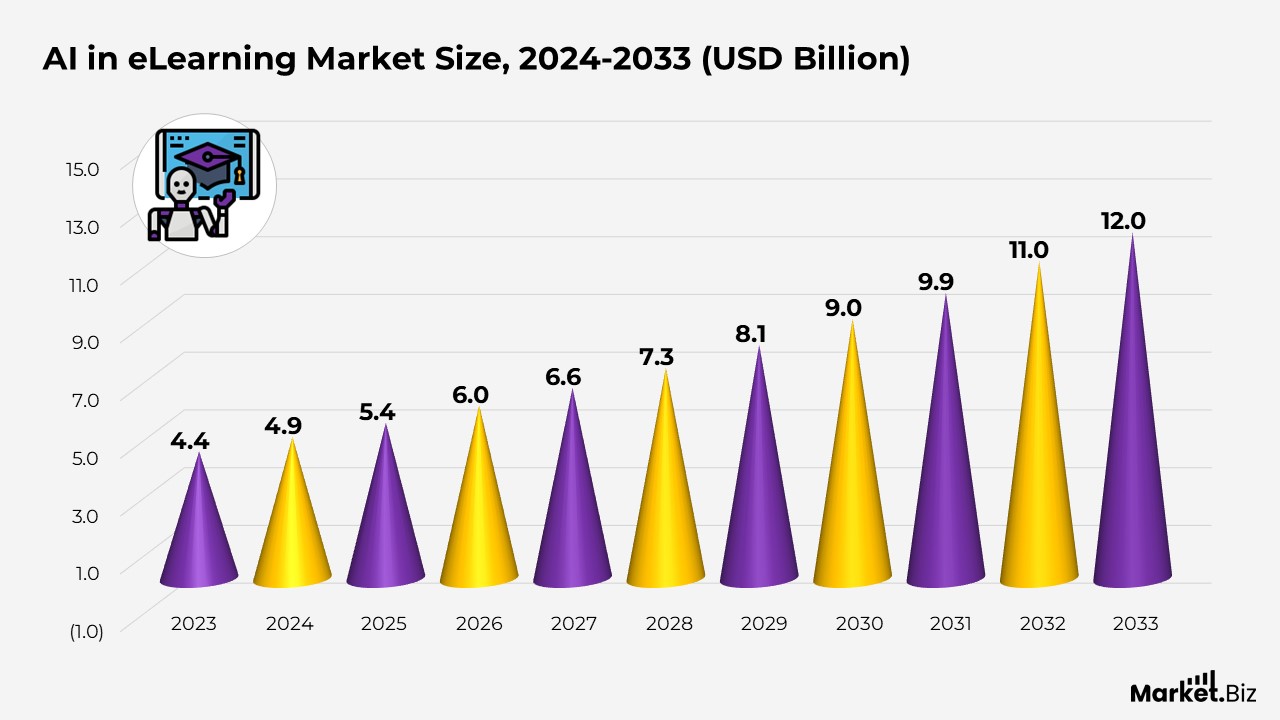
- The global AI in eLearning market is projected to grow from $4.9 billion in 2024 to $12.0 billion by 2033, representing a compound annual growth rate (CAGR) of 10.7% from 2024 to 2032.
- The eLearning market is experiencing growth driven by the increasing demand for flexible and accessible education, with AI enhancing the learning experience through personalised content and recommendations.
- In 2023, the solution segment led the market, with an over 68% share, driven by the adoption of advanced software tools, including intelligent tutoring systems and learning management systems.
- The cloud-based segment dominated the market in 2023, capturing more than 65% of the market share, thanks to its flexibility and scalability, which offer seamless remote learning experiences.
- The virtual classroom segment held a dominant market share of over 30% in 2023, fueled by the growing demand for interactive and immersive learning experiences enhanced by AI.
- In 2023, the machine learning (ML) segment held over 37% of the market, driven by its transformative impact on personalizing and optimizing learning experiences.
- Academic institutions held a market share of more than 53% in 2023, driven by the widespread adoption of AI in schools, colleges, and universities, aimed at improving educational outcomes and operational efficiency.
- North America led the AI in the eLearning market in 2023, capturing over 32.8% of the market and generating USD 1.4 billion in revenue, attributed to advanced tech infrastructure and the presence of AI technology firms.
(Source: Market.us)
eLearning Statistics
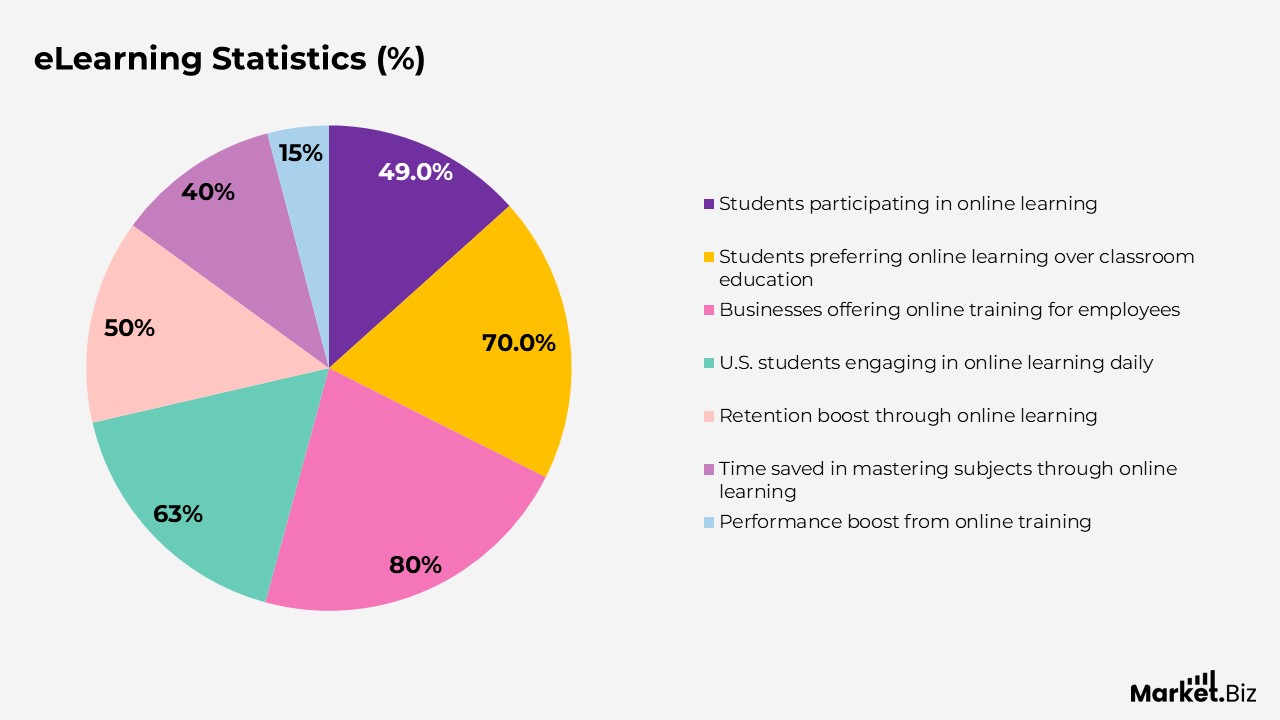
- 49% of students worldwide have participated in some form of online learning.
- Online learning is the fastest-growing sector in education, having expanded by 900% since its inception in 2000.
- 70% of students believe that online learning is more effective than traditional classroom-based education.
- The number of online learning users is anticipated to reach 57 million by 2027.
- 80% of businesses now offer online training or learning programs for their employees.
- 63% of U.S. students engage in online learning activities daily.
- Online learning can boost student and employee retention by up to 50%.
- Online learning can cut down the time required to master a subject by 40% to 60%.
- The online learning market is projected to exceed $370 billion by 2026.
- Online training and education can enhance employee performance by 15-25%.
(Source: Devlin Peck)
eLearning Adoption – By Application
Corporate eLearning
- By 2023, 98% of corporations planned to incorporate e-learning into their employee training programs, making online learning a standard in corporate training.
- 61% of corporate learning and development professionals identify closing skill gaps as the primary objective of their training programs, with other priorities including fostering organizational growth and boosting employee engagement.
- 42% of companies report that adopting e-learning has contributed to increased revenue by enhancing workforce productivity and performance.
- According to IBM, every $1 spent on online training yields an approximate $30 increase in productivity, resulting from faster skill application and shorter training times.
- 40% of Fortune 500 companies utilize online training programs.
- 45% of businesses report that learning is embedded in their corporate culture at a level of 4 on a 5-point scale.
- Half of organizations believe their training strategies are preparing them for the future.
- 94% of employees are more likely to stay with a company that prioritizes employee learning and development.
- 59% of millennials are inclined to apply for a role at a company that values investment in training.
- 47% of businesses plan to integrate online learning with traditional classroom training in the post-pandemic era.
- 93% of organizations offer compliance training online, at least in part.
- 58% of global employees express a preference for self-paced learning.
(Source: Brighter Strides ABA Therapy, Exploding Topics, Shift eLearning, International Business Machines Corporation)
Online eLearning
- User penetration of online learning platforms is expected to reach 11.6% by 2023 and 16.6% by 2027.
- Revenue generated from online learning platforms is forecasted to hit $2.85 billion by 2023.
- Udemy remains the leading online learning platform, boasting a user base of over 10 million students. It is renowned for offering high-quality content across various niches and categories.
- The e-learning market for MOOCs is projected to grow to $25.55 billion in the coming years, marking a shift toward a new era in online education.
- By 2023, Masterclass will offer over 150 courses across various categories, with lesson lengths ranging from 2 hours to over 5 hours each.
- Online learning platforms collectively generated $47 billion in revenue, indicating a strong preference among users for digital learning formats.
- The top 500 instructors on Skillshare earn an average of $2,000 monthly.
- Skillshare is expected to surpass 13 million users by 2023, offering more than 355,000 classes.
- The majority of courses on Udemy, approximately 90%, are paid.
- Teachable ranks as the second most popular online learning platform worldwide, following Udemy, which has 35 million users.
The COVID-19 pandemic drastically reshaped the global education system, pushing millions to rely on online learning.
- The closure of schools during the pandemic left 1.36 billion learners worldwide unable to attend in-person classes.
- 43% of school administrators are in favor of continuing remote learning even after the pandemic ends.
- Around 10% of post-secondary institutions now primarily offer online courses.
- In 2020, 77% of students in public colleges and 68% in private colleges participated in at least one online course.
- 2.8 million students are enrolled in online colleges.
- A significant 95% of alumni from online colleges recommend eLearning to others.
- 70% of learners believe that online education is comparable to or superior to traditional classroom learning.
- In the U.S., 63% of high school students use digital learning tools daily, and 45% of elementary students engage with at least one such tool each day.
- At Tencent K-12 Online School in Wuhan, China, 81% of learners (730,000) preferred online classes over traditional classroom settings.
(Source: iSpring, Tech Jury, Skill Scouter, Forbes Masterclass, Think Impact )
eLearning job statistics
- The average salary for an instructional designer in the U.S. is $66,500 per year.
- Training managers in the U.S. earn an average salary of $70,300 annually.
- Freelance instructional designers in the U.S. typically earn an average income of $104,228 per year.
- Instructional designers with portfolios tend to earn 15% more than their counterparts without one.
- Between Q2 and Q3 of 2021, the demand for Learning & Development (L&D) specialists surged by 94%.
- L&D professionals experience promotions 15% more frequently compared to their HR colleagues.
(Source: iSpring)
Training Formats and Content Types
- 70% of employees prefer online self-paced courses as their primary method of training.
- 62% of corporate learners favor a hybrid (blended) learning approach.
- Despite its popularity, blended learning now accounts for only 32% of total training hours, down from 43% the previous year.
- Traditional classroom training made up just 24% of training hours in 2022, a decline from 30% in the previous year.
- 64% of corporate learners enjoy learning through interactive role-play simulations.
- According to an iSpring study, interactive role-play simulations are most commonly used in the IT sector (48%) and the Service sector (34%).
- Mobile learning accounted for 4% of training hours during the 2021-2022 period.
- The mobile learning market is projected to reach $80 billion by 2027.
- The U.S. accounts for 31% of global mobile learning spending.
- Only 1% of all training hours incorporate advanced technologies such as AI, VR, and AR.
(Source: iSpring)
eLearning software and tools
- The marketplace hosts around 800 vendors specializing in Learning Management Systems (LMS).
- The market for authoring software is projected to reach a value of $2.5 billion by 2028.
- In 2022, the market value for collaborative authoring tools surpassed $1.7 billion.
- The most commonly adopted technologies include Learning Management Systems (LMSs) (89%), rapid eLearning tools (40%), and mobile applications(36%).
- 89% of U.S. companies incorporate an LMS into their online training programs.
- Around 30% of organizations either partially or fully outsource the operation or hosting of their Learning Management System (LMS).
- 42% of companies outsource some degree of content development for training purposes.
- Blackboard was identified as the leading LMS in North America as of 2021.
- For 2023, Learning Management Systems (LMS) topped the list of planned purchases, with 39% of organizations planning to invest, followed by authoring tools at 36%.
(Source: iSpring)
LMS Statistics
- Approximately 83% of organisations currently utilise a learning management system (LMS).
- An estimated 73.8 million individuals are active users of Learning Management System (LMS) platforms. And we believe you should join them!
- LMS platforms lead the way as the most widely used learning technology, with 89% adoption, followed by rapid eLearning tools at 44% and mobile apps at 31%.
- Poor usability (53%) and high costs (44%) are the primary reasons why learning leaders are actively seeking a better LMS.
- 55% of LMS implementations are hosted on the cloud, with 45% relying on on-premise solutions.
- The majority of LMS administration is managed internally (83%), while 23% of organizations opt to outsource their LMS functions.
- A staggering 50% of L&D professionals feel that their learning systems don’t meet the needs of their workforce. Not a great sign!
- 44% of organizations report dissatisfaction with their current LMS solution.
- Only 22.9% of survey participants believe their Learning Management System (LMS) is addressing the right issues for their organization.
- 1 in 4 survey respondents intend to switch LMS providers—if that’s you, we’ve got a top recommendation!
(Source: Growth Engineering Technologies)
Effectiveness of Online Learning
There is substantial evidence supporting the effectiveness of online learning both in terms of learning outcomes and business performance. Here are some key findings:
- Knowledge retention in eLearning ranges from 25-60%, while traditional classroom learning yields only 8-10% retention.
- 55% of Americans surveyed believe the quality of online learning is on par with traditional face-to-face training.
- eLearning has the potential to boost employee productivity by up to 25%.
- Learning the same material online takes 40-60% less time than in a classroom environment.
- Microlearning is 17% more effective for knowledge transfer compared to traditional learning methods.
- Employee engagement through eLearning can rise by as much as 18%.
(Source: iSpring, Statista)
eLearning vs. Classroom Training
- IBM discovered that their employees absorbed 5x more material through online learning compared to traditional offline methods.
- Retention rates for online learning can be as high as 60%, whereas traditional classroom training typically yields a retention rate of only 8-10%.
- Online learning requires 40% to 60% less time than face-to-face training, reducing costs and allowing employees to return to their work tasks more quickly.
- A significant 90% of students favor eLearning over classroom learning due to its flexible and easily accessible nature.
- The top reasons employees prefer online learning over traditional methods include the ability to learn at their own pace (95%) and reduced travel time (84%).
- Similarly, 85% of learners report that their online learning experience was at least as satisfactory as, or better than, their face-to-face classes.
(Source: Growth Engineering Technologies, International Business Machines Corporation )
eLearning Development and Employee Training Trends
- Organizations allocate approximately $340 billion annually to employee training and development, with an average expenditure of over $1,500 per employee each year.
- On average, developing a 1-hour e-learning course takes approximately 197 hours, although this can vary significantly, ranging from 49 hours to 716 hours, depending on the course’s complexity and content.
- The cost to create a typical 1-hour eLearning course is around $9,826 per employee.
- 75% of Learning and Development (L&D) professionals predict an increase in the creation of custom learning content in the upcoming years.
- Vendors who specialize in content creation generally charge between £25,000 ($31,200) and £30,000 ($37,440) to develop 1 hour of original content.
- 53% of course creators report spending 3 months or more on the development of their eLearning courses, illustrating the time-intensive nature of the process.
- According to Podia, the typical price for an online course is $137.
- Learners who pay for courses tend to spend 10% more time engaging with their course content than those who have free access.
- Learners who pay for courses tend to spend 10% more time engaging with their course content than those who have free access.
(Source: Podia, Growth Engineering Technologies)
eLearning & Online Learning Piracy
Piracy remains a significant challenge for the eLearning and online learning industries. Here are some crucial statistics:
- 52% of users engage with videos that have been illegally downloaded or streamed.
- Over 60% of individuals are aware that they are participating in piracy when downloading or streaming copyrighted content.
- Approximately 25% of global internet usage is dedicated to online piracy activities.
- The majority of websites facilitating piracy are hosted in the U.S. and Europe.
- Free hosting websites are predominantly used for downloading pirated content.
- Telegram has become a prominent platform for distributing pirated content through its app.
- The expected revenue loss for the online learning sector due to piracy in 2022 is estimated to exceed $20 billion.
(Source: VdoCipher)
The Difficulties of Online Learning
- Online learning presents challenges that are often more complex than those found in traditional one-on-one instruction. Many students find it difficult to adjust, as they have only experienced conventional classroom environments up until now.
- Moreover, technical difficulties are a frequent hurdle, as online learning platforms are heavily dependent on technology, which is not always reliable.
- A lack of computer literacy is another issue, as many online learning tools require computer skills that not all students possess.
- Time management can also be a struggle, particularly when students are preparing for exams, as they must navigate self-paced learning while juggling multiple deadlines and other responsibilities.
Conclusion
The statistics surrounding eLearning underscore its growing importance and effectiveness in both educational and corporate settings. The data reveals that online learning is becoming increasingly comparable to, or even more effective than, traditional learning methods, particularly in areas such as knowledge retention, productivity, and learner engagement.
Despite these advancements, challenges like piracy remain significant, with substantial financial impacts on the industry. As the demand for eLearning continues to rise, addressing issues such as content security and fully harnessing the benefits of online education will be crucial for creating more efficient and sustainable learning experiences. In conclusion, the future of eLearning looks bright, provided the industry effectively navigates both the opportunities and challenges it faces.
FAQ’s
52% of users are involved in watching illegally downloaded or streamed videos, indicating a significant presence of piracy in the online learning sector.
Research reveals that eLearning leads to a knowledge retention rate of 25-60%, compared to just 8-10% in traditional classroom settings.
70% of learners believe online education can be equally or even more effective than face-to-face learning, especially when interactive tools like role-playing simulations are used.
eLearning can reduce the time needed to cover the same material by 40-60% compared to conventional classroom learning.
eLearning can enhance employee productivity by up to 25% and increase engagement by as much as 18%.
Piracy caused revenue losses exceeding $20 billion in the online learning sector in 2022, with 25% of global internet usage attributed to online piracy.
Telegram has emerged as a leading platform for distributing pirated eLearning materials.