









Co-working Statistics: Co-working spaces have rapidly transformed the global workforce landscape, with over 40,000 co-working spaces worldwide in 2025, housing more than 3.8 million members. This shift is driven by the rise of remote work, freelance professionals, and small businesses seeking flexible office solutions.
The global co-working market size is projected to reach $13.03 billion by 2026, growing at a compound annual growth rate (CAGR) of 16.4%. As businesses increasingly prioritize cost-efficiency and collaboration, co-working spaces continue to rise in popularity, offering diverse, adaptable environments for professionals across various industries.
Editor’s Choice
- The global co-working market is projected to grow to $13.03 billion by 2026, with a CAGR of 16.4%.
- Over 40,000 co-working spaces are expected to operate worldwide in 2025, accommodating more than 3.8 million members.
- North America leads the co-working market, accounting for 35% of global co-working space share.
- Millennials (ages 25-40) make up approximately 70% of co-working space members globally.
- Co-working spaces in the U.S. report that 20% of corporate workers visit at least once a week.
- 74% of co-working members report increased productivity due to a flexible work environment.
- The average size of a co-working space is 25,000 to 30,000 square feet, offering various membership options.
- WeWork leads the co-working market with over 800 locations worldwide and 600,000 members.
- The tech industry dominates co-working space usage, with over 25% of members in IT and digital services.
- The co-working market is expected to see a 69% increase in spaces over the next few years.
General Co-working Statistics
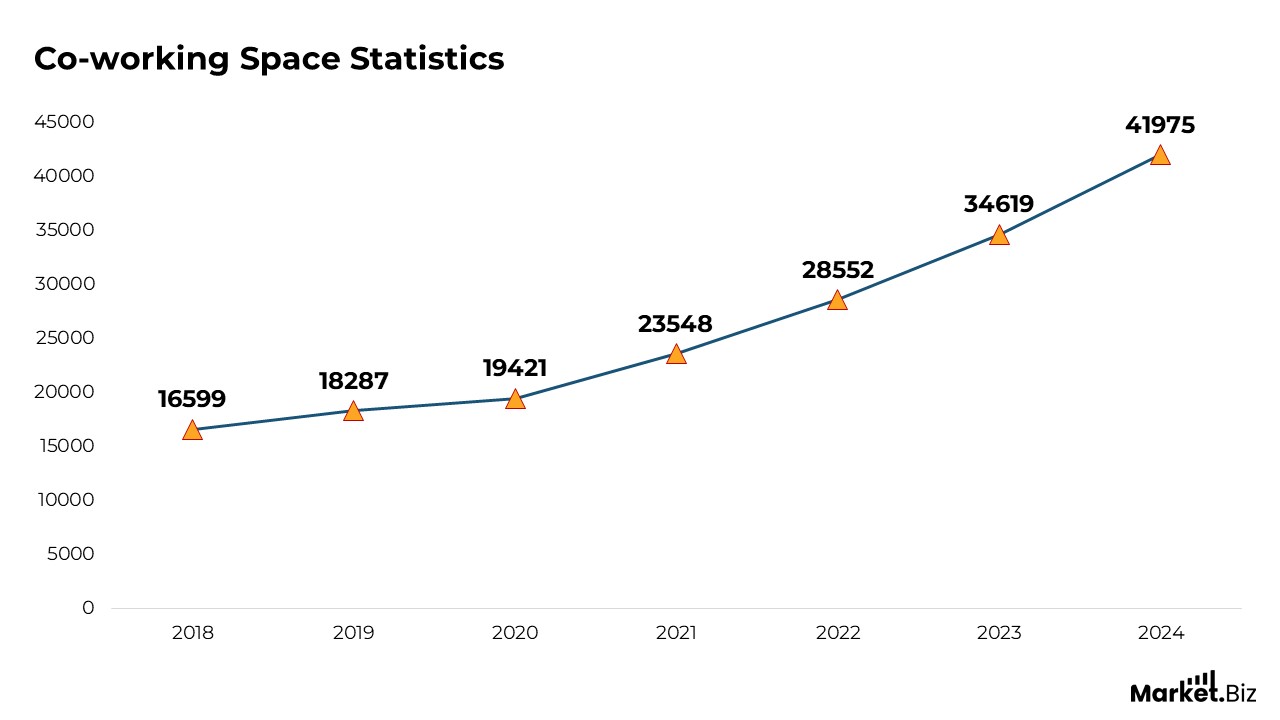
- As of 2022, there are about 19,400 co-working spaces worldwide, with more than 6,200 of those located in the United States.
- In the United States, co-working spaces were utilized by 1.08 million people in 2022.
- Around 1.933 million people used co-working spaces worldwide in 2020.
- Globally, the average co-working space is 7,308 square feet. In the United States, the average space is 9,799 square feet.
- 18.3% of co-working spaces worldwide are located in the United States.
- In the United States, a typical co-working space can accommodate 105 people. The average capacity worldwide is 83 people.
- With an average of 114 people per co-working space, Asia has the largest capacity, while South America has the smallest, at 54.
- Before the COVID-19 pandemic started in March 2020, 3.4% of Americans worked from home.
- Furthermore, 20% of workers in corporate positions visit co-working spaces at least once a week.
Moreover
- The majority of co-working users 55% continue to work at the co-working space they initially joined.
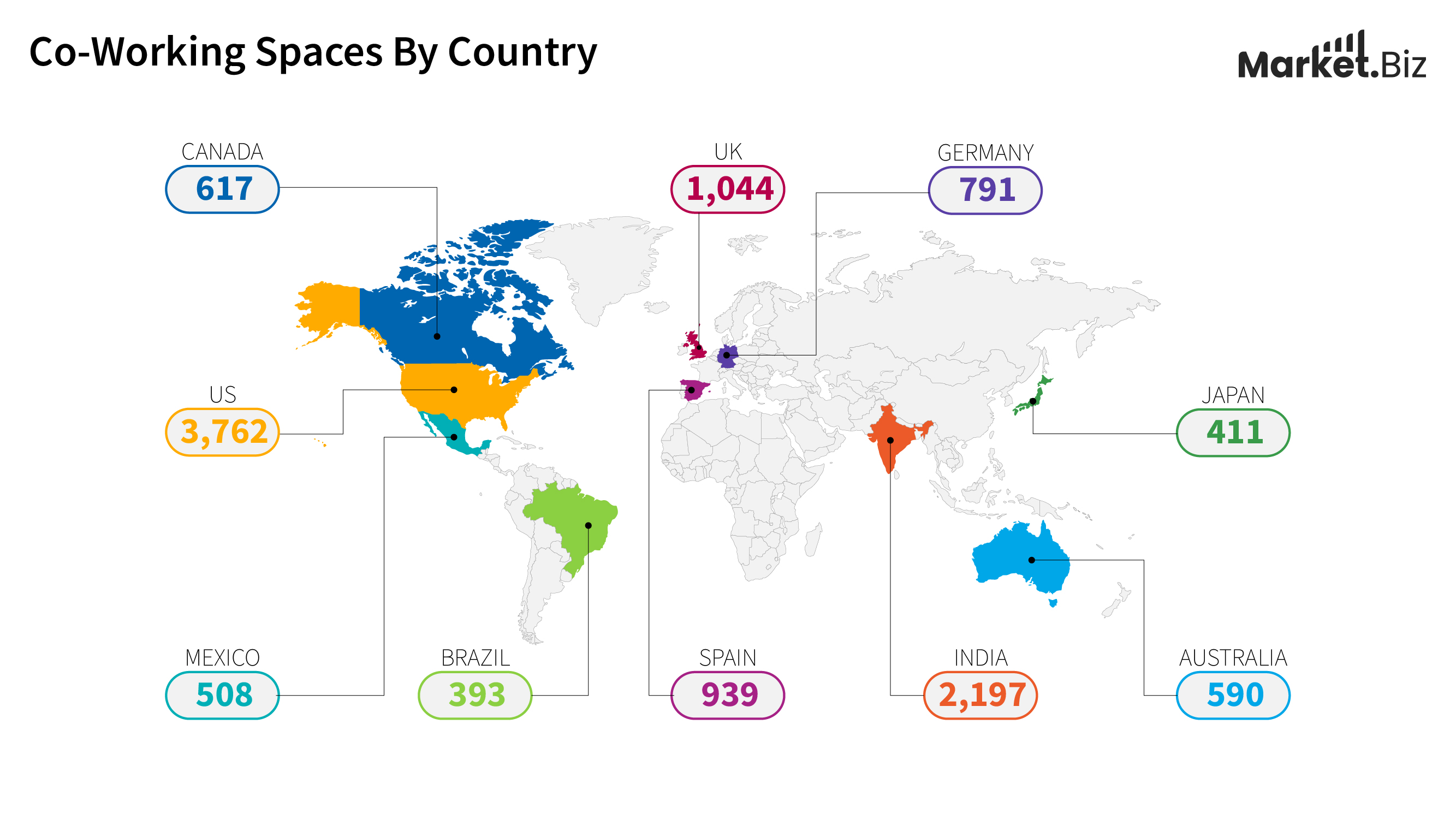
- With more than 3,700 shared workspaces, the US leads the co-working market. With 2,197 spaces, India is next, followed by the UK with 1,044 spaces.
- According to co-working trends, there will be 69% more co-working spaces in the future.
- Furthermore, co-working companies predict that 82% of people would prefer to work nearby.
- The global co-working space market is expected to grow from $9.27 billion in 2021 to $13.03 billion by 2026, with a CAGR of 16.4%.
- As of 2025, over 40,000 co-working spaces are operating worldwide, catering to more than 3.8 million members.
- North America leads the co-working market with over 14,000 spaces, accounting for around 35% of the global share.
- The average size of a co-working space is 25,000 to 30,000 square feet, offering a range of membership types from hot desks to private offices.
- By 2026, over 50% of the global workforce is expected to work remotely at least part-time, driving the demand for co-working spaces.
Co-working Data by Demographics
Co-working Spaces by Age
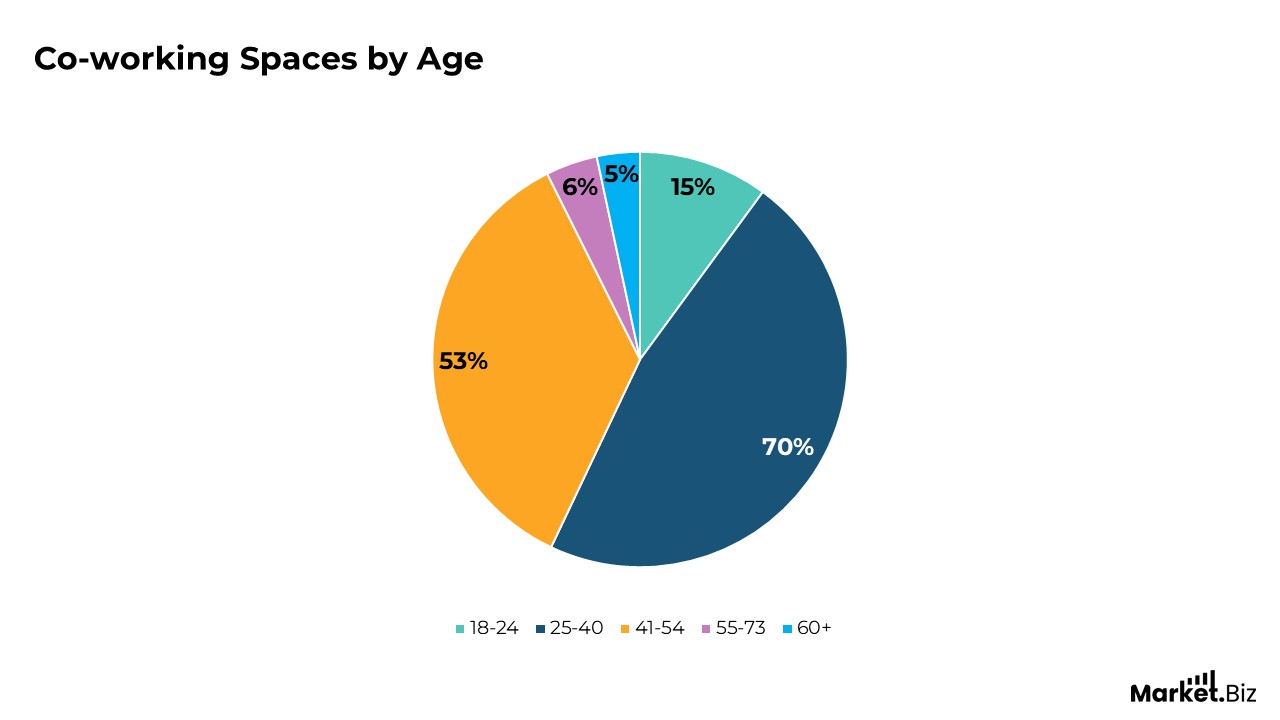
- The largest age group using co-working spaces is between 25-34 years, comprising 39% of the global co-working membership.
- Millennials (ages 25-40) make up approximately 70% of all co-working space members worldwide.
- Gen Z (ages 18-24) is emerging as a growing demographic, accounting for nearly 15% of co-working space users as of 2024.
- Baby Boomers (ages 55-73) represent around 6% of co-working space members, with an increasing interest in flexible work options.
- Co-working spaces in North America see the highest proportion of members aged 25-34, contributing to 45% of memberships in major cities.
- A significant 20% of co-working space users are aged 35-44, reflecting a shift toward mid-career professionals seeking flexibility.
- Senior professionals over 60 are increasingly turning to co-working spaces, with 5% of users in this demographic seeking flexible, low-cost office solutions.
- In Europe, the median age of co-working members is 32, showing a preference for younger, tech-savvy professionals in cities like Berlin and London.
Gender Stats By Co-working Spaces
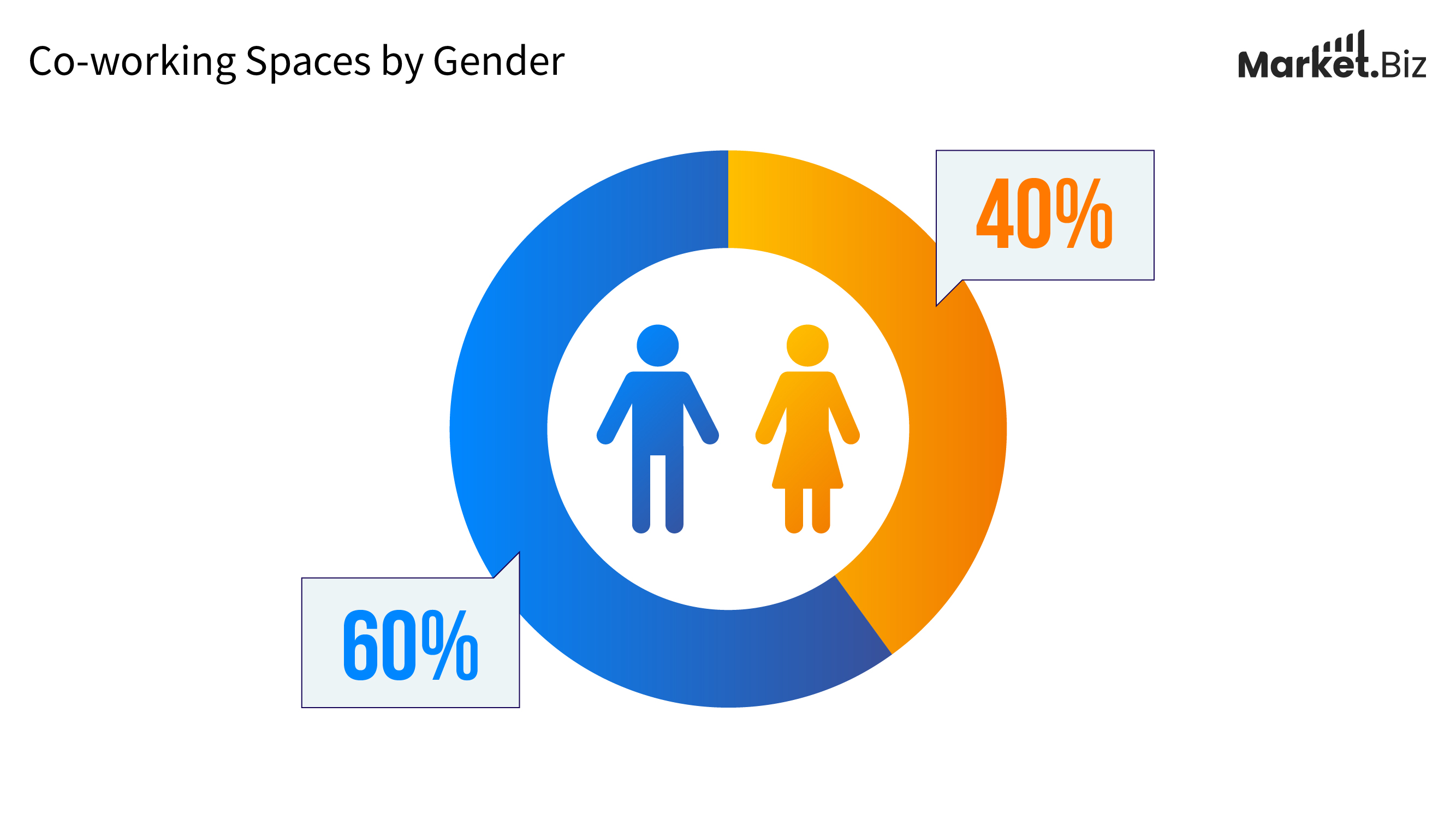
- The gender distribution in co-working spaces is fairly balanced, with women making up about 40% of the global co-working membership.
- In the US, women comprise approximately 45% of co-working members, reflecting a higher percentage of women entrepreneurs and freelancers.
- Women in tech and creative industries make up a significant proportion of co-working space users, with over 30% in fields like marketing and design.
- Gender-neutral spaces are becoming more common, with around 12% of co-working spaces worldwide offering inclusivity for all gender identities.
- The percentage of women entrepreneurs using co-working spaces has grown by 15% over the last five years, according to a 2024 Global Co-working Survey.
- Men, particularly in engineering and finance sectors, make up 60% of users in co-working spaces focused on tech or financial services.
- In Asia, gender equality in co-working spaces is improving, with women now constituting around 38% of the membership in major cities like Singapore.
- In the UK, 43% of co-working space members are women, indicating a steady increase in female-led start-ups and businesses.
Co-working Spaces by Industry
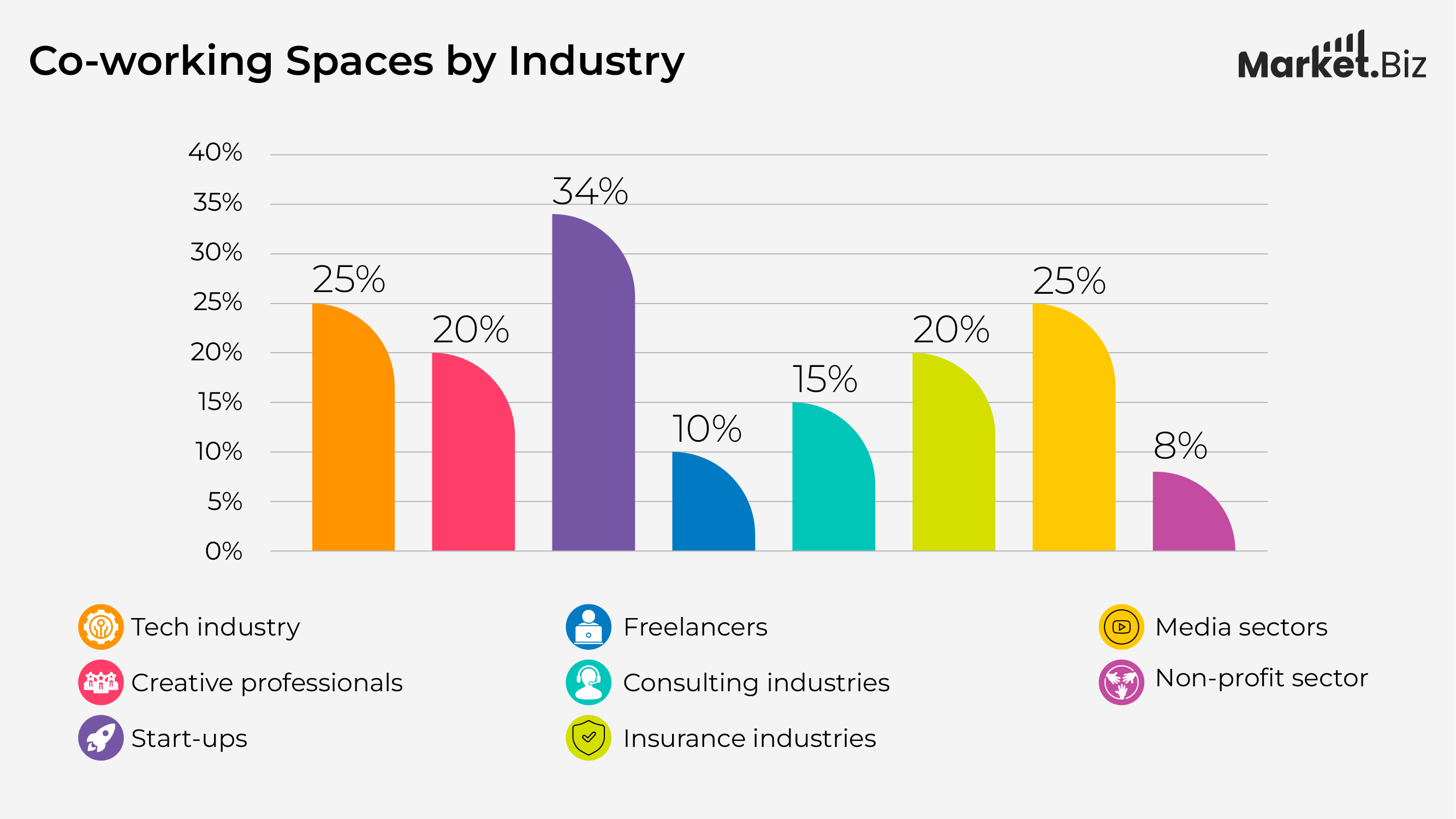
- The tech industry leads in co-working space usage, with over 25% of members involved in IT, software development, and digital services.
- Creative professionals, including designers, marketers, and content creators, represent 20% of the total co-working membership globally.
- Start-ups make up 34% of the co-working space market, with technology-driven and sustainable start-ups forming a large portion of the demand.
- Freelancers in the healthcare and education sectors are increasingly adopting co-working spaces, accounting for 10% of the total user base.
- Co-working spaces in major cities like San Francisco and New York see a large portion (15%) of members from the finance and consulting industries.
- The rise of remote working in legal, finance, and insurance industries has led to a 20% increase in co-working space usage among professionals in these fields.
- Co-working spaces in creative and media hubs like Los Angeles and London see nearly 25% of their memberships drawn from the entertainment and media sectors.
- The number of co-working space users from the non-profit sector has grown by 8% in the last year, reflecting the increasing trend of flexible working within social enterprises.
Companies Co-working Data
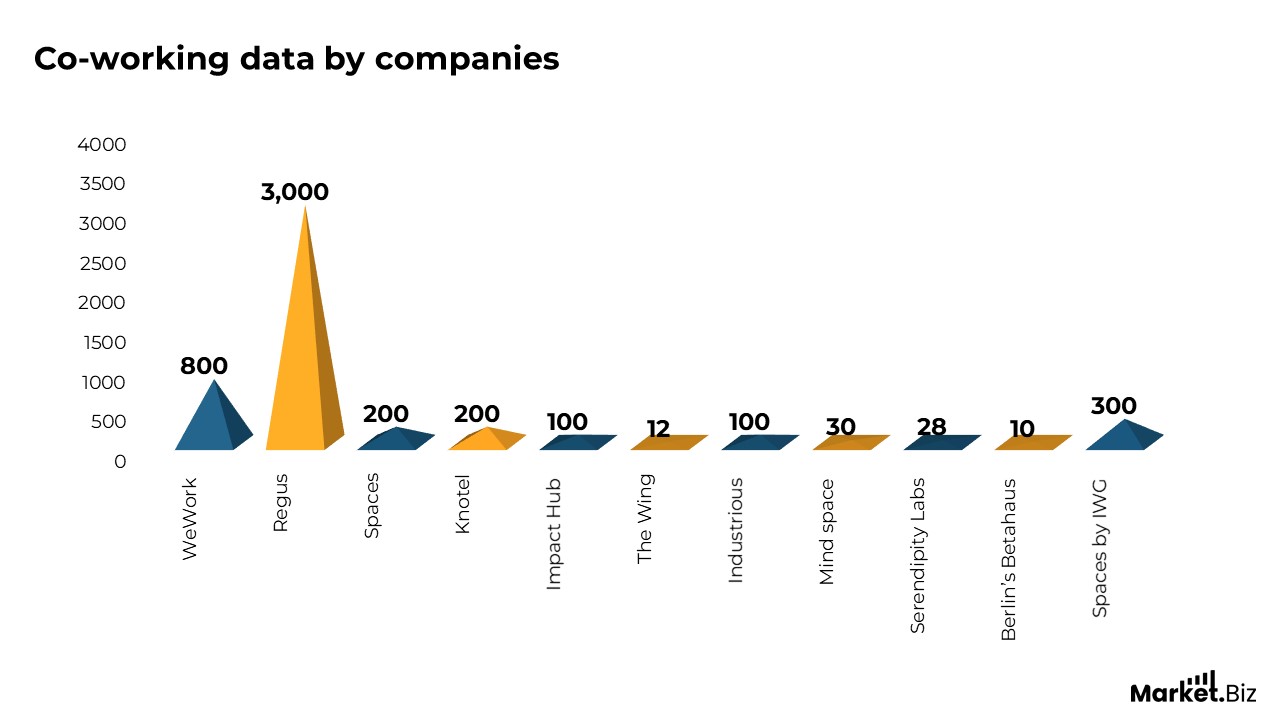
- WeWork leads the global co-working market with over 800 locations across 38 countries, serving more than 600,000 members as of 2025.
- Regus operates over 3,000 co-working spaces in 120 countries, with more than 2.5 million clients using their flexible office solutions.
- Spaces (a subsidiary of Regus) has grown rapidly to more than 200 locations worldwide, catering primarily to creative and entrepreneurial sectors.
- IWG (International Workplace Group), the parent company of Regus and Spaces, serves over 3 million members globally across its various brands.
- Knotel, focusing on enterprise clients, boasts more than 200 locations in 17 cities, with clients such as Cisco and Spotify.
- Impact Hub has more than 100 locations globally, focusing on social enterprises and sustainability-driven organizations, supporting over 15,000 members.
- The Wing, which caters primarily to women professionals, has expanded to 12 locations, serving over 10,000 members worldwide.
- Industrious has expanded to more than 100 locations in the U.S., focusing on high-end, flexible office spaces, with a strong emphasis on customer experience.
Moreover
- Mind Space operates over 30 co-working spaces across Europe, the U.S., and Israel, focusing on design-centric work environments.
- Serendipity Labs offers flexible office space across 28 locations in the U.S., providing high-end amenities to professionals and businesses.
- Berlin’s Betahaus is one of Europe’s pioneering co-working brands, with over 10 locations in major cities, providing a collaborative environment for tech start-ups.
- WeWork’s enterprise solutions now account for over 40% of its total membership, with Fortune 500 companies like IBM and Facebook among its clients.
- Spaces by IWG has expanded its presence in urban areas, with over 300 locations, catering to a more creative and collaborative workforce.
- Cross Campus, based in California, is a leading regional co-working provider with six locations, known for its high-quality event spaces and networking opportunities.
- Co-working Bansko in Bulgaria offers a niche destination for remote workers, attracting over 1,000 members annually in its co-working and co-workation spaces.
Co-working Data by Country
- The U.S. is home to over 3,762 co-working spaces, accounting for 40% of the global market, with major hubs in cities like New York, San Francisco, and Los Angeles.
- India’s co-working market has grown rapidly, with more than 2,197 co-working spaces, and is expected to reach 15 million square feet of flexible office space in 2025.
- London dominates the UK market with over 1,044 co-working spaces, housing a diverse range of freelancers, start-ups, and small businesses.
- Spain has become Europe’s co-working capital, with more than 939 spaces, as Germany’s overall market is expected to reach $2 billion by 2026.
- Germany’s co-working space market is one of the largest in Asia, with over 791 locations, driven by a growing number of tech startups and remote workers.
- Canada has seen a 30% year-on-year growth in co-working spaces, with major cities like Sydney and Melbourne offering flexible spaces for more than 500,000 members.
- Australia has co-working hotspots with over 590 co-working spaces catering to the growing start-up and tech sector.
- Mexico boasts over 508 co-working spaces, with a 20% increase in membership since 2020, largely due to the growing demand from creative industries.
- The co-working market in Brazil has expanded rapidly, with over 393 spaces across the country, particularly in São Paulo and Rio de Janeiro.
- Japan is a regional leader in Asia for co-working spaces, with more than 411 locations, driven by a vibrant entrepreneurial and tech start-up ecosystem.
Advantages of Co-working
- Co-working spaces reduce overhead costs by 25-40% compared to traditional office leases, offering affordable solutions for start-ups and small businesses.
- With 24/7 access and no long-term commitment, 70% of co-working members report greater flexibility in scaling their business operations.
- Co-working spaces foster collaboration, with 80% of members experiencing increased networking opportunities that often lead to partnerships or business growth.
- Members benefit from high-quality office amenities, such as high-speed internet, meeting rooms, and printing services, which would cost 30-50% more in traditional office settings.
- 75% of co-working members report a productivity boost due to the collaborative, distraction-free work environment.
- Over 60% of co-working space users say the collaborative environment sparks creativity and innovation.
- Co-working spaces are often located in central, accessible areas, with 60% of members choosing co-working for proximity to public transportation and urban hubs.
- 65% of remote workers report that co-working spaces help them maintain a healthy work-life balance, offering a professional environment outside of home distractions.
- Co-working spaces build communities; 72% of members say that the support system from fellow members contributes to both professional and personal growth.
- Companies can easily scale their operations, with 45% of co-working members expanding their office space as their business grows.
- Co-working spaces often incorporate wellness programs, with 55% of users reporting improved mental health and well-being due to the positive work environment.
Challenges of Co-working
- 45% of co-working space users report concerns about the lack of privacy and sensitive data security in shared environments.
- As demand grows, 38% of co-working spaces in major cities face issues with overcrowding, reducing the quality of the workspace.
- While typically cheaper than traditional office leases, 28% of co-working members experience unpredictable costs due to fluctuating membership fees.
- 22% of members in open-plan co-working spaces cite noise and distractions as a significant challenge to their productivity.
- 33% of businesses in co-working spaces report difficulty in customizing their office layouts to meet their specific needs.
- Co-working space quality can vary significantly, with 30% of users dissatisfied with inconsistent service levels, such as cleaning and maintenance.
- 25% of co-working space tenants express concerns about the lack of long-term leasing options, making it difficult to plan for future growth.
- With diverse members, 18% of users report occasional conflicts or misalignments with other professionals within the co-working community.
- In high-demand co-working spaces, 40% of members struggle to secure meeting rooms, impacting business operations.
- 35% of co-working members, especially in large spaces, feel disconnected and report a lack of personalized attention from the operators.
- Some co-working spaces heavily depend on digital management tools, which 27% of users find impersonal and inefficient.
- 21% of co-working members report dissatisfaction with the availability or quality of amenities such as parking, kitchen facilities, or wellness spaces.
- In fast-growing markets like New York and San Francisco, 30% of co-working members find it challenging to book desks or offices during peak hours.
- In some co-working environments, 17% of users find that the informal atmosphere can hinder the professionalism expected in certain industries.
Co-working Space Statistics
- The number of global co-working spaces has surged to over 40,000 in 2025, with membership expected to exceed 5 million by 2027.
- The co-working sector is growing rapidly, with a projected market size of $13 billion by 2026, driven by flexible work trends and the rise of remote working.
- Europe hosts around 13,000 co-working spaces, with the UK, Germany, and France accounting for over 50% of the region’s total spaces.
- The Asia-Pacific region has seen a 20% year-on-year increase in co-working space openings, reaching more than 12,000 locations in 2025.
- On average, co-working spaces host 150 to 200 members, with some large spaces accommodating over 1,000 members in major metropolitan areas.
- Small businesses and start-ups make up 60% of the co-working space clientele, with the majority of users aged 25-34.
- More than 50% of co-working spaces in the U.S. report offering hybrid office solutions, with remote workers comprising 40% of their client base.
- Co-working spaces with dedicated desks and private offices have seen a 35% increase in demand in 2024, indicating a shift towards more permanent work setups.
- In 2024, the eco-friendly co-working wave will account for 80% of co-working space trend shares.
- The following, however, come next: live-work environments take centre stage (55%), co-living and co-working fusion (55%), hybrid workspaces and office redefinition (55%), boutique vs. corporate dynamics (55%), and niche professional environments (20%).
- It is anticipated that the global co-working space user base will double from 2021 to 2024, with 5 million users.
Co-working Productivity Statistics
- 74% of co-working members report increased productivity due to a flexible work environment and fewer distractions compared to working from home.
- 65% of remote workers in co-working spaces say they are more productive thanks to access to high-speed internet and professional-grade office amenities.
- 72% of co-working members cite improved focus and task management as key benefits of working in a dedicated office space, according to a 2024 survey.
- 63% of members in co-working spaces say the ability to network and collaborate with others positively impacts their productivity.
- 78% of co-working space users report feeling more motivated at work when surrounded by like-minded professionals and a dynamic environment.
- 45% of businesses operating in co-working spaces experience an increase in overall productivity due to the ability to scale and adapt office space as needed.
- Co-working space members report a 30% higher level of work-life balance, leading to increased productivity and overall job satisfaction.
- 68% of freelancers in co-working spaces indicate a significant productivity boost, with a decrease in isolation-related issues compared to working from home.
- 80% of co-working members believe their creativity is enhanced by exposure to diverse professionals and new perspectives in shared office environments.
- A study shows that co-working members working in environments with wellness programs report a 22% higher level of productivity compared to those without such offerings.
Conclusion
The co-working space market is experiencing significant growth, driven by the rise of remote work and flexible office solutions. With a large portion of co-working members being millennials, the demand for collaborative and adaptable work environments continues to rise across industries, especially in tech, creative sectors, and start-ups.
North America remains the dominant market, while regions like Asia and Europe also witness strong growth. Despite challenges like overcrowding and privacy concerns, co-working spaces provide substantial benefits, including increased productivity, networking opportunities, and enhanced work-life balance. As businesses and individuals increasingly prioritize flexibility, the future of co-working spaces looks promising, with demand expected to continue growing in the coming years.
FAQ’s
The size, location, and level of management efficiency of the co-working space can all affect the profit margin. While medium spaces (those with 50–150 members) usually see 10–20% profit margins, small spaces frequently break even or run at a loss.
Due to the rising demand for flexible workspaces, co-working operators leased a record 125 lakh square feet of office space in 2024, a 44% increase from the year before. Cities like Los Angeles, Dallas, Austin, and Chicago are expanding dramatically as companies place a higher priority on cost-effectiveness and agility.
Financial instability and eventual closure can result from poor budget management, excessive spending early in your co-working journey, or a failure to prepare for lean times. If your co-working space is new or has trouble with occupancy, this is more likely to happen.
In 2025, hyper-local co-working spaces will be very popular. Local ties, collaborations, and community projects will be the main topics of these areas. To foster a feeling of community, they will provide individualized services like neighbourhood gatherings and local introductions.