









Introduction
Time Management Statistics: Time management plays a key role in boosting productivity and improving work-life balance. Studies show that 82% of successful people rely on time management tools to stay organized. Yet, many employees spend nearly 51% of their workday on tasks that don’t add value.
The average worker loses about 31 hours every month to unproductive meetings and distractions. Proper time management can help reduce stress, with 72% of employees saying it helps them maintain a better balance between work and life. By understanding time management statistics, both businesses and individuals can create strategies that make the most of their time and increase overall efficiency.
Editor’s Choice
- 82% of successful people use time management tools to stay organized, helping them achieve their goals more efficiently.
- Employees lose about 31 hours per month to unproductive meetings and distractions, highlighting the importance of effective time management.
- 51% of employees spend significant time on tasks that don’t contribute to their core responsibilities, reducing overall efficiency.
- 72% of employees say effective time management helps them maintain a better work-life balance and reduces stress.
- AI-powered time management tools automate up to 45% of routine tasks, allowing employees to focus on more strategic work.
- 80% of employees admit to procrastinating, especially on difficult or uninteresting tasks, which disrupts effective time management.
- On average, employees waste 2.8 hours per day on distractions like emails and social media, reducing productivity.
- Teams with effective time management see a 25% improvement in collaboration and efficiency.
General Time Management Statistics
- 1 in 3 people struggle with procrastination, impacting their time management and overall productivity levels.
- According to 55% of workers, time management tools like calendars and task management software help them stay organized.
- 82% of successful people use time management tools to stay organized, helping them achieve their goals more efficiently.
- Employees lost around31 hours per month due to unproductive meetings and unnecessary interruptions, leading to reduced efficiency.
- 51% of employees report spending a significant portion of their day on tasks that don’t contribute to their core job responsibilities.
- According to 72% of employees, effective time management helps them achieve a better work-life balance, reducing stress and improving overall job satisfaction.
- 50% of workers feel overwhelmed by their workload, often due to poor time management and the inability to prioritize tasks.
- 77% of executives believe time management skills are crucial for success in leadership positions, impacting decision-making and productivity.
- On average, 2.8 hours per day are wasted due to distractions like emails, social media, and other interruptions.
- 10-20% increase in productivity is seen when employees use time management techniques like the Pomodoro Technique or task batching.
- 45% of professionals feel they could achieve more if they improved their time management skills.
- 34% of employees report feeling “not engaged” at work, often due to time mismanagement and unclear priorities.
- 60% of managers claim they struggle to manage their time effectively, which impacts team performance.
- 67% of workers say they find multitasking a barrier to effective time management, as it lowers their focus and efficiency.
- 95% of people believe that improving their time management would lead to better personal and professional success.
Time Management at Work Statistics
Management Statistics for Employees
- Employees spend a significant portion of their day on low-value tasks, with 51% of their time spent on tasks that don’t contribute to their core responsibilities.
- A survey found that 71% of workers believe that managing their time better would improve their productivity and help them meet deadlines more consistently.
- 55% of employees report feeling overwhelmed due to poor time management skills, which impacts their ability to perform effectively.
- 2.8 hours per day are wasted by employees on distractions like social media, emails, and phone notifications, reducing overall productivity.
- A large percentage, 80% of employees, admit to regularly procrastinating, particularly on tasks they find difficult or uninteresting, which disrupts time management.
- 50% of workers struggle to balance multiple tasks, often leading to burnout and ineffective time management.
- According to 72% of workers, time management training would significantly improve their work performance.
- 60% of employees believe they could get more done in a day if they were better at prioritizing and managing their time.
- 68% of employees report that flexible work hours improve their time management, helping them balance personal and professional responsibilities more effectively.
Time Management Statistics for Business Owners
- Time management is one of their biggest challenges for 70% of small business owners, affecting both productivity and growth.
- A significant 45% of business owners claim they spend too much time handling administrative tasks that could be delegated or automated.
- 62% of entrepreneurs feel they struggle to prioritize their time, often juggling too many roles within their businesses.
- 40% of business owners say that poor time management directly impacts their business’s profitability and long-term success.
- 80% of entrepreneurs report feeling stressed by time constraints, which affects their decision-making and leadership effectiveness.
- According to 55% of business owners, implementing time management tools and systems would increase overall operational efficiency.
- 35% of business owners delegate less than 10% of their tasks, often due to a lack of effective time management skills.
- 90% of successful business owners use time management techniques, such as task batching and time-blocking, to boost productivity.
- 30% of business owners cite distractions like emails, meetings, and phone calls as their biggest time management challenges.
- 74% of business owners report that improving their time management skills would have a direct positive impact on their company’s growth and profitability.
Time Management on Free Time Statistics
Management Regarding the Internet
- People report spending over 65% of their time online, often leading to unproductive use of their free time.
- 30% of workers say that excessive internet usage during free time significantly impacts their ability to focus when they return to work.
- On average, 78% the day is spent on social media platforms, with users stating that they feel their free time could be better spent.
- 75% of internet users say they often lose track of time while browsing or using social media, leading to wasted free time.
- A survey found that 80% of young adults believe they could be more productive if they limited internet use during their free time.
- 45% of people say they feel guilty about spending too much time online, especially on entertainment websites, during their leisure hours.
- 40% of workers report that online distractions during their free time lead to increased stress and decreased work-life balance.
- According to 25% of adults, they frequently try to limit their internet usage during free time to focus on hobbies, personal development, or spending time with family.
Time Management Regarding Sleep
- Adults report consistently getting less than 7 hours of sleep per night, with 35% saying this negatively impacts their productivity and time management the next day.
- 50% of people struggle with maintaining a consistent sleep schedule, often staying up late and feeling unproductive the next day.
- 60% of workers acknowledge that a lack of sleep affects their job performance, leading to poor decision-making and ineffective time management.
- People say they waste valuable free time staying up late, with 25% admitting that it impacts their ability to efficiently manage the following day’s tasks.
- Adults are aware that getting more sleep would improve their overall productivity, with 70% claiming it would help with time management and energy levels during the day.
- 45% of workers report that they often use weekends to catch up on sleep, which affects their free-time activities and overall time management.
- 38% of people report that they try to set regular sleep patterns to improve their time management and enhance their productivity.
- Inconsistent sleep schedules lead to inefficient use of free time, with 55% of students claiming it affects both academic performance and personal time management.
Time Management Statistics for Students
- Students claim that 68% of them struggle with time management, particularly when balancing academics, social life, and part-time jobs.
- 45% of college students use a combination of to-do lists and digital reminders to manage academic deadlines and assignments.
- Studies show that 63% of students feel that better time management directly contributes to improved mental health and well-being.
- 50% of students struggle with staying focused while studying, often due to distractions from social media, messaging apps, or other technologies.
- 28% of students report that they rarely get enough sleep, primarily due to inefficient time management and late-night study sessions.
- Around 35% of students say they often forget to allocate time for exercise or self-care, leading to increased stress levels.
- 55% of students believe that setting specific, achievable goals helps them better manage their academic workload and improve productivity.
- Students with a clear daily schedule feel more confident and less stressed, with 72% of them reporting these positive outcomes.
- Procrastination is a barrier to effective time management for 40% of students, causing them to complete assignments at the last minute.
- 48% of students believe that reducing time spent on their phones and social media would significantly enhance their academic time management.
- Time management apps like Trello, Google Calendar, and To-do-list are used by 25% of students to structure their study schedules and improve task organization.
- 58% of students report that attending time management workshops or classes has helped them develop better study habits and manage their workload more efficiently.
Statistics on Methods for Time Management
- Statista reports that 68% of workers globally use digital tools like Trello and Asana for task management, showing a growing preference for tech-driven time management solutions.
- 50% of professionals prioritize tasks based on deadlines, which is crucial for efficient time management.
- Research by the American Psychological Association shows that 55% of successful time managers employ time blocking techniques to maximize focus and productivity.
- 47% of productivity-focused individuals use the Pomodoro Technique to enhance concentration and reduce burnout.
- 40% of employees who delegate effectively report a significant increase in their overall productivity and time management.
- The National Productivity Association found that people who plan their day are 35% more likely to complete their tasks on time.
- 55% of workers who take regular breaks throughout their day report higher energy levels and improved time management.
Statistics on Bad Time Management
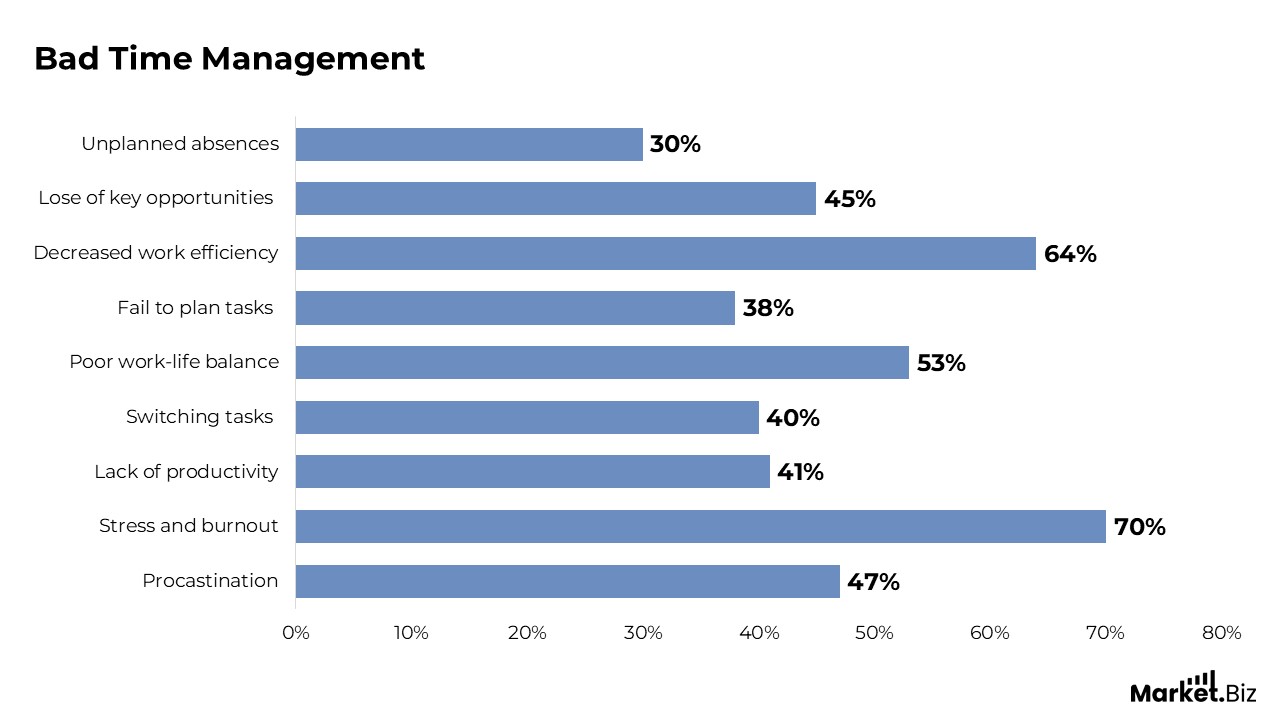
- 47% of employees admit to regularly procrastinating, leading to poor time management and missed deadlines.
- 70% of employees who report poor time management practices also experience high levels of stress and burnout.
- 41% of professionals regularly miss deadlines due to poor time management, affecting productivity and team performance.
- Switching tasks frequently can reduce productivity by up to 40%, a result of poor time management habits.
- 53% of employees struggle to balance work and personal life due to poor time management practices.
- 38% of individuals who fail to plan their tasks are less likely to meet their goals.
- 64% of workers who struggle with time management report elevated levels of stress, leading to decreased work efficiency.
- Poor time management can result in a 25% decrease in overall productivity in an organization.
- 45% of business owners lose key opportunities due to poor time management and a lack of prioritization.
- 30% of employees with bad time management habits are more likely to take unplanned absences, affecting overall team performance.
Causes of Bad Time Management
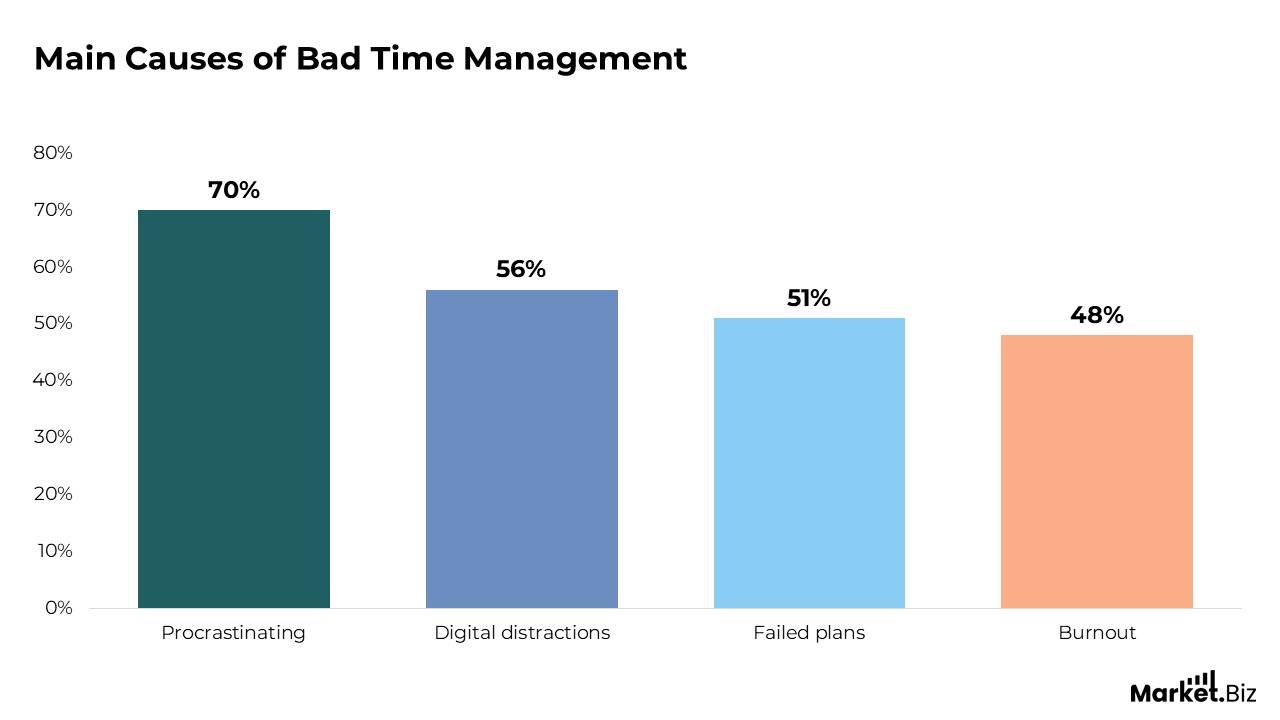
- A significant 38% of employees report that not knowing what tasks to prioritize contributes to poor time management.
- Procrastination affects 20% of adults in the U.S., with 70% of people admitting to procrastinating on important tasks.
- 48% of employees overcommit to tasks, leading to burnout and time management issues.
- Studies show that 56% of workers struggle with digital distractions, leading to loss of productivity and poor time management.
- 31% of workers say unrealistic deadlines are a top cause of poor time management, resulting in stress and rushed tasks.
- Multitasking reduces productivity by 40% and leads to inefficient time management.
- 40% of people without clear goals often experience disorganized time management, focusing on less important tasks.
- 43% of leaders admit struggling with delegation, resulting in micromanagement and time mismanagement.
- 51% of individuals say they fail to plan their day, which leads to feeling overwhelmed and managing time poorly.
- People often underestimate how long tasks will take, causing delays and poor time allocation.
- 45% of employees cite difficulty staying focused as a major barrier to managing their time effectively.
- A chaotic work environment can waste 1–2 hours daily due to distractions and interruptions.
- Perfectionists spend an average of 20% more time than necessary on tasks, causing delays and inefficiency.
- Studies reveal that 42% of individuals with poor time management also report insufficient rest, leading to decreased focus and productivity.
Reasons Why People Waste Time at the Workplace
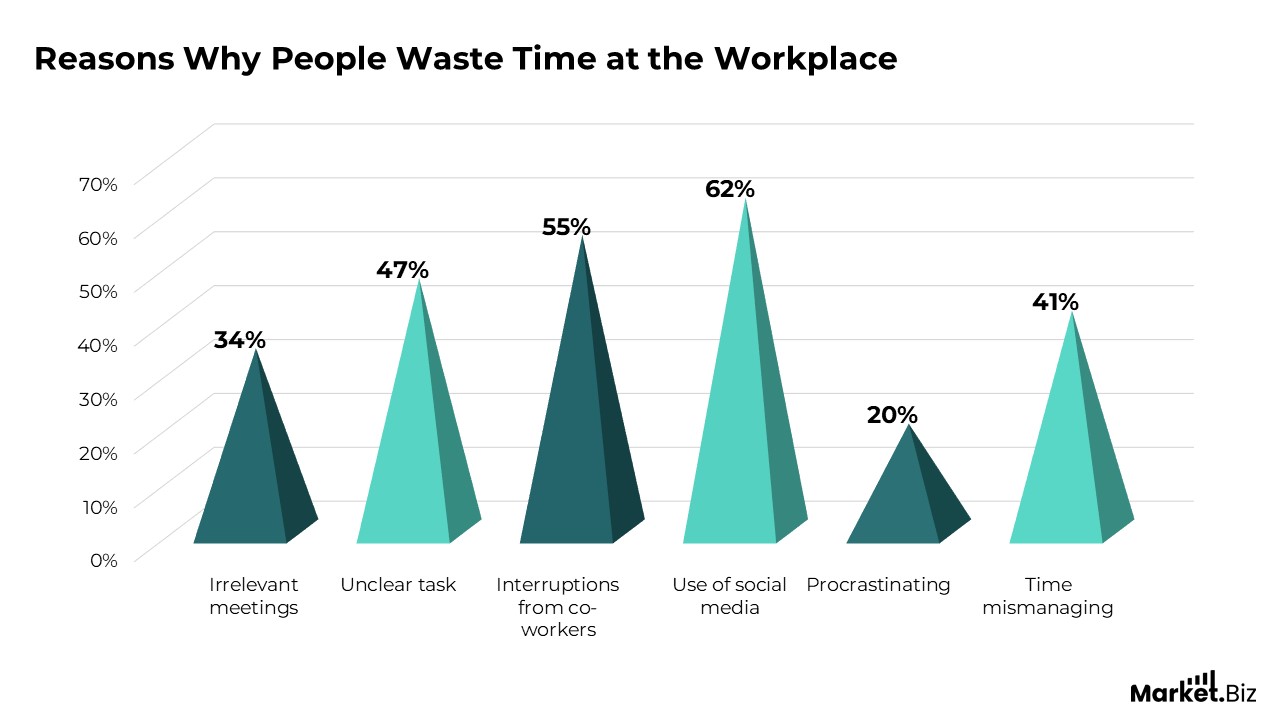
- 34% of employees say they attend meetings that aren’t relevant to their role, which results in wasted time and decreased efficiency.
- Due to unclear task instructions or goals, 47% of employees report wasting time, leading to confusion and inefficiency.
- Interruptions from co-workers are cited by 55% of workers as a major source of time wasted during the day.
- Employees admit to wasting time on social media during work hours, with 62% reporting this behavior, which significantly reduces overall productivity.
- 20% of employees admit to frequently procrastinating, which leads to delayed tasks and overall time mismanagement.
- 41% of employees feel they are not managing their time effectively, which results in unnecessary delays and decreased productivity.
Benefits of Good Time Management Statistics
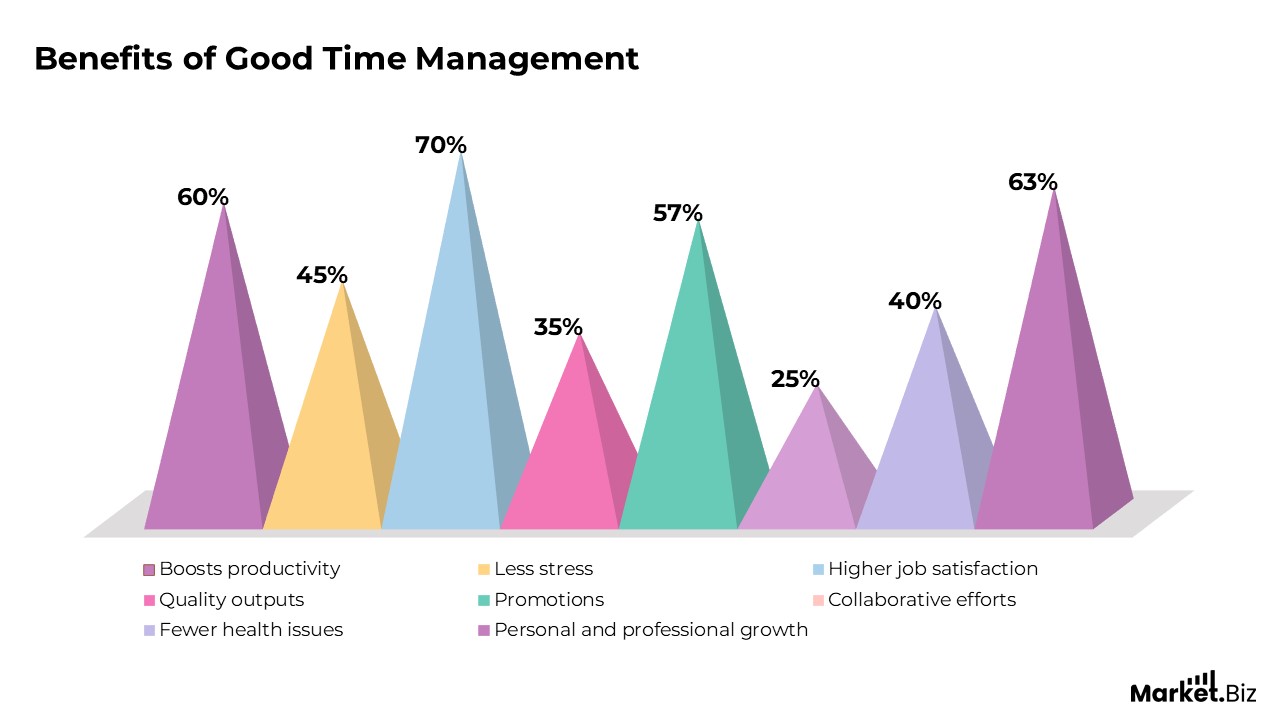
- 60% of high-performing employees credit their success to effective time management, which directly boosts productivity.
- Employees with good time management skills experience 45% less stress, as they can meet deadlines and balance tasks more effectively.
- 70% of workers with strong time management skills report higher job satisfaction due to a better work-life balance.
- People who manage their time well are 35% more focused at work, resulting in higher-quality outputs.
- Good time management allows workers to reclaim up to 30 minutes a day, which can be spent on personal or creative activities.
- 57% of managers agree that employees with strong time management skills are more likely to receive promotions.
- Teams with effective time management see a 25% improvement in collaborative efforts, as tasks are completed more efficiently.
- Employees who manage their time effectively report 40% fewer health issues related to work stress and burnout.
- 63% of people who set clear goals and manage their time well are more likely to achieve them, contributing to personal and professional growth.
Role of AI in Time Management Statistics
- AI-powered tools can automate up to 45% of routine administrative tasks, freeing up valuable time for more strategic work.
- 64% of workers using AI time management tools report being able to prioritize tasks more effectively, leading to better productivity.
- AI-driven time tracking software can help individuals track their activities with 98% accuracy, helping users optimize their daily schedules.
- AI-based tools help managers make 30% faster and more informed decisions by analyzing data and suggesting the most time-efficient solutions.
- AI scheduling assistants can reduce scheduling conflicts by up to 70%, improving overall calendar management and reducing wasted time.
- AI tools that monitor distractions can boost focus by 15%, alerting users to potential time-wasting activities.
- AI-driven reminder systems can improve task completion rates by 50%, ensuring deadlines are met without missing important tasks.
- 58% of employees using AI time management systems report better time allocation, helping them balance work and personal tasks more effectively.
- AI enhances team collaboration by reducing communication delays, with 40% of teams reporting faster project completion times.
- 47% of businesses using AI for time management experience a 20% increase in overall productivity, thanks to optimized task assignment and resource allocation.
- AI systems can reduce cognitive overload by 38%, allowing employees to focus on high-value tasks and improve decision-making.
- AI time management solutions help 55% of users achieve a better work-life balance by managing workloads more efficiently and reducing burnout.
Conclusion
The report highlights how important time management is for both personal and professional success. It shows that 82% of successful individuals use time management tools to stay organized, which helps them meet their goals more efficiently. Despite this, many workers waste up to 31 hours per month due to unproductive meetings and distractions. Proper time management can help reduce stress, with 72% of employees saying it improves their work-life balance.
AI tools are also making a big impact, automating up to 45% of routine tasks, which allows employees to focus on more important work. However, challenges like procrastination and poor prioritization still hinder productivity, with 41% of professionals missing deadlines. Ultimately, improving time management can lead to higher productivity, reduced stress, and better overall success for both employees and businesses.
FAQs
51% of people’s workday is spent on less important activities because 82% of them lack an efficient time management system. Every year, businesses in the US lose about $588 billion as a result of workplace distractions.
The 70-30 principle is about increasing the action, but 30% for optimizing what space does. This is a lesson that hit me very violently a few months ago. It was recognising the positive effects of Clayden’s body and other things in my life, but still found a way to sneak up on me.
A 7 sleep. 8 hours of study or work. For everything else, including meals, rest, and personal time, there are 9 hours.
Your ability to manage your time well as a college student can make the difference between success and failure. According to psychologist William Knause, 90% of college students put things off. Of these, 25% develop chronic procrastination, and many of them drop out of college.