









Introduction
Employee Engagement Statistics: Employee engagement plays a key role in an organization’s success, directly impacting productivity and employee retention. Currently, only 36% of employees are fully engaged in their work, which presents a major opportunity for improvement. Engaged employees are 21% more productive, and companies with higher engagement levels experience 41% fewer absentee days.
Furthermore, businesses with engaged teams have 59% less turnover. By understanding employee engagement statistics, companies can create strategies to improve job satisfaction, boost performance, and drive overall growth.
Editor’s Choice
- Only 36% of employees are fully engaged, presenting an opportunity for improvement.
- Engaged employees are 21% more productive and take 41% fewer sick days.
- High engagement reduces turnover by 59%, lowering recruitment costs.
- Remote workers are 22% more engaged than in-office employees due to flexibility.
- Disengaged employees cost the global economy $7.8 trillion annually in lost productivity.
- 81.9% of employees say rewards increase engagement, emphasizing recognition’s importance.
- Engaged companies see 25% less turnover and 21% higher profitability.
- 90% of employees feel more engaged when their company supports well-being.
- 36% of Millennials are engaged, higher than other generations.
- Generation Z has the lowest engagement rate at 23%.
- Disengaged employees are 2.5 times more likely to leave, increasing turnover costs.
- By 2028, 78% of businesses will prioritize employee engagement as their top HR focus.
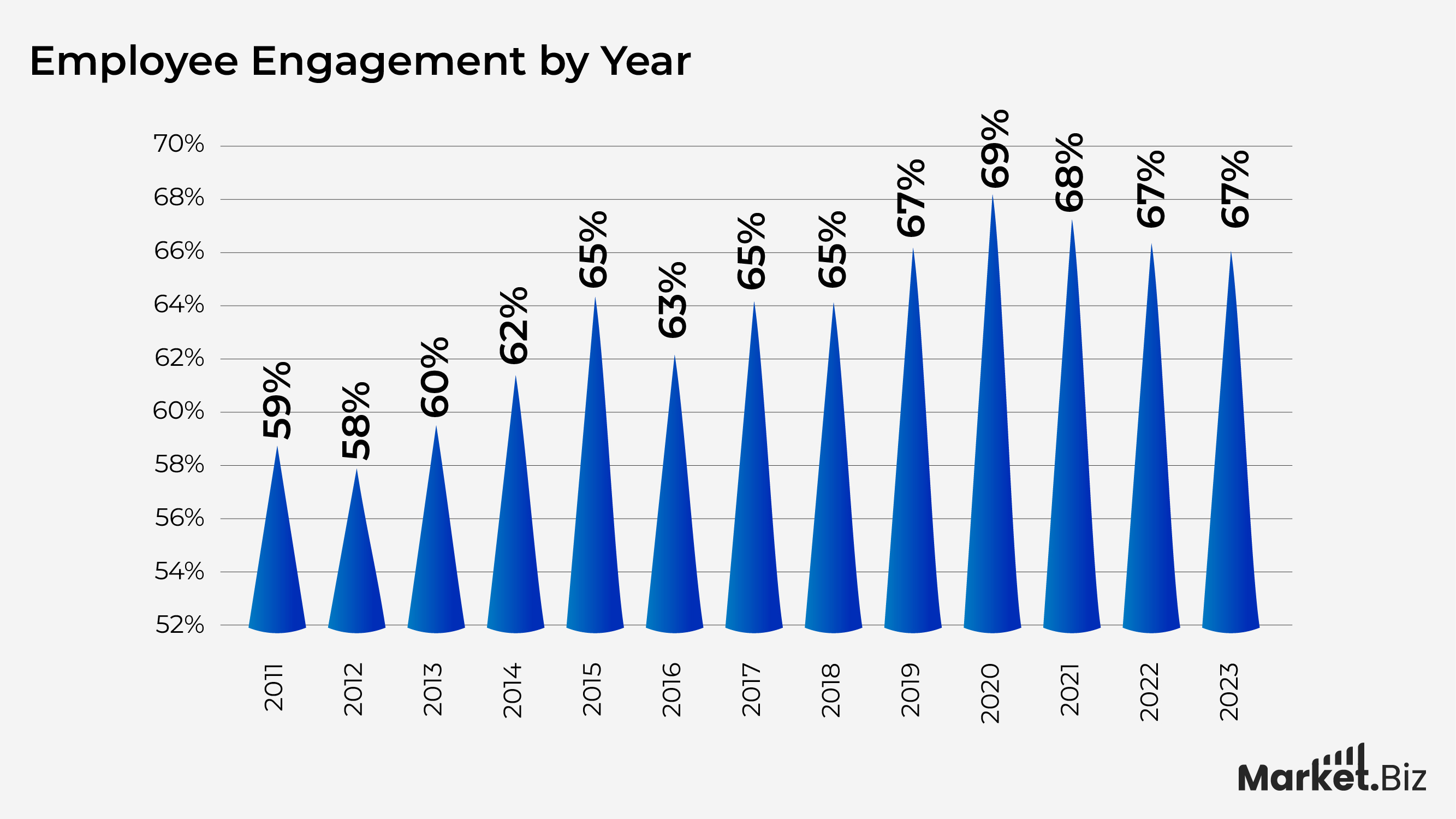
(Source: Statista)
General Employee Engagement Statistics
- The ability to concentrate on work that they enjoy makes 64% of employees feel more engaged at work, followed by work-life balance, which makes 60% feel more engaged.
- Having a good manager (57%) and being able to work remotely (60%) are additional factors that contribute to high levels of engagement.
- 18% of workers are actively displaying disengagement, and 59% of workers are disengaged.
- South Asia leads the world in engagement as of 2024 (33%), followed by the US and Canada (31%).
- The enormous impact of disengaged employees is demonstrated by the USD 8.8 trillion productivity loss they cause globally.
- Three out of four workers are considering leaving their current positions.
- According to employee engagement statistics, 81.9% of workers agreed in a survey that rewarding employees for their efforts increases engagement.
- According to 56% of HR professionals, recognizing employees also makes it easier to hire new hires, and 68% of them think it helps keep current employees from leaving.
Moreover
- Just 22% of businesses are aware of the true causes of their employees’ disengagement or lack of motivation.
- If it meant working at a job they genuinely enjoy, half of all employees would take a pay reduction.
- To work for a company that truly values their well-being, 41% of employees would accept a lower salary.
- Four out of ten workers believe they don’t receive enough training to perform their jobs effectively as of 2024.
- The low or toxic culture at their current job is cited by nearly half (47%) of those who wish to change jobs.
- A third of employees leave their jobs in search of fresh, interesting challenges elsewhere.
- Globally, only 21% of employees are actively engaged in their work, with the majority (79%) either not engaged or actively disengaged.
- Engaged employees are 17% more productive than their disengaged counterparts, contributing significantly to business performance.
Employee Engagement Statistics
By the Numbers
- 30% of American workers are engaged.
- Among those actively disengaged, 17%.
- In 2024, there will be 1.8 times as many engaged employees as actively disengaged ones. Given that the ratio was 2.1 to -1 in 2023, that indicates a declining trend.
- Organizations that adhere to best practices typically report 70% employee engagement.
- Companies with engaged employees experience 25% less turnover and 21% higher profitability, proving that engagement directly impacts both retention and performance.
- 64% of employees said they would work harder if they were better recognized, making recognition a key driver of engagement.
- Remote workers are 22% more engaged than in-office workers, with flexibility cited as the primary reason.
- Disengaged employees cost the global economy around $7.8 trillion, or 11% of global GDP, due to lost productivity.
- 58% of engaged employees feel their job responsibilities align well with their personal interests, which increases both satisfaction and productivity.
- Employee engagement tends to decrease by 5-7% annually when organizations fail to provide opportunities for growth and development.
- 90% of employees report higher engagement when they believe their company is committed to employee well-being and mental health support.
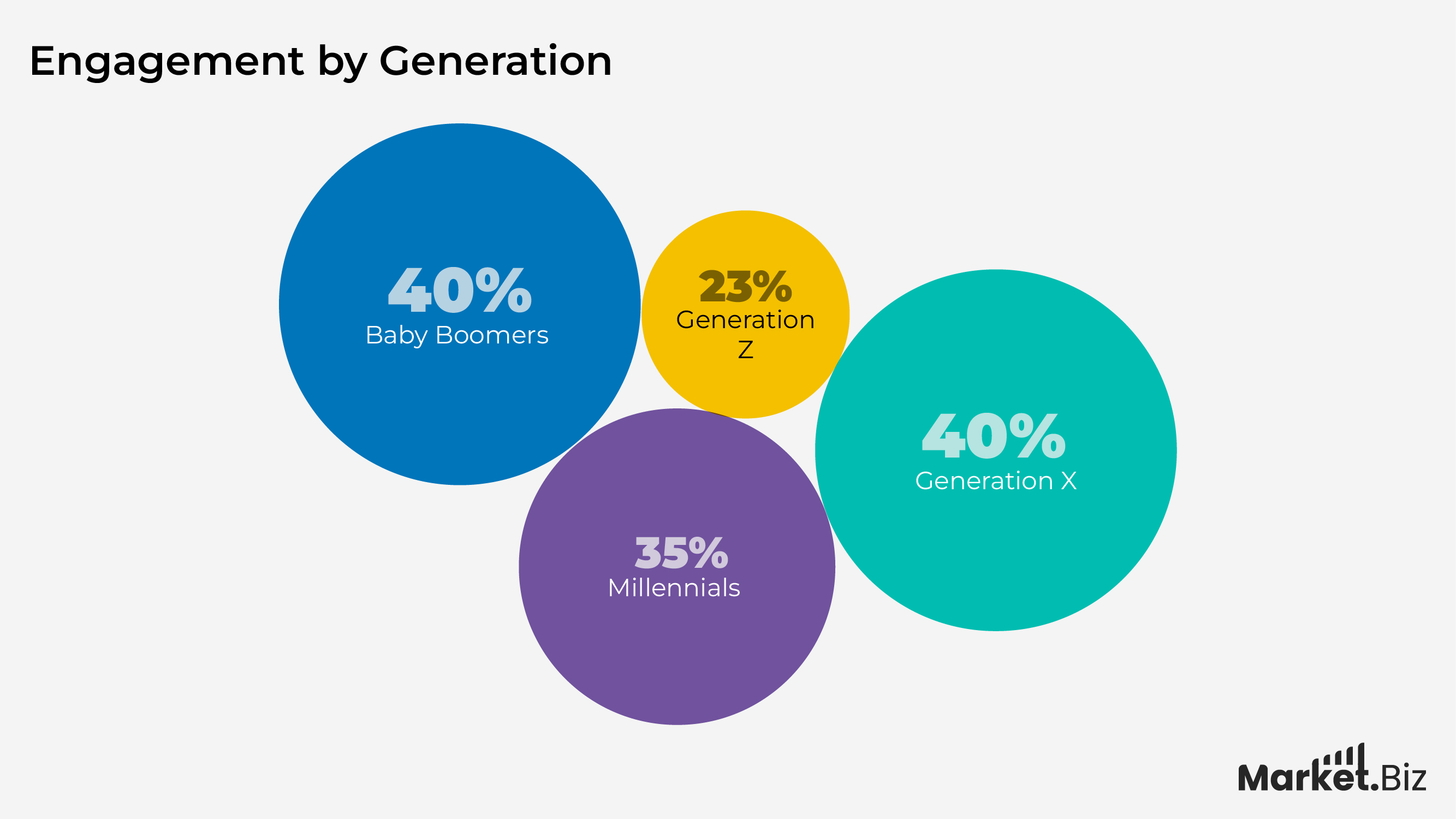
Engagement by Generation
- Millennials make up 35% of the global workforce, with 36% of them reporting feeling engaged at work, higher than other generations.
- Generation Z has the lowest engagement rate, with only 23% of Gen Z employees feeling engaged, compared to 30% of Millennials.
- Baby Boomers have a higher engagement rate, with 40% reporting engagement in comparison to other generational groups.
- Generation X is more likely to be disengaged, with 40% of them reporting low engagement levels in the workplace.
- Millennials are 2.5 times more likely to leave their job if they feel disengaged, underlining the importance of maintaining their interest.
- 56% of Millennials believe that work-life balance is the key to job satisfaction, which heavily influences their engagement levels.
- Generation Z values job security more than other generations, with 55% reporting that they feel more engaged when their role offers long-term stability.
Moreover
- Baby Boomers are more likely to stay with their employer even when disengaged, with 43% of them reporting higher retention despite low engagement.
- 45% of Millennials say that career development opportunities increase their engagement levels, highlighting the need for continuous learning.
- Generation X tends to have higher job satisfaction when they feel their work is valued and their opinions are heard, which boosts engagement levels by 20%.
- 40% of Millennials say their company’s corporate social responsibility efforts increase their engagement and loyalty to the company.
- Generation Z is more likely to prioritize mental health benefits, with 63% of them saying mental well-being support would increase their workplace engagement.
- 51% of Generation X employees say they are more likely to engage with their employer when offered flexibility in work hours.
- Baby Boomers report higher satisfaction with stable, traditional job structures and tend to remain more loyal to their employers, even when not fully engaged.
- Millennials are 50% more likely to engage in team-building and collaborative activities, which enhances their overall workplace engagement.
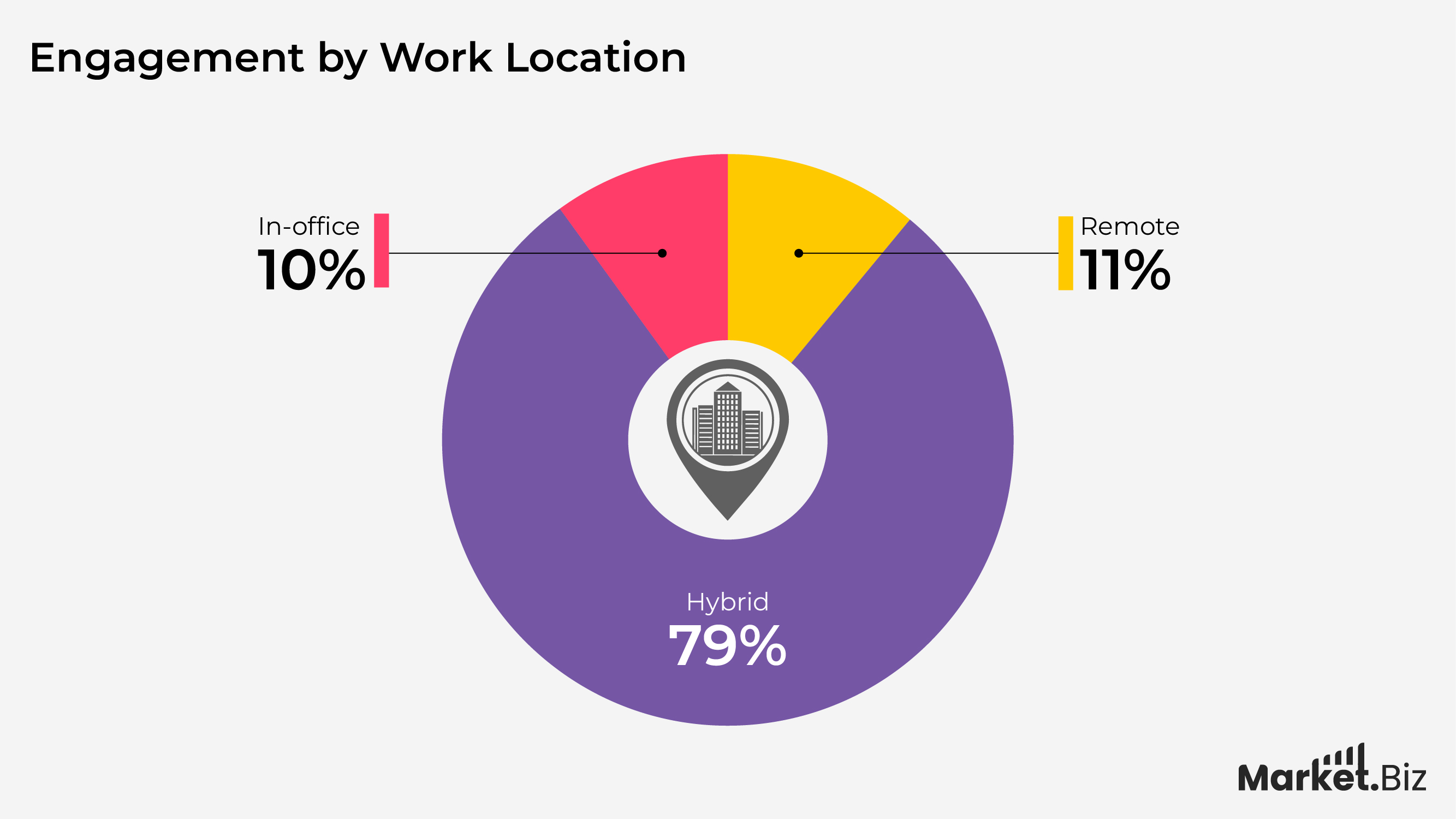
Engagement by Work Location
- Remote workers are 11% more engaged than their in-office counterparts, with flexibility and autonomy being key factors driving higher engagement.
- Hybrid workers report the highest engagement levels, with 79% feeling motivated when they can balance both in-office and remote work.
- Employees working in-office have a 10% lower engagement rate compared to those working remotely, indicating that the traditional office setup is less effective in maintaining engagement.
- Fully remote teams show a 30% increase in engagement when employers provide clear communication and regular check-ins, highlighting the importance of connection in virtual workspaces.
- Employees who split their time between home and the office are 25% more likely to feel engaged, suggesting that the flexibility to choose the work environment can boost morale.
- In-office workers report higher levels of stress and burnout, with only 55% of them feeling engaged, compared to 72% of remote workers who feel more balanced and engaged in their roles.
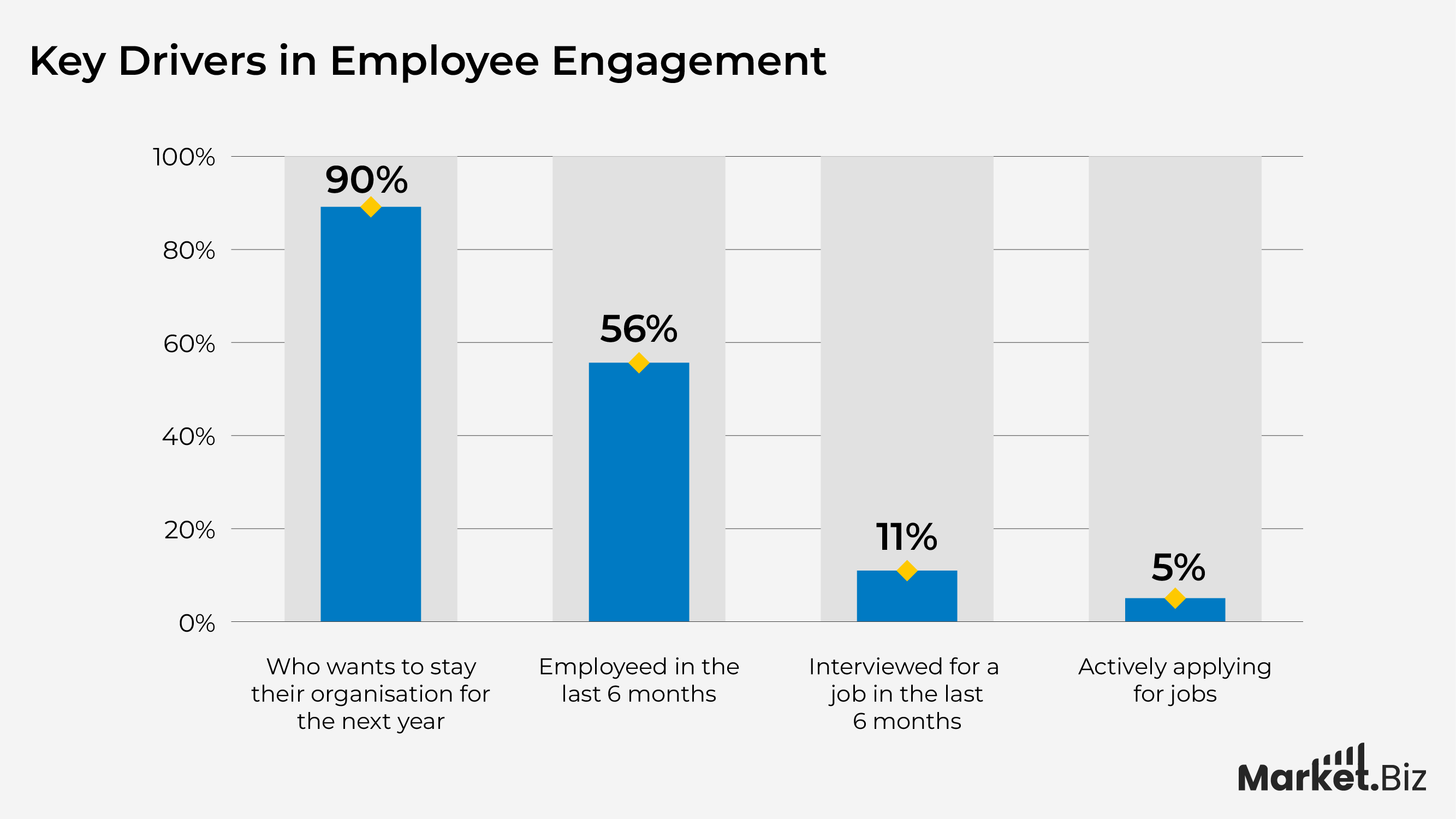
Key Drivers in Employee Engagement
- Employees who receive regular recognition are 5 times more likely to be engaged, with 70% of employees citing recognition as a major driver of their motivation.
- 63% of employees say that opportunities for career advancement and skill development directly impact their engagement levels, highlighting the importance of growth opportunities.
- 70% of employee engagement is driven by leadership, with employees feeling more engaged when they trust their managers and feel supported in their roles.
- 55% of employees report that flexible work arrangements are key to maintaining high engagement levels, especially in the context of remote work options.
- 78% of employees are more engaged when they believe their work is meaningful and aligned with their personal values, showing that purpose-driven roles are essential for motivation.
(Source: Flair)
Impact of Employee Engagement
- Engaged employees are 21% more productive than their disengaged counterparts, directly impacting business performance and outcomes.
- Companies with high employee engagement levels see 41% lower absenteeism, leading to improved workforce availability and reduced operational disruptions.
- Organizations with engaged employees experience 59% lower turnover rates, significantly reducing the cost of recruitment and training new staff.
- Employee engagement has a direct effect on profitability, with highly engaged teams driving a 21% increase in profits.
- Highly engaged employees are 87% less likely to leave their company, fostering better talent retention and reducing costly turnover.
- Employee engagement positively affects customer satisfaction, as engaged employees are 12% more likely to deliver superior customer service and satisfaction.
- Teams with high engagement levels experience 70% higher productivity, demonstrating that motivated employees contribute more efficiently and effectively.
- Engaged employees are 3 times more likely to stay with their employer, creating stability within the workforce and reducing churn.
- Companies with strong employee engagement initiatives see 23% higher profitability compared to those with lower engagement levels.
- 84% of engaged employees report feeling a strong connection to the company’s mission, which drives loyalty and commitment to organizational goals.
- Engagement boosts collaboration, with 66% of employees saying they work better as a team when they feel engaged and valued.
- Organizations that focus on employee engagement achieve a 17% increase in customer loyalty, which further supports long-term business success.
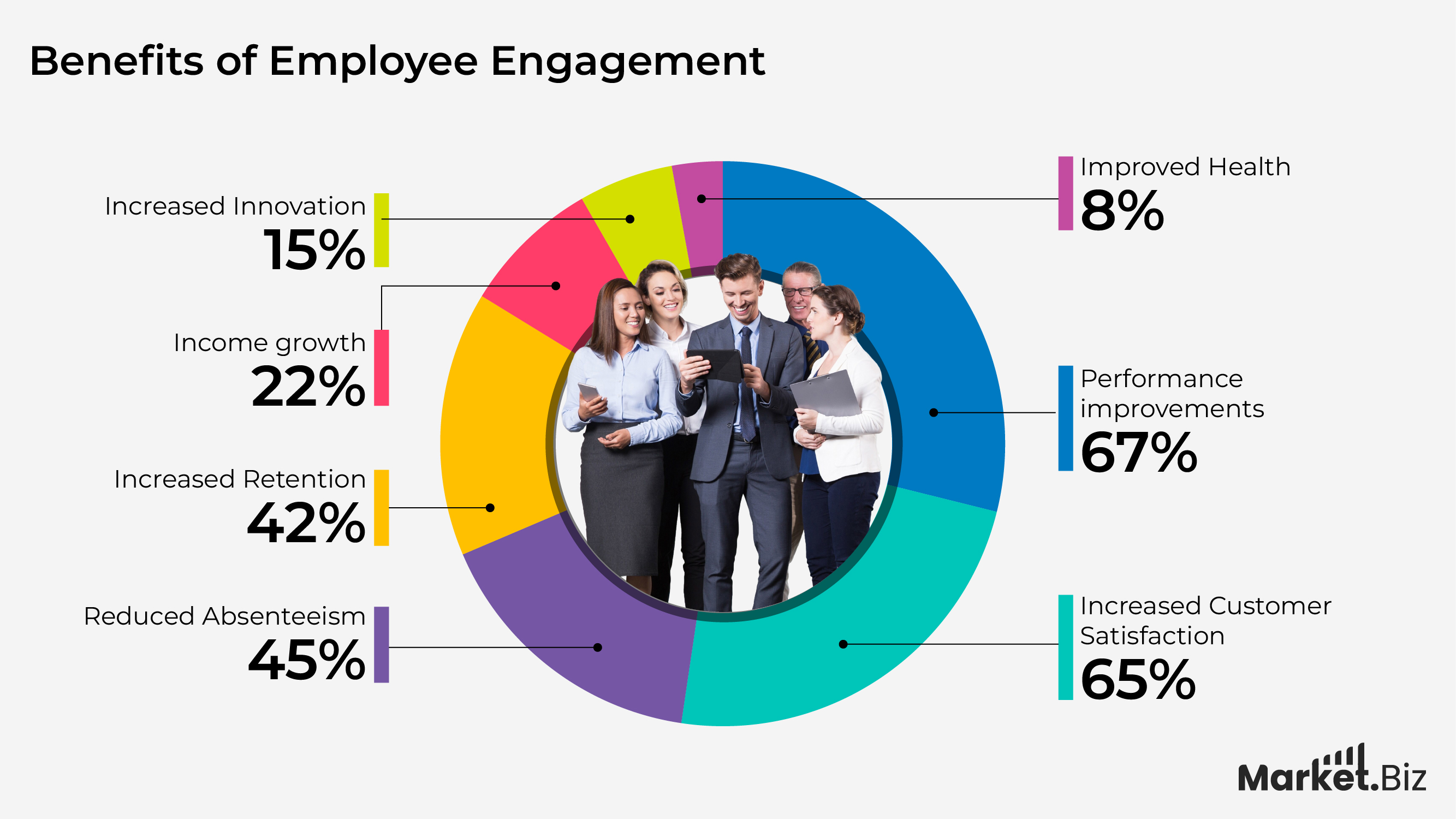
Benefits of Employee Engagement
- Engaged employees are 2.5 times more likely to stay with their employer, reducing turnover and the costs associated with hiring and training new staff.
- Companies with higher engagement levels see a 10% increase in customer loyalty, as employees with strong engagement tend to build better relationships with clients.
- Engaged employees are 40% more likely to contribute ideas for innovation, driving creativity and helping companies stay competitive in the market.
- Organizations with engaged employees report 21% higher profitability, demonstrating a direct correlation between employee morale and financial success.
- Engaged employees have a 60% higher likelihood of promoting their organization as a great place to work, enhancing the company’s reputation and attracting top talent.
- Businesses with high employee engagement levels experience a 12% reduction in operational costs due to improved productivity and more efficient use of resources.
- Engagement improves employee retention by 30%, allowing organizations to maintain continuity and avoid the disruptions caused by high turnover.
- Engaged teams are 50% more likely to meet or exceed their performance targets, contributing directly to business growth and achievement of organizational goals.
- Employees who are engaged are 9 times more likely to go above and beyond their basic job requirements, driving higher levels of discretionary effort.
- High employee engagement has a positive impact on company culture, with 78% of engaged employees saying they feel aligned with the company’s values and mission.
- Engaged employees are 3.5 times more likely to report higher job satisfaction, leading to a happier and more motivated workforce.
- Companies with high engagement see a 14% improvement in quality of work, as engaged employees are more invested in producing accurate and high-quality results.
(Source: Flair)
Costs of Employee Disengagement
- Disengaged employees cost the global economy approximately $7.8 trillion annually in lost productivity, or about 11% of global GDP.
- Companies with low engagement see 18% lower productivity, which directly impacts their ability to meet performance targets and financial goals.
- Disengaged employees are 2.5 times more likely to leave their company, increasing turnover costs for recruitment, training, and onboarding new staff.
- Employee disengagement leads to 37% higher absenteeism, as disengaged workers are more likely to take sick leave or be absent without notice.
- Organizations with disengaged employees experience a 32% higher risk of negative customer satisfaction, as disengaged staff are less motivated to provide excellent service.
- Disengagement reduces collaboration, with disengaged employees being 50% less likely to contribute ideas or work effectively in teams.
- The cost of lost productivity due to disengagement is estimated at $3,400 for every $10,000 in salary for disengaged employees.
- Disengaged employees contribute to a negative workplace culture, lowering morale across teams and increasing the risk of internal conflict.
- Companies with low employee engagement see a 10% decrease in profitability, as low engagement undermines overall efficiency and performance.
- Employee disengagement is linked to a 25% increase in workplace accidents and safety incidents, as disengaged workers are less focused and more prone to errors.
- Disengaged employees are 3.5 times more likely to be absent from work, leading to disruptions in daily operations and increased workload for other team members.
- Disengagement leads to 20% higher turnover in key positions, which can disrupt business continuity and increase the cost of knowledge transfer and training new hires.
Challenges in Employee Engagement
- In the United States, 36% of workers are actively involved in their jobs.
- Customer loyalty rises by an astounding 233% for businesses with engaged staff.
- Due to low engagement, 43% of workers experience burnout.
- Millennials feel misunderstood by older generations, and 66% of them plan to quit their jobs within the next five years.
- Compared to millennials, baby boomers are twice as likely to remain in one position for ten years or more.
- The notion that Gen Z, the digital native generation, prefers digital communication over face-to-face communication is called into question because they prefer face-to-face communication by 33%.
- Compared to 28% of millennials, 38% of Gen X employees believe they require more appropriate training.
- According to 70% of non-millennials, younger workers are less dedicated to their careers.
- Decisions can be made twice as fast and the number of meetings needed is cut in half by teams that follow an inclusive process.
- Businesses with more diverse management teams saw a 19% increase in revenue, which was ascribed to innovation.
- Diversity in the workplace is important to 67% of job seekers when evaluating employment opportunities.
- Nonetheless, 41% of managers claim they are “too busy” to carry out diversity-related projects.
- Employees in inclusive organizations are 3.5 times more likely to realize their full creative potential and 1.7 times more likely to feel innovative.
- 70% of businesses have either put a digital transformation strategy into place or are in the process of creating one.
- The $8 trillion global cost of cybercrime highlights how difficult it is to secure quickly changing technology.
- Just 10% of businesses think they have finished digitization, despite the fact that 87% see it as a competitive opportunity.
The Future of Employee Engagement
- Employee engagement will be the top HR metric for 78% of businesses worldwide by 2028, up from 60% in 2021.
- Businesses with highly engaged workers will be 20% more productive on average than those with low levels of engagement.
- By 2030, remote work flexibility is expected to help increase overall employee engagement by 15%.
- By 2027, 67% of companies plan to implement gamification techniques to improve training and engagement.
- 85% of HR procedures will be automated by 2030, with AI-powered solutions managing duties like hiring, onboarding, and performance reviews.
- More than 60% of employee training programs will use AI-driven personalization in 2025, guaranteeing more individualized and effective instruction.
- By 2029, adoption rates of augmented reality (AR) and virtual reality (VR) training modules are expected to increase by 300%.
- By 2030, 45% of employee questions and HR-related duties will be handled by catboats, such as virtual assistants and WhatsApp catboats.
- More than half of the workforce will work gigs either full-time or in addition to their regular jobs by 2030.
Moreover
- By 2026, 35% of multinational corporations will have implemented the 4-day workweek in an effort to increase output and improve worker satisfaction.
- The fact that almost 60% of jobs in 2030 have not yet been created shows how quickly job roles are changing.
- By 2027, collaborative technologies will help increase remote and cross-functional team projects by 40%.
- By 2028, businesses that invest in a comprehensive well-being program will see a 25% reduction in employee turnover.
- 80% of multinational corporations will provide mental health resources and support as part of their benefits package by 2027.
- By 2029, 70% of companies will prioritize workspace customization because they understand how it affects employee happiness and productivity.
- By 2026, 90% of companies will have switched from annual reviews to continuous feedback systems.
- 65 percent of businesses will have plans in place by 2028 to guarantee work-life integration rather than just balance.
- By 2030, opportunities for personal growth and development will rank among the top three considerations for job seekers.
- By 2027, it’s predicted that 50% of businesses will provide “unlimited” paid time off, prioritizing outcomes over hours worked.
Conclusion
Employee engagement is crucial for organizational success, with a significant portion of employees currently disengaged.
Engaged employees are more productive, take fewer sick days, and contribute to lower turnover rates. Disengaged employees cost the global economy a substantial amount annually and are more likely to leave, increasing recruitment costs.
Companies that focus on well-being, recognition, and development see higher engagement and better outcomes. As more businesses prioritize engagement, fostering a highly engaged workforce is essential for long-term success.
FAQ’s
Employee engagement is the emotional dedication of workers to their jobs and the company. It is essential in 2025 since it has a big influence on output, staff retention, and overall business success.
The most recent data on employee engagement highlights how crucial it is to achieving business objectives. Recent surveys or trustworthy data from credible sources show how it affects organizational performance.
Actively Disengaged (unmotivated and possibly harmful to workplace morale and productivity), Not Engaged (doing the bare minimum), and actively Engaged (highly involved and motivated) are the three categories. Through automated pulse surveys and ongoing OKR tracking, People box assists in identifying these engagement patterns, allowing managers to act quickly before disengagement affects team performance.
Employee engagement increases motivation, teamwork, and focus, all of which boost output. Teams at companies with high levels of engagement perform better, miss fewer days of work, and are more creative.