









Introduction
Digital Transformation Statistics: Digital transformation has emerged as a crucial driver of innovation and growth across industries. As companies seek to improve customer experiences, optimize operations, and maintain their competitive edge, the adoption of technologies like artificial intelligence (AI), cloud computing, and data analytics has significantly accelerated.
These advancements are empowering businesses to enhance efficiency, foster innovation, and better adapt to shifting market demands. The COVID-19 pandemic played a key role in fast-tracking this transformation, prompting organizations in sectors such as retail, healthcare, and finance to implement digital solutions to manage disruptions.
As the digital landscape evolves, businesses must embrace new trends and technologies to stay agile and poised for long-term success. Digital transformation is now an essential strategy for organizations determined to thrive in the modern, digital-first world.
Editor’s Choice
- Approximately 58% of small businesses use digital marketing to engage with their customers.
- For every $1 invested in digital marketing, businesses typically generate a $5 return.
- Global digital advertising expenditures are steadily rising and are projected to reach $734.6 billion by 2025.
- On average, businesses allocate $45.11 per user for social media advertising.
- By 2026, smartphones are expected to account for 69% of total advertising expenditures.
- Programmatic advertising is anticipated to represent 87% of digital advertising revenue by 2026.
- Social media ad spending is forecast to surpass $230 billion.
- 74% of organizations prioritize digital transformation as a key objective.
- 77% of companies have already begun their digital transformation journey.
- Only 35% of organizations report successful outcomes from their digital transformation initiatives.
(Source: Market.us)
General Digital Transformation Statistics
- 61% of business executives identify digital transformation as a top priority in their organizations.
- 94% of large organizations in the US and UK have developed a digital transformation strategy, with only 5% of respondents stating they lack one.
- 81% of business leaders view investments in digital transformation as either essential or necessary for business success.
- Digital transformation is a key technology initiative for 74% of organizations, ranking among the top 3 IT priorities, following closely behind cybersecurity (76%) and cloud (75%).
- 56% of US executives report that the ROI for their digital transformation initiatives has exceeded expectations.
- 58% of organizations plan to increase their spending on digital transformation initiatives this year compared to the previous year.
- 63% of executives globally have seen a performance boost from digital transformation initiatives in the last 2 years.
- 38% of executives worldwide say they have the support of senior leadership for deploying emerging technologies.
Moreover
- 89% of C-level executives report having pursued at least one major digital transformation initiative in the past two years.
- 35% of organizations aim to improve customer experience as a primary objective of their digital transformation efforts.
- According to Prophet, 51% of digital transformation efforts are driven by growth opportunities, 41% by competitive pressures, and 38% by new regulatory standards like GDPR, amid frequent high-profile data breach scandals.
- IDC forecasts that 90% of new enterprise apps will integrate AI technology by 2025.
- 29% of CEOs and executives reported a positive impact on growth after implementing digital transformation, while 41% noted improvements in their sales and marketing campaigns.
- According to Gartner, 60% of mainstream companies will prioritize becoming a composable business, aiming to outpace competitors by 80% in the speed of implementing new features.
- 64% of organizations believe building new digital businesses is essential to remain competitive in 2024 and beyond.
- 69% of IT decision-makers primarily see digital transformation as a means to enhance process efficiency.
(Source: International Data Corporation, Gartner, Deloitte, Kissflow Inc., West Monroe, Valtech, Flexera, KPMG, McKinsey, Prophet, Quixy, DemandSage)
Digital Transformation in Manufacturing
- 92% of manufacturers prioritize digital transformation, but only 16% have real-time monitoring of their entire manufacturing process, making it difficult to track equipment, materials, and workforce during production.
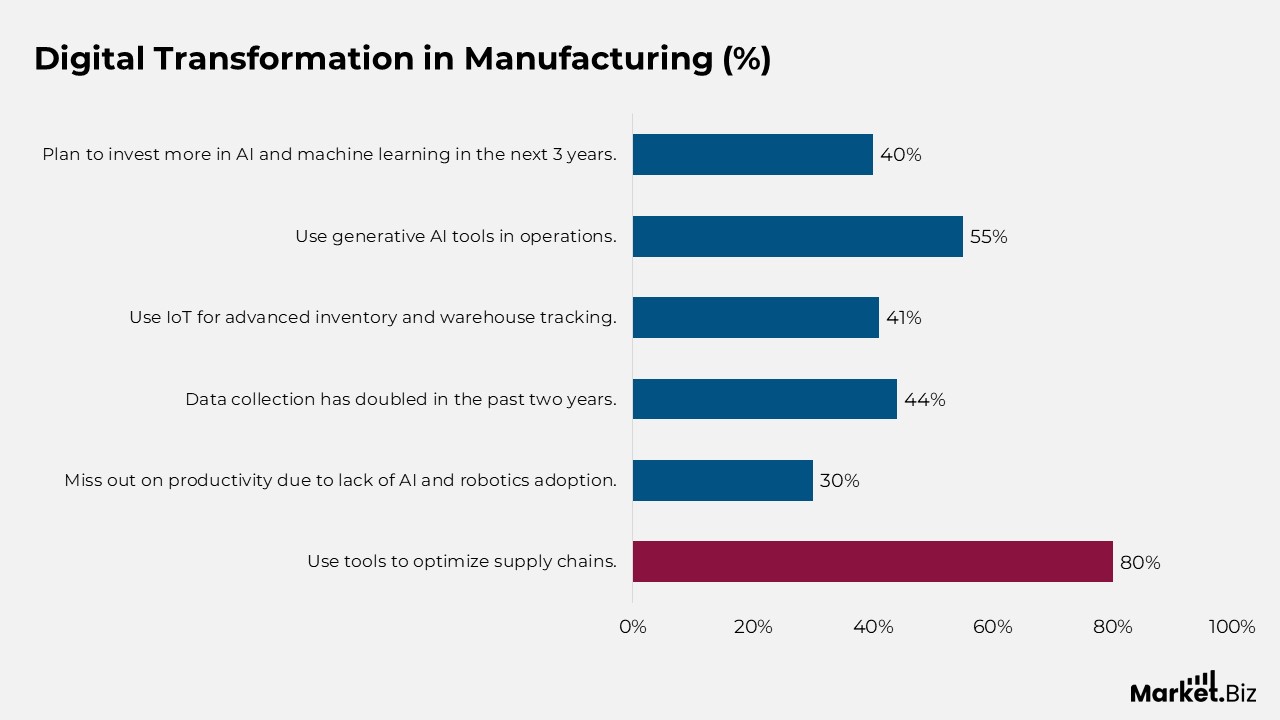
- 80% of manufacturers utilize tools to optimize their supply chains, though many struggle to connect strategic vision with day-to-day operations, focusing more on resolving individual issues.
- Manufacturers that fail to adopt technologies like AI and robotics miss out on 30% to 50% of potential productivity.
- 44% of manufacturers report that the data they collect has doubled over the past two years, with expectations to triple by 2030, though many lack confidence in their ability to analyze this data.
- Progress in the later stages of manufacturing is slower, with only 41% of manufacturers using IoT for advanced inventory and warehouse tracking.
- 55% of industrial product manufacturers currently use generative AI tools in their operations, and more than 40% plan to invest further in AI and machine learning over the next three years.
(Source: National Association of Manufacturers, Manufacturers Alliance, Bain & Company, Zebra, Deloitte)
Digital Transformation in Retail
- Consumers report that only 43% of their experiences felt personalized, despite brands claiming they personalize 61% of experiences, highlighting a gap between consumer expectations and brand efforts.
- A survey of 20,000 consumers revealed that more than half want to use chatbots or virtual assistants (55%) while shopping, with similar interest in AI tools (59%). and augmented/virtual reality (55%)
- 71% of consumers expect companies to understand their preferences, indicating that personalization is not only important for luxury brands but also for businesses across various sectors.
- The market for AI services in retail is expected to grow from $5 billion to over $31 billion by 2028.
(Source: World Economic Forum, Deloitte, International Business Machines Corporation, Think With Google, WalkMe and its affiliates)
Digital Transformation Market Size
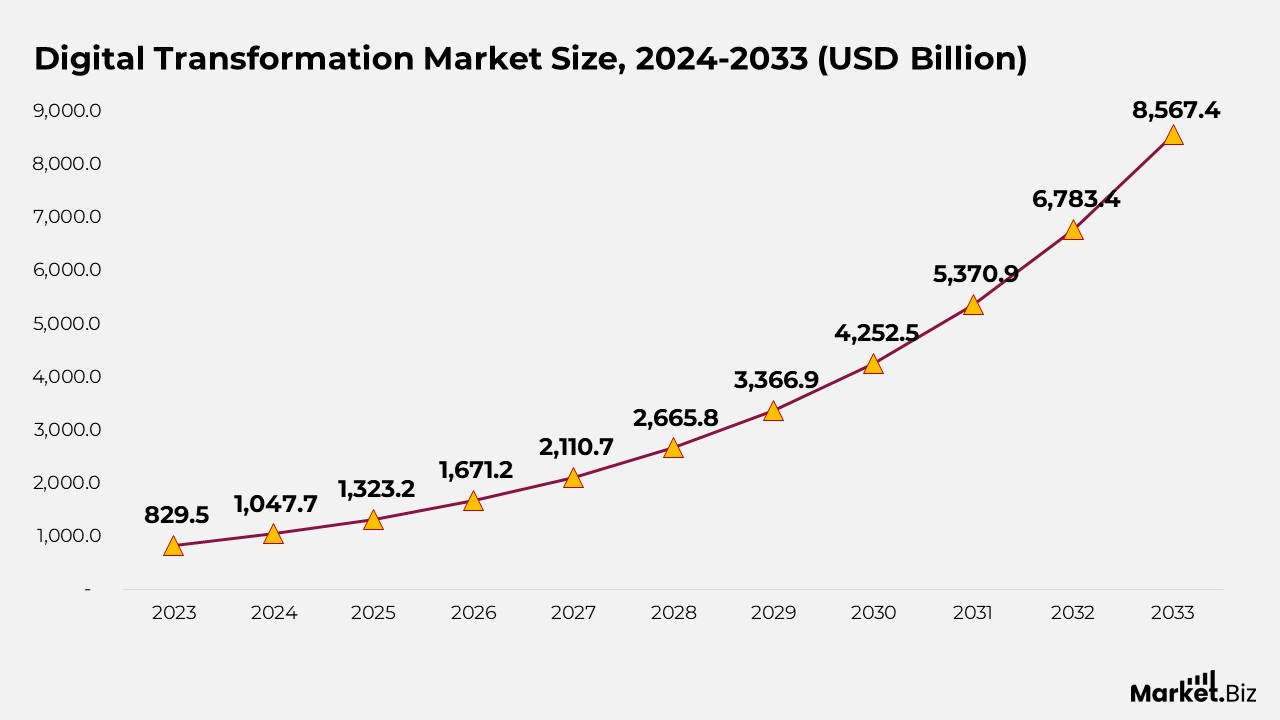
- According to Market.us, the digital transformation market is projected to grow from $1,047.7 billion in 2024 to $8,567.4 billion by 2033, representing a compound annual growth rate (CAGR) of 26.3% from 2024 to 2033.
- The market growth is driven by the rising adoption of mobile devices and apps, enhancing personalized customer interactions and on-the-go engagement.
- In 2023, the Solution segment dominated the market, capturing over 69.7% of the share, driven by the demand for digital business solutions.
- In 2023, the on-premises segment held a dominant position with over 63.9% market share, mainly due to concerns over data security and regulatory compliance.
- The Big Data & Analytics segment commanded a significant market share of 30.1% in 2023, driven by the growing volume of data across various industries.
- Large Enterprises captured 61.5% of the digital transformation market in 2023, benefiting from financial resources to invest in advanced technologies.
- The BFSI sector led the end-use industry segment, accounting for 27.4% of the market in 2023, driven by the need for enhanced customer experience and regulatory compliance.
Moreover
- North America dominated the digital transformation market in 2023, holding over 41.9% of the global market share, with a valuation of $218.2 billion.
- North America’s advanced digital infrastructure and adoption of technologies have fueled rapid digital transformation across various sectors.
- 69% of firms in the European Union implemented advanced digital technologies in 2022, as reported by the European Investment Bank.
- By 2023, digitally transformed entities are estimated to account for more than 50% of global GDP, amounting to $53.3 trillion.
- Digital transformation has taken precedence over cybersecurity and cloud initiatives, with 73% and 65% of organizations prioritizing it.
- For 69% of IT decision-makers, digital transformation is primarily seen as a key driver of operational efficiency.
- Despite increased investment, only 35% of organizations reported successful outcomes from their digital transformation efforts, indicating challenges in implementation.
- 74% of Chief Supply Chain Officers (CSCOs) view hybrid cloud integration as essential for digital transformation in supply chain management.
- 86% of organizations believe workplace transformation fosters better collaboration among teams, acting as a catalyst for improved teamwork.
(Source: Market.us)
Digital Transformation in Edtech Market Size
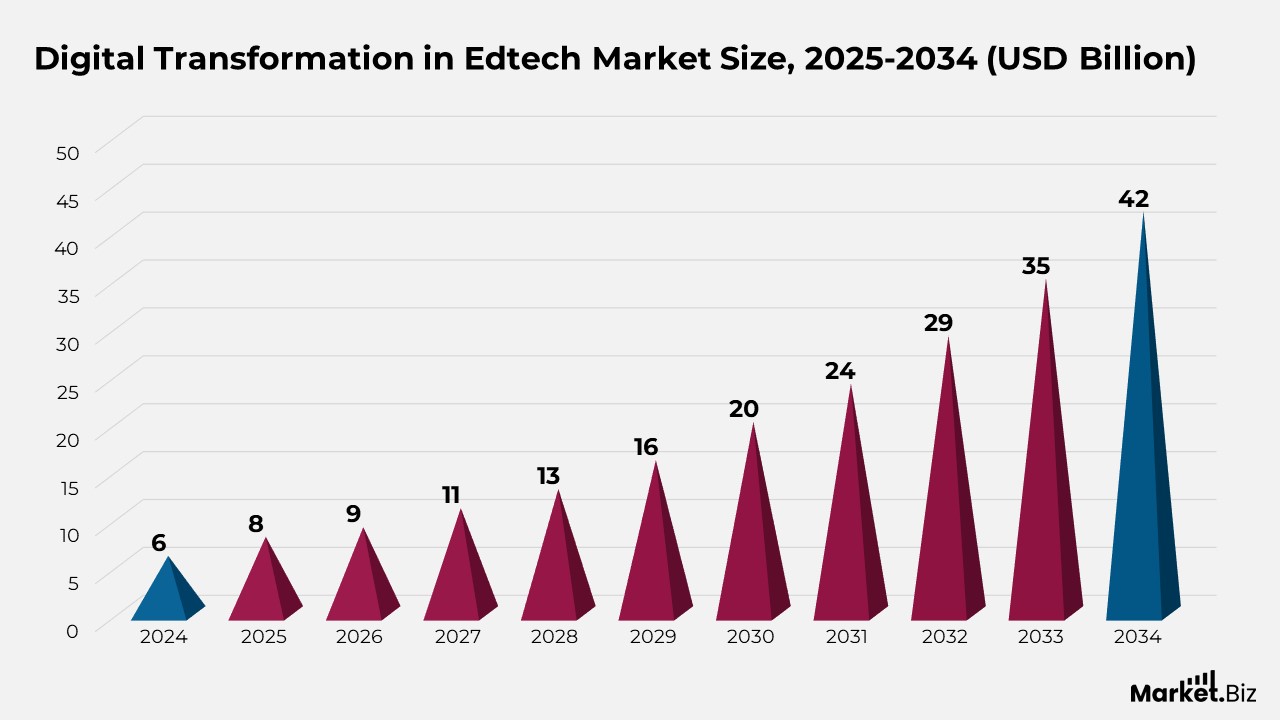
- According to Market.us, the digital transformation in the edtech market is projected to grow from $8 billion in 2025 to $42 billion by 2034, representing a compound annual growth rate (CAGR) of 21.2% from 2025 to 2034.
- The market growth is driven by the widespread adoption of mobile devices and internet connectivity, enabling digital learning solutions and personalized experiences.
- In 2024, the Artificial Intelligence (AI) segment subjugated the digital transformation in EdTech, holding over 35.7% of the market share, due to its role in personalized learning.
- The K-12 segment captured more than 39.7% of the EdTech market in 2024, driven by its early adoption of digital educational tools.
- North America led the digital transformation in EdTech with a 40.3% market share and USD 2.4 billion in revenue in 2024, supported by strong technological infrastructure.
- The US market for digital transformation in EdTech was valued at USD 1.99 billion in 2024, with a projected CAGR of 18.2%.
- The growth in the sector is driven by increased investment in EdTech startups, the rise of e-learning platforms, and AI integration in educational content and delivery.
- 86% of teachers believe EdTech is essential, while 96% report that it enhances student engagement, highlighting its significant impact on teaching.
- 65% of teachers use digital tools daily, and 87% rely on them at least a few times a week, showcasing the widespread adoption of EdTech.
- 63% of educators believe EdTech accelerates learning, further underscoring its effectiveness in enhancing educational outcomes.
Digital Transformation in Financial Services
- Denmark leads the world in online banking adoption, with 97.76% of its population using it, followed by the Netherlands (96.35%) and Norway (96.8%), reflecting the strong use of digital financial services in Northern Europe.
- AI is projected to boost global banking profits by $2 trillion by 2028, a 9% rise over the next five years.
- 98% of CFOs say their departments have invested in automation tools like AI over the past year, although many still have low levels of digitization in their finance operations.
- 46% of financial services leaders report that digital transformation has increased employee productivity, and 45% have seen improvements in employee satisfaction, which helps attract and retain talent.
- Over 75% of banks plan to increase investments in data management and cloud services to support their generative AI strategies.
(Source: Statista, KPMG, CitiGroup, Deloitte, McKinsey)
Digital Transformation in Healthcare
- 60% of healthcare professionals believe digital tools can enhance communication with care teams, 55% think they will improve access to care, and 40% believe they can reduce out-of-pocket costs.
- Big data plays a significant role in healthcare, aiding in preventive care, better patient outcomes, and improved efficiency, though less than 5% of health data is currently utilized to improve health outcomes.
- 75% of organizations prioritize digital and analytics transformation, though many lack the necessary resources and planning for successful implementation.
(Source: Statista, World Bank, McKinsey, Deloitte)
Digital Adoption Statistics
- Data-driven organizations are 23 times more likely to acquire new customers compared to others.
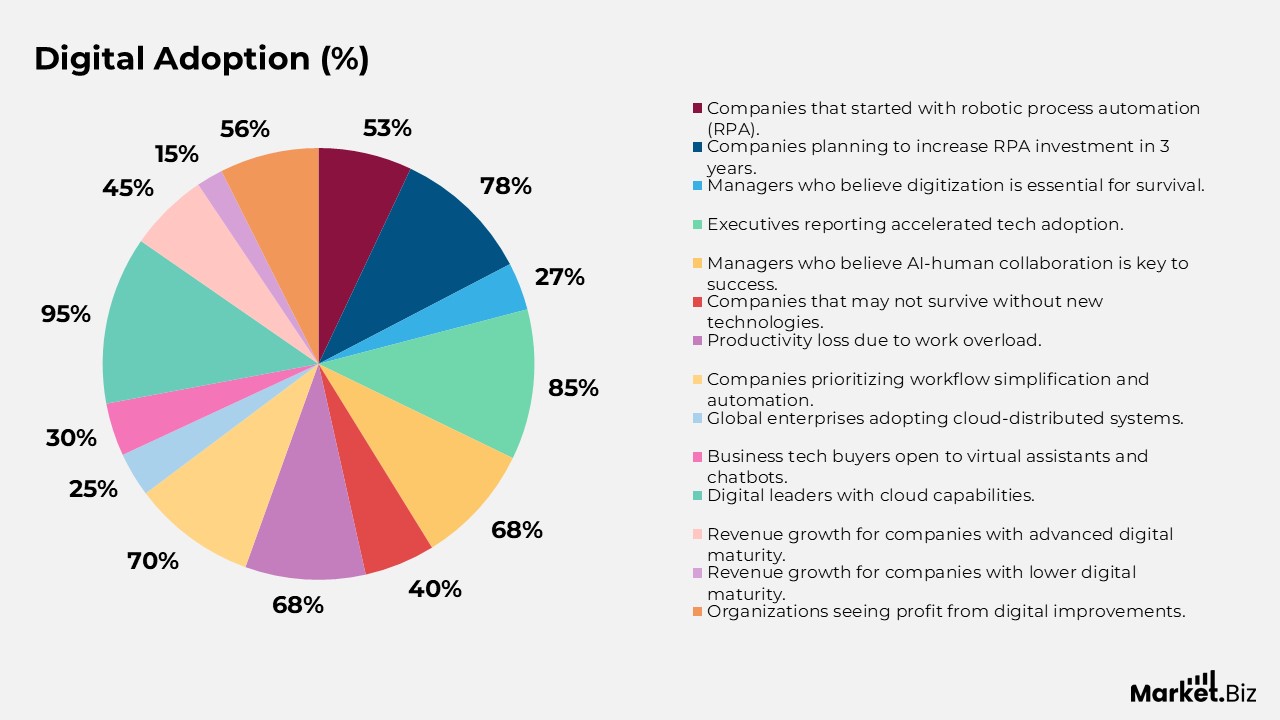
- 53% of companies have begun their journey with robotic process automation (RPA), with 78% planning to increase their investment in the next three years.
- 27% of managers believe that digitization is no longer optional, but essential for business survival.
- 85% of executives report that their organizations have significantly or moderately accelerated the adoption and implementation of new technologies.
- 68% of managers believe that collaboration between AI and humans is crucial to the future success of their businesses.
- 40% of companies may not survive the next decade if they fail to adapt and transform to embrace the latest technologies.
- Work overload can reduce productivity by 68%, emphasizing the need for investment in technologies that eliminate mundane tasks like commuting and administrative work to boost productivity.
- 70% of companies have identified simplifying workflows and automating manual processes through technology to reduce costs as a top priority moving forward.
- 25% of global enterprises have adopted cloud-distributed systems on a large scale.
- 30% of business technology buyers are open to using virtual assistants and chatbots for enhanced efficiency.
- 95% of digital leaders have integrated significant cloud capabilities, helping them stay ahead of competitors.
- Companies with advanced digital maturity have experienced 45% revenue growth, compared to only 15% growth for those with lower digital maturity.
- 56% of organizations report that digital improvements and innovations have already contributed to increased profits.
- For many companies, the pandemic accelerated the development and adoption of digital tools by nearly seven years.
(Source: McKinsey, Digital Marketing Institute, Open Text, Global RPA Survey, Forrester, Fujitsu, Accenture, East Innovations, KPMG, Tech Republic, Deloitte, Whatfix)
Advanced Technologies in Digital Transformation
- 26% of organizations are exploring AI and machine learning technologies, while 24% are currently piloting these implementations.
- Automation is gaining momentum, with 53% of organizations already on their Robotic Process Automation (RPA) journey, a number expected to rise to 72% within the next two years.
- Gartner analysts predict that by 2025, more than 85% of organizations will adopt a cloud-first strategy.
- 60% of organizations are incorporating generative AI into their marketing strategies, highlighting its transformative role in reshaping workflows and improving decision-making.
- As of last year, nearly 92% of digital leaders confirmed their companies had implemented cloud technology to some extent.
- Cloud computing boasts the highest adoption rate among emerging technologies, with 90% of organizations globally already using cloud technologies.
- Big data and analytics are the 2nd most widely adopted technologies, with approximately 61% of respondents indicating active usage.
(Source: Gartner, MindInventory)
Digital Transformation Spending and Adoption by Country
- Latin America and China are leading the charge in digital transformation spending, with five-year growth rates of 17.9% and 17.4%, respectively.
- European companies are lagging behind their US counterparts in adopting generative AI, with a gap of 45% to 70%. For instance, Europe controls 18% of global data center capacity, while the US holds 37%, despite similar GDP figures of around $23 trillion for Europe and $27 trillion for the US.
- Singapore has topped a global digital competitiveness ranking among 67 countries, followed by Switzerland in second place and Denmark in third.
- In Asia, 45% of companies have embraced generative AI, slightly higher than in other regions. Only 16% of companies in Asia report little or no adoption of generative AI, compared to 18% in North America and 23% in Europe.
(Source: IDC, IMD, McKinsey, Boston Consulting Group)
Challenges in Digital Transformation
- Globally, 32% of leaders across various industries view complex work environments as a key obstacle to digital transformation success.
- 27% of senior leaders cite the lack of technical expertise as a significant barrier to achieving transformation goals.
- Organizations that implement a comprehensive technology value framework are 20% more likely to achieve significant enterprise value.
- 39% of executives highlight the shortage of digital talent as a critical challenge in executing transformation strategies.
- 26% of senior executives consider high costs to be a major challenge in driving digital transformation initiatives.
- Digital transformation can lead to 10-30% improvement in throughput, 10-20% in quality cost reduction, and up to 50% decrease in machine downtime.
- 62.5% of respondents cite difficulties in consolidating and utilizing customer data as the primary reason for not being able to implement digital transformation.
- 87.5% of digital transformation efforts fail, illustrating the complexities involved in technological evolution.
- While 75% of companies claim to be customer-centric, only 30% of consumers agree, indicating a significant gap in perceived customer orientation.
- Currently, 15% of asset-intensive organizations integrate ET/OT/IT investment roadmaps for Industrial Internet of Things (IIoT).
- 35% of organizations view improving customer experience as one of the primary goals of their digital transformation initiatives.
(Source: eSparkBiz, Statista, IDC)
Conclusion
Digital transformation is significantly transforming industries worldwide, as organizations increasingly adopt cutting-edge technologies to boost efficiency, enhance customer experiences, and foster innovation.
Despite its widespread recognition, numerous challenges, including a shortage of technical expertise, high costs, and a lack of skilled talent, continue to prevent many businesses from fully tapping into the potential of digital transformation.
Although some companies have seen notable improvements in throughput, quality, and reduced downtime, achieving success remains a complex endeavor, with many initiatives still facing obstacles in data integration and utilization.
As digital transformation evolves, organizations that take a comprehensive, technology-driven approach are more likely to realize substantial business value, positioning themselves for sustained growth and a competitive edge in an increasingly digital landscape.
FAQ’s
Digital transformation involves the integration of digital technologies into every facet of a business, significantly altering how organizations operate and provide value to their customers. This transformation includes adopting technologies such as artificial intelligence, cloud computing, automation, and data analytics to boost efficiency, enhance customer experiences, and drive innovation.
Digital transformation is essential for businesses to remain competitive in a fast-changing market. It allows companies to streamline operations, make better decisions, improve customer satisfaction, and develop new business models. Organizations that embrace digital transformation are more likely to achieve long-term success and maintain a competitive edge.
Digital transformation has a significant positive impact on business performance. Organizations that adopt a comprehensive technology strategy are 20% more likely to achieve substantial enterprise value. Furthermore, digital transformation can improve throughput by 10-30%, reduce quality costs by 10-20%, and decrease machine downtime by up to 50%.
While many organizations recognize the importance of digital transformation, success rates are relatively low. Only 35% of companies report achieving success in their digital transformation efforts, reflecting the complexity and challenges involved in fully realizing their potential.