









Introduction
Microwave Oven Statistics: The microwave market has experienced considerable transformations owing to innovative technologies that are changing how individuals cook and prepare their meals. The primary technology driving this market is the magnetron. This crucial component generates microwave energy, which is responsible for heating food. Over the years, magnetron technology has seen substantial advancements.
A significant factor contributing to the market’s expansion is the incorporation of smart technology. Smart features in microwaves provide a variety of advantages, such as remote control, monitoring capabilities, recipe suggestions, and automatic cooking settings. These functionalities are made possible by integrated sensors, wireless connectivity, and sophisticated software.
For instance, certain contemporary microwaves can be controlled via smartphone applications, allowing users to initiate or halt cooking from a distance. This article will further illuminate Microwave Statistics.
Editor’s Choice
- In 2025, the global revenue from the Microwave Ovens market is projected to reach US$10.02 billion.
- In 2026, this segment is expected to show a volume growth of 1.71%.
- The microwave oven first appeared in January 1947.
- By 2026, the market size is expected to further grow to USD 10.44 billion, increasing to USD 10.89 billion in 2027.
- In 2024, convection microwaves dominated the market, achieving $4.9 billion in sales, and are expected to experience a compound annual growth rate (CAGR) of 5.2% from 2025 to 2034.
- In 2018, the average price stood at $107.3, but it experienced a slight decline to $106.8 in 2019.
- In 2022, China dominated global microwave oven exports, achieving an export value of USD 3.82 billion, which constituted 70.30% of the overall market.
- By 2029, unit sales are expected to reach a peak of 253 million units.
What is a Microwave Oven?
A microwave oven is an electrical device that heats and prepares food by exposing it to electromagnetic radiation within the microwave frequency spectrum. Microwave ovens can be considered according to their installation method into freestanding and built-in varieties. Among these, built-in microwaves generally provide higher power and come with improved ventilation.
Furthermore, the costs of microwave ovens vary based on the features of each model, which can range from basic microwave-only units (often called solo microwaves) to more sophisticated combination ovens that offer steam, grill, and convection functions. It is essential to understand that convection ovens without microwave capabilities, built-in combination ovens that feature grill, steam, and convection options, as well as microwave accessories such as cookware and spare parts, are not included in this classification.
General Microwave Oven Statistics
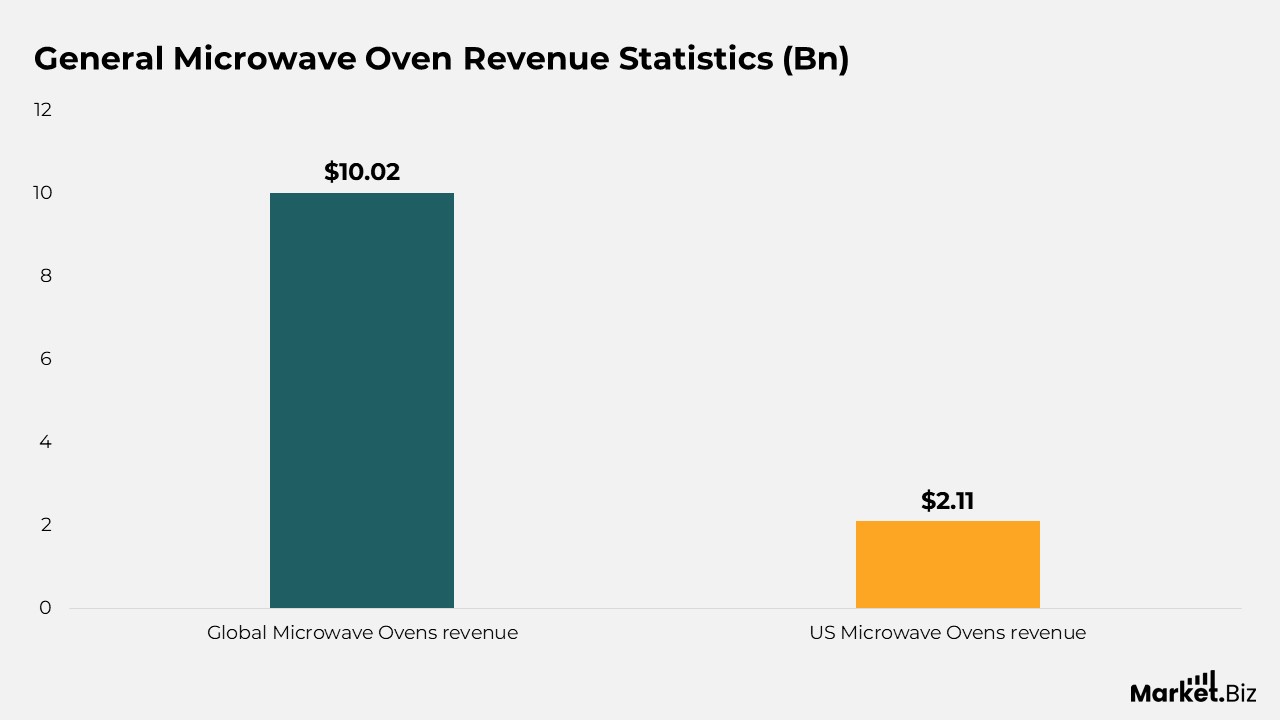
- In 2025, the global revenue from the Microwave Ovens market is projected to reach US$10.02 billion.
- It is anticipated to grow at an annual rate of 4.18% (CAGR 2025-2030).
- Among global statistics, the United States emerges as the leading country in revenue, with an expected US$2.11 billion in 2025.
- When analyzing revenue per household in relation to the total number of households, it is estimated that every household will generate US$4.86 in revenue in 2025.
- Regarding the volume of the Microwave Ovens market, it is forecasted to attain 88.75 million units by 2030.
- In 2026, this segment is expected to show a volume growth of 1.71%.
- On average, each household is projected to possess a volume of 0.04 units in the Microwave Ovens market in 2025.
- Microwave ovens have become a vital household appliance in numerous countries, including the United States, owing to their convenience and efficiency in saving time.
Facts about Microwave Ovens
- The microwave oven first appeared in January 1947.
- The characteristic short and wide design of a microwave oven, which is prevalent today, was created by Litton Industries during the 1960s.
- According to the U.S. Bureau of Labor Statistics, more than 90% of American households possessed a microwave oven by 1997.
- Typically, consumer microwave ovens operate at a frequency of 2.45 gigahertz, whereas larger industrial or commercial ovens frequently utilize microwaves at 915 megahertz.
- Microwave heating is particularly effective on water due to its dipole molecules, while it is less effective on fats and sugars.
- A microwave oven transforms only a portion of its electrical input into microwave energy, approximately 64%.
- Items removed from a microwave oven are seldom significantly hotter than 100 °C.
Microwave Oven Market Size
- The global microwave oven market has shown significant growth over the years, achieving a compound annual growth rate (CAGR) of 4.2%, with revenue figures indicating steady increases in most years.
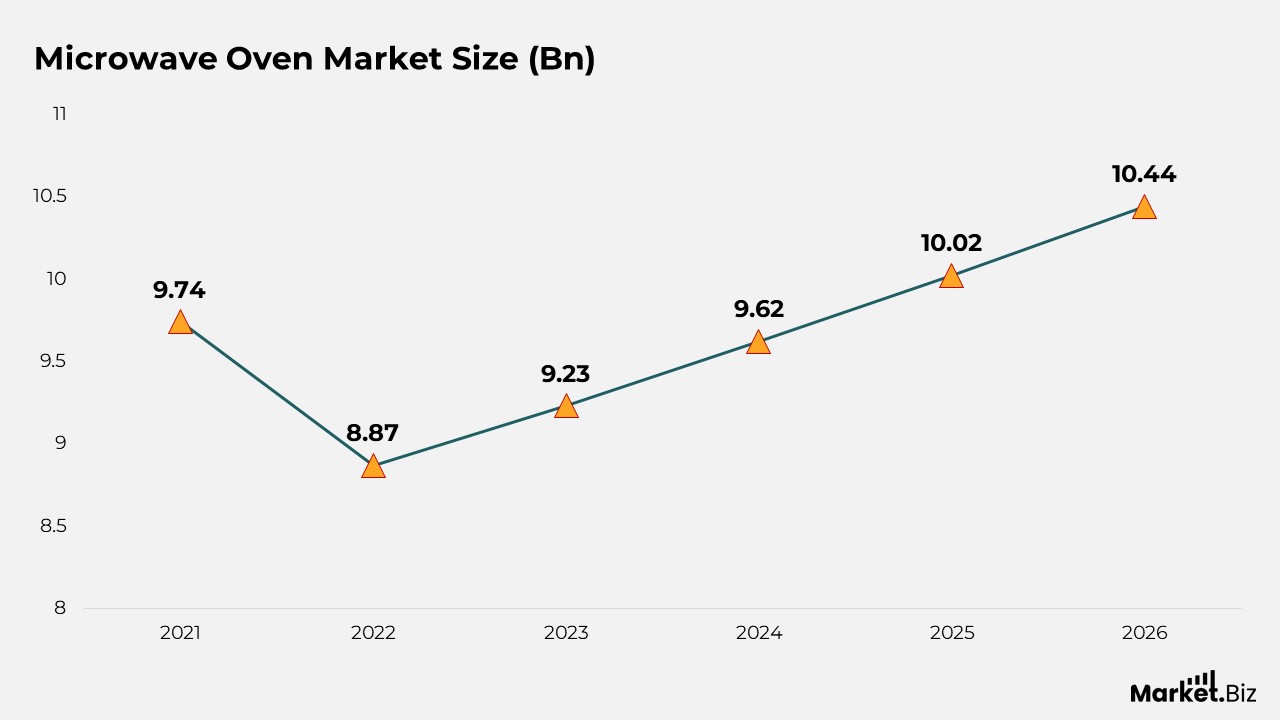
- In 2018, the market revenue was recorded at USD 7.80 billion, which saw a slight increase to USD 7.87 billion in 2019.
- By 2020, the market experienced substantial growth, reaching USD 8.79 billion, followed by a remarkable rise to USD 9.74 billion in 2021.
- However, in 2022, the revenue experienced a slight decline to USD 8.87 billion before regaining its upward momentum, increasing to USD 9.23 billion in 2023.
- The upward trend is projected to persist, with anticipated revenues of USD 9.62 billion in 2024 and surpassing the USD 10 billion threshold to achieve USD 10.02 billion in 2025.
- By 2026, the market size is expected to further grow to USD 10.44 billion, increasing to USD 10.89 billion in 2027.
- This growth trajectory is expected to continue, with forecasts estimating revenues of USD 11.32 billion in 2028 and USD 11.82 billion in 2029 (potentially reflecting an updated or secondary analysis for that year).
Microwave Oven Product Statistics
- According to Microwave Statistics, the market for microwave ovens is divided into three categories: convection, grill, and solo microwaves based on their type.
- In 2024, convection microwaves dominated the market, achieving $4.9 billion in sales, and are expected to experience a compound annual growth rate (CAGR) of 5.2% from 2025 to 2034.
- Due to their versatility and efficient use of space, convection microwaves are highly favoured in urban residences and commercial kitchens.
- These ovens are particularly sought after as they enable users to bake, grill, and cook more quickly than traditional models.
- Their popularity has surged in developed regions such as North America, Europe, and Asia-Pacific, where an increasing number of individuals are adopting home baking, innovative cooking techniques, and evolving kitchen trends.
Microwave Oven Price Statistics
- Between 2018 and 2029, the average cost of microwave ovens has steadily increased, primarily due to inflation, heightened demand, and advancements in technology and quality.
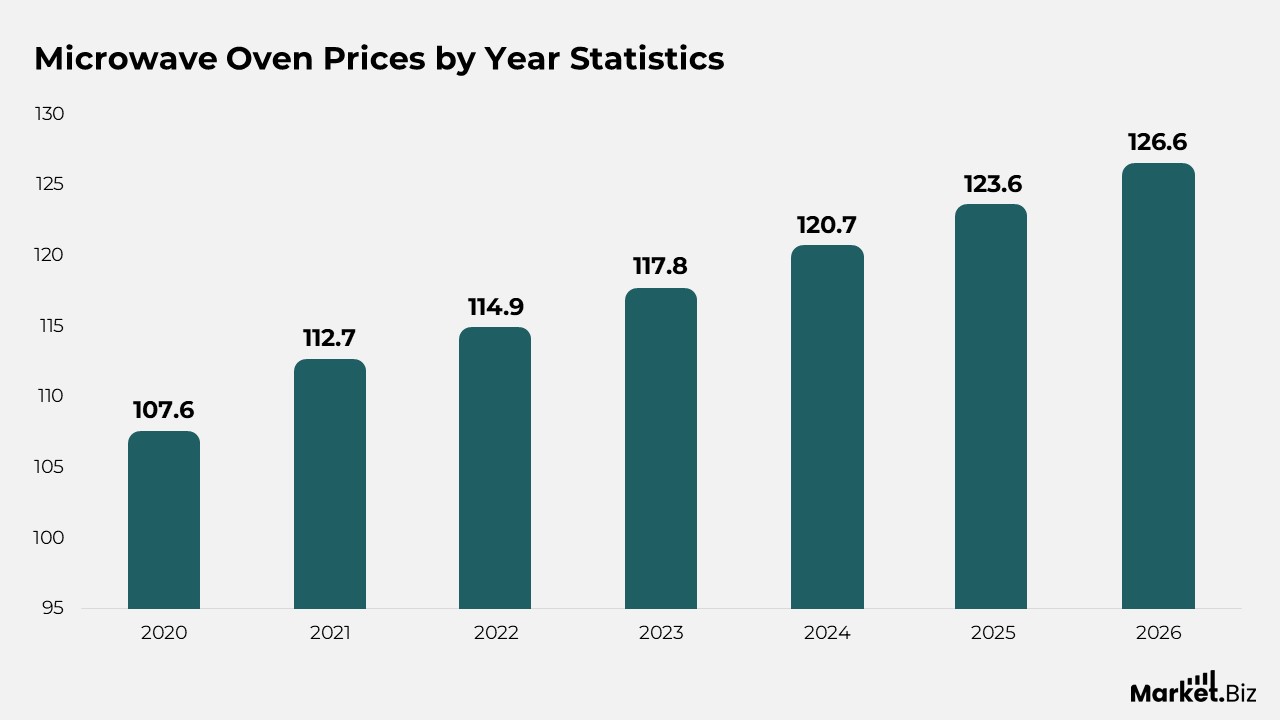
- In 2018, the average price stood at $107.3, but it experienced a slight decline to $106.8 in 2019.
- By 2020, prices rebounded to $107.6.
- A significant increase occurred in 2021, raising the price to $112.7, which further escalated to $114.9 in 2022.
- The upward trajectory persisted, reaching $117.8 in 2023, with a projected rise to $120.7 in 2024.
- Projections indicate that prices will ascend to $123.6 in 2025, $126.6 in 2026, and $129.6 in 2027.
- By 2028, the price is anticipated to reach $132.5, ultimately culminating at $135.6 in 2029.
- This ongoing price increase underscores the impact of rising expenses, advancing technology, and increasing consumer demand for contemporary microwave ovens.
Microwave Oven Imports
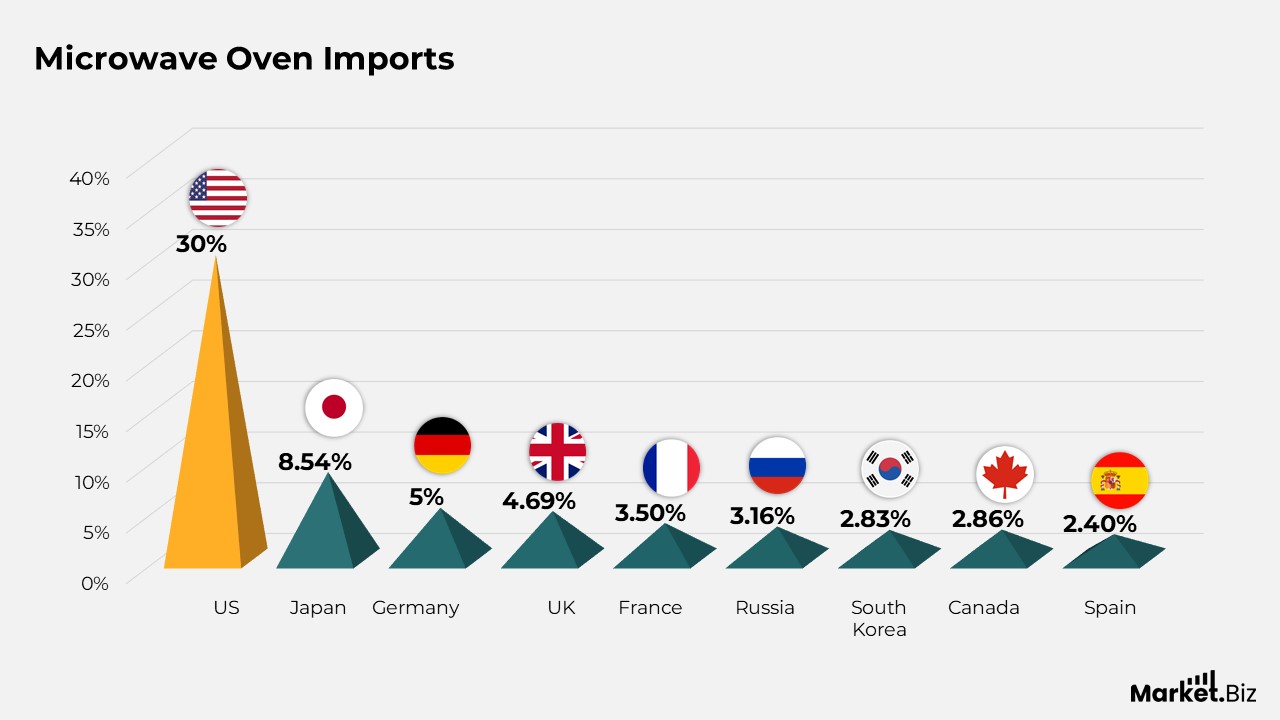
- In 2022, the global market for microwave oven imports was dominated by the United States, which reported an import value of USD 1.63 billion, constituting 30% of the total imports.
- Japan attained the second position with an import value of USD 0.464 billion, representing 8.54% of the market.
- Germany followed with imports amounting to USD 0.272 billion, which accounted for 5%.
- The United Kingdom maintained a market share of 4.69% with an import value of USD 0.255 billion, whereas France contributed USD 0.190 billion, equivalent to 3.50%.
- Russia imported microwave ovens valued at USD 0.172 billion, which constituted 3.16% of the market.
- South Korea and Canada followed closely behind, with import values of USD 0.154 billion (2.83%) and USD 0.156 billion (2.86%), respectively.
- Spain’s imports amounted to USD 0.131 billion, accounting for 2.40%, while Mexico’s contribution was USD 0.121 billion (2.23%).
- Australia and Poland reported import values of USD 0.113 billion (2.08%) and USD 0.119 billion (2.19%), respectively.
Microwave Oven Exports
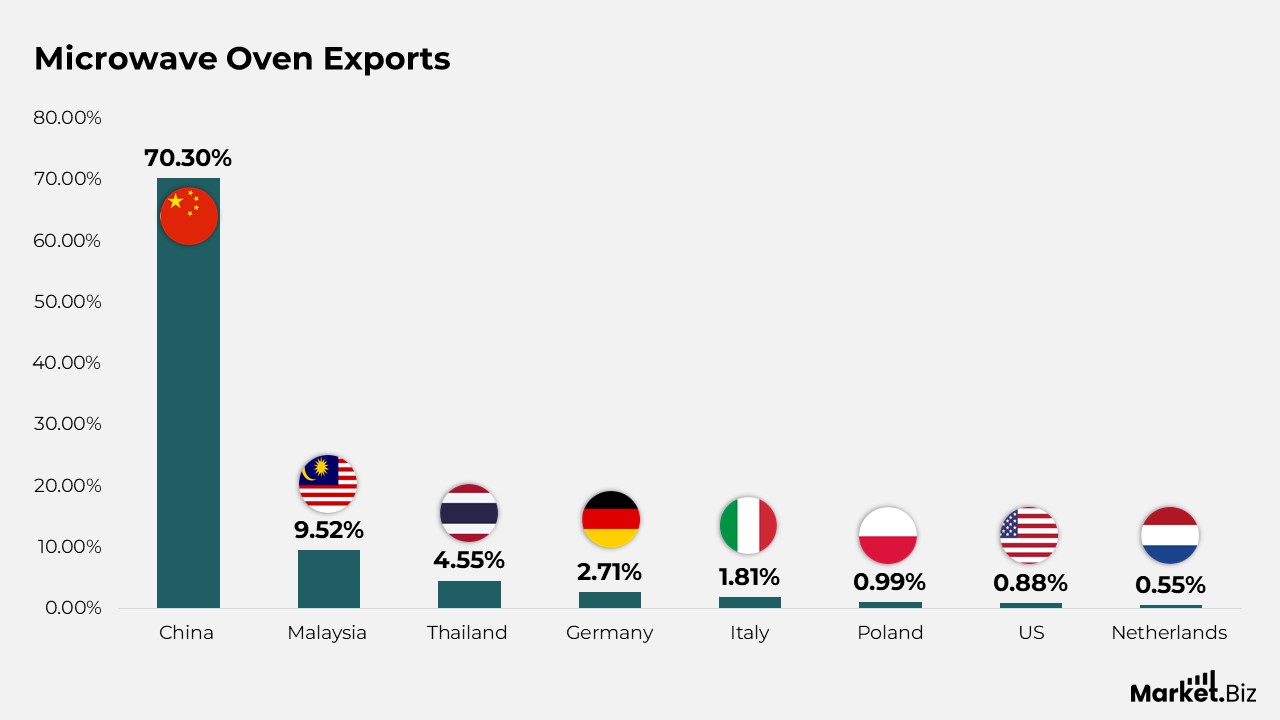
- In 2022, China dominated global microwave oven exports, achieving an export value of USD 3.82 billion, which constituted 70.30% of the overall market.
- Following China, Malaysia recorded an export value of USD 0.518 billion, contributing 9.52%, while Thailand secured the third position with exports amounting to USD 0.247 billion, representing 4.55% of the total.
- Germany’s exports reached USD 0.147 billion, accounting for 2.71%, and Italy’s export value was USD 0.0983 billion, which represented 1.81%.
- Poland’s contribution to global exports was USD 0.0535 billion, capturing 0.99%, while the United States reported an export value of USD 0.0477 billion, equivalent to 0.88%.
- The Netherlands followed with exports worth USD 0.03 billion, contributing 0.55%, and the United Arab Emirates exported USD 0.0393 billion (0.72%).
- Lastly, Sweden rounded out the list with exports totaling USD 0.0292 billion, representing 0.54% of the global market.
Microwave Oven Sale Statistics
- The worldwide sales of cookers and ovens have demonstrated a steady increase from 2019 to 2029, although some years have experienced fluctuations.
- In 2019, the recorded unit sales stood at 204.38 million, which rose to 219.02 million in 2020.
- By 2021, sales had climbed to 227.98 million, indicating substantial growth. Nevertheless, a minor decline was noted in 2022, with sales falling to 222.28 million.
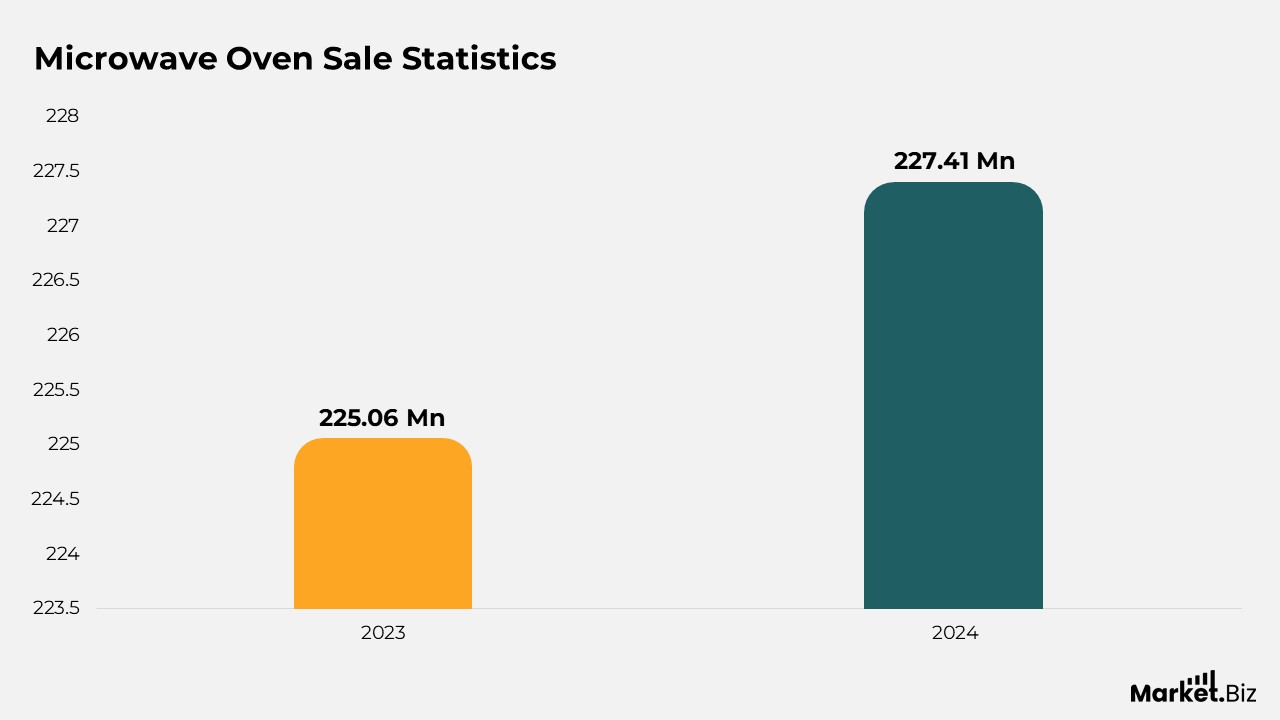
- The market saw a recovery in 2023, achieving unit sales of 225.06 million.
- Forecasts for the future suggest a continued upward trend, with unit sales anticipated to reach 227.41 million in 2024 and 232.44 million in 2025.
- The positive trajectory persists, with projections indicating sales will hit 237.47 million in 2026, 242.61 million in 2027, and 247.83 million in 2028.
- By 2029, unit sales are expected to reach a peak of 253 million units.
Microwave Oven Expenditure Statistics
- In 2007, the typical expenditure was USD 7.61, which saw a slight increase to USD 7.85 in 2008.
- Nevertheless, a small decrease was observed in 2009, with spending falling to USD 7.59.
- By 2010, expenditures rose to USD 8.38, but this upward trajectory was reversed in 2011, hitting its lowest level at USD 6.48.
- The market experienced a recovery in the following years, with spending climbing to USD 7.98 in 2012 and USD 10.15 in 2013.
- In 2014, expenditures reached a peak of USD 11.04 before dropping to USD 8.67 in 2015.
- Moderate increases were noted in 2016 and 2017, with spending recorded at USD 9.12 and USD 8.77, respectively.
- By 2018, the amount rose once more to USD 10.88, indicating a resurgence in consumer interest.
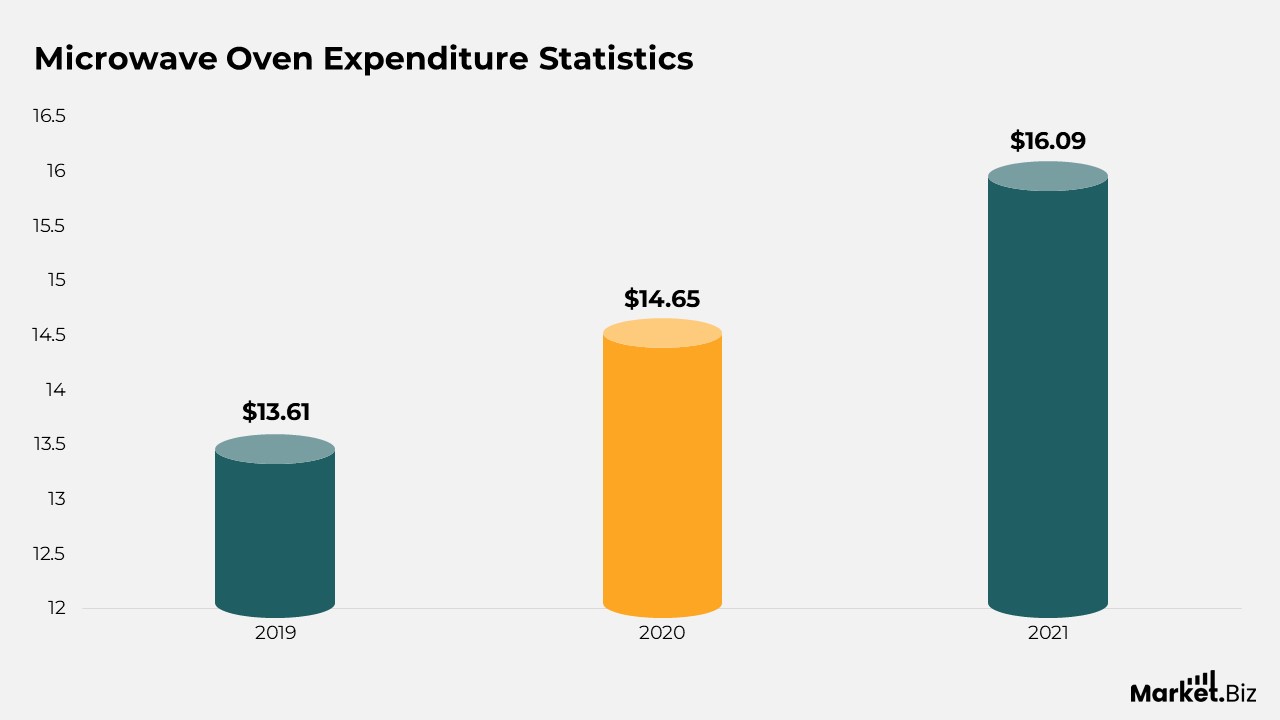
- A significant increase was noted in 2019 when expenditures soared to USD 13.61.
- This upward trend persisted into 2020, reaching USD 14.65, and further peaked in 2021 at USD 16.09.
Recent Developments
- In March 2025, Panasonic introduced the HomeChef Connect 4-in-1 multi-oven, transforming daily cooking through the kitchen+ App that integrates with Fresco. This strategic transition from merely selling the product, along with cooking assistance, has significantly improved the business approach.
- In July 2024, LG Electronics India unveiled a new collection of microwave ovens for 2024, showcasing advanced technology and contemporary designs. The latest lineup from LG comprises nine new models, including seven from the Scan to Cook series and two from the premium object series.
- In December 2024, Cucu Electronics, a general home appliance manufacturer, released a microwave oven that is user-friendly with dial operation, featuring a compact design that aligns with the minimalist trend.
- In August 2023, Miele launched the Miele Steam Oven equipped with the HydroClean feature. This cutting-edge self-cleaning capability is intended to remove tough food residues. Users can add a liquid cleaner into the strainer located at the base of the oven, and the application will automatically combine it with fresh water and distribute the cleaning solution throughout its interior.
Conclusion
The global microwave oven market has demonstrated consistent growth, propelled by a rising demand for convenience, advancements in technology, and changing consumer lifestyles. Developed markets such as the UK, France, and Ireland showcase high ownership rates that exceed 90%, while emerging markets offer significant growth potential. Notable trends include the integration of smart technologies, energy-efficient models, and multifunctional capabilities.
Despite experiencing a decline in certain regions, such as Germany, the market continues to be robust due to its affordability and practicality. Future expansion will be driven by urbanization, increasing disposable incomes, and innovations in smart appliances, establishing microwaves as a fundamental element in contemporary kitchens across the globe.
FAQs
Today, over 90% of households in the United States possess a microwave oven. As consumer spending on microwave ovens has risen over time within the U.S. economy, their representation in the Consumer Price Index (CPI) has also increased, currently making up 11% of the weight in the Major Appliances item stratum price index.
Microwave radiation is a type of electromagnetic radiation characterized by wavelengths that are shorter than those of other radio waves but longer than those of infrared waves. Its wavelength spans from approximately one meter to one millimeter, which corresponds to frequencies ranging from 300 MHz to 300 GHz, broadly defined.
A microwave generally has a lifespan of about 7 to 10 years, although this can vary considerably depending on factors such as brand, model, maintenance, and frequency of use. Higher-end models and well-cared-for microwaves may endure longer, while heavy usage or inadequate maintenance can reduce their lifespan. Indicators of a malfunctioning microwave include failure to heat food, sparking, unusual noises, and a malfunctioning door latch.
In 1946, Raytheon marketed the inaugural commercial microwave, known as the RadaRange, to restaurants, large cafeterias, and the galleys of ships. This device stood nearly six feet tall, weighed over 750 pounds, utilized approximately 3,000 watts of power, and was sold for around $5,000. By 1967, the market witnessed the launch of the first microwave oven tailored for domestic use.

