









Introduction
Business Process Outsourcing Statistics and Facts: Business Process Outsourcing (BPO) involves outsourcing specific business tasks to external service providers, allowing companies to attention on their core capabilities.
By relying on specialized expertise, organizations can efficiently manage non-core areas like customer service, HR, IT support, and finance. Over the years, the BPO industry has grown significantly, driven by factors such as cost savings, technological progress, and the need for increased operational efficiency.
The integration of automation and artificial intelligence continues to transform the BPO landscape, offering scalable solutions to industries including healthcare, finance, retail, and manufacturing. As businesses increasingly prioritize flexibility and streamlined operations, the BPO sector is expected to remain a key player in global economic growth, providing valuable insights into evolving outsourcing trends.
Editor’s Choice
- 92% of G2000 companies rely on IT outsourcing.
- Business process outsourcing contributes 9% to the Philippines’ GDP.
- 37% of small businesses outsource at least one business process.
- Over 1 million new employees join China’s services outsourcing industry each year.
- Over 90% of organizations are enhancing IT outsourcing by integrating cloud services.
- According to the Google Cloud Brand Pulse Survey, the top ways cloud providers can earn trust from enterprise cloud decision-makers are strong capabilities in protecting and controlling client data (40%) and effective coordination with security vendors and existing security solutions (38%).
- Approximately 30 million jobs are at risk of being outsourced.
- More than 94% of organizations utilize some form of IT outsourcing.
General Business Process Outsourcing Statistics
- The military industry accounts for some of the most significant outsourced transactions, generating $100 billion in revenue.
- Approximately 40% of help desk roles within the banking sector are outsourced.
- Before the pandemic, the global outsourcing market was valued at $92.5 billion.
- Every year, around 300,000 jobs are outsourced from the United States.
- Over 93% of businesses are considering or have already implemented cloud services to improve outsourcing operations.
- Data security is a primary concern for 68% of organizations contemplating cloud computing for outsourcing.
- The global financial services outsourcing market is valued at over $130 billion.
- 29% of businesses with fewer than 50 employees outsource, compared to 66% of companies with 50 or more employees.
- 24% of small businesses outsource to enhance operational efficiency.
- The most frequently outsourced tasks in small businesses include accounting and IT services.
- 52% of executives report outsourcing specific business functions.
- 76% of executives indicate outsourcing IT functions.
Moreover
- 89% of companies leverage service providers for their cloud services.
- 96% of executives report using third-party providers for data and analytics services.
- Key qualities that companies value in a service provider include transparency (54%), trustworthiness (41%), understanding of the business (36%), proven results (36%), and consistent communication (33%).
- In 2022, the average spending on outsourcing by SMBs was $198,550.
- 52% of small businesses regularly engage a firm or agency for outsourcing, with 45% using freelancers and 45% using consultants.
- Price, industry experience, and team diversity are the three most crucial factors for small businesses when choosing an outsourcing provider.
- In 2023, the business process outsourcing market is projected to generate $350 billion in revenue.
- The market volume is expected to reach $450 billion by 2027, with annual revenue growth of 6.48%.
- The average spend per employee in the BPO market is anticipated to be $100.50 in 2023.
- The United States is expected to generate the highest revenue in the global BPO market, with $129.7 billion in 2023.
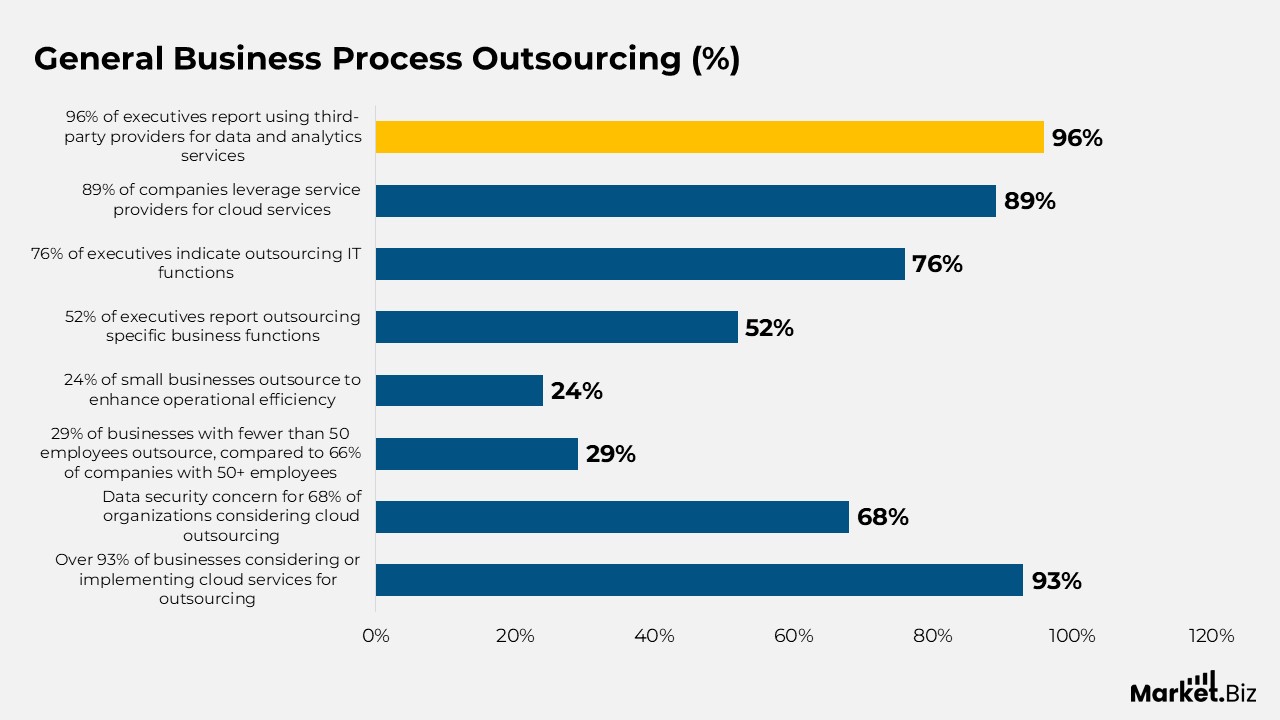
(Source: City University of New York, Credit Donkey, Statista, Zippia, Deloitte, Digitalguardian, Fortunly, Clutch)
Business Process Outsourcing Market Size
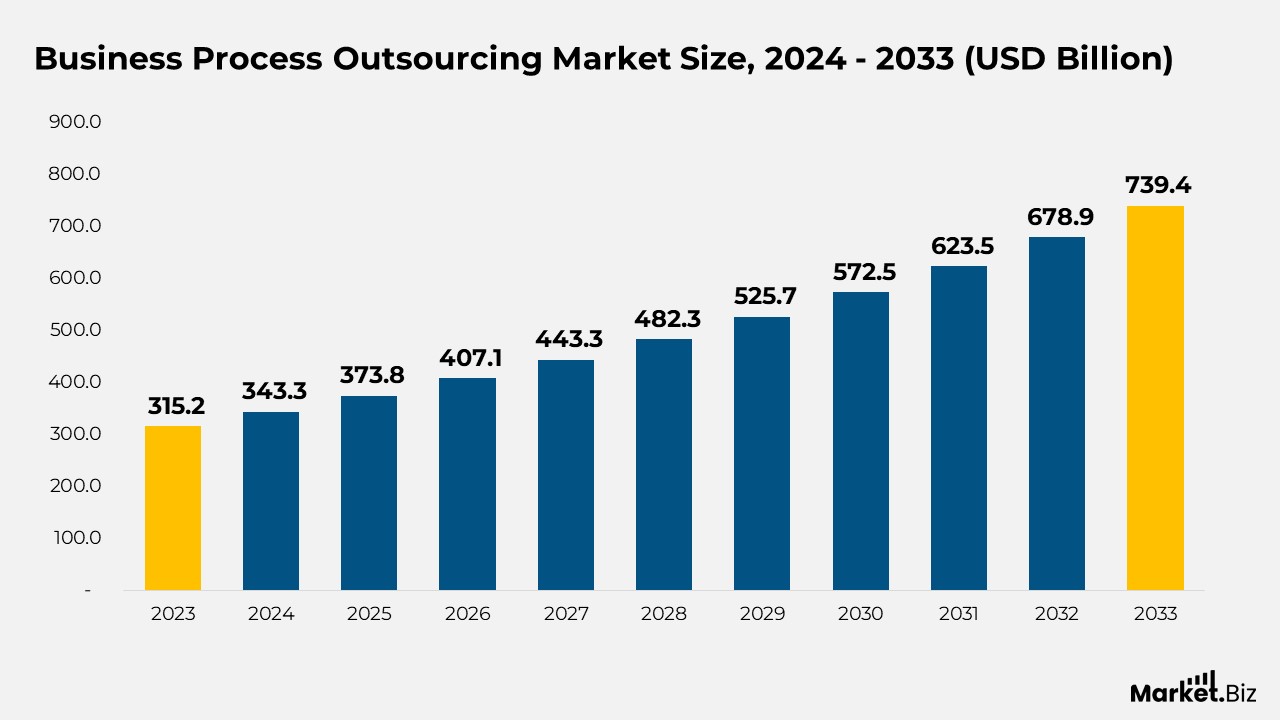
- According to Market.us, the business process outsourcing market is expected to rise from $343.3 billion in 2024 to $739.4 billion by 2033, representing a CAGR of 8.9% from 2024 to 2033.
- Technological innovations such as cloud computing and AI are fueling the expansion of the BPO market, making outsourcing more affordable, efficient, and scalable, while enabling faster service delivery.
- In 2023, the Service Type segment emerged as the largest in the BPO market, capturing more than 34.5% of the market. This dominance is attributed to essential services like customer service, finance, accounting, and HR, which are critical to the smooth functioning of businesses across various sectors.
- The Large Enterprises segment held the top position in the BPO market in 2023, with a 67.0% share, driven by the need for cost reduction, access to specialized talent, and enhanced operational efficiency through outsourcing.
Moreover
- The IT & Telecommunications sector was the leading player in the BPO market in 2023, commanding more than 36.1% of the market share. This was due to the sector’s ongoing need for continuous innovation, large-scale network management, and handling complex systems that are integral to modern communication services.
- North America maintained the largest share of the BPO market in 2023, with a 38.4% share and revenues of USD 121 billion, benefiting from its advanced IT infrastructure and established outsourcing capabilities in customer service, HR, and finance.
- Around 70% of companies turn to outsourcing primarily to reduce costs, with HR outsourcing delivering an average cost saving of 27.2%, enabling businesses to tap into global talent pools while reducing overhead expenses.
- Approximately 65% of companies report that outsourcing enables them to focus on their core business functions, streamlining operations, and dedicating resources to key strategic objectives.
- Around 37% of small businesses use outsourcing to improve their operational efficiency, allowing them to compete with larger players by leveraging external expertise and optimizing their internal processes.
(Source: Market.us)
BPO Business Analytics Market Size
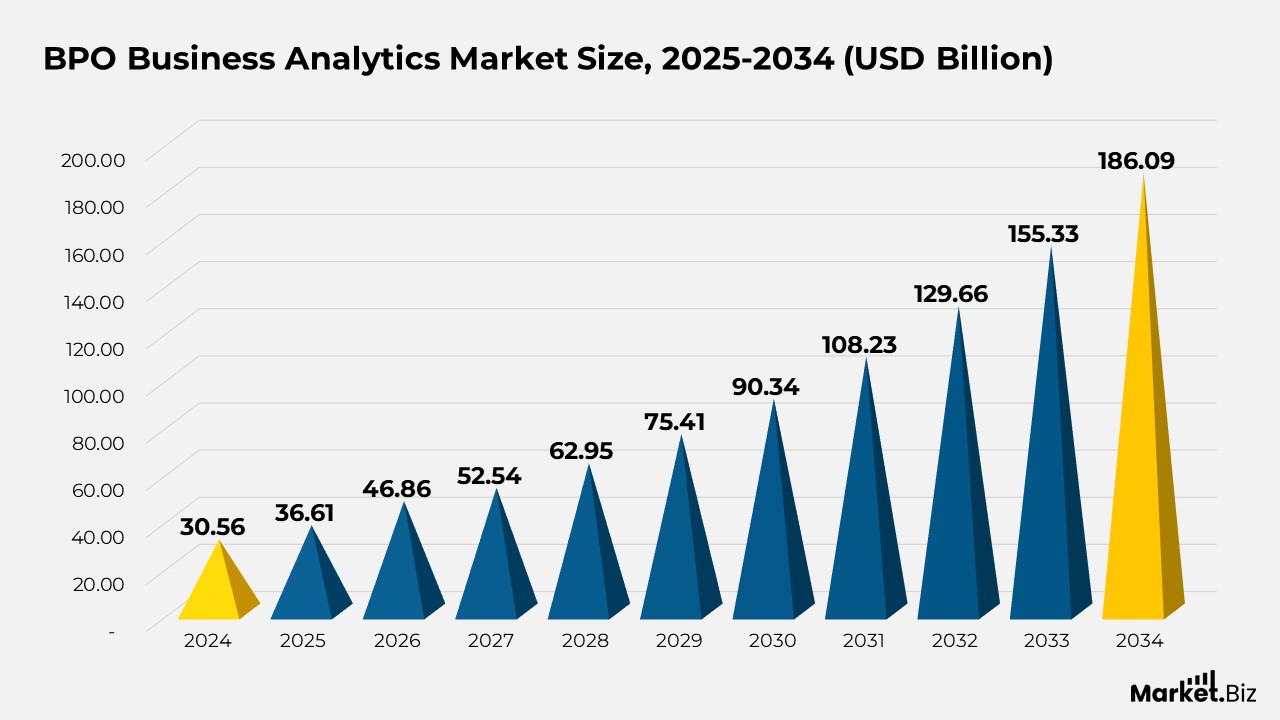
- According to Market.us, the BPOB analytics market is projected to rise from $36.61 billion in 2025 to $186.09 billion by 2034, representing a compound annual growth rate (CAGR) of 19.8% from 2025 to 2034.
- The growth of the BPO market is driven by the increasing need for data-driven decision-making, with organizations leveraging analytics to optimize operations and enhance competitive advantage.
- In 2024, the Software segment dominated the BPO Business Analytics Market, capturing a 54% share, fueled by the growing use of advanced analytics platforms and AI integration.
- The Cloud-Based segment held a leading market position in 2024, capturing 65.2% of the market, driven by the demand for scalable, flexible, and cost-effective analytics solutions.
- In 2024, Large Enterprises dominated the BPO Business Analytics Market, securing 72.5% of the market, driven by their investment capacity and need for advanced analytics to inform strategic decisions.
- The BFSI segment accounted for 25% of the Global BPO Business Analytics Market in 2024, reflecting its heavy reliance on data for fraud detection, risk assessment, compliance, and customer analytics.
- North America held a leading share of the BPO Business Analytics Market in 2024, with a 41.8% share, generating USD 12.77 billion in revenue, driven by early adoption of advanced technologies.
- The US BPO Business Analytics market is valued at USD 12.08 billion in 2024, with a projected CAGR of 17.3%, fueled by digital transformation, strong data infrastructure, and increasing demand for customer insights.
(Source: Market.us)
Business Process Outsourcing Trends
- 37% of businesses outsource their accounting functions.
- IT services are the most commonly outsourced process, accounting for 37% of all outsourced operations.
- Following accounting and IT services, 34% of companies outsource digital marketing tasks.
- Lead generation and cold calling are additional processes frequently outsourced.
- 28% of businesses plan to outsource company development to reduce costs.
- The five most outsourced business processes are legal functions (64%), tax (61%), HR (57%), finance (51%), and manufacturing and supply chain procurement (48%).
- IT functions are widely outsourced, with companies relying on external providers for cybersecurity (81%), IT infrastructure services (77%), data analytics (75%), next-gen tech (78%), app/software development (79%), app support (73%), and helpdesk and user computing (68%).
- In 2023, small businesses are looking to find new outsourcing providers for IT services (22%), marketing (27%), and design (21%).
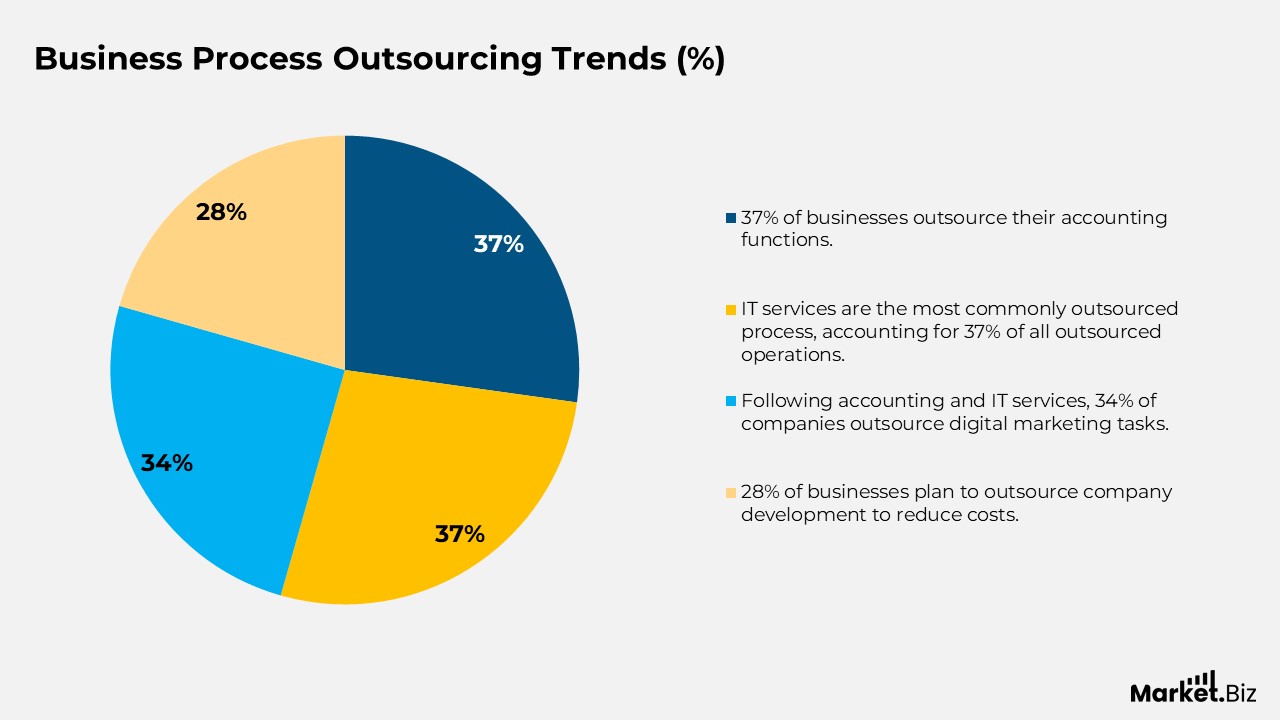
(Source: City University of New York, Credit Donkey, Statista, Zippia, Deloitte, Digitalguardian, Fortunly, Clutch)
Outsourcing Investment Trends
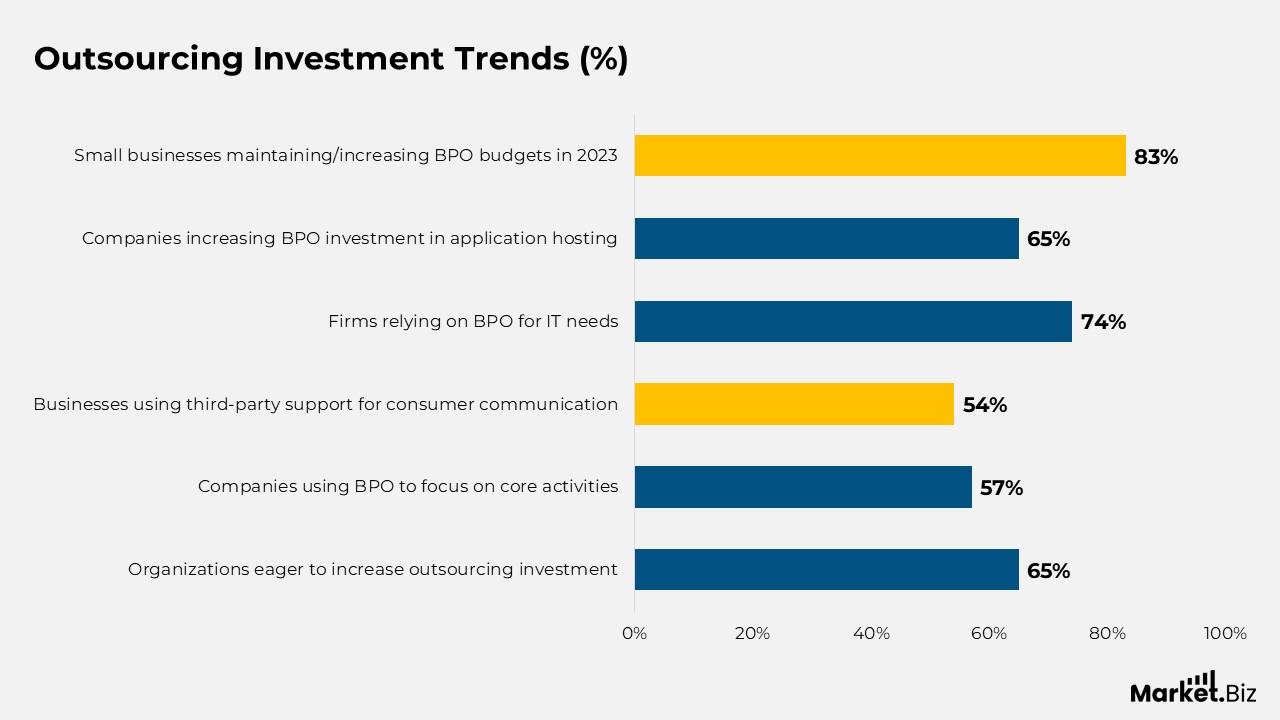
- 65% of organizations using BPOs for application hosting are eager to increase their outsourcing investment.
- In India, the information technology BPO industry generated $154 billion in revenue in 2017-18.
- 57% of companies use business process outsourcing to focus on core activities, operations, and strategic issues.
- Approximately 54% of businesses employ at least one third-party support staff to handle consumer communication.
- Currently, 74% of firms rely on BPO for their information technology needs.
- 65% of companies using BPO for application hosting plan to increase their investment in the coming year.
- 67% of organizations will boost their budget for operating services, 57% will invest more in managed services, and 32% will increase spending on traditional outsourcing.
- 83% of small businesses plan to maintain or increase their BPO budget in 2023.
(Source: Customerthink, Brandongaille, Statista, Fortunly, Intelligent Bee, Deloitte, Clutch)
Customer Service & Human Resources
- More than 40% of support desk roles in banking and financial institutions are outsourced.
- 24% of businesses state that outsourcing HR and customer service allows them to focus on core operations.
- Due to current business demands, organizations spend considerable time and resources on accounting operations. As a result, accounting is the second most outsourced area, with 37% of companies outsourcing their accounting functions to BPOs.
(Source: Deloitte, Fortunly, Clutch)
Challenges Driving Business Process Outsourcing Decisions
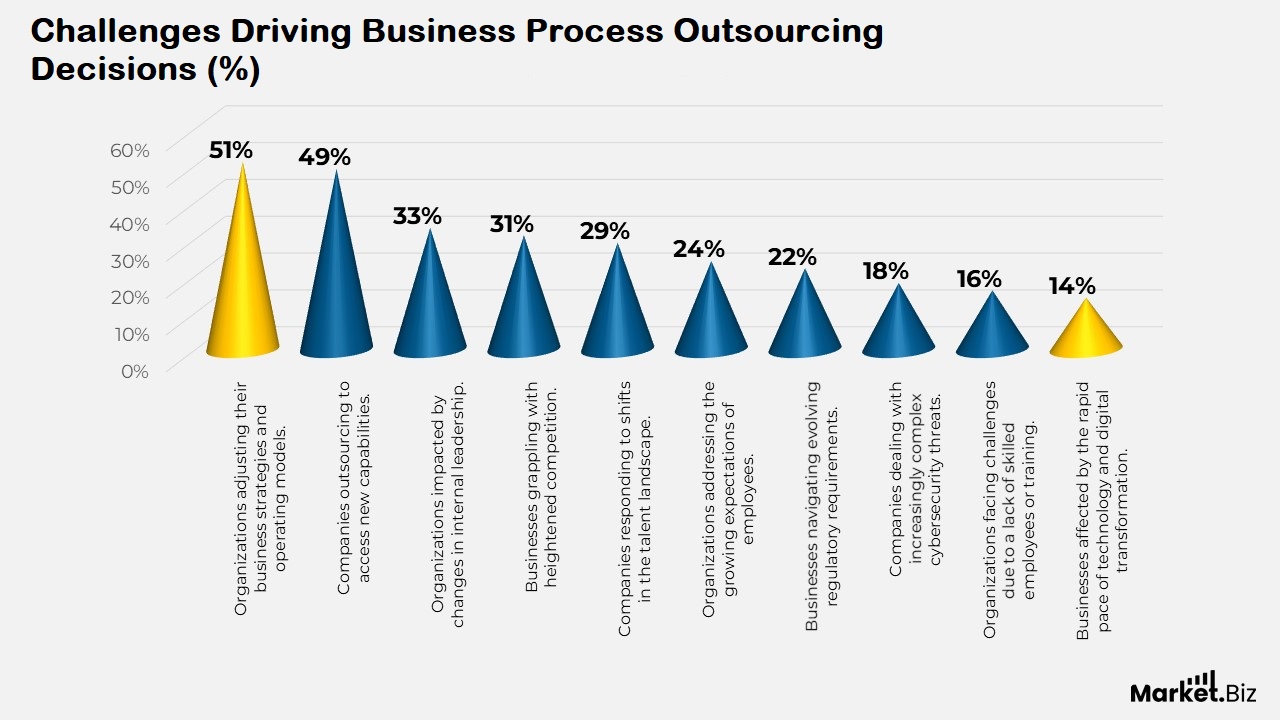
- 51% of organizations are adjusting their business strategies and operating models.
- 49% of companies are outsourcing to access new capabilities.
- Changes in internal leadership impact 33% of organizations.
- 31% of businesses are grappling with heightened competition.
- 29% of companies are responding to shifts in the talent landscape.
- 24% of organizations are addressing the growing expectations of employees.
- 22% of businesses are navigating evolving regulatory requirements.
- 18% of companies are dealing with increasingly complex cybersecurity threats.
- 16% of organizations face challenges due to a lack of skilled employees or training.
- 14% of businesses are affected by the rapid pace of technology and digital transformation.
(Source: Deloitte, DOIT Software, Statista, DemandSage)
Benefits of BPO
- 70% of surveyed executives cite cost as the primary reason for outsourcing.
- In a global survey of business leaders, 59% identified cost-cutting as a major driver for outsourcing, with other factors including focusing on core business activities and addressing capacity challenges.
- Outsourced lead-generation teams can generate up to 43% more leads than in-house teams.
- For cost savings, 28% of businesses choose to outsource company development.
- Companies outsource to access new capabilities (51%), reduce costs (57%), and adapt to strategic changes (49%).
- According to the Bureau of Labor Statistics, benefits, including health-related ones, account for 29.4% of employers’ expenditures, leading many firms to opt for BPO services.
(Source: Deloitte, Statista, RipeConcepts, Connext)
Types of Outsourced Services for Organizations
- 81% of executives rely on third-party vendors for partial or full cybersecurity services.
- More than 40% of larger companies outsource various HR and operational functions, though none fully outsource all tasks.
- 76% of executives receive IT services through third-party delivery models.
- Third-party delivery models are expected to reach similar adoption levels to IT outsourcing, up to 80%.
- ISS World and Accenture are key global leaders in outsourcing. Excelling in facility services, IT, help desk, HR consulting, and outsourcing, respectively.
- Around 44% of businesses outsource their financial operations to external providers.
- 30% of marketing professionals outsource content marketing tasks.
- Cold calling and lead generation are usually outsourced operational tasks.
- The most frequently outsourced business functions include HR operations (57%), legal services (64%), financial management (51%), tax services (61%), and manufacturing and procurement within the supply chain (48%).
(Source: Deloitte, Sopro Holdings Limited, Sopro Holdings Limited, Statista)
Small Business Outsourcing Statistics
- More than 1 in 3 small businesses outsource at least one business process.
- Over 52% of small businesses plan to outsource at least one process in the near future.
- 37% of small businesses outsource both accounting and IT services. Other frequently outsourced functions include digital marketing (34%), development (28%), human resources (24%), and customer support (24%).
- 24% of small businesses cite increased efficiency as the primary reason for outsourcing. Other reasons include accessing additional expertise (18%), gaining flexibility (16%), and allowing employees to focus on other tasks (15%).
- A 2022 survey of 600 small businesses in the US and Canada by Upcity found that 23% consider high costs to be the biggest challenge when working with outsourced teams. Additional challenges include communication issues (21%), missed deadlines (14%), and failure to follow instructions (12%).
- 15% of organizations with fewer than 2,500 employees fully outsource their payroll services, compared to only 8% of organizations with 10,000 or more employees. Meanwhile, HR software solutions like Rippling are simplifying payroll management without compromising efficiency.
(Source: Statista, Upcity, Clutch)
Conclusion
The Business Process Outsourcing (BPO) market is witnessing strong growth. Driven by advancements in technology such as cloud computing, AI, and automation. This enhances the cost-effectiveness and efficiency of outsourcing. The growing demand for data-driven decision-making, scalability, and access to specialized expertise is shaping the future of BPO services.
Large enterprises, especially in industries like IT, telecommunications, and BFSI, continue to dominate the market by leveraging outsourcing to optimize operations and reduce costs. North America, with its advanced IT infrastructure, remains the leading region, while small businesses are increasingly adopting outsourcing to streamline operations and improve efficiency.
As companies strive to stay competitive and adaptable, BPO services will remain a key driver of their strategic growth. Offering opportunities for enhanced operational efficiency, cost savings, and access to advanced technologies.
FAQ’s
The growth of the BPO market is largely attributed to technological advancements, including cloud computing, AI, machine learning, and automation, which improve service efficiency, scalability, and cost-effectiveness. Additionally, the increasing reliance on data-driven decision-making and the demand for specialized expertise are key contributors to market expansion.
In 2023, the Service Type segment led the BPO market, holding a 34.5% share. Other dominant segments include Large Enterprises and Cloud-Based services. As these sectors can invest in advanced technologies and benefit from scalable solutions.
Large enterprises dominate the BPO market, accounting for more than 67.0% of the total market share. Their demand for outsourcing is driven by a need for cost reduction, access to a skilled workforce, and the optimization of operations.
In 2023, the IT & Telecommunications sector represented over 36.1% of the BPO market. This significant share is driven by the sector’s continuous need for innovation, complex network management, and global-scale system handling.
North America leads the global BPO market, capturing 38.4% of the market in 2023, generating USD 121 billion in revenue. This dominance is due to its advanced IT infrastructure, early adoption of new technologies, and established outsourcing capabilities in areas such as customer service, HR, and finance.
The US BPO market is experiencing strong growth, valued at USD 12.08 billion in 2024, with a projected CAGR of 17.3%. Ongoing digital transformation, a solid data infrastructure, and increasing demand for customer-focused and insights-driven operations drive this growth.