








Introduction
Train Statistics: The global train industry, which is essential for both passenger transport and freight logistics, showcases a range of technological advancements and market dynamics. Freight trains are the primary mode for long-distance cargo transport, shaped by economic activities and trade volumes. Passenger trains, which serve urban rail transit and long-haul travel, are increasingly supported by urbanization and environmental concerns that promote sustainable transport solutions.
Technological innovations in materials, propulsion, and digital connectivity improve efficiency and safety in both sectors. Despite facing challenges such as high infrastructure costs and regulatory complexities, the industry is set for growth. This growth is driven by the expansion of high-speed rail networks and global initiatives aimed at sustainable mobility.
Strategic investments in infrastructure and alignment with regulations will be vital in determining the future direction of the industry, ensuring its continued relevance in contemporary transportation ecosystems.
Editor’s Choice
- In 2023, the global train market achieved a revenue of USD 71.5 billion.
- In 2022, the market generated USD 68.9 billion. This figure rose to USD 71.5 billion in 2023 and further increased to USD 73.9 billion in 2024.
- South and Central America achieved a significant CAGR of 6.8%, with North America following at 5%.
- The United States has an extensive railway network that spans 250,000 kilometers.
- China tops the rankings with a remarkable 1,550 billion passenger kilometers logged in 2019, closely trailed by India, which recorded 1,157 billion passenger kilometers in that same year.
- Shinjuku Station, located in Tokyo, Japan, is recognized as the busiest train station in the world, with over 3.6 million passengers passing through daily.
- As of 2014, the United States has the largest railway network in the world, spanning a total distance of 293,564.2 kilometers.
- The longest journey is from Moscow to Vladivostok, covering an impressive distance of 9,259 kilometers (5,753 miles).
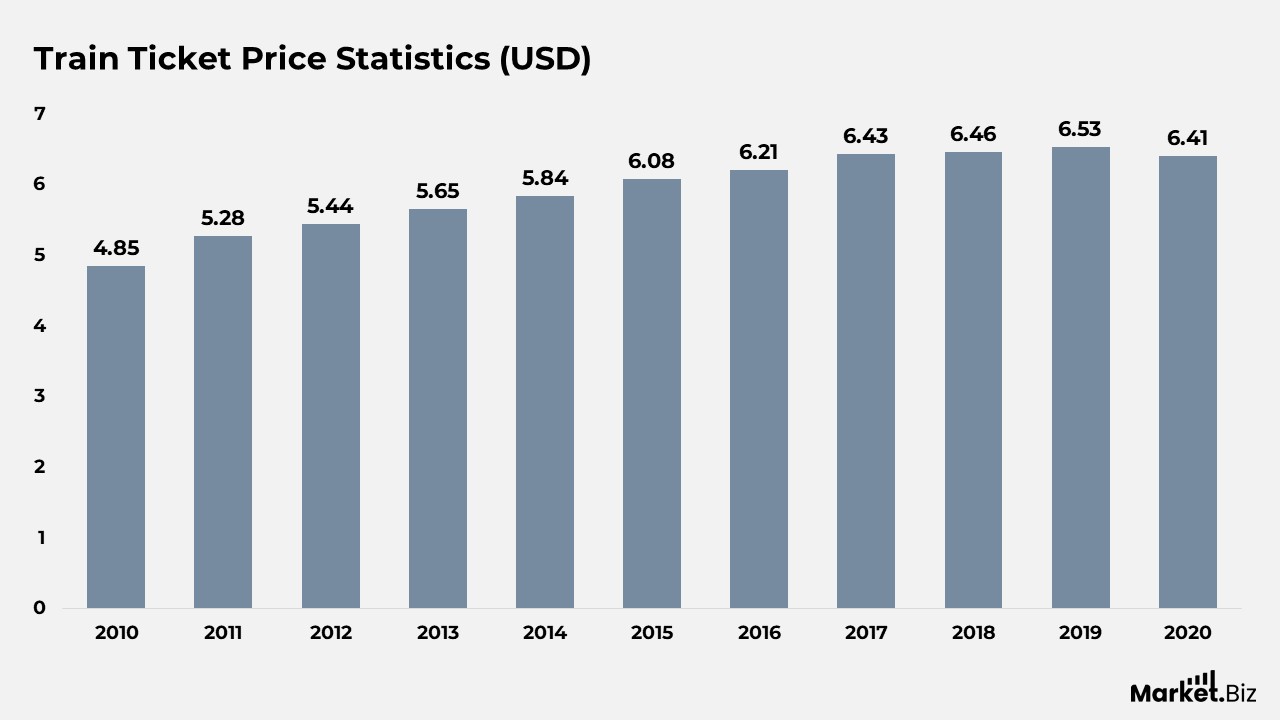
- In 2010, the typical fare was $4.85, which rose to $5.28 in 2011 and $5.44 in 2012.
General Train Statistics
- Train Statistics indicate that Alstom, Siemens, Stadler, Hyundai Rotem, CAF, CRRC Corp. Ltd., TMH, among others, are leading manufacturers of metro rolling stock.
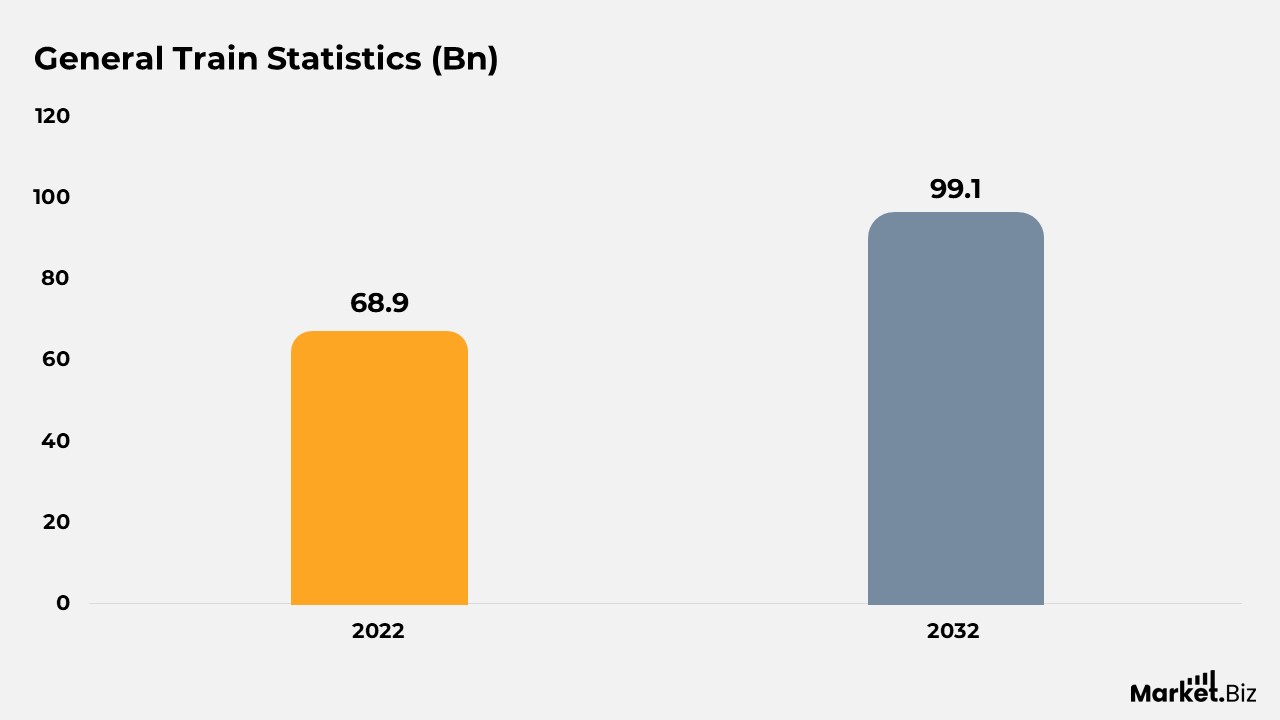
- In 2023, the global train market achieved a revenue of USD 71.5 billion.
- By 2032, the market is anticipated to reach USD 99.1 billion, with passenger trains contributing USD 60.45 billion and freight trains generating USD 38.65 billion.
- The global train market reveals a distinct preference for offline ticketing, which holds a significant 69% market share.
- The United States leads the global ranking of countries by railway network length, boasting an extensive network of 250,000 kilometers.
- As of 2019, global passenger train usage was primarily concentrated in a few key regions, with India holding the largest share at 39% of the total global passenger train usage.
- The longest train route extends from Moscow to Vladivostok, covering an impressive distance of 9,259 kilometers (5,753 miles).
- In the United States, BNSF Railway has announced a capital investment plan of nearly $4 billion for 2023, focusing on infrastructure enhancements and technological advancements to ensure a dependable and efficient rail network.
- The Solar Powered Trains Market is projected to reach approximately USD 4 billion by 2033, up from USD 2.2 billion in 2023, reflecting a CAGR of 6.2% during the projection period from 2024 to 2033.
Train Market Growth Statistics
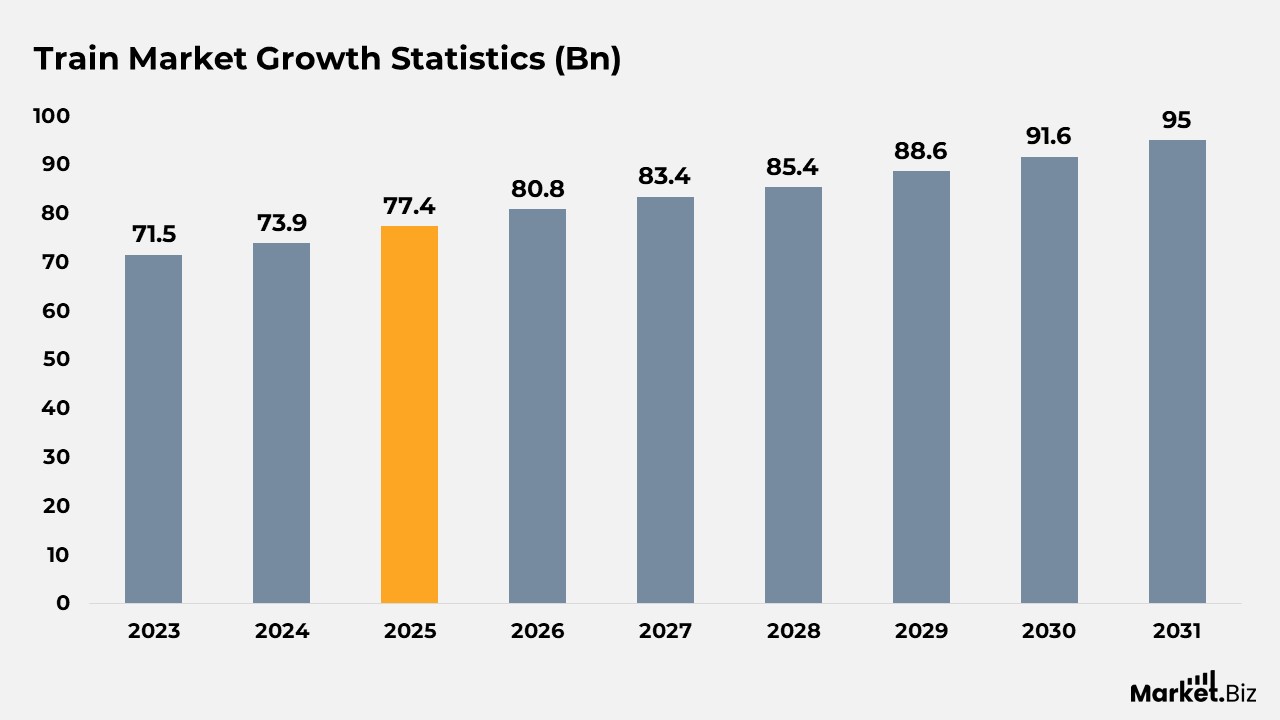
- In 2022, the market generated USD 68.9 billion. This figure rose to USD 71.5 billion in 2023 and further increased to USD 73.9 billion in 2024.
- The upward trend persisted, with revenues reaching USD 77.4 billion in 2025 and USD 80.8 billion in 2026.
- By 2027, the market revenue had reached USD 83.4 billion, climbing to USD 85.4 billion in 2028.
- The growth trajectory continued to gain momentum, with revenues of USD 88.6 billion in 2029 and USD 91.6 billion in 2030.
- The market achieved USD 95.0 billion in 2031 and is anticipated to reach USD 99.1 billion by 2032.
Railway Technology Market Growth Rate
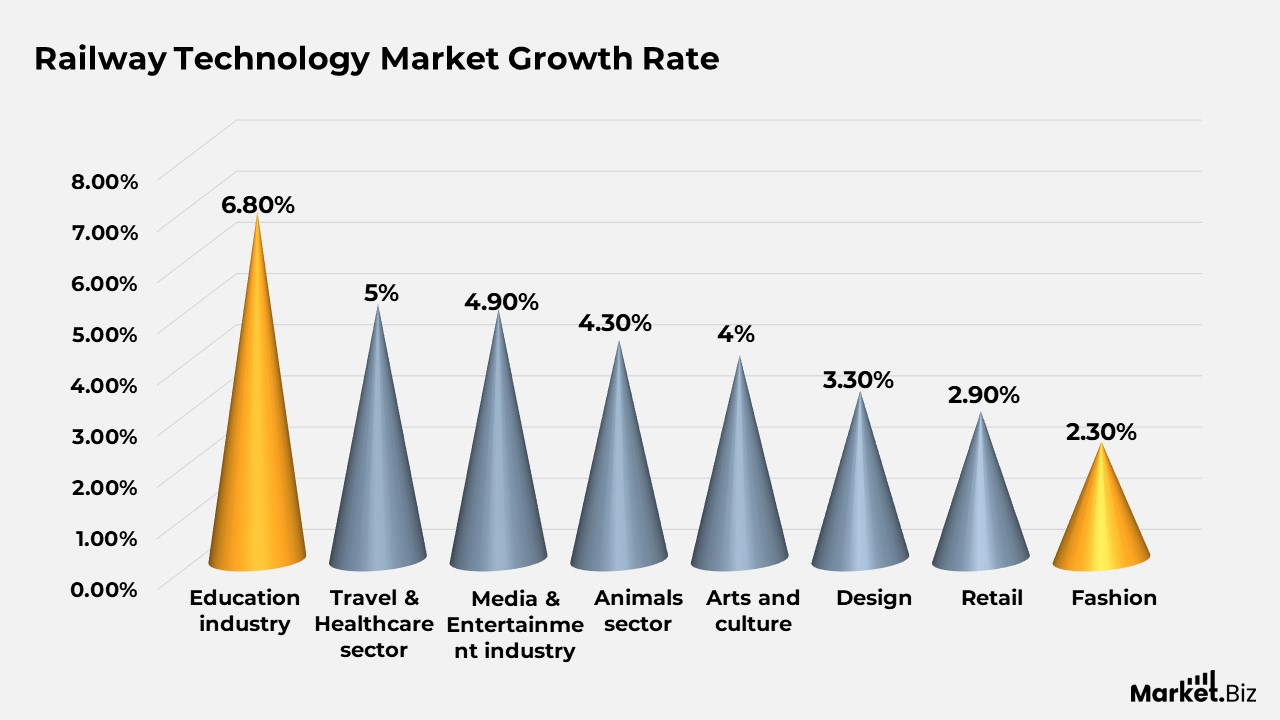
- South and Central America achieved a significant CAGR of 6.8%, with North America following at 5%.
- The Commonwealth of Independent States (CIS) recorded a growth rate of 4.9%, while Asia experienced a CAGR of 4.3%.
- The Africa/Middle East region expanded at 4%, and Western Europe reported a growth rate of 3.3%.
- Eastern Europe recorded a CAGR of 2.9%, while Australia/Pacific exhibited the lowest growth rate at 2.3%.
Largest Train Network Countries
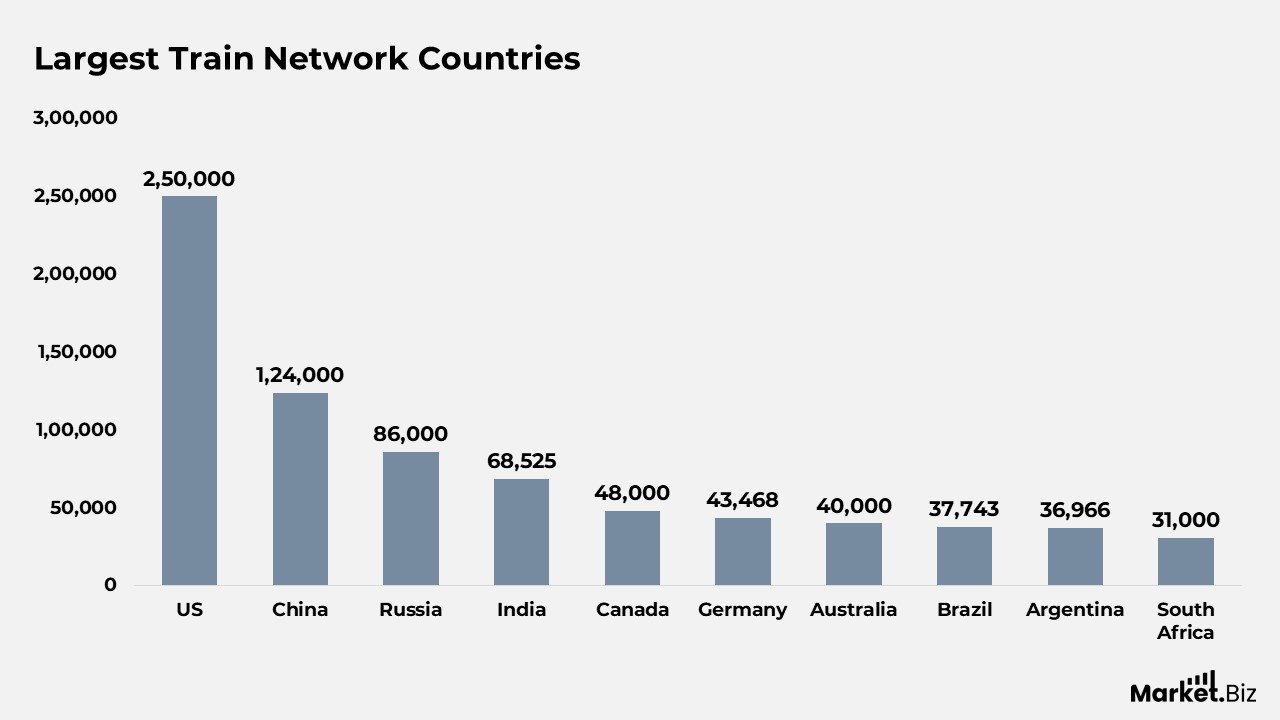
- The United States has an extensive railway network that spans 250,000 kilometers.
- In second place is China, which has a railway system measuring 124,000 kilometers.
- Russia is in third place with a network of 86,000 kilometers, while India ranks fourth with 68,525 kilometers.
- Canada is fifth, with a railway network that extends 48,000 kilometers.
- Germany occupies the sixth position with 43,468 kilometers, and Australia is seventh with a railway network of 40,000 kilometers.
- Brazil is in eighth place, closely following with 37,743 kilometers, and Argentina ranks 9th with 36,966 kilometers.
- Completing the top ten is South Africa, which has a railway network measuring 31,000 kilometers.
Train Passenger Traffic Statistics
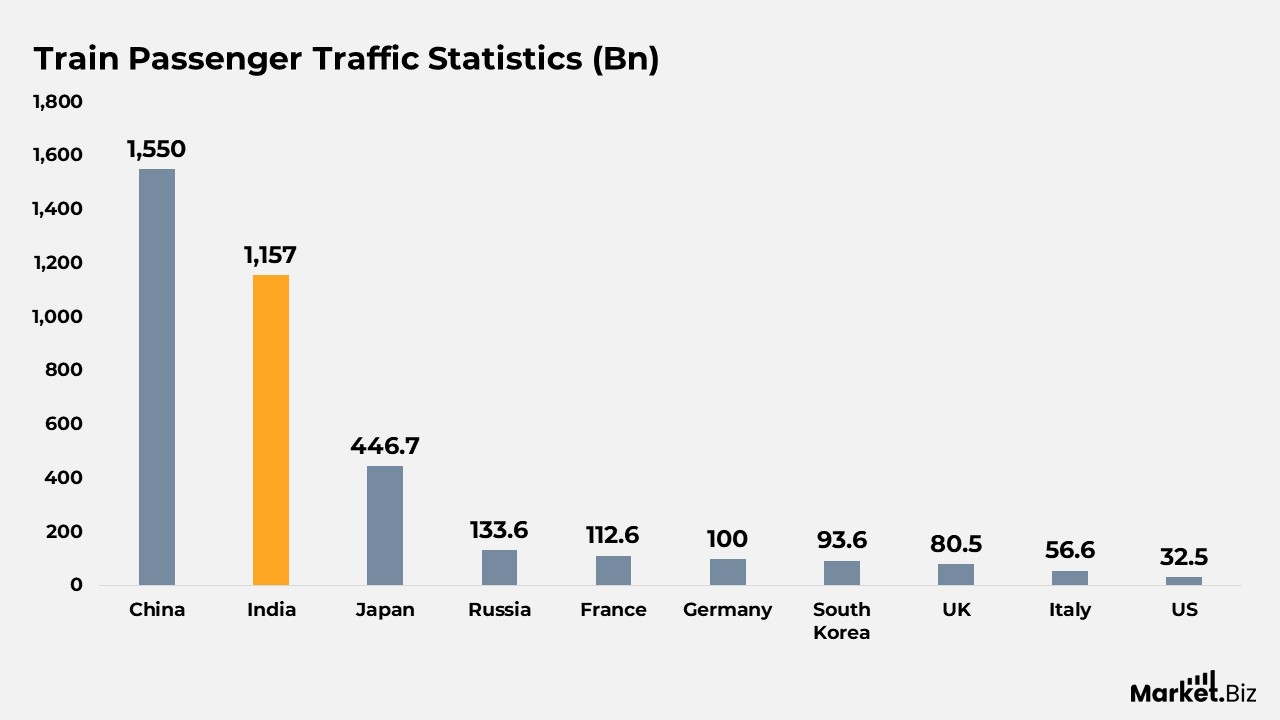
- China tops the rankings with a remarkable 1,550 billion passenger kilometers logged in 2019, closely trailed by India, which recorded 1,157 billion passenger kilometers in that same year.
- Japan occupies the third position with 446.7 billion passenger kilometers, also noted in 2019.
- Following is France reported 112.6 billion passenger kilometers, while Russia reported 133.6 billion passenger kilometers, both figures from 2019.
- In 2019, Germany held the sixth position with 100 billion passenger kilometers, while South Korea occupied the seventh place with 93.9 billion passenger kilometers.
- The United Kingdom achieved 80.5 billion traveller kilometers in 2018, which placed it in the eighth position.
- The United States completes the top ten with 32.5 billion passenger kilometers, and Italy is ranked ninth with 56.6 billion passenger kilometers, both statistics being from 2019.
Train Stations Statistics
- Shinjuku Station, located in Tokyo, Japan, is recognized as the busiest train station in the world, accommodating over 3.6 million passengers daily.
- Established in 1885, it boasts 36 platforms and more than 200 exits, functioning as a crucial hub for western suburbs and Tokyo’s special wards.
- In Australia, Flinders Street Station in Melbourne serves approximately 92,000 passengers each day and is historically significant as the first railway station in an Australian city, having been completed in 1909.
- Germany’s Hamburg Hauptbahnhof serves around 480,000 passengers daily and is ranked as the third busiest station in Europe, playing a vital role in both local transit and long-distance travel.
- London Waterloo, recognized as the largest station in Britain by floor area, accommodates over 210 million passengers each year, including those using its connected tube station.
- Grand Central Terminal, located in New York City, is famous for its distinctive architecture, catering to approximately 750,000 passengers on a daily basis while facilitating connections for Metro-North Railroad and subway services.
- Howrah Junction, situated in Kolkata, India, holds the title of the largest railway station in the country, handling around 700,000 passengers each day across its 23 platforms.
- Gare du Nord, found in Paris, France, ranks first in Europe for annual passenger traffic, with an estimated 214 million passengers, and provides a diverse array of domestic and international rail services.
Railway Networks Statistics
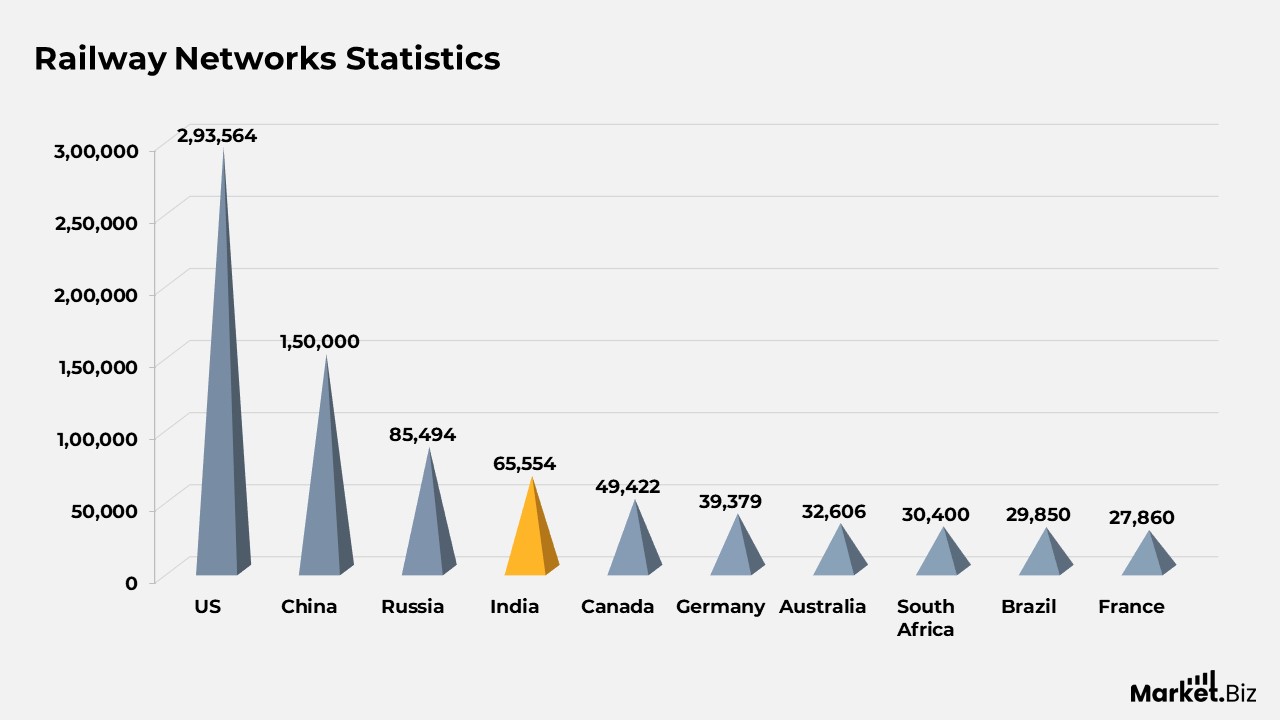
- As of 2014, the United States has the largest railway network in the world, spanning a total distance of 293,564.2 kilometers.
- China ranks second with a railway length of 150,000 kilometers as of 2021, while Russia holds the third position with 85,494 kilometers reported in 2019.
- India’s railway system, as of 2014, covers more than 65,554 kilometers.
- Canada’s railway network is measured at 49,422 kilometers as of 2021, and Germany’s network reached 39,379 kilometers in 2020.
- As per the data from 2022, Australia possesses a railway network that extends to 32,606 kilometers, whereas South Africa indicated a length of 30,400 kilometers in 2021.
- Brazil’s railway infrastructure, as of 2014, covers 29,849.9 kilometers, followed by France, which reported 27,860 kilometers in 2020.
- Japan’s railway system was documented at 27,311 kilometers in 2015.
- In 2017, Mexico reported a railway system measuring 23,389 kilometers, while Ukraine reported 21,733 kilometers in 2014.
- Poland’s railway network reached 19,461 kilometers in 2020, and Italy reported 18,475 kilometers in the same year.
Longest Train Journeys Statistics
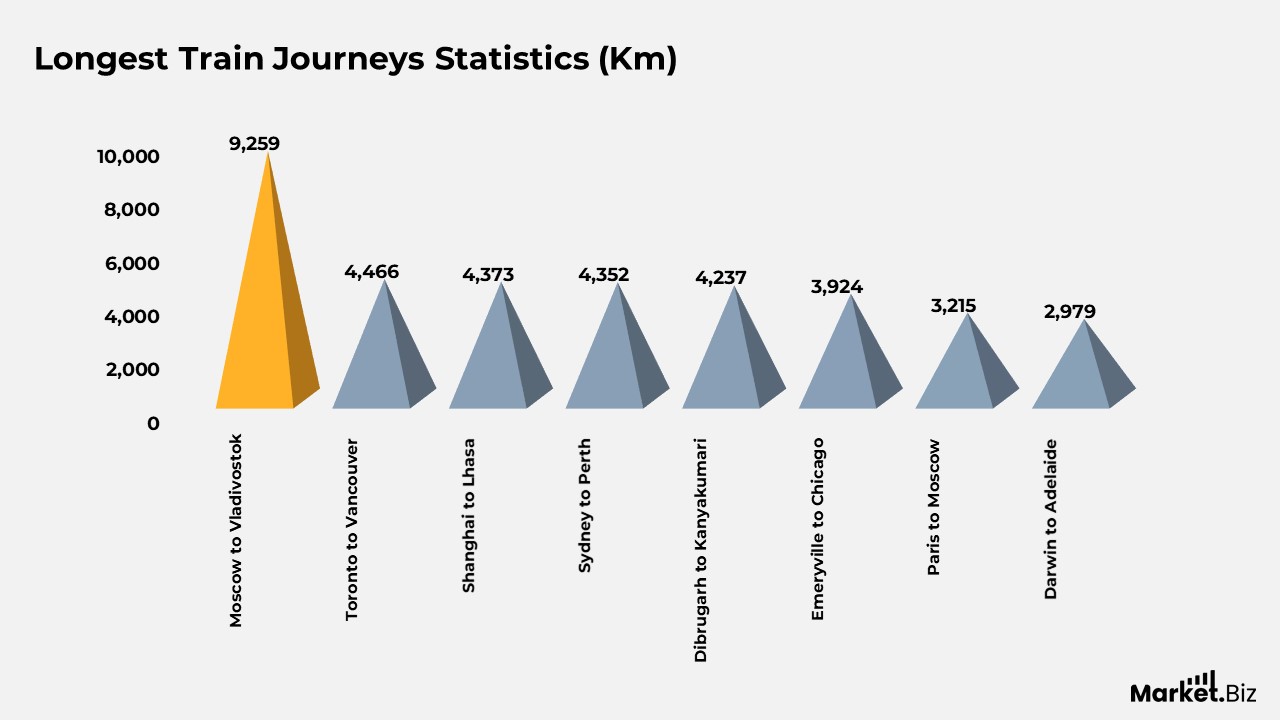
- The longest journey is from Moscow to Vladivostok, covering an impressive distance of 9,259 kilometers (5,753 miles).
- Following this, the trip from Toronto to Vancouver spans 4,466 kilometers (2,775 miles), while the route from Shanghai to Lhasa extends 4,373 kilometers (2,717 miles).
- The distance from Sydney to Perth is 4,352 kilometers (2,704 miles), and in India, the journey from Dibrugarh to Kanyakumari stretches 4,237 kilometers (2,633 miles).
- In North America, the route from Emeryville to Chicago covers 3,924 kilometers (2,438 miles).
- In Europe, the journey from Paris to Moscow spans 3,215 kilometers (1,998 miles), and in Australia, the distance from Darwin to Adelaide measures 2,979 kilometers (1,851 miles).
Train Ticket Price Statistics
- In 2010, the typical fare was $4.85, which rose to $5.28 in 2011 and $5.44 in 2012.
- This upward trend persisted, with fares climbing to $5.65 in 2013 and $5.84 in 2014.
- By 2015, the average fare had increased to $6.08, followed by a rise to $6.21 in 2016.
- The fare continued to rise to $6.43 in 2017 and slightly increased to $6.46 in 2018.
- In 2019, the average fare reached $6.53.
- However, in 2020, there was a minor decline, with the fare averaging $6.41.
Train Passengers Statistics
By Age & Gender
- In England in 2015, males averaged 22 rail trips per year, surpassing the 18 trips that females averaged.
- Rail usage displayed significant variations among different age groups, with individuals aged 21-29 taking the highest average of 41 trips annually, in sharp contrast to those over 70 years old, who averaged only six trips each year.
- For women between the ages of 21 and 29, the typical number of rail journeys was significantly elevated at 43 per year, representing the highest average amongst all age and gender demographics.
- In contrast, women aged 70 and above took the least number of rail trips annually, with an average of only five journeys.
By Income
- In 2015, the number of rail journeys per individual in the U.K. showed considerable variation based on income levels.
- Individuals belonging to the lowest real income bracket averaged 10 rail journeys per person, whereas those in the second income bracket averaged 12 trips.
- The third income bracket experienced an increase to 17 trips per individual, and the fourth bracket further increased to 20 trips.
- It is noteworthy that individuals in the highest real income bracket made a significantly greater number of rail journeys, averaging 42 trips per person.
Recent Developments
- China is actively enhancing its high-speed rail network, with intentions to incorporate an additional 10,000 kilometers of new tracks by 2025, with the goal of improving connectivity among major cities and fostering regional development.
- The global high-speed rail market is projected to experience a compound annual growth rate (CAGR) of 5.8% from 2023 to 2028, propelled by a rising demand for rapid, efficient, and sustainable transportation solutions in both urban and intercity travel.
- The European Union’s Rail Strategy for 2030 seeks to double the volume of high-speed rail traffic and boost rail freight transport by 50%, Further, with an emphasis on minimizing carbon emissions and improving rail connectivity throughout Europe.
Conclusion
The global train industry is undergoing significant changes, supported by considerable investments from both governmental bodies and private entities aimed at improving safety, efficiency, and infrastructure. In the United States, the Railway Safety Act of 2023, along with substantial funding for rail initiatives, highlights a robust dedication to enhancing rail systems.
Moreover, India has raised its daily train operations from 10,186 to 10,748, demonstrating the sector’s adaptability to the demands of commuters. Technological innovations, such as high-speed rail and cybersecurity protocols, are being adopted globally, with China’s Belt and Road Initiative and Europe’s standardization efforts at the forefront.
The emphasis on environmental sustainability further encourages rail transport as a more eco-friendly option, propelled by advancements in renewable energy and energy-efficient technologies.
FAQs
Countries that do not possess railway tracks, stations, or networks include the Maldives, Bhutan, Iceland, and others. Numerous nations are devoid of railway systems. Among them are Iceland, Andorra, Bhutan, Kuwait, the Maldives, Guinea-Bissau, Libya, and Yemen.
George Stephenson is referred to as the “Father of the Railways” due to his substantial contributions to steam-powered locomotives and railway infrastructure, including the establishment of the standard gauge, which has become the international standard for the majority of railways.
In the railway sector, “LC” typically denotes Level Crossing, which refers to the point where a road or pathway intersects a railway line at the same elevation.

