









Introduction
AI in HR and Recruitment Statistics: AI is increasingly shaping the future of Human Resources (HR) and recruitment, offering innovative solutions that streamline processes and improve decision-making. The global AI in HR market is projected to grow from $2.4 billion in 2021 to over $11 billion by 2027, reflecting the widespread adoption of AI technologies.
These tools are revolutionizing areas like resume screening, candidate sourcing, and interview processes, improving efficiency and reducing hiring biases. AI’s ability to analyse vast datasets enables HR professionals to make data-driven decisions, while also enhancing candidate experience.
Editor’s Choice
- The AI in HR market is expected to grow from $2.4 billion in 2021 to $11 billion by 2027.
- 35% of companies use AI for resume screening and candidate sourcing, boosting efficiency by 50%.
- AI can reduce time-to-hire by up to 40%, speeding up recruitment.
- Predictive analytics in recruitment improves candidate success and fit by 25%.
- North America holds over 40% of the AI recruitment market, with Asia-Pacific growing at 40% CAGR.
- AI-driven skill assessments are projected to grow from $1.3 billion in 2021 to $4.2 billion by 2026.
- 75% of candidates report better experiences with AI-powered catboats.
- AI has increased diversity hires by 20%, promoting fairer recruitment.
- By 2026, AI screening will account for 60% of the recruitment market.
- 70% of hiring managers say AI enhances recruitment accuracy and decisions.
- AI job matching improves hiring accuracy by 50%, reducing costs by 25%.
- The AI HR software market is expected to grow from $2.8 billion in 2021 to $11.8 billion by 2027.
General AI in HR and Recruitment Statistics
- 35% of global organizations are utilizing AI in HR and recruitment to automate tasks such as resume screening and candidate sourcing.
- AI can reduce the time-to-hire by up to 40%, streamlining processes like resume screening, initial interviews, and candidate outreach.
- AI-driven resume screening tools have been shown to increase hiring efficiency by 50%, cutting down the time HR teams spend on manual resume review.
- 30% of HR professionals report that AI technologies have improved the quality of their hires by providing more accurate candidate matches.
- AI helps reduce hiring biases, with studies showing that AI-powered recruitment platforms can decrease bias by up to 60%, promoting more diverse hiring practices.
- Companies using AI in recruitment have reported a 20-30% reduction in recruitment costs due to automation and faster hiring processes.
- 75% of candidates report a better experience when interacting with AI-powered catboats during the recruitment process, improving engagement and communication.
- AI’s predictive analytics in recruitment has led to a 25% improvement in predicting candidate success and cultural fit, helping HR teams make more informed decisions.
- The AI in HR market is expected to grow at a compound annual growth rate (CAGR) of 34% from 2022 to 2027, reaching an estimated value of $11 billion by 2027.
- AI can improve candidate sourcing by 50%, automating the identification of talent across various online platforms, such as LinkedIn and job boards.
- AI tools that analyse employee behaviour and performance data have helped companies reduce turnover by up to 15% by identifying at-risk employees early.
- AI-driven tools can improve diversity in hiring by identifying diverse talent pools and mitigating unconscious biases, with some companies seeing a 20% increase in diversity hires.
- 40% of job applicants report that they would prefer to interact with an AI-powered Chabot for screening and interview scheduling, offering a more streamlined experience.
- AI-powered video interview platforms are becoming more common, with 35% of companies using AI to assess video interviews based on factors like speech patterns and body language.
- AI-driven tools for employee engagement and feedback collection have increased response rates by 50%, providing HR teams with actionable insights to improve workplace culture.
Market Size of AI Recruitment
- The global AI recruitment market was valued at $2.8 billion in 2021 and is expected to reach $11 billion by 2027, growing at a CAGR of 34%.
- North America dominates the AI recruitment market, accounting for over 40% of the market share due to high adoption rates in the U.S. and Canada.
- The adoption of AI recruitment solutions in Asia-Pacific is projected to grow at the highest rate, with a CAGR of 40%, driven by expanding economies like China and India.
- In 2022, the AI-driven recruitment software market in Europe was valued at approximately $600 million, reflecting a significant increase in automation adoption by businesses.
- Small and medium-sized enterprises (SMEs) represent a growing segment, with around 30% of them expected to implement AI recruitment tools in 2025.
- The AI recruitment market in the healthcare sector is expected to grow by 35% over the next five years, as hospitals and clinics increasingly automate hiring to reduce staffing shortages.
- By 2026, AI-powered candidate screening and sourcing is expected to comprise 60% of the recruitment market, indicating a major shift towards automation in talent acquisition.
- The use of AI for resume screening is estimated to account for $1.2 billion of the total AI recruitment market in 2025, highlighting its growing importance in the hiring process.
- AI-based interview platforms are projected to experience a 25% year-over-year growth, making them one of the fastest-growing sub-segments in the AI recruitment market.
- The market for AI recruitment catboats is expected to reach $3.5 billion by 2026, driven by increasing demand for streamlined candidate interactions and 24/7 support.
- The financial services sector is investing heavily in AI recruitment, with an estimated $500 million spent annually on AI tools to improve hiring efficiency and candidate matching.
- With the increasing focus on diversity and inclusion, AI recruitment tools designed to reduce bias are expected to grow by 20% annually, helping companies promote fairer hiring practices.
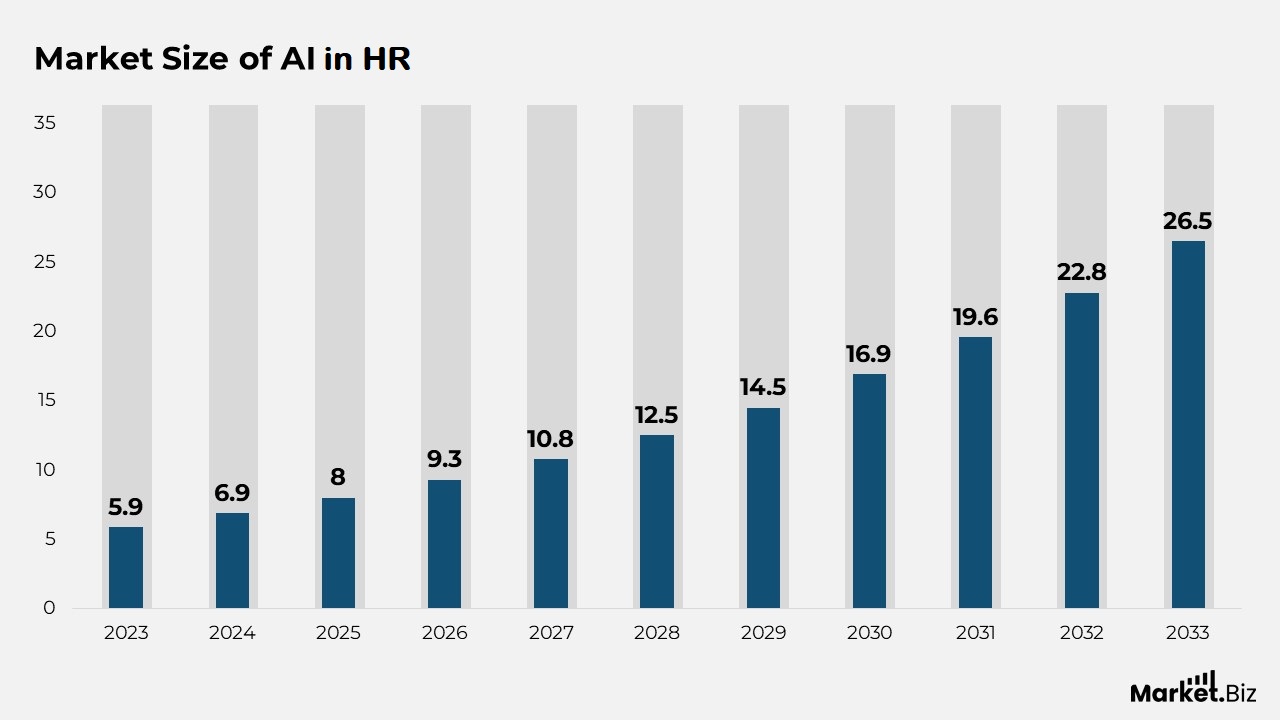
(Source: Market.US, WP-Content)
AI in Skill Assessment
- The AI-powered skill assessment market is projected to grow from $1.3 billion in 2021 to $4.2 billion by 2026, with a CAGR of 25%.
- AI-driven skill assessments help improve candidate evaluation accuracy by up to 30%, allowing employers to better match skills with job requirements.
- Around 40% of companies use AI for skill testing in recruitment, automating the process to reduce bias and streamline hiring.
- In 2023, 60% of HR departments reported adopting AI-based skill assessment tools to enhance employee training and development.
- The global demand for AI-based coding assessments is on the rise, with the market for technical skill assessments growing by 28% annually.
- AI-powered skill assessment tools can reduce hiring time by 35%, enabling faster evaluation and decision-making in recruitment processes.
- 55% of candidates say they prefer AI-based assessments for their efficiency and objectivity compared to traditional interview-based evaluations.
- AI-enabled psychometric tests are becoming increasingly popular, with their market expected to grow by 20% over the next five years.
- Companies using AI for skill assessments report a 25% improvement in employee performance after targeted development based on AI-generated insights.
- By 2026, AI is expected to be used in 70% of global skill assessments for recruitment, reflecting its increasing role in workforce optimization and talent management.
(Source: Mettl, WP-Content)
Predictive Analytics in Recruitment
- Predictive analytics is helping businesses reduce hiring mistakes by up to 25% by providing data-driven insights into candidate potential and job fit.
- Around 60% of talent acquisition professionals use predictive analytics to forecast employee success and ensure cultural alignment in recruitment.
- Companies using predictive analytics in their recruitment processes report a 30% faster time-to-fill due to automated candidate evaluation and decision-making.
- The adoption of predictive analytics in recruitment is projected to grow by 35% over the next 5 years, driven by advancements in AI and machine learning technologies.
- 50% of organizations leverage predictive analytics to improve employee retention by identifying candidates with long-term growth potential.
- By 2026, predictive analytics in recruitment is expected to contribute to a 20% reduction in recruitment costs by improving hiring efficiency and reducing turnover.
- 70% of HR professionals say that predictive analytics tools have helped enhance the candidate experience by providing clearer expectations throughout the hiring process.
- AI-driven predictive analytics can increase the accuracy of hiring decisions by up to 40%, ensuring that candidates are well-suited for the role.
- Predictive analytics is helping companies anticipate workforce needs, with 45% of businesses using these tools for proactive talent pipelining.
- In industries like finance and healthcare, predictive analytics is seeing rapid adoption, with 30% of companies in these sectors already using data to predict employee performance.
- The use of predictive analytics for workforce planning is estimated to reduce turnover rates by
- 10-15%, as organizations can make more informed hiring decisions based on predictive data.
Data-Driven Hiring Decisions
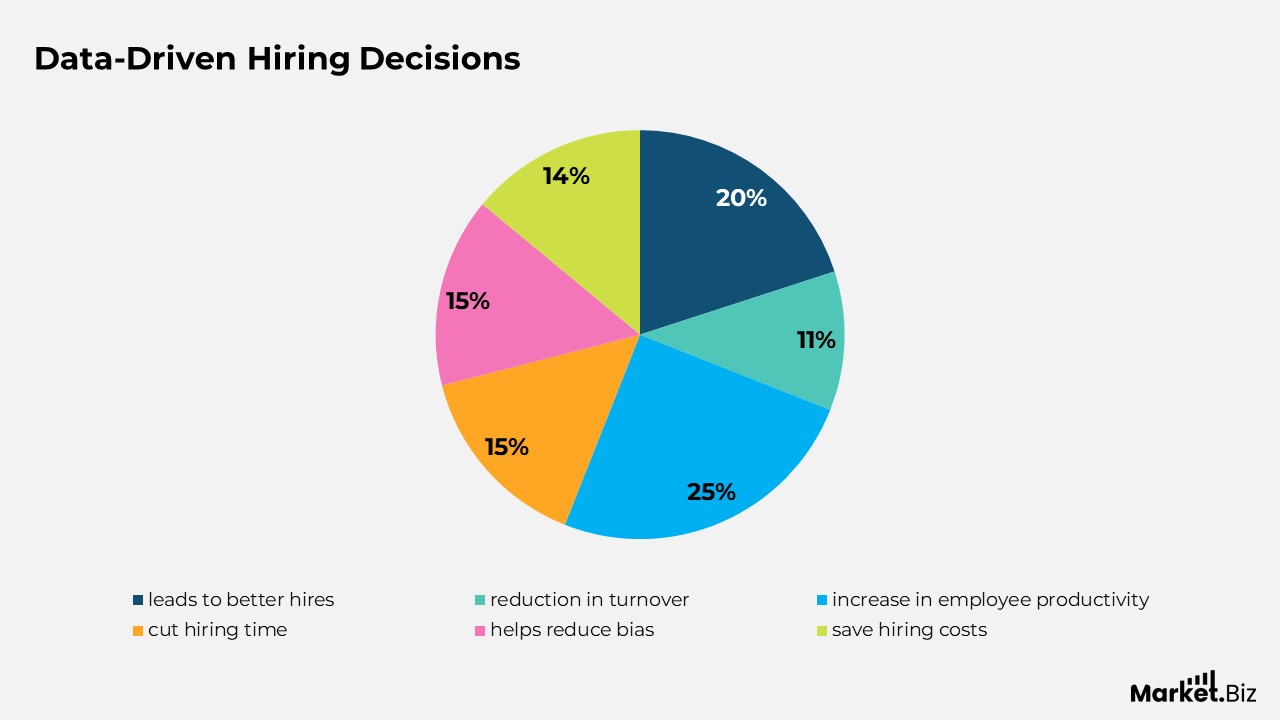
- 20% of hiring managers say using data to make hiring decisions leads to better hires by giving them clearer insights into candidates’ skills and potential.
- Companies that use data-driven hiring processes experience an 11% reduction in turnover, as they’re able to match candidates to roles that suit them better.
- 65% of companies now incorporate data analytics into their recruitment, helping them assess candidates’ qualifications, culture fit, and long-term potential.
- Organizations that rely on data for hiring decisions report a 25% increase in employee productivity due to better matches between job requirements and candidates’ strengths.
- Using data-driven recruitment platforms can cut hiring time by 15%, speeding up the process with automated candidate matching and predictive analytics.
- 15% of HR professionals believe data-driven hiring helps reduce bias, making their recruitment processes more diverse and inclusive.
- The global market for data-driven hiring solutions is expected to grow from $2.8 billion in 2021 to $6.5 billion by 2026, fuelled by the growing use of AI and machine learning.
- Data-driven recruitment can save companies up to 14% in hiring costs, as it helps them target the right talent and reduces the need for external recruiting agencies.
- 55% of candidates report a better experience when data is used in hiring, as it creates a more transparent process and faster feedback.
- In 2025, it’s expected that more than 60% of hiring decisions will be made using data, as companies continue to embrace the benefits of data analytics in recruitment.
AI-Based Job Matching Algorithms
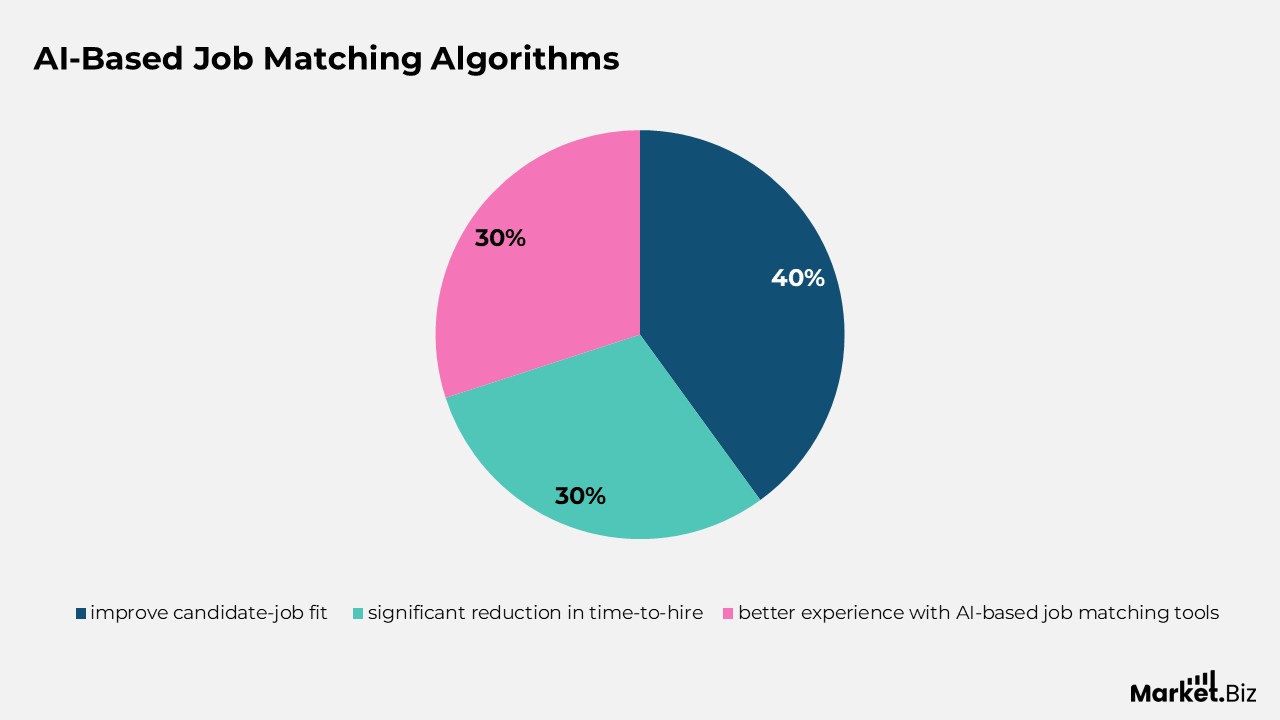
- AI-based job matching algorithms can improve candidate-job fit by up to 40%, helping companies find the best talent faster and more accurately.
- 65% of companies that use AI for job matching report a significant reduction in time-to-hire, cutting the process by up to 30%.
- The global market for AI-based job matching is expected to grow from $1.1 billion in 2021 to $6.5 billion by 2026, driven by increasing demand for automation in recruitment.
- AI-driven job matching systems analyse over 100 variables, such as skills, experience, and personality traits, to match candidates with the right roles.
- 30% of job seekers report a better experience with AI-based job matching tools, as they receive personalized job recommendations based on their profile and preferences.
- AI-based algorithms can increase hiring accuracy by up to 50%, reducing the chances of hiring mismatches and improving overall recruitment efficiency.
- Companies using AI for job matching have experienced a 20% improvement in employee retention, as the technology ensures better alignment between candidates and job roles.
- 55% of recruitment professionals believe AI job matching tools will become a standard part of the hiring process within the next 5 years.
- AI-powered job matching can reduce hiring costs by up to 25% by automating candidate sourcing, screening, and matching, allowing HR teams to focus on higher-value tasks.
- By 2027, AI job matching algorithms are expected to be used in 80% of global recruitment processes, as more organizations adopt data-driven solutions for talent acquisition.
Chabot’s for Recruitment
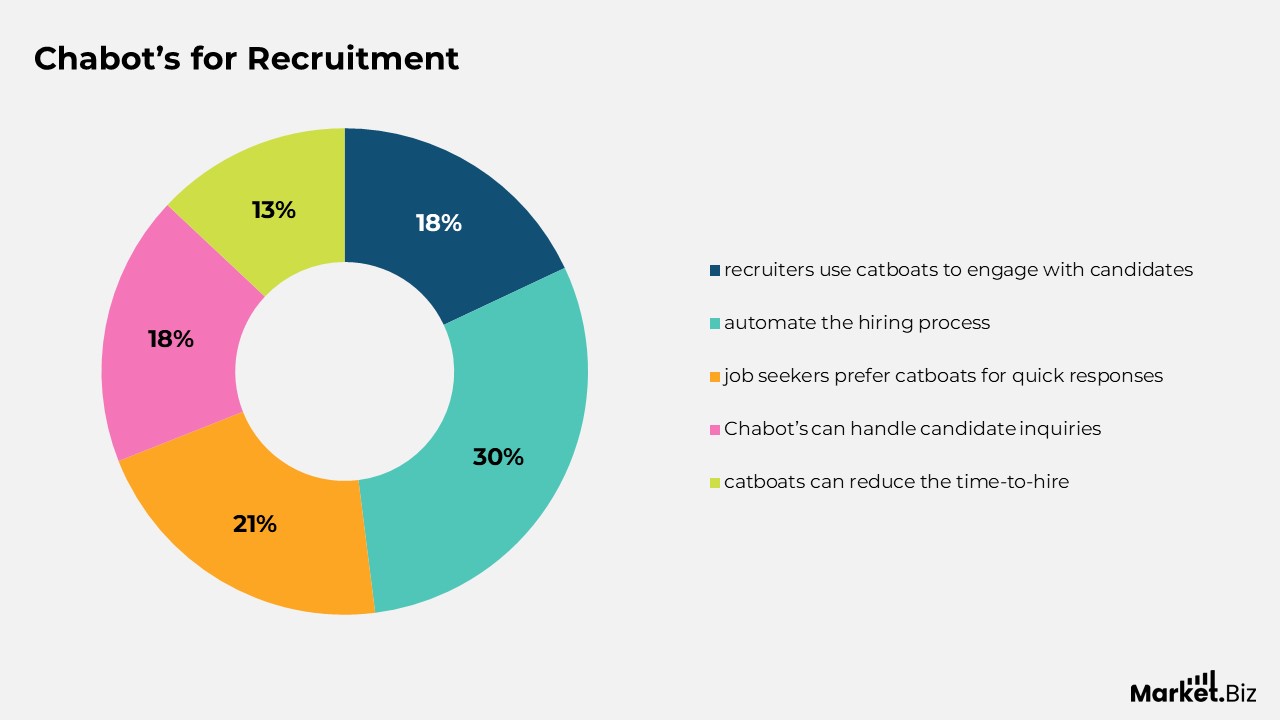
- 58% of recruiters use catboats to engage with candidates, reducing response time and improving candidate experience during the recruitment process.
- Chabot’s in recruitment can automate up to 60% of the hiring process, including initial candidate screenings and answering frequently asked questions.
- 80% of job seekers prefer interacting with catboats for quick responses, leading to a better overall candidate experience.
- The global Chabot market for recruitment is projected to grow from $1.3 billion in 2021 to $3.5 billion by 2026, reflecting increased adoption of automation in hiring.
- Chabot’s can handle up to 90% of candidate inquiries during the initial stages, allowing recruiters to focus on high-priority tasks like interviews and decision-making.
- By automating repetitive tasks, catboats can reduce the time-to-hire by up to 30%, speeding up the recruitment process and improving efficiency.
- 60% of candidates report that Chabot interactions have helped them feel more informed about job roles and the hiring process.
- Chabot’s can assist in improving recruitment accuracy by collecting and analysing candidate data, leading to better job matching and reduced turnover.
- 72% of hiring managers believe catboats can increase their recruitment efficiency, providing quicker responses and a more streamlined hiring process.
- Chabot’s can conduct pre-screening assessments, saving HR teams up to 40% of time spent on initial candidate evaluations.
- 45% of organizations use AI-powered catboats to enhance their recruitment marketing efforts, providing personalized interactions that engage job seekers at every stage.
- With the ability to communicate in multiple languages, recruitment catboats are helping global companies connect with candidates across different regions, expanding their talent pool.
Major Challenges
- 45% of HR professionals worry about protecting sensitive candidate information when using AI-driven recruitment tools.
- 38% of organizations struggle with ensuring AI recruitment tools are fair, as these systems can sometimes perpetuate existing biases.
- Over half of HR leaders (52%) find it difficult to explain how AI makes hiring decisions, raising concerns about transparency in the process.
- 48% of recruiters fear that relying too heavily on AI could overlook important qualities in candidates that don’t show up in the data.
- 40% of companies face difficulties when trying to integrate AI tools with their existing HR systems, leading to inefficiencies and extra costs.
- 33% of small and medium-sized businesses find the initial cost of adopting AI in recruitment too high, making it hard for them to invest.
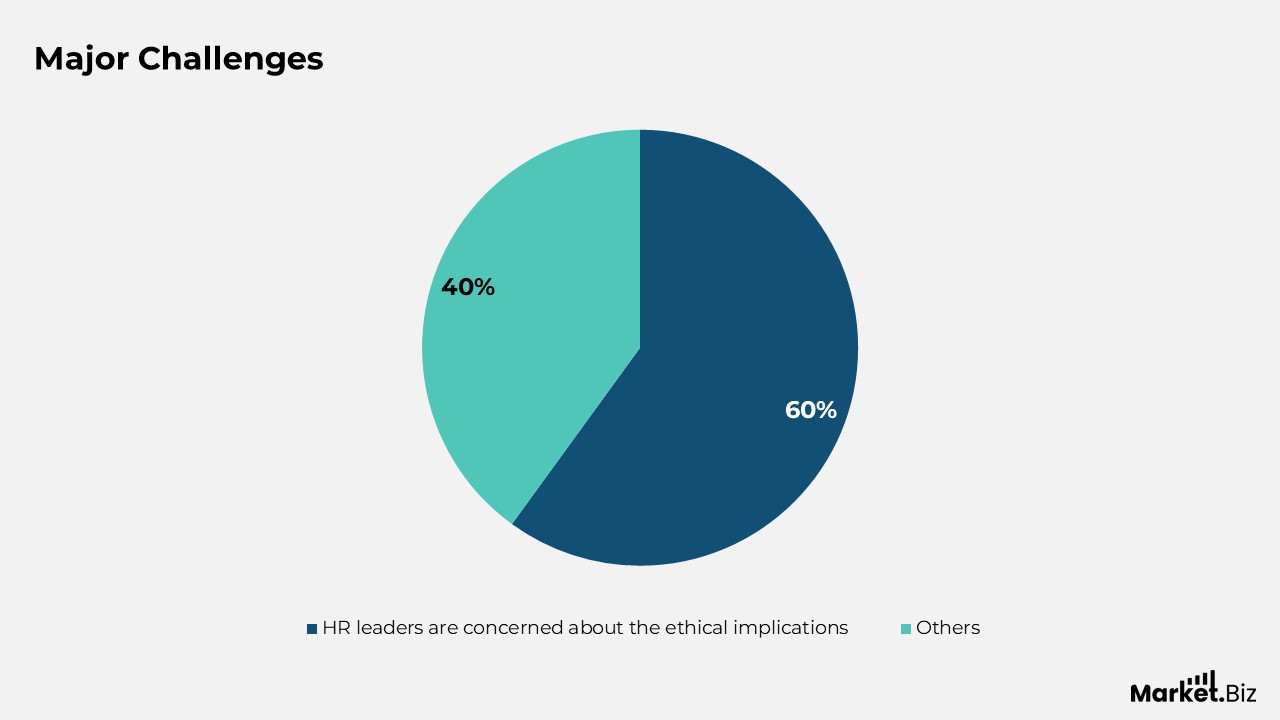
- 60% of HR leaders are concerned about the ethical implications of using AI, especially regarding fairness and privacy in hiring.
- 55% of HR teams struggle to keep AI algorithms up to date, requiring constant maintenance and data updates to stay effective.
- 70% of job seekers are sceptical of AI-driven hiring processes, fearing that it could lead to impersonal or unfair evaluations, affecting a company’s reputation.
- 41% of companies find it challenging to hire the right talent to implement and manage AI tools, as the technology requires specialized expertise.
Integration of AI with HR Software
- 25% of companies report improved HR efficiency after integrating AI with their HR software, automating repetitive tasks like resume screening and candidate sourcing.
- The global market for AI in HR software is expected to grow from $2.8 billion in 2021 to $11.8 billion by 2027, driven by increased automation adoption.
- 60% of organizations that integrate AI with their HR systems say it has enhanced their ability to make data-driven decisions in recruitment and talent management.
- AI integration in HR software can reduce the time-to-hire by up to 30%, streamlining the recruitment process and improving candidate experience.
- 70% of HR leaders believe AI integration has improved employee engagement by providing personalized learning and development recommendations.
- AI-powered HR software can automate up to 50% of administrative tasks, such as payroll processing and employee record management, saving HR department’s valuable time.
- 40% of businesses using AI with HR software report a 25% reduction in hiring costs, as automation decreases the need for third-party recruitment services.
- 55% of companies using AI-enhanced HR systems find that the integration improves employee retention by identifying at-risk employees early and offering proactive solutions.
- By 2026, AI-powered HR software is expected to be integrated into 70% of global HR departments, reflecting the growing reliance on automation and data insights.
- The integration of AI with HR software has led to a 20% increase in recruitment accuracy, as AI helps to match candidates more effectively with job roles.
Recent Developments
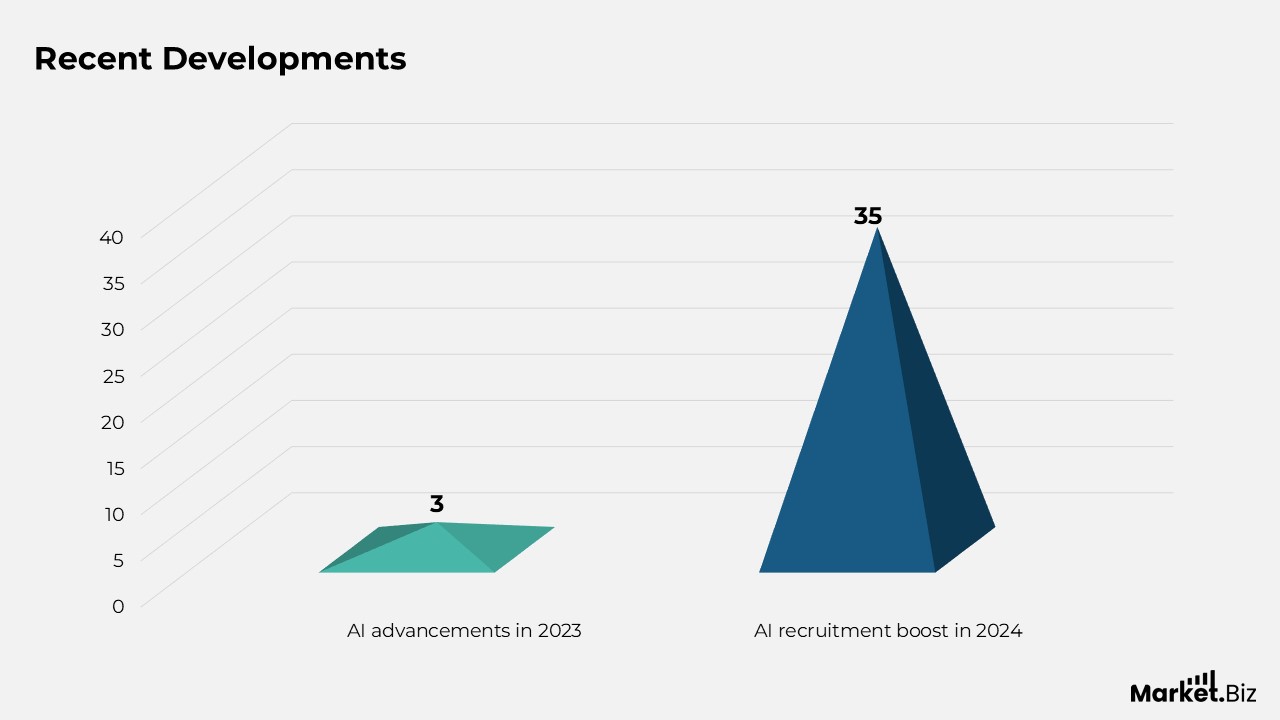
- The global AI recruitment market saw a significant boost in 2024, growing by 35%, as companies increasingly adopted AI-driven tools for talent acquisition and management.
- In 2023, HR technology companies invested over $3 billion in AI advancements, with a focus on improving automation and candidate experience through smart analytics and catboats.
- Over 60% of organizations have now implemented AI in employee training programs, utilizing personalized learning platforms to enhance skills and reduce training costs.
- The rise of AI-powered video interviewing platforms is reshaping recruitment, with 40% of companies using these tools to enhance the interview process and reduce hiring time by 30%.
- In 2023, the use of predictive analytics for employee retention grew by 28%, as organizations leverage data insights to proactively address turnover and improve engagement.
- In 2025, 75% of HR teams are expected to integrate AI for performance management, with AI systems offering real-time feedback and personalized development plans for employees.
- The demand for AI-based diversity and inclusion tools has surged, with 50% of Fortune 500 companies adopting AI solutions to reduce bias and promote diversity in hiring.
- Cloud-based HR platforms with integrated AI capabilities have become mainstream, with 26% of large enterprises now using these tools to optimize HR functions and drive operational efficiency.
Future of AI in HR and Recruitment
- By 2030, AI is expected to automate 40% of HR tasks, significantly reducing administrative workload and allowing HR professionals to focus on strategic decision-making.
- The global AI recruitment market is projected to reach $16 billion by 2030, driven by increasing demand for AI-based tools to improve candidate sourcing and talent management.
- 65% of organizations plan to integrate AI-driven predictive analytics into their recruitment processes by 2026, aiming to enhance hiring accuracy and reduce turnover rates.
- AI-powered catboats are expected to handle 80% of initial candidate screenings by 2027, streamlining communication and speeding up the hiring process for employers.
- The adoption of AI for diversity and inclusion efforts will grow by 30% in the next five years, as companies focus on reducing bias and improving workforce representation.
- 58% of HR leaders anticipate that AI will play a central role in employee development by 2030, with AI tools providing personalized learning paths and continuous performance feedback.
Conclusion
The integration of AI in HR and recruitment is revolutionizing talent acquisition and management. AI technologies are enhancing efficiency, reducing biases, and improving candidate experiences. AI-driven tools such as predictive analytics, resume screening, and job matching algorithms are streamlining processes and improving recruitment accuracy.
The adoption of AI solutions across various industries highlights the growing reliance on automation to optimize HR functions. As AI continues to evolve, its impact on workforce management, diversity, and decision-making will expand, making it an essential tool in the future of HR and recruitment.
FAQ’s
The global AI in HR market was valued at $2.4 billion in 2021 and is projected to reach over $11 billion by 2027, growing at a compound annual growth rate (CAGR) of 34%. This growth reflects the increasing adoption of AI technologies to optimize HR processes.
AI enhances the recruitment process by automating tasks such as resume screening, candidate sourcing, and initial interviews, improving efficiency, reducing bias, and speeding up hiring times by up to 40%. It also helps improve the quality of hires by providing more accurate candidate matches.
Challenges include concerns about the transparency of AI decision-making, protecting sensitive candidate data, overcoming biases in AI systems, and the high cost of adoption, particularly for small and medium-sized businesses. Integrating AI tools with existing HR systems can also pose difficulties.
AI recruitment tools help reduce biases by analysing data without the influence of human prejudices. Some AI platforms have been shown to decrease hiring biases by up to 60%, leading to more diverse hiring practices and promoting inclusive workforce representation.
The future of AI in HR and recruitment is promising, with predictions indicating that AI will automate up to 40% of HR tasks by 2030. AI will play a key role in enhancing predictive analytics, improving diversity efforts, and streamlining recruitment processes to reduce costs and increase hiring accuracy.