









Introduction
Construction Industry Statistics: The construction industry is a key driver of global economic development, job creation, and infrastructure advancement, ranging from residential buildings to major public works like roads and bridges.
Understanding the sector’s dynamics is essential for stakeholders such as policymakers, investors, and contractors, as factors like economic cycles, technological progress, government regulations, and global supply chains shape it.
Statistics within the construction industry provide crucial insights into market size, growth trajectories, workforce characteristics, and financial performance, enabling stakeholders to make data-driven decisions and enhance project outcomes.
Editor’s Choice
- Labor shortages continue to challenge the industry, with 85% of construction companies struggling to fill positions due to skill gaps.
- The adoption of Building Information Modelling (BIM) is on the rise, with over 70% of construction companies in advanced economies like Germany utilizing BIM for efficient project planning and management.
- The construction sector contributes to 30% of global waste, driving the need for more sustainable building practices.
- Construction productivity has seen a modest annual growth of just 1% over the past 20 years, emphasizing the need for more innovation in the field.
- As of 2023, around 745,000 construction businesses are operating in the U.S.
- The construction industry employs approximately 7.8 million individuals across more than 745,000 businesses annually.
Trends in the Construction Industry
- Design-build is expected to account for 47% ($1.9 trillion) of U.S. construction spending by 2026.
- 94% of construction companies are actively taking steps toward sustainability.
- 63% of construction companies are incorporating AI into their operations to drive sustainability initiatives.
- Design-build projects are completed 102% faster compared to traditional design-bid-build methods.
- 23% of firms are adopting lean construction practices, tools like BIM, and offsite prefabrication to improve jobsite performance.
- Modular construction is projected to grow at a 7.9% compound annual growth rate (CAGR) by 2030.
- Around 90% of companies using prefabrication report significant improvements in productivity, quality, and schedule reliability compared to traditional construction methods.
- 14% of trades report manufacturing more than 50% of their work in the shop instead of the field.
- 65% of construction firms are utilizing robotics at job sites, with 35% incorporating autonomous heavy equipment.
- Circular construction practices, such as material reuse and modular building, with recycled materials accounting for 18% of construction inputs in Europe.
(Source: DBIA, Autodesk Inc., AGC, Dodge Data & Analytics, Autodesk & Dodge Data & Analytics, BuiltWorlds, UN Environment Programme )
Challenges and Delays in the Construction Industry
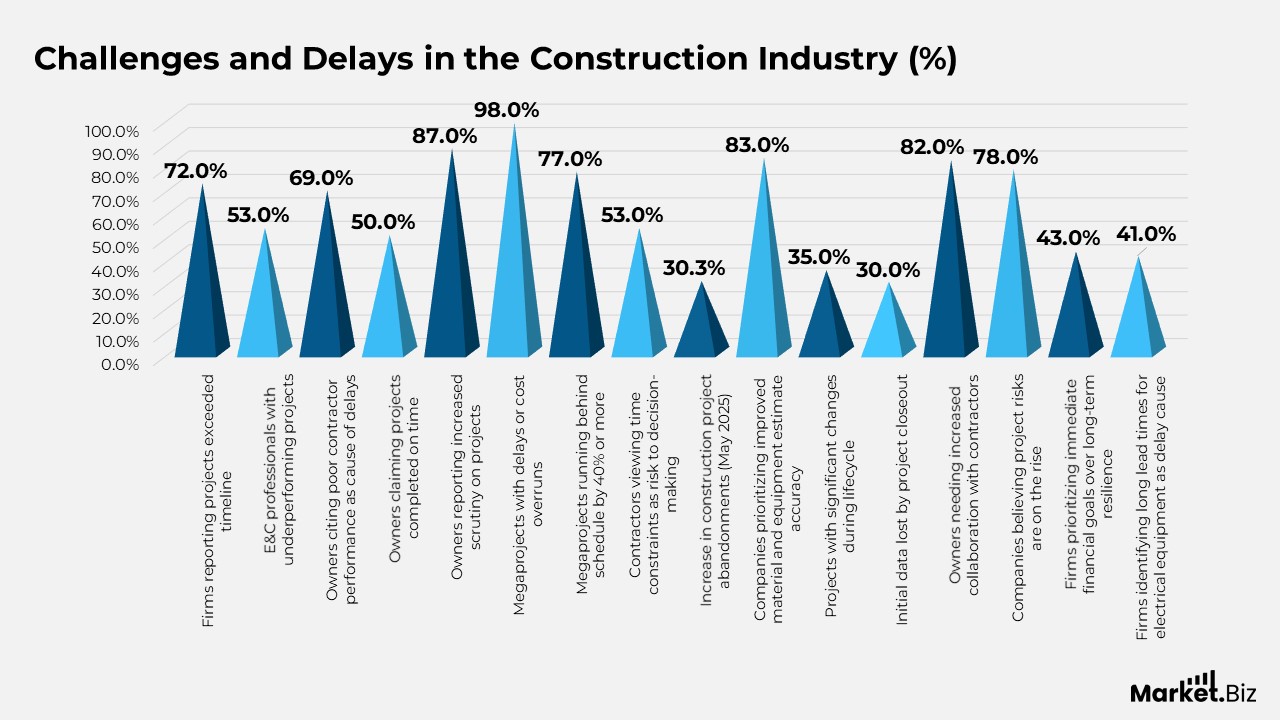
- 72% of firms report that their projects have exceeded the expected timeline.
- Construction profit growth is projected to slow down from 14.2% in FY23 to an average of 4.4% over the next five years.
- More than 50% of engineering and construction professionals experienced at least one underperforming project last year.
- 69% of project owners cite poor contractor performance as the leading cause of project delays.
- Only 50% of owners claim that their projects are completed within the scheduled timeframe.
- 87% of owners report that their projects are facing increased scrutiny.
- Large projects typically take 20% longer to complete than planned and may exceed the budget by as much as 80%.
- 98% of megaprojects experience delays or cost overruns.
- 77% of megaprojects worldwide are running behind schedule by 40% or more.
- 53% of contractors in the U.S. view time constraints and urgent decision-making as the greatest risk to effective decision-making.
- A 30.3% increase in complete construction project rejections was reported in May 2025.
Moreover
- 83% of construction companies consider improving the accuracy of material and equipment estimates their top priority to address market volatility and poor performance.
- On average, 35% of all construction projects will experience significant changes during the project lifecycle.
- Up to 30% of the initial data created during the design and construction phases is lost by project closeout.
- 82% of owners feel there is a need for increased collaboration with contractors.
- 78% of engineering and construction companies believe project risks are on the rise.
- 43% of construction firms prioritize immediate financial goals over long-term organizational resilience.
- The global average length of construction disputes in 2024 was 14.4 months, marking a 6% increase from the previous year.
- The global average cost of construction disputes in 2024 was $43 million.
- 41% of construction companies identify long lead times for electrical equipment like transformers and switchgear as a primary cause of project delays.
(Source: Autodesk Inc., AGC, Autodesk + Deloitte, KPMG, McKinsey Global Institute)
Construction Costs and Labor Challenges
- Construction input prices have risen at an annual rate of 9.7% through the first quarter of 2025.
- 81% of firms have increased base pay rates for their workers in the past year.
- Compensation costs for private construction workers have risen by 3.4% from 2024 to 2025.
- 50% of firms report that projects have been canceled, postponed, or scaled back due to rising costs.
- 52% of construction companies have delayed or canceled projects due to pricing instability and supply chain disruptions linked to tariffs.
- The most common challenges faced by construction firms are cost pressures, with 52% citing raw material costs and 37% mentioning labor costs.
- Since 2020, construction materials have experienced a 40% increase in average prices.
- The cost of construction equipment has risen by 30.5% in 2025 compared to pre-COVID prices in February 2020.
(Source: Autodesk Inc., ConstructionDive, AGC, BLS, Plant-Tours, Autodesk + Deloitte, Construction Equipment)
Construction Fabrics Market Size
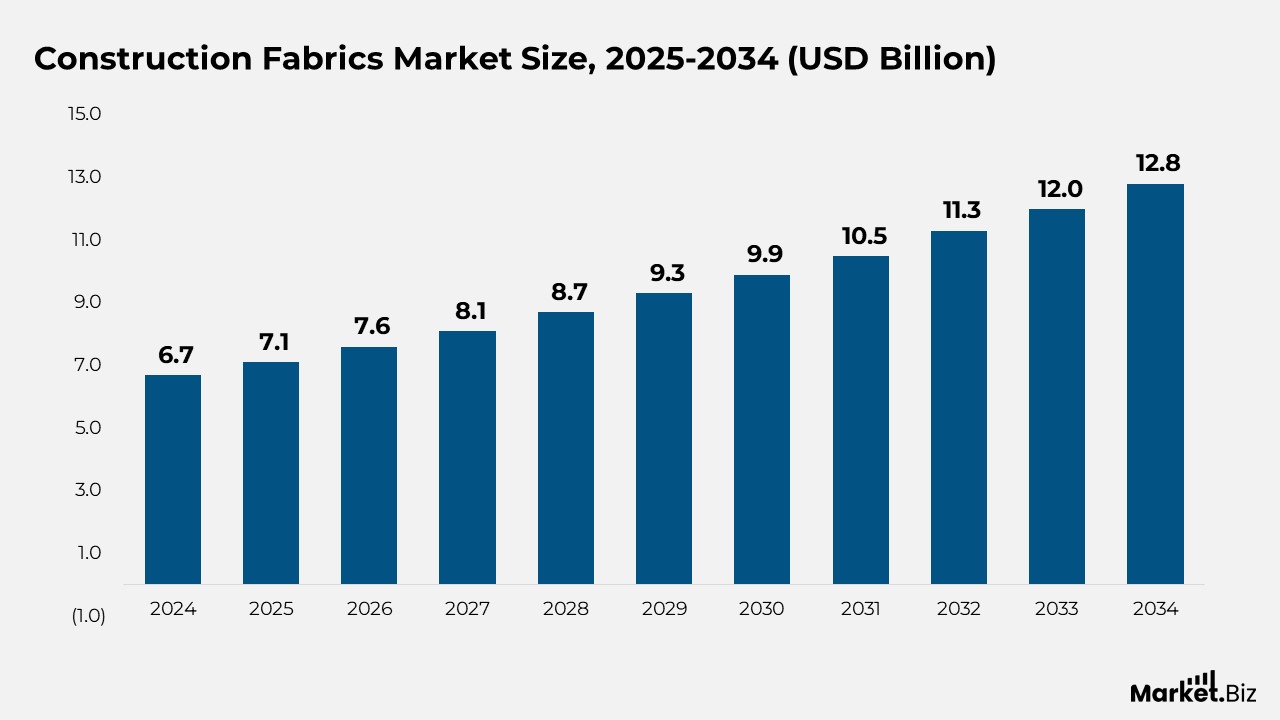
- According to Market.us, the construction fabrics market is expected to rise from $7.1 billion in 2025 to $12.8 billion by 2034, representing a compound annual growth rate (CAGR) of 6.7% from 2025 to 2034.
- The market’s growth is fueled by increasing infrastructural demands and government-backed initiatives.
- 57.2% of the construction fabrics market was dominated by Polyvinyl Chloride (PVC) in 2024, driven by its flexibility, weather resistance, and cost-efficiency.
- Tensile Architecture held 44.9% of the global construction fabrics market in 2024, reflecting the demand for lightweight, flexible, and visually appealing structures.
- Non-residential applications accounted for 71.4% of the market share in 2024, driven by the need for durable and energy-efficient materials in commercial and public buildings.
- The Asia Pacific (APAC) region led the global construction fabrics market with 45.8% of the total market share, valued at approximately USD 3.0 billion in 2024.
- India’s textile and apparel exports reached USD 44.4 billion in 2022, with a significant contribution from the construction fabrics segment.
(Source: Market.us)
Healthcare Construction Market Size
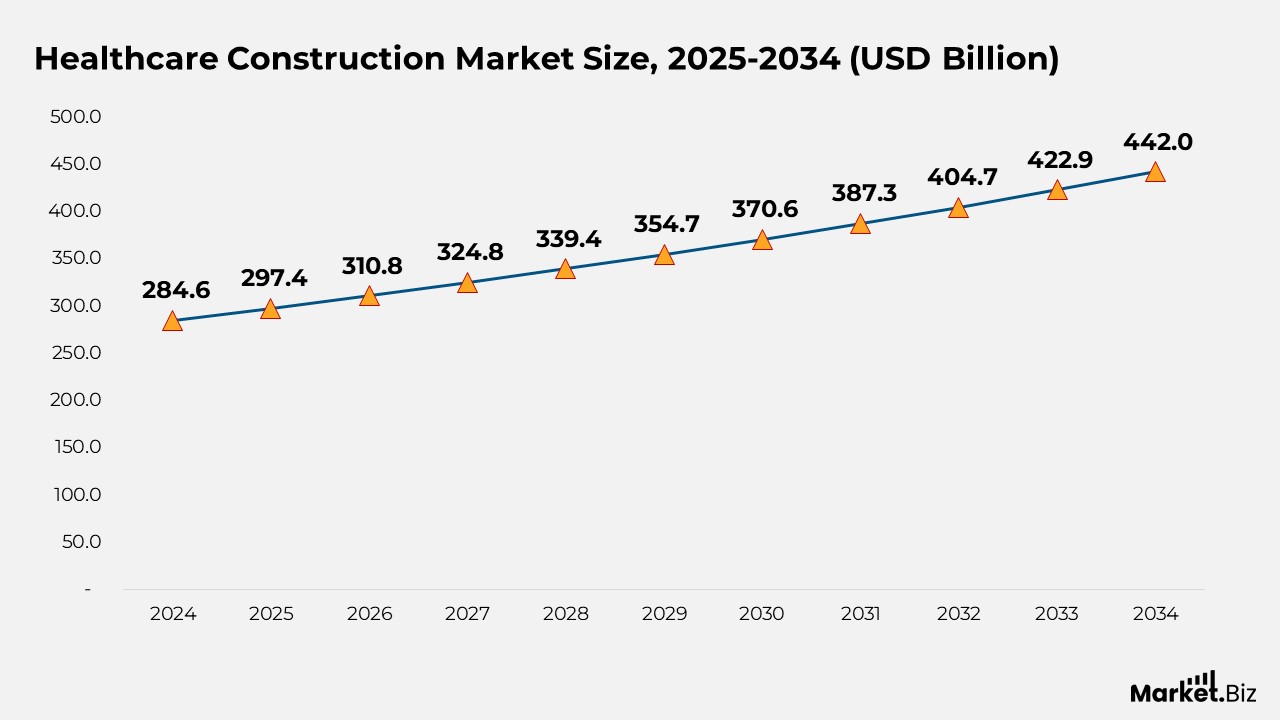
- According to Market.us, the healthcare construction fabrics market is expected to rise from $297.4 billion in 2025 to $442.0 billion by 2034, representing a compound annual growth rate (CAGR) of 4.5% from 2025 to 2034.
- Market growth is driven by rising healthcare expenditure, an aging global population, increasing chronic diseases, and medical technology advancements.
- Hospitals accounted for 52.0% of the healthcare construction market share in 2024, fueled by an aging population and technological progress.
- The New Construction segment held 63.5% of the market share in 2024, driven by the need for modern facilities to accommodate advanced medical technologies.
- The private sector represented 61.8% of the end-user market in 2024, with significant investments in healthcare construction projects like the Children’s Hospital of Philadelphia and Ohio State University’s Wexner Medical Center.
- North America led the market with a 36.2% share in 2024, driven by aging populations, technological advancements, and high demand for healthcare services, especially in New York.
(Source: Market.us)
Costs and Financial Pressures in the Construction Industry
- Construction input prices have surged by 9.7% annually through the first quarter of 2025.
- 81% of construction firms have increased base pay rates for their employees over the past year.
- Compensation costs for workers in the private construction sector have risen by 3.4% between 2024 and 2025.
- 50% of construction firms report that owners have canceled, postponed, or scaled back projects due to escalating costs.
- 52% of construction companies have delayed or canceled projects due to pricing instability and supply chain disruptions tied to tariffs.
- The primary challenges cited by construction businesses include cost pressures, with 52% pointing to rising raw material costs and 37% highlighting labor costs.
- Since 2020, the cost of construction materials has increased by an average of 40%.
- Construction equipment prices are 30.5% higher in 2025 compared to pre-COVID prices in February 2020.
(Source: Autodesk Inc., ConstructionDive, Construction Equipment, BLS, AGC, Plant-Tours, Autodesk + Deloitte)
Labor Shortage
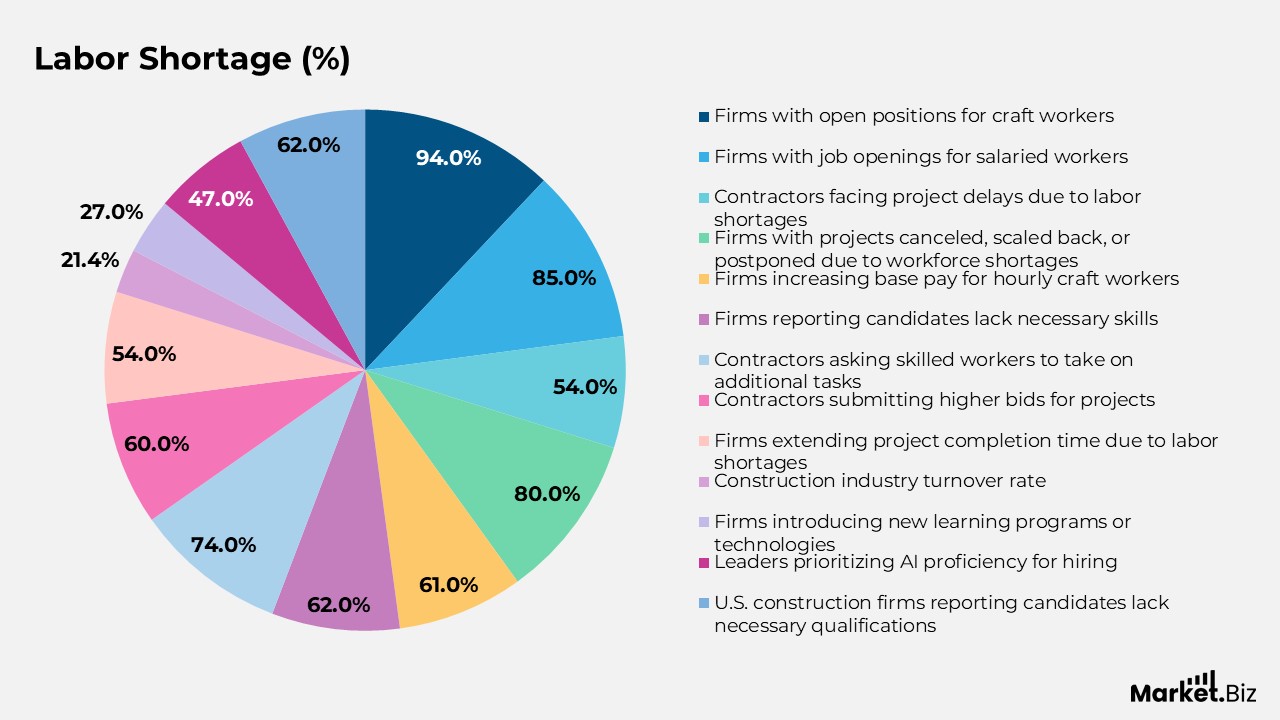
- 94% of construction firms report having open positions for craft workers.
- 85% of construction companies have job openings for salaried workers.
- 94% of firms with craft worker starts and 92% of those with salaried worker vacancies say these positions are difficult to fill.
- 54% of contractors have faced project delays due to shortages of both their own and subcontractor workers.
- 80% of construction firms have had at least one project scaled back, canceled, or postponed because of workforce shortages.
- 61% of construction firms have increased base pay for hourly craft workers compared to the previous year.
- 62% of companies report that available candidates lack the necessary skills to work in the industry.
- 74% of contractors have asked skilled workers to take on additional tasks due to the labor shortage.
- 60% of contractors are submitting higher bids for projects due to labor shortages.
- 54% of firms have had to extend the completion time for ongoing projects because of labor shortages.
- As of April 2025, there were 248,000 job openings in the construction industry.
- The construction industry faces a 21.4% turnover rate, one of the highest across all sectors.
- 27% of construction firms have introduced new learning programs or technologies to enhance training and skills development for their workforce.
- 47% of construction industry leaders say that proficiency in AI will be a critical hiring focus in the coming years.
- 62% of U.S. construction firms report that candidates lack the necessary qualifications for available positions.
(Source: Autodesk Inc., ConstructionDive, U.S. Chamber of Commerce, ABC, Construction Equipment, BLS, AGC, Plant-Tours, Autodesk + Deloitte)
Data Usage in the Construction Industry
- By 2025, global data volume is expected to reach 175 zettabytes (175 billion terabytes), marking a five-fold increase since 2018.
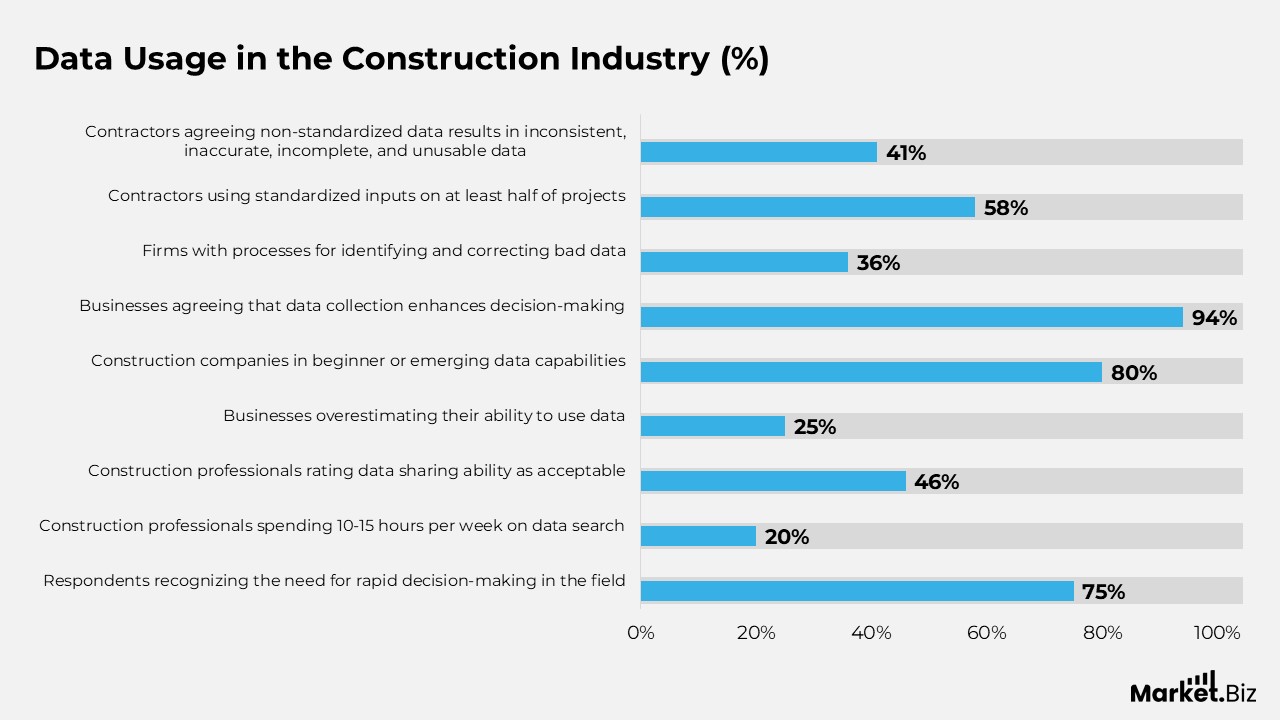
- 75% of respondents recognize the growing need for rapid decision-making in the field.
- 20% of construction professionals report spending 10-15 hours per week searching for the data necessary for their roles, resulting in significant time lost on data management.
- Digital leaders in the construction industry save two hours per week on data management tasks, freeing up 5% more time for higher-value work.
- 46% of construction professionals rate their company’s ability to share data as acceptable.
- 97% of businesses recognize at least one benefit from improved data usage, with cost reductions being the most common benefit, cited by 33% of companies.
- 25% of businesses overestimate their ability to use data when self-assessing effectively.
- 80% of construction companies fall into the beginner or emerging levels of data capabilities.
- Construction businesses with advanced data capabilities could see a 2.7 percentage point increase in expected profit growth, representing a 50% improvement in average annual profit growth, from 4.4% to 7.1%.
- 94% of construction businesses agree that data collection and analysis have enhanced decision-making.
- Construction data leaders are significantly more likely to use wearables (4X), IoT (9X more likely), mobile apps (4X), and AI/ML (7X more likely).
- Only one-third of construction companies receive daily insights from at least one data source.
- 36% of firms have established a process for identifying and correcting bad data.
- Poor data is responsible for 14% of all construction rework, costing the industry $88.69 billion globally in avoidable rework.
- 58% of contractors use standardized inputs on at least half of their projects.
- 41% of contractors agree that non-standardized data inputs result in inconsistent, inaccurate, incomplete, and unusable data.
(Source: Autodesk Inc., Autodesk + Deloitte)
Women in Construction Statistics
- 13% of all construction companies are now women-owned, reflecting a 94% increase since 2007, showcasing the significant growth in women’s participation in the industry.
- Despite this growth, women made up only 10.8% of the U.S. construction workforce in 2023, a slight decrease of 0.1% from the previous year, when it was 10.9%.
- Breakdown of women’s roles in construction in the U.S.:
- 36.10% in Sales and Office positions
- 36.10% in Management roles
- 24.60% in Construction and Maintenance
- 2% in Transportation
- 1.20% in Service roles
- In India’s real estate and construction sector, which employs 57 million workers, 50 million are men and just 7 million are women.
- According to a 2021-22 analysis by CIPD, the construction industry had the highest gender pay gap of any sector, at 23.7%.
- In Q1 of 2024, the proportion of women in the U.S. construction workforce dropped to 13.6%, the lowest since the COVID pandemic, with the last time it was under 14% occurring in the final quarter of 2020.
- Despite these challenges, 80% of women in construction report enjoying their work, and 76% believe the role of women in the industry is improving, up from 70% the previous year.
- Unmarried mothers are more likely to participate in the workforce than married mothers, with 77.7% of unmarried mothers employed in March 2020, compared to 70.4% of married mothers.
(Source: Statista, Connected World, Desapex LLP, EMAP Publishing Limited, Redefined Ltd)
Technological Advancements in the Construction Industry
- A poll conducted after the November 2020 U.S. elections revealed that 76% of executives in the engineering and construction (E&C) sector planned to invest in at least one digital technology in 2021.
- 76% of E&C decision-makers are allocating more resources towards connected technologies to address challenges related to cost control and profit margins.
- A 2018 survey found that 18% of small and medium-sized construction companies were utilizing drones, with 8% planning to adopt drone technology by 2020.
- 24% of E&C leaders are investing in drones and robotics to improve efficiency on construction sites.
- Only 16% of small and medium-sized construction firms are using autonomous equipment, with an additional 8% planning to implement it by 2020.
- Although augmented reality (AR) has the potential to improve collaboration and 3D modeling, only 6% of construction companies are using AR/VR due to the high costs associated with adoption.
- In 2018, only 2 out of 5 industry professionals planned to purchase or upgrade construction management software within the following year.
Moreover
- The most sought-after features in construction management platforms are project tracking (73%), job costing (72%), project estimating (66%), improved accuracy (47%), and process standardization/automation (39%).
- Trials involving autonomous vehicles combined with human-operated excavators have resulted in a 40% increase in efficiency compared to traditional methods.
- Over the last decade, $10 billion has been invested in advancing construction technology.
- The rise of telehealth and wearable health technologies may reduce the need for traditional healthcare facilities, which saw a modest 1% increase in construction spending to $42 billion in 2018.
- 26% of E&C executives are increasing their use of prefabrication and modular construction materials.
- Module assembly yards have proven to be cost-effective, reducing expenses by 6% to 30%.
- E&C leaders are focusing on digital supply networks to address the challenge faced by 54% of contractors: the lack of at least one essential construction component.
(Source: Deloitte, SoftwareConnect, The B1M, FMI, Autodesk, FinancesOnline)
AI in the Construction Industry
- 97% of construction businesses recognize the benefits of greater data usage, with cost reduction being the most frequently cited advantage.
- 57% of construction companies consider themselves digital leaders, while 35% identify as emerging, and 25% as beginners.
- Digital leaders in construction are twice as likely to rate their data-sharing capabilities as strong compared to beginners, with 38% of digital leaders rating it as strong versus 15% of beginners.
- 70% of contractors believe that advanced technologies can improve schedules (75%), enhance productivity (78%), and boost safety (79%).
- 75% of construction companies in Singapore and 61% in Australia view technology as essential for quality and safety management.
- 44% of construction firms have faith that AI and robotics will positively impact costs by automating manual and error-prone tasks.
- 41% of firms see AI and robotics improving the quality of jobs, making workers safer, and increasing productivity.
- 40% of construction companies have adopted AI, although many are still in the early stages.
- 52% of companies prioritize the needs of field staff when investing in new technology.
- However, only 28% of companies gather feedback from field staff before investing in technology.
- 60% of general contractors and trades value the use of software to manage safety and inspections during construction as a critical process improvement.
- AI has the potential to increase profits in the construction industry by 71% by 2035.
- The AI market in construction is projected to reach $13.5 billion by 2030.
- Only 6% of architects are using AI regularly.
- 61% of firms report that BIM processes have reduced project errors.
- 55% of firms report that BIM has shortened the time required for communication.
- 82% of BIM users report a positive return on investment.
- 32% of owners and contractors are using internally developed tools.
(Source: Autodesk, KPMG, USG, Dodge Data & Analytics, Accenture, Adroit)
Conclusion
The construction industry remains a key driver of global economic growth, fueled by urbanization, increasing infrastructure needs, and technological advancements. Spanning from residential properties to large-scale public projects, the sector’s development is influenced by factors such as economic conditions, regulatory changes, and evolving consumer preferences.
Key statistics demonstrate the dominance of materials like PVC, the rise of tensile architecture, and the growing significance of non-residential construction. Furthermore, the leadership of the Asia Pacific region and the steady growth of India’s textile exports highlight the growing impact of construction fabrics in the industry.
As the sector continues to evolve, stakeholders must remain vigilant to these trends and utilize data to guide strategic decisions, fostering sustainable and innovative growth in an ever-changing market.
FAQ’s
The construction industry covers the planning, design, and development of infrastructure and buildings, including residential, commercial, and industrial projects. It spans a wide range of activities, from new construction to renovation, maintenance, and repairs.
The growth of the construction industry is driven by urbanization, the growing need for infrastructure, technological advancements, population growth, government funding for public works, and the increasing demand for residential and commercial spaces.
Key materials in construction include concrete, steel, wood, glass, and synthetic materials such as PVC. The choice of materials depends on factors such as durability, cost, aesthetics, and environmental impact.
Technology is transforming the construction industry with innovations like Building Information Modeling (BIM), automation, 3D printing, drones, and smart materials, all of which enhance project planning, efficiency, safety, and sustainability.
Current trends in construction include the adoption of sustainable building practices, the rise of green construction, the use of advanced materials (like smart fabrics), the shift toward modular and prefabricated construction, and the increasing use of digital technologies such as software automation.