









Introduction
DeepFake AI Statistics: DeepFake technology, fueled by cutting-edge Artificial Intelligence (AI), has quickly gained attention for its ability to create highly convincing alterations in audio and visual content. Through the use of deep learning algorithms, DeepFakes can modify videos, images, and voice recordings to make them appear as though individuals are saying or doing things they never actually did.
Initially developed for entertainment and creative applications, this technology has raised significant ethical issues, particularly in the realms of misinformation, privacy violations, and political manipulation. As DeepFake technology becomes more accessible, detecting these manipulations is becoming increasingly difficult, leading to growing concerns about trust in digital media.
In light of these challenges, it is crucial to understand the statistics and trends related to DeepFake AI to better address its implications across various sectors, including social media, law enforcement, and cybersecurity…
Editor’s Choice
- 60% of consumers reported encountering a deepfake video in the past year.
- Only 15% of consumers claim to have never come across a deepfake video.
- The average accuracy for humans in detecting deepfake images is 62%.
- Human subjects correctly identified high-quality deepfake videos just 24.5% of the time.
- Fraudsters are increasingly leveraging AI-powered deepfakes for scams, with a staggering 3,000% increase in fraud cases in 2023. The widespread availability of generative AI tools has made it easier for criminals to produce convincing fake content.
- In 2024, businesses lost nearly $500,000 on average due to deepfake-related fraud, with larger companies experiencing losses of up to $680,000.
- The number of deepfake videos surged by 550% from 2019 to 2024, totaling 95,820 videos.
General Deepfake AI Statistics
- In 2023, the number of deepfake videos reached 95,820, a staggering 550% increase since 2019.
- The number of deepfake videos online roughly doubles every six months, with a rise from 49,081 in June 2020 to 85,047 in December 2020.
- Malicious entities have escalated their use of deepfakes to bypass verification checks, with attempts increasing by 3,000% in 2024.
- From 2018 to 2019, deepfake videos surged by 100%, reaching 14,678.
- Compared to 2022, there were three times as many video deepfakes and eight times as many voice-based deepfakes in 2023.
- In 2023, social media users shared approximately 500,000 deep faked videos and voice recordings, many involving political figures, impacting global politics.
- The detection of deepfakes worldwide surged tenfold from 2022 to 2023, with increases of 1,740% in North America, 1,530% in Asia Pacific, 780% in Europe, 450% in Africa and the Middle East, and 410% in Latin America.
- Human detectors have only 57% accuracy in detecting deepfakes, much lower than the 84% accuracy of leading detection models.
- The process of creating a deepfake photo or video can be completed in as little as 8 minutes.
- Face swaps are among the most common deepfake types, seeing a 704% increase from the first half to the latter half of 2023.
(Source: Security Hero, Sensity, Onfido, Regmedia, Reuters, Sumsub, PNAS, NPR, Tripwire)
Threat of Deepfake Scams Statistics
- Deepfakes and other AI-driven fraudulent activities are among the most common forms of identity theft.
- Email remains the primary method for delivering deepfake phishing attacks.
- In 2024, approximately 26% of people encountered a deepfake scam online, with 9% falling victim to it.
- Surprisingly, 80% of Telegram channels feature deepfake content.
- The rise of generative AI and deepfakes underscores the importance of facial recognition in identity verification.
- A significant portion of deepfake attack victims (77%) lost money due to these scams.
- A 3rd of deepfake victims lost more than USD 1,000, while 7% experienced losses of up to USD 15,000 due to fraud.
(Source: Sumsub, Broadcom, McAfee, Human or AI, Jumio, Spiralytics)
Pornography and Deepfakes
- Deepfake creators can produce a one-minute pornographic video of anyone in under 25 minutes with just one clear image and no cost involved.
- It is no surprise that 96% of pornographic deepfakes online are non-consensual.
- The majority (98%) of online deepfakes are not political or entertainment-related, but are pornographic.
- Most deepfake cases (87.7%) occur in the crypto sector, online gaming (1.6%) and with fintech (7.7%) following far behind.
- Nearly all (94%) individuals featured in pornographic deepfakes are from the entertainment industry, including celebrities and influencers.
- About one-third of deepfake tools available allow users to create pornographic content.
- Nearly all (99%) of pornographic deepfake targets are women.
(Source: Security Hero, Deeptrace, Sumsub, Spiralytics)
Deepfake Detection Market Size
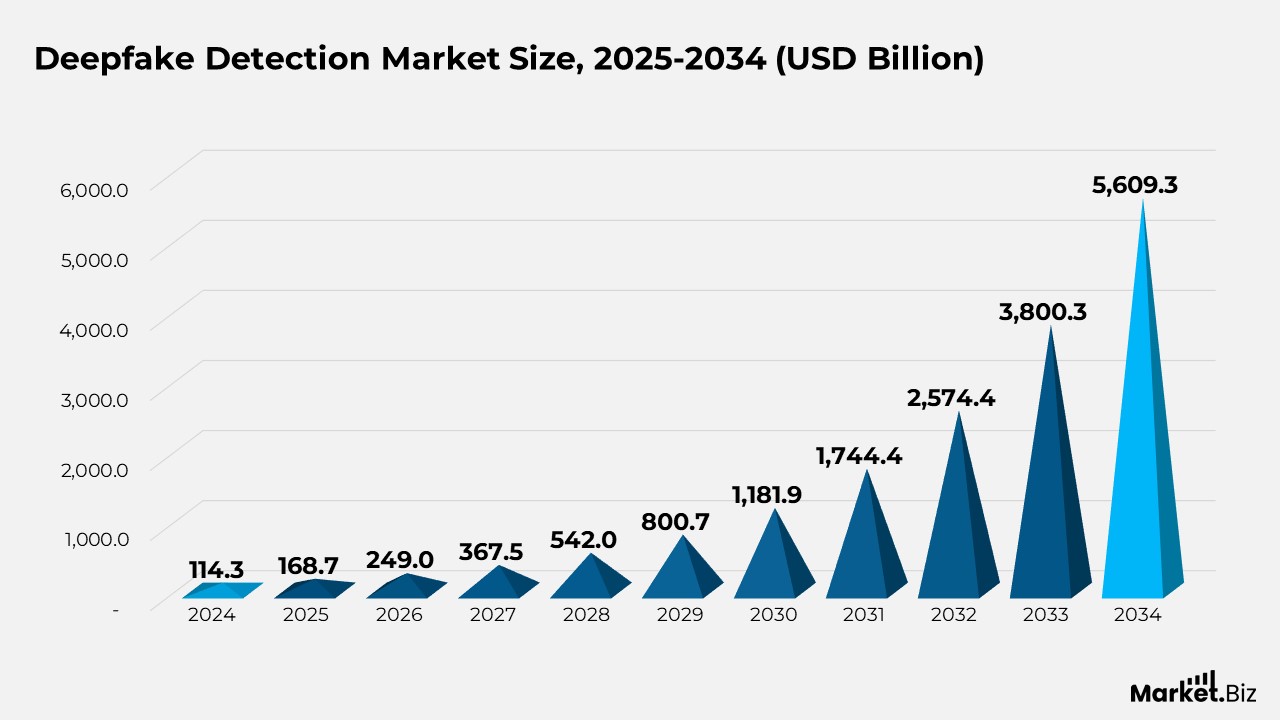
- According to Market.us, the deepfake detection market is expected to rise from $168.7 million in 2025 to $5,609.3 million by 2034, representing a compound annual growth rate (CAGR) of 47.6% from 2025 to 2034.
- The deepfake detection market is experiencing growth due to the rising demand for authenticity verification, increased regulatory pressures, enhanced cybersecurity measures, and the escalating issues surrounding digital misinformation, alongside the growing sophistication of deepfake technology.
- In 2024, the Video & Image Deepfake Detection segment led the market, capturing more than 66.7% of the share, primarily due to the extensive use of visual content across platforms like social media, news outlets, and advertising, all of which require strong content verification systems.
- The Cloud-based segment took the lead in the deepfake detection market in 2024, holding more than 61.8% of the market share, driven by the scalability and flexibility offered by cloud solutions, enabling organizations to access detection tools rapidly without significant infrastructure costs.
Moreover
- In 2024, the Media and Entertainment segment dominated the market, securing over 49.2% of the deepfake detection market, as media companies and content creators strive to protect the authenticity of their visual content to safeguard their reputations and counter misinformation.
- North America held a significant portion of the Deepfake Detection Market in 2024, with more than 42.6% of the market share, generating USD 48.6 million in revenue. This leadership is supported by the region’s advanced technological infrastructure, high concentration of tech firms, and the presence of major social media and digital content platforms.
- The US Deepfake Detection Market was valued at USD 44.79 million in 2024, with projections for rapid growth at a 45.7% CAGR, as the demand for deepfake detection technologies increases alongside the growing prevalence of digital content manipulation across various industries.
- The growing adoption of AI and machine learning plays a crucial role in advancing deepfake detection technologies, allowing for more accurate and efficient identification of manipulated content.
- Deepfake fraud saw a more than 10-fold increase globally from 2022 to 2023, with the crypto sector accounting for 88% of cases, highlighting the increasing use of deepfakes in financial scams and the need for enhanced detection capabilities in high-risk sectors like fintech.
(Source: Market.us)
DeepFake AI Market Size
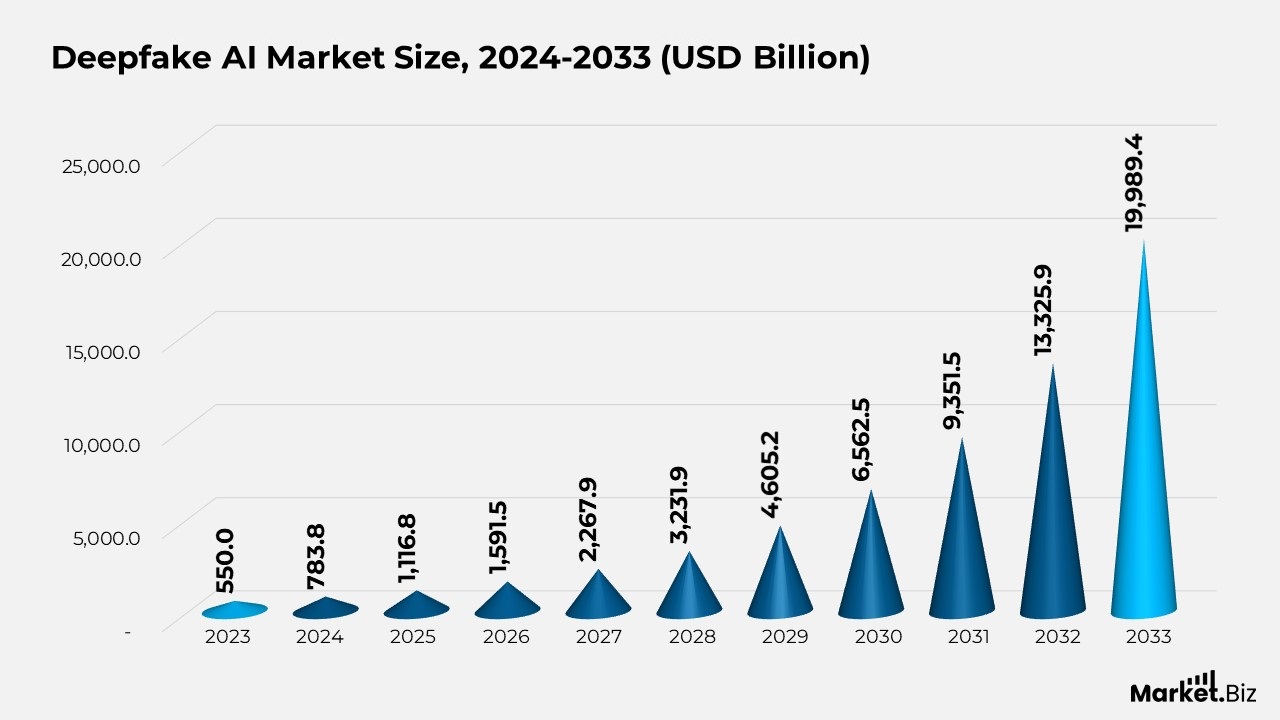
- According to Market.us, the Deepfake AI market is expected to rise from $783.8 million in 2024 to $19,989.4 billion by 2033, representing a compound annual growth rate (CAGR) of 42.5% from 2024 to 2033.
- The growth of the deepfake AI market is driven by advancements in AI and machine learning, which make it easier to create realistic fake content, and the growing demand for digital content in the entertainment industry.
- In 2023, the Software segment dominated the deepfake AI market, holding more than 67.5% of the market share, driven by widespread adoption across industries like media, entertainment, and advertising.
- In 2023, the Generative Adversarial Networks (GANs) segment led the deepfake AI market, capturing more than 27.4% of the market share, due to the critical role GANs play in generating high-quality, realistic deepfake content.
- In 2023, the Media & Entertainment segment secured a dominant position in the deepfake AI market, holding more than 34.5% of the market share, largely due to the extensive use of deepfake technology in creating engaging content for film, television, and gaming industries.
- In 2023, North America led the deepfake AI market, capturing more than 38.5% of the market share and generating USD 211.7 million in revenue, supported by advanced technological infrastructure and substantial investments in AI and machine learning.
(Source: Market.us)
How Effective Are We at Detecting Deepfakes?
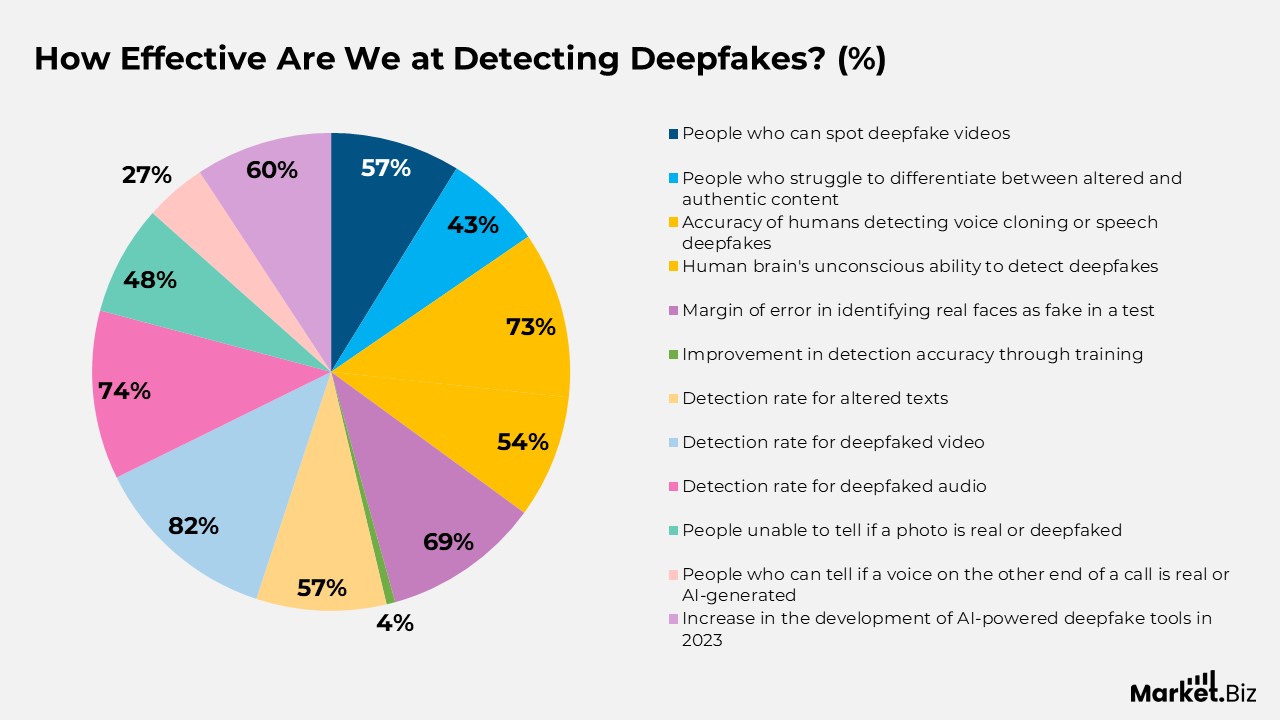
- 57% of people can spot deepfake videos, while 43% struggle to differentiate between altered and authentic content.
- Humans can only detect voice cloning or speech deepfakes 73% of the time.
- The human brain can unconsciously detect deepfakes 54% of the time.
- Humans show a significant margin of error, with respondents identifying 69% of real faces as fake in a test.
- In a study testing 280 participants’ ability to detect deepfakes, the average accuracy was 62%, with individual results ranging from 30% to 85%.
- Training improves deepfake detection accuracy by only 3.84% on average.
- Detecting altered texts is challenging, with only a 57% detection rate, while deepfaked video (82%) and audio (74%) are easier to identify.
- Nearly 48.2% of people cannot tell if a photo of a person is real or deepfaked, which is slightly below a 50-50 random guess.
- The same study found that people rated deepfaked faces 7.7% more trustworthy than real faces.
- Only 27% of people can tell if someone on the other end of a call is a real person or an AI-generated voice.
- The development of AI-powered deepfake tools increased by 60% in 2023.
(Source: Statista, PLOS, Analytics Insight, ScienceDirect, Oxford Academic, Cornell University, PNAS, McAfee, Human or AI, Liminal)
Deepfake Attacks
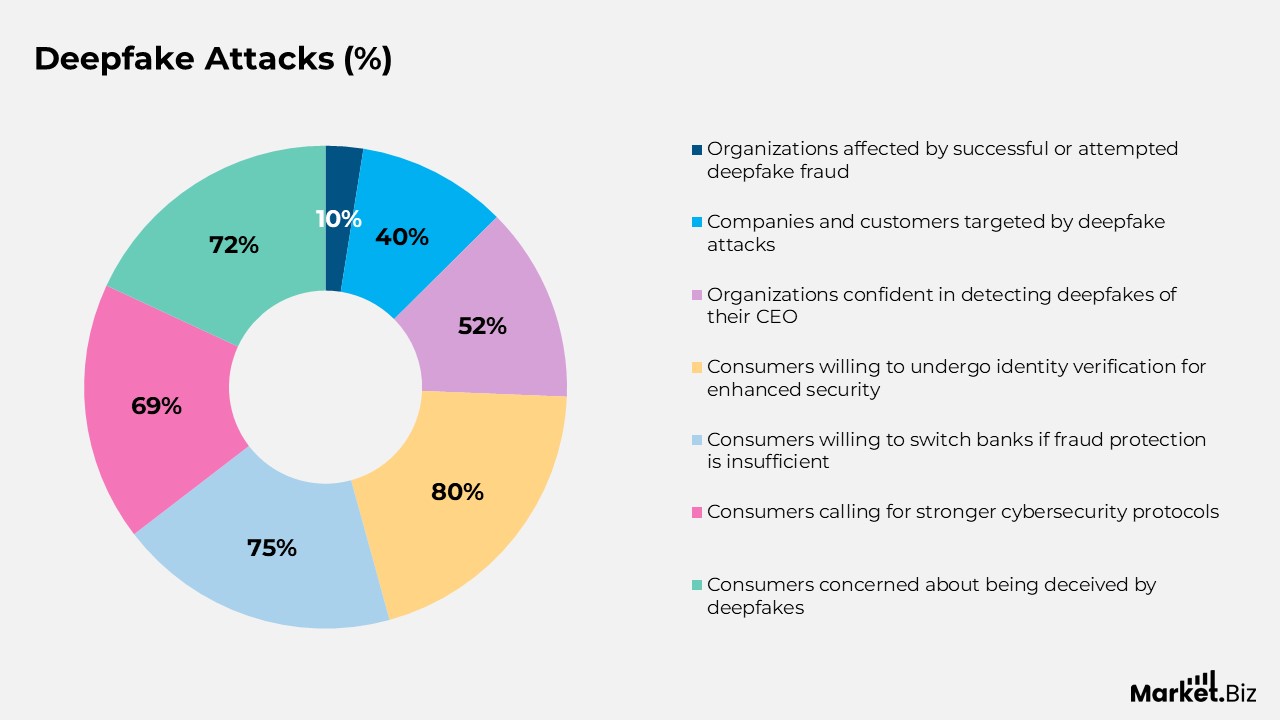
- Over 10% of organizations have fallen victim to successful or attempted deepfake fraud, mainly due to outdated cybersecurity protocols.
- New research reveals that nearly 40% of both companies and their customers have been targeted by deepfake attacks.
- Despite the prevalence of deepfake attacks targeting corporations, only 52% of organizations feel confident in their ability to detect deepfakes of their CEO.
- Around 80% of consumers are willing to undergo extensive identity verification procedures when using financial services if it enhances security.
- Additionally, 75% of consumers would switch banks if the bank’s fraud protection measures were insufficient to prevent deepfake attacks.
- With the increasing threat of deepfake attacks and other cybersecurity risks, 69% of consumers are calling for stronger cybersecurity protocols.
- The majority of consumers (72%) are constantly concerned about being deceived by deepfakes.
(Source: Statista, PLOS, Analytics Insight, ScienceDirect, Oxford Academic, Cornell University, PNAS, McAfee, Human or AI, Liminal)
The Social Implications of Deepfakes
- People are becoming increasingly suspicious of deepfakes, thanks to global efforts aimed at raising awareness about the technology.
- 77% of Americans believe there should be more regulations and restrictions to prevent misleading deepfakes.
- Around 61% of US adults feel that the average American cannot recognize altered photos and videos.
- 32% of adults have become more distrustful of social media due to deepfakes.
- Deepfakes have a minimal impact on people’s memories, although the effect is still notable.
- 63% of Americans report that altered videos and photos confuse them about the facts surrounding current events.
- Nearly 43% of surveyed individuals view the influence of deepfakes on elections as the most concerning use of the technology, while 37% believe it undermines trust in media.
- 23% of Americans admitted to encountering a political deepfake that they later discovered was fake.
(Source: PLOS, Pew Research, McAfee)
How Business Leaders View the Risks of Deepfakes?
- Despite many companies falling victim to deepfake threats, 31% of business executives remain confident that deepfakes haven’t increased their fraud risk.
- 37% of executives believe deepfakes do not pose a risk to their businesses, mainly because they feel their companies are too small to be targets and their cybersecurity measures are sufficient.
- 32% of business leaders lack confidence in their staff’s ability to recognize deepfake fraud attempts targeting their companies.
- Over 50% of executives state that their employees have insufficient training to identify and respond to deepfake attacks.
- Approximately 25% of company leaders are either minimally or completely unfamiliar with deepfake technology.
- 80% of companies lack adequate protocols to handle and defend against deepfake attacks, leaving them vulnerable.
- 61% of executives have not established any protocols or processes to manage deepfake risks within their organizations.
- Only 13% of companies have sufficient protocols to defend against fraud, impersonation, and other types of attacks.
- Nearly 45% of surveyed individuals would respond to a message claiming to be from a friend or loved one, regardless of its authenticity.
- Over 90% of deepfaked YouTube videos feature Western subjects.
(Source: Business.com, McAfee, Deeptrace)
Conclusion
DeepFake AI technology holds immense promise for the creative industries, but its swift advancement and growing availability pose considerable challenges. The ethical issues related to misinformation, privacy breaches, and political manipulation are critical concerns, as they undermine the credibility of digital media.
As this technology becomes more refined and harder to detect, governments, technology companies, and society must work together in developing strategies to minimize its harmful effects. Gaining a deeper understanding of the emerging trends and statistics surrounding DeepFake AI will be key to managing its complexities and ensuring its responsible use.
FAQ’s
DeepFake AI involves the use of sophisticated artificial intelligence and deep learning techniques to create hyper-realistic audio and visual alterations. This technology enables the modification of videos, images, and voice recordings, making it appear as though individuals are saying or doing things they never actually did.
DeepFake AI operates by training deep learning models, usually powered by neural networks, to analyze and replicate patterns found in real-world data. These models are trained on extensive video, audio, and image data, enabling them to generate convincing synthetic content that mirrors the characteristics of the original material.
Originally developed for creative and entertainment purposes, DeepFake technology has expanded to industries such as filmmaking, advertising, gaming, and social media. However, it has also found malicious uses, including spreading misinformation, cyberbullying, and political manipulation.
Key ethical concerns surrounding DeepFake AI include the spread of false information, invasion of privacy, and political manipulation. DeepFakes can be used to create misleading narratives, impersonate people, or distort events, all of which undermine trust in digital media.
Although DeepFakes are becoming more advanced and difficult to detect, there are ongoing efforts to develop technologies and tools for identifying them. However, as AI continues to evolve, detecting DeepFakes remains a complex challenge.
The risks associated with DeepFake technology include the propagation of fake news, cybercrime, defamation, and the overall erosion of trust in digital media. Politically, DeepFakes can be used to manipulate public opinion, interfere with elections, and damage reputations.