








Introduction
Facial Recognition Statistics: Recent advancements in facial recognition technology have been driven by significant progress in artificial intelligence (AI) and machine learning. As one of the most prominent biometric technologies, facial recognition is now widely used in sectors such as security, healthcare, finance, and retail.
Its applications span from enhancing public safety to offering more personalized customer experiences. As the technology becomes more accurate and accessible, it is increasingly embedded into daily life, from unlocking personal devices to identifying individuals in public environments.
However, the broad adoption of facial recognition has raised important concerns regarding privacy, data security, and ethical issues. Despite these challenges, the growing demand for facial recognition solutions ensures its continued prominence in future developments across various industries.
Editor’s Choice
- The likelihood of someone unlocking your iPhone or iPad with Face ID is less than 1 in a million.
- Over 176 million Americans use facial recognition technology, with 131 million using it daily.
- Facial recognition technology boasts an accuracy rate of at least 99.5%.
- As of 2023, Customs and Border Protection (CBP) has utilized biometric facial comparison to process over 300 million travellers, successfully preventing over 1,800 impostors from entering the U.S.
- In the U.S., 86% of adults are familiar with facial recognition technology, and 68% believe it enhances public safety.
- 70% of police forces globally have access to some form of facial recognition technology.
- 30% of U.S. adults approve of companies using facial recognition for monitoring employee attendance.
- It is expected that by 2025, nearly 90% of new vehicles will be equipped with facial recognition for enhanced security and user personalization.
- In 2023, 46% of passengers at airports utilized biometrics, including facial recognition, an increase from 34% in 2022.
- The Metropolitan Police in London ramped up facial recognition deployment, using it 117 times between January and August 2024, leading to over 360 arrests, including 30 sex offenders.
- 52% of consumers express privacy concerns, which deters them from using facial recognition technology.
- By 2025, nearly 90% of new cars are expected to incorporate facial recognition technology for improved security and personalization.
- In China, approximately 200 million surveillance cameras use facial recognition for public safety monitoring.
General Facial Recognition Statistics
- The accuracy of facial recognition technology is reported to be at least 99.5%.
- Facial recognition has been used to verify the identities of over 300 million travellers, leading to the detection of 1,800 individuals attempting to enter the U.S. with false identities.
- In gyms, 12% of individuals aged 18-34, 6% of those aged 35-54, and 1% of people aged 55+ utilize facial recognition technology on shared equipment.
- Around 15% of people aged 18-34 use facial recognition for work-related tasks such as clocking in, compared to 9% of individuals aged 35-54 and just 3% of those over 55.
- Approximately 80% of Americans are aware of the use of facial recognition technology by law enforcement.
- Between January and August 2024, London’s Metropolitan Police utilized live facial recognition 117 times, a significant increase from just 32 instances between 2020 and 2023.
- In the United States, 86% of adults are aware of facial recognition technology.
- About 42% of respondents feel comfortable with the idea of using facial recognition to enhance safety in homes and workplaces.
- 71% of retail business leaders consider facial recognition a vital tool for security purposes.
- Over 176 million Americans use facial recognition technology, with 131 million relying on it daily.
- China operates around 200 million surveillance cameras equipped with facial recognition to monitor and maintain public safety.
(Source: Kooc Media Ltd., Coolest-Gadgets)
Facial Recognition Market Size
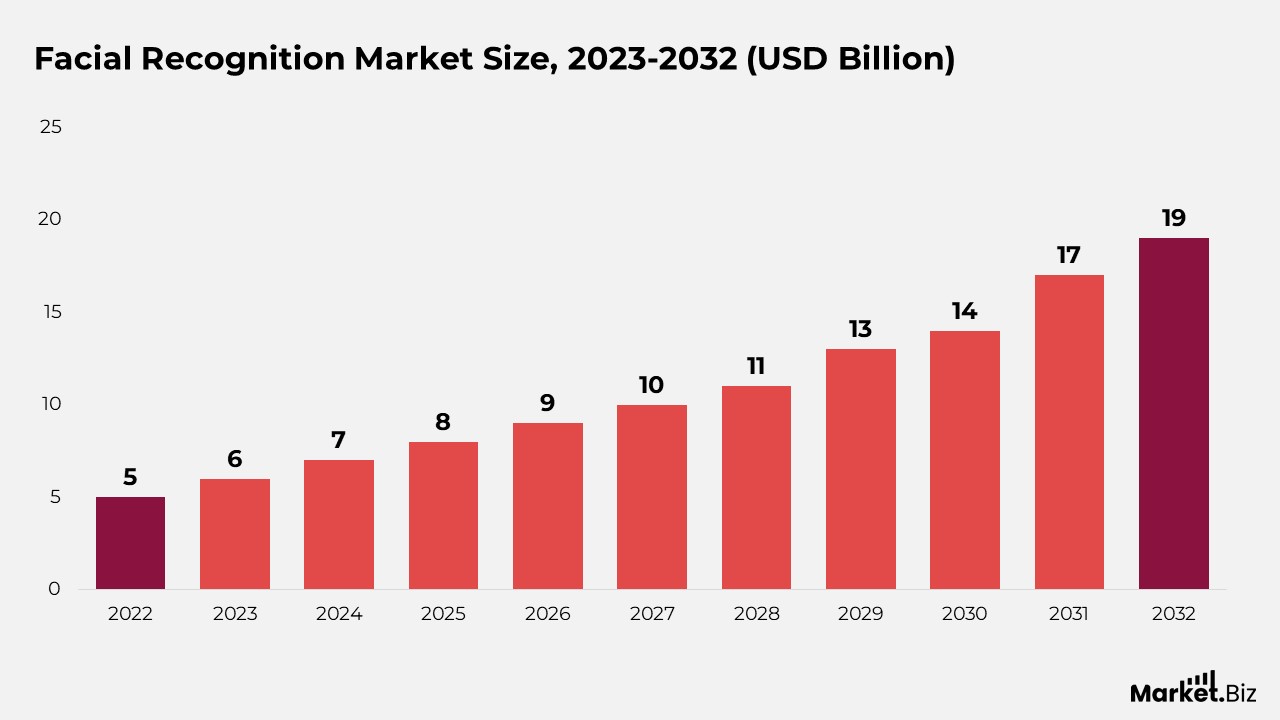
- According to Market.us, the facial recognition market is projected to grow from $6 billion in 2023 to 19 billion by 2032, representing a compound annual growth rate (CAGR) of 14.6% from 2023 to 2032.
- The growth of the facial recognition market is driven by increasing demand for security solutions and advancements in artificial intelligence.
- 36.8% of the facial recognition market was held by the 3D segment in 2022, due to its superior accuracy and reliability.
- 37.8% of the facial recognition market in 2022 was captured by the Access Control segment, driven by growing needs for enhanced security.
- The Retail & E-commerce segment held 27% of the market in 2022, largely due to the integration of facial recognition in personalized marketing and security.
- North America dominated the facial recognition market in 2022, capturing 37.8% of the market with a revenue of USD 1.8 billion.
- As of 2023, over 176 million Americans are using facial recognition technology, with 131 million engaging with it daily.
- About 80% of global governments use facial recognition technology, demonstrating its importance in public security and administrative efficiency.
- 70% of police forces worldwide use facial recognition technology, showcasing its widespread adoption in law enforcement and surveillance.
- Facial recognition technology is used in 40% of workplaces worldwide, enhancing security and employee management.
- Banking and financial institutions in 80% of countries employ facial recognition technology for security and customer verification.
- The transport sector has adopted facial recognition, with 20% of countries using it on public buses and 30% on trains and subways.
- During the COVID-19 pandemic, 40% of countries adopted facial recognition to monitor and reduce virus transmission.
- Experts predict a 45% growth in facial recognition usage, supported by its high accuracy.
(Source: Market.us)
Image Recognition Market Size
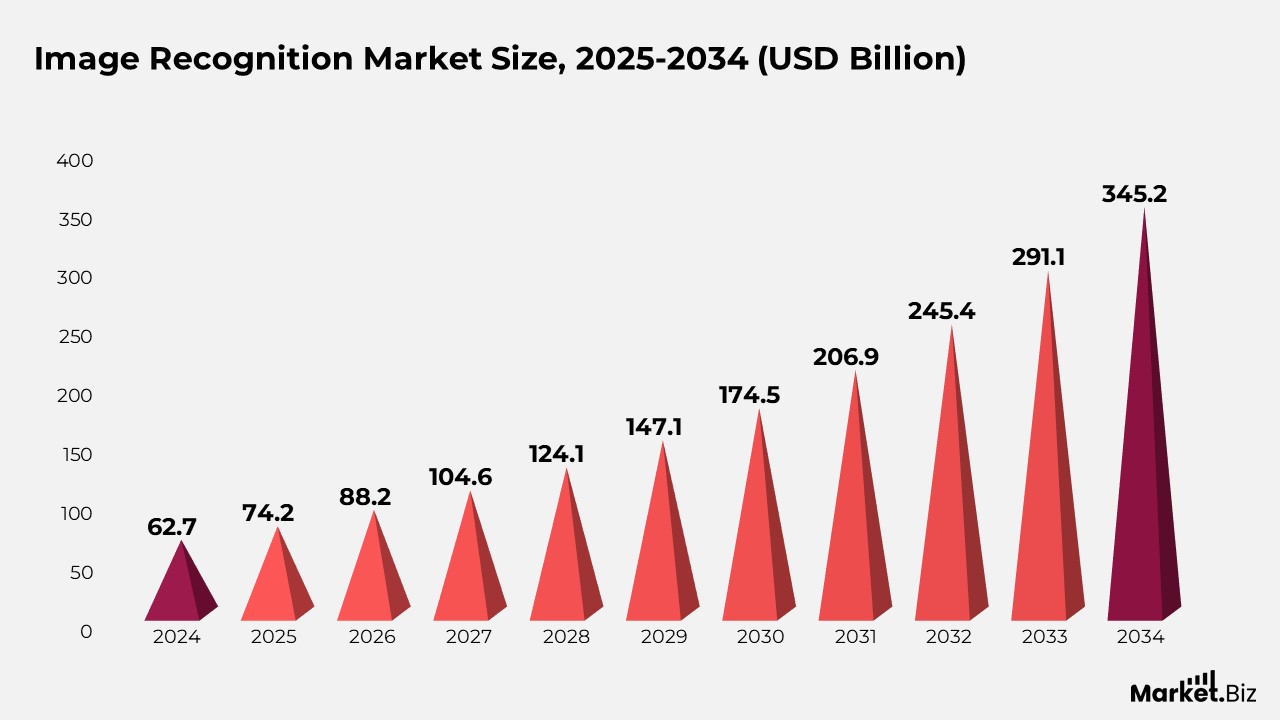
- According to Market.us, the global image recognition market is projected to grow from $74.2 billion in 2025 to $245.4 billion by 2032, representing a compound annual growth rate (CAGR) of 18.60% from 2025 to 2034.
- According to Market.us, the image recognition market is projected to grow from $74.2 billion in 2025 to $345.2 billion by 2034, representing a compound annual growth rate (CAGR) of 18.60% from 2025 to 2034.
- The image recognition market is driven by advancements in artificial intelligence (AI) and machine learning (ML), enabling industries like healthcare, retail, automotive, and security to improve efficiency, automate processes, and enhance user experiences.
- In 2024, the hardware segment captured 40.5% of the global image recognition market, driven by the demand for high-performance computing systems and advanced imaging devices.
- The Code Recognition segment held 28.8% of the market in 2024, largely due to the widespread use of QR codes, barcodes, and digital scanning solutions in industries like retail, logistics, healthcare, and manufacturing.
- The Scanning and Imaging segment accounted for 32.5% of the market in 2024, fueled by the increasing use of high-resolution imaging and scanning technologies in healthcare, manufacturing, retail, and security.
- In 2024, the on-premises segment held 66.7% of the market, driven by the growing need for data security, privacy, and real-time processing in industries such as healthcare, banking, government, and defence.
Moreover
- The Retail and E-commerce segment captured 25.2% of the market in 2024, spurred by the digital transformation in retail, with businesses using image recognition to enhance customer engagement and operational efficiency.
- North America dominated the image recognition market in 2024, capturing 35.2% of the market with USD 22.07 billion in revenue, thanks to the rapid adoption of advanced technologies.
- The United States accounted for USD 17.65 billion of the North American market, leading with a strong 17.2% CAGR, driven by investments in AI-driven image recognition across various industries.
- There are 2.5 billion smartphone users globally, with 80% using image recognition features.
- 1.2 billion social media users interact with image recognition technology daily.
- 75% of users interact with image recognition technology at least once a week.
- 40% of users use image recognition daily for tasks like facial recognition or visual search.
- A typical image recognition model is trained with 10 million images in its dataset.
- Training a complex AI model requires 100,000 hours of computational time.
- By 2025, the number of connected smart devices is expected to reach 40 billion, significantly increasing the volume of visual data processed by image recognition systems.
- 75% of these connected devices are projected to use some form of image recognition.
(Source: Market.us)
Facial Recognition in Law, Security and Enforcement
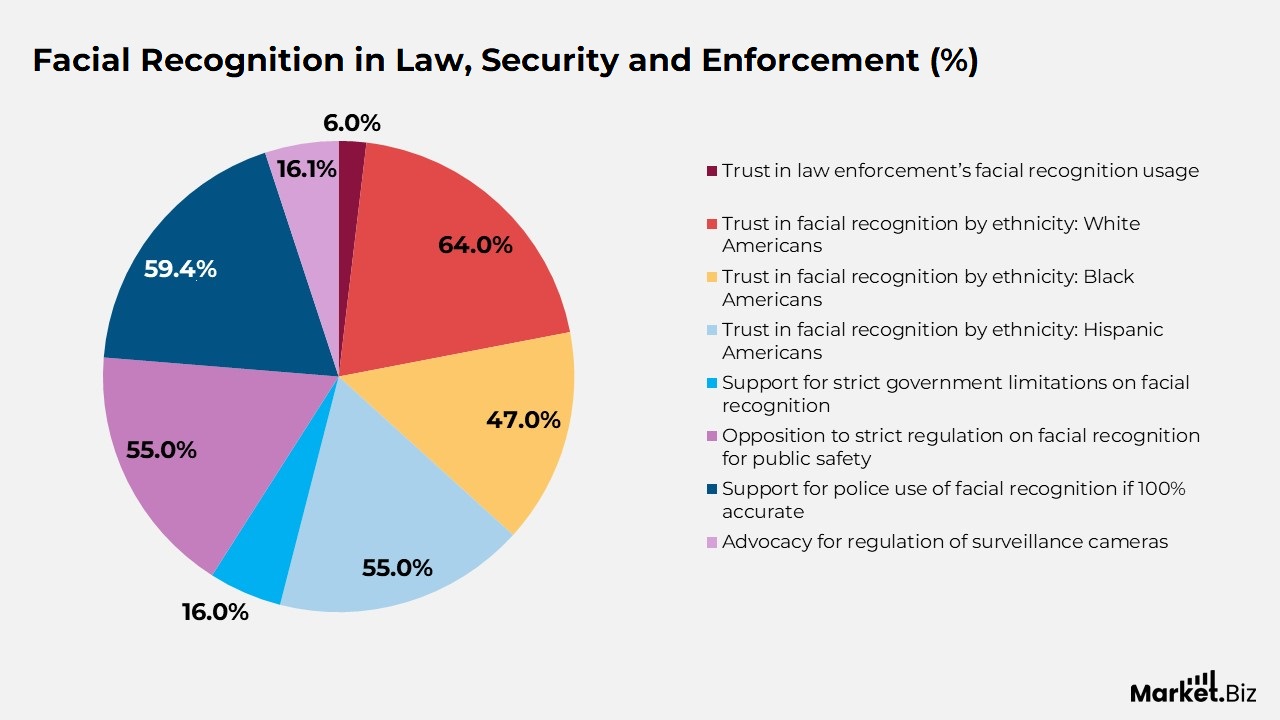
- 6% of Americans trust law enforcement to use facial recognition technology responsibly for identifying threats in public spaces.
- Adults aged 30 and older are more open to law enforcement using facial recognition compared to those aged 18 to 29.
- Regarding ethnic differences, 64% of White adult Americans trust law enforcement with facial recognition, while 47% of Black and 55% of Hispanic respondents share the same view.
- Only 16% of Americans support strict government limitations on facial recognition use, while 55% oppose strict regulation, especially when it pertains to public safety.
- 59.4% of American adults believe police should be allowed to use facial recognition for tracking suspects if the technology achieves 100% accuracy.
- 16.1% of Americans strongly advocate for government regulation of surveillance camera usage.
- In India, law enforcement used facial recognition technology to locate 3,000 missing children in just a few days, with over 50% of them successfully reunited with their families.
- In New York, facial recognition technology helped record 4,000 arrests by searching through driver’s license databases.
(Source: Smith, Castro & McLaughlin, Nagaraj, Kravets, FinancesOnline )
Acceptance of Facial Recognition Technology
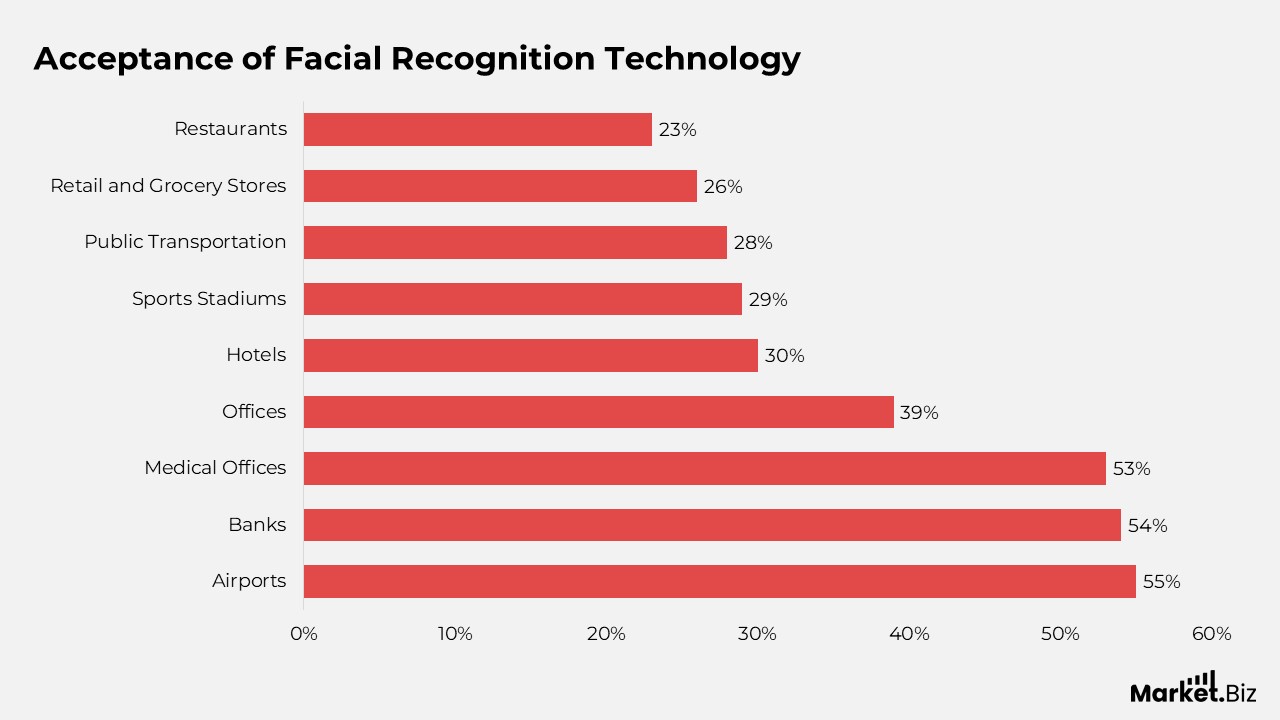
- 55% of Americans are open to the use of facial recognition in airports, seeking improved security and a smoother travel experience.
- 54% support facial recognition technology in banks, showing comfort with enhanced financial security.
- 53% agree with its use in medical offices, emphasizing the need for secure patient identification.
- 39% favor the use of facial recognition in offices, with a focus on workplace security.
- 30% support facial recognition technology in hotels, recognizing its potential to streamline check-ins and improve safety.
- 29% are open to its use in sports stadiums, prioritizing safety and crowd control.
- 28% support facial recognition in public transportation, aiming for more secure and efficient systems.
- 26% agree with using facial recognition in retail and grocery stores, seeing benefits in faster checkouts and theft prevention.
- 23% are open to using facial recognition in restaurants, envisioning faster service and enhanced security.
(Source: PhotoAiD, Statista, Pew Research Center)
Public Perception and Industry Adoption of Facial Recognition Technology
- In the U.S., 30% of adults find it acceptable for companies to use facial recognition for employee attendance tracking.
- A study reveals that only 32% of consumers are comfortable with private companies utilizing facial recognition technology.
- 54% of U.S. adults disagree with advertising methods that use facial recognition to analyze consumer responses to ads, while 30% find it acceptable.
- Regarding the use of facial recognition by apartment venders for security, 30% of American adults approve, while 34% disapprove of this approach.
- 74% of hotel operators believe that using biometrics to identify hotel staff will become mainstream by 2025.
- 62% of customers agree that using facial recognition to identify hotel guests will enhance their experience, and 41% are more likely to choose hotels offering this technology.
- Retail stores equipped with facial recognition technology can reduce violent incidents by 91%.
- 49% of individuals believe that retail stores should implement facial recognition technology to help reduce shoplifting.
- In Spain, a study by CaxiaBank reveals that 70% of users would prefer to use facial recognition instead of a PIN when withdrawing money from ATMs.
Moreover
- Around 36% of Americans trust that technology companies will use facial recognition technology responsibly.
- Fewer than 40% of people find it acceptable for facial recognition to be used for tracking entry and exit in housing buildings, nursing employee attendance (30%), or analyzing how people respond to advertisements in real-time (15%).
- Approximately 73% of U.S. adults believe facial recognition is somewhat effective in accurately identifying individuals.
- Nearly half of Americans agree that facial recognition technology should be used in stores, but only if it can help catch shoplifters.
- Just 32% of consumers are comfortable with businesses scanning their faces, while over 81% express concerns about the misuse of biometric data.
- 84% of people support federal regulation of facial recognition technology.
- A staggering 95% of Americans believe they should have the right to opt out of facial recognition systems.
- More than half of Americans (57%) are comfortable having their facial images added to a facial recognition database if it enhances public safety.
- Around 70% of U.S. adults think facial recognition can improve security systems and are open to its use in workplaces, schools, and other public spaces.
- 76% of Americans support the use of facial recognition in schools to identify known child predators.
(Source: Smith, Capers, Oracle Hospitality, n.d.; FaceFirst; Statista, n.d.; CaixaBank, FinancesOnline, Passport-Photo.online)
U.S. Acceptance of Facial Recognition Technology
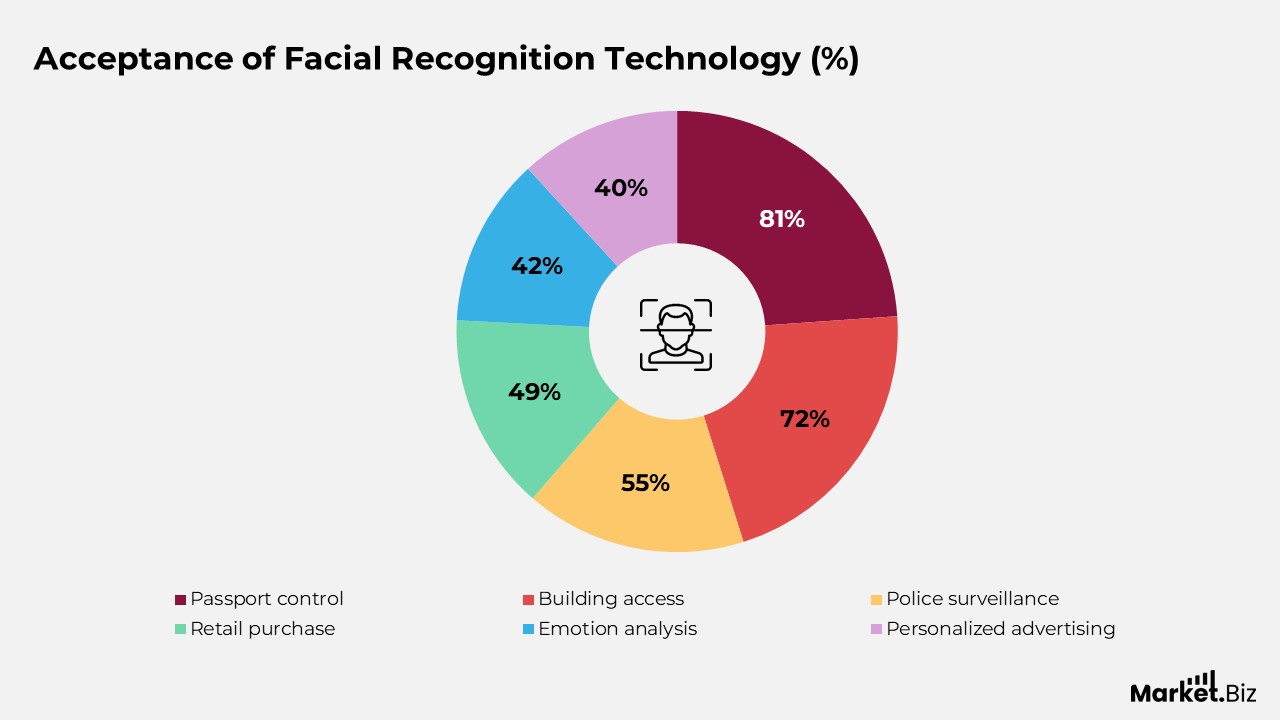
- 81% of Americans support using facial recognition for passport control, viewing it as an effective method to enhance border security.
- 72% of people approve of facial recognition for building access, recognizing its potential to improve security in restricted areas.
- 55% of individuals agree with using facial recognition for police surveillance, although opinions on its role in law enforcement remain divided.
- 49% of Americans accept facial recognition for retail purchases, indicating its increasing role in the shopping experience.
- 42% of people are open to emotion analysis using facial recognition, valuing its potential in understanding customer reactions.
- 40% of individuals are comfortable with personalized advertising driven by facial recognition, showing moderate support for targeted marketing.
- Nearly half of U.S. adults (46%) support the broad deployment of facial recognition by law enforcement, believing it would benefit society.
- Around 80% of Americans are at least somewhat aware of the use of facial recognition technology by the police.
- A majority (57%) believe that crime levels in the U.S. would remain unchanged if police widely implemented facial recognition technology.
- Approximately 78% of people think facial recognition technology would enhance police efficiency in locating missing persons, with 74% believing it would aid in solving crimes.
(Source: PhotoAiD, FinancesOnline)
Conclusion
Facial recognition technology is rapidly becoming more widespread, with governments, businesses, and individuals recognizing its potential to enhance security and streamline various processes. Boasting high accuracy rates and broad adoption across industries ranging from law enforcement to retail and fitness centers this technology is undeniably crucial to modern safety and operational efficiency.
As younger generations become more acquainted with and accepting of its use, the reliance on facial recognition is expected to increase. While the advantages of improved security and convenience are substantial, ongoing debates about privacy and regulatory measures will influence its future implementation.
The growing adoption of this technology, as demonstrated in countries like the U.S. and China, indicates a shift toward integrating advanced surveillance systems into everyday life, striking a balance between innovation and ethical concerns.
FAQ’s
It is anticipated that 70% of governments will extensively utilize facial recognition technology by 2024.
Facial recognition technology is highly accurate, with an accuracy rate of at least 99.5%.
Facial recognition has been used to screen over 300 million travellers, helping to catch more than 1,800 individuals attempting to enter the U.S. with fake identities.
12% of people aged 18-34, 6% of those aged 35-54, and 1% of individuals over 55 use facial recognition on shared gym equipment.
15% of individuals aged 18-34 use facial recognition for tasks like clocking in at work, while 9% of those aged 35-54 and 3% of those over 55 utilize the technology for similar tasks.
Around 80% of Americans are familiar with police use of facial recognition, and 86% of U.S. adults recognize its existence.
Between January and August 2024, London’s Metropolitan Police employed live facial recognition technology 117 times, a sharp increase from just 32 instances between 2020 and 2023.