









Introduction
Karaoke Statistics: The karaoke industry is a rapidly expanding global market, with estimates placing its size between $5.4 billion and $6.35 billion in 2024. It is anticipated to keep growing in the following years, potentially exceeding $9 billion by 2033, as indicated by various reports. The Asia-Pacific region, especially Japan, South Korea, and China, commands the largest share of this market due to its rich karaoke culture.
The growth of this industry is pushed by the rising popularity of karaoke as a recreational activity, particularly in bars and private rooms, supported by accessible technology and a growing demand for social and engaging entertainment. Karaoke comes in several forms, including traditional bar settings, private rooms, home installations, and online platforms.
It promotes social interaction, enhances self-confidence, and offers stress relief, making it a cherished pastime that continues to adapt alongside technological advancements and cultural shifts.
Editor’s Choice
- In 2021, the karaoke equipment market was valued at $751 million and is anticipated to reach $905.8 million by 2031, reflecting an annual growth rate of 1.9%.
- The global karaoke market is experiencing rapid growth, with its value projected to continue rising.
- Karaoke originated in Kobe, Japan, around 1971 when musician Daisuke Inoue created his own karaoke machine.
- The global karaoke market has shown a consistent growth pattern, with revenue figures steadily increasing from $5.3 billion in 2022 at a CAGR of 2.60%.
- In 2023, the karaoke machine sales market in Japan exhibited significant diversity based on the type of venue, quantified in billions of Japanese yen.
- The karaoke bar sector’s market size in the United States from 2011 to 2022 has exhibited varying performance over the years, measured in billion U.S. dollars.
- Pokekara has emerged as the leading application with an impressive total of 1,692.27 thousand downloads, highlighting its dominant status in the market.
What is karaoke?
Karaoke is a participatory type of entertainment where individuals perform songs alongside an instrumental pre-recorded track, with the lyrics displayed on a screen. It is a cherished activity for various social events and celebrations. Whether taking part in a relaxed corporate gathering or a lively bachelorette party, karaoke consistently elevates the fun and thrill of the occasion.
In Western cultures, many people are accustomed to seeing karaoke performed on a stage before an audience, whereas in Asia, it is typically enjoyed in private karaoke rooms, where friends and family come together to celebrate the joy of singing.
General Karaoke Statistics
- The global karaoke market is experiencing rapid growth, with its value projected to continue rising.
- The increasing popularity of karaoke as an enjoyable and social pastime is fueling this expansion, as more individuals seek interactive forms of entertainment.
- Karaoke machines are indispensable in the karaoke industry. These comprehensive systems, equipped with built-in microphones, are prevalent in both residential settings and entertainment venues.
- In 2021, the karaoke equipment market was valued at $751 million and is anticipated to reach $905.8 million by 2031, reflecting an annual growth rate of 1.9%.
- According to Karaoke Statistics, innovation plays a crucial role in maintaining competitiveness within the karaoke market.
- Contemporary karaoke machines are significantly more sophisticated, providing enhanced sound quality, Bluetooth connectivity, and compatibility with various karaoke applications and platforms. These advancements facilitate user access to an extensive selection of songs, thereby enriching the karaoke experience.
- Karaoke has transitioned into the digital realm, with applications such as Smule and Singa at the forefront. These platforms have revolutionized the way individuals engage with karaoke, incorporating features such as performance recording, sharing, and participation in online karaoke competitions.
Moreover
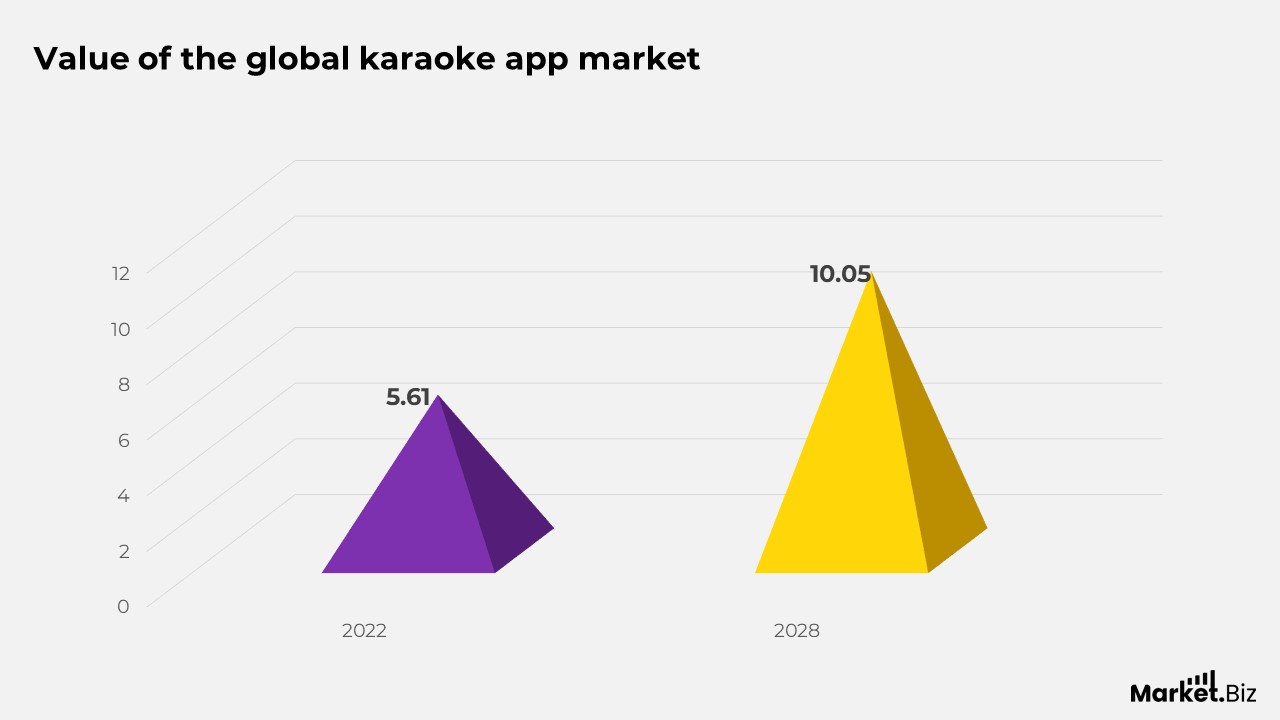
- Research indicates that the global karaoke app market was valued at $5.61 billion in 2022 and is projected to grow at an annual rate of 10.19%, reaching $10.05 billion by 2028.
- Karaoke competitions are gaining traction, drawing in both amateur and professional vocalists.
- Karaoke Statistics report that karaoke nights have led to a 31% increase in customer attendance and a 42% rise in customer spending.
- Understanding consumer preferences is essential in the karaoke industry.
- Studies indicate that individuals are progressively seeking portable and adaptable karaoke systems equipped with features such as high-definition displays, wireless microphones, and robust sound systems.
- These evolving preferences are shaping the offerings and marketing approaches of prominent karaoke brands.
- Karaoke has transcended its traditional association with karaoke bars. Establishments like hotels, restaurants, and even cruise ships are incorporating karaoke systems to enhance their entertainment selections.
- In the UK, numerous businesses acknowledge the importance of delivering enjoyable and interactive experiences for their clientele.
- Karaoke Statistics have noted that social media has significantly contributed to the rise in karaoke’s popularity.
Karaoke Facts
- Karaoke originated in Kobe, Japan, around 1971 when musician Daisuke Inoue created his own karaoke machine.
- As of 2021, Japan boasts approximately 8.19 thousand karaoke establishments.
- The term “karaoke” translates to empty orchestra in Japanese.
- Some karaoke machines in Japan not only evaluate the singer’s performance but also track the calories burned while singing.
- The global karaoke industry is estimated to be valued at around 10 billion and has consistently been the most lucrative in Asia.
- Karaoke enjoys significant popularity in China, with over 100,000 karaoke bars.
- The Guinness World Record for the longest karaoke marathon involving multiple participants is 895 hours and 2 minutes, achieved on December 22, 2019. This feat was accomplished during an event organized by Virag Madhumalati at Little World Mall in Navi Mumbai, India.
- Leonard Polverelli holds the record for the longest karaoke marathon. This event took place from September 19-23, 2011, at the Astra Cafe in Pesaro, Italy. The marathon lasted 101 hours, 59 minutes, and 15 seconds, during which Polverelli performed a total of 1,925 songs.
- The five most requested karaoke songs of all time are reportedly “Summer Nights” (from Grease), “Sweet Caroline” (by Neil Diamond), “Bohemian Rhapsody” (by Queen), “Billie Jean” (by Michael Jackson), and “Let It Go” (by Idina Menzel).
- There is a Karaoke World Championship event that began in Finland in 2003 and is held annually in various countries.
- The people of the Philippines have such a passion for karaoke that it is said there are karaoke machines in every household, including those in rural areas.
- Sinatra’s 1969 hit “My Way” is prohibited in many karaoke bars in the Philippines due to the violence it has incited during karaoke performances.
- In 1975, Filipino entrepreneur Roberto del Rosario patented the first karaoke machine, known as the Sing Along System.
Karaoke Market Statistics
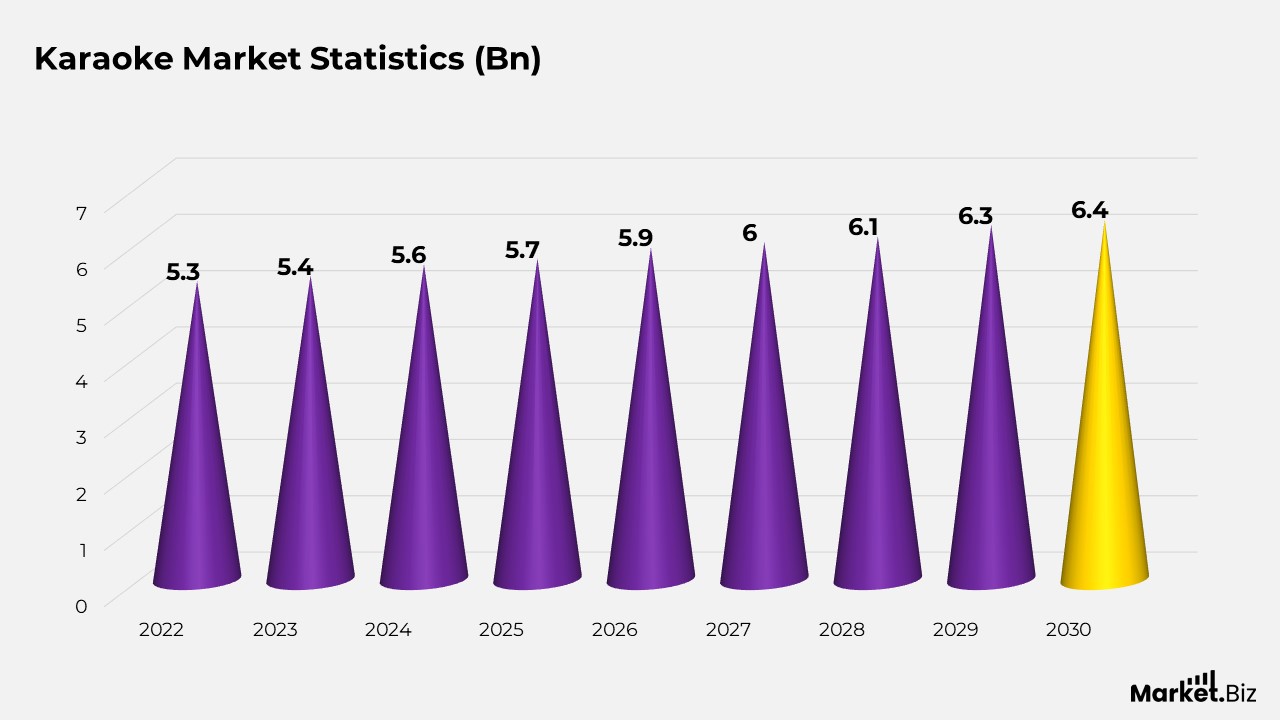
- The global karaoke market has shown a consistent growth pattern, with revenue figures steadily increasing from $5.3 billion in 2022 at a CAGR of 2.60%.
- In 2023, the market revenue saw a slight rise to $5.4 billion, followed by an increase to $5.6 billion in 2024.
- The upward trend persisted, with revenues climbing to $5.7 billion in 2025 and further advancing to $5.9 billion by 2026.
- The growth continued into the latter part of the decade, with the market reaching a revenue of $6.0 billion in 2027, and a minor increase was observed in 2028 with $6.1 billion.
- The growth trajectory sustained its pace, achieving $6.3 billion in 2029, followed by $6.4 billion in 2030.
- The market is projected to further expand to $6.6 billion in 2031 and is expected to attain $6.8 billion by 2032.
Japanese Karaoke Market Statistics
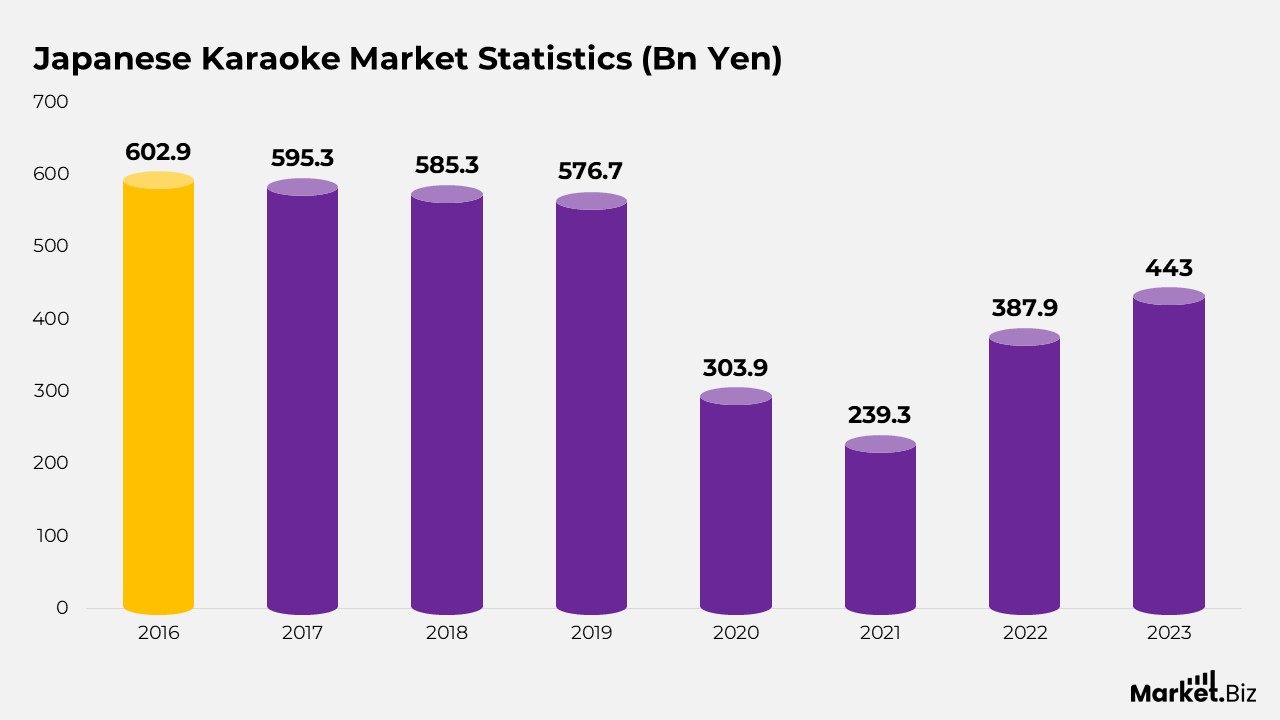
- Subsequently, the market experienced a gradual decline, recording 602.9 billion yen in 2016, 595.3 billion yen in 2017, 585.3 billion yen in 2018, and 576.7 billion yen in 2019, indicating a consistent downturn leading up to the pandemic.
- The most notable decrease occurred in 2020, when the market was halved to 303.9 billion yen, likely as a result of the COVID-19 pandemic.
- In 2021, the market further contracted to 239.3 billion yen, marking its lowest level.
- Nevertheless, the market began to rebound in 2022, increasing to 387.9 billion yen.
- According to Karaoke Statistics, this growth persisted into 2023, with the market reaching 443 billion yen.
- In 2023, the karaoke market in Japan exhibited varying sales figures depending on the type of venue.
- Karaoke boxes emerged as the leading revenue generators, yielding a robust income of 297.3 billion Japanese yen, underscoring their popularity and significance in Japan’s karaoke culture.
- Bars and pubs, where karaoke is also a favored pastime, achieved notable sales of 112.3 billion yen.
- Conversely, hotels and inns, where karaoke is less prevalent, only produced 2.3 billion yen in revenue.
- Other venues offering karaoke contributed 31.1 billion yen.
- These statistics emphasize the widespread enjoyment of karaoke in diverse environments throughout Japan, ranging from specialized karaoke rooms to social venues like bars.
- In 2023, the karaoke machine sales market in Japan exhibited significant diversity based on the type of venue, quantified in billions of Japanese yen.
- Drinking establishments such as bars and pubs dominated the market with 112.2 billion yen, highlighting the popularity of karaoke in these locations.
- More specialized karaoke boxes generated 13.3 billion yen, indicating that they serve a particular demographic.
Karaoke Sales Statistics
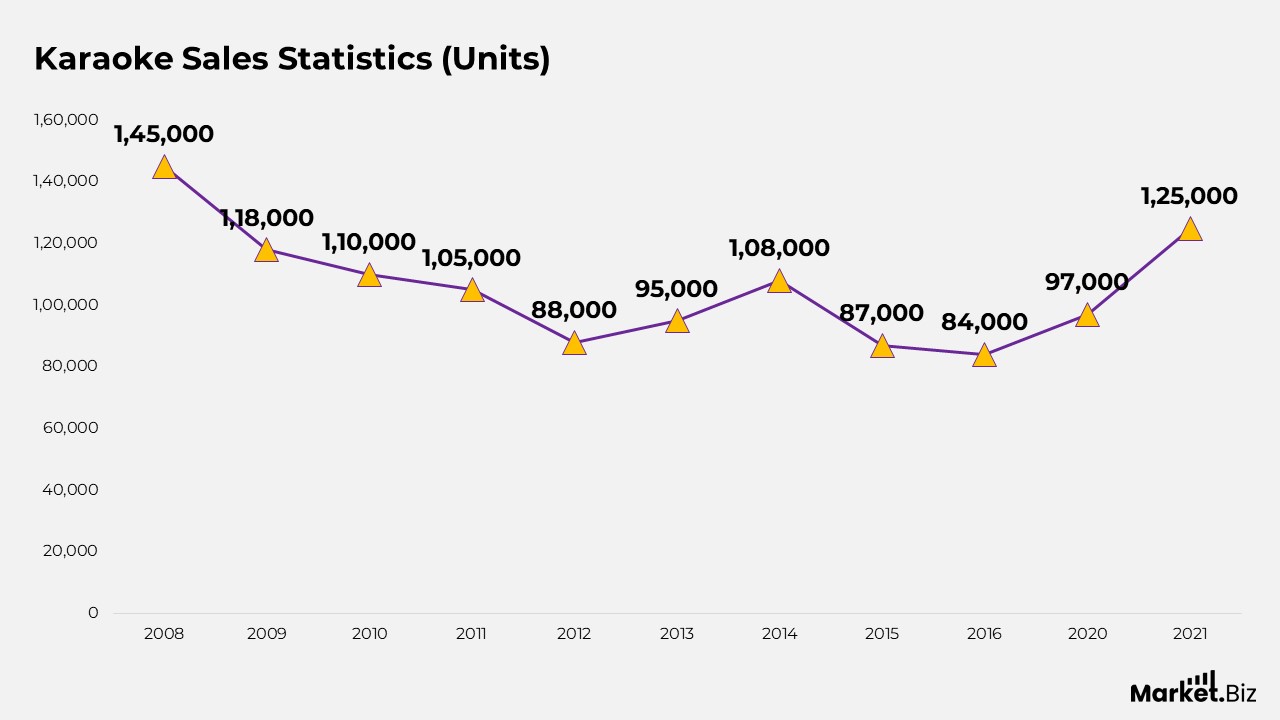
- The sales figures for karaoke machines in the United States from 2008 to 2021 displayed a range of trends, quantified in thousands of units sold each year.
- In 2008, sales reached a high of 145,000 units, indicating robust market interest. However, the subsequent years experienced a steady decline, with sales falling to 118,000 in 2009, 110,000 in 2010, and further down to 105,000 in 2011.
- The decline accelerated sharply to 88,000 units in 2012. A minor recovery occurred in 2013, with sales increasing to 95,000 units, followed by a more substantial rebound in 2014 when sales hit 108,000 units.
- After 2014, the market faced another downturn, with sales dropping to 87,000 in 2015 and hitting a low of 84,000 by 2016.
- From 2017 to 2019, stability was noted, with sales remaining around 86,000 to 85,000 units.
- The year 2020 experienced a rise to 97,000 units, likely due to heightened demand for home entertainment during pandemic lockdowns.
- Notably, 2021 saw a remarkable recovery and growth, with sales soaring to 125,000 units, potentially fueled by the relaxation of COVID-19 restrictions and a resurgence in consumer spending within the entertainment industry.
Statistics of Karaoke Bar Industry
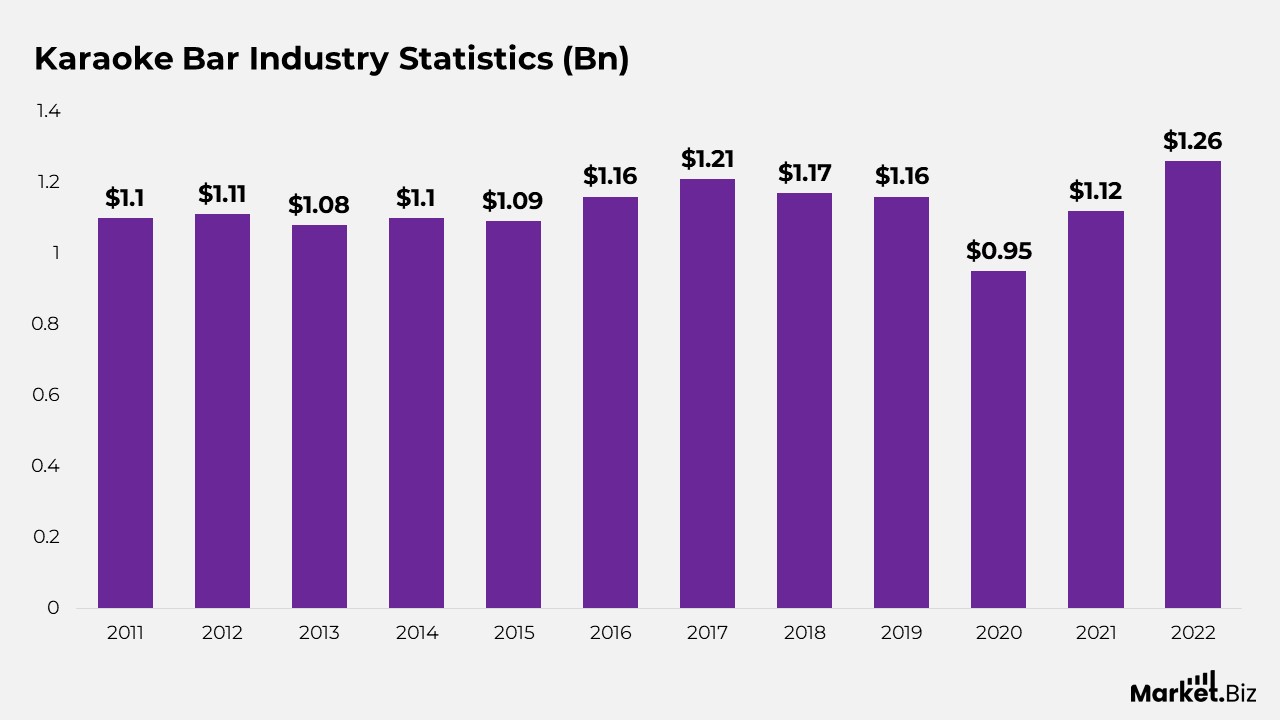
- The karaoke bar sector’s market size in the United States from 2011 to 2022 has exhibited varying performance over the years, measured in billion U.S. dollars.
- The sector commenced at $1.1 billion in 2011, experiencing minor fluctuations in the subsequent years: $1.11 billion in 2012, a slight decrease to $1.08 billion in 2013, and a return to $1.1 billion in 2014.
- It encountered a small decline to $1.09 billion in 2015 but rebounded to $1.16 billion in 2016, reaching a peak of $1.21 billion in 2017.
- However, it experienced a slight reduction to $1.17 billion in 2018 and maintained a steady figure of $1.16 billion in 2019.
- The year 2020 saw a notable decline to $0.95 billion, likely influenced by the global pandemic’s restrictions on social gatherings and entertainment venues.
- Nevertheless, the market displayed signs of recovery in 2021, increasing to $1.12 billion, with projections indicating a further rise to $1.26 billion in 2022, suggesting a positive trend as the sector adjusted to new norms and potentially benefited from renewed consumer interest in social entertainment.
Karaoke Apps Statistics
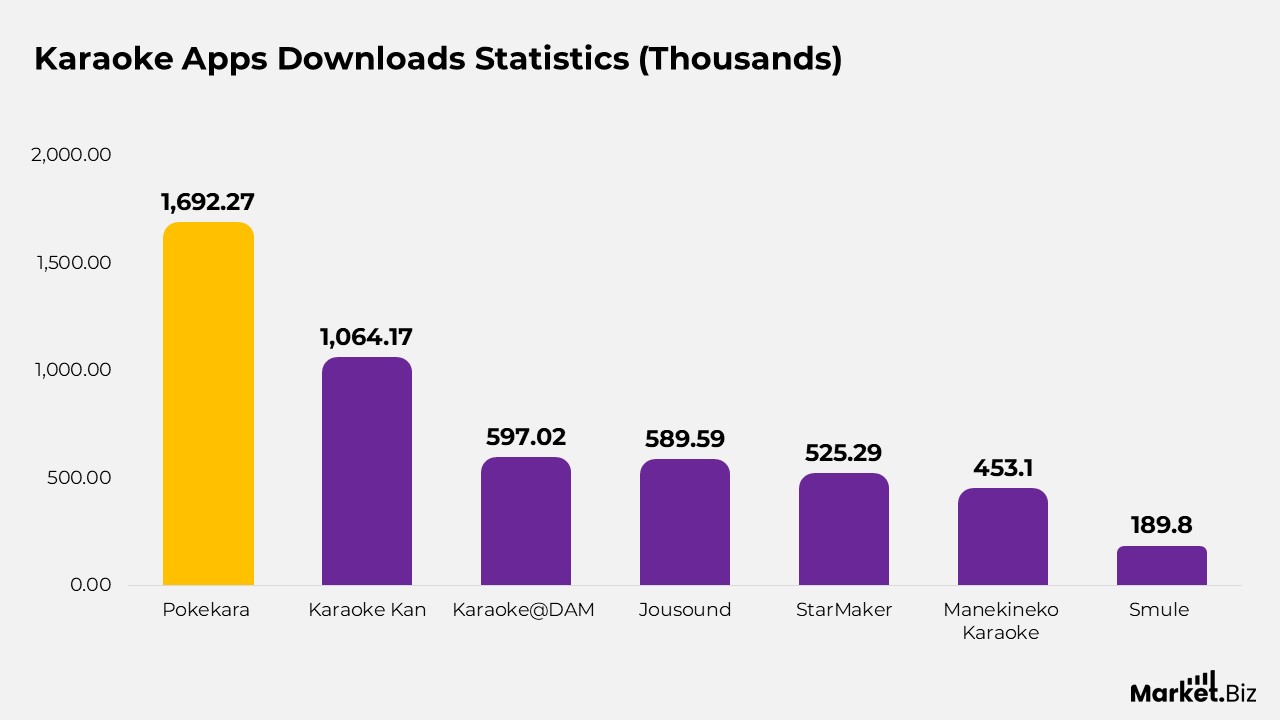
- Pokekara has emerged as the leading application with an impressive total of 1,692.27 thousand downloads, highlighting its dominant status in the market.
- In second place is Karaoke Kan, which achieved 1,064.17 thousand downloads, showcasing its strong appeal among karaoke fans.
- Karaoke@DAM and Jousound also exhibited notable popularity, with 597.02 thousand and 589.59 thousand downloads, respectively, while StarMaker followed closely behind with 525.29 thousand downloads.
- Further down the rankings, Manekineko Karaoke recorded 453.1 thousand downloads, indicating a solid fan base.
- Globally recognized Smule attracted the attention of 189.8 thousand users in Japan. Additionally, smaller applications such as Yokee Karaoke and Topia have established their own niches, with 125.23 thousand and 118.74 thousand downloads, respectively.
- Although Karasta had the fewest downloads in this group, it still managed to engage 67.52 thousand users, highlighting the varied preferences within the Japanese karaoke app market.
Recent Developments
- In March 2024, Sony and Spotify established a strategic alliance to incorporate Spotify’s music streaming service into Sony’s karaoke systems, thereby granting users access to an extensive music library and improving the overall user experience.
- In May 2024, LG Electronics obtained a substantial stake in KTV Karaoke, a Chinese karaoke entertainment firm, signifying their entry into the Chinese market and broadening its footprint in the Asia-Pacific region.
- In April 2025, Singtel, a prominent communications and technology group in Asia, formed a strategic partnership with Karaoke TV, a leading provider of interactive karaoke services, to deliver Singtel customers a premium karaoke experience integrated with their current entertainment packages.
Conclusion
Karaoke experiences different levels of popularity across the globe, with some individuals embracing it wholeheartedly while others choose to overlook it. This entertainment medium is appreciated in both vibrant public venues, such as karaoke bars, and within the comfort of one’s home, based on personal tastes.
Its influence also reaches educational contexts, where students view it as a means to make learning enjoyable, improve comprehension, and alleviate stress. Nevertheless, it does have its disadvantages, including possible distractions and the need for significant preparation time.
Younger audiences generally exhibit more interest, especially in countries like Japan, where karaoke is an integral part of the culture. In contrast, a significant portion of the population in France has never engaged in karaoke, highlighting the diverse cultural differences in entertainment choices.
FAQs
Asia Pacific holds the largest karaoke market share at 42.3%, attributed to the robust karaoke culture present in Japan, South Korea, and China, as reported by EIN Presswire.
Each song exceeded 3 minutes in duration, with intervals between songs not surpassing 30 seconds. No song was repeated within any two-hour timeframe. Currently, the longest karaoke solo marathon record is held by Italian performer Leonardo Polverelli, having sung 1,295 songs in a duration of 101 hours, 59 minutes, and 15 seconds.
The Philippines is widely regarded as the karaoke capital of the world, a designation that seems entirely appropriate. For Filipinos, singing is an inherent ability. Renowned for their joyful spirit and resilient nature, singing serves as an instinctive means of self-expression and a celebration of life.